Showing posts with label politics. Show all posts

Thursday, July 9, 2026

The Protest Café | BorderLight 2026

What if the United States threw a once-in-a-generation celebration and nobody came? Well, after last weekend, we all know the answer to that that question. When I was a kid, the American government commissioned all kinds of things to celebrate the Bicentennial, including the short film People People People, created by animators John and Faith Hubley. 

It is a surprisingly frank depiction of life on this continent (or this part of it, anyway) from before the arrival of European colonizers, and including some of the more unsettling aspects of what they (we) did once they (we) got here. The Bicentennial was a celebration, but it was also an education. And even the government, for a brief moment, strove to educate people.

First on my dance card for BorderLight 2026 was a selection of American protest songs, The Protest Café, bringing together some of my favorite folks. I have seen Eric Schmiedl and Tina D. Stump work together, most recently BUCKEYES; Buses & Baseball at last year's BorderLight, and this show also brings in Chennelle Bryant-Harris and Chelsea Cannon, both of whom composed the entire cast for Schmiedl's play adaptation Huck Finn, which I produced for the Great Lakes Theater outreach tour in 2018.

Chelsea & Chennelle
The program began before the rains began, it was a lovely evening. Eighty degrees, but cloudy, on the Patio at the Hermit Club. I had enough time after work to grab a pint at the bar and settle in to a table, where I found familiar faces and made new friends. I am reminded of previous festivals in other cities, where I felt alone and desperate for connection. Here, I know everyone. Like, really. It makes me so happy. It feels like home.

The Protest Cafe is brief and joyful, but powerful. We were invited to sing along, and I was delighted not only by how many lyrics I knew, but by the songs they chose. I was expecting something old-timey. Union songs! The Bourgeois Blues! Instead we were treated to protest songs from the entire span of the last century — and even one from this.

Looking around, I saw a one or two (white male) faces that weren't necessarily happy with the menu of songs. I wonder what they thought was going was going to be protested, the King of England? The First Amendment? Immigration? There's a spirited rendition of Irving Berlin's When That Man Is Dead and Gone. It was written about Hitler, but if in hearing it you are thinking about someone else, someone in particular, well surely that's his fault and not yours.

The company is inviting and warm, and so very patriotic. This one's free, but you need to make a reservation as seating is limited.

Sunday, July 24, 2022

Under the Banner of Heaven (miniseries)

Gil Birmingham & Andrew Garfield
"Under the Banner of Heaven"
(FX, 2022)
It’s that second day after a major procedure, when you can feel the worst. That’s where I am right now. Tried to sleep sitting up, tried to sleep lying on my chest. Around four in the morning I curled up on my side with my head twisted to the right and I was finally able to get a couple hours rest.

Meantime, I have been burning through the FX miniseries, Under the Banner of Heaven, Based on the true crime novel by Jon Krakauer.

My father first shared Krakauer with me. The summer my wife and I got married, I read Into Thin Air, his account of the 1996 Chomolungma (Everest) Disaster, while sitting on my porch in 90° weather, and it literally made me chilly. On our honeymoon, she was reading Into the Wild on the patio of a hotel room at Denali, not even 20 miles from where Christopher McCandless died.

Under the Banner of Heaven begins with a double murder which just happened to take place thirty-eight years ago today, July 24, 1984. A pious young woman and her child were killed by men who felt their actions were justified by God. Victim and assailants thought of themselves as Mormon, but had different ideas of what that meant. But women dying at the hands of men in a quest for dominance is universal, and not unique to any one belief system.

I haven’t read the book this series is based on. Father did, an amateur historian and devout Christian. I can only imagine how he may have judged each of the individuals represented in the book, those who are members of the Mormon faith.

I feel however, that this miniseries adaptation, like the musical The Book of Mormon, is not a critique or condemnation of this one Christian religion, but of all religion. In this case, it is also a metaphor for the United States as a whole. Watching this show, which follows the murder investigation and also depicts the historical origins of The Church of Jesus Christ of Latter-day Saints, I believe that the Mormon church is possibly the most American thing ever created.

I believe that Americans are essentially good, and that the American experiment has allowed us the freedom to live independently from strictures of the past. But it has also allowed for a minority of white men to pursue paths of complete selfishness which they defend through a mutating set of beliefs which they call righteous but are always a means to whatever end they desire.

So it is with the LDS, and also the Supreme Court.

Heavenly Father wants us to do this is a common phrase throughout the series, and it is as mutable as the assertion Founding Fathers want us to do this. Interpreting and perverting their unknowable wills has become its own religion.

Wednesday, April 22, 2020

Play a Day: Millenials Suck!

Alisha Espinosa
For Wednesday, I read Millenials Suck! by Alisha Espinosa and listed at New Play Exchange.

When you grew up defines your generation. But being a young adult comes with the requisite baggage of feelings and fears and it is the manner in which the latter copes with the former that makes you Millennial, Gen X, Boomer, Silent, Greatest, and so on, back and back through American history.

I mean, don't get me started. When it comes to generational politics, I am the one who gets a conference call from the lunchroom at work if the subject comes up.

Just yesterday, a Millennial cohort lamented "Why do people hate us Millennials so much Lol," and I said who are you calling people? Only Boomers do that. Another threatened to search "Millennial" on my fb page and I told them to go ahead, because I knew I was a card-carrying ally and then I told her her to search "Boomer" on my fb page and she came back and told me I am a joy to behold.

I did a "Boomer" search on my page myself and was surprised at how much shade I throw at them. It's startling.

Millenials Suck! is a collection of vignettes on a common theme, and it is alive with music and movement, packed with tales of aching and anger in the Big City. Espinosa chronicles the desire for and fear of commitment common to young adults, but complicated by the present moment.

We, Gen X, were raised in a nation that told us we should be able to have anything, because it was America, and it was easy -- our only war lasted a month and it was a rout. So any problems we have must be our own. These young adults today have seen that society collapse like a house of cards and refuse to take the blame for it, which is only correct.

If the Post-Millennials in my own home are any indication they will be much more cynical than their parents, and far more militant. But I digress.

The playwright wrestles issues of race and class and gender and ideology, with humor and style, creating a cohort of charismatic characters, trip from one small NYC apartment to the next (and also a county fair) with a wise and open heart. I loved this. I don't miss being in my twenties.

Who should I read tomorrow?

Tuesday, February 25, 2020

The Bully of Baker Street: Week Three

Newton D. Baker Elementary
In the past three weeks, Classics On Tour has already staged twenty-nine performances of Sherlock Holmes Meets the Bully of Baker Street! They have nineteen more (and one workshop) to go!

In addition to the many schools the Sherlock Holmes Meets the Bully of Baker Street tour is visiting, we are also taking the show to fifteen libraries and other public venues.

At a few public libraries, the audience has been almost entirely made up of adults, fans of the great detective in all of his permutations. The big people are no less enthusiastic about responding to the questions the characters ask them during the performance and seem to understand they are attending a show meant for children.

Post-show discussions run in different directions with these audiences, as adults have questions not only about the show, but about the purpose of the show. About the theme of bullying, and how our student audiences have responded.

Pioneer Drama Service
(Published 2021)
On our post-show evaluation, audience members are invited to share their thoughts about what they most liked about the show, and also what they liked the least. One woman, a senior citizen, wrote, “Too preachy!” And I suppose it is. You could say it’s meant to be.

During the post-show discussion, one audience member in Lakewood, after first making clear that she was very happy to see a diverse cast, wanted to know how intentional the casting was. A generation ago it would have been the politically correct thing to just say the casting was “color-blind” and wasn’t intentional at all. 

But that isn’t true, and our acting company addressed that with their response. Because the play is, in fact, a little preachy, and because we knew we would be sending the play into schools with a predominantly African-American student body, the picture of who is doing to lecturing and who is being lectured to -- and also who is doing the bullying -- these were all issues we wanted to take into account when creating the company.

Chagrin Falls Intermediate School

One comment that has confused me was the person who wrote on their evaluation “No Politics!!” I’d like to know what they meant. There is nothing overtly political in my script. Is Vicky being called a “nasty girl” a political statement? Is Vicky’s pride in becoming an American immigrant a political statement?

If these expressions are thought to be political, whose fault is that?

To be continued.

Monday, October 7, 2019

Tyrant, Shakespeare On Politics (book)

Angela Merkel, on vacation, reading "Tyrant."
Stephen Greenblatt, American author of the acclaimed Will In the World, was apparently so entirely disturbed by the election of Donald J, Trump that he swiftly produced a brief examination of Shakespeare’s villains (189 pages) and how they each compare to the current occupant of the White House.

Tyrant, Shakespeare on Politics, was released on May 8, 2018, and even at that point it was easy to see what kind of President Trump was going to be, as if that were not previously evident. Though he never names the President, his thesis is clear, with every chapter and every would-be emperor described, accurately for the most part, with precisely the same language many have used to describe Trump.

He calls Jack Cade, leader of a populist uprising in Henry VI Part 2, a “loud-mouthed demagogue” possessing an “indifference to the truth, shamelessness, and hyperinflated self-confidence.”

Shakespeare's Richard III “divides the world into winners and losers” and “is not merely indifferent to the law; he hates it … because it gets in his way.”

Macbeth has “a compulsive need to prove his manhood, dread of impotence … a fear of failure.” These psychological cues explain his “penchant for bullying, the vicious misogyny” and “explosive violence.”

Surprisingly, Greenblatt spends few words on the character of Julius Caesar, who, of all of Shakespeare’s monarchs, has been the one most often directly compared to Trump, for all of each man's vanity, poor health, and weakness for flattery at the same time ferociously protesting their own god-like inability to be manipulated.

Instead, this author focuses, as the play does, on the character of Brutus, and his desire to preempt disaster and assassinate Caesar before he attains absolute rule. Shakespeare’s lesson, it is clear, is that violent overthrow, no matter how pure the intent, is never pure, and impossible by design; an oxymoron in action.

“Real-world actions grounded on noble ideals,” Greenblatt suggests, “may have unforeseen and ironic consequences.”

Carole Healey as Julius Caesar
Photo: Roger Mastroianni
(Great Lakes Theater, 2019)
Published almost a year before the release of the Mueller Report, Greenblatt also provides a warning; that, though investigation and the possibility of impeachment is not a violent act, subverting the will of the electorate will always be suspect, and probably futile, even if you believe it would be the poorer choice to do nothing at all.
“The attempt to avert a possible Constitutional crisis, were Caesar to decide to assume tyrannical powers, precipitates the collapse of the state. The very act that was meant to save the republic turns out to destroy it. Caesar is dead, but by the end of the play Caesarism is triumphant.”
As it happened, the Mueller investigation came to a close without touching Trump nearer, finding that while a foreign power certainly offered Citizen Trump political assistance during the 2016 election, there was not definitive proof that he accepted it.

It should surprise no one who has been paying attention that we are now mired in a nearly identical circumstance, with definitive proof that President Trump himself has solicited political assistance from (at least) one foreign power for the 2020 election.

Impeachment now increasingly likely, looking into the works of Shakespeare may be a direful predictor of future events.

Monday, April 15, 2019

Play a Day: The Bloodless Jungle

Peter Lawson Jones
For Monday I read The Bloodless Jungle by Peter Lawson Jones and available at New Play Exchange.

Jones is a Cleveland icon, not only a playwright and an actor of the stage and screen, he is also a lawyer with an extensive record of public service, and he pours a great deal of his lifetime of professional experience into this play script about a State Senator running his first campaign for U.S Congress.

Bloodless Jungle was written a couple years back, and it is amazing (and demoralizing) how much has changed in such a short amount of time, but there is nothing dated about the plot. Our protagonist, Ethan St. John (great name) is a Frank Capra character, that rare politician who will not compromise his ideals in order to win an election.

Political dramas have become very popular. What I most enjoyed reading Jones's play is that he presents a slate of characters with varying agendas, from the unpaid volunteers to the highly paid operatives, each with distinct, vivid personalities. He doesn't traffic in types, providing each sympathetic arguments. It's hard to take sides, especially knowing what we know in today's political climate.

The unhappy question in the real world is, will "Mr. Smith" ever again even get to Washington?

Who should I read tomorrow?

Saturday, November 3, 2018

Professor Street Theater

2275 Professor Street (1992)
It was November 4, 1992. We were having rehearsal for our third week of performances of You Have the Right to Remain Silent!

I went up to the office during a break to check the election returns on CNN, where I was stunned to see the projected returns quite solidly suggested that Bill Clinton was going to win.

The idea that twelve years of Republican presidency, and specifically the Reagan-Bush Era, was coming to a close, was beyond my ken.

In 1980 I was twelve. Then I was twenty-four.

I came downstairs and announced the news, which led to a general cheer from the entire company.

Retro, our more libertarian member, sneered, “Man. What the hell are you people gonna write about now?”

The space was the Professor Street Theater. We’d signed the lease in August, $700 a month for two thousand feet of performance space downstairs and four rooms upstairs.

Four could squat for $175 each and we’d never need to generate a penny’s worth of profit for our work. We presented Silent! for eight months, closing in May to take a short break, produced a Shakespeare and then vacated for a different Tremont location.

Retro held onto the lease for a while, creating and presenting the Off-Hollywood Flick Fest there before the owner sold the place and it was a private residence and artists’ studio for nearly twenty-five years before the coffee shop Beviamo relocated there last year.

Professor Street Theater (above) and Beviamo Cafe (below)

Last April, I stepped into the space at 2275 Professor for the first time for the first time in almost a quarter century for a latte, and to get majorly freaked out.

It’s the same room, only so much brighter and different. Our early 90s landlord was adamant about our not changing a thing about the building, he pitched a fit when we painted a sign on the front door without his permission. It was easier to ask forgiveness.

The walls had been paneled all the way to the ceiling, the present occupants stripped away top level revealing fashionable brick, and painted the lower part white, brightening to room. We had papered over the windows for show privacy and to render the room entirely dark if necessary. Now the room is full of natural light.

Then & now.
While there are a few major alterations (the bathroom has been rerouted) what was startling was how the same the room felt. It was disorienting, sitting on a new platform in the window, sipping coffee and looking over the space like a hovering ghost.

Thoughts of a revival were inevitable. What if we staged a fundraiser, reading old scripts, or even writing new ones, right here where it all happened? No, really, maybe we shouldn’t. And besides, no one knows where the scripts are anymore. I don’t have them.

So what did we have to write about, now that "our guy" was going to the White House? We had only for two been weeks criticizing the George H. W Bush administration, would we now be praising and supporting this new president? Waving the flag for the status quo?

We did begin that way, we had to. He repealed the gag rule, that abortion could not be discussed in the military. And we would champion his attempts at health care reform and allowing gays to serve openly in the military … two agendas which failed, and failed badly in short order.

Much of our work turned inward, and by that I mean not only introspective (and also, unfortunately, at each other) but more local.

In the final days of 1992, an African-American man died while in police custody. He had been placed in a choke hold which rendered him unconscious, and was later determined to have been the cause of death. Then, as now, excessive force is an issue which plagues the Cleveland police department. Torque wrote a piece about that.

The choke hold play (title?)
There were audience members who openly objected to the political stuff, especially when it wasn’t funny. We took a stand against being portrayed as a sketch comedy group (or God forbid, improv) and intentionally threw in conceptual pieces for their own sake, with no punchline whatsoever.

The Scene Magazine reviewer, turgidly recounting every minute sexual reference from the performance he witnessed (even creating a few where they didn't existed) claimed the choke hold scene "backfired like a '62 Buick."

He also described Beemer as a "solid gold b----," so I guess that's funny?

After election day we retired a piece written by Jelly Jam, one I was proud to have had a hand in, creating a recorded soundscape of musical and nature sounds, and a weird voice-over (Lee's voice slowed down.)

With the lights dimmed, the entire company of seven crawled the floor, rose to their feet, came together but then fell away as the voice described and ancient ritual which made a people strong, but as more and more failed to participate, the civilization collapsed.

The ritual was called “voting.”

Yes, we were young and determined and optimistic and basic. We were also right.

Vote on November 6th.


Source: "Comedy for the Young at Heart" by Keith Joseph, Cleveland Scene, 2/18/1993

Thanks to Kim Martin for the 2018 photos!

Saturday, September 29, 2018

Bread & Puppet Theater presents "Grasshopper Rebellion Circus"

"Grasshopper Rebellion Circus"
Bread & Puppet Theater, 2018
Once We Were Young and Activist

Growing up during the late 1970s in suburbia, the hippie days were long past, as if they ever even were. A subject of mockery and disdain, moving into the Reagan era the very idea of public protest, of activism, just was not cool, man.

My brother, however, was very interested in current events. It was he, not my father, who wanted the national news switched on at 6:30 PM, every single night. Among other artifacts, he had a few Doonesbury anthologies lying around. These I read, and they soon became an obsession for me.

Gary Trudeau's comic strip Doonesbury documented (among other things) the student’s-eye-view of the college scene during the tail end of the Vietnam War. To understand the jokes I needed to understand the time, and so I began to read books and watch films to bring me up to speed, and slowly developed what you might call a bleeding heart liberal’s worldview.

In the year 1980 I was surely the only twelve year-old in Bay Village to have watched the motion picture Woodstock.

Interestingly enough, I still registered as a Republican when I turned eighteen. I thought that I was Republican the same way I understood myself to be Caucasian or Presbyterian. The first time I voted in a Presidential election I noticed I had voted for all the Democratic candidates and soon after officially changed my party affiliation.

"Grasshopper Rebellion Circus"
Bread & Puppet Theater, 2018
But though I leaned left, I was not what you might call radical. At Ohio U., I had an interest in social justice, but I still looked down my nose at those modern, Gen X hippies. The guys from Rocky River who cut the soles off their shoes who have never left Athens. The guys from Athens who eventually moved to Brooklyn. They would stage street protests about … whatever, and I just thought it was embarrassing. Surely there are better ways to get your point across than playing acoustic instruments and wave hand-painted signs and bleating cringe-worthy phrases ad nauseam.

We write letters to the editor. We produce plays for the people who desire to see them. And if we are truly serious about social change, we run for public office. But standing on a street corner screaming is just, well it’s gauche, isn’t it?

The tipping point for me was the Persian Gulf War of 1991. I was still at college and the outrage on campus in Athens, Ohio rivaled anything I’d ever personally experienced. I did feel there were those in the crowd who seemed excited at the possibility of Vietnam redux, complete with old-timey protest songs and tie-dye, sit-ins and peace signs. But I was against the war, too, I was opposed to the proposed New World Order that was being shaped so soon after the collapse of the Soviet Union. And so I participated in my first outdoor performance protest on January 16, 2001 (see: Desert Scream.)

That was before the 30-day war, before the parades, before Whitney Houston’s "Star Spangled Banner" topped the pop charts. America’s bright, shiny victory left me feeling hollow and dispirited and helpless. That was when I decided that I liked street protest. Because I saw the bravery and strength in shouting at the top of your lungs on a street corner in the face of seeming adversity. Maybe it wouldn’t accomplish anything. But it’s the only thing that could.

"Grasshopper Rebellion Circus"
Bread & Puppet Theater, 2018
Bread and Puppet Theater

Last week the circus came to town, the Grasshopper Rebellion Circus. The show was produced by Bread & Puppet Theater, a world-renown political activist street theater collective, founded fifty-five years ago. They set up camp on Wade Oval in University Circle, and I changed a physical therapy appointment to make the date.

It had rained for several days prior to the event, but this was a perfect early-fall evening, just a little cool. Jacket weather.

They used no electrical anything for their performance, which began at 5:30 pm. Natural light, no amplification. They performed live music, and used large hand-painted signs. Their voices, when they used them, were big, and they carried well. They had trained to speak in odd voices, as to best catch the ear. To be concise, rehearsed and clear.

The event was episodic, ideal for street theater. Our crowd had gathered here to settle in for the performance, we had chairs and blankets, but it could easily have taken place in Public Square or Times Square. If you were walking by you could stop for one or two scenes or plays, then move along.

The company was multi-racial. The musicians were almost all men, the actors predominantly women. There were child performers, too.

The crowd, while diverse in age, was mostly white. There were some old school, east side Baby Boomer liberals seated down in front, putting their wizened fists in the air. The Millennium age companion standing next to me in the back sniffed that he didn’t really like it, which surprised me. At the very least you could appreciate the music, the movement, the puppets. It was rough but entirely professional.

There were a few brief speeches about the current atrocities in Gaza, Yemen, at home, on the Supreme Court. There was plenty to see, laugh about, get angry at, question, delight in.

One scene stuck with me as familiar: A giant puppet of James Madison arrived and handed the citizenry the Second Amendment. With it emerged a multitude of AK-47s and the citizens stalked the stage, bearing their arms, until one by one they were shot and killed.

"The History of Western Civilization"
Guerrilla Theater Company, 1994
Photo: Mike Cantwell
One of Guerrilla Theater Company’s few entirely wordless performances was “The History of Civilization” which included with a struggle over a handgun which concluded with everyone dead and the sole survivor, witnessing the carnage he had created, on the apparent verge of suicide.

We didn’t produce a lot of purely physical pieces in GTC, we didn’t have a live band (we did have a DJ) but I was always proud when we did. I know I found it very challenging to compose something visual without having to conclude with dialogue.

The B&P performance was a touching reminder of the work we did in Guerrilla, the manner in which we, too, made political point. Obvious, broad, uncomfortable political points. And I noticed I missed political theater for its own sake, that this gathering of “Hippies With Dolls” (their words) was a rare treat, in our own yard.

It was also a reminder that you don’t have to be young to do this. You just have to care.

They traditionally conclude the performance by handing out bread and aïoli to any who choose partake, and walking up to receive some with the wife and the boy, I was reminded of last year, when we attended the Neo-Futurists and received some of those small pieces of pizza he was so looking forward to.

Monday, February 19, 2018

Fire and Fury (book)

Light (before) reading.
I was sitting at breakfast in Orlando, on the third day of the new year, when I discovered and then read those first, tantalizing excerpts from Michael Wolff’s now-notorious book on the first few months of the Trump presidency, Fire and Fury.

Wolff has had the advantage of being first, if not the most accurate, chronicler of the current unpleasantness. Like many who are appalled by the current occupier of the White House and his entire cast of unsavory characters, I looked forward to buying the book when it was released, if only as another sign that the status quo was unacceptable and that we will never stop making it clear that it is.

Interesting that Wikileaks would release a PDF of the entire book the day before its release. I remember when Assange pretended to promote transparency in all governments, instead of transparency only for those he has decided are his enemies. Violating the copyright for an entire written work is not the same as releasing the Pentagon Papers, it’s just a crime, and one obviously intended to drive down sales.

Why am I writing about this now, when Fire and Fury is last month’s news? Well, the fact is, I hoped to read the entire thing in just a few day and write about it then, but I got through a few chapters and it just languished on the pile.

The fact is, it’s a bit dry. The book succeeds primarily for being first. It made the President very angry, but he’ll be angry again, and many times over, as each subsequent book is written, by journalists, his former colleagues, and his countless accusers.

Following the initial “Oh, boy!!!” factor of reading about Election Night, and how terrified the Trump camp was coming to terms with that fact that they had actually won, I realized something very basic about this book which has also tamped down my interest in reading to the end.

We know all this. We have known all of this. There is nothing in this supposedly explosive book that is a revelation. I have been saying for the better part of a year that everything that has happened makes complete sense when you consider that absolutely no one in Trump's campaign, including the man himself, thought he would win.

That’s why they were unprepared to govern. That’s why they front-ended accusations that the election was rigged -- to slander the presumptive victor, Hillary Clinton. And that’s why they blithely committed crimes against the state which would pay staggeringly great dividends -- political and financial -- after their loss, and go entirely uninvestigated. It all makes sense, and this book simply corroborates what was and is clearly evident.

It is all obvious, it has always been obvious, and it is all true. Doesn’t matter how the author presented himself to his subjects. They told him their version of the truth, and it was the same stuff  that was coming through their official channels, their constant leaking, and the president’s uncontrollable need to tweet.

As a preemptive defense, Wolff restates, again and again, how everyone in the White House desperately wanted to talk. And not just to him, every member of the staff -- not the White House staff, not underlings, but Trump’s own advisors, his inner-circle, even adjunct members of his own family -- talked, all the time, to everyone, about everything. Wolff is not presenting himself as some kind of insider with exclusive knowledge. He was just smart enough to be there and to make sure everyone had his cell number.

One of the most satisfying pleasures (if you can call it that) of reading Fire and Fury is knowing what happened immediately after its release, and that was the humiliation of Steve Bannon. A reprehensible turdshirt whose photographic image emits a discomfiting pong, his name is all over this book, his quotes are most-attributed. This man, who delighted in his own ability to send liberals to the fainting couch, proved himself to be an over-confident clown whose belief in his own magnitude left him confident enough to speak on the record, and at length, about absolutely everything.

Either that or he's so insecure he needs to constantly let everyone at the party know that he's someone. The most intimidating villains are the quietest. It's the difference between Bob ("Twin Peaks" reference) and Windhom Earle. One is scary, the other isn't. You talk too much, Windom. You never shut up.

Bannon lost his position, he lost the president’s confidence, he lost his job at Breitbart, and he lost his sugar mommy. He made a comic mistake and has paid a steep price. We feared him when he was in the Oval Office, and justifiably so. Bannon is an embittered, creepy, right-wing opportunist with angry, racist tunnel vision, and he had the ear of the President of the United States. It was awful.

Now, we can’t hope he’ll go to prison, because he's probably the only person associated with Trump who hasn't actually broken a law. But he's out, out of everything. Who can trust him? He’s a joke.

There’s one thing he did say, however, it’s a quote from the book, and it gave me a great deal of clarity and hope in this difficult time.

So Bannon’s at this dinner party (yes, thrown by Michael Wolff himself, very clever) going on about what he, or rather Trump, needs to do to roll back the tide of international American permissiveness. Halting immigration, pulling out of treaties, abandoning influence in the Middle East -- letting them just kill each other. More walls, stronger borders, America first. Yadda yadda. He mocks Obama. A lightweight, a fool.

"I don't know what Obama does," Bannon said. "What has he accomplished, what does he do?"

What does Obama do. This man, Bannon, who had a hand in electing the new president, admits ignorance as to what Obama did, what Obama does, about who Obama is, about what Obama represents.

It's not that he dismisses Barack Obama and that sizable percentage of Americans who admire him and were and are affected by Obama's Presidency. It's that Bannon doesn’t get it. He doesn't see it. He sees an America he wants to create, but he has absolutely no idea what America actually is.

Steve Bannon and his kind fear a future they cannot fathom nor comprehend and are certainly incapable of altering or controlling. That is why they are dangerous. It is also why they are doomed to failure.

Happy President's Day.

Sunday, April 30, 2017

Play a Day: 1980 (Or Why I'm Voting For John Anderson)

Patricia Cotter
For Sunday the last day of April, I read 1980 (Or Why I'm Voting For John Anderson) by Patricia Cotter, and available from New Play Exchange.

"It would be nice to change ... the world."

After all that has happened -- during the last one hundred days, and after the past thirty days reading plays about race and gender, about relationships and politics, comedy and tragedy, sex and terrorism, despair and hope -- it was only fitting I conclude with a period parable reflecting upon that greatest of American traditions, believing in a loser.

I am just old enough to remember John Anderson running as a third-party candidate for President, but not old enough to understand the implications. I started reading Doonesbury when I was twelve, just after Reagan was elected, so it wasn't until the book of recent strips came out that I became familiar with a certain phrase I have used myself once too often ... Mike is at a small phone bank in a dismal campaign office in New Hampshire, cold-calling for this doomed Illinois congressman, and he responds to a disinterested voter by saying, "Well, he's never heard of you, either."

We did win on November 8. We got the most votes. Can you be so right and still lose everything?

The four characters in Cotter's play, three women, one man of color, they each believe in the underdog, each for their own reasons, and they work for him but without the fire that the zealot possesses. Anderson's campaign was reactionary, as most third-party candidacies are. He was representing an opposition to Reagan, but as his positions were more similar to Carter's he was really saying, I'll do what this guy tried to do only better this time. It's not a strong message.

And Reagan was Reagan.

So concludes Reading a Play a Day in April. Thank you for following, for retweeting, for liking and for commenting. I have met several wonderful people, which only goes to remind me that there are so many more incomparable writers out there, producing great work that deserves to be read and produced.

Tomorrow the time I have used for the reading with be occupied with the writing. A page a day in May! Probably more than a page each day, but maybe not much more. I started something earlier this month and I have no idea where it's taking me, which is unusual for me, and exciting. I like the people, and what they are up to, and I want to know what happens to them. I am looking forward to that.

Scripts by David Hansen available to read on New Play Exchange:

Saturday, April 22, 2017

Play a Day: Blindfolded Into the Dark

Wilfredo Ramos
For Saturday morning I read Blindfolded Into the Dark by Wilfredo Ramos, and available for download from New Play Exchange.

So, three improvisers are captured by the Islamic State ...

What truly impressed me about this work was its combination of unapologetic tastelessness and heart.

It has been a long while since I have enjoyed (endured?) the outrageous storefront theater that marked the late 80s and early 90s, shows like Cannibal Cheerleaders On Crack, about which I remember virtually nothing except a representation of every single bodily fluid was eventually projected onto the audience and one guy tries to fuck a cheeseburger.

After 9/11 and greater and daily awareness of the horrors of terrorism, certain subjects or storylines didn't seem off-limits so much as simply not funny. However, from the outset Blindfolded lunges fearlessly into the abyss, presenting Pythonesque debates between captor and captive on the nature or reality and wrangling the inevitable, absurd bureaucracy inherent in any organization.

Yes and there is an ISIL captor whose name brings to mind Bohemian Rhapsody. Yes and there is a terrorist commander with a LUSH fetish. Yes and the three American theater artist captives represent a neat cross-section of your stereotypical improv comedy troupe; one Jewish, one gay, and the woman.

(My own play, This Is The Times, which takes place during the Red Scare, features an improv trio which includes one Jewish, one black, and the woman. So it goes.)

Mel Brooks told us we need to laugh at Hitler to render him powerless. In this play Ramos presents the barbaric hideousness of modern warfare, but through ridiculous and very funny dialogue promises that hope for the future rests within each of us.

Now let's get out of here.

Friday, February 3, 2017

On Bullying

"The Jabberwocky" Company
You know where I stand politically. You are aware of my thoughts, my feelings. I write about them in this blog. I am outspoken on social media, and on the street. Like the vast majority of Americans, I am not happy with the direction our nation has taken.

But I am also a father, and I have a responsibility not to project disappointment or despair onto my children. They are not unaware. They were active during the campaign, and they were as shocked as we by the result. I never lied to them. I never promised them she would win. But like most of us, I never truly imagined that he could.

I mean, he didn't. And yet, he is the President. But that's another story.

The night of the election the only thing keeping me from falling apart was my daughter, who was very upset and could not sleep. I projected stoicism for her. This was not the end, but merely another setback in the slow but inexorable march towards progress. She finally did sleep, between us, like she did when she was a child. I did not sleep.

We keep an eye on the children. Because I believe the children are ... well, they are the future, right? And children will listen, and so on. My generation began their childhood during an era of great cynicism and uncertainty, which left us guarded and jaded, as were our parents. I would prefer my children to be as optimistic and confident as their immediate elders. I can't change the world, but I can shape the way they receive it.

Prior to the election, I had ideas for Red Onion, White Garlic. Talespinner Children's Theatre announced the production in October, but there was no script yet, just ideas, a list of things I would like to see or to have happen, and that's important, too, but you can do that and never accomplish the actual writing. November 8 broke that open for me, and ideas that had previously seemed novel took on actual significance.

Opening doors.
For example, every character in the play is female. That is not to say there are no men in it, although that is entirely true. But I did not omit male characters, the play is not defined by what it does not have. It is about these characters, and you may notice they are all women. I am aware that, in the past, I have written some weak female characters. Here, I took the opportunity to create women who are strong and foolish, wary and conflicted, scheming and malicious, generous and odd. It is all about them, and their story is delightful.

Like the man said, what stories will you choose to tell? Rehearsals for that production begin in two weeks.

At the same time, we have started an exciting new program at Great Lakes Theater. I have blogged for years about the outreach tour, about productions like The Secret Adversary and Double Heart. These were created with teen and adult audiences in mind. The new Classics on Tour program, which will visit twenty-one public sites in northeast Ohio and dozens of area schools, is our first production geared specifically for an elementary school-aged audience.

Rehearsals for The Jabberwocky began this week. This script was originally created by and produced for the Idaho Theatre for Youth, this is its second production. Inspired by Lewis Carroll's poem, here three kids use the power of imagination to not only escape the real world bullying they find in a local library, but also learn how best to deal with their tormentors.

It's an anti-bullying play, which are very popular these days. There are countless professional companies who have at least one in their educational outreach repertoire. And schools respond, they want programming with strong messages about conflict resolution and successful interpersonal communication.

It is disheartening when we live in an era when the most powerful man in the country (elected by millions, if far less than the majority of voters) sets an example of dominance and intimidation, mocking those with physical disabilities, degrading women, and dehumanizing refugees and immigrants. That is the way our children now understand you become President of the United States.

Lisa is directing this one, and we have put together an amazing ensemble of young performers for what promises to be a physically adventurous work. We have always had a short rehearsal period for these one-hour performances, but for this expanded performance schedule we have also contracted them for day long rehearsals. In just the first few days we have facilitated workshops in commedia, combat choreography, and puppetry.

Great Lakes Theater presents The Jabberwocky, tour begins February 21, 2017.

There will be puppets.

Thursday, December 29, 2016

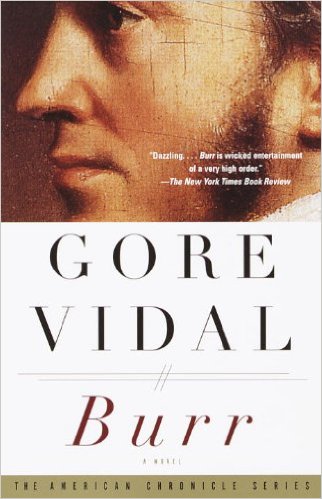
Burr (book)

Leslie Odom Jr. as Aaron Burr in "Hamilton" (2015)
We have spent the week vacationing with my in-laws. There are several ways to reach Athens, Ohio from Cleveland, none of them anything like a straight line. Though it is quicker to take I-71 through Columbus no one hates themselves that much, so we usually take 77 to Marietta and the one of a number of ways to get to 50 West.

A newly completed bridge, part of state road 50, spans the Ohio River, and lately we have taken that route. Connecting Parkersburg and Marietta (yes, you actually go through West Virginia for a few miles) it vaults over the western tip of Blennerhassett Island, site of an historic meeting which would doom the island’s Irish namesake and also the political aspirations of that most mercurial of American icons, Aaron Burr.

Blennerhassett Mansion, where the one-time Vice President and murderer of Alexander Hamilton met Harman Blennerhassett and his wife Margaret to make plans for an expedition down the Mississippi to New Orleans, was located at the opposite end of the island. An historic recreation of the mansion is there to visit today. Twenty-five years ago I performed in a musical inspired by these events, Eden of the River, which was presented on that site.

Driving or flying, as it were, over that island, as we do most times we visit my in-laws, I am reminded not only of all the time I spent on it, but how little of it I explored. It’s not a very large piece of land, yet the only time I stepped away from the boat landing or the area immediately surrounding the mansion was that afternoon I and another chorus member escaped to the woods to make out.

We didn’t go far and we did not stay long. You can interpret that as you will.

What was it like in December 1806, two hundred and ten years years ago, when Burr returned to Belle Prairie (today pronounced BELL-pree) to raise men, funds and supplies -- yet no weapons -- for his ill-fated expedition party? There was no bridge to the island, there still isn’t, this one goes over it, as I said, not to it. How dense the forest, how passable the terrain? Were there any native peoples in the vicinity, how isolated were the Blennerhassett from Western civilization?

The characters of Harman and Elizabeth do play an important role in Gore Vidal’s Burr (1973) an historical novel told from the point of view of the young Charles Schuyler (a fictional character and no relation to the Schuylers in the musical Hamilton) and the book is one part of a collection of American histories the author wrote and named Narratives of Empire.

Never read Vidal before, have to admit, I know him as a talking head in The Celluloid Closet, commenting on his own work as one of numerous writers for the screenplay for Ben-Hur (1959) starring Charleton Heston. Vidal's personality as an arch literary satirist of the twentieth century has largely come to me via osmosis. My father's shelves, which we are currently culling, include several of his works. I am under the impression that any man of my father’s generation with a standard liberal arts education would be wanting without them, though my father was better read than most. Certainly better than I.

The book has taken months for me to read, not because it is not compelling -- it is -- and a satisfying read. My days have been so long, my responsibilities continuous and varied, and though I would pick it up most nights I would only make it through three or so pages before being overwhelmed. I even tried reading a few pages that long, dark night of November 8, when my thirteen year-old daughter was so crestfallen over the election that she could not rest and we compelled her to sleep with us.

True, this novel's content pertains to history, American history, but removed as it was from current events it provided a mild distraction.

The girl with Nik Walker (Aaron Burr on tour in "Hamilton")
Cleveland, Playhouse Square (2018)
In fact, it is because of current events that the novel itself comes as something of a comfort. Vidal is a member of a bygone era, Vulture called him a “dapper, left-wing bomb thrower” -- not a literal bomb-thrower, but that kind of old-school gadfly who could verbally cut you to the quick and leave you incoherently enraged. But first you have to a) be listening and b) understand that you have been insulted. Today’s right-wing demagogues owe their present success by simply refusing to do either.

Burr, the novel, provides the author the advantage of furnishing savage commentary upon icons of American history from a vantage point twice removed, from either his main subject, once Senator, then Vice President, but always “Colonel” Aaron Burr, or from his narrator, Mister Schuyler, a young man who in the course of just a few years rises from a desperate, penniless, inexperienced newspaper writer to a comfortable position in the the Van Buren administration.

Schuyler’s commission is to write a memoir of the ageing Burr (now eighty, some got half as many) and over their time together not only develops great admiration for the Colonel, but also absorbs his worldview, restrained temperament and even to some degree his remarkably subtle wit.

It is this wit, however, in recounting Burr’s version of the American Revolution and all that came after, that provides the subject, and in fact the author, to portray George Washington as a colossal failure on the battlefield, exhibiting terrible judgement (and apparent fantastically large buttocks) winning only one battle -- Yorktown -- and not without foreign assistance.

Later it is Jefferson, not Burr, who appears to hold no moral center, shifting any position necessary to keep the nation a loose confederation of states, denying strong federal power and yet as President freely violating or proposing to violate any of new bill of rights to maintain the status quo (i.e.: slavery) or to destroy his perceived enemies (i.e.: Aaron Burr.)

Tony Fabio as Aaron Burr in "Eden on the River" (1989)
The legendarily soft-spoken Jefferson, always clearly articulating his position, is rendered a slippery cipher, always scheming, fiddling with his inventions, and in constant opposition to Burr, who, by his own description of events, made the appropriate decisions necessary for Jefferson to become President. For the sake of the nation.

Of course, this is Burr speaking. And he speaks to an impressionable man who develops such admiration for him, delighted by his “exquisite irony” and “serene good humor.” It takes a moment to realize that the true object of such compliments is Vidal himself.

And this is comforting how? Donald Trump has made a mockery of American history with his arrogant run for President. Assuming he would never win, he was also more successful as a sloppy, right-wing bomb thrower, capitalizing on resentment, anger and outright racism to propel himself to be the loudest and most visible opponent to Barack Obama. His goal was self-aggrandizement, but unfortunately for him and the rest of us, he now needs to lead, something he has never been successful at doing.

It is demoralizing to imagine we are ending an era in which a young Puerto Rican-American with a Broadway musical under his belt could be granted an audience with the President of the United States to rap a song about the largely unregarded first Secretary of the Treasury which caused a YouTube sensation which inspired him and a company of talented artists to create a new musical which sparked a national conversation on what it means to be American, to be America.

Donald J. Trump does not inspire confidence, he can’t make anything great, and the only artwork he has ever inspired in my neighborhood was a great, hideous nude statue someone dumped on Coventry last summer.

Vidal wrote Burr in the era of Nixon, his novel reeking of cynicism, every player a player, twisting words and circumstance to his own advantage. His America of the early 19th century is a murky backwater where the rich stuff their faces and drink and smoke and spit and talk and talk and talk.

"The Emperor Has No Balls"
Ginger (2016)
He chooses a protagonist in Aaron Burr, worshipped by the common people, heralded wherever he goes, once he has been exiled by proper society for the murder of Alexander Hamilton.* In tearing down icons and exalting this scoundrel, Vidal makes you reconsider all you believe you know about the Founding Fathers. Good Lord, the man even suggests Davy Crockett was raped first before being killed at the Alamo.

So, the United States of America has elected to be its Chief Executive a scoundrel, a self-serving villain who will do what he can to subvert the Constitution to maintain the status quo and destroy his enemies, again. We got this far, citizens. The Republic will prevail.

Exactly how we will overcome, that is a terrible mystery and one which we carry into the new year. It has been suggested that Vidal’s type of scorched earth criticism of those with whom he disagrees has brought us to our current level of discourse. For when your facts are correct, but you are arrogant about it, why would your opponent even respond with an intellectually supported response? Why not just say,”Fuck you, you’re wrong.” and listen to the multitudes cheer? It certainly worked in 2016.

*About that; Lin-Manuel Miranda’s Hamilton taunts Burr to mention a “specific grievance” from over “thirty years of disagreements” for which he should apologize, there was one specific, heinous, personal insinuation made by Hamilton in mixed company and behind Burr's back, an insinuation which had absolutely nothing to do with Burr’s political or professional machinations, which might lead one, were they so inclined, to challenge one to a duel.

 This post has been updated to include a photo from 2018.

Monday, December 5, 2016

Twenty-Seventeen

"Twelfth Night"  at Cleveland Public Library
Photo: Catherine Young
What will the new year hold, apart from malfeasance and kleptocracy at the highest levels of government? Hard to believe an entire year ago I was already fretting the Presidential election, and what do you know, it actually played out pretty much the way I expected. I can deal with it. I am more concerned about the children.

But this is about playwriting. This time last year I believed I would only be producing two adaptations. I was unaware that I would remount I Hate This, that I would be going to Alaska, that I would be further developing a new work I had started two years earlier, that my father would die.

Great things that did happen in 2016:
This spring I have the honor of presenting my third world premiere at Talespinner Children’s Theatre. Red Onion, White Garlic will spin no less than three Indonesian folk tales into one narrative of two grown step-sisters. I am so happy that I have had the opportunity to create three very different stories for this company, from the dreams of a child to a wacky princess adventure to this mature story of familial responsibility.

What else, I cannot say. Received a query about performing the stillbirth play in Turkish, that sounded very interesting but I have not heard back. If the recent past has taught me anything, however, it is that surprises, good and ill, await around every corner.

What’s next?

Sunday, November 13, 2016

Saturday Night Live (TV show)

I’m not giving up and neither should you.
Guerrilla Theater Company opened You Have The Right To Remain Silent on October 23, 1992, with performances every single Friday and Saturday night beginning at 11:00 PM until closing for a summer hiatus the following May.

We had received good advice from friends operating a different late night theater production in Chicago. They said for the first two years, they most performed to a small number of dedicated family and friends.

It was our mission to write new work for every weekend (seven new out of twenty-one short plays, every week) and to never cancel a performance. We canceled one, during a blizzard. No one showed up for that one regardless, and I am glad to say it was the only performance where no one did.

My partner Torque had a dream, which was that when something important happened, in Cleveland, or in the world, people would want to know what the Guerrillas had to say about it. That our satiric take on events would be important.

After all, pre-internet, up-to-the-moment political satire was relegated to the television, and the television didn’t traffic in political satire. Johnny Carson and Arsenio Hall were your only nighttime talk show hosts, and they kept it light.

There were no network hosts willing to take strong political positions like Stephen Colbert, Jimmy Kimmel or Seth Meyers, no Daily Show, Full Frontal or Last Week Tonight. The only program that might comment on current events would be Saturday Night Live.

Three weeks before we opened, on October 3,1992 the network allowed host Tim Robbins to shame General Electric in his opening monologue -- but then were caught flat-footed when musical guest Sinéad O’Connor surprised everyone by tearing up a photograph of John Paull II. It was rare moment of protest on a program that had famously avoided that kind of controversy.

The fact is, we didn’t really watch the show anymore. Core company members Rob Schneider, Chris Farley and Julia Sweeney were not exactly daring in their performances, Kevin Nealon one of the most toothless Weekend Update hosts, and Dana Carvey departed shortly after George H. W. Bush left office.

There have only been a couple times in recent memory when tuning in to (or most recently, checking the YouTube page for) Saturday Night Live was something absolutely everyone wanted to do, to see what their their take was going on.

The first was eight years ago, when Tina Fey’s iconic impersonation of Sarah Palin so defined Palin’s character that ever since it has seemed like Palin has only been impersonating Tina Fey.

Most recently, it has been the Clinton/Trump debates. Kate McKinnon has impersonated Hillary Clinton during the entire 2016 campaign season, but it was Alec Baldwin’s scabrous take on Donald J. Trump that caused a sensation.

There are those who have criticized these debate sketches for “normalizing” the person of Donald J. Trump, which is ridiculous. You don’t blame the fool. Only the Republican Party can be blamed for nominating and promoting an outspoken, xenophobic misogynist who never condemned the endorsement of the Ku Klux Klan and embraced the support of the Russian government for normalizing Donald J. Trump.

And their gamble won. By standing idly by while American integrity was compromised and American dignity was decimated, the Republican Party has near absolute power of the government. Lines that few had dared cross before certainly have been, and we can only imagine what happens next.

But Hillary Clinton is (fill in the blank.) Okay, whatever. She lost* and between she and President Obama reminded the American people what it means to step away with dignity, with whatever dignity it is we as a nation have left.

I was sure that few who have enjoyed watching SNL during the past few weeks were looking forward to last night’s program. I mean, do we ever want to see Baldwin’s Trump ever again? What could possibly be funny on November 12, 2016?

Well. As my father always reminded me, when you aim at a king you must kill him. And the folks at SNL created a cold open to conclude this traumatic election season with class, style, pathos, breathtaking timeliness and most of all talent.


Who knew Kate McKinnon could sing and play the piano like that?

Leonard Cohen died the day before election day, on November 7 and for better or for worse, his Hallelujah is his best known and most covered song. But is because of our familiarity with that song, as performed by McKinnon’s Hillary Clinton, that makes this tired paean once again mournfully triumphant.

*The Electoral College. Hillary Clinton won the popular vote by a sizable margin.

Thursday, October 27, 2016

44 Plays For 44 Presidents

Photo: Steve Wagner
The Hall of Presidents

In 1995 my (then) girlfriend and I took a drive across the upper Midwest and we stopped in to the Neofuturarium to see Too Much Light Makes the Baby Go Blind, (TML) an attempt to perform 30 plays in 60 minutes. They had recently unveiled their Hall of Presidents, which was at that time forty-two large modernist paintings which present not just the man, but the idea of each man who was once President of the United States.

The Hall of Presidents exhibit was originally conceived by Greg Kotis (Urinetown) and Ayun Halliday (No Touch Monkey) with each portrait executed by a different artist in a variety of media. Witnessing the Cleveland Public Theater production of 44 Plays For 44 Presidents, I was reminded of these paintings, and the way in which each of us views the distant past, our personal past, and the very, very recent past.

The Neo-Futurists cleave to the premise if not the fascist politics of the Italian Futurists and the aesthetic of TML can be neatly summed up by F.T. Marinelli’s Futurist Synthetic Theatre manifesto of 1915, to wit; It's stupid to write one hundred pages where one would do. TML consists of extremely brief plays about absolutely anything, making their point quickly and elegantly, and then moving on to the next.

Taking inspiration from their Hall of Presidents, five members of the company, Andy Bayiates, Sean Benjamin, Genevra Gallo-Bayiates, Chloe Johnston and Karen Weinberg, set out to compose one brief play for each of the (at that time) forty-three men who had held that position.

Actually forty-two because we count Cleveland twice. It’s confusing.

Triple-A Plowed Under (1936)
Living Newspaper

I read the original script for 43 Plays For 43 Presidents over ten years ago, and there was an obvious resemblance to TML, very brief plays varying from the absurd to the sublime, only in this case not presented at random, and focused on a common theme.

In performance I felt the production less like TML, and more like a Living Newspaper, one of those offered by the Federal Theater Project in the 1930s. These plays, with titles like Power, Injunction Granted and Triple-A Plowed Under, relied heavily on research to present facts to an audience, often with a specific social agenda.

Like 44 Presidents, Living Newspaper plays were also meant to entertain, commenting - sometimes heavily - on the issues presented, and utilizing a wide and creative variety of performance styles, dance, music and technology to make their point.

Cleveland Public Theatre
Remember The Ladies

We brought the kids, age 11 and 13. I knew they would be entertained, but they were also educated and that’s nice, too. My kids do not normally have anything to say about a play immediately after a performance. We'll ask and they just kind of shrug.

We hadn’t even left the theater Monday night when my daughter said quite emphatically, “That was really good.” And I was hoping she’d say that, because there is one particular component of the Cleveland Public Theatre production which is unique among all those that have been produced in the past fourteen years.

In Cleveland all the performers are women.

I have commented recently about so-called “non-traditional” casting. Choosing actors of color for roles historically played by white actors, or even actual persons from history of European descent. It’s not actually new, Shakespeare’s women were played by boys, the Moor of Venice almost certainly by an English actor in blackface. Somehow going the other way has put people of privilege in a tizzy.

Watching a talented ensemble of seven women portray all of the American Presidents what impression did that leave on my teenage daughter? She hasn't expanded on that yet, only that it’s "really good."

1994 - President Clinton
by Jean Chernoff
Who Lives, Who Dies, Who Tells Your Story

The two acts differ considerably, and much of this is due not only to the writing, and decisions made by this production team, but also the considerable revisions the script has received since it first premiered. The entire play wears its political views proudly on its sleeve, but the events of the nineteenth century are handled with less gravity than those of the twentieth.

For example, in As Karma Sees Fit, William Henry Harrison’s life prior to his inauguration is summed up by his personal responsibility for the wholesale slaughter of native peoples. It is implied that his death thirty-two days after his having been sworn into office is some kind of “indian” curse. We laugh at the irony.

However, in The Not-So-Fair-Deal, Truman describes “the moon, the stars, and the planets” having fallen upon him by FDR’s demise (his words) then drops a symbolic heavenly body onto a war flag of Japan, and there is nothing funny about it. Which president was responsible for more death? Why is one darkly amusing and the other simply awful? Will time + tragedy ever = comedy in this case?

In fact, it is around FDR’s play that the production, as written and performed, veers into the hagiographic. The original version of FDR (simply titled FDR parts 1, 2, 3, 4 & 5) are much more poetic. The fourth part imagines a twelve-year old who had never known another President, and they ask, “what if the sun never shifted … and you could always find it just where you left it.” But then they ask;
When night fell
Would you know it was night?
Or would you think
The sun is gone?
The Honorable George Herbert Walker Bush, III
by Gregg Reynolds
In its present version (Character Above All) it is a candlelit vigil, and a straightforward recitation of his many actions, virtuous and those much less so. This is all well and good but the second half of the twentieth century goes on like that, the guilty condemned, the virtuous exalted. It does not always follow party lines.

George H.W. Bush has received the most significant reconsideration in the past fourteen years. In 2002 he was a moderate whose universally praised war victory couldn’t save him from the criticism he received domestically.

In this version, The Bargain: Prelude To The Great Divide, Bush père is pilloried as a decent man who sold his soul to the devil (personified in the character of Lee Atwater) to achieve high office and is here accused of single-handedly ushering in the modern era of conservative dog whistles, fear-mongering and race-baiting.

Surprisingly, the most recent play that did not receive reconsideration was that for Bill Clinton. He was the sitting President when the Hall of Presidents was created, and received a fine, attractive portrait, suitable perhaps for the White House itself, and in that way much unlike the others.

Consider, for example, his predecessor, whose own portrait is actually a large poster of Saddam Hussein, with a small, George H.W. Bush action figure in box sitting in his lap.

By 2002, however, the writers of this play were able to consider Clinton's entire administration, and found him wanting. In How The Left Was Lost, Bill Clinton is manipulatively charming and all too willing to sell out progressive ideals.

What's In The Box

The evening concludes appropriately enough with an election. The audience gets to choose which play they would like to see last, either the one for him or the one for her. The company makes it clear they do not judge; we were asked to select by a show of applause which play we want to see, not who we actually want for president.

Word has it they have, in fact, performed the Trump play twice already, but the evening we were there the vote was clear, we were with Hillary. And really, after watching a company of women lay bare the magnificent excesses of all our previous, exclusively male heads of state, it only seemed appropriate.

The rap, What's In The Box, describes the frustration you might imagine a woman might feel when everyone knows everything about them, and makes up even stories about them, and yet everyone says this is the most secretive and deceitful woman who ever lived.

The company received this script during the rehearsal period, before the debates began, before grab her by the pussy and such a nasty woman. 

My thirteen year-old girl has watched and listened while the first female candidate for President of a major political party has calmly endured the most hateful and anti-woman rhetoric. My daughter is paying attention.

She has also bought an HRC T-shirt with her own money.

In early September, Hillary's "box" of secrets may have been interpreted only tangentially by its sexual connotation. In late October, it is a metaphor for all of the private and public violations women have to endure every single day, and not only from the dumpster fire at the top of Republican ticket.

Closing argument; You get my public image, bitches / but this is mine.

44 Plays For 44 Presidents continues at Cleveland Public Theatre through Saturday, October 29, 2016.