Showing posts with label National Theatre. Show all posts

Wednesday, June 8, 2022

England, 1997 (Week Two)

Shakespeare's Globe
Our second week visiting England in June 1997 was busier than our first, and in spite of developing something like a cold, we kept seeing shows and even took an overnight trip to Stratford-Upon-Avon. It helped that my brother and his family lived close to the city, which helped cut down on cost. We did a few things together, but they were also raising a sweet two year-old girl which kept them close to home.

Monday night we saw Ute Lemper sing Weimar Berliner cabaret songs at the Almeida Cabaret in Islington. She was a new surprise to us, though by the late 90s the German-born performer was already an award-winning actress on stages across Europe playing the leads in shows like Cats and Chicago.

Today I learned that if you were a German child in the late 1980s, she was the singing voice of your Ariel in Disney’s The Little Mermaid. On the evening in question she was singing and storytelling about the kinds of passionate and transgressive songs which inspired those created for Cabaret.
Mon, June 9: “Opening night. Full house. Third row. It was wonderful. Tall, red hair, high cheekbones, child-eating smile, arching eyebrows … humorous, passionate, amazing … English, German and French, beautiful and scary.”
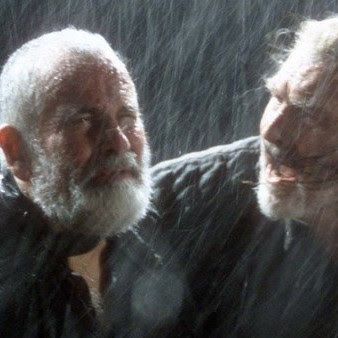
Ian Holm & David Burke
"King Lear"
(National Theatre, 1997)
Yes, it rained on stage.
Featuring songs with titles like Masculine/Feminine, Sex Appeal and Ich Bin Ein Vamp! Lemper shared the legacy of sexual liberation and gender fluidity which would soon be extinguished by a Fascist regime. (See also: The Degenerate Art Exhibit.)
“The Almeida is my theater, it’s the theater I want. Like a round, brick well, high-ceilinged … intimate. Fantastic space.”
The next day we were able to get rush tickets to see Ian Holm’s return to the stage after several decades, performing King Lear in the Cottesloe Theatre at the National.
Tue, June 10: “A cold, cold Lear. Holm came out of the gate intense and quick to anger … small man but a huge presence. I wish Dad could see it. Almost no music. Run on, act at your leisure, run off.”
We took an overnight trip to Oxford and Stratford. I was unwell but we pushed on.

With brother and his family.
Even Oxford had a tourist trap, and we do love tourist traps. We took a spin on The Oxford Story which is a straight-up dark ride, a maddeningly slow roller coaster ride through the history of England’s oldest university featuring lots of still marionettes. Narration was provided over headphones while we were shuttled along in cramped, little desks.
Wed, June 11: “And it’s sponsored, produced and sanctioned by the school! Can I blame the Americans? Our entertainments must be 3-D, automated, cold and tacky. The House on the Rock produced by the Corporation for Public Broadcasting.”
We spent the night in Stratford where we had dinner at the Glory Hole (yes) and took in a performance of Camino Real at the Swan Theatre, where I also saw “The Seagull” in 1990. 
“A live band made for most excellent music – a lot of Beat-era jazz, for example.”
"Phantasmagoria!"
(There is literally a guy on the floor,
covering his head.)
The next morning we saw more Shakespeare-oriented historical sights than the entire time I was there in 1990. Of course, much of my time there seven years earlier was to take workshops and to see shows, and it was very, very snowy. My partner said Stratford was the most delightful place we had visited so far.

We took the train back to London, and that evening, Henrik, Toni and I saw Anthony Neilson's The Censor at the Royal Court. Bad Epitaph would produce this play in September 2001. The run was cut short for obvious reasons.
Thu, June 13: “Great. Inspiring. Emotionally awful.”
On Friday we visited the Museum of the Moving Image (MOMI), a historical celebration of the science and craft of projected entertainment. I was particularly taken with the devices which created thrilling or unsettling imagery for unsettled audiences well before the invention of what came to be known as the motion picture.
Fri June 14: “The Phantasmagoria! … an 18th century slide [magic lantern] show – images, tinted slide drawings, projected on a screen in a darkened room, accompanied by spooky music, augmented by smoke cast before the lens, or slowly bringing it into focus, or casting one image the another, back and forth to give the impression of movement – or a sequence of two images (Adam and Eve biting the apple/being cast out of Eden) intercut by a lightning bolt flashing on and off, with appropriate sound effect. 

"And to appreciate how spooky this would be to an audience! It was great! So creative! I wish I could be half as inventive!”
Salieri's, seat detail.
That night was our only real “date night” with just the two of us and my brother and sister-in-law. We headed to the Warner Brothers Cinema on Leicester Square to see Big Night, a period film about Italian immigrant brothers who operate a restaurant on the Jersey Shore and starring Stanley Tucci and Tony Shaloub. My wife and I had already seen it when it was released in the US, and it remains one of our favorite films.

It only made sense that we close the evening with a long, indulgent dinner at Salieri’s, which Toni and I had discovered the week before. The decor was “a little ridiculous – everything is painted, the seats have scenes on them of cabarets and showgirls, so do the walls and the ceiling. Mermaids and seahorses and gambling dandys.”
Fri, June 14: “The harp player actually played La Colegiala.”
Saturday afternoon we took a tour of Shakespeare’s Globe Theatre, which was utterly remarkable. When our student group had visited Southwark in late 1990, it was just a big, muddy hole in the ground and our tour guide gave the impression that the thing would never actually get built. And here it was, a peg-by-peg and fully-practical reproduction of an Elizabethan theater.

The place hadn’t officially opened to the public yet, and in fact there was a major event going on that evening and ours was the last tour before the theater was closed for the festivities. We had a snack in the cafe as the place was filled with an assembly of formally dressed people, several of whom I recognized from stage and film. I noticed that Michael Maloney, one of Branagh’s favorite players, was seated at the table next to ours. He caught me gawking. That was embarrassing.

Juliet Stevenson & Nicholas Robinson
"Caucasian Chalk Circle"
(Théâtre de Complicité, 1997)
That evening we closed our journey by attending Caucasian Chalk Circle at the National Theatre, produced by Simon McBurney’s troupe Théâtre de Complicité (today simply Complicité) which is perhaps the greatest theatrical performance I have ever had the joy to witness.
Sat June 15: “Produced with a great sense of play, humor and adventure. In the round … using long poles they made spears and guns, but also a rickety bridge, and even made a river using them.”
One particular moment though, which always reminds me of the unique magic that is stagecraft: The child was portrayed by a succession of puppets, from the baby to the toddler and so on, and with each iteration the chorus would sing as the “younger” puppet was led off and the “older” puppet was introduced. A marionette the size of an eight year-old walked off and an impossibly big one, the size of a ten year-old was led on, operated by no fewer than six company members.

But as this one was walked by the puppeteers, each one stepped away, and as it walked on its own the last puppet operator pulled a skin-tight mask from its head as it was revealed to be an actual human actor. The audience gasped and applauded, it was marvelous. So glad we saw this show last. It is a shared memory my wife and I treasure to this day.

I was last in England five years ago, with mother to attend my niece's college graduation. How was that only five years ago? I worry I will never return.

Friday, June 18, 2021

Howard Katz (play)

Ron Cook is Howard Katz
Twenty years ago, during the summer of 2001, my wife and I were left with nothing to do. We were prepared to have a child some time in May, and we were unprepared suddenly not to. My brother suggested a visit to London, which seemed like as good an idea as any.

That the two of us, my wife and I, had difficulty negotiating large cities and interpersonal relationships on this trip is documented in my play I Hate This. Put simply, we only wanted to look at beautiful things and talk about the baby and be sad. This made things challenging.

I wanted to attend theater, which I found a distraction. This is all well and good when you are attending a fancy dress party version of Macbeth at the Globe, or a revival of Noises Off. It is quite another thing to attend a new play, one which decides to slap you about the face and head during the final two minutes.

Howard Katz was Patrick Marber’s eagerly awaited follow-up to Closer. I very much enjoyed reading Closer, which premiered in 1997 and was first produced in Cleveland at Dobama Theatre in April, 2001. I would have auditioned for that, I thought I would be perfect for the role of Dan. I was at that time deeply interested in contemporary drama about transgressive relationships. But I did not audition, because you know why because.

Anyway, we went to see Howard Katz.

A cross between King Lear and the story of Job as told by David Mamet, Howard Katz, the man, is an asshole, a show biz agent who has a midlife crisis and loses everything in order to save his soul. The company featured Ron Cook in the starring role, a young Russell Tovey, and Paul Ritter, who I recently noticed in Chernobyl. The show opened in the Cottesloe at the National Theatre that weekend, where it received rather tepid reviews.
“Marber is trying to write a modern Death of a Salesman; but, unlike Miller, he never establishes a molten link between his hero's private flaws and the false dreams imposed by society. So one is left to take what pleasure one can in some sharp showbiz satire and odd zingers.” 
- Michael Billington, The Guardian 6/14/2001
London, Summer 2001
Most galling to me, to us, was Katz’s closing monologue. Having self-sabotaged his relationships, his career, and his fortune, left homeless and alone on a park bench, his epiphany, his redemption arrives as he remembers the complete and utter joy he felt at the birth of his son. I was disturbed, and Toni was inconsolable.

The train ride back to Battersea that evening was difficult. My brother wanted to chat about the show, because that’s what we do after a play. We were not in the mood to do that, and it took a moment for him to understand that. We went back to his home, where my sister-in-law was sitting up, and we all drank hot chocolate with Baileys, and yes. We talked about the baby.

It occured to me that summer just how many stories end with the birth of a child. As the ideas for a solo performance about my experiences started to come together, I asked myself how I could end my tale at the beginning.

Playhouse Square will premiere "I Hate This (a play without the baby)" in Summer 2021. Details to come.

Monday, April 29, 2019

Play a Day: King Lear

This is a year of many auspicious anniversaries.

Thirty years ago I performed my first Shakespearean role, that of Friar John in Romeo and Juliet. Twenty-five years ago I directed my first Shakespeare, which was also Romeo and Juliet. In that production I provided a recorded voice over for Prince Escalus.

Twenty years ago I directed Hamlet, and did a walk-on as the Ghost of Hamlet’s father.

I have performed a few other Shakespearean roles. Petruchio in the Guerrilla Theater Company production of The Taming of the Shrew. Bardolph in Henry IV for Cleveland Shakespeare Festival. Pistol in the Merry Wives of Windsor at Great Lakes Theater, and also in The Tempest as Adrian.

What? You don’t know who Adrian is? He is the least-consequential named character in all of Shakespeare. He has a name, "yet--" he does nothing and provides absolutely no information we do not already know. In this production his signal contribution was to get his head bitten off by a harpy.

The fact is, in spite of being regarded as a Shakespeare guy, I have performed very little Shakespeare. This summer, however, I will be playing one of my very favorite roles, that of the Earl of Kent in the True Chronicle Historie of the life and death of King Lear and his three Daughters, or as more popularly known, King Lear.

As Adrian with Dougfred Miller as Antonio
The Tempest, Great Lakes Theater (2007)
Is it just me, or is this play going through something of a renaissance in the 21st Century? Is it because the Baby Boomers are entering their final years and want to redefine him for a new age?

I have had the opportunity to witness a couple iconic performances of King Lear in my time. In 1990 we and a college group visited London and Stratford and saw Lear performed by John Wood, who most Gen X Americans would know as Professor Falken from the motion picture War Games. The two standout performances were that of the non-yet-famous Ralph Fiennes and Alex Kingston as Edmund and Cordelia, respectively.

Several years later, Toni and I were in London and saw Ian Holm play Lear at the National, following his long hiatus from the stage. On that trip I picked up a copy of the book Shakespeare Made Fit: Restoration Adaptations of Shakespeare edited by Sandra Clark.

In that I learned of Nahum Tate’s adaptation of Lear, in which he created a much happier conclusion, one in which Edgar and Cordelia (who never speak to one another in Shakespeare’s original) fall in love and overthrow Edmund to live as King and Queen of a united England. Published in 1681, “Tate’s Lear” was the favored version until around 1863, when William Macready staged the first truly popular restoration of Shakespeare’s original tragedy.

David Troughton as Tom, right
With Penelope Wilton
The Norman Conquests, BBC (1977)
It was Tate’s version that was to be my third Shakespearean production, announced for Cleveland Shakespeare Festival’s 2000 summer season. When it became necessary to abridge that year’s production schedule from three productions to two, Tate’s Lear was cancelled. We had a wonderful cast who were tremendously disappointed, and it still pains me to remember that I let them down, having made the proposal myself not to move ahead with the production.

Ironically, perhaps, one of the other two productions that year was a compact and modern production of Love’s Labour’s Lost, directed by Eric Schmiedl. Referred to as “The GQ Love’s Labour’s,” Eric had cut the text down to just the lovers’ story (no Don Armado, sorry, no Holoferenes) punctuating the narrative with a few passages from popular magazines describe what the modern person wants in a relationship.

My relationship with Eric goes back to our tenures briefly overlapping at Karamu in the early 90s, later we were in the Cleveland Play House Playwrights’ Unit. He has directed me in Sarah Morton’s Night Bloomers, Eric Coble’s The Velocity of Autumn, David Sedaris’s The Santaland Diaries, and now we are entering the rehearsal process for a streamlined, studio production of King Lear at the Beck Center for the Arts.

Kent is such a desirable role for a man my age, and I hope I can do him justice. He has the first line of the play, and it is entirely unassuming, one of the rare circumstance in Shakespeare when the action just starts, right in the middle of a conversation, Kent speaking with the Earl of Gloucester about a point of interest which has marginal bearing upon the issues of the narrative.

He is pressed into action, having to suddenly bridge a confounding gap and is forced into action he couldn’t have considered five minutes previously. He is not particularly remarkable, except for his absolute devotion to those he loves, sharp wit, and his ability to kick a young man’s ass.

David Troughton as Earl of Kent, right
With Linda Kerr Scott and John Wood
King Lear, Royal Shakespeare Company (1990)
I have seen two men whose performances as Kent rest upon my shoulders. The first was David Troughton, whose work I had first seen when he played Tom in the BCC production of Alan Ayckbourn’s The Norman Conquests. Why a ten year old would be watching a British comedy about intimate relationships you can blame on my brother, regardless I remembered him when our school group visited Stratford that 1990.

Troughton was a then-member of the RSC, and in addition to leading workshops and acting as a mediator between our team and the company, he and his wife Alison welcomed us into their home and they were just remarkably kind and thoughtful people.

He and Ciarán Hinds conducted the final battle between Achilles and Hector (respectively) from Troilus and Cressida for us during a stage combat workshop. I saw him play Holoferenes in Love’s Labour’s Lost onstage, and he was Kent to John Wood’s Lear.

It was a remarkable week.

Most recently, I saw the production at Great Lakes Theater, directed by Joseph Hanreddy. That was four years ago. Hanreddy has done such marvelous work with our company, and this was no exception, a towering performance by Aled Davies in the lead role. His Kent, his "Caius" was Dougfred Miller.

I first met Doug the summer of 2005, when we played Merry Wives of Windsor at Great Lakes. Doing summer shows, my birthday often overlaps rehearsal or performance (this has happened numerous times) but I don't tell anyone. There's too much, I want it to be about me. That July 26 I walked into Becky's after rehearsal, on my own, prepared to drink a solitary toast to my own 37th anniversary. Doug was there at the bar and invited me to sit with him -- I hadn't really gotten to know anyone in the cast yet, and he expressed a deep, sincere interest in me, which was very gratifying on such a day.

Dougfred Miller as Earl of Kent, right
With Cassandra Bissell
King Lear, Great Lakes Theater (2015)
The next year we created a great moment together on stage for The Tempest -- the one in which I played the least consequential named character in Shakespeare. Doug was Antonio, the usurping Duke. Director Andrew May had stage these moments where Ariel was literally playing with us -- we were like puppets on strings. She paused us as I (as Adrian) had made a fist, as to strike Antonio. We were released and I hit him, Doug (as Antonio) reeled from the impact, as our "strings" were cut, sending us crashing to the floor.

Not remembering having been in this state, I rose from the floor, rubbing my hand as he rose rubbing his chin. We looked at each other -- and then away. A marvelous take. If anyone in the audience caught the exchange, I have absolutely no idea.

A performer possessed in equal measures great compassion, dedication to craft, an unparalleled wit and god-like sense of comic timing, his Kent was to me emblematic of Doug's work at its finest.

As we begin rehearsals for King Lear this evening, I enter the only way I could, following the example of such generous men, with humility and hope.

Beck Center for the Arts presents "King Lear" directed by Eric Schmiedl, May 31 - June 30, 2019.

Monday, September 19, 2011

Berthold Brecht

Eugen Berthold Friedrich Brecht (February 10, 1898 – August 14, 1956) was the greatest playwright of the 20th Century. Wait, let me rephrase that. Berthold Brecht was the playwright of the 20th Century. That's more accurate. The darkest, bloodiest period of human history. A century so packed with misery, betrayal and horror, we ended it a year early. And Brecht knew it, and wrote plays about it.

Life of Galileo, 2011
Cleveland Play House
Yes, for those of you paying attention, the inaugural production of Cleveland Play House in the newly redesigned Allen Theatre was written by Berthold Brecht, though they have worked very hard to make sure no one knows that (see marquee, right.)

Originally written in the late 1930s, and revised during Brecht's time in California during the late 1940s, this Cleveland Play House production of Life of Galileo is painfully relevant. It could have been written today. Seriously. That does not mean the rap sequence was necessary, I really wish they hadn't done that.

(Capsule review: Paul Whitworth is delightful and heartbreaking in the lead role, and he is well-supported by the professional company, and a highly satisfying design team. Go see it. For real.)

Galileo discovers the moons of Jupiter. The fact that an interstellar body can have its own satellites thrown into question an Earth-centered universe. When he invites the powers-to-be to gaze into his telescope, as evidence, as proof, to define fact, they ask "Why?"

And so it is today. Why look? What is the reason? What is the result of learning truth? What will happen if we discover that everything we know is wrong? What will happen? Better not to look.

In the United States, Brechtian is a word which can mean all kinds of things; cold, stagey, artificial. Apparently, though Brecht loved the theater, he thought audiences should have a miserable, awful time at the theater. This is of course nonsense. His texts belie this fact. He stood in opposition to "realistic" theater, where we are supposed to forget we are watching a play. But stagecraft is a central concern of his work, and the best productions of his plays are those which are active, passionate, aggressive, hilarious -- alive.
Caucasian Chalk Circle
(Théâtre de Complicité, 1997)

My wife and I saw Caucasian Chalk Circle at the National Theatre:
"… produced with a great sense of play, humor, and adventure. In the round. A large company playing lots of roles … some of them were only there to be musicians, but they also joined in for crowd scenes and to help create “the set” … using long, study poles, they made spears and guns, but also a rickety bridge and even made a river using them.

"The creative use of props and movements. You can be anywhere."
- personal journal, June 15, 1997
Brecht was called before the House Committee on Un-American Activities, and did appear on October 30, 1947 where he denied membership in the Communist Party. The very next day, he left the United States forever, eventually settling in East Berlin. As Brecht illustrates in Galileo, fear is a much more powerful motivating factor than honor, nobility or compassion.

Then again, in Caucasian Chalk Circle he suggests the opposite.

Cleveland Play House presents "Life of Galileo" by Berthold Brecht at the Allen Theatre in Playhouse Square, September 16 through October 9, 2011.