 |
| Shakespeare's Globe |
Monday night we saw Ute Lemper sing Weimar Berliner cabaret songs at the Almeida Cabaret in Islington. She was a new surprise to us, though by the late 90s the German-born performer was already an award-winning actress on stages across Europe playing the leads in shows like Cats and Chicago.
Today I learned that if you were a German child in the late 1980s, she was the singing voice of your Ariel in Disney’s The Little Mermaid. On the evening in question she was singing and storytelling about the kinds of passionate and transgressive songs which inspired those created for Cabaret.
Mon, June 9: “Opening night. Full house. Third row. It was wonderful. Tall, red hair, high cheekbones, child-eating smile, arching eyebrows … humorous, passionate, amazing … English, German and French, beautiful and scary.”
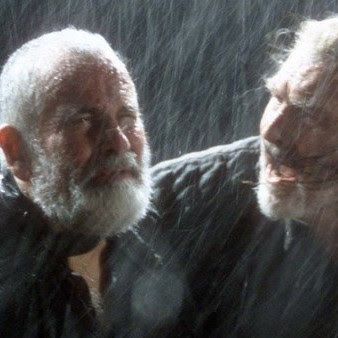 |
| Ian Holm & David Burke "King Lear" (National Theatre, 1997) Yes, it rained on stage. |
“The Almeida is my theater, it’s the theater I want. Like a round, brick well, high-ceilinged … intimate. Fantastic space.”The next day we were able to get rush tickets to see Ian Holm’s return to the stage after several decades, performing King Lear in the Cottesloe Theatre at the National.
Tue, June 10: “A cold, cold Lear. Holm came out of the gate intense and quick to anger … small man but a huge presence. I wish Dad could see it. Almost no music. Run on, act at your leisure, run off.”We took an overnight trip to Oxford and Stratford. I was unwell but we pushed on.
 |
| With brother and his family. |
Wed, June 11: “And it’s sponsored, produced and sanctioned by the school! Can I blame the Americans? Our entertainments must be 3-D, automated, cold and tacky. The House on the Rock produced by the Corporation for Public Broadcasting.”We spent the night in Stratford where we had dinner at the Glory Hole (yes) and took in a performance of Camino Real at the Swan Theatre, where I also saw “The Seagull” in 1990.
“A live band made for most excellent music – a lot of Beat-era jazz, for example.”
.jpg) |
| "Phantasmagoria!" (There is literally a guy on the floor, covering his head.) |
We took the train back to London, and that evening, Henrik, Toni and I saw Anthony Neilson's The Censor at the Royal Court. Bad Epitaph would produce this play in September 2001. The run was cut short for obvious reasons.
Thu, June 13: “Great. Inspiring. Emotionally awful.”On Friday we visited the Museum of the Moving Image (MOMI), a historical celebration of the science and craft of projected entertainment. I was particularly taken with the devices which created thrilling or unsettling imagery for unsettled audiences well before the invention of what came to be known as the motion picture.
Fri June 14: “The Phantasmagoria! … an 18th century slide [magic lantern] show – images, tinted slide drawings, projected on a screen in a darkened room, accompanied by spooky music, augmented by smoke cast before the lens, or slowly bringing it into focus, or casting one image the another, back and forth to give the impression of movement – or a sequence of two images (Adam and Eve biting the apple/being cast out of Eden) intercut by a lightning bolt flashing on and off, with appropriate sound effect."And to appreciate how spooky this would be to an audience! It was great! So creative! I wish I could be half as inventive!”
.png) |
| Salieri's, seat detail. |
It only made sense that we close the evening with a long, indulgent dinner at Salieri’s, which Toni and I had discovered the week before. The decor was “a little ridiculous – everything is painted, the seats have scenes on them of cabarets and showgirls, so do the walls and the ceiling. Mermaids and seahorses and gambling dandys.”
Fri, June 14: “The harp player actually played La Colegiala.”Saturday afternoon we took a tour of Shakespeare’s Globe Theatre, which was utterly remarkable. When our student group had visited Southwark in late 1990, it was just a big, muddy hole in the ground and our tour guide gave the impression that the thing would never actually get built. And here it was, a peg-by-peg and fully-practical reproduction of an Elizabethan theater.
The place hadn’t officially opened to the public yet, and in fact there was a major event going on that evening and ours was the last tour before the theater was closed for the festivities. We had a snack in the cafe as the place was filled with an assembly of formally dressed people, several of whom I recognized from stage and film. I noticed that Michael Maloney, one of Branagh’s favorite players, was seated at the table next to ours. He caught me gawking. That was embarrassing.
 |
| Juliet Stevenson & Nicholas Robinson "Caucasian Chalk Circle" (Théâtre de Complicité, 1997) |
Sat June 15: “Produced with a great sense of play, humor and adventure. In the round … using long poles they made spears and guns, but also a rickety bridge, and even made a river using them.”One particular moment though, which always reminds me of the unique magic that is stagecraft: The child was portrayed by a succession of puppets, from the baby to the toddler and so on, and with each iteration the chorus would sing as the “younger” puppet was led off and the “older” puppet was introduced. A marionette the size of an eight year-old walked off and an impossibly big one, the size of a ten year-old was led on, operated by no fewer than six company members.
But as this one was walked by the puppeteers, each one stepped away, and as it walked on its own the last puppet operator pulled a skin-tight mask from its head as it was revealed to be an actual human actor. The audience gasped and applauded, it was marvelous. So glad we saw this show last. It is a shared memory my wife and I treasure to this day.
I was last in England five years ago, with mother to attend my niece's college graduation. How was that only five years ago? I worry I will never return.


