Showing posts with label Donald Trump. Show all posts

Friday, September 4, 2020

The Plot Against America (HBO)

Ten years ago I wrote this brief reader response to The Plot Against America, today I finished viewing the miniseries adaptation for HBO. Like their recent reinterpretation of Watchmen, HBO has produced another high-concept "alternate history" drama which sings with contemporary importance.

Roth wrote his novel during the Bush era, and was frank about his having been inspired by the run-up to the Iraq War. Little did he know how events would play our during the final years of his own life. Having read the book myself during the Obama years, you can see how affected I was by the lies propogated by the "birther" movement, who sought to delegitimize the President.

And here we are. They did not need to work very hard to create images for this television adaptation which put one in mind of the Unite the Right rally in Charlottesville three years ago, and city streets in Minneapolis, Portland, and Kenosha.

What I did not mention in my decade-old blog post was how disappointed I was with the conclusion of Roth's book. Lindburgh flies to Berlin, a special election is called, FDR wins, and history as we know it continues. It is all too pat, too sunny.

This adaptation has a superior ending, and one which leaves me chilled. We hear Sinatra's rendition of The House I Live In, a lovely call for American tolerance and acceptance, and see people of all walks of life coming together to vote for a President.

We also see men in black removing voting machines from precincts, claiming they are broken, and white men burning ballots in abandoned fields. The Plot Against America program debuted on March 16 of this year, as the country was shutting down for the pandemic, and before the President began his most recent agenda, casting doubt on our elections and dismantling the post office.

It is far too late to suggest that it can't happen here.

Tuesday, August 18, 2020

David Hansen, American Playwright

I’m on social media. You’re on social media. I mean, you’re here, right now. Funny to think of something as old and tired as a blog to be social media, but it totally is. Welcome.

I have a dry wit, it comes from my mother’s side of the family. As she was swiftly losing her mind in early December, the nurses and doctors would test her faculaties by asking basic questions. Do you know where you are? What day is it? What year is it?

That last gave her trouble first. Then they asked, “Do you know who the President is?” After a brief pause she said, “Who can forget that?”

Learning the niceties of online communication has been hard-fought for me. But I have learned, like everyone else, to include an exclamation point to show the enthusiasm you might otherwise do with a smile. And to add a smile or wink emoji to let someone I know that I am saying something in jest. To them.

But if I am making a sarcastic comment on Facebeook, or especially on Twitter, it is galling to add “” or some other indicator to a wry joke. Drawing attention to the fact that my comment is not meant to be taken seriously ruins the joke. Either you “get” it or you don’t. If you don’t get it, it’s probably not a very good joke.

The other day, I posted something on Twitter, summing up my lack of respect for a certain political action committee, founded by a certain set of Republicans, who have made it their mission to make sure Donald J. Trump is not reƫlected.

Liberals are thrilled, and to the extent that anyone wants to assign this president to the ashcan of history, so am I. But let’s not kid ourselves, if absolutely any other human were representing the GOP of the ballot, these fellows would be providing their money and support to the person. It’s not conservatism they despise, it’s just that man.

The Lincoln Project
steals memes.
(h/t JeffFromRegina)
They tweeted something which included the phrase “Are you in?” and urging folks to respond. I replied stating that I had: “Suddenly decided that after a lifetime of harmful, self-serving decisions, I actually don't want my obit to include the phrase ‘voted for Trump twice.’" and included their hashtag (see above.)

Two days later that Tweet has over 4,800 likes, and hundreds of retweets. Most replies congratulate and thank me. A small handful call me out for being stupid enough to vote for him once, and in that they would not be wrong, if it were true.

Because it was a joke. I feel a bit of what they used to call sheepish. But not much.

Several years ago my colleagues made up a little song, inspired by the song "Joseph Smith, American Moses" from the cringey and somewhat dated musical The Book of Mormon. It went like this:
“David Hansen ...
American Playwright.”
That’s it. And that is how I became David Hansen, American Playwright. I put it on my Facebook page, and on my website. It does feel odd, however, to use that title, things being how they are. What do I mean when I call myself an American playwright? Am I one of those Americans?

No. At least I hope not. I am one of these Americans, which should be obvious when you read my work, which is much more sincere than what I choose to tweet. I put forth an America I see and would like to see.

But if you are unfamiliar with my work - unfamiliar with me - how can you tell? A white, cis-male of a certain age, perhaps my bold statement of nationality is an indication of some kind of jingostic bent.

In my individual pursuit of a more perfect Union, it is a risk I am currently willing to take.

Sunday, April 12, 2020

Play a Day: The Great Porn Caper

Bryan Stubbles
For Easter Sunday, I read The Great Porn Caper by Bryan Stubbles and available at New Play Exchange.

Bryan is a prolific playwright from Utah, currently staying-at-home in Jakarta (or so he claims) and a social media gadfly who has often promoted my schtick at his blog, Unknown Playwrights, which you should visit and often.

I am a big fan of his research into theater posters from across time and space. Theater posters still promote interesting and evocative graphic design, as movie posters absolutely no longer do.

The Great Porn Caper is a playfully sordid road trip for disaffected Post-Millennials (can we stop saying "Gen Z" for God's sake) which roils with absurdity and loopy wordplay while also taking the piss out of Neo-Nazis, white trash, and Donald Trump, or did I just say the same thing three times.

I would love to see a production of this play, preferably in a storefront theater with like twenty folding chairs for seats, and not just because I want to see young people in swimwear although that is part of it.

Who should I read tomorrow?

Monday, October 7, 2019

Tyrant, Shakespeare On Politics (book)

Angela Merkel, on vacation, reading "Tyrant."
Stephen Greenblatt, American author of the acclaimed Will In the World, was apparently so entirely disturbed by the election of Donald J, Trump that he swiftly produced a brief examination of Shakespeare’s villains (189 pages) and how they each compare to the current occupant of the White House.

Tyrant, Shakespeare on Politics, was released on May 8, 2018, and even at that point it was easy to see what kind of President Trump was going to be, as if that were not previously evident. Though he never names the President, his thesis is clear, with every chapter and every would-be emperor described, accurately for the most part, with precisely the same language many have used to describe Trump.

He calls Jack Cade, leader of a populist uprising in Henry VI Part 2, a “loud-mouthed demagogue” possessing an “indifference to the truth, shamelessness, and hyperinflated self-confidence.”

Shakespeare's Richard III “divides the world into winners and losers” and “is not merely indifferent to the law; he hates it … because it gets in his way.”

Macbeth has “a compulsive need to prove his manhood, dread of impotence … a fear of failure.” These psychological cues explain his “penchant for bullying, the vicious misogyny” and “explosive violence.”

Surprisingly, Greenblatt spends few words on the character of Julius Caesar, who, of all of Shakespeare’s monarchs, has been the one most often directly compared to Trump, for all of each man's vanity, poor health, and weakness for flattery at the same time ferociously protesting their own god-like inability to be manipulated.

Instead, this author focuses, as the play does, on the character of Brutus, and his desire to preempt disaster and assassinate Caesar before he attains absolute rule. Shakespeare’s lesson, it is clear, is that violent overthrow, no matter how pure the intent, is never pure, and impossible by design; an oxymoron in action.

“Real-world actions grounded on noble ideals,” Greenblatt suggests, “may have unforeseen and ironic consequences.”

Carole Healey as Julius Caesar
Photo: Roger Mastroianni
(Great Lakes Theater, 2019)
Published almost a year before the release of the Mueller Report, Greenblatt also provides a warning; that, though investigation and the possibility of impeachment is not a violent act, subverting the will of the electorate will always be suspect, and probably futile, even if you believe it would be the poorer choice to do nothing at all.
“The attempt to avert a possible Constitutional crisis, were Caesar to decide to assume tyrannical powers, precipitates the collapse of the state. The very act that was meant to save the republic turns out to destroy it. Caesar is dead, but by the end of the play Caesarism is triumphant.”
As it happened, the Mueller investigation came to a close without touching Trump nearer, finding that while a foreign power certainly offered Citizen Trump political assistance during the 2016 election, there was not definitive proof that he accepted it.

It should surprise no one who has been paying attention that we are now mired in a nearly identical circumstance, with definitive proof that President Trump himself has solicited political assistance from (at least) one foreign power for the 2020 election.

Impeachment now increasingly likely, looking into the works of Shakespeare may be a direful predictor of future events.

Thursday, April 5, 2018

Play a Day: People of the Book

Yussef El Guindi
For Thursday I read People of the Book, by Yussef El Guindi, and available at New Play Exchange.

"Can we all agree going into this war made us less safe?"

That is a question one of the characters ask in this People of the Book, and though you may assume they are referring to the Iraq War of 2003, they could easily be referring to the Persian Gulf War of 1991.

Following the demise of the Soviet Union and the end of the Cold War, the power-imbalance led to leaders like Saddam Hussein to press their advantage in a way which would have been more difficult in previous years.

President George H.W. Bush pressed his advantage as well. The West had not seen a wide-scale war in some time. Saddam's invasion of Kuwait was tailor-made for international outrage and for one shining moment, the United States was able to convince most of the world to join in or at the very least stay out of the way.

The war lasted thirty-three days, or has never ended, depending on how you look at it.

Taken literally, El Guindi's play is about deception, professional and personal jealousy, and the effect of American wars in the Middle East. It's a great read, with playful and cutting dialogue, and it is also a metaphor for how American has played itself, chaining our fate to the region. Each of the four central characters reflect a different point of view, about art and writing, about the war and its worth, and what responsibility the United States has yet to take for its actions.

Yesterday the President announced his plans regarding the conflict in Syria. "I want to get out," said President Trump. That's what he said. "I want to get out."

Monday, February 19, 2018

Fire and Fury (book)

Light (before) reading.
I was sitting at breakfast in Orlando, on the third day of the new year, when I discovered and then read those first, tantalizing excerpts from Michael Wolff’s now-notorious book on the first few months of the Trump presidency, Fire and Fury.

Wolff has had the advantage of being first, if not the most accurate, chronicler of the current unpleasantness. Like many who are appalled by the current occupier of the White House and his entire cast of unsavory characters, I looked forward to buying the book when it was released, if only as another sign that the status quo was unacceptable and that we will never stop making it clear that it is.

Interesting that Wikileaks would release a PDF of the entire book the day before its release. I remember when Assange pretended to promote transparency in all governments, instead of transparency only for those he has decided are his enemies. Violating the copyright for an entire written work is not the same as releasing the Pentagon Papers, it’s just a crime, and one obviously intended to drive down sales.

Why am I writing about this now, when Fire and Fury is last month’s news? Well, the fact is, I hoped to read the entire thing in just a few day and write about it then, but I got through a few chapters and it just languished on the pile.

The fact is, it’s a bit dry. The book succeeds primarily for being first. It made the President very angry, but he’ll be angry again, and many times over, as each subsequent book is written, by journalists, his former colleagues, and his countless accusers.

Following the initial “Oh, boy!!!” factor of reading about Election Night, and how terrified the Trump camp was coming to terms with that fact that they had actually won, I realized something very basic about this book which has also tamped down my interest in reading to the end.

We know all this. We have known all of this. There is nothing in this supposedly explosive book that is a revelation. I have been saying for the better part of a year that everything that has happened makes complete sense when you consider that absolutely no one in Trump's campaign, including the man himself, thought he would win.

That’s why they were unprepared to govern. That’s why they front-ended accusations that the election was rigged -- to slander the presumptive victor, Hillary Clinton. And that’s why they blithely committed crimes against the state which would pay staggeringly great dividends -- political and financial -- after their loss, and go entirely uninvestigated. It all makes sense, and this book simply corroborates what was and is clearly evident.

It is all obvious, it has always been obvious, and it is all true. Doesn’t matter how the author presented himself to his subjects. They told him their version of the truth, and it was the same stuff  that was coming through their official channels, their constant leaking, and the president’s uncontrollable need to tweet.

As a preemptive defense, Wolff restates, again and again, how everyone in the White House desperately wanted to talk. And not just to him, every member of the staff -- not the White House staff, not underlings, but Trump’s own advisors, his inner-circle, even adjunct members of his own family -- talked, all the time, to everyone, about everything. Wolff is not presenting himself as some kind of insider with exclusive knowledge. He was just smart enough to be there and to make sure everyone had his cell number.

One of the most satisfying pleasures (if you can call it that) of reading Fire and Fury is knowing what happened immediately after its release, and that was the humiliation of Steve Bannon. A reprehensible turdshirt whose photographic image emits a discomfiting pong, his name is all over this book, his quotes are most-attributed. This man, who delighted in his own ability to send liberals to the fainting couch, proved himself to be an over-confident clown whose belief in his own magnitude left him confident enough to speak on the record, and at length, about absolutely everything.

Either that or he's so insecure he needs to constantly let everyone at the party know that he's someone. The most intimidating villains are the quietest. It's the difference between Bob ("Twin Peaks" reference) and Windhom Earle. One is scary, the other isn't. You talk too much, Windom. You never shut up.

Bannon lost his position, he lost the president’s confidence, he lost his job at Breitbart, and he lost his sugar mommy. He made a comic mistake and has paid a steep price. We feared him when he was in the Oval Office, and justifiably so. Bannon is an embittered, creepy, right-wing opportunist with angry, racist tunnel vision, and he had the ear of the President of the United States. It was awful.

Now, we can’t hope he’ll go to prison, because he's probably the only person associated with Trump who hasn't actually broken a law. But he's out, out of everything. Who can trust him? He’s a joke.

There’s one thing he did say, however, it’s a quote from the book, and it gave me a great deal of clarity and hope in this difficult time.

So Bannon’s at this dinner party (yes, thrown by Michael Wolff himself, very clever) going on about what he, or rather Trump, needs to do to roll back the tide of international American permissiveness. Halting immigration, pulling out of treaties, abandoning influence in the Middle East -- letting them just kill each other. More walls, stronger borders, America first. Yadda yadda. He mocks Obama. A lightweight, a fool.

"I don't know what Obama does," Bannon said. "What has he accomplished, what does he do?"

What does Obama do. This man, Bannon, who had a hand in electing the new president, admits ignorance as to what Obama did, what Obama does, about who Obama is, about what Obama represents.

It's not that he dismisses Barack Obama and that sizable percentage of Americans who admire him and were and are affected by Obama's Presidency. It's that Bannon doesn’t get it. He doesn't see it. He sees an America he wants to create, but he has absolutely no idea what America actually is.

Steve Bannon and his kind fear a future they cannot fathom nor comprehend and are certainly incapable of altering or controlling. That is why they are dangerous. It is also why they are doomed to failure.

Happy President's Day.

Sunday, October 1, 2017

Hurricane (song)

Let us now sing the praises of the lighting designer.

The most mercurial of theatrical craftspersons, the light designer, put simply, illuminates the space. This was an element of stagecraft of which I was entirely ignorant as I entered college. I had literally never considered what if any thought went into the lighting of a stage -- and I had even directed plays in high school. Someone else took care of it for me, and I remained uneducated.

I thought you just, well. Turned on the lights.

Light design was a course I took my freshman year and I began to understand color and shape and their countless variation. I learned what a gel was, could tell the difference between a Leko and a Fresnel (and how to pronounce them.) I developed a fetish for gobos. But my appreciation for light has been slow. It is always the very last thing I think of.

Touring I Hate This the very first thing I did was get rid of the bed special, a rectangular light which would appear when my character was in the hospital, and disappear when he wasn’t. It was impractical for such a basic tour. Video I needed, and sound. But just turn the lights on, a general wash, that will be fine. Light design is a luxury.

When Double Heart went from touring to the New York Fringe, someone reminded me that the tour never employs a light designer (general wash, please) and that we would need one for the Connelly. Couldn’t we just use some other show’s plot? Seriously, I wanted to get away with that. Lucky for me I’d met Cris a few years earlier, a professional designer living in New York and he was able and amenable not only to do the work, but made us all look so much lovelier in the production.

Double Heart tech rehearsal
Light design by Cris Dopher
Watching Hamilton at the Richard Rogers last summer was a bit of a blur, not least of which because we were seated high in the galleries, but the light made me see and appreciate a trope which got by me when first listening to the score, that of the eye.

The set for the production is deceptive in its simplicity, it is a big, open room. Tables and chairs are brought in, sometimes the mere suggestions of tables - a board held by company members - and so the light has a lot to do to set mood, to isolate areas of the stage, and people. And there are those two turntables which sweep people and set pieces around the stage, sometimes quite fast. The action swirls, and light swirls with it.

In the first act, when Washington first sings history has its eyes on me, the turntable is ringed with blue, but the unlit (black) center shrinks, and you realize you are seeing a great eye, the pupil constricting.

In the second act, this effect is mirrored when Hamilton sings “Hurricane.”

This used to be my least favorite song on the recording. There’s always that song in the second act, the low-point song (and yes, I know the show goes lower) which is slow, reflective, and usually, somnabulant. Lin-Manuel Miranda has a fine voice, but speaking honestly I feel he wrote this one for someone else to sing.

Lucky for us, someone else did sing it the night we were there, the incomparable Javier MuƱoz, and it was downright operatic. But if the singing raised my estimation of the song and its place in the production, the choreography - and the light - gave the words the emotional weight which was intended.

As Hamilton is struggling with his choices as he confronts a potentially career-ending scandal, he recalls his childhood in St. Croix, and the hurricane which nearly destroyed the city. “In the eye of a hurricane,” he sings, “there is quiet - for just a moment. A yellow sky.”

The eye returns, a sickly yellow, dilating, slowly rotating circle. As he describes the chaos and destruction of the disaster, a tragedy whose record he created as a young teenager, and which record created the conditions for his education in colonial America, company members hoist and hold props and furniture - tables, quills, chairs, books, paper - and people, slowly and unnaturally held in the air and swept around the circle, caught in the maelstrom. Helpless.

The hurricanes come, and we prepare for them as best we can. What follows after is the definition of how successful and competent we are as a civilization. The current administration was swift to respond to Hurricanes Harvey and Irma, which struck Texas and Florida, respectively. But Trump’s response to Hurricane Maria, which devastated the American territory of Puerto Rico has been shamefully slow.

When President Trump chose to rage-tweet at San Juan Mayor Carmen YulĆ­n Cruz for criticizing these efforts, Miranda - the son of native Puerto Ricans - jumped into the fray.


This was surprising, because the artist is notably polite, positive, and generous on Twitter. After the curtain speech for Vice President-Elect Mike Pence, Miranda kept his cool, telling Terry Gross:
“I don’t get engage in a tweet battle with anybody. Twitter is optional, y'all!” 
It is a fine show of character not to respond to personal insults directed at one’s self. But the president’s drawing politics into this humanitarian crisis was apparently a step too far, and Miranda’s response has made headlines.

You, too, can assist, Miranda has been promoting the Hispanic Federation, which has two funds that are going directly to on-the-ground relief in both Puerto Rico, and also in response to Mexico’s recent devastating earthquake. Donate today.

Wednesday, June 7, 2017

The Crown (TV show)

John Lithgow (right) as Winston Churchill in "The Crown"
The problem with using the stage to make direct and obvious political statement is that the message can be misinterpreted, casually dismissed, or in the case of most local productions, singing to the choir or more often ignored entirely.

The first year of Guerrilla Theater Company our more obvious agitprop was leavened with playful absurdity, but as our more pointed statements we from time to time dismissed out of hand or criticized, we bent the rules of inclusion to force each of the performer-writers to defend the point of each brief vignette. In short order the creators of some of our most popular pieces decided to move on and our audiences dwindled.

When a company decides to present a classic piece of political theater, the language and situation would most likely not most obviously resemble contemporary concerns. When Ensemble Theatre presented Waiting For Lefty six years ago (to take one example) they strove for period accuracy in production in costume and design, but their video projections reflected the very recent Occupy Wall Street uprisings. And yet, the Great Recession was not the Great Depression and the pictures did nothing to change Odets' clumsy words. In spite of using David Bowie in the soundtrack, it was still more museum piece than think piece.

Timing is also important. Bad Epitaph produced Lysistrata in 2000, which was enjoyed as an absurd sex comedy, but as we were not currently engaged in an wars (at least not any we could see) the playwright’s original political intent was beside the point. We came a bit closer to the mark in 2004 when we produced Kirk Wood Bromley’s The American Revolution.

True, we made no obvious references to the present geopolitical situation, the early years of Bush’s war in Iraq, and the Colonial version of occupier and freedom-fighter, but just putting it out there seemed to make its own statement. As Plain Dealer critic Tony Brown put it, we didn’t need to be “ponderously obvious” about it, as that was his job.

“One imagines that if the revolutionaries were to say and do now some of things they said and did then, John Ashcroft probably would have them locked up without lawyers in the prison at Guantanamo Bay on terrorism charges,” said Brown.

Ladies and gentlemen, ponderously obvious.

The Trump era has invited a slew of productions of Julius Caesar, which has been an obvious go-to for those who would warn against tyranny in all it forms, for centuries. In New York this summer you can see a modern-dress production for free at the Delacorte in Central Park, or an Off-Broadway production by Access Theatre featuring an all-female cast and set in an independent, girls’ school.

Orson Welles' "Julius Caesar" (1937)
It is facile to swap out one political leader for another. Arguably when Orson Welles presented this work during the reign of Mussolini, that strongman must have appeared to be a literal incarnation of almighty Caesar. But Donald J. Trump more closely inhabits the strengths and failings of Caesar -- as conceived of by William Shakespeare -- especially in those scenes where he loudly protests his immutability even as he agrees with who ever spoke with him most recently.

But a military genius with an extensive record of victories on the battle-field? Darn that ankle spur.

The question remains whether or not political commentary on stage has any relevance at all. To those of us who are theater practitioners, of course it does. But most people do not see plays, are unaware of plays, are entirely unaffected by plays.

However, the extremity of the actions of and declarations from the Trump Administration have emboldened commercial entities, which would normally avoid controversy and offense. We live in a golden era of men in suits sitting at desks (and one woman standing in slacks) taking the piss out of the president every night of the week.

In fact, the word and actions of the young Trump Administration have been so extreme, and transparently anti-democratic, that any creative expression in regards to totalitarianism and propaganda in the service of such ends can appear to be intentional commentary on the current president.

Yes, sales of George Orwell’s 1984 spiked after the inauguration, but when Audible produced a television ad featuring Zachary Quinto performing an audiobook version, it created controversy. Reading passages from a seventy year-old book is commentary on Donald Trump? Whose fault is that, Audible’s, Orwell’s or Trump’s?

Hulu’s production of The Handmaid’s Tale includes scenes that appear to emulate the January 21, 2017 Women’s March, but production started last year, long before the election. How might this program have been received during a Hillary Clinton Administration? How significant is it a big screen Wonder Woman came out this past weekend and has broken all kinds of records including biggest opening for a female director. Has the disappointment and disillusionment of the past six months actually fed interest in such a vehicle?

Last week I started watching the Netflix series The Crown, which debuted four days before this past election. I like Peter Morgan, loved The Queen, The Audience. I’m an Anglophile, and my interest in the monarchy reaches beyond what is necessary to comprehend Shakespeare’s history plays.

With this series, dramatising the first months of the reign of Elizabeth II, Morgan seems to be a bit more heavy-handed with the exposition than with other treatises on Elizabeth Windsor, as though he assumes most of his audience will be American - or at the very least, not British. The idea of having to explain to the new queen that she chooses her royal name (her father George VI was born Albert, for example) is ridiculous, she knows that.

I’m loving John Lithgow as Winston Churchill, the first time I have seen any actor embody the character without doing a Churchill impression. Episode four, "Act of God," felt as though it too were mocking the new American President for his behavior, even though that episode, like the entire season, were all released on the same date, November 4, 2016.

The Great Smog of 1952
The Great Smog of 1952 was a bizarre weather event, an “anticyclone” which trapped air pollution - mostly the result of the use of coal for electricity and heat - over the Greater London area for several days. It was catastrophic, resulting in thousands or by some estimates over one hundred thousand deaths, due to either accidents due to low visibility or illness due to inhalation. These facts are a matter of historical record.

"Act of God" suggests Churchill, the Prime Minister, intentionally ignored scientific studies which made plain the health risks related to the coal-based power infrastructure and even reports that such a freak weather event were possible.

That I watched this episode on the very day President Trump announced the United States was withdrawing from the Paris Agreement wasn’t even the most alarmingly prescient element of this episode. That came when, in the midst of a national calamity, the Prime Minister was determined, during a cabinet meeting, on ranting about whether the Queen’s consort, Prince Philip, Duke of Edinburgh, should be allowed to train for a pilot’s license.

The comparison is ponderously obvious.

Source:
Freedom Rings With An Edge in “American Revolution” by Tony Brown, The Plain Dealer, 6/23/2004
Great Smog of London, Wikipedia

Thursday, December 29, 2016

Burr (book)

Leslie Odom Jr. as Aaron Burr in "Hamilton" (2015)
We have spent the week vacationing with my in-laws. There are several ways to reach Athens, Ohio from Cleveland, none of them anything like a straight line. Though it is quicker to take I-71 through Columbus no one hates themselves that much, so we usually take 77 to Marietta and the one of a number of ways to get to 50 West.

A newly completed bridge, part of state road 50, spans the Ohio River, and lately we have taken that route. Connecting Parkersburg and Marietta (yes, you actually go through West Virginia for a few miles) it vaults over the western tip of Blennerhassett Island, site of an historic meeting which would doom the island’s Irish namesake and also the political aspirations of that most mercurial of American icons, Aaron Burr.

Blennerhassett Mansion, where the one-time Vice President and murderer of Alexander Hamilton met Harman Blennerhassett and his wife Margaret to make plans for an expedition down the Mississippi to New Orleans, was located at the opposite end of the island. An historic recreation of the mansion is there to visit today. Twenty-five years ago I performed in a musical inspired by these events, Eden of the River, which was presented on that site.

Driving or flying, as it were, over that island, as we do most times we visit my in-laws, I am reminded not only of all the time I spent on it, but how little of it I explored. It’s not a very large piece of land, yet the only time I stepped away from the boat landing or the area immediately surrounding the mansion was that afternoon I and another chorus member escaped to the woods to make out.

We didn’t go far and we did not stay long. You can interpret that as you will.

What was it like in December 1806, two hundred and ten years years ago, when Burr returned to Belle Prairie (today pronounced BELL-pree) to raise men, funds and supplies -- yet no weapons -- for his ill-fated expedition party? There was no bridge to the island, there still isn’t, this one goes over it, as I said, not to it. How dense the forest, how passable the terrain? Were there any native peoples in the vicinity, how isolated were the Blennerhassett from Western civilization?

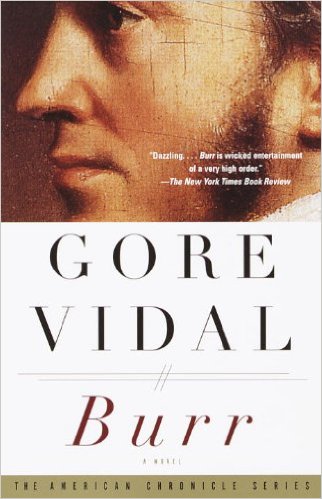
The characters of Harman and Elizabeth do play an important role in Gore Vidal’s Burr (1973) an historical novel told from the point of view of the young Charles Schuyler (a fictional character and no relation to the Schuylers in the musical Hamilton) and the book is one part of a collection of American histories the author wrote and named Narratives of Empire.

Never read Vidal before, have to admit, I know him as a talking head in The Celluloid Closet, commenting on his own work as one of numerous writers for the screenplay for Ben-Hur (1959) starring Charleton Heston. Vidal's personality as an arch literary satirist of the twentieth century has largely come to me via osmosis. My father's shelves, which we are currently culling, include several of his works. I am under the impression that any man of my father’s generation with a standard liberal arts education would be wanting without them, though my father was better read than most. Certainly better than I.

The book has taken months for me to read, not because it is not compelling -- it is -- and a satisfying read. My days have been so long, my responsibilities continuous and varied, and though I would pick it up most nights I would only make it through three or so pages before being overwhelmed. I even tried reading a few pages that long, dark night of November 8, when my thirteen year-old daughter was so crestfallen over the election that she could not rest and we compelled her to sleep with us.

True, this novel's content pertains to history, American history, but removed as it was from current events it provided a mild distraction.

The girl with Nik Walker (Aaron Burr on tour in "Hamilton")
Cleveland, Playhouse Square (2018)
In fact, it is because of current events that the novel itself comes as something of a comfort. Vidal is a member of a bygone era, Vulture called him a “dapper, left-wing bomb thrower” -- not a literal bomb-thrower, but that kind of old-school gadfly who could verbally cut you to the quick and leave you incoherently enraged. But first you have to a) be listening and b) understand that you have been insulted. Today’s right-wing demagogues owe their present success by simply refusing to do either.

Burr, the novel, provides the author the advantage of furnishing savage commentary upon icons of American history from a vantage point twice removed, from either his main subject, once Senator, then Vice President, but always “Colonel” Aaron Burr, or from his narrator, Mister Schuyler, a young man who in the course of just a few years rises from a desperate, penniless, inexperienced newspaper writer to a comfortable position in the the Van Buren administration.

Schuyler’s commission is to write a memoir of the ageing Burr (now eighty, some got half as many) and over their time together not only develops great admiration for the Colonel, but also absorbs his worldview, restrained temperament and even to some degree his remarkably subtle wit.

It is this wit, however, in recounting Burr’s version of the American Revolution and all that came after, that provides the subject, and in fact the author, to portray George Washington as a colossal failure on the battlefield, exhibiting terrible judgement (and apparent fantastically large buttocks) winning only one battle -- Yorktown -- and not without foreign assistance.

Later it is Jefferson, not Burr, who appears to hold no moral center, shifting any position necessary to keep the nation a loose confederation of states, denying strong federal power and yet as President freely violating or proposing to violate any of new bill of rights to maintain the status quo (i.e.: slavery) or to destroy his perceived enemies (i.e.: Aaron Burr.)

Tony Fabio as Aaron Burr in "Eden on the River" (1989)
The legendarily soft-spoken Jefferson, always clearly articulating his position, is rendered a slippery cipher, always scheming, fiddling with his inventions, and in constant opposition to Burr, who, by his own description of events, made the appropriate decisions necessary for Jefferson to become President. For the sake of the nation.

Of course, this is Burr speaking. And he speaks to an impressionable man who develops such admiration for him, delighted by his “exquisite irony” and “serene good humor.” It takes a moment to realize that the true object of such compliments is Vidal himself.

And this is comforting how? Donald Trump has made a mockery of American history with his arrogant run for President. Assuming he would never win, he was also more successful as a sloppy, right-wing bomb thrower, capitalizing on resentment, anger and outright racism to propel himself to be the loudest and most visible opponent to Barack Obama. His goal was self-aggrandizement, but unfortunately for him and the rest of us, he now needs to lead, something he has never been successful at doing.

It is demoralizing to imagine we are ending an era in which a young Puerto Rican-American with a Broadway musical under his belt could be granted an audience with the President of the United States to rap a song about the largely unregarded first Secretary of the Treasury which caused a YouTube sensation which inspired him and a company of talented artists to create a new musical which sparked a national conversation on what it means to be American, to be America.

Donald J. Trump does not inspire confidence, he can’t make anything great, and the only artwork he has ever inspired in my neighborhood was a great, hideous nude statue someone dumped on Coventry last summer.

Vidal wrote Burr in the era of Nixon, his novel reeking of cynicism, every player a player, twisting words and circumstance to his own advantage. His America of the early 19th century is a murky backwater where the rich stuff their faces and drink and smoke and spit and talk and talk and talk.

"The Emperor Has No Balls"
Ginger (2016)
He chooses a protagonist in Aaron Burr, worshipped by the common people, heralded wherever he goes, once he has been exiled by proper society for the murder of Alexander Hamilton.* In tearing down icons and exalting this scoundrel, Vidal makes you reconsider all you believe you know about the Founding Fathers. Good Lord, the man even suggests Davy Crockett was raped first before being killed at the Alamo.

So, the United States of America has elected to be its Chief Executive a scoundrel, a self-serving villain who will do what he can to subvert the Constitution to maintain the status quo and destroy his enemies, again. We got this far, citizens. The Republic will prevail.

Exactly how we will overcome, that is a terrible mystery and one which we carry into the new year. It has been suggested that Vidal’s type of scorched earth criticism of those with whom he disagrees has brought us to our current level of discourse. For when your facts are correct, but you are arrogant about it, why would your opponent even respond with an intellectually supported response? Why not just say,”Fuck you, you’re wrong.” and listen to the multitudes cheer? It certainly worked in 2016.

*About that; Lin-Manuel Miranda’s Hamilton taunts Burr to mention a “specific grievance” from over “thirty years of disagreements” for which he should apologize, there was one specific, heinous, personal insinuation made by Hamilton in mixed company and behind Burr's back, an insinuation which had absolutely nothing to do with Burr’s political or professional machinations, which might lead one, were they so inclined, to challenge one to a duel.

 This post has been updated to include a photo from 2018.

Sunday, November 13, 2016

Saturday Night Live (TV show)

I’m not giving up and neither should you.
Guerrilla Theater Company opened You Have The Right To Remain Silent on October 23, 1992, with performances every single Friday and Saturday night beginning at 11:00 PM until closing for a summer hiatus the following May.

We had received good advice from friends operating a different late night theater production in Chicago. They said for the first two years, they most performed to a small number of dedicated family and friends.

It was our mission to write new work for every weekend (seven new out of twenty-one short plays, every week) and to never cancel a performance. We canceled one, during a blizzard. No one showed up for that one regardless, and I am glad to say it was the only performance where no one did.

My partner Torque had a dream, which was that when something important happened, in Cleveland, or in the world, people would want to know what the Guerrillas had to say about it. That our satiric take on events would be important.

After all, pre-internet, up-to-the-moment political satire was relegated to the television, and the television didn’t traffic in political satire. Johnny Carson and Arsenio Hall were your only nighttime talk show hosts, and they kept it light.

There were no network hosts willing to take strong political positions like Stephen Colbert, Jimmy Kimmel or Seth Meyers, no Daily Show, Full Frontal or Last Week Tonight. The only program that might comment on current events would be Saturday Night Live.

Three weeks before we opened, on October 3,1992 the network allowed host Tim Robbins to shame General Electric in his opening monologue -- but then were caught flat-footed when musical guest SinĆ©ad O’Connor surprised everyone by tearing up a photograph of John Paull II. It was rare moment of protest on a program that had famously avoided that kind of controversy.

The fact is, we didn’t really watch the show anymore. Core company members Rob Schneider, Chris Farley and Julia Sweeney were not exactly daring in their performances, Kevin Nealon one of the most toothless Weekend Update hosts, and Dana Carvey departed shortly after George H. W. Bush left office.

There have only been a couple times in recent memory when tuning in to (or most recently, checking the YouTube page for) Saturday Night Live was something absolutely everyone wanted to do, to see what their their take was going on.

The first was eight years ago, when Tina Fey’s iconic impersonation of Sarah Palin so defined Palin’s character that ever since it has seemed like Palin has only been impersonating Tina Fey.

Most recently, it has been the Clinton/Trump debates. Kate McKinnon has impersonated Hillary Clinton during the entire 2016 campaign season, but it was Alec Baldwin’s scabrous take on Donald J. Trump that caused a sensation.

There are those who have criticized these debate sketches for “normalizing” the person of Donald J. Trump, which is ridiculous. You don’t blame the fool. Only the Republican Party can be blamed for nominating and promoting an outspoken, xenophobic misogynist who never condemned the endorsement of the Ku Klux Klan and embraced the support of the Russian government for normalizing Donald J. Trump.

And their gamble won. By standing idly by while American integrity was compromised and American dignity was decimated, the Republican Party has near absolute power of the government. Lines that few had dared cross before certainly have been, and we can only imagine what happens next.

But Hillary Clinton is (fill in the blank.) Okay, whatever. She lost* and between she and President Obama reminded the American people what it means to step away with dignity, with whatever dignity it is we as a nation have left.

I was sure that few who have enjoyed watching SNL during the past few weeks were looking forward to last night’s program. I mean, do we ever want to see Baldwin’s Trump ever again? What could possibly be funny on November 12, 2016?

Well. As my father always reminded me, when you aim at a king you must kill him. And the folks at SNL created a cold open to conclude this traumatic election season with class, style, pathos, breathtaking timeliness and most of all talent.


Who knew Kate McKinnon could sing and play the piano like that?

Leonard Cohen died the day before election day, on November 7 and for better or for worse, his Hallelujah is his best known and most covered song. But is because of our familiarity with that song, as performed by McKinnon’s Hillary Clinton, that makes this tired paean once again mournfully triumphant.

*The Electoral College. Hillary Clinton won the popular vote by a sizable margin.

Monday, July 18, 2016

2016 Republican National Convention (Sunday)

"Life Is Sharing The Same Park Bench" (1969)
Six years ago I spent a lot of time at the library reading newspapers from 1936, which was the last time Cleveland hosted a national political convention. Technically, it hosted three the same year, for the Republicans, the Socialists, and also Father Coughlin’s National Union for Social Justice.

Now, it wouldn’t matter whether the Republicans or Democrats chose to have their convention here this year, I did not anticipate getting involved. Not that I am not political. Of course, I am. But I am not a delegate, and political tourism is not my thing.

In fact, as it became more evident that Donald J. Trump would be their nominee, Cleveland’s moment in the sun began to look harsh and bleak. The kind of people who support Trump are angry people, and wilfully ignorant people. They admire him for the way he talks, which doesn’t make any sense because what he says is dull, obvious, arrogant, steeped in unearned entitlement and a braggadocchio that can only be appreciated by one who feels eternally at odds with perceived enemies.

There were rumors of hate groups from across the country, descending on Public Square, and legions of officers, and anarchists to oppose them. Downtown would be an unwelcoming police state. As the security fences began to go up, to keep all but those authorized from the convention venues, this possibility was appearing more evident.

Offices downtown declared they would be closed for the week, mine one of them. I would work at home and avoid this spectacle, which was a pity because the summer had started with such strength and hope. It seemed a shame to miss out on this historic moment, even if it was shadowed by an angry, orange cloud.

Can you imagine? In 1936 baseball games were happening in that great, new stadium on the lake (and yes, also League Park) adjacent to the Great Lakes Exposition, through which thousands of tourists passed daily, and the Republicans were able to accomplish their business in the Public Hall, which was within walking distance, and still take in, for example, the Marx Brothers performing live in a stand at the Palace Theatre. Everything! Downtown!

Sisters with different parents.
Yes, yes. I know. The good old days. What a simpler time.

As it has turned out, however, we have not stayed home. We have not even stayed on the east side. Since just before the convention began, we have been out, in the city, and all because these things are happening in our midst.

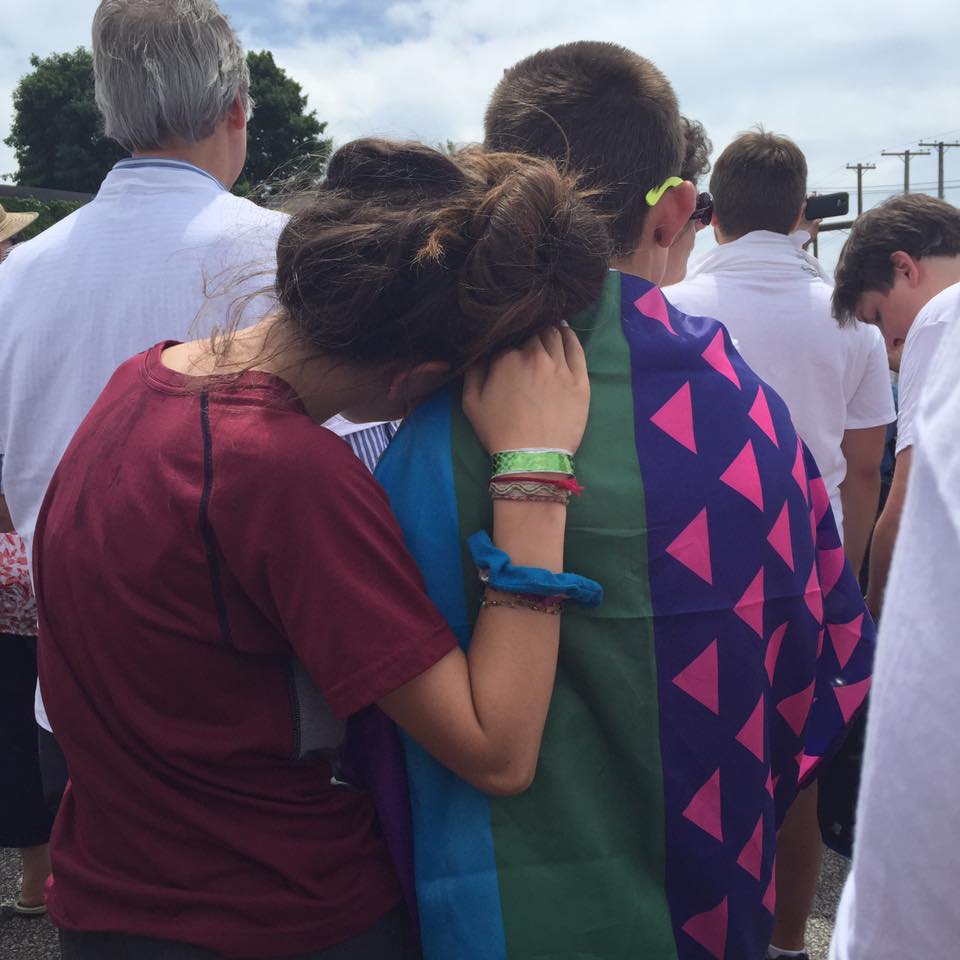
Sunday morning the entire family headed to the Near West Side to join thousands of others for a demonstration of peace and hope, called Circle The City With Love. Put simply, we were to span the Lorain-Carnegie Bridge, hold hands and be silent for thirty minutes. And we did. The moment was not without drama, as it was over eighty degrees and a few members passed out or nearly did so. But it was a surprisingly effective event and left me feeling a bit more optimistic.

Everyone who participated was invited to a free concert starring The Roots at the Wolstein Center. We didn’t know who the sponsoring producer was, it turns out to have been the AIDS Health Foundation and Keep the Promise USA to raise awareness and funds to combat HIV/AIDS around the world.

Keynote speaker was Dr. Cornel West, which was a major attraction for the wife. Early in the proceedings, however, I saw Brother Cornel and his associates fill out a row near the rear to enjoy the powerful gospel performance of Mary Mary. He was accompanied by a gaunt woman with a severe, silver cut.

Yes. It was Dr. Jill Stein, Green Party candidate for president. I was worried we had been punk’d into attending a Stein rally, but the AHF is a real thing, and though the good doctor introduced her, he didn’t say anything about her other than she is a candidate, and she said nothing at all. Anything perceived as campaigning would have violated FEC rules.

There were numerous acts, including B.O.B and Raheem DeVaughn, Teyana Taylor, and Questlove and The Roots played for about an hour. They were truly spectacular, a powerful, energetic musical ensemble. Their singer (I can’t find his name, not the lead rapper, he was like a special guest and I can’t find him online) sang a beautiful rendition of John Lennon’s Mother which was truly moving. It’s a powerful song, but I have never heard it performed by someone with a beautiful, clear singing voice. And in light of recent events, it was chilling.

I was surprised by my children. It was a long day, but they were awed by the event on the bridge, and thrilled by the long afternoon's concerts and speeches. It was quite an overwhelming day. Walking back to our car, down Prospect and through Playhouse Square with my family in tow, we could see black liveries with tinted windows veering down the streets, and there was a definite stillness in the air, a Sunday evening calm perhaps, or a calm before the storm?

Regardless, we were ready.

To be continued.