
Showing posts with label Sherlock Holmes Meets the Bully of Baker Street. Show all posts

Sunday, December 12, 2021

Ten Most Visited Posts from 2021

Since beginning this blog in 2010, I have used it as a repositority for research, to report on works-in-progress, to flog productions and publications, promote the work of others, file book reports, to keep track of my progress pursuing my MFA, and to opine about matters pertaining to the world of theater.

Some posts go viral, most do not. I have a dedicated following of about two dozen folks (hello.) Every now and then something catches everyody's attention, and that's nice.

For some odd reason, the most popular posts of the year were written in the past couple months. You'd think I would have accumulated more views for stuff from the beginning of the year. I think I have had a lot to say this season. Might have something to do with going the fuck outside. 

Here now, my most visited posts from the year 2021.
10. On Execution
You move just a finger,
Say the slightest word,
Something’s bound to linger.
Be heard.
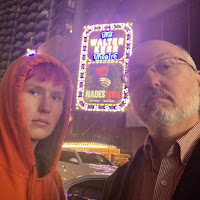
9. “Hadestown” at the Walter Kerr Theatre

Having the opportunity to take my sixteen year-old to New York to attend a Broadway show was a highlight of the year. My own excitement to be back in the city was leavened by how much I learned about him during our brief stay.

Brian Pedaci
"Savory Taṇhā"
8. On Clichés

When does it become all right not to tell the entire fable, but just to reference it? You know what story I’m talking about. It’s in your nature.

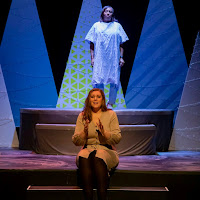
7. “Savory Taṇhā” at Cleveland Public Theatre

As the shutdown lifted (for better or for worse) and live, in-performance resumed, I realized I was not as overwhelmed by the experience of re-engaging in theatrical performance as so many others, and much of this is due to the opportunity afforded my by Cleveland Public Theatre, presenting Savory Taṇhā live via Zoom, first as a weekend of workshops in summer 2020, and then as a full three-week run early this year.
Sylka Edmondson
Katie Wells
"10 Minutes to Midnight"
6. 10 Minutes to Midnight: 9 Quirky Plays for the Holidays

This is still playing and you should see it!

5. 2021 Shubert Fendrich Memorial Playwriting Award

This was a delightful surprise, receiving this award, and since the announcement, Sherlock Holmes Meets the Bully of Baker Street has been licensed for production in schools in the United States and Canada.

4. On Trigger Warnings

Things have changed. Things have absolutely changed, and the world is divided into those who have the agency to say we must do things differently and those who say no, I want to do things the same way we always have. I find that those who oppose content warnings do not present compelling arguments for why they shouldn’t exist. 
3. Juke Box Hero

Part of my rock and roll fantasy (I mean – it’s all part of my rock and roll fantasy) has been to be able to play drums successfully with a band, and one night this fall I had my shot and I took it.

2. The “I Hate This” Series

When our video recording of I Hate This (performed by James Rankin) is released some time in the new year it will have been worth the wait. Several posts documenting the process of creating this work would individually take several places on this list, so in the interest of variety I added them up to represent one single entry. I am grateful this story has attracted so much attention.

James Alexander Rankin
"I Hate This"
Photo by Cody York
1. Philip Johnson (Revisited)

Upon the announcement that the Cleveland Clinic plans to bulldoze the edifice which former housed the Cleveland Play House (which should have come as a surprise to absolutely no one) there were a few days of outrage express not only by those who have strong memories of their time in the space, but also many who have no personal interest in Cleveland theater history but felt it necessary to malign the Clinic on principle.

Many argued that the space should be kept and maintained as an arts facility (though none would volunteer to shepherd such a project) and were unimpressed when I suggested that if the largest performing arts organization in the region found the place financially untenable, Lord knows some coalition of small arts organizations would also.

Monday, June 14, 2021

2021 Shubert Fendrich Memorial Playwriting Award

The big news I was planing to announce today was that Sherlock Holmes Meets the Bully of Baker Street is being published by Pioneer Drama Service (PDS). And that is still big news! PDS is a purveyor of plays for child, youth and family audiences, and a publisher which is widely familiar to schools, churches and recreation centers across the nation.

Having one of my plays tapped for publication by PDS is really wonderful. For over ten years I have been writing educational outreach plays and plays for child and family audiences. The opportunity to share my writing with local audiences has been a delight, and to provide positive messages of collaboration and empathy. Now that this script is part of the PDS catalogue, it will reach a much wider audience. 

What I entirely did not expect was learning that Sherlock Holmes Meets the Bully of Baker Street has received the 2021 Shubert Fendrich Memorial Playwriting Award! For decades PDS has awarded one play submission this honor per year. It is only awarded to a playwright they do not yet represent.

Full disclosure: When I had submitted the work for publication, I was ignorant of this contest! I knew they were about to announce new releases, including Bully of Baker Street, but this was a complete surprise. On Friday, FedEx delivered the announcement, a check, and a handsome, shiny plaque.

This recognition and support from Pioneer Drama Service is a tremendous validation of my work as a playwright, particularly a writer of plays for young audiences, and it is deeply appreciated.

Thursday, December 17, 2020

Ten Recommended Posts from 2020

Joshua McElroy, Khaki Hermann
"Sherlock Holmes Meets the Bully of Baker Street"
(Great Lakes Theater, 2020)
Ten years on, what is this blog? It is a journal. It is a promotional tool. It is self-aggrandizing but also keeps me honest. It is a record of my progress as a playwright. And it is also an opportunity to research and record past events and tie them to the current moment.

These ten blog posts from 2020 may not have attracted as much attention, But hey, I took the time to research and write them and I recommend another look because they're pretty good.

On Procrastination

Accepting the opportunity to moderate a playwright’s panel at CPT while you are fresh in grief and trying to comprehend your mother’s eulogy is just another thing that has to get done.

The Bully of Baker Street: Week Three

Reflections on a tour in progress, and how gratifying it is to learn that adults find your educational play for elementary school children progressive and a challenge to their political beliefs.

The Short Play Project: Humiliation Series

There are about a dozen short play “collection” blog posts, but this one is my favorite. Three short play videos that beg the question: AITA?

"Residency On Demand"
(Great Lakes Theater, 2020)
Documenting Cleveland, Tuesday, May 12, 2020


We all think of ourselves as Samuel Pepys, diarists of extraordinary times. But the records of the Pandemic of 2020-21(?) are so grossly extensive. What have you, on May 12, Literary Cleveland in conjunction with Scene Magazine produced an exhaustive document of the city from one end to the other, and I was glad to be a participant.

Our Midwest Journey (1995)

Our first road trip was a test of our relationship, and in a way defined our future together. A rumination on our mutual love of the highway, tourist traps, and funky theater. 

Savory Taṇhā in Performance (Thursday)

Thoughts on opening night of a live, Zoom theater event, as part of a nationwide discussion on not merely the value, but the very validity of virtual theater.

The Mirror and the Light (book)

The third part of Hilary Mantel’s “Thomas Cromwell” trilogy was surprisingly affecting, and so politically timely. Back then when you fell out of favor, the monarch had you literally killed.

Our Midwest Journey (1995)
My First Fringe Festival


I had always wanted to dive into my first fringe festival (as audience member) experience, as it so deeply informed my next decade. I was amazed to find as much source material online as I did.

Three Hundred Sixty-Five Days of Practice

Would you like to see exactly what it looks like to write three pages every morning for an entire see?

Dobama ‘96 Trading Cards

I have always loved and been fascinated by package design and marketing. But this is the story of a gig that almost destroyed me.

Tuesday, December 15, 2020

Ten Most Visited Posts from 2020

David
I blog about lots of things. And this blog is almost eleven years old. I like to keep track of what people who follow the blog like to read, and how people find the site who have never visited it before.

I have hidden certain posts for the time being, those which aren’t very interesting and yet seem to drive traffic to the site. The one on Chef Boyardee, for example, receives hundred of clocks a year. And the death of Eliot Ness. If that’s why you came here, you might never return.

This is a list of the most popular posts written in the year 2020.

10. On Revision

Final notes before first rehearsal for a new play script. Revision is good!

9. Culver City Public Theatre present “Sherlock Holmes Meets the Bully of Baker Street”

A fascinating, pandemic-era return to a script originally written and performed for live audiences of thousands in schools and libraries, now packaged for safely viewing at a distance.

8. Assessment 

From time to time I have provided a self-assessment, where I am in my work. What has been happening in general. How is my mental and physical health. These often drop when I have been away from the blog for a bit.

Zelda
At this point I was taking a vacation, and reflecting on three hundred days of consecutive writing (I am currently on Day 465) and what had transpired since then, the death of my mother, the pandemic, and even good things, like a show I had written that was about to virtually “open.”

7. Play a Day: John Proctor is the Villain

Each April I read one full-length play from those posted at New Play Exchange. This was one of my favorites, written by Kimberly Belflower, and has been receiving a great deal of deserved attention. The title of this play was actually the inspiration for my most recent full-length; the working title was “John Bender is the Villain,” but I have since changed that. 

It's now titled "Goatfucker".  

6. Fosse, Verdon and all that jazz. 

The recent passing of producer and choreographer Ann Reinking brought me back to this one, an examination of how to break down the “great man” theory of history.

5. Ben Is Dead (magazine)

A nostalgic look at an artifact about nostalgia. Many thanks to the folks at BID for pushing this one up the charts.

4. “Love’s” in the time of COVID-19

A document of the last live, public performance of a play I saw in a theater, the night of Friday, March 13. This melancholy celebration was only appropriate.  

Virginia
3. Enola Holmes (film)

This one gained traction no doubt because the film had just dropped and folks were interested in that. But it generated a great conversation about adaptation, woman-centered narrative, and modern themes presented in period drama.

2. My mother’s hands.

A brief reflection, written the morning after my mother died.

1. A few bits of wisdom.

A letter from my grandfather to my college-aged mother, posted a few hours before my mother died. It is only just that this was the most visited and shared post of the year. It’s a good letter.

Sunday, December 13, 2020

Ten Theater Projects in 2020

"High (short play)"
(Center for Arts Inspired Learning)
2020: The Big Cancel.

Last week WaPo theater critic Peter Marks made the argument for a cabinet level position for the arts, a Secretary of Arts and Culture, if you will. And were not living in a nation which has always been and remains a reactionary, Puritanical society I might hold out hope for such a move, a champion for the millions of arts workers and the hundreds billions of dollars a year that are tied up in the arts.

As things stand, the performing arts are either on hold or online. Even with a vaccine on the horizon, current estimates suggest it will be another year before we are safely congregating in large numbers.

Like so many writers, I had projects in development which were canceled, or postponed. But I was also one of the fortunate creators whose work either went online, turned into something else, or whole new works were developed as a result of the pandemic.

In chronological order:

"The Witches"
Jailyn Sherell Harris, Adrionna Powell Lawrence
Sherlock Holmes Meets the Bully of Baker Street (Great Lakes Theater)

We began rehearsals for this year’s outreach touring play a few days after my mother died. Three weeks of rehearsal and fifty performances later, the show closed on March 8. At the end of that week, the office downtown was closed, and it remains so to this day. 

The Witches (Cleveland Public Theatre) 

We had our first read-through of this new play script in late February. It was to be workshopped at Cleveland Public Theatre over one weekend in April. We had to replace one of our actors, and had a single rehearsal with the new team on Tuesday, March 10. 

A couple months later I returned to that space, mask on, disinfectant at the ready, to use for an entirely different project, and the rehearsal table was still there, with additional copies of the rehearsal calendar lying around, one of the actors had left their script. It was all just waiting there for an acting company that never returned, a project abruptly abandoned.

"50 Hamlets"
Chennelle Bryant-Harris
(Great Lakes Theater)
The Short Play Project


What began as a feverish writing project took on a life of its own after the shutdown began, as I put out a call for folks to use my two-to-three page scripts and make short videos out of them, staying within CDC distance guidelines. And they did, over seventy individual, short films, created by artists from all over the county (and even overseas) with imagination and heart. Watch them all here.

50 Hamlets (Great Lakes Theater)

As we were striving to continue offering educational programming to the schools which have come to depend upon it, we were also learning ways we could take advantage of the opportunities presented through modern technology to bridge time and space. Arts educators who have proudly called themselves “actor-teachers” reaching back forty years collaborated to create this unique artifact from the beginning of the shutdown.

The Famous Victories of Henry the Fifth (Brave Spirits Theatre)

As we were all learning how best to navigate Zoom recordings, I accepted a role in this live performance produced by Brave Spirits Theatre in Staunton, VA. They had plans to stage a slate of history plays, pre-Shakespearean works, many of which the Bard used as template for his own, more famous plays. They moved production online, and I learned an awful lot about the limitations of the medium, and also its tricks. Brave Spirits announced their dissolution on November 21, another financial casualty of the pandemic.

"Savory Taṇhā"
Hillary Wheelock, Zyrece Montgomery
(Cleveland Public Theatre)
The Way I Danced With You (Culver City Public Theatre)


As we were all learning how best to navigate Zoom recordings, my friends at Culver City Public Theatre were presenting bi-weekly new play readings through the summer, and this romantic two-hander was part of that line-up. 

Savory Taṇhā (Cleveland Public Theatre)

What began as a feverish writing project took on a life of its own when I was asked to curate a selection of short plays to be produced live via Zoom. We were all trying to figure out how best to share the experience of live theater utilizing available technology

Sherlock Holmes Meets the Bully of Baker Street (Culver City Public Theatre)

Plans were made for the folks in Culver City to present another one of my works as their annual, free summer offering for families. Instead, they created a lovely, recorded adaptation of the play which started my year.

"Sherlock Holmes Meets the Bully of Baker Street"
Richard R. Rosales
(Culver City Public Theatre)
Residency On Demand (Great Lakes Theater)


Like many arts organizations we have been trying to figure out how to reach our students. They are either still working from home, or those schools that are open are not permitting visitors. We rethought our lesson plans and created a makeshift TV studio in our rehearsal space, and have started piloting live classes. I can’t tell you how good it feels to get back into schools, even at a distance.

Untitled Pandemic Play Script (NEOMFA)

All of my doubts and anxieties have been distilled into a play script for two women actors and one set. The comment I am perhaps most grateful for from the workshop reading was, “I am surprised I get into this play so much.” Now it just needs a proper title. I mean, it has one. But I think I have to change it.

Thinking about calling it “Goatfucker.” What do you think?

Source: The culture is ailing. It’s time for a Dr. Fauci for the arts by Peter Marks, Washington Post (12/2/2020)

Saturday, September 26, 2020

Process II

This is my one hundredth post for 2020.

I have not written a short story in a long time. I wrote a brief piece for a local magazine about ten years ago that I was happy with. I tried my hand at writing articles for Cleveland Magazine in the mid-aughts but they weren’t very good. 

They were fine.

For my “dark fiction” class I need to turn in a short story in a couple weeks, one which includes elements ranging from the gothic and grotesque to the horrific and weird. Neither my writing fiction nor engaging in negative storytelling do I consider strong suits; hence, I took the class.

Creating and comprehending the plot of a mystery, specifically Sherlock Holmes Meets the Bully of Baker Street, inspired me to plot out the plot visually in a manner I had not attempted before. I created a chaotic flow chart, where I could drop things I knew must happen, in the order they must happen, at various points on a large, blank page, correcting them with arrows. The spaces in between were then filled with songs, puzzles, and other elements which I hoped to include and gave me a visual sense of pacing.

As a result, I could write the play in pieces-parts, without worrying about the order -- I could organize them according to the graphic later -- and concluded with a first draft that was coherent and largely complete. This was something which would have been useful crafting my previous mysteries, espcially those which had been adapted from pre-existing works. 

The story I am working on for my fiction class is one I have been thinking of for twenty-five years. Seriously, I have had this tale rolling around in my head for decades, but have never written it. Because I never had the time or inclination to -- I did not know where it fit in my writing life. Now I do, and I cannot express how exciting that is.

Because it is an assignment. I have to do this, not for me, but for a class! Which is a much better reason for me to get it done.

Thursday, September 10, 2020

Culver City Public Theatre presents "Sherlock Holmes Meets the Bully of Baker Street"

Brian Knoebel as
Alma Tadema-Lawrence
(CCPT, 2020)
Last night was a treat. Chennelle and Chelsea joined us for some late summer, socially-distanced deck time so we could watch the premiere of the Culver City Public Theatre (CCPT) production of Sherlock Holmes Meets the Bully of Baker Street.

This is the second production of that script. The folks at CCPT, who produced Rosalynde & the Falcon last year, were intending to offer performances of About a Ghoul to their audiences as their annual, free, outdoor summer show for families. Things being how they are, they thought a mystery might be better suited to the medium.

At first they considered a live “Zoom” performance, opting instead for something pre-recorded, with surprising results!

California is three hours behind us, so I made the mistake of thinking last night’s 6:00 PM showing would be during one of my classes. When I finally put it together that it would be, in fact, at nine (eastern) … well, then I thought I might see it. I might not. I haven’t been sleeping well. I might wait and see it this weekend.

Richard Rosales (left) in
"Rosalynde & the Falcon"
(CCPT, 2019)
I told all of this to Chennelle late in the afternoon and she invited herself over -- which was just all right with me! We rarely see each other (we all rarely see anyone anymore, of course) and besides, she originated the main character of Vicky for the inaugural production for Great Lakes Theater.

I don’t just mean she was the first to perform the role, either. I wrote it for her. I was so happy to get to watch this with her.

We all sat out on the deck, beneath the fairy lights, six feet apart, drinking seltzer in the open air, on an appropriately cool September evening, and were treated to an engagingly loopy COVID-era production.

Richard Rosales is the titular detective. He played the King in CCPT’s Rosalynde in the park, and brought his high haughty humor to the character of Sherlock Holmes as well, while Ashley J. Woods as Vicky is like a Covent Garden flower seller channeled by Catherine Tate’s schoolgirl Lauren Cooper, and they make a charming pair of sleuths.

King Edward busts a move.
Scene-stealers include Brian Knoebel who was killing it with his drag renditions of Miss Barnaby and boho artiste Alma Tadema-Lawrence (he left us cackling with glee) and the precious young Maggie McKissick as Annie, the orphan, in an actual curly red wig and moppet’s dress.

Director Marina Curtis Tidwell did not merely direct a play, she produced a TV show, complete with music and Pythonesque animations. Marina truly did a remarkable job keeping the edits tight and timely.

Each actor created their own scenes in their own homes, provided costumes, backdrops and set pieces by the company to give a coherent look. The production would not look out of place on your local PBS station, a playful mystery for kids with some historic educational value and a strong anti-bullying message. 

First Reading
(August 25, 2019)

They were even able to incorporate the “choices” that are intended to be offered to a live, child audience -- “should I do A or B?” In this case, the actor looks at the camera to consult the viewer (a Blue’s Clues moment) though in this case the outcome is predetermined.

It is shocking to me, shocking, that it was one a year ago that a number of us clustered together on our deck to hold the first reading of this script. Chelsea and Chennelle were there, too -- Chelsea reading Vicky and Chennelle the Barney track. If we knew then what we know now, right? It is a mystery.

Last night I slept like a baby.

Saturday, February 29, 2020

The Bully of Baker Street: Coloring Sheet!


Designed by Luke Brett, this original coloring sheet has been provided to school aged kids across town, and we have received some wonderful works of art in return!

If there are any adult coloring aficionados out there who would like to take their shot with this image of “Vicky & Sherlock,” I would love to see the results.

Tuesday, February 25, 2020

The Bully of Baker Street: Week Three

Newton D. Baker Elementary
In the past three weeks, Classics On Tour has already staged twenty-nine performances of Sherlock Holmes Meets the Bully of Baker Street! They have nineteen more (and one workshop) to go!

In addition to the many schools the Sherlock Holmes Meets the Bully of Baker Street tour is visiting, we are also taking the show to fifteen libraries and other public venues.

At a few public libraries, the audience has been almost entirely made up of adults, fans of the great detective in all of his permutations. The big people are no less enthusiastic about responding to the questions the characters ask them during the performance and seem to understand they are attending a show meant for children.

Post-show discussions run in different directions with these audiences, as adults have questions not only about the show, but about the purpose of the show. About the theme of bullying, and how our student audiences have responded.

Pioneer Drama Service
(Published 2021)
On our post-show evaluation, audience members are invited to share their thoughts about what they most liked about the show, and also what they liked the least. One woman, a senior citizen, wrote, “Too preachy!” And I suppose it is. You could say it’s meant to be.

During the post-show discussion, one audience member in Lakewood, after first making clear that she was very happy to see a diverse cast, wanted to know how intentional the casting was. A generation ago it would have been the politically correct thing to just say the casting was “color-blind” and wasn’t intentional at all. 

But that isn’t true, and our acting company addressed that with their response. Because the play is, in fact, a little preachy, and because we knew we would be sending the play into schools with a predominantly African-American student body, the picture of who is doing to lecturing and who is being lectured to -- and also who is doing the bullying -- these were all issues we wanted to take into account when creating the company.

Chagrin Falls Intermediate School

One comment that has confused me was the person who wrote on their evaluation “No Politics!!” I’d like to know what they meant. There is nothing overtly political in my script. Is Vicky being called a “nasty girl” a political statement? Is Vicky’s pride in becoming an American immigrant a political statement?

If these expressions are thought to be political, whose fault is that?

To be continued.

Monday, February 10, 2020

The Bully of Baker Street: Week One

Oliver Hazard Perry Elementary
The tour has been on the road for one week. Today the acting company had an entire day off, and like true Millennials they spent it working double shifts at their designated restaurants and ride sharing.

In the past week they had three public performances and six schools. This week they will have three public performances and eight schools. It’s a big job, load-in and putting up the set, performing the show, tearing it down and heading to a second site to do it all again. They are professionals, and they’re each doing such excellent work.

Response has been very positive. We provide evaluations to teachers at school and each of our adult audience members at public venues.

In response to the question, what did you like most about the production, many teachers responded along these lines:
  • The way the characters connected with the students during the Q & A following the play.
  • The interactive aspect of the play and the period costumes and sets.
  • The message and the way it was delivered through theater!
Talespinner Children's Theatre
Photo by Liz Steward
And the message is getting through. Following the post-show discussion led by the acting company at our first performance at a Cleveland Metropolitan School, the Curriculum Instruction Specialist took a moment to address the students. She asked specific questions about the choices the characters in the play made, which communicated to me how closely she had followed the story.

She summed up by reminding the students, “It’s nice to be important, but it’s more important to be nice.”

When asked what they liked least about the production, I did hear this comment more than once:
  • May have been a bit over the head of some of our K and 1st
I admit, this may be true. However, when the student audience includes higher grades, the response from the older kids appears to clue the younger ones in on developments they might otherwise miss.

Pioneer Drama Service
(Published 2021)
Most remarkable was the teacher who reported that they took materials found in the teacher resource guide -- the Arthur Conan Doyle biography, the “biography” of Sherlock Holmes, and my own playwright’s notes about my youthful experiences with the detective -- to create her own “Cliff’s Notes” chronology tracing the artistic synthesis from the Victorian era to that day’s performance of our production.

She made this for third graders! I want to get a copy of that. Public reaction has also been very good, with audience members praising the, “excellent actors,” and the period costumes and music. They like the “audience interaction” and “the ‘choose your own adventure’ aspect” of the play script.

Also, kids are surprised to learn that the woman playing Miss Barnaby is also the artist lady!

My favorite comment so far was from the guy at the Heights Library whose favorite part was Vicky “calling out Sherlock on his BS.”

To be continued.

Tuesday, February 4, 2020

The Bully of Baker Street: Costume Design

Design by Zack Hickle
One month ago, a week prior to the first rehearsal of Sherlock Holmes Meets the Bully of Baker Street, I wrote a post about revision. One of the major, last-minute changes to the script involved changing Miss Barnaby from a glowering headmistress, someone along the line of Mathilda’s Miss Trunchbull, into the young Miss Barnaby, left the run the orphanage while the headmaster is off “on holiday.”

Still aggressive and domineering, making the main “bully” of the tale a peer of the protagonist Vicky (hopefully) makes the conflict more accessible to young audiences. But, it also meant that our costume designer, Zack Hickle, needed to come up with a quick fix.

As you can see from his original rendering (right) Miss Barnaby looks quite severe in her red work smock, and her big poofy shoulders. But it wouldn’t exactly be appropriate for a “head girl,” an underling who has been put in charge of her peers.

So Zack removed the sleeves and skirting from her jacket, still providing Miss Barnaby with a smart, blood red vest, and Khaki, the actress, has been provided with a fine red wig instead of a gray one. Her exposed, white shirtsleeves still feature the big shoulders of the original design.

Nick Chokan, Annie
& Khaki Hermann
Pictured right, Miss Barnaby menaces little Annie. Zack also designed the dress and built the puppet (voiced and operated by Nick Chokan.)

This is why I do theater. The collaborative process, the give and take. The openness of one artist to accommodate a suggested change in direction from another artist. I reimagined a character based on suggestion, a designer reimagined a design to accommodate that.

Today we open, this morning for a crowd of fifth graders in Elyria, this evening for a public audience comprised, I imagine, largely of adults. There is a lot of audience interaction in this one, and I am very excited to see how the actors work with the audience!

You should join us.

To be continued.

Thursday, January 23, 2020

On Editing

We have corsets!
Revision is an act of change, or alteration. Re-writing is as or can be even more important than original writing. The version of Sherlock Holmes Meets the Bully of Baker Street I presented to the touring company was only the third draft, play scripts can go through many more revisions before production.

Editing, however, is an altogether different enterprise. Editing and revision can be synonymous. In this case, however, we are talking about cutting, excising, weeding. You can only assume how long a text might take to perform until it’s actually read, and even then you need to account for set changes, the use of music or the arrangement of song.

And then there are the words themselves. Until you hear them, hear actors perform them, you might not understand how they are received. And editing will be required to provide clarity, eliminate repetition or redundancy, drop jokes or turns of phrase than simply do not land, eliminate repetition or redundancy, and in general, to make the thing shorter.

We want, we need a fifty minute show. That’s what we’re selling, and schools need to account for the actual duration of the performance. To that end we have already struck out entire verses from almost each of the five songs. Not that the songs are terribly long, each first lasted a little over two minutes. Now they run between a minute and ninety seconds.

221B Baker Street
Does this bother me? Not at all. Yes, the verses are delightful and fun to hear. But we’re telling a story and each song is a means to an end, they are not the thing itself.

And then there’s the text. At the end of every rehearsal we ditch a few lines, or entire exchanges. And I say yes, thank you, to each and every one.

Lines you won’t hear in performance:
VICKY: … you will have to excuse me if I am skeptical about your … reformation.
SHERLOCK: Good word, “reformation.”
VICKY: Thanks.
SHERLOCK: Good for you.
VICKY: Stop it.
It’s a funny exchange, it speaks to the nature of their relationship at that moment. But a similar exchange happens again, a little bit later, and with greater significance.

At another moment we hear the description of an incident in New Jersey harbor, in which the hold of a ship was packed with asphalt, and during a sudden heat wave the cargo melted, sinking the ship. This is something which did in fact happen at the turn of the century, has happened several times in maritime history, in fact. It’s all very interesting, I guess, but who cares? The ship sank. No one died. All cargo was destroyed. Moving on.

This is why I do not like to direct my own work. I have written several tours for Great Lakes, including On the Dark Side of Twilight, The Mysterious Affair at Styles and Double Heart, and in each case judicious editing made the plays so much better than if we had proceeded with the draft provided. These productions were directed by Andrew May and Lisa Ortenzi, and in each of these cases overseen by my supervisor at the time, Daniel Hahn. They each provided vital contributions to editing the script, and so did the acting companies involved.

The Great Globe Itself (2015)
The only time I have directed an outreach tour was The Great Globe Itself, which I also wrote. And the experience reinforced my belief that I am my own worst director. Don’t get me wrong, it was a funny play. The actors, Arthur, James, and Roderick, they each did tremendous work. The designers and builders, our choreographer and our dialogue coach, and our interns who created the educational materials, it was all spot-on and well-executed.

But the script wasn’t sure what it wanted to be. I had thrown so much into the pot, arcane history about the Globe Theatre, the Great Lakes Exposition, Doctor Who, it’s like my every minute, personal artistic interest had been chucked in a blender.

It wouldn’t have taken much, it wasn’t a terribly long play. It was just that much too long, speeches should have been trimmed, gags dumped, and someone, anyone, could have asked, what are you trying to say here? It is a mistake I hope not to repeat.

To be continued.

Friday, January 17, 2020

Music Hall!

Music Director Eric Schmiedl
Music Hall is a form of entertainment which was extremely popular in England during the Victorian Era, featuring comedy performances and rousing, boisterous songs.

Subject matter for music hall songs could be thought unsuitable for “respectable” audiences, focusing on and making light, as they often did, on subjects such as poverty, crime and inappropriate social behavior.

Each of the songs that I selected for inclusion in the play script for Sherlock Holmes Meets the Bully of Baker Street were written in the late 19th and early 20th centuries, though some of the lyrics have been adapted to suit the plot of the play, and the age of its intended audience.

For example, we use the song “Oh my! How the Money Rolls In!” which uses the traditional Scottish melody for “My Bonnie Lies Over the Ocean,” which allows Miss Barnaby to describe the illegal activities committed by her young charges:
Young Annie steals fruit from the corner
Which Sylvia sells in the square
Then brings all the pennies she’s made up
I’ll give her back one as her share!

Young Darla she sneaks into houses
Takes all of the silver and plate
Her talents have grown exponentially
And the darling sweet robin’s just eight
Those are my original lyrics, suitable for an elementary school audience. The original song (titled “My God! How the Money Rolls In!”) is much more lascivious. Over the years a variety performers created increasingly obscene lyrics describing how each member of the family turns tricks; it was “The Aristocrats” of its day. For example:
My mother's a bawdy house keeper
Every night when the evening grows dim
She hangs a red light in the window
My God, how the money rolls in!

My grandma makes cheap prophylactics
She pierces the end with a pin
And grandpa does quickie abortions
My God, how the money rolls in!
"The Mystery of Edwin Drood"
(Great Lakes Theater, 2009)
Ten years ago, Great Lakes Theater produced The Mystery of Edwin Drood, a musical adaptation of Charles Dickens’s final, unfinished novel of the same name, with music, book and lyrics by Rupert Holmes (no relation) the creator of "Escape (The Piña Colada Song)".

Utilizing the fast-paced and ribald style of the music hall, Holmes was able to tell Dickens’s sordid tale of opium, prostitution and murder with humor and audience interaction. The murderer, in fact, is chosen each performance by the audience!

Now, any casual consumer of Holmesian mythos (and here I am referring to the detective, and not the composer of "Him") knows that Sherlock plays the violin. Yet as I plunged into writing the plot for the Bully of Baker Street, I knew it would be more sprightly and fun for the company to sing their stories to our proposed child audience rather than subject them to a recital. And so we return to the Music Hall.

Note: I love violin recitals. Here is a really good one.

Rehearsals began this week, and our musical director is none other than the masterful Eric Schmiedl. Eric penned the last two "Classics On Tour" productions for Great Lakes (Huck Finn and Treasure Island) in which he was also a performer, and the arranger and lead musical performer. Including period music has now become a trademark of these touring performances for children, and I didn’t see why a Sherlock Holmes mystery should be any different.

The songs include "The Artist" by A.J. Mills and B. Scott, in which a painter describes her bohemian pose, and "Broken Down" by Harry Clifton, a woeful tale of loss of status. Eric has arranged the former to be in the style of Gilbert & Sullivan, the latter as bluesy yet ironically upbeat. Each is a showcase for one of the characters, with supporting vocals provided by the rest of the company.


Source: Traditional Music Library

Sunday, January 5, 2020

On Revision

VICKY: I think “bully” is a thing that you do. It’s not a thing that you are.
Joshua McElroy as Sherlock Holmes
(Great Lakes Theater)
The first play I wrote for production was Breaking Point, a one-act adaptation of my daily comic strip for the college newspaper. The fact that I was also directing the script was an early lesson and made me hesitant to ever direct my own work ever again.

The problem is, I don’t know whether I should be a playwright who should have an eye to revising the as-yet un-produced work, or a director whose responsibility is to the text as it exists.

Breaking Point was problematic, and thank goodness it was and that I saw that. I recall that the ending was entirely unsatisfying, especially to the women in the company. I can’t even remember what happened, but I do know the argument was quite simply, “this doesn’t make sense, no one behaves like that.”

I knew in my heart of hearts that people do behave like that, because the moment in question was something that actually happened to me. Did it, though? And does it matter? We were producing a play, not a documentary, and if everyone says it doesn’t make sense, you have to at least entertain the idea that it really doesn’t make sense.

Breaking Point (1989)
I revised. My first revision. The ending was much more satisfying (especially to the women in the company) and in fact got the biggest reaction from the audience. Lesson learned. Revision is good.

But it’s hard. You have established a reality for yourself, it was hard fought, and now you have to change your reality. The Vampyres featured two major monologues by the protagonist, John Polidori, at the beginning and the end. The first monologue was not working, not at all. The director asked me question after question after question about it, trying to make it work. I changed a word here or there, but I was deeply unhappy with the criticism.

Over Christmas 1996, I just rewrote the entire thing. It was better. Our actor could make it work.

When we revived the show in 2005, I cut both monologues. They were both tedious, maudlin, unsympathetic, and unnecessary. Why did I ever think we needed them?

(Side note: I believe it is a testament to my fascination with Brian Pedaci, who originated the role of Polidori in 1997, that I believed they were worth including. I could listen to him recite a dictionary. Looking back, I would rather listen to him recite a dictionary.)

We held a reading of the second draft of Sherlock Holmes Meets the Bully of Baker Street on Monday, September 30, for the Great Lakes Theater Education Committee. Obvious plotting errors from the first reading had been cleared up. Comments about character had been taken to heart, and I had found ways to make Vicky was a stronger protagonist. She wanted specific things and stood up for herself in a manner which was appropriate -- learning to stand up for herself is, of course, an important theme of the story.

The Vampyres (1997)
One major point of contention, however, was the character of Barney and her relationship with Vicky. Barney is headmistress of the orphanage, and the titular bully of the play, or so it is assumed. It is this relationship, in which the abuse runs from adult to child which made people justifiably concerned. We are creating a play about bullying, not domestic abuse. Yes, the two are associated, but you can understand how that might take the conversation where we do not want it to go.

When it was recommended that the bullying be peer-to-peer I was a bit distressed. I had already plotted the mystery, created the characters, and written the play. To suddenly introduce other characters, other girls in the neighborhood, perhaps, to antagonize our narrator … it would be like starting all over again. Comments were offered in good faith, and I spent the past few months going over it in my head. I didn’t know what to do, and I was running out of time.

Then, over Christmas, because Christmas is when I have all of my best ideas, I had an idea. What if Barney isn’t middle-aged? What if she’s the same age as Vicky? What if they were once like sisters, but now Barney has been appointed to manage the asylum while the headmaster is away on a holiday? It’s the Victorian Era, such things could certainly happen.

Chennelle Bryant- Harris as Vicky
(Great Lakes Theater)
Making Barney an aggressive boastful nineteen year-old was easier than I first thought it might be. But questions remain and they should be answered to provide more context to the mission of the production. We have incorporated tactics for coping with bullying behavior, with some of them even put into practice. Can we also address possible causes for this behavior?

Potential causes include:
  • Problems at home 
  • Bullied themselves 
  • Struggle with personal issues
Perhaps Barney doesn’t even like the name Barney. Her last name is Barnaby, Barney is a nickname. Calling someone a name, if they don’t like it, is a form of abuse. Sherlock himself is guilty of it as he insists on calling Vicky “Watson” even when she asks him not to.

Rehearsals begin in one week!

To be continued.

Monday, December 2, 2019

Lestrade's Lads

Steve Lewis (left) and Henrik Hansen
This photo was staged.
(Chronicle-Telegram)
When my brother was in middle school, he and eight of his colleagues formed a local chapter of the Baker Street Irregulars. Theirs was an officially recognized “scion society” of BSI, an international organization of Sherlock Holmes enthusiasts that has in its time included such notable members as Harry Truman, Neil Gaiman and Curtis “Booger” Armstrong.

This youthful Bay Village society called itself Lestrade's Lads, after the Scotland Yard inspector who often took credit for Holmes's achievements.

The BSI celebrates the birthday of “the Master” each January 6 with a gala in New York City. In 1978 the Lads were in eighth grade, and they were content to sit together at our house, listening to vinyl records of 1940s radio adaptations starring Basil Rathbone and Nigel Bruce, sharing trivia, and hoping Big Chuck and Lil’ John might play one of the films.

One of the more notable things about members of the BSI is their engagement in the game, or the belief that Holmes and Watson were not fictitious and that Arthur Conan Doyle was merely a literary agent for Dr. Watson. The “fun” part of this game is creating a realistic timeline and character biographies from Doyle’s fifty-six short stories and four canonical Holmes novels which can be wildly contradictory.

These mental exercises are beyond my ken, as I have never been a great follower of the character of Sherlock Holmes in any medium, beyond the recent incarnation as performed by Benedict Cumberbatch. Even then I only watched two seasons.

But having been assigned the responsibility of writing a new mystery for the character, I did not wish to stumble blindly into a chronology so richly mined. I hoped to create a pastiche, and not merely fanfic. A possible, brief adventure that could fit into the established narrative, and because I wanted him to have a young female companion, I needed Watson to be absent.

In 1962, William S. Baring-Gould published what has come to be regarded as the definitive “biography” of the world’s most famous detective, Sherlock Holmes of Baker Street. He writes:
Watson, in the winter of 1900-01 and the following spring, was much too busy writing his narrative of "The Hound of the Baskervilles" to share many cases with Holmes, but his narrative was in the hands of the publishers by May of 1901, and he was able to take part in a case destined to become a classic in the annals of criminology -- that of the Priory School.
And so, the adventure of Sherlock Holmes Meets the Bully of Baker Street takes place over the course of a couple of days in early spring, 1901. For good measure, I even sent Watson out of the country for a fortnight on a family matter.

Each of my brothers were in town for Thanksgiving. Henrik, a life-long Anglophile, has been living in England for over a quarter-century. Shortly before he departed this afternoon, we went through the few childhood belongings that remain in the attic of my mother’s home.

These include a massive, two-volume set The Annotated Sherlock Holmes, The Sherlock Holmes Scrapbook, magazines, photographs, paperbacks, and newspaper clippings, and the three-album set of radio dramas Lestrade’s Lads listened to more than forty years ago.


To be continued.

Sources:
Bay’s Baker Street Irregulars: Sherlock Holmes ‘never said all that’ by Cynthia Roberts, The Chronicle Telegram (1/1/1978)
The Baker Street Journal: An Index to an Irregular Quarterly of Sherlockiana (Vol. 20:1 - Vol. 43:4)
Sherlock Holmes of Baker Street, A Life of the World’s First Consulting Detective by William S. Baring-Gould (Bramhall House, 1962)