Showing posts with label Great Lakes Theater. Show all posts

Saturday, July 11, 2026

Blessed Unrest: A Fantasia on Martha Graham's Demons | BorderLight 2026

Anne J. McEvoy
Someone needs to write a book about Anne McEvoy. Many know her as a local theater actor and director. She has played most Cleveland area stages — and also her streets as a historic interpreter.

Did you also know she co-founded Nature's Bin in the 1970s, which was not only an important local food source but provided vocational training for those with developmental disabilities?

I first got to know Anne when we were both cast in You Can't Take It With You at Great Lakes Theater in 2005, and soon after we played together in The Dark Lady of the Sonnets for the GLT outreach tour.

She's originated roles in a few of my plays, including my adaptation of The Mysterious Affair at Styles, and during the quarantine she was a player in Savory Taṇhā for Cleveland Public Theatre. 

And with Women in History she has interpreted a slew a memorable characters, including Sarah Bernhardt, Elizabeth Cady Stanton, Abigail Adams, and Dorothy Fuldheim, among many others. She also performed the role of Mary, mother of Jesus, in Mamaí Theater Company's final production, The Testament of Mary by Colm Tóibín, a production marked by crowds of protestors lining the avenue currently occupied by the BorderLight Festival. 

William & Elizabeth
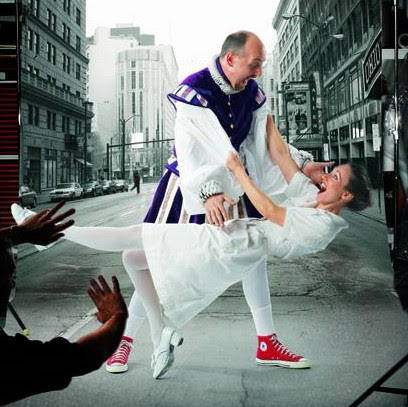
"The Dark Lady of the Sonnets"
(2006)
In Blessed Unrest: A Fantasia on Martha Graham's Demons (written by the performer, directed by Jamie Koeth) McEvoy embodies the legendary mother of modern dance as she grapples with the limitations of her physical self. The unapologetic anger she feels that can no longer dance, anger and resentment, but never self-pity.

Emily Kuntz makes two remarkable appearances, first as a memory of a young Graham, dancing in ponytail and black headband. Later, as a contemporary student, providing the septuagenarian Graham the opportunity to find a way back from despair.

It's a bravura performance from McEvoy, and one I hope finds a larger local audience some time soon.

Saturday, July 26, 2025

The Right Room | In Performance

Charles & Mathilda
(Zach Palumbo & Nicole Coury)
Photo: BorderLight Theater Festival
The BorderLight Theater Festival is closed for 2025, and with that, so too our run of The Right Room in the Presidential Suite at the Crowne Plaza Hotel Playhouse Square. For those in the room, and for our young company, it was a once-in-a-lifetime experience.

The audience only saw the bedroom; the bed, a couch, a few armchairs. They, the audience, were asked to sit in one of eight, ordinary, cushioned chairs. They were also asked not to relocate those chairs, and to make sure their personal items were stashed underneath. They were also advised that though this play would be intimate, it would not be interactive; do not touch or speak to the actors, and they will not touch or speak to you.

Once they were settled, the characters entered through the same room the audience had. Throughout the performance they accessed the bathroom (lines delivered when folks were offstage in the bathroom were amusingly louder than those delivered in the room itself) and occasionally dipped into a closet – but it wasn’t an actual closet. It was a door into the adjoining suite, blocked by a curtain.

The suite (or living room area) was our green room, it was larger than the bedroom. The east end of the Crowne Plaza is rounded, with a view overlooking East 14th and Euclid, the Chandelier. The audience could see this as they entered, but most sat with their backs to the windows for the show. If you can imagine, the entire suite wrapped around the end of the hallway. The door to the suite faced the door to the bedroom itself.

Just as the actors were lining up for entrances at the top of the first performance, facing the suite door, ready to cross the hallway to the bedroom door, I was standing off to one side behind them. Suddenly, the actors playing Fanny and Mason both turned their heads to look at me. And in that moment I saw my biological grandparents, people I never had the chance to meet or even know about, young and attractive and with their whole lives ahead of them. I wasn't expecting that.

Their real names, by the way, were George and Martha. Truth is stronger than fiction.  

BorderLight show pages included the opportunity for audience members to rate and review the productions, and we received many wonderful comments. Here are just a few:
“Each character was incredibly human; in turns flawed, lonely, searching, funny, sad, excited, passionate, confused, and affected by people and a past they only partly understood.” - Amelia B.

“The staging was deft and I was never at a loss of where to look or what story was being told. A truly immersive theater experience that has to be seen to be believed.” - Philip F.

“Jasmine Renee’s direction was outstanding. Pulling off clear storytelling in such an intimate space is no small challenge, and she nailed it. Serenity Grace Tate’s costumes were spot on, and I was comforted to see that Julia Fisher was engaged as Intimacy Director... I hope his play has a life beyond the wonderful Borderlight Festival. We all need to find ourselves in the right room.” - Daniel H.
On a related note: Today is my birthday, and by tradition, I am on vacation. In the office, birthdays are celebrated with cake and ice cream, and about ten years ago they began celebrating mine in my absence. 

It started with a photo of the staff having ice cream at a place on the square, the gag becoming sillier with each passing year. One year they were all crammed into my office … with ice cream. During the quarantine, a picture of an empty breakroom with hats and noisemakers on the large table.

This year? A staff picture in a room at the Crowne Plaza Hotel with a note reading, "We're finally in the Right Room!"

In case you were wondering, I truly love where I work.

Wednesday, December 11, 2024

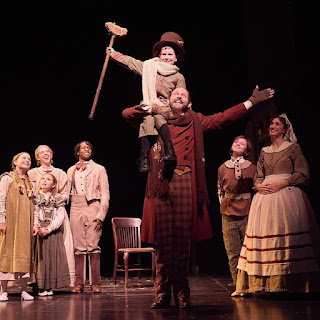
A Christmas Carol (2024)

James Alexander Rankin as Bob Cratchit
"A Christmas Carol"
(Great Lakes Theater, 2024)
Costume design by James Scott
Scenic Design by John Ezell
& Gene Emerson Friedman
Photo by Roger Mastroianni
Great Lakes Theater first produced A Christmas Carol in 1989. Then-Artistic Director Gerald Freedman wrote an adaptation that cleaves neatly to the original work. As a framing device, the Cleaveland family (the name is never spoken, you can find it in your program) gather together on Christmas Eve to read Charles Dickens’ classic work, a simple and elegant entry to the story.

Recently, I discovered my ticket for the first time I saw the show, surprised to see it was from that first year. Dated December 22, 1989, it may even have been closing night. I was twenty-one, home for the holidays during my fourth year at college. At the time I was most impressed by the Ghost of Christmas Present, performed by Kevin McCarty. Kevin was completing his MFA in Acting at Ohio University just as I was an incoming freshman. A big man with a stern brown and a deep and resonant voice, his ghost was full of life and joy but also quite intimidating.

Since that time, the Great Lakes production has grown into a true institution. I cannot imagine anyone intending this or any regional theater production to continue for five years, let alone thirty-six and counting, and I truly believe the city would be poorer with its absence. Part of that is due to Mr. Dickens, but also Mr. Freedman and the entire original creative team.

Because of the sincerity of the framing device – which includes the youngest of the Cleavelands wordlessly witnessing the events of the story, casting members of his household as the characters – this adaptation has avoided becoming dated. It is commonplace for us to ironically wink at the audience because, you know, it’s A Christmas Carol, after all. But it’s played straight, and so it stands, not stuck in the 1980s or 90s, but entirely Victorian in style and language.

Kevin McCarty as the Ghost of Christmas Present
(Great Lakes Theater, 1996)
Photo by Roger Mastroianni
Credit is due to this adaptation embracing Dickens’ message of social justice and economic disparity, including details from the novel which are often glossed over. I am especially touched by the scene when Christmas Present takes Scrooge around the globe, and even beneath the earth, to see miners, a lighthouse keeper, and a ships’ captain out to sea. The breadth of humanity and the wideness of the world is sublimely depicted here through traditional stage tricks of light and darkness and fog. The hand-tooled appearance of the set and effects contributes greatly to the sweetness and enduring popularity of this production.

From 1982 to 2008, Great Lakes produced exclusively in the Ohio (now Mimi Ohio) Theatre. Relocating the majority of their work to the Hanna Theatre sixteen seasons ago, A Christmas Carol remains in the Mimi Ohio, the theater for which it was designed. Retrofitting the show to the intimate Hanna would for all intents and purposes mean redesigning the entire production, which would make it something entirely different, and not necessarily for the better. In the stately Ohio the show is like a handsome and antique holiday picture postcard.

I started bringing my own, living children to see A Christmas Carol when each turned four years old. But this is a ghost story, and there are some remarkable frights along the way. Marley’s entrance is startling (it includes a dramatic reminder of from where he is arriving) which often produces squeaks and squeals from youthful audience members. I stayed particularly attentive to our eldest their first year (2007) as the Ghost of Christmas Yet-to-Come made its silent, awe-inspiring appearance. After a few intense moments, our little one leaned to me and whispered, “... is that a puppet?” They were spooked, but even at that age they knew a thing or two about stagecraft.

During the 2015-2016 season, Playhouse Square renovated the lobby of the Ohio, restoring it to its original 1920s grandeur. That holiday season, however, due to the construction, it was necessary to take a long, narrow, featureless tunnel into the theater. But what I best remember was that that was the year my entire side of the family – my parents, my brothers and their spouses, my wife and children and our nieces – we all saw the show together on the same night. Father said he’d never seen it before, which surprised me. The memory of this evening is all the more poignant for me as our father died early the next year.

Nick Steen in costume as Ebenezer Scrooge
handing out awards for the
"A Christmas Carol" Writing Contest
(November 26, 2024)
As should be made evident, in addition to my responsibilities assisting with student matinees and facilitating the A Christmas Carol Writing Contest, I have also seen the show many times, watching with a kind of fascination as the tone changes with each director (technically, it has always been “directed by Gerald Freedman” as each subsequent director works to maintain his original staging) and the several – though surprisingly few – men who have assumed the mantle of Ebenezer Scrooge.

A week before Thanksgiving this year, and just as the show was about to open, I was asked to join the acting company, a necessary last-minute replacement. An understudy would take the first weekend, and I would join in thereafter and for the rest of the run. And so my entire holiday schedule this year has been turned upside-down, a crash course in A Christmas Carol and an altogether delightful experience, though at first a bit like jumping onto a moving train.

It was not surprising to me that several members of the company assumed I had performed in this show before. I have worked for Great Lakes Theater for some time. But I have not done this show, and I am very glad to participate in this way, grateful for the opportunity.

At a talkback last week, a student asked the company which moment in the show is our favorite, and I said the street scenes. There are three times when nearly the entire company crosses the stage – that’s a lot of people and not a terribly large space. The choreography is tight and I did mess up once or twice the first couple of times, crushed against a window or bumping into furniture. But by the end of Thanksgiving weekend I felt like an old hand, and am now truly able to breathe and enjoy those moments.

Myself, in costume emceeing the
"A Christmas Carol" Writing Contest
(December 3, 2024)
I’ve made new friends in the company, and am having the chance to work with others I’ve known for years but have never shared a stage with. Some members of the “young company” are the children of old friends, or even students I have taught in schools through the residency program. It’s a youthful, vibrant company – even for those of us who aren’t so young anymore.

And that may be why I love this season, and this production, and the lesson it brings. It is about our shared humanity, negotiating this one world together. No one is more respectful nor deferential than a player in a narrow backstage space, making way for a fellow company or crew member who needs a clear path to rush from point to point, holding a large prop or a basket of costumes, or sporting a voluminous, hallway-spanning skirt.

For closing thoughts, I give you nephew Fred:
“But I am sure I have always thought of Christmas time … as a good time; a kind, forgiving, charitable, pleasant time; the only time I know of, in the long calendar of the year, when men and women seem by one consent to open their shut-up hearts freely, and to think of people below them as if they really were fellow-passengers to the grave, and not another race of creatures bound on other journeys.

“And therefore, uncle, though it has never put a scrap of gold or silver in my pocket, I believe that it has done me good, and will do me good; and I say, God bless it!”


- “A Christmas Carol” by Charles Dickens, 1843
Great Lakes Theater's 36th annual production of "A Christmas Carol" continues through December 22, 2024

Disclaimer: I am employed by Great Lakes Theater. The thoughts and opinions expressed here are my own.

Sunday, January 14, 2024

Hamlet & Me (Part XII)

Gertrude & Hamlet
Laura Perrotta, Laura Welsh Berg
Great Lake Theater, 2017
Photo: Roger Mastroiann
i
"What then? What rests?"
- Hamlet, III.iii

To conclude, I have seen more live stage productions of Hamlet than any other play by Shakespeare, except for perhaps As You Like It, which is a shame because, as G.B. Shaw said, “It is not as I like it.” But the latter is more commonly produced than the former at a rate of at least ten-to-one.

There are, of course, the recent stage productions of Hamlet adapted for television and much beloved by my contemporaries, those starring Benedict Cumberbatch, Paapa Essiedu, Andrew Scott or David Tennant. Oddly enough, I have never made the time to watch any of those. The fact is, I love to hear Shakespeare in a theater, live or filmed, but have little patience for him on the small screen.

I can think of three downright terrible live productions of Hamlet. I haven’t made mention of any of them in this series of posts, but I will say the principal sin of each of these productions was a lack of inspiration. Hamlet is such a weird play, the man himself such an odd character, you can’t just decide to “do” Hamlet. When you aim at a king, etc.

A couple years ago I recounted my experience thrilling to Clayton Jevne’s One-Man Hamlet at the Minnesota Fringe (you may watch the entire show online) and I am still smarting that I did not make time to see the Israeli Cameri Theatre troupe perform the play entirely in Hebrew when they visited Cleveland in 2008. I have yet to see Hamlet performed in another language, but I know the text so well that I think doing so would be a fascinating thing to do. I will not pass on another such opportunity.

If I were to elevate one Hamlet that I have enjoyed above all others, that would be Laura Welsh Berg at Great Lakes Theater in 2017. This was not a gender-concealed retelling, like the Asta Nielsen film or my Beck Center production, Berg was playing Hamlet as a man, in Elizabethan dress and on a stage design to evoke the Globe. It was the most “traditional” production of Hamlet I’d ever seen, and it was a revelation.

While I do not agree with what Edward P. Vining characterized as feminine “weaknesses” in the Dane’s psychology, I have found that Hamlet’s transparent misogyny becomes something quite else when communicated by a woman. Disappointment instead of derision. Empathy instead of anger. Berg powerfully embodied all of the grief and rage and condescension Hamlet holds for his father, his uncle, Polonius, while also making the “nunnery” and “closet” scenes, in which he traumatizes first his lover and then his mother, truly affecting for all parties.

Recently, I read the script for the new play The Motive and the Cue by Jack Thorne. Inspired by the books Letters From an Actor by William Redfield and John Gielgud Directs Richard Burton in "Hamlet" by Richard Sterne. It is an imagined dramatization of the rehearsal process for that 1964 Broadway production.

I find that this script is most successful at describing to an audience just what it is a director does – and what they should not do – as the legendary though cash-poor Gielgud endeavors to shape the performance of the besotted but powerful Burton in a role that he, Gielgud, knows all too well, or perhaps much too well, while Burton struggles to make the role his, Burton’s, own.

It's a play I'd like to attend. Better still, I'd like to play Gielgud. I think I could. And anyway, no one ever asked me to play Hamlet.

Monday, December 18, 2023

Hamlet & Me (Part II)

Promotional Mailing
Great Lakes Theater Festival, 1989
My third year at Ohio University was Our Shakespeare Year. We hadn’t touched the Bard my previous two years, at all. But the school was producing Romeo & Juliet that spring, so it was necessary to bring us all up to speed. We rehearsed soliloquies for performance, the school purchased a complete set of John Barton’s “Playing Shakespeare” series on VHS.

Side note on the “Playing Shakespeare” tapes. They were expensive and Mother Martha V., our beloved school secretary, kept a close eye on them. They were for classroom use only, they were not to be borrowed, but they could be stolen which we promptly did, dubbing them off and then returning them. Eventually one went missing (not our fault, I swear) and I have ever after lived in fear.

Also that spring, a certain classical theater company* based in Cleveland was producing Hamlet. Directed by Gerald Freedman, the style was very modern, it was promoted as an “angry young man” version of Hamlet. A number of us drove up from Athens to catch a Saturday matinee, but a water main break in the Ohio Theatre meant the performance was canceled, so my friends and I went to see the just-opened-that-weekend Indiana Jones and the Last Crusade that afternoon.

We did get seats for that evening’s performance, which were way up in the vert last row of the thousand seat house. This would be the very first time I would see a live performance of Hamlet. I hated it.

No doubt I had a chip on my shoulder. I was twenty years old. I had spent an entire semester devoted to the works of Shakespeare. I had memorized an entire soliloquy (two, actually) from the great Dane. I knew a thing or two about Hamlet, and about being an angry young man.

Looking back, I am sure I would have enjoyed this production, if it hadn’t been my first. At the time, I found its touches of modernity far too clever. Claudius had a nasal twang meant to evoke that of sitting President George H.W. Bush (folks hate politics in their Shakespeare), the mad Ophelia went topless, and then there was the man himself whose main objective was, as I recall, to be angry.

One of my mentors gave me a very good piece of advice, to wit; Anger is boring. My own rendition of “O, that this too solid flesh,” was peevish, this Hamlet was literally shaking with rage.

At one point he walks on stage, fires up a spliff, takes a mean drag, and begins, “To be …” It brought the house down. I thought, at the time, that that was entirely inappropriate, turning the most famous speech in the English language into a pot-fueled rant.

Hamlet and the Ghost
(Anthony Powell & Peter Aylward)
Great Lakes Theater Festival, 1989
Photo: Roger Mastroianni
I have different opinions today, about cannabis and more importantly, about that speech, which I still haven’t figured out. Opinions differed among audiences, too. Letters to the company in response to the production ranged from the outraged to praise like the following:
“Your exciting, riveting production of Hamlet is just about the most creative and wonderful production I have seen in years. The attention and shock which you elicited from the audience was palpable. No one moved, no one coughed, no one spoke throughout the performance.

No wonder. This modern interpretation of the classic was … so meaningful. Freedman did more than change the costumes and setting; he interpreted Hamlet in light of modern times for a contemporary audience.

Yours is the kind of production that young people must see. Then they will understand that Shakespeare was meant to be seen and heard – not read”
- Norman W., Cleveland
I agree with all of that. They received some negative letters, too, though most I read were of the “why do you have to mess with Shakespeare?” variety, criticism lobbed at all modern adaptations of Shakespeare for more than a century, and a point of view I find tiresome. The director himself put it very well, in his Director's Note:
"There is no perfect' Hamlet, or a Hamlet for all seasons and all people. One of the difficulties in producing the play is that each person sees Hamlet in himself or herself. Critics have for centuries encrusted the role with ideas and theories that have biased readers to various interpretations. The theater is the place to experience him."  - Gerald Freedman
And at least I finally saw it. The entire play, beginning to end, performed by a professional company. Only ten years later I would attempt to direct it myself, and my intention would also be to create an exciting, riveting -- and modern -- production of Hamlet.

To be continued.

Source: GLTF Spotlight, August 1989, Vol. 4, No. 3

*Full disclosure, my employer is Great Lakes Theater.

Saturday, March 4, 2023

The Great Globe Itself (revisited)

"I'll come in again."
Recently I have been digitizing a lot of materials at the office. That includes the prompt books for outreach tours, going back decades, a number of which I have written.

So, yes. I have been lingering over my old scripts, because they're interesting. They include sound cues, stage directions — and edits. Lines that were added, lines that were cut, lines that were changed.

These changes would make their way into the final draft of my script. But one line change caught my eye, from The Great Globe Itself, first produced in 2015. It's a significant edit, because it answers a question, central to the third act, which I had failed to address when we started rehearsal.

"They come to hear the gods, not me."

I checked the version I had posted to New Play Exchange and was surprised to find that I had not included it in the final draft. All the other changes were there, but not that one. It makes a difference, and I'm glad I caught the mistake.

"The Great Globe Itself" is available at New Play Exchange, or contact me directly.

Saturday, January 7, 2023

NYC NYE 2023 (part one)

Mural, American Airlines Theatre Penthouse Lounge

New Year’s is a big deal for us. Not that we have traditionally been extravagant at the turning of the calendar. In fact, we have been quite modest the past few years. Even before the pandemic, we chose to stay home, alone. We only ever need each other, anyway.

Auspicious subway find.
We met on the street the year we rang in the 90s, headed to the same gathering, and have spent every NYE together since, for better and for worse. And last year we decided we would go to New York, where we fell in love and shared so many early relationship memories. Omicron be damned, and it was awesome.

When I missed the American Repertory Theatre production of 1776 in Boston this summer due to health issues, and they announced a Broadway run, I suggested we do it again – spent NYE in NYC. Maybe this is going to be our New Year’s tradition, from here on out. We would both be very happy with that. My wife scored first class seats, and we enjoyed Bloody Marys and held hands at 10,000 feet.

The wife found us a sweet little Airbnb where Washington Heights meets Inwood, and just a short walk to Fort Tryon Park. The place had a really nice reclaimed wood aesthetic. We asked our contact where we could get lunch and she suggested Koko Seafood, a Dominican joint on Nagle.

The ghosts of Steve & Eydie
hath appeared to me —
at Sardi's once ...
The guy dropped two menus but he also suggested we could have whatever they already had prepared, so we said yeah, what do you have back there? She got the stewed chicken, I got the grilled chicken, we each got red beans and rice. We were made very, very happy.

It was such a good meal that, following a much-needed nap (I think I got four hours of sleep the night before) we decided to skip dinner and just get drinks somewhere in Times Square. She asked if I’d ever been to Sardi’s, I said that I had not. We enjoyed cocktails seated next to a festooned caricature of Steve Lawrence, which was only appropriate.

Then onto the American Airlines Theatre for the Roundabout production of 1776. Here’s the thing about 1776, the original score for this show (music and lyrics by Sherman Edwards, book by Peter Stone) is part of my earliest memories. My father enjoyed it a great deal, and why wouldn't he. A lively celebration of the origins of our nation, created in 1969, possibly the worst point in our history. The vinyl was on regular rotation in my house growing up, I still have it somewhere. And the 1972 film was a must-see whenever it came on the TV, usually around Independence Day.

Festive NYC streets.
However, it has not aged well, as it sands down the sins of “our forefathers'' even as it attempts to address them. Even Lin-Manuel Miranda did this in creating Hamilton, entirely omitting the fact that Alexander Hamilton himself was once a slaver.

In subsequent productions of 1776, in community theaters and colleges around the country, people of color and women have been cast as members of a company of historical figures who were all white men. After the success of Hamilton, I wondered how long it would take before someone attempted a diverse professional production. The A.R.T. production (produced on Broadway by the Roundabout Theatre) features an acting company composed entirely of people who identify as women or non-binary.

This has not been without controversy, which was to be expected. I loved the production, I really did. You could say it had been produced for me or someone exactly like me, a privileged, middle-aged, liberal, white person – and one who already enjoys the score. Attending a performance like this would naturally soothe my sensibilities, as it would ideally present an opportunity for those affected by these men's actions, but not present in their decision making, to interpret and hopefully to provide context for the founders limitations.

Sara Porkolob in "1776"
(Photo: Sara Krulwich)
Company member Sara Porkolob, who plays South Carolina Congressman Edward Rutledge, started a firestorm among the theater community last October in which they dared to answer questions about the production with candor and honesty. They did not agree with the suggestion that the production is artistically fulfilling – for them – and even more aggressive comments for saying they only give 75% to this show a night.

Much, much more interesting, however, are their comments about the frustration of being a multidisciplinary performance artist who takes a job as solely a performer in someone else’s work. The fact that, in their opinion, the show still does not go far enough in critiquing the so-called “American experiment." It is a rich and interesting interview with an amazing artist, and I strongly recommend reading the entire thing.

The best excuse for being controversial, however, is when you are also brilliant. The most emotionally disturbing song in the entire show, no matter where you are seeing it, and the only part of the show which comes even close to addressing the massive errors in the American experiment which are still with us today, is the the eleven o’clock number Molasses to Rum, led by Porkolob, for which they say they give 90% and which they entirely walk away with. If what I heard that night was 90% of what they have to offer, I am literally frightened to experience their talent at full bore. I hope that someday I will.

Photo: TRG Reality
My one personal regret was that I did not get to see Elizabeth A. Davis as Jefferson, though the family did last summer. We were in the company of The Merry Wives of Windsor at Great Lakes together in 2005 as she was completing her studies at Case, and she participated in an odd “Mr. Shakespeare” photo shoot in which we first recreate the famous V-J Day photograph and then I apparently drop her (right.)  Maintaining the role in Boston on then Broadway while visibly and increasingly pregnant over the course of the fall, Davis left the production as scheduled around Christmas.

Sunday, December 11, 2022

"A Christmas Carol" Writing Contest (2022)

Actor Lynn Robert Berg greets and awards a
writing contest school winner on stage
at the Mimi Ohio Theatre.
Since 1989, Great Lakes Theater has produced a writing contest for sixth, seventh and eighth grade students in the Cleveland Metropolitan School District, in association with the annual production of Gerald Freedman’s adaptation of Charles Dickens’ A Christmas Carol.

This past season was my tenth year shepherding the program, which involves engaging English Language Arts teachers throughout the district to participate in the program, contracting the readers who will choose the most original and creative works from the written entries, and making arrangements for all participating students to attend one of two free student matinees of the production.

The past two holidays seasons have been disheartening, to say the least, as there was no stage production of A Christmas Carol in 2020 (though GLT did produce an excellent radio adaptation that year) and while the show went on in 2021, the fact that vaccinations were not yet available to students twelve and younger made student matinees untenable.

The writing contest continued, however. But with remote instruction and without the promise of matinees for students, participation was depressed, which is entirely understandable. For me, however, it was one more of a raft of disappointments during a very difficult period.


In order to revive interest in the contest this year, GLT offered writing workshops to any teachers interested in receiving them. This past fall I conducted twenty such hour-long workshops at schools across the city. While exhausting (and taxing on my voice) it was very inspiring to be able to make a direct connection with so many students – in person – and to engage them in the craft of creative writing.

Here’s the thing; I always wanted to write. When I was a child, I wrote. But my efforts were never promoted. They were never fostered. Not by my parents, and my efforts were outright derided by my brothers’ friends. There was always someone to tell me what I was doing wrong, no one took me aside to show me how to do it right. It took me a long time before I realized it was something I could do. Someone I could be.


In these workshops, there wasn’t a lot of time to cover structure, apart from the basics. What we did was brainstorm, create characters with motivations inspired by themes present in Dickens’ work. When a student offered up a character, I would ask questions about who they were, and where they were, and what they – the character – wanted. And then I asked them to write about that for a few minutes, then we would go further.

When all the entries were submitted, and six grand prize winners were chosen from over a thousand written entries, five of the six had participated in one of these writing workshops. But so many of the stories were so well written this year, whether they had received a workshop or not. Stories about love and acceptance, and grief and anger, about loss and doubt but also confidence and hope.


These kids, my kids, all of our kids, have been through so much these past years, and there is all this talk about how they are behind, in their education and in their socialization. But reading these stories, and hearing their voices as they reacted to a live performance at those student matinees of A Christmas Carol, I see so many strong, resilient, and thoughtful young people.

Saturday, November 19, 2022

Process LXXVIII

Actor-Teachers at Theodore Roosevelt High School
Suddenly, pages! I wrote ten pages of a new script in time for workshop on Monday. When I adapted those two Christie novels, I drew dialogue pretty much directly from the books. There is another way, of course. You can be inspired by the work and make the dialogue up entirely.

This is what Coble did with his adaptation of The Machine Stops (among several others) which we produced into a radio drama that premiered fifteen years ago this week, if you can imagine that. He created his own idea of the characters and what they might say.

True, Metropolis is a silent movie and the title cards do not offer much in the form of spoken word. But the novel does, though as it is a translation from German, it has a quality that is not quite like natural English speaking. First of all, because it’s German, it’s all verbs.

That’s a joke.

This week I also had the opportunity to make a few school visits, which was nice, traveling far afield, to Kent and also my high school alma mater. I have been so engaged with the "Christmas Carol" writing contest, I haven't seen as much of the actor-teachers as I would like.  

Always on my God damn phone.
Thursday night was our penultimate regular class for creative nonfiction – and the evening I had my essay critiqued, which was really special. The comments were generously positive, my professor called me "master of the walk-off line" for how I closed each section, and a few commented on how seamlessly I included dialogue, as though I were some kind of playwright or something. At the same time everyone provided me with so many critical observations and opportunities for revision.

Writing is rewriting, so they say. Good lord, how many times did I repeat that during the workshops I provided for the writing contest last month? The wife assures me one of my best attributes (as a writer, I am awesome in so many ways) is how I receive criticism and incorporate it into my work. 

This was not always the case, and like an actor who insists on explaining why they made the choice they are being asked to reconsider, I would also defend that what I had written the first time was absolutely correct.

It’s the most important lesson I ever learned in undergrad: “Take the note.”

Friday, June 24, 2022

Notes on Camp: Day Eight

It is true, with the improv club on our penultimate day, we could spend the entire day rehearsing and preparing for our performance.

To think. We weren’t even sure if we could do this. Would anyone sign up? Would they agree to masks? And how would that go? I’ll tell you, it went fine. Only the photos will remind me that we were even wearing them. And no one got sick, not at this camp.

Family and friends of the campers arrived in time for a 2:30 PM performance. The Jesters & Fools (9-11 group) presented an original play about oracles before our teams presented their short plays and Shakespeare scenes, before the entire camp came together for our final song and dance number. It was a one-hour show! Created in eight days!

The short plays, by the way, were presented in a manner inspired by the Neo-Futurists. We called it “Ten Short Plays in Twenty Minutes” with the caveat that there were neither ten plays nor were we performing them in twenty minutes, though when all was done I believe we did execute all eleven plays in twenty minutes or less.

On the drive in this morning, I was already thinking about next year, when hopefully I will have a better opportunity to organize the improvisation workshops. The first week is for a close study of the mechanics or techniques, the second concentrating on a singular character for use in a (short) long form improv.

Now, if you will excuse me. I am going on vacation.

Thursday, June 23, 2022

Notes on Camp: Day Seven

Another Improv Club is in the books, and I am very surprised and relieved with how it all worked out.

The Crows and Mechanicals each had their own genre (mystery and soap opera, respectively) and after a brief introduction of each character, they were provided an episode title and called upon to perform two person scenes that took place in whatever space I provided (The abandoned MacGruder Place! The dunes on the beach at the Cape!) concluding with a “slacker” scene in which each character cycled in and out of three person scenes in turn.

And we consumed a massive amount of pop, chips and cookies. Because nightclub.

On any other year, I would head down to our rehearsal space to pick up additional costumes or props for our rehearsed "splash" scenes as necessary, depending on what scenes we were creating. Kelly insisted (and I bless her for it) that we spend the rest of the day creating everything we didn’t already have out of paper, cardboard, watches of fabric, duct tape, hot glue, paint and their imaginations.

Self-directed work is the best work. It really, really is. Bless you, Maria Montessori.

The end of the day, after cleaning up, I got to kick back and watch Tim and Asia coach all the campers in the choreography for the closing song for our performance … which is tomorrow!

Wednesday, June 22, 2022

Notes on Camp: Day Six

“I'm taking an awful risk, Vader. This had better work.” 
- Governor Tarkin, "Star Wars" (1977)
The improv club was created as a way for the campers to show off their skills in a manner in which they did not need to feel the pressure of an audience of anyone other than their peers (i.e., their parents). If a comment is accidentally blue – trust me, I actively discourage this – no harm, no foul.

This year, however, we haven’t taken the same amount of time to develop these skills. It all comes down to their innate ability to riff, the characters they have been thinking about since last week (we haven’t actually played with any of them to date), a set of camper-generated prompts in the form of episode titles, and the heavy hand of the narrator: me.

So, anyway. We had a lot to do today, and a lot planned. Short scenes and Shakespeare in the morning, final improv rehearsal in the afternoon. What we did not expect was that the fire alarms would be tested for over an hour and a half. The sound was loud and disturbed – and it was ninety degrees outside. We found the band room to be slightly less horribly loud, and played games and, yes, practiced some improv, until lunch.

These things happen. How you cope with them is what matters.

Tuesday, June 21, 2022

Notes on Camp: Day Five

And we’re back. In days past, this would be a restart, greeting new campers for the second week, beginning a second-week lesson plan which tracks the first week, but not entirely the same because many campers took both weeks.

So, instead of restarting, we are resetting – taking this opportunity to revise expectations based on the personalities of the players involved. As our Crows and Mechanicals are full of clowns, he have assigned two cuttings from Shakespeare’s comedies to compliment the “Battle Royale” which now surrounds a third scene, one from Henry IV, part 1.

This took up a great part of the day, which was fine. We have that time to spare. We were still able to spend time running our short plays, stage combat, and concluding the day with musical practice.

Are we doing too much? I do not know. Are they up for the challenge? Yes, they are!

Friday, June 17, 2022

Notes on Camp: Day Four


Camper walks in wearing a T-shirt reading “Be Kind.” Gray shirt, simple black font. I want my own version of this shirt.

The memory feature of Facebook has been rolling out camp memories every single day. It’s all a bit overwhelming.

We began the day by moving one of the Jester & Fools up to the Upstart Crows. This happens, one of the older kids from one of the younger groups is not challenged by what they are working on, or sometimes we notice that all of their friends are in the older group, and we adjust accordingly.

I asked the team to write for five minutes, reflecting upon what they had discovered, or discovered about themselves in the past three days. Then they shared their names and pronouns (so our newest member could hear them) followed by a one or two word summation of what they have discovered.

It was gratifying to learn all the wonderful things they had picked up, and that they are happy to be here. We need to reflect sometimes, to remember where we were, and how far we have come. Their telling me reminds me of this, too.

Today we ran through all eleven short plays. I was so impressed, not only at what a fantastic playwright I am, but how well my work can be interpreted by middle and high school students. I really need to create a book.

Thursday, June 16, 2022

Notes on Camp: Day Three

“That summer feeling is gonna haunt you one day in your life.”
- Jonathan Richman
Summer is different. The smell of the gas pump, which is an entirely ordinary aroma, takes on a nostalgic pong when it is received standing in sight of the highway, your car filled with family and luggage.

Going to camp is different. I’m wearing shorts to work. I pick up a latte for the forty minute drive across the city. The windows are open, and I am singing at the top of my voice. It feels so much more relaxed.

The days are crammed with activity. Campers have now selected short plays on which to concentrate, we will begin rehearsal of those in earnest tomorrow. Kelly is not only staging the Battle Royale, but including verses from Shakspeare to tie them together.

The improv sessions are loud, hilarious and dizzying. My only question is whether or not the preparation will come together into a performance. But, we’re having fun, right?

Wednesday, June 15, 2022

Notes on Camp: Day Two

Afternoons, Kelly and I trade off between the Upstart Crows (middle school) and Rude Mechanicals (high school). She is guiding them through a Shakespearean “Battle Royale” while I lead them through improvisation exercises.

In this way, the campers are getting a lot of specialized attention in two different aspects of performance. I don’t think we’ve ever provided as much time on stage combat before, and never with as an experienced mentor as Kelly.

As for improv club, I was inspired by someone one of our interns said during the planning sessions, comparing long-form improv to a role playing game – which is another way of looking at the work we use to do in the Night Kitchen; concentrating on creating one very specific character for the actor to create and embody. They, the established character, can enter into any scenario, handle conflict and create relationships, pushing a storyline forward without inconsistency.

That’s the plan, anyway. Wish me luck!

Tuesday, June 14, 2022

Notes on Camp: Day One

Dutiful interns Sylvia & Connor
Something old, something new. Mornings, Kelly and I work in tandem with students aged twelve to eighteen. It’s been three years since we held in-person camp, and I was curious as to how many of these kids would have attended our camp before. And it was around half. I was shocked. I was so pleased. 

How many had aged out? How many had folks were weren’t ready to send their kids to an experience like this? But so many were back, and it is so good to see them again.

We are wearing masks. Yes, it’s a drag. But I wouldn’t do it otherwise, and I am grateful for the accommodation. They want to be here and so do we.

We worked together to create a list of expectations for the week, to which we could all agree. Some expectations involve playing certain games. Others involve providing mutual respect and attention. We got onto the same page.

Campers got to know each other a little, introduce each other, learn names. And then we got to work! And this year, guess what? We’re working on (among other things) the Short Play Project. I have a tranche of two-person plays, many of which are perfect for middle and high school aged kids to work on.

Exactly how we do that, I will make note of as the week progresses. Today, we had cold reads, tearing through a number of them, but not enough apparently, as they were eager to keep reading them aloud for each other.

Monday, June 13, 2022

Notes on Camp: Day Zero

Rude Mechanicals, 2019

We emerge from quarantine, if not from pandemic. Since 2010 Great Lakes Theater has held a two-week summer arts camp at Berea-Midpark High School (formerly Camp Theater!) for kids from kindergarten to high school. I am happy to say there were campers who returned year after year.

Scenes from Club Improv (2019)
Two years ago, when the inevitable decision to cancel camp was made, we offered a virtual version for a week in June 2020. It was simply part of the general contribution of goodwill provided during that season of disappointment and uncertainty. We got to see the familiar faces of kids we would not be meeting in person for some time, if ever again.

Last year we didn’t have any kind of camp at all.

This is a year of change, as the camp will be hosted in a new location, and incorporate music and dance into our lesson plans. This year I am working closely with Kelly Elliott, as we team-teach middle and high school aged campers in stage combat and improvisation.

Also? A trio of interns, Ally, Connor and Sylvia, all former campers, who either graduated from high school this or last year. We have instructed them since they were kids, now they will work alongside us.

Good Lord, I could cry. I'm really looking forward to this.

Friday, February 18, 2022

The Mysterious Affair at Styles (In Motion)

Before the proliferation of smart phones (after which time everyone became a cinematographer) capturing random moments on video was a bit more rudimentary. As I have been recalling the ten years since my play adaptation of The Mysterious Affair at Styles premiered, certain video "memories" have popped up on social media.


Tuesday, February 14, 2012
Opening Night
Alcazar Hotel, Cleveland Heights

Producer Daniel Hahn whipped out his flip-phone to record a record turnout for the Great Lakes Theater outreach tour (above). Over one hundred and twenty people attended opening night at the Alcazar Ballrooom. I promise, this is due to the enduring popularity of Agatha Christie, and not my reputation.

The first image is that of director Lisa Ortenzi, who did such a marvelous job getting this show on the road.
 

Thursday, March 1, 2012
Nordonia Hills Branch of the Akron Public Library

Ten years ago I had not yet acquired a smart phone, but I did have a laptop and used that to create this time-lapse document (above) of how our company of five brought in and put up the quite impressive and heavy set. 

Wednesday, February 15, 2012
Lorain County Community College

The second night of performance, Daniel brought his family camcorder and recorded the entire performance at LCCC. It's handheld, so of course it's a little shaky. In this clip, Captain Hastings bids farewell the his audience. Don't worry, no spoilers, and we do get to see the entire company emerge for curtain call.

Monday, February 14, 2022

The Mysterious Affair at Styles: Ten Years On

Playmakers, Inc.
Covington, LA (2022)
St. Valentine’s Day, 2012. My adaptation of Agatha Christie’s first novel The Mysterious Affair at Styles, premiered at the Alcazar Hotel in Cleveland Heights. This would play become my first published script, and a significant moment in my life as a writer.

When it was announced that Great Lakes Theater would produce The Mousetrap at the Hanna Theatre in spring 2012, I proposed adapting one of Christie’s two (at that time) public domain works for the annual touring show. Writing this particular piece was an education for me in many ways.

For example, I had never read anything by Christie. I knew little about the First World War. I had never adapted a novel before, never written a mystery before, and I had to figure out how to present twelve characters with an allotted cast of five.

Chattanooga Theatre Centre
Chattanooga, TN (2018)
This was my sixth outreach tour as an actor, and my second as playwright. Our five person ensemble included actors I had worked with in previous tours, including Michael Gatto, Anne McEvoy and Emily Pucell Czarnota.

Two years earlier, Emily was in my play On the Dark Side of Twilight, a three-hander, with me and Dusten Welch. Our working dynamic was so familiar in that tour, that when we brought in an actor who was new to all of us for this production, we both kept calling him Dusten. That was James Rankin.

The good folks at Playscripts, Inc. chose to publish it the same year, and since that time there have been (to date) two dozen productions. Not an overwhelming number, but there are a few limitations to this particular adaptation which narrow the kind of organizations which might choose to present the show. It is brief, for one thing, no intermission.

Alaska Pacific Univ.
Anchorage, AK (2017)
Also, The Mysterious Affair at Styles is in the public domain in the United States only. There is a larger media company which manages the written work of Agatha Christie, and they carefully guard her copyrighted works. Copyright laws vary from nation to nation, and in the British Commonwealth, her work remains so.
"Loaded with many comedic moments."
- Ryan Jordan, University Echo, Chattanooga
So, no British productions. We learned this early on when an “am-dram” (as they say) licensed the work, announced auditions online, and almost immediately stated they were instead producing And Then There Were None.

Poughkeepsie Day School
Poughkeepsie, NY (2020)
Yet, within the fifty states (including Alaska) the piece is enjoying a healthy life at middle schools and high schools, as well as some fine community theater productions, most recently at a theater in the New Orleans region, and soon a charter school in D.C. It was written to have a flexible cast size (5 - 12 players, or more) and one basic drawing room set, making it a great choice for schools and smaller theaters.

To me, the most important element of the original production was when we found James to play Captain Hastings. James was only 22 at the time, and I had seen him in a production of Waiting For Lefty at Ensemble Theatre. In my script, Hasting rarely leaves the playing area, for as in the novel he is the narrator, letting the audience into the story.
"A thrill for any detective afficionado."
- Marjorie Preston, Sun Press, Cleveland
James Alexander Rankin
Great Lakes Theater
Cleveland, OH (2012)
Some twenty years my junior, he played the naive and at times foolish sidekick and sounding board to my Poirot with open-faced humor, and like Poirot and Hastings we swiftly became great friends. It was a particular delight to write my Much Ado About Nothing prequel Double Heart (The Courtship of Beatrice and Benedick) with Emily and James in mind as the young lovers. 

Next up, he is featured in the long-awaited video production of my solo performance I Hate This (a play without the baby), produced by Playhouse Square. The release of this production has been postponed as we work out the logistics of how best to use the piece as an educational product for medical professionals, and also as an aid to those who have experienced neonatal demise.

The Styles Affair? No, I'll never forget the Styles Affair.