Showing posts with label Lin-Manuel Miranda. Show all posts

Sunday, October 1, 2017

Hurricane (song)

Let us now sing the praises of the lighting designer.

The most mercurial of theatrical craftspersons, the light designer, put simply, illuminates the space. This was an element of stagecraft of which I was entirely ignorant as I entered college. I had literally never considered what if any thought went into the lighting of a stage -- and I had even directed plays in high school. Someone else took care of it for me, and I remained uneducated.

I thought you just, well. Turned on the lights.

Light design was a course I took my freshman year and I began to understand color and shape and their countless variation. I learned what a gel was, could tell the difference between a Leko and a Fresnel (and how to pronounce them.) I developed a fetish for gobos. But my appreciation for light has been slow. It is always the very last thing I think of.

Touring I Hate This the very first thing I did was get rid of the bed special, a rectangular light which would appear when my character was in the hospital, and disappear when he wasn’t. It was impractical for such a basic tour. Video I needed, and sound. But just turn the lights on, a general wash, that will be fine. Light design is a luxury.

When Double Heart went from touring to the New York Fringe, someone reminded me that the tour never employs a light designer (general wash, please) and that we would need one for the Connelly. Couldn’t we just use some other show’s plot? Seriously, I wanted to get away with that. Lucky for me I’d met Cris a few years earlier, a professional designer living in New York and he was able and amenable not only to do the work, but made us all look so much lovelier in the production.

Double Heart tech rehearsal
Light design by Cris Dopher
Watching Hamilton at the Richard Rogers last summer was a bit of a blur, not least of which because we were seated high in the galleries, but the light made me see and appreciate a trope which got by me when first listening to the score, that of the eye.

The set for the production is deceptive in its simplicity, it is a big, open room. Tables and chairs are brought in, sometimes the mere suggestions of tables - a board held by company members - and so the light has a lot to do to set mood, to isolate areas of the stage, and people. And there are those two turntables which sweep people and set pieces around the stage, sometimes quite fast. The action swirls, and light swirls with it.

In the first act, when Washington first sings history has its eyes on me, the turntable is ringed with blue, but the unlit (black) center shrinks, and you realize you are seeing a great eye, the pupil constricting.

In the second act, this effect is mirrored when Hamilton sings “Hurricane.”

This used to be my least favorite song on the recording. There’s always that song in the second act, the low-point song (and yes, I know the show goes lower) which is slow, reflective, and usually, somnabulant. Lin-Manuel Miranda has a fine voice, but speaking honestly I feel he wrote this one for someone else to sing.

Lucky for us, someone else did sing it the night we were there, the incomparable Javier Muñoz, and it was downright operatic. But if the singing raised my estimation of the song and its place in the production, the choreography - and the light - gave the words the emotional weight which was intended.

As Hamilton is struggling with his choices as he confronts a potentially career-ending scandal, he recalls his childhood in St. Croix, and the hurricane which nearly destroyed the city. “In the eye of a hurricane,” he sings, “there is quiet - for just a moment. A yellow sky.”

The eye returns, a sickly yellow, dilating, slowly rotating circle. As he describes the chaos and destruction of the disaster, a tragedy whose record he created as a young teenager, and which record created the conditions for his education in colonial America, company members hoist and hold props and furniture - tables, quills, chairs, books, paper - and people, slowly and unnaturally held in the air and swept around the circle, caught in the maelstrom. Helpless.

The hurricanes come, and we prepare for them as best we can. What follows after is the definition of how successful and competent we are as a civilization. The current administration was swift to respond to Hurricanes Harvey and Irma, which struck Texas and Florida, respectively. But Trump’s response to Hurricane Maria, which devastated the American territory of Puerto Rico has been shamefully slow.

When President Trump chose to rage-tweet at San Juan Mayor Carmen Yulín Cruz for criticizing these efforts, Miranda - the son of native Puerto Ricans - jumped into the fray.


This was surprising, because the artist is notably polite, positive, and generous on Twitter. After the curtain speech for Vice President-Elect Mike Pence, Miranda kept his cool, telling Terry Gross:
“I don’t get engage in a tweet battle with anybody. Twitter is optional, y'all!” 
It is a fine show of character not to respond to personal insults directed at one’s self. But the president’s drawing politics into this humanitarian crisis was apparently a step too far, and Miranda’s response has made headlines.

You, too, can assist, Miranda has been promoting the Hispanic Federation, which has two funds that are going directly to on-the-ground relief in both Puerto Rico, and also in response to Mexico’s recent devastating earthquake. Donate today.

Thursday, December 29, 2016

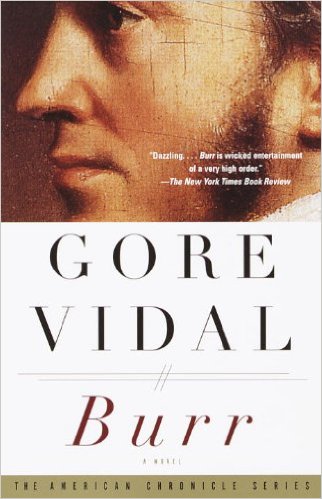
Burr (book)

Leslie Odom Jr. as Aaron Burr in "Hamilton" (2015)
We have spent the week vacationing with my in-laws. There are several ways to reach Athens, Ohio from Cleveland, none of them anything like a straight line. Though it is quicker to take I-71 through Columbus no one hates themselves that much, so we usually take 77 to Marietta and the one of a number of ways to get to 50 West.

A newly completed bridge, part of state road 50, spans the Ohio River, and lately we have taken that route. Connecting Parkersburg and Marietta (yes, you actually go through West Virginia for a few miles) it vaults over the western tip of Blennerhassett Island, site of an historic meeting which would doom the island’s Irish namesake and also the political aspirations of that most mercurial of American icons, Aaron Burr.

Blennerhassett Mansion, where the one-time Vice President and murderer of Alexander Hamilton met Harman Blennerhassett and his wife Margaret to make plans for an expedition down the Mississippi to New Orleans, was located at the opposite end of the island. An historic recreation of the mansion is there to visit today. Twenty-five years ago I performed in a musical inspired by these events, Eden of the River, which was presented on that site.

Driving or flying, as it were, over that island, as we do most times we visit my in-laws, I am reminded not only of all the time I spent on it, but how little of it I explored. It’s not a very large piece of land, yet the only time I stepped away from the boat landing or the area immediately surrounding the mansion was that afternoon I and another chorus member escaped to the woods to make out.

We didn’t go far and we did not stay long. You can interpret that as you will.

What was it like in December 1806, two hundred and ten years years ago, when Burr returned to Belle Prairie (today pronounced BELL-pree) to raise men, funds and supplies -- yet no weapons -- for his ill-fated expedition party? There was no bridge to the island, there still isn’t, this one goes over it, as I said, not to it. How dense the forest, how passable the terrain? Were there any native peoples in the vicinity, how isolated were the Blennerhassett from Western civilization?

The characters of Harman and Elizabeth do play an important role in Gore Vidal’s Burr (1973) an historical novel told from the point of view of the young Charles Schuyler (a fictional character and no relation to the Schuylers in the musical Hamilton) and the book is one part of a collection of American histories the author wrote and named Narratives of Empire.

Never read Vidal before, have to admit, I know him as a talking head in The Celluloid Closet, commenting on his own work as one of numerous writers for the screenplay for Ben-Hur (1959) starring Charleton Heston. Vidal's personality as an arch literary satirist of the twentieth century has largely come to me via osmosis. My father's shelves, which we are currently culling, include several of his works. I am under the impression that any man of my father’s generation with a standard liberal arts education would be wanting without them, though my father was better read than most. Certainly better than I.

The book has taken months for me to read, not because it is not compelling -- it is -- and a satisfying read. My days have been so long, my responsibilities continuous and varied, and though I would pick it up most nights I would only make it through three or so pages before being overwhelmed. I even tried reading a few pages that long, dark night of November 8, when my thirteen year-old daughter was so crestfallen over the election that she could not rest and we compelled her to sleep with us.

True, this novel's content pertains to history, American history, but removed as it was from current events it provided a mild distraction.

The girl with Nik Walker (Aaron Burr on tour in "Hamilton")
Cleveland, Playhouse Square (2018)
In fact, it is because of current events that the novel itself comes as something of a comfort. Vidal is a member of a bygone era, Vulture called him a “dapper, left-wing bomb thrower” -- not a literal bomb-thrower, but that kind of old-school gadfly who could verbally cut you to the quick and leave you incoherently enraged. But first you have to a) be listening and b) understand that you have been insulted. Today’s right-wing demagogues owe their present success by simply refusing to do either.

Burr, the novel, provides the author the advantage of furnishing savage commentary upon icons of American history from a vantage point twice removed, from either his main subject, once Senator, then Vice President, but always “Colonel” Aaron Burr, or from his narrator, Mister Schuyler, a young man who in the course of just a few years rises from a desperate, penniless, inexperienced newspaper writer to a comfortable position in the the Van Buren administration.

Schuyler’s commission is to write a memoir of the ageing Burr (now eighty, some got half as many) and over their time together not only develops great admiration for the Colonel, but also absorbs his worldview, restrained temperament and even to some degree his remarkably subtle wit.

It is this wit, however, in recounting Burr’s version of the American Revolution and all that came after, that provides the subject, and in fact the author, to portray George Washington as a colossal failure on the battlefield, exhibiting terrible judgement (and apparent fantastically large buttocks) winning only one battle -- Yorktown -- and not without foreign assistance.

Later it is Jefferson, not Burr, who appears to hold no moral center, shifting any position necessary to keep the nation a loose confederation of states, denying strong federal power and yet as President freely violating or proposing to violate any of new bill of rights to maintain the status quo (i.e.: slavery) or to destroy his perceived enemies (i.e.: Aaron Burr.)

Tony Fabio as Aaron Burr in "Eden on the River" (1989)
The legendarily soft-spoken Jefferson, always clearly articulating his position, is rendered a slippery cipher, always scheming, fiddling with his inventions, and in constant opposition to Burr, who, by his own description of events, made the appropriate decisions necessary for Jefferson to become President. For the sake of the nation.

Of course, this is Burr speaking. And he speaks to an impressionable man who develops such admiration for him, delighted by his “exquisite irony” and “serene good humor.” It takes a moment to realize that the true object of such compliments is Vidal himself.

And this is comforting how? Donald Trump has made a mockery of American history with his arrogant run for President. Assuming he would never win, he was also more successful as a sloppy, right-wing bomb thrower, capitalizing on resentment, anger and outright racism to propel himself to be the loudest and most visible opponent to Barack Obama. His goal was self-aggrandizement, but unfortunately for him and the rest of us, he now needs to lead, something he has never been successful at doing.

It is demoralizing to imagine we are ending an era in which a young Puerto Rican-American with a Broadway musical under his belt could be granted an audience with the President of the United States to rap a song about the largely unregarded first Secretary of the Treasury which caused a YouTube sensation which inspired him and a company of talented artists to create a new musical which sparked a national conversation on what it means to be American, to be America.

Donald J. Trump does not inspire confidence, he can’t make anything great, and the only artwork he has ever inspired in my neighborhood was a great, hideous nude statue someone dumped on Coventry last summer.

Vidal wrote Burr in the era of Nixon, his novel reeking of cynicism, every player a player, twisting words and circumstance to his own advantage. His America of the early 19th century is a murky backwater where the rich stuff their faces and drink and smoke and spit and talk and talk and talk.

"The Emperor Has No Balls"
Ginger (2016)
He chooses a protagonist in Aaron Burr, worshipped by the common people, heralded wherever he goes, once he has been exiled by proper society for the murder of Alexander Hamilton.* In tearing down icons and exalting this scoundrel, Vidal makes you reconsider all you believe you know about the Founding Fathers. Good Lord, the man even suggests Davy Crockett was raped first before being killed at the Alamo.

So, the United States of America has elected to be its Chief Executive a scoundrel, a self-serving villain who will do what he can to subvert the Constitution to maintain the status quo and destroy his enemies, again. We got this far, citizens. The Republic will prevail.

Exactly how we will overcome, that is a terrible mystery and one which we carry into the new year. It has been suggested that Vidal’s type of scorched earth criticism of those with whom he disagrees has brought us to our current level of discourse. For when your facts are correct, but you are arrogant about it, why would your opponent even respond with an intellectually supported response? Why not just say,”Fuck you, you’re wrong.” and listen to the multitudes cheer? It certainly worked in 2016.

*About that; Lin-Manuel Miranda’s Hamilton taunts Burr to mention a “specific grievance” from over “thirty years of disagreements” for which he should apologize, there was one specific, heinous, personal insinuation made by Hamilton in mixed company and behind Burr's back, an insinuation which had absolutely nothing to do with Burr’s political or professional machinations, which might lead one, were they so inclined, to challenge one to a duel.

 This post has been updated to include a photo from 2018.

Monday, April 11, 2016

Hamilton (musical)

Civics lesson from a slaver

Ken Howard died last month. A proud union actor and leader, he is remembered by most from the 1970s dramatic TV program The White Shadow. To many of us, he has always been the face we picture when we think of Thomas Jefferson.

I turned eight in 1976, the American Bicentennial. We visited Williamsburg, our class portraits included Betsy Ross’s flag, and I personally have a strong and intimate association with seeing the film adaptation of the musical 1776 on broadcast television.

The musical was originally produced on Broadway in 1969, when the U.S. was deep into Vietnam, the film version in 1972. For years, before cable anyway, it was rebroadcast around the Independence Day holiday. My family had the cast album, which we loved playing.

This story, depicting the signers of the Declaration of Independence as witty, flawed, somewhat crabby, but above all hopeful public servants was a helpful antidote to the general malaise of actually being American at that time.

It was much later that I learned, much to my disillusionment, that musical’s book compels the character of Jefferson to tell one whopper of a lie, in an obvious effort to leave the tall, awkward, Blythe Danner-loving redhead untarnished.

When debating the inclusion of language which would have publicly condemned the practice of enslavement, a South Carolina congressman reminds Thomas Jefferson of Virginia that he is also a slaver.

Jefferson states quietly, “I have already resolved to release my slaves.”

Actions speak louder. In reality Thomas Jefferson never released any slaves, with the exception of those he fathered, whom he conveniently allowed to “escape.” In fact, there was a practice at that time for slavers to put into their wills to grant freedom to those they held in slavery upon the slaver’s death. George Washington, for example, did this. Thomas Jefferson did not, passing possession of two hundred or so souls onto his heirs.

The worst sins of the historical characters in the musical 1776 is that they are a bit laconic and playfully lascivious.

Enter Lin-Manuel Miranda and the cultural juggernaut that is Hamilton. Inspired by biography and history, Miranda has single-handedly retrieved the least-known or least-understood of the “founding fathers” from obscurity by creating a vast and complex narrative which begs repeated listening. Most of us cannot hope to attend the production at the Richard Rogers Theatre, and have spent the past several months listening to the soundtrack, which weaves rap, hip-hop and R&B into traditional but staggeringly effective modern showtunes.

Part of the appeal of Miranda’s Alexander Hamilton is how unapologetic the character is. In fact, he is the diametric opposite of apologetic, he refuses to apologize for anything.

What is a legacy?

Recently I purchased the cast recording to In The Heights. Without question it is a very well-written show, fun to listen to, and inspiring. It is important that Latinx voices are being heard, on Broadway, that musical styles never before presented were in the mix, the faces, the accents, the names. It deserved to and received the Tony Award for Best Musical that it received.

Miranda wrote the music and lyrics for In The Heights, with a book by Quiara Alegría Hudes. Miranda also wrote the music, lyrics and book for Hamilton.

Hamilton is a monster.

My children listen to it, all the time, it is on before school and whenever we get into the car. My thirteen year-old child listens to it when they are doing their homework, every single day. My ten year-old son is working very hard to memorize every single word — especially the cabinet meetings. The boy loves the cabinet meetings.

Several of our elder child's friends are on board, and my wife sees her students sharing earbuds to listen between classes. I walk into the office of one of my work colleagues to drop off paperwork, she's listening to Hamilton. I keep seeing friends and colleagues surprise me on Instagram with their selfies at the Richard Rogers.

What is the difference between these two Miranda shows, or in fact between Hamilton and virtually any other Broadway show that has created a kind of widespread, “crossover” appeal that hasn’t been seen since perhaps the original production of Hair?

I think it's all the history.

Doctoral theses will be written, have been, are being as we speak, to be sure. My question is this; what is it about history which at once lends drama instant gravitas, but also compels great writers to reach deeper, go farther — and provides us the freedom to move along wherever it will take us?

The best example I can think of is The Crucible. Not a critically well-received drama when it was first produced, though it did win awards. But with that one play Miller reached far outside of himself to find the humanity in an arcane historical event and created the piece which I believe will stand the test of time, greater than All My Sons, greater than Death of a Salesman.

In one thousand years, Salesman may seem as obscure as The Women of Trāchis. But we will still be performing The Crucible, and it will play as fresh as it did in 1953, or as it remains today. Who is John Proctor? Who is Alexander Hamilton?

Well, he’s me, isn’t he? And who are you? Who are you? Who are you?

… Not Yet

There was a recent bit of unpleasantness regarding the open call audition for the national touring production of Hamilton. They were looking for “Non-White Actors” and said so, causing scores of melanin-deprived individuals to get the vapors. “Colorblind” casting is one thing, but to show blatant preference against a single race? This feeling of being treated unfairly just because of my skin?

White people cannot comprehend the idea of not being allowed to have something they want. Even something they do not want.

The fallout was that, in spite of several prominent examples of AEA productions which called specifically for “white actors” the call for actors for the tour was changed to a more inclusive, “performers of all racial and ethnic backgrounds.” In that way they are free to do what casting directors have done for centuries, and simply disregard any performer they feel does not suit the production.

At long last, white American actors will know what it feels like to "Audition While Black."

The non-white make-up of the original cast of Hamilton is, of course, part of what makes it unique. Miranda has said as much, that this is America today, representing America as it began.

It is that opportunity for creative representation which makes theater unique. The boy and I watched the movie Gettysburg last month, and while it strives for historical accuracy, the beards are a little difficult to take. Historical film wants to be accurate. The stage is all about the suspension of disbelief.

Recently I recounted an incident in which I debated with stranger about a production of The Crucible at the Cleveland Play House which featured a mixed-race cast. Watching an African-American actor perform John Proctor apparently disturbed this man a great deal, which I simply do not get. He saw a black man, I saw John Proctor.

Theater has always been a representation of reality and not an exact replica the thing itself. Anyone can play anything, if they play it well enough. Is appreciating this a generational thing? My children love the actors, singers and rappers who perform Alexander Hamilton, Aaron Burr, George Washington, Thomas Jefferson, Hercules Mulligan (EVERYONE loves Hercules Mulligan) each of them portrayed in Hamilton by non-white performers. My children are not stupid, and they are not confused by these performances, they are aware that actual men they represent were racially European-Americans. They just love the music, the words, the voices, the personalities.

The performance of their characters by those who are not white may have confused or confounded or even offended the men they represent. But would an eighteenth century man be any less surprised or scandalized or even offended by the music and lyrics of Sherman “1776” Stone? I do not believe so.

History has its eyes on you.

Much has been written about the historical accuracy of Hamilton, Miranda is pretty up front about that. Yesterday there was a piece in the Times about the accuracy of the politics of the piece, and how it positions Hamilton as a visionary hero and Jefferson as a villain.

Who cares. Really. This is a play. You are worried the kids are going to get their opinions on history from a Broadway musical? Sister, please, turn on the so-called news and listen to the outright lies being offered by real people. This is art and should be judged as art.

The fact is, the artistry is brilliant. The words, as blogger Tim Sniffen put it; "The words caressed my brain and flowed over my face like hot, relevant syrup." (Read the whole thing, rarely have I read professional jealousy so lovingly and hilariously expressed.) It is not a cop-out to remind everyone that art has a responsibility to reveal the TRUTH, and not to let facts get in the way.

What is exciting to me, personally, is that this is the first time my little family – wife, daughter and son – have discovered and been overwhelmingly excited by the same cultural object all at the same time. It is as new to me as it is to them, none of us are better educated than anyone else on this. I know my history, but my kids are closer to the pop culture and they are teaching me the memes the fandom, the inside jokes, the appearances on Jimmy Fallon, and everything else that comes with it in Twenty-Sixteen.

And after all, may I remind you; “I have already resolved to release my slaves"? Srsly? Don't talk to me about facts.

The Orphanage

We purchased the original cast recording in early February, less than two weeks before my father died. I remember this because he and my mother had visited one day during a snowstorm and we had a long afternoon talking. That’s what my father and I did, we talked. I was telling him about this exciting musical I was listening to, and how much I thought he would like it, because it is about American history, only I wasn’t sure he would like it because he couldn’t understand rap music. It’s not that he didn’t like rap music, it’s that he couldn’t understand the words going by so fast, and he found that frustrating.

The following Friday morning, I had just gotten out of the shower and received a call that he had suffered a massive heart attack, and that it looked bad and that I should get to the hospital as soon as possible. I learned later that it was far too late, but I dressed as fast as I could and drove across town and found myself suddenly, quietly blurt out, “stay alive …” and almost immediately wishing I hadn’t.

The days and weeks that followed we listened to the cast album, and I mean a lot. There have been and there continue to be a lot of drives between Cleveland Heights and Lakewood, and each time the kids ask if we can listen to Hamilton. I mean, my butt hasn't even hit the driver's seat and my kid says, "Hamilton."

So, to this guy, the sense of emotional emergency, and its aftermath, are all tied up in that period. Like my association between 1776 and the Bicentennial, I will always remember the events surrounding my father's death and discovering these songs.

And it is because of my father that I cannot make it through the closing song (Who Lives, Who Dies, Who Tells Your Story) without breaking into tears. After two hours of listening to his enemies — and even he, himself - describe Hamilton as an orphan, and also bastard and whoreson, the poignancy of his wife Eliza’s greatest gift, the Orphan Asylum Society of the City of New York (today Graham Windham) resonates deeply.

Because, you see, my father was also given up by his birth mother. My father was an orphan. And I can’t help it. In this song, I see him. I see him every time.