Showing posts with label Waiting For Lefty. Show all posts

Wednesday, June 7, 2017

The Crown (TV show)

John Lithgow (right) as Winston Churchill in "The Crown"
The problem with using the stage to make direct and obvious political statement is that the message can be misinterpreted, casually dismissed, or in the case of most local productions, singing to the choir or more often ignored entirely.

The first year of Guerrilla Theater Company our more obvious agitprop was leavened with playful absurdity, but as our more pointed statements we from time to time dismissed out of hand or criticized, we bent the rules of inclusion to force each of the performer-writers to defend the point of each brief vignette. In short order the creators of some of our most popular pieces decided to move on and our audiences dwindled.

When a company decides to present a classic piece of political theater, the language and situation would most likely not most obviously resemble contemporary concerns. When Ensemble Theatre presented Waiting For Lefty six years ago (to take one example) they strove for period accuracy in production in costume and design, but their video projections reflected the very recent Occupy Wall Street uprisings. And yet, the Great Recession was not the Great Depression and the pictures did nothing to change Odets' clumsy words. In spite of using David Bowie in the soundtrack, it was still more museum piece than think piece.

Timing is also important. Bad Epitaph produced Lysistrata in 2000, which was enjoyed as an absurd sex comedy, but as we were not currently engaged in an wars (at least not any we could see) the playwright’s original political intent was beside the point. We came a bit closer to the mark in 2004 when we produced Kirk Wood Bromley’s The American Revolution.

True, we made no obvious references to the present geopolitical situation, the early years of Bush’s war in Iraq, and the Colonial version of occupier and freedom-fighter, but just putting it out there seemed to make its own statement. As Plain Dealer critic Tony Brown put it, we didn’t need to be “ponderously obvious” about it, as that was his job.

“One imagines that if the revolutionaries were to say and do now some of things they said and did then, John Ashcroft probably would have them locked up without lawyers in the prison at Guantanamo Bay on terrorism charges,” said Brown.

Ladies and gentlemen, ponderously obvious.

The Trump era has invited a slew of productions of Julius Caesar, which has been an obvious go-to for those who would warn against tyranny in all it forms, for centuries. In New York this summer you can see a modern-dress production for free at the Delacorte in Central Park, or an Off-Broadway production by Access Theatre featuring an all-female cast and set in an independent, girls’ school.

Orson Welles' "Julius Caesar" (1937)
It is facile to swap out one political leader for another. Arguably when Orson Welles presented this work during the reign of Mussolini, that strongman must have appeared to be a literal incarnation of almighty Caesar. But Donald J. Trump more closely inhabits the strengths and failings of Caesar -- as conceived of by William Shakespeare -- especially in those scenes where he loudly protests his immutability even as he agrees with who ever spoke with him most recently.

But a military genius with an extensive record of victories on the battle-field? Darn that ankle spur.

The question remains whether or not political commentary on stage has any relevance at all. To those of us who are theater practitioners, of course it does. But most people do not see plays, are unaware of plays, are entirely unaffected by plays.

However, the extremity of the actions of and declarations from the Trump Administration have emboldened commercial entities, which would normally avoid controversy and offense. We live in a golden era of men in suits sitting at desks (and one woman standing in slacks) taking the piss out of the president every night of the week.

In fact, the word and actions of the young Trump Administration have been so extreme, and transparently anti-democratic, that any creative expression in regards to totalitarianism and propaganda in the service of such ends can appear to be intentional commentary on the current president.

Yes, sales of George Orwell’s 1984 spiked after the inauguration, but when Audible produced a television ad featuring Zachary Quinto performing an audiobook version, it created controversy. Reading passages from a seventy year-old book is commentary on Donald Trump? Whose fault is that, Audible’s, Orwell’s or Trump’s?

Hulu’s production of The Handmaid’s Tale includes scenes that appear to emulate the January 21, 2017 Women’s March, but production started last year, long before the election. How might this program have been received during a Hillary Clinton Administration? How significant is it a big screen Wonder Woman came out this past weekend and has broken all kinds of records including biggest opening for a female director. Has the disappointment and disillusionment of the past six months actually fed interest in such a vehicle?

Last week I started watching the Netflix series The Crown, which debuted four days before this past election. I like Peter Morgan, loved The Queen, The Audience. I’m an Anglophile, and my interest in the monarchy reaches beyond what is necessary to comprehend Shakespeare’s history plays.

With this series, dramatising the first months of the reign of Elizabeth II, Morgan seems to be a bit more heavy-handed with the exposition than with other treatises on Elizabeth Windsor, as though he assumes most of his audience will be American - or at the very least, not British. The idea of having to explain to the new queen that she chooses her royal name (her father George VI was born Albert, for example) is ridiculous, she knows that.

I’m loving John Lithgow as Winston Churchill, the first time I have seen any actor embody the character without doing a Churchill impression. Episode four, "Act of God," felt as though it too were mocking the new American President for his behavior, even though that episode, like the entire season, were all released on the same date, November 4, 2016.

The Great Smog of 1952
The Great Smog of 1952 was a bizarre weather event, an “anticyclone” which trapped air pollution - mostly the result of the use of coal for electricity and heat - over the Greater London area for several days. It was catastrophic, resulting in thousands or by some estimates over one hundred thousand deaths, due to either accidents due to low visibility or illness due to inhalation. These facts are a matter of historical record.

"Act of God" suggests Churchill, the Prime Minister, intentionally ignored scientific studies which made plain the health risks related to the coal-based power infrastructure and even reports that such a freak weather event were possible.

That I watched this episode on the very day President Trump announced the United States was withdrawing from the Paris Agreement wasn’t even the most alarmingly prescient element of this episode. That came when, in the midst of a national calamity, the Prime Minister was determined, during a cabinet meeting, on ranting about whether the Queen’s consort, Prince Philip, Duke of Edinburgh, should be allowed to train for a pilot’s license.

The comparison is ponderously obvious.

Source:
Freedom Rings With An Edge in “American Revolution” by Tony Brown, The Plain Dealer, 6/23/2004
Great Smog of London, Wikipedia

Monday, October 31, 2011

Waiting For Lefty (2011)

The People's Theatre is not aligned with any political party. That is the euphemistic way of saying that it is not Communistic, and its organizers wish you to be clear about that. - William F. McDermott, The Plain Dealer, 1935
When I moved to Cleveland Heights we had three theaters. Name me another American suburb that can boast having three theaters. Well, anyway, time passed and by 2005 we had none. Ensemble lost their lease at the Civic, Dobama had been evicted from Coventry, and like all things Jewish, the JCC had moved from Cleveland Heights to Beachwood.

The new Mandel Jewish Community Center has many exciting new features, but theater? Eh, not so much. Dobama managed miraculously to maintain an identity in the wild before returning to the Heights at their fine new home in the CH-UH Library complex. And Ensemble has carved a new home out of the former Coventry Elementary School, and a really great space it is.

Two out of three? Not bad.

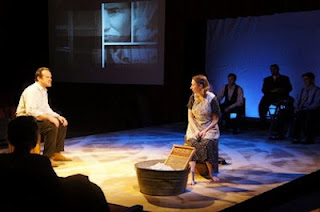
This afternoon I caught the closing performance of Ensemble's production of Waiting For Lefty, the first show in this new theater space. Life has not been kind to my wife's extended family the past several weeks, and in spite of wanting to catch numerous productions this fall, several closed this weekend without an opportunity for us to see them. At least I could catch this 70-minute program in my own backyard.

Seated in the front row, I invited Mike Partington to take the chair next to mine. It had been years since we had had the chance to talk, and this week I saw him both at Harvey's Tribute and in this place. Mike's got some years on me, our pre-show conversation had a lot to do with theater space, how he first reacted to the new Bolton Theatre at the Play House -- same as almost everyone else, really, stunned that they had dumped a thrust stage at East 77th Street to add yet another proscenium.

Ensemble Theatre has a thrust, with seating sections on three sides. It feels more like the old Dobama on Coventry than the new Dobama does. The platform stage is so close to the audience, and actors make entrances and exits through the house as well as through the wings. I love that.

I was very pleased to see such a large audience on a Sunday afternoon. Sunday matinees are notoriously depressing in Cleveland, with maybe ten to twenty people in the house. It was quite a full house!


So. First time seeing Waiting For Lefty in its entirety. How does it hold up? Interesting! While employing period costumes and some kind of non-specific tough-guy New Yawk accents, the Ensemble production utilized their large video screen to bridge scene changes with footage and music from the future (HUAC testimony, Occupy Wall Street demonstrations) to empasize the continuing resonance of the work.

Remember: The Living Newspaper performances of the 1930s did use film projections and live music to bridge scene changes, and as commentary!

However, having just directed a staged reading of It Can’t Happen Here, I have been disabused of the notion that writing from the 1930s is dated, or must feel dated. Sinclair Lewis words, spoken by a contemporary cast, was suprisingly fresh, meaningful, humorous and resonance with our modern audience last Monday night. People were taken with the story, and moved by its conclusion.

A friend who caught the show reflected how much more slangy Lefty is, which explains why it is seems dated. Also, there’s no real story to be swept up in, it is a collection of vignettes on a common theme. It’s like Saturday Night Live without punchlines.

But that’s not the real problem with its presentation as a contemporary work. It’s one long debate, more like Greek drama than soap opera. For example, the tale of a young suitor, on a perfect summer’s evening, breaking up with his devoted gal because he can never be the man that she deserves in this economy, where the bosses and the company men keep the worker under his boot, where a guy can’t earn a crust while Uncle Sam stands idly by, doing as little as possible because the truth is The Man still mans the controls of government and always will, so the little guy is left to gasp meekly for dignity - let alone a dollar, and its high time we pulled together and rose up to demand what is coming to us, an eight hour day, a pension and a heart handshake, but until that day comes I will never be the kind of joe who can care for a girl the way she deserves to be treated, and not like some two-bit floozy, always promising, never committing, I mean what kind of life is that for a young American lady? The Masters of Power don’t care about these things, the velvet-gloved capitalist executive sees the workers as an endless supply of hands and muscle to hoist the gears that make the things that fill their endless, bulging pockets …

Hey, baby, where you going?


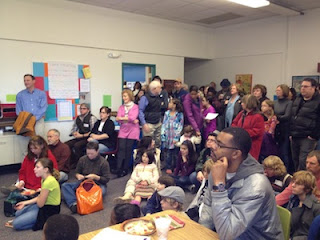
After the performance, the audience was invited into another part of Coventry Elementary (wait, do we have a name for this new community facility concept?) for a special event celebrating the opening of Lake Erie Ink.

What's that, you say? So glad you asked! It's a drop-on center for area youth with an emphasis on creative writing! HOW AWESOME IS THAT??? It's like an 826 Valencia for Cleveland Heights. I mean, it is an 826 Valencia for Cleveland Heights.


And wow-man-wow, there were a lot of people there! Cleveland Heights Poet Laureate Cavana Faithwalker represented, and world-renown hipster-shaman-beatnik-poet Ray McNiece was on hand to lead children in poetry exercises. There were a number of writing activities for young and old, I wrote a haiku on a paper pumpkin:

WORKERS THEATER
JUST SAW ‘WAITING FOR LEFTY’
LIKE AN UPPERCUT


Hey! You! Douchebag in the hat!

Tuesday, November 2, 2010

The Ostriches

People’s Theater Plays
The Cleveland Citizen, December 6, 1935

The People’s Theatre will present “The Ostriches” … a brilliant comedy on war written by Rudolph Wittenberg, who recently came to this country from Germany. The Theatre itself was organized last June to present plays of social importance to a vast audience of people who have never seen their own lives portrayed in the theatre.

Many unions have given their endorsement and a great number saw performances of an earlier production, the stirring “Waiting For Lefty,” which has revolutionized American theatre of today, both in method of presentation and in subject. Also a great number of unions in Cleveland have seen “Union Label,” a short skit which is part of its mobile theatre. In one week a play was written and rehearsed by the People’s Theatre and performed in conjunction with the Union Buyers’ Club at a benefit for the (Brunk) strikers.

War is declared in Europe and two neighbors in America join in hand-to-hand combat on their own territory. After being reconciled in jail they decide to prevent the horrors of war reaching this country by forming the “International Peace Co.” Interspaced with scene of hilarious comedy are realistic flashbacks which are signaled by descending sirens.

As the theatre was founded for the workingmen, the admissions price of 35 cents is also with his budget.
The Ostriches as translated by Howard Da Silva, opened on December 23 in a former nightclub at 4300 Carnegie. The opening night performance was delayed forty minutes (accompanied by the sounds of hammering backstage) and when the curtain finally rose you could see the wet paint on the just-completed set.
The People's Theatre is not aligned with any political party. That is the euphemistic way of saying that it is not Communistic, and its organizers wish you to be clear about that. - William F. McDermott, The Plain Dealer
Sources:
The Cleveland Citizen
The Plain Dealer
Showtime in Cleveland (Vacha)

Wednesday, August 4, 2010

Clifford Odets


Born 1906, Clifford Gorodetsky wrote Waiting for Lefty, went to Hollywood, and lost his teeth.

"Odets, where is thy sting?"
- George S. Kaufman

Named names before the House Committee on Un-American Activities in 1952, rarely wrote again.

Died in 1963 of colon cancer. He was 57.

Source: Wikipedia

Tuesday, August 3, 2010

Waiting For Lefty (1935)


Brian Pedaci was Harry Fatt

Life imitates art.

So now, after consuming several Federal Theater Project agit-prop "Living Newspapers" I finally turn to the grandfather of all labor agitation plays, Clifford Odet's Waiting for Lefty. Caught part of the Charenton Theater production, presented in a urine-scented alley as part of the Ingenuity Festival in 2005, but only the last few scenes.

Odet's play was first presented by the Group Theatre in March 1935. Harold Clurman famously described it as "the birth cry of the thirties." Framed by a Union Hall meeting, the play is a parade of brief vignettes, presenting numerous cases of injustice, or the Little Guy kept down by the Big Guy. Outrage is heaped upon outrage - marriages fall apart, relationships are abandoned, underlings are urged to spy on their co-workers, the well-connected are moved ahead, and there's even some examples of racism - against Jews, the only Black in the play is a lowly errand boy referred to by the 'n-word' who is never actually seen.

Surprising to me is how this play, which pre-dates all the others I have so far read (not itself a Federal Theater Project production) provides the template for those which follows. I understand that Odets did not create this form of drama, the episodic panorama on a common theme, but I did not expect it to resemble a Living Newspaper so closely.

In addition, events presented in this play, produced in early 1935, set the stage for the real-life events of late 1935 and 1936 in during the Akron Rubber Strikes. Lefty begins with Harry Fatt, porcine, cigar-chomping union boss, telling his constituents to sit still, forget about going on strike, that the union was looking out for them and that everything was going to be fine. This is what the national union organizers kept telling the rubber workers of Akron.

Even more hilarious; every time someone in the crowd speaks up, to question Fatt's call for calm and order, and reassurances that Roosevelt would take care of everything, Fatt immediately roars that the interlocutor is a Communist, a dirty red, and demands they be thrown from the hall. This was the same technique used by the union bosses in Akron.

This is not to suggest that substance followed form, or that Odet's was some kind of awesome prognosticator. No, it provdies me the education that these things were happening, this was the times. The only prophetic aspect of the production is the very end, when ordinary taxi driver Agate Keller takes the stage to speak, others rise to hold Fatt and his cronies at bay, and Keller stages a worker led call to STRIKE! STRIKE! STRIKE!

And so it finally happened in Akron - almost a year later - that the rubber workers stopped waiting for Lefty, refused to wait another day, and began the modern labor movement without a leader, and did it themselves.