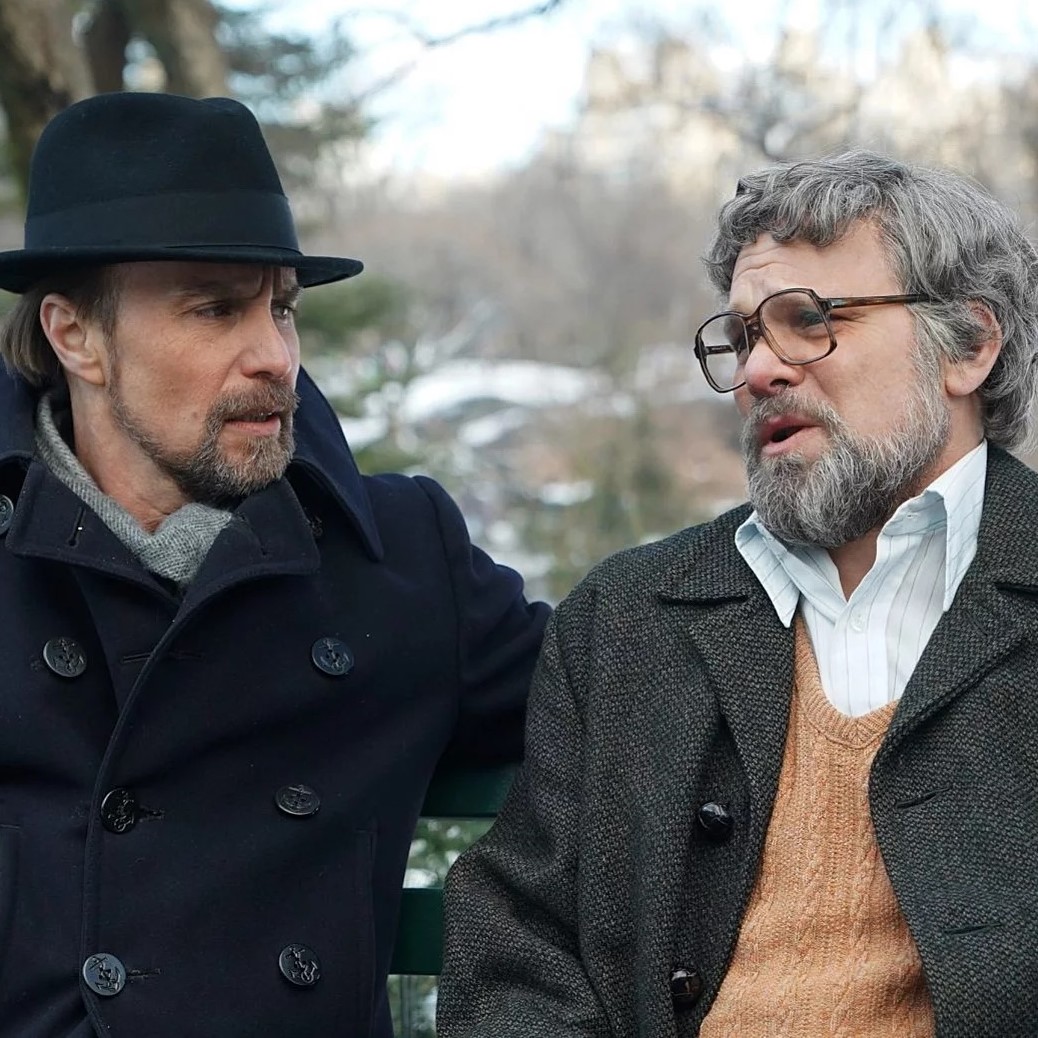
Ten years ago I wrote this brief reader response to The Plot Against America, today I finished viewing the miniseries adaptation for HBO. Like their recent reinterpretation of Watchmen, HBO has produced another high-concept "alternate history" drama which sings with contemporary importance.
Roth wrote his novel during the Bush era, and was frank about his having been inspired by the run-up to the Iraq War. Little did he know how events would play our during the final years of his own life. Having read the book myself during the Obama years, you can see how affected I was by the lies propogated by the "birther" movement, who sought to delegitimize the President.
And here we are. They did not need to work very hard to create images for this television adaptation which put one in mind of the Unite the Right rally in Charlottesville three years ago, and city streets in Minneapolis, Portland, and Kenosha.
What I did not mention in my decade-old blog post was how disappointed I was with the conclusion of Roth's book. Lindburgh flies to Berlin, a special election is called, FDR wins, and history as we know it continues. It is all too pat, too sunny.
This adaptation has a superior ending, and one which leaves me chilled. We hear Sinatra's rendition of The House I Live In, a lovely call for American tolerance and acceptance, and see people of all walks of life coming together to vote for a President.
We also see men in black removing voting machines from precincts, claiming they are broken, and white men burning ballots in abandoned fields. The Plot Against America program debuted on March 16 of this year, as the country was shutting down for the pandemic, and before the President began his most recent agenda, casting doubt on our elections and dismantling the post office.
"Happy Happy Bunny Visits Sad Sad Owl" (not actually) by Samuel Beckett, age 7 from "The Complete Lost Works of ..."
The last millennium, as any obnoxious numerology will tell you, ended at the stroke of midnight on December 31, 2000, because we count from one to ten, and not zero to nine.
Anyone with a social life or a personality or friends will tell you oh hell no, I was there and the new millennium began on January 1, 2000 baby, whoop whoop, that was awesome.
Which just goes to show that numbers are only symbols and the majority wins in the marketplace of popular imagination.
The year 2000 was, for me, an ending and not, as it seemed to me at the time, the continuation of a journey upon a determined path. I was newly wed, I had started a popular theater company, I was 32 years of age, and we had plans to start a family. And yet, there was a new me that was about to be born. My first life was about to end, for better or worse, and I was unaware.
Philip Bosco, Michael Cumpsty, and Blair Brown "Copenhagen" (Broadway, 2000)
The summer of 2000, my wife had left a job at a weekly newspaper to begin grad school, rehearsals were about to commence -- for both of us. Bad Epitaph was producing Cloud 9, and Dobama’s Night Kitchen her new play Angst:84. Late August, twenty years ago, and it was the perfect time to plan a weekend in New York City, to see old friends and even catch a show. We took the train. Time was expansive. We had no kids.
We had even gotten tickets to see Michael Frayn’s Copenhagen at the Royale. Science plays were all the rage, don’t you know. David Auburn’s Proof was transferring to Broadway that fall, Caryl Churchill's 2002 play A Number and Stoppard's Arcadia nine years earlier. Three actors walked in circles around a bare stage ("like particles in an experiment") talking about physics. It was a hit! We used to be smart.
It was a dare, taking a train and buying tickets for a show, and we just made it, too. Heading straight from the station to the theater, we shoved our backpacks under our seats, no time even to pee.
We were staying with her old boyfriend Harris in an apartment on the east side in the 60s. As the three of us made plans for the weekend, he suggested we see a show at the New York International Fringe Festival. I did not know what that was.
That night, my wife was having dinner with an old friend from Sarah Lawrence and so Harris and I had disco sushi at Avenue A and went to see a festival offering, FrankenClown, ostensibly an evil clown show, even promising “several slayings and raucous laughter” but turned out to be a pretty straightforward retelling of Shelley’s classic in clown make-up.
Home of disco sushi.
But. My God! Looking through the festival guide, there were over one hundred shows going on across the L.E.S. A happening was happening! I felt vengeful and jealous. Also old.
I thought of the past five years of my life, the several shows we had created in the Night Kitchen, original plays and ensemble-written pieces and long-form improvs, any one of them could have been submitted to this festival -- except it didn’t exist yet. The New York fringe began in 1997, and I left Dobama soon after. Alas.
After the show we caught up with the others and bar-hopped until about four a.m.
CJ does the thing.
The next morning my head and tummy were a little tender and so we lay low for the early afternoon. One of them said something about “CJ doing the thing” and I was the only one in the room who had not yet started watching The West Wing, they had to explain it to me. Harris downloaded “The Jackal” using LimeWire because we could not yet just dial up something from YouTube, so I could hear the song. It was peak Y2K.
That night we had more success with the fringe, joining a packed house at Surf Reality in the East Village to see The Complete Lost Works of Samuel Beckett as Found in an Envelope (partially burned) in a Dustbin in Paris Labeled "Never to be performed. Never. Ever. EVER! Or I'll Sue! I'LL SUE FROM THE GRAVE!!! It was created and performed by Theater Oobleck members Ben Schnieder and Danny Thompson, and Neo-Futurist founder Greg Allen and included elements of each companies’ work, particularly their high-brow loopiness.
By now I was in the zone and I desperately wanted to see one more show before we left. Sunday afternoon we packed our backpacks and headed back downtown for one more show. We saw the play Merrick's Gallery at the Present Company Theatorium on Stanton Street, headquarters for the entire festival. During intermission I nosed around, trying to gladhand one of the administrators.
I was bitten. This was the next step. Bringing a show to New York to participate in a festival like this was definitely on the agenda for the future. And the opportunity presented itself sooner than I imagined, though not with one of my shows. The Night Kitchen took my wife’s play, Angst:84, to the Fringe the next year, produced right there at the Present Company Theatorium. I ran sound for that production, and during my copious spare time took in sixteen other shows at FringeNYC 2001.
This experience did not start my new life, but in hindsight it was a piece of it. For the better part of ten years I had endeavored to create new works in northeast Ohio, to be a participant in making Cleveland into the theater city I knew it might be. And it's not like I hadn't attending storefront theater before in Chicago, the Twin Cities, New York, London, and elsewhere.
But to be confronted with the sheer massive scope of current theatrical productions, all in one place at one time, was to be more suddenly and deeply engaged in the national and global theater community. There was an element of FOMO to it, to be sure. I wanted in.
"Angst:84" company at the Present Company Theatorium (FringeNYC 2001)
I brought three of my own shows to fringe festivals, in New York and elsewhere. Did it make an impact on my career? Maybe. Was it fun? Sure. Did I learn anything? A lot. But it feels like a long time ago. And now I have, at last, started grad school.
Amy Salloway, who I met at the Minnesota Fringe in 2003, she said, "Fringe festivals are summer camp for theater people." For me, however, summer is over.
Sources:
Playbill, "Copenhagen" (Royale Theatre, 2000) Dog Days Sizzle for Theater's Off-Offbeat Pups by Jesse McKinley The New York Times (8/18/2000) The former Present Company Theatorium space was demolished to make way for luxury apartments in the late 00s.
I’m on social media. You’re on social media. I mean, you’re here, right now. Funny to think of something as old and tired as a blog to be social media, but it totally is. Welcome.
I have a dry wit, it comes from my mother’s side of the family. As she was swiftly losing her mind in early December, the nurses and doctors would test her faculaties by asking basic questions. Do you know where you are? What day is it? What year is it?
That last gave her trouble first. Then they asked, “Do you know who the President is?” After a brief pause she said, “Who can forget that?”
Learning the niceties of online communication has been hard-fought for me. But I have learned, like everyone else, to include an exclamation point to show the enthusiasm you might otherwise do with a smile. And to add a smile or wink emoji to let someone I know that I am saying something in jest. To them.
But if I am making a sarcastic comment on Facebeook, or especially on Twitter, it is galling to add “” or some other indicator to a wry joke. Drawing attention to the fact that my comment is not meant to be taken seriously ruins the joke. Either you “get” it or you don’t. If you don’t get it, it’s probably not a very good joke.
The other day, I posted something on Twitter, summing up my lack of respect for a certain political action committee, founded by a certain set of Republicans, who have made it their mission to make sure Donald J. Trump is not reëlected.
Liberals are thrilled, and to the extent that anyone wants to assign this president to the ashcan of history, so am I. But let’s not kid ourselves, if absolutely any other human were representing the GOP of the ballot, these fellows would be providing their money and support to the person. It’s not conservatism they despise, it’s just that man.
The Lincoln Project steals memes. (h/t JeffFromRegina)
They tweeted something which included the phrase “Are you in?” and urging folks to respond. I replied stating that I had: “Suddenly decided that after a lifetime of harmful, self-serving decisions, I actually don't want my obit to include the phrase ‘voted for Trump twice.’" and included their hashtag (see above.)
Two days later that Tweet has over 4,800 likes, and hundreds of retweets. Most replies congratulate and thank me. A small handful call me out for being stupid enough to vote for him once, and in that they would not be wrong, if it were true.
Because it was a joke. I feel a bit of what they used to call sheepish. But not much.
Several years ago my colleagues made up a little song, inspired by the song "Joseph Smith, American Moses" from the cringey and somewhat dated musical The Book of Mormon. It went like this:
“David Hansen ... American Playwright.”
That’s it. And that is how I became David Hansen, American Playwright. I put it on my Facebook page, and on my website. It does feel odd, however, to use that title, things being how they are. What do I mean when I call myself an American playwright? Am I one of those Americans?
No. At least I hope not. I am one of these Americans, which should be obvious when you read my work, which is much more sincere than what I choose to tweet. I put forth an America I see and would like to see.
But if you are unfamiliar with my work - unfamiliar with me - how can you tell? A white, cis-male of a certain age, perhaps my bold statement of nationality is an indication of some kind of jingostic bent.
In my individual pursuit of a more perfect Union, it is a risk I am currently willing to take.
Last month I was contacted by Giorgiana Lascu at the Center for Arts-Inspired Learning. She was seeking short plays for her high school aged interns to perform, record and edit as part of the ArtWorks program.
She had six young women and one young man engaged in performance and video production, and asked if I had any plays that weren't bound by race, gender or age. In fact, the vast majority of my short plays are written for anyone to perform! We spent an exciting afternoon as I pitched scripts and her protégés had a great time reading and choosing from them.
ArtWorks is a job training and arts education program, a paid internship, and these high school aged kids were to direct, shoot and edit these scripts, as well as perform for each other.
Thrilling for me is how teenagers interpreted the relationships in each of these pieces. "Driver's Seat" was written with a parent and child in mind. Here they are siblings or friends, possibly people in a relationship. "Confidence" was included in Savory Taṇhā, and it is fascinating to me how social cues change between age and experience. The text lays it all out for you, the question is how do you communicate?
My favorite reaction to "High" is what my mother-in-law texted me after watching it:
"sorry" 🙄
(lol)
"Driver's Seat"
Performed by Ta'niyah Richardson & Natozjah Johnson
"Confidence"
Performed by Yai Johnson & Miasia Wells
"High"
Performed by Al Gorman & Freddie French
Videos recorded and edited collaboratively by ArtWorks Theatre Co-Op 2020: Frederick French, Al Gorman, Yai Johnson, Natozjah Johnson, Ta'niyah Richardson, Dalaija Walker & Miasia Wells.
When I was in college, I used to make a mixtape every summer. I referred to it (to myself) as a “junk tape.” It was intended to be a document of the season, because I love summer so much, even when I hate it.
If there was a song I was listening to a lot, I’d add it to the tape. A movie I discovered at the video store, I put a snatch of great dialogue or music on the tape. Or moaning. You get what I’m saying.
Bumpers from Sunday Progressions, maybe I would record myself reading one sentence from a novel or a comic book. I still have them somewhere, from 1987, 1988, 1989, 1990 …
The 1991 mixtape was the absolute best. It was a complicated summer, the tape begins from when I left Los Angeles, and chronicles my being single in my new apartment, trying to rekindle a relationship, meeting people on Coventry, getting kittens, waiting tables, having troublesome one-night stands.
The following summer I was partway through creating my Summer 1992 mixtape when it, the 1991 tape, and my car, were stolen in New York City. I made summer tapes for a couple years to follow, but it was always with a sense of sadness for their lost brethren.
Rosencrantz & Guildenstern (1991)
The summer of 1991 still exists, of course, in my memory. Not many photographs, not much documentation, but I was there. Out there, on the street. Performing at open mics in the yard, handing change to addicts, listening to my roommate have sex, meeting characters. Laying the groundwork for my adulthood. But there is still an emotional gap, and it is recorded onto that lost cassette.
Now, unlike then, I have documentation. Gigabytes of documentation. But will this summer be absent in other ways? Because of everything that did not happen, or happened at a technological remove.
Will we hold memories of good times when our senses are not entirely engaged? All the cocktail parties, trivia nights, play readings and performances, did they actually happen if the people we interacted with were not in three dimensions? Have no odor? No observable feet?
CAMP THEATER
Trying the think back even two months is taxing. Each Friday I think, again? And yet, I will retain fond memories of this year's virtual Camp Theater!
However, though we all have made fascinating and in some cases groundbreaking discoveries in online and distanced performance, nothing compares to the energy of young people brought together to play and work, to act, dance, sing and combat, to dress up and stage work together, and I hope we never have to do it this way again.
Chase Kneuven & Alexis Long (Culver City Public Theatre)
THE WAY I DANCED WITH YOU
Our friends at the Culver City Public Theatre were forced to suspend their spring production of Romeo & Juliet -- and also their free, summer production of About a Ghoul, my children’s play adapted from Moroccan folk tales.
In lieu of these events they have hosted a series of virtual play readings, and I was very happy to witness their reading of my play The Way I Danced With You, directed by Lauren Bruniges and performed by Alex Long and Chase Kneuven.
Even better, they are currently in the process of creating a full, virtual production of Sherlock Holmes Meets the Bully of Baker Street, which will be presented on select dates next month.
Topsail Island, North Carolina
NORTH CAROLINA
Okay, I don’t want to get defensive about this but, okay? We went on vacation, and not just anywhere, but we went to the beach. I know what you’re thinking, you’re thinking, “what the fuck were you thinking?”
Look, it’s not like we went to Florida. I wasn’t soaking in a hot tub with two hundred strangers, I wasn’t soaking in coronavirus soup. My mother-in-law had rented a beach house before it all came down and we weighed our options and thought, well. We know this place. The beach is not crowded, we will social distance, be together as a family. No hugs, no handshakes. We’ll dine-in and enjoy the sun and try to create some sense of sanity.
I am reminded of freshman year at school. First years were not permitted to do acting work. As an extracurricular I volunteered to be a DJ for the green radio station, and one of my classmates mused that I had found a way to still be vocal and creative, even if I couldn’t do so onstage. It felt like that, almost like getting away with something.
Brian Pedaci & Zyrece Montgomery (Cleveland Public Theatre)
The fact that I conducted the final rehearsals and all of the performances from a beach house felt even more transgressive. This is how I get my kicks, I guess.
We had barely been home before driving off again, this time to Flood’s Cove. Heading out, I thought it was an unwise decision, and not for the obvious reasons. I have never arrived at the Barnstable without my mother there waiting for me. Stepping into that empty, unprepared cabin, was a challenge but I held it together. We closed the door to the first floor room she used to share with father, and just last year with Jacques.
My wife, my son, and I (the girl has a job and stayed at home) only this trio dined each night at the table which was traditionally full of Hansens and Bakers, Thayers, Kosboths and Tanskis. I wondered why I was there, was I there for me, or was I merely holding a place?
But as the week progressed, I felt my own place. The boy and I would fish, or he would fish and I would read and we went out on the water and I began to feel my own sense of ownership. And I knew I would return.
Many grateful thanks.
ESTATE SALE
Settling my mother’s estate has been a multi-level process, one which should have been resolved months ago but for the virus. Every time I go there I feel as though it will be my last, first to assess the estate sale team, bringing everything she has ever owned (she has owned, but also what he parents owned, eight decades of belongings) to be sorted, priced, and sold.
It was overwhelming. This is why you pay people to do things you don’t have the heart to do.
The sale was successful, ask me for a reference. I was out of town for the weekend itself, I was glad to be literally removed from town. But I still needed to return to haul out the garbage, the useless leftovers, the junk. The unwanted artifacts.
Waiting for the guys to come, the junk men. Lying on the floor of the dining room, the same space mom occupied in her hospice bed as she died. I hoped it would be poignant, that there might be some epiphany but mostly I just looked at my phone and dozed. CENTER FOR ARTS-INSPIRED LEARNING
As the summer was drawing to a close, I was contacted by Giorgiana Lascu at the Center for Arts-Inspired Learning (formerly Young Audiences of Northeast Ohio) to provide some short play scripts for her teenage interns as part of their end-of-season program of events. We spent a crazy morning pitching out scripts and her charges were very excited about getting to work on them.
In the past five months, folks have created nearly seventy-five short films from these scripts. I have actually backed away from writing as many, recently I have been playing with dialogue between a mother and daughter and I am not sure where that is going to go yet, but it is an exciting new journey.
Meantime, it does my heart glad to look back over the summer, to see it book-ended by Camp Theater, and by this project, enjoying the work of hopeful young people.
THE DECK
Five years ago we had our deck rebuilt and since that time I have taken loving care of it. We have expanded the furniture to include shelves and a small table, found on someone’s curb.
Houseplants and candles and twinkle lights and now it is as though we have added an entire new room to our modest abode. And we write and we read and we drink (we’ve recently cut the drinking) and relax and create and do our best to enjoy what we have and to make our way through.
I am anxious about the time we all have to go back indoors.
Thank you for listening to my Summer 2020 junk tape.
Several years ago, we had the opportunity to hear Ben Vereen speak as part of an arts education event sponsored by Cleveland State. Following his address, I met him and had a picture. I told Mr. Vereen that when I was a child, one of my favorite movies was All That Jazz and he gave me the most peculiar look.
All That Jazz is an autobiographical film, directed by Bob Fosse, ostensibly a version of his own life and career -- from his own point of view, of course.
My brother’s copy of the soundtrack album was in constant rotation in our house, all through the year 1980. That was my gateway to the movie, through the music, which I knew by heart well before knowing anything about the content of the film. Snatches of dialogue included on the record, like “It’s showtime, folks!” “Pretty pictures,” and “You can applaud if you want to,” became catchphrases, dropped into conversation among the many young people who frequented our home.
It premiered on cable in the summer of 1981, just as I had turned thirteen, and it was an event screening. A crowd was invited to our place to watch. Here my troubles began.
Roy Scheider & Ben Vereen (All That Jazz, 1979)
The story, in brief: Broadway director Joe Gideon (Roy Scheider) has been courting Death (personified by Jessica Lange) his entire life. He’s overworked, strung out on pills, cigarettes and alcohol, oppressed by his ex-wife and ex-girlfriend, producers, rival directors, and the critics. Through it all, however, he maintains a sense of humor, style, and above all, he is cool.
One very bad lesson this impressionable adolescent took away from the film, aware even then that it was based on the life experiences of the filmmaker, is that your personal life is fair game in the creation of your work.
And not by half -- Ann Reinking, aforementioned ex-girlfriend, plays a version of herself in the movie. How much more permission do you need to use facts from your own deeply personal or intimate moments in your stories, comic strips, plays? You don’t even need to ask permission.
Of course, that makes you a terrible person. But even that’s okay, because you are surrounded by terrible people. But you alone are cool.
Ann Reinking, center (All That Jazz, 1979)
Last summer, All That Jazz was playing on the big screen at the Palace, and I brought my daughter to see it. She was sixteen. I didn’t think the subject matter was more adult than anything she regularly watched on her screen.
Driving home, however, she said, “I don’t know why you wanted me to see that.” I knew what she meant. It doesn’t hold up. I mean, I think it’s hilarious. But in 2019, with my engaged and empowered teenager next to me, I was aware of how toxic the character of Joe Gideon is. How entitled, how arrogant, how terrible he is, to everyone. Unapologetic and manipulative.
It is just another Great Man story, where time and again Gideon (i.e. Fosse) is shown to take bad writing, bad performance, bad situations, and turn them into art. All by himself.
And then there is his long, drawn-out, graphic death. And we have all had enough death in this family.
Since the start of the pandemic, the wife and I have been making our way through TV series. Watched High Fidelity in March or April, very disappointed it won’t continue.
The past two weeks we consumed Fosse/Verdon, a high-profile event from last year, produced by the creative team from Hamilton, with a mission to set the record straight on Bob Fosse (played by Sam Rockwell), to incorporate the story of Gwen Verdon (Michelle Williams), his muse, collaborative equal and partner, ex-wife, and mother of his only child, into his creative legacy, a place where she by all accounts rightfully belongs.
Sam Rockwell & Norbert Leo Butz (Fosse/Verdon, 2019)
The eight-part program also passes judgment on All That Jazz, revealing it to be the flawed, solipsistic, and disingenuous thing that it truly is, Palme D’Or notwithstanding.
In the final episode, which focuses largely on the production of that movie, Fosse’s best friend, writer Paddy Chayefsky (Norbert Leo Butz) provides strongly worded and helpful criticism on the script, prior to production.
“The problem with your movie, Bob, is very simple. Your character doesn’t change. Your hero doesn’t change … none of your characters ever change, which is why your endings are always shit, I say this as a friend.”
This helpful piece of advice, “Storytelling 101,” says Chayefsky, is not heeded. Gideon dies at the end (a full eight years before Fosse himself actually did, in 1987) with everything a mess, his movie, his musical, his relationships, and everyone feels sorry for him. But death is not redemption. It’s just another number. Then Merman starts singing, “There’s No Business Like Show Business,” roll credits. Death is a joke. The ending really is shit.
Sam Rockwell as Bob Fosse Lin-Manuel Miranda as Roy Scheider (Fosse/Verdon, 2019)
The final moments of Fosse/Verdon, which portrays Fosse’s actual death, is just sad. A sixty year-old man has a fatal heart attack on the sidewalk, while his creative and life partner watches, helpless. Sad. That’s the problem with life histories, they always end in death. But the hero still hasn’t changed.
However, let’s back up a bit. In setting the record straight, Fosse is stripped of the cool with which he bestowed upon Gideon. Just-Bob is revealed to be terribly insecure, racked with doubt, and in constant need of emotional and artistic assistance from Verdon, a woman who is driven, determined, and very smart, who herself needs to appeal to the men who hold power -- most notably Bob Fosse -- to achieve her dreams.
She’s not a perfect mother, but Fosse is a horrible father (unlike Joe Gideon, of course) they are each negligent “Ice Storm” generation parents, it’s eleven o’clock and they have no fucking idea where their children are.
Here’s the thing, I really enjoyed Fosse/Verdon. I mean, I would watch both Rockwell and Williams in anything, anyway. It's gorgeous, it's dramatic, it's witty. But in the end, the series felt like a long, drawn out, somewhat depressing version of All That Jazz. Only now we have reasons for toxic behavior.
Sam Rockwell & Michelle Williams (Fosse/Verdon, 2019)
The behavior itself is not excused, but providing reasons, backstory, we do lean into forgiveness. And I am not sure that is warranted.
People without number have been molested as children, emotionally abused by their parents, had difficulty bearing offspring, but who are not themselves reprehensible in their behavior. Some of them are even great artists.
And while this may be the right time to reassess the life and artistic contribution of Gwen Verdon, once again she does the heavy lifting in a program which still feels like its mission is to rehabilitate the reputation of its more dominant, "Great Man" protagonist.
Alexander, rumors only grow. And we both know what we know.
On this date, four hundred and eighty years ago, July 28, 1540, Thomas Cromwell, Earl of Essex, Order of the Garter, Viceregent and Lord Privy Seal, was beheaded at the Tower of London by order of King Henry VIII for crimes of treason and heresy.
Spoiler alert.
Hilary Mantel’s trilogy of novels on the life of Thomas Cromwell each conclude with a decapitation. Wolf Hall (2009) with that of Thomas More, Bring Up the Bodies (2012) with Anne Boleyn, and with the subject himself in The Mirror and the Light, which was released March 5 of this year.
My wife gifted me with the hardcover just as we all went into quarantine. It took four months to read half of it, and the past week to read the rest. I thought several times of putting it aside, but I have developed an attachment to the character of Cromwell, not only as Mantel has painted him but also in the performance by Mark Rylance in the six-part BBC adaptation of the first two novels.
Thomas Cromwell (Hans Holbein, 1532-33)
Novelists who set a specific number of books to complete an epic story often find themselves trying to cram too much into the last one (Deathly Hallows comes to mind -- Half-Blood Prince, too, for that matter, maybe I'm just thinking of Harry Potter) and Mirror is the longest of this set, but for most of the first half I felt we were spending far too much time on tangential relationships and all the weird dishes that English men of wealth used to have for dinner.
Also, I have poor reading habits. I can take in maybe a page or two before bed and then I am spent. Summer vacation affords me the opportunity to sit and read, for hours. This past week I avoided work, both in my employment and my art. I set it aside. I vacationed. I went fishing with my son and I read this book. Once I could spend all of my time living in it, it came alive for me.
And it hurt. I knew how it was going to end, but I avoided delving into history to learn how or why beforehand. I even entertained the idea that he outlived the king and was put to death in the chaotic years that followed, but I was pretty sure there was no way that was how it actually happened. Henry VIII used people up, again and again, and it was Cromwell’s complicity in these acts which made it all but certain that he would eventually no longer be seen as useful to this monstrous monarch.
Rylance as Cromwell (Wolf Hall, 2015)
It makes sense that the primary reason for Cromwell’s fall from grace was that, having successfully played the role of pimp for a monarch who was increasingly desperate for a male heir, he contracted a fourth wife, Anne of Cleves, whom history has regarded as the king did himself: fugly.
To the author’s credit, however, she creates an alternative scenario inspired by true events. The ever-playful Tudor decides to surprise his betrothed before their appointed first meeting. This was a habit of his, as illustrated in Shakespeare’s All Is True, putting on disguises to the delight of the ladies long past the age when such behavior was deemed appropriate.
In Mantel’s version of events, unprepared for the arrival, it was the German Anna whose first reaction to the middle-aged, somewhat lame and already overweight Henry was a reflection of his own physical state that no one had yet shown him.
The best way to read.
Again, I am put in mind of the BBC adaptation, in which Damian Lewis portrays a hot king Henry, and wonder, if they are to create three more episodes to bring the tale to its conclusion, whether or not they would use the Billions star and if it is even possible to make this actor unattractive.
Cromwell’s downfall as depicted is remarkable, he never loses his wit (nor Mantel hers, the author’s sense of humor is a particular delight) and his death handled in a manner in keeping with my own recent philosophical imaginings on the subject. It broke my heart.