Showing posts with label film. Show all posts

Friday, January 24, 2025

CWRU 50th Annual Science Fiction Marathon

Pizzazz was a short-lived pop culture magazine produced by Marvel Comics from October 1977 to January 1979. Any given issue might include articles about Mattel’s Slime, Spider-Man, Shaun Cassidy, or the film Sgt. Pepper’s Lonely Hearts Club Band. It was also notable for including short comics of the first new Star Wars stories to follow the original film.

I had my tenth birthday during the all-too-brief print run of Pizzazz and I was absolutely the demographic. The June 1978 issue (“First National Edition!”) featured the article “Do-It-Yourself Guide to Day-And-Night Marathon Summer Vacation TV Watching.” A tongue in cheek piece (but I didn’t know that) it was intended for that kid who saw the summer as one long, boring stretch of nothing to do.

The story included tips on what to wear (ratty bathrobe), what to eat (and where to store it within arms reach), how to orient yourself in front of the TV, even what to use to change the channels without getting up (a grocery store stick) in the era before remote controls. Fans of Ferris Bueller might be interested to know it provides instruction on how to trick your parents into believing you are ill which includes making a tape recording of yourself coughing.

It Came From Outer Space
They even suggested using an egg timer to take naps during late-night commercials before the stations went off the air (they used to do that) and you could catch a couple hours sleep before sign-on.

After completing a week's worth of non-stop television viewing, the article concluded, “You’ve done it! You’re 10 times more bored than you were when you started. You swear you’ll never watch another minute of TV for the rest of your life. But just think how good the rest of the summer looks now!” Which is pretty much how I felt by the conclusion of the CWRU Film Society 50th Annual Science Fiction Marathon last weekend.

Since 1976, at this time of year, Strosacker Auditorium on the Case campus would be packed with nerds to watch non-stop flicks from Friday evening to some time after midnight on Sunday morning. I’ve been several times, usually to catch a few movies in a row depending on what was being offered. This year the rundown was so epic, I decided for the first time to do the entire thing.

Mars Attacks!
While I did not pack a ratty bathrobe, I did bring a change of pajama pants, slip-on shoes (not slippers) a pillow, and also a blanket that I never chose to use. I have been watching what I eat recently, due to an elevation in my bad cholesterol. For the marathon I brought no food of my own, only cash with a resolve only to consume what was made available. Before the show even began, that included a slice of Dewey’s pizza, a bag of popcorn and a Pepsi. It was luxurious.

We watched Ready Player One (2018) and It Came From Outer Space (1953) and for a midnight snack enjoyed a vanilla muffin with chocolate chunks. Every year there are two or three “surprise” attractions, and at 1:15 AM that was Mars Attacks (1996). I changed into my soft pants, settled in and promptly fell asleep.

One Million B.C.
I was a bit self-conscious about wearing pajama bottoms, I know the kids do but I’m not a kid. But then I saw grown men walking into the bathroom in their socks, so I stopped worrying about it.

In 1998, to promote the Dobams’s Night Kitchen long-form, sci-fi improv One Step Beyond, members of the company appeared at Strosacker during the marathon to play trivia and give away tickets. Thing is, we appeared twice: late Friday night, and again on Saturday morning. The thing we didn’t think of is that there’s really only one audience for the marathon. The second time I took the stage I was heckled; “Hey! I know why I’m in the same clothes I was wearing last night, why are you?”

I also slept through most of Disney’s The Black Hole (1979) and no one could blame me. By that time I had figured out how to curl into my lecture hall seat in the right way so that I could be comfortable. It was cute.

This Island Earth
One Million B.C.
(the 1940 one, not the other one) started a little before five a.m. and that kept my attention, if only because of all of the animals that were harmed or mutilated for its creation.

The first time I brought my son to the marathon was in 2017, when we saw Arrival (2016) and Hitchhiker’s Guide to the Galaxy (2005). The boy was eleven, he said Arrival was the best movie of that year. He’s never said anything about Hitchhiker’s Guide.

Thankfully, I had brought a toothbrush to the marathon, freshened up and got a cup of coffee. And they had apples! We saw This Island Earth (1955) and breakfast was a whole everything bagel from the Cleveland Bagel Co. with cream cheese and they also had Malley’s stuff here so I had two milk chocolate covered pretzels. It was heaven.

Wall-E
January 2020, four of us came to the marathon specifically to see Twelve Monkeys (1995) and before that, the short French film it was based on, La Jetée (1962). By then, we already knew about COVID-19, it just wasn’t here yet. It was a disturbing evening.

Next up was Terminator 2: Judgement Day, which I hadn’t seen in over thirty years. Forgot how young Ed Furlong is in T2. After, we enjoyed a program of the opening credits to a dozen or so Saturday morning cartoons from the 60s through the aughts.

One year — I think it was 1999 – they showed Until the End of the World (1991) and that was a doozy. A somewhat futuristic noir from Wim Wenders, the obtuse, three-hour plotline was complicated by the fact that the film canisters had gotten out of order, the audience was in revolt. Lone voices in the dark would occasionally cry, “WHERE’S THE SCIENCE FICTION???” and “AUUGGHH!!!”

The Lost World
The Wall-E (2008) screening at 11:30 AM included a trailer for Hello, Dolly! (1969) and shawarma from Aladdin’s. Then we watched The Day the Earth Stood Still (1955) which is possibly the greatest science fiction film of all time. I know this because I have seen it several times, usually at the marathon because they play it so often.

During a tense but quiet moment near the end I loudly observed, “... he came back to life – and his name is CARPENTER!” My riff was met by a cascade of groans and catcalls.

Did you know ..? The Lost World (adapted into a silent film in 1925) is the only short story by Sir Arthur Conan Doyle not to feature Sherlock Holmes? The midafternoon screening included a live accompaniment by Jeff Rapsis.

Godzilla
For dinner they brought in burgers, and I was surprised to see a large crowd of new audience members file in and fill empty seats for the 6:00 PM screening of 2001: A Space Odyssey (1968). Rumor has it it was assigned for someone’s class, but who wouldn’t take the opportunity to see Kubrick’s epic? I hadn’t even seen it until last year when it was streaming, and I was excited to see it on a big screen.

There was a bit of acrimony as some joining us had little patience for the riffing coming from those who had been there for almost twenty-four hours. Meanwhile, one of the men’s toilets was down. By intermission the burgers were gone.

Our first CWRU Science Fiction Marathon was probably 1996. I can’t recall going before that time. The Adventures of Buckaroo Banzai Across the Eighth Dimension (1984) which was on this year’s bill played that year, too. The riffing when Ellen Barkin appeared got seriously rapey and my partner loudly told them to knock that stuff off, and they did.

2001: A Space Odyssey
Trailers and shorts before the feature are always references – or clues – to the feature about to play. For Secret Film #2 they included trailers for Gorillas in the Mist (1988) and The Whales of August (1987) and the Looney Tunes short Rabbit Fire (1951). The movie? The original Godzilla! (1954) I was asleep by the time he crushed Tokyo. With two flicks left I put my pants back on.

By midnight, I was ready to cash it in and head home, but then I decided what’s the point of having done this if I wasn’t going to see it through? We finish marathons. Besides, I still had that pillow. I dozed through a lot of Deadpool & Wolverine and by 3:30 AM we all staggered out into the frigid morning.

“You’ve done it! You’re 10 times more bored than you were when you started. You swear you’ll never watch another movie for the rest of your life. But just think how good the rest of the winter looks now!”

Monday night my wife and I went to the Cedar Lee.

Friday, December 22, 2023

Hamlet & Me (Part V)

"It's me. Hi."
Derek Jacobi, Kenneth Branagh, Julie Christie
Hamlet, 1996
Look. I come to bury Kenneth Branagh’s Hamlet, not to praise it.

But how can you argue with success? It’s a brightly colored production with manically animated set pieces and swirling camerawork – Hamlet as an action film, which is fine! The character has long been described as a man who cannot decide, who is unable to “take action.” But he does! He’s always on the move! And Branagh makes him vital and exciting, not brooding and torpid.

I visit schools all over, have done so for years, and if there is a film version of Hamlet most shown in these schools, this is positively that one.

However, in the act of presenting the complete text, a four-hour endeavor, the entire undertaking feels rushed, under-rehearsed and not carefully considered.

Watching the film for the first time in a recently renovated Centrum Theatre on Coventry, I was impressed by the first soliloquy, “O, That this too, too solid flesh …” Not for the rendition itself (which is fine) but how long the take is. Branagh delivers the piece without a cut, and then the scene continues unbroken as Horatio, Barnardo and Marcellus enter to share the news of the ghost.

Long, uncut takes like this allow an actor to display the range of their stagecraft, and it’s like watching a good play, up close. Take for example Claudius (Derek Jacobi) seducing Laertes (Michael Maloney) into committing acts of treachery. It’s a great scene from the play, and one usually cut to the bare facts.

Unfortunately, as the film goes on these long takes feel like a method to rush the filming along. For the “rogue and peasant slave” soliloquy, which should be one of the high-points of any production, Branagh thrashes about with his limbs, frantically gawping as he trashes a map room. It may be emotionally appropriate, but the director in me wanted him to try it again. I was led to believe the whole production was so big he decided that there wasn’t time to get it right.

Other crimes, in no particular order:
  • Scary, scary Brian Blessed
  • Sexy Dane sex
  • Rapier javelin
  • Smushed Ophelia face
  • Christ pose exit
  • Jack Lemmon
And perhaps most egregious, the speech “How all occasions do inform against me” is depressing, not rousing. It is not “St. Crispin’s Day.”

As my father once told me, “If you aim at a king, you must kill him.” That summer I had already started to fantasize about staging some future production of Hamlet, and I would take my time in conceiving it.

Friday, January 14, 2022

The Tragedy of Macbeth (2021)

Denzel Washington & Frances McDormand
(The Tragedy of Macbeth, 2021)
Includes spoilers for Joel Coen’s 2021 adaptation of Shakespeare’s “The Tragedy of Macbeth.”


Recently, I have started attending the movies alone. This is something I have never liked to do, and I can even now count the times I have done so on one hand. But it’s becoming a guilty pleasure, made more accessible as my children are away or otherwise occupied, to claim this time for myself.

My favorite movie house is only a five minute drive from my house, Monday nights are five bucks, I get a beer and popcorn (popcorn all to myself, how decadent is that) and settle in. Things being how they are, I often have a row to myself. I feel like a king.

And speaking of kings (how’s that for a segue?) here’s the thing about Shakespeare. Like hearing the cover version of a classic standard, once you know a particular piece – Macbeth, for example – you no longer need to bend your ear to the language. You just know it, you’ve memorized it as you have a familiar tune or lyric. It opens up your senses to different productions, their interpretations, the design, performance, and so on, and you can even be surprised by words you hadn’t given much thought to before.

However, I am also at a stage in my experience with Shakespeare where I do not need to see certain plays ever again. And I won’t. While I will always seek out a new production of Hamlet, I never need to see As You Like It ever again, nor The Tempest, and certainly not Macbeth.

Michael Fassbender
(Macbeth, 2015)
I can find something interesting in even the very worst Hamlet (and I have seen the very worst Hamlet) but a bad Macbeth is tedious.

Enough folks warned me that the 2015 film adaptation of Macbeth, directed by Justin Kurzel and starring Michael Fassbender and Marion Cotillard was bloated, with an emphasis on visuals and a deep disinterest in the actual language that I didn’t bother to watch it. What’s the point?

However, I rushed to my local move house to see The Tragedy of Macbeth, directed by Coen brother Joel Coen without consulting the reviews, because I had faith in the director (who chose to use the full title, as I like to do for my productions) and in its star, Denzel Washington.

Some notable and striking design choices for this adaptation include, most obviously, the use of black and white. Also, it is filmed in 4:3 ratio, like you would for an obsolete television set.

These elements, and especially an entirely non-natural setting, are evocative of the German expressionist filmmakers. I’m thinking specifically of The Cabinet of Dr. Caligari, which, like, Macbeth, is a tale of madness and murder. The effect of the artificial sets and narrow field of vision is claustrophobic.

Conrad Veidt & Lil Dagover
(The Cabinet of Dr. Caligari, 1920)
Coen creates symbolic images using light and shadow, tall stone portals with pointed peaks take the shape of knives; in fact, the “air-drawn dagger” Macbeth sees is not some “fatal vision” but the door handle at the end of a long corridor, catching the light.

This moment is also significant, as Washington strides the length of the corridor, fretting this floating dagger and the murder he is about to commit, the camera cuts from the door to his face to his feet to his hand, the whole time reciting nearly the entire speech, clearly, and uncut.

So many of the important speeches of Macbeth and Lady Macbeth are performed in their entirety, or nearly so. The Coen brothers have always been brilliant with language in their films, but Joel Coen does not here presume his text is superior to that of Shakespeare.

Light and shadow, black and white, the use of confined space, Coen uses his actors and their surroundings like shadow puppets, creating striking images as they move across the screen.

Much well-deserved attention has been given to actor Kathryn Hunter, who plays the wyrd sisters, her preternatural movement and voice being central to the movie’s unsettling sense of the bizarre.

But Coen puts his own unique stamp on this often-interpreted play through his use of the Thane of Ross (Alex Hassell) a tertiary character who in this version, assuming lines from other otherwise unnamed characters, becomes a fly in the ointment. His actions are inscrutable and his motives unclear until the last moment of screentime.

Alex Hassell as Thane of Ross
(The Tragedy of Macbeth, 2021)
Is this Ross also a witch? His interaction with Hunter, thinly disguised as an “old man” suggests he may have been possessed, or a witch in the form of an ally familiar to Macbeth. As he mounts the stairs towards an emotionally weakened Lady Macbeth, he holds his arms crooked in such a manner that his cloak and figure suggest that of a bird – like one of the ravens which the Weird Sisters employ at several key moments in the film.

Finally, we see him spiriting away Fleance, the son of Banquo, fulfilling the sisters’ prophecy. Those familiar with the story might think this to be an unnecessary conclusion, but what of those who are not? Coming to Macbeth with no prior knowledge (as no doubt thousands of viewers will) the coronation of the callow Malcolm may seem anti-climactic. The succession of Banquo’s children is central to the plot, but the audience never sees it happen.

Shakespeare’s audience did see it happen, as they knew that their recently crowned King James was a descendant of the historic Banquo, and so do contemporary fans of the play. Coen makes Banquo’s triumph clear and evident, for all to appreciate. The charm's wound up!

"The Tragedy of Macbeth" is now streaming on Apple TV.

Wednesday, July 28, 2021

The Electric Hotel (book)

Pengo’s 2021 Summer Book Club

Last Christmas, my wife presented me with a copy of Dominic Smith’s historical fiction about the origins of the motion picture, The Electric Hotel. The New York Times calls this novel a “highly entertaining work about the act of creation” though by the time the word reached me, she, my wife, claimed it had been called the greatest book on the act of creation, which is to say ever, and that I found hard to believe.

As I have opined previously this summer, I do like works about the art of creation, but only when they are about other media; I like movies about painting, painting about dancing, dance about television, TV about theater, plays about writing, books about movies. But plays about theater are usually self-congratulatory and rife with inside jokes. Movies about movie-making can be awfully sentimental and hagiographic. Television programs about TV, don’t get me started.

There are exceptions, of course, and we all know what those are. But for every Sports Night there is a Studio 60 on the Sunset Strip. For every The Player there is Once Upon a Time in Hollywood (don’t get me started on Once Upon a Time in Hollywood.)

The greatest film about the art of creation is, of course, Big Night. This small, period film by Stanley Tucci and Campbell Scott film is a beautiful tribute to the immigrant American experience and all the dreams and disappointments that it engenders. But it is first and foremost an epic tale about the creation of food, what it signifies, why what we cook and how we cook it is important, never more poignantly exhibited than the single, five-minute closing shot, virtually wordless, which involves the preparation of a simple breakfast of eggs.

Stanley Tucci, Tony Shaloub
"Big Night" (1996)
The Electric Hotel
is like two books. One chronicles the very, very early days of cinema, when folks were happy to just watch short clips of cats doing tricks (yes, yes) and how in very short order unconscionable amounts of money were being spent to cobble together fantastic sights to tell stories of beautiful, horrible people. The other book is about the origins of the uses of film as documentary fact and also political propaganda.

The fact that we have not found any new uses for motion pictures in the hundred years since is actually quite demoralizing.

Each tale is presented as prelude to the narrative thread, the rediscovery of these ancient works by a young film historian in the early 1960s. This man is a cipher, it’s not his story and just as well little time is given to him. His presence is a constant reassurance that the films so elegantly described in Smith’s text will not actually be lost to fire, flood, or the natural decomposition of plastic nitrate.

But is it the greatest rumination on the act of creation ever set to paper? Actually, it may be. At least, it excellently represents the chaos of creation. So many biopics or “great man” histories create a familiar origin tale of those who were destined by the universe to become what they eventually, inevitably became. Against all odds! They rise and fall and rise again!

These fictional film makers, impresarios, side show and classical stage performers; they added their piece to the puzzle of how motion pictures work and what they could do with them. But there was no plan, no grand vision for what it would be. Lives are messy, and art is messy, it is only in hindsight that someone else decides whether any of it was worth doing.

Friday, April 20, 2018

Play a Day: Kiss Kiss Bang Bang

Stuart Hoffman
For Friday I read Kiss Kiss Bang Bang by Stuart Hoffman, and available at New Play Exchange.

I've been working really hard to get more Cleveland playwrights onto NPX, welcome to the crew, Stu! (No one calls him Stu.)

We grew up loving movies. It was a movie household. The folks would take us to see "foreign" films at art houses and on college campuses. My brother wrote reviews for the high school paper, we watched Siskel & Ebert when they were still on PBS. If you couldn't play Movie-Star-Movie, we couldn't be friends.

I thought I knew a thing or two before I took a summer course in film criticism at college. Jesus, what I didn't know. We saw not only La Strada (1954) and Seventh Seal (1957), but also Milos Forman's first English language film, Taking Off (1971) and the completely bizarre pseudosex-documentary WR: Mysteries of the Organism (also 1971). What did that lone horse wandering down the street mean? WHAT DID THE HORSE MEAN?

Thanks to cable, I watched movies all the time when I was a teenager. I saw Lolita (1962) when I was twelve, which is a complicated thing to say. My education in the Vietnam War began with Apocalypse Now (1979). And I believe Scavenger Hunt (also 1979) is a misunderstood comic masterpiece.

My ex-wife hated black and white movies. So, there you are.

Hoffman's script is sweetly smart romantic comedy (should I say "rom-com"?) pitting a slasher movie fan and host of a radio talk show against a film studies professor. It deals with what movies mean to people, and why some folks obsess about discussing and debating them. They discuss symbolism and sentiment, and how we talk about movies to share secret knowledge and express secret feelings.

It's really fun, with two complex and interesting leads, a play which deceptively explores and explodes storytelling tropes with wit and wisdom.

Tuesday, March 28, 2017

The Flick (2017)

"The Flick" at Dobama Theatre
Once upon a time, movie houses dotted the Cleveland Heights landscape like Dollar Stores do now.

My own children lament the loss of the Regal Cinema up at Severance. Sure, we can go to the Regal at Richmond for first-run movies or to Shaker Square, but they loved the idea of having a movie theater one block from our house.

Center Mayfield (1981)
Photo: Cleveland Heights Historical Society
I can remember the previous movie theater at Severance Center, which closed in 2000. When I was in college and just getting my east side footing, my new friends invited me across town to see Robocop, Dragnet … I must have been there a half dozen times during the summer of 1987 alone.

Never really liked the Regal at Severance and I don't like the one at Richmond ... mall movie theaters just make me unhappy. Like so many other hyper-business-structures, they redirected traffic from independent 35mm houses into their shiny multiplex madness, and now they too have fallen into disrepair, squalor and sadness.

The Center Mayfield was located not far from Severance, just up the street, a 1,200 seat house which was split and rather poorly, too, into three smaller theaters. The last time I saw a movie there was in early 1995, one of a few people in the house to watch Kenneth Branagh’s execrable Mary Shelley’s Frankenstein.

See, they’d cut up the theaters, but they hadn’t relocated the seats. In the middle theater, that may have been fine. But if you were in the left-hand theater (as I was) your seat would be angled slightly toward the right wall of the theater, you had to twist your spine a little to view the screen straight on. At that time I was awaiting a hernia operation and I do not remember ever being so uncomfortable in my life. And I was watching Mary Shelley’s Frankenstein.

Center Mayfield (2016)
Photo: Cinema Treasures
Not long after that experience, the Center Mayfield closed their doors. The following twenty-two years it languished, first as a Hollywood Video, then as a liquor store. A movie rental store with an actual marquee is not bad. A liquor store in a former movie house that couldn’t bother to remove the trappings of having more recently been a Hollywood Video, that was pathetic. January 2017, the entire building was bulldozed, and is currently a large, flooded pit.

The theater seats, however, had an afterlife. They were acquired by Dobama, and during the summer of 1995 were cleaned and installed in their former venue on Coventry until that company was evicted ten years later, in 2005.

A few years earlier, in 1992, business partners Charles Zuchowski and Morrie Zryl renovated the former Heights Art Theatre at the corner of Euclid Heights Boulevard and Coventry. Originally built in 1919, this movie house was best known for featuring pornographic films in the 1970s and 80s.

Centrum Theatre (1998)
Photo: cleveland.com
Rebranded the Centrum Theatre, I first saw a great many films from the 1990s there (Romeo + Juliet, When We Were Kings) as well as significant revivals. I had that rare opportunity few people have to first see Citizen Kane on a big screen, and also Orson Welles’s storied Othello.

Before we were married, my wife and I both worked at 1846 Coventry, in very the same building. I was down in the basement working as public relations director for Dobama (until 1998) and she was an editor for the Free Times up on the second floor. After work, we could walk around the corner to see a movie, just like that.

However, Zuchowski and Zryl sold the place shortly after the renovation, and the national distributor which had bought it sunk slowly into debt, giving up before the decade was out. The poster for the last film I saw there, Being John Malkovich, remained on display for the better part of 2000. Another company tried to revive the house but with little success. The Centrum has its final screening in 2003.

Meanwhile, Dobama Theatre had found a new home in the former YMCA space, now part of an expanded complex for the Cleveland Heights-University Heights Public Library. But they needed theater seats!

Guess where the theater seats came from? That’s right.

Annie Baker’s play The Flick follows the theme of disappointment in contemporary America set by her previous works like Circle Mirror Transformation and The Aliens. The story takes place in a rundown, independent movie house (in my mind I imagine the last days of the Center Mayfield) and the characters are an unlikely trio who manage and maintain the theater - we never see the owner - and set in the theater itself.

I am a great admirer of Baker's writing and was very excited when I first learned that Dobama would be producing The Flick. This new work created some controversy when it debuted at Playwrights Horizons in 2013. Some complained to the artistic director that the play is too long.

Seats go into the new Dobama Theatre on Lee Road (2009)
Photo: cleveland.com
That wasn’t the controversy, though, audience members will complain about anything. No, the controversy was when the artistic director sent a letter apologizing to their subscribers for not having warned them of the play’s length, which is bullshit.

Anyway, The Flick went on to win Baker the Pulitzer Prize, and you know what they say is the best revenge.

Dobama is where I have seen both Circle Mirror and Aliens, and each time I was first uninspired by the premise (evening theater classes, slackers slacking behind a convenience store) only to be compelled and moved by the characters, their stories, the plot, the performances. Last Thursday I had the opportunity to catch The Flick before it closed, which was a blessing.

One of the most interesting features of this play is where it is set. As I said, it takes place in the theater itself, not the lobby or at the concession stand, but in the house. Wherever this play has been produced the audience is first subjected to the somewhat disorienting picture of something which is at once completely familiar, but also not.

Detail.
You are looking at the back of a movie theater, facing the seats, the door you would have normally entered through to see the movie, you can see into the projection booth and what’s inside of it.

You are the screen. The absent movie going audience is facing you.

In the Dobama space, you may or may not notice that the seats on the set are identical to those you are sitting in. Not just the red fabric of the seats themselves, but the sides of the seats at the end of each row, are blazoned with interlocking “Zs.”

Two Zs, for Zuchowski and Zryl, seats custom-made for the late Centrum Theatre.

The Flick by Annie Baker was produced at Dobama Theater, March 3 - 26, 2017.

Wednesday, October 23, 2013

Nemo (1989)

Grip that pole, Nemo.

There has been one full-length animated film based on Little Nemo in Slumberland and the characters of Winsor McCay. A Japanese-American co-production it was released in Japan (titled simply Nemo) on July 15, 1989.

The Miyazaki film Kiki's Delivery Service opened one week later, and as the McCay-inspired work is entirely tedious and predictable and Miyazaki is a fucking genius, Nemo was a box-office disaster. Perhaps its mediocrity has to do with the fact that Chris Columbus has co-credit as screenwriter and everything he touches is awful.

I had never watched Nemo until after the rehearsal process for our Adventures In Slumberland began last week. However, I knew exactly what it would be, and how it would fail, and in what shape I wanted my guide-script to take in order to avoid those obvious, traditional pitfalls.

I needn't have been worried. This film never concerns itself with homage, it's just a stupid, noisy kiddie flick.

Things that are awful about this movie include:
  • The first five minutes are a horrifying nightmare rife with nakedly Freudian "rushing train" symbolism.
  • Though McCay's entire concept is predicated on Nemo's desire to meet the Princess, here he finds the idea repugnant because she's a girl.
  • Flip is voiced by Mickey Rooney. 
I could go on. What is most disappointing is just how pedestrian it is. Slumberland is exotic, perhaps, but nothing dream-like. McCay's stationary comic strip images are packed with explosive subconscious imagination, and nothing in this Nemo movie comes close. Huffalumps and Woozles owes much more to Little Nemo than Nemo does.


Nemo (the motion picture) also inspired a popular video game, Pajama Hero Nemo which is virtually indistinguishable from all other cabinet video games released in 1990 (X-Men, The Simpsons) in which a stationary protagonist while the background moves from right to left (side-scrolling) who just kind of destroys everything that enters their line of vision.

"Adventures In Slumberland, a holiday play of Little Nemo" is available in paperback and eBook.

Wednesday, September 18, 2013

Before Sunrise (1995), Before Sunset (2004)


Spoilers.

The other night the Cinematheque was showing all three of Richard Linklater’s Before films - Before Sunrise (1995), Before Sunset (2004) and Before Midnight (2013).

When it was first released in 1995, I did not see Before Sunrise and probably and would never have thought again about it, if not for the fact that my brother once asked if I had seen it and telling me how much he had enjoyed it.

Before Sunrise (1995)
Indeed, if I had seen that first part, at the time, I do not believe I would have enjoyed it. I had never been any kind of fan of Ethan Hawke. I was amused by Hamlet (2000), I entirely despised Reality Bites (1994). The guy is my age and supposed to be this important Gen X indie character but he always has always struck me as just a much softer Matt Dillon, and a bit self-serious.

When I imagine watching the movie on first release, as a twenty-seven year-old, when his character (Jesse) lays down the “jump ahead ten, twenty years, and you’re married” gambit to lure Julie Delpy (Celine) off a train to walk the streets of Vienna for one night, I would have bristled at its far-too cleverness. The movie asks, "Don’t you wish you had the stones to say things like that to pretty girls?"

Of course, I know plenty of guys who do deliver monologues like that to pretty girls to try to get what they want. Those guys should know these pretty girls always tell me about these hilariously precious attempts over coffee -- and about the sprawling, defensive emails that arrive the morning after, and we laugh. It’s fun.

Actually, yes. I am one of those guys. Or I used to be. One of those guys who would say those things. Sometimes it worked, especially on one night in July, 1994, and if it hadn't, I would not have been sitting next to my wife at the Cinematheque last Sunday night.

She and I had originally planned to see all three, but her work and my need to continue certain important house projects brought us to the sound conclusion that we should see the first on the big screen, and if we liked it, we would check out the other two at some future date.

As the credits rolled for Sunrise I turned to my wife and said, "We're going to stay for the second one, right?"

Before Sunset (2004)
What seemed bizarre, and as I said, contrived about the “jump ahead ten, twenty years” speech in Sunrise is that we know now that there are now three films (to date) which chronicle a single relationship between two people which spans (to date) almost twenty years. Director Linklater could not have known, making this inexpensive, independent romantic slacker film, that any or all of the artists involved would be available or interested in producing a sequel. Name another earnest, romantic, low-budget movie with a sequel.

Nineteen years ago I couldn’t have imagined sitting where I was, either.

We ran into friends at the theater, between the first and second movies, who assured us the third one (Before Midnight) is actually the best of the three, which I found incomprehensible. My expectations for the second were now high, if only because I had just found the first so well-made film, and so moving. I was actually giddy with anticipation to watch Sunset. But how could this second film be ... different?

The fact that a duology (let along a trilogy) had never even been planned, that the director and actors came together to write another movie about the same characters at a different stage in their lives, made it about what is rather than what was. Sunrise, the fluid meandering of one long night, as two twenty-somethings get to know each other, and the places that evening's wandering takes them (palm readings, poetry for spare change) became in Sunset the frantic, desperate chattering of two people in their thirties trying to recapture something they had, uncertain as to whether they could.

It wasn’t until Monday that it struck me that the entirety of Sunset is in real time. From the bookstore to a café to a boat to a car to home, without a break. An inexorable, 80-minute progression to where they wanted to be but could never have gotten to nine years earlier.

One of the traps the second film avoids entirely is any drama about Hawke’s character being married with children. I was wondering when he would bring it up, his wedding ring is certainly conspicuous. But she already knows. She’s read about him, he’s a published author, that’s how she found him. It’s a fact of life, they’ve been apart nine years. What was supposed to happen?

Before Midnight (2013)
But that walk up the staircase, and then settling into her apartment. Making tea, listening to music, slowing down, he knew he wasn't leaving. I was reminded of when my first marriage was falling apart, when I was already seeing the woman I am now married to. We had fooled around, it was frantic, my wife knew about that. She hadn’t said no.

Then we began arranging visits. Because I wanted to know what it was like to be normal with this new person. I told my (then) wife I was planning to get back to New York, to spend time there doing things with our mutual friend.

“You want to try it out,” she said. She knew. She was absolutely right.

We left after Sunset. We had to. A babysitter was watching our kids, my wife had papers to grade, I had grocery shopping to do. It felt like a such a betrayal, stopping here, leaving Celine and Jesse behind, when we knew there was more to the story, the hardest part -- the part where they are our ages. I mean, the ages we are right now.

She and I meandered around the Case campus, trying to find a place to eat. We walked and talked. I was giddy after the first film, after the second I just ached.

But I was relieved. So much frantic longing, which I am glad to say is in my past. I hadn’t waited, I took the leap back then and while it wasn’t easy. It wasn’t fair and it wasn’t nice. But it is impossible to say that it was wrong.

Ensemble Theatre presents the World Premiere of "The Way I Danced With You," opening March 21, 2019.


This post was edited 3/12/2019. These days I like Ethan Hawke quite a bit.

You can read "The Way I Danced With You (The George Michael Play)" today at New Play Exchange.

Wednesday, August 29, 2012

Winsor McCay, the Famous Cartoonist of the N.Y. Herald and his Moving Comics (1911)


http://www.talespinnerchildrenstheatre.org/performances/slumberland.htmOn April 8, 1911 this short film (popularly known simply as Little Nemo) directed by Winsor McCay and James Stuart Blackton had its debut. Only two minutes are actually animated, and the moving images repeat, and while fanciful, are of course very simply compared to anything we are used to. However, when you consider that McCay drew all four thousand pages himself, by hand, you have to admire his time, effort, and outstanding creativity.

This was not the first animated film, that honor goes to co-director Blackton, whose Humorous Phases of Funny Faces was released in 1906.


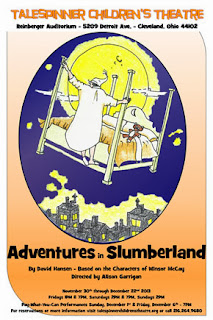
Talespinner Children's Theatre presents Adventures In Slumberland by David Hansen, Nov. 30 - Dec. 22, 2013.

Monday, December 26, 2011

The Adventures of Tintin


Belgian graphic designer Georges Prosper "Hergé" Remi (22 May 1907 – 3 March 1983) created the young, intrepid reporter Tintin (pronounced tan-tan, thank you) and the series of adventures which bear his name.

You know, there was a period during my childhood when my mother thought it would be a good idea to make family vacations out of my father's occasional international working excursions (he was in foreign exchange for Cleveland Trust) which brought me to England, Paris and Norway in the years 1977, 1978 and 1979. This comfy culture shock exposed me to Tintin, Rupert, Asterix and even the Smurfs years before my American contemporaries.

This explains my cosmopolitan world view, bizarre sense of humor, and my general sense of arrogance.

Did you know Inspector Thompson and Inspector Thomson are not brothers, let alone twins?
Tintin adventures stretched from 1929 to the mid-1960s though for me they always had a pre-war vibe. It makes perfect sense that Spielberg would choose to create a movie based out of this material, because the end-product is like Indiana Jones, only with a lot more reasonably acceptable slapstick. The CGI-effected performances make some of the more extreme physical violence a lot more funny and a lot less "Oh my GOD!"

What was most enjoyable for me was that the film plays like a Tintin novel, beginning with Tintin landing in the middle of a mystery, and progressing with great speed to a ship, to the middle of the ocean, to a desert to a non-specific Middle Eastern emirate ... it just goes and goes, no backstory, no Hollywood time wasted explaining who Tintin is, where he came from, even what paper he even works for. Just go-go-go.

And with the exception of an entire absence of tobacco products of any kind, its pretty damn faithful. Guns, whisky, blood ... and only one female character at all, the venerable Madame Castafiore. Tintin is a "boy's own" story, you want more girl characters, adapt something else.


For Christmas I got some of the new editions of Tintin, which are easier to hold but not to read (they are small) but include introductions to key characters which made leaping into what feels like an extended narrative much easier. Just reading half of Red Rackham's Treasure made my six year-old's idea of attending the movie much less fraught.

However, I will want to pick and choose which volumes to acquire or share with the kids, and not just because of the smoking or winking attitude towards Captain Haddock's obsession with drink. A number of them are pretty damn racist. Hergé famously had a world-view alteration from a Tchang Tchong-jen, a Chinese-born companion, which drove him to recreate most of his early work, especially the hideous Tintin in the Congo.

Sunday, December 4, 2011

Kill The Irishman

"Shillelagh!!!"

Kill The Irishman is the kind of film that makes me want to kill Irishmen.

I appreciate that this 2011 movie about legendary Cleveland one-time labor leader and full-time thug Danny Greene takes its liberties with history in the effort to create a gritty, 1970s era gangster flick. However, it paints its subject in such a flattering light that I cannot honestly tell if it is not meant to be satirical.

Let's get this straight ...

Growing up in Collinwood, Greene has the crap knocked out of him a lot by the Italian kids, which entirely justifies his virulent race-hatred for all Italians.

As a longshoreman, Greene was passionate about unfair working conditions. Working in 110 degree heat didn't harm him, because Danny Greene is Irish and stronger than most men, but it killed his Irish warrior pride that he didn't have the clout to stand up to the union bosses who demeaned his fellow workers. (Cue the low Irish whistle, you know, from Titanic, symbolizing 1,000 years of Irish dignity in the face of British tyranny.)

Soon after, Danny bitch slaps the President of the Longshoreman, and takes over. I mean he actually slaps him a couple times, and that it's it. Danny Greene is the president of the local.

At roughly the same time Greene has a few drinks at a local tavern where he is hit on by the sweet, Irish barmaid (played by Italian-American actress Linda Cardellini, which is funny when you think about it) and they have sex in his car. This is not torrid because there have been no mention of women so far in the entire film and so this must be a first time for him. It's okay because he will marry her.

However, before he can orgasm, one of his old friends knocks at the window of the car, with his new girlfriend's head on the dash and feet on the ceiling. Instead of doing what any other human male would do and tell his friend to get the fuck out of here, he pulls up his pants and goes to assist his desperate pal out of a fix with the Cleveland Italian mob.

In a life-altering decision, without which a good boy like Danny Greene would never have entered a life of crime, he gets his pal off the hook by assisting the Mafia with a heist on the docks. This explains why Greene so easily entered into a system of racketeering as a union boss, and by the look of things the only blemish in his presidency. Life was good, he married the only girl he'd ever had sex with, and he was kind and generous to all members of the union. You can tell because the union office used to look like shit, and Danny made it look professional and nice and well-lit.

It is a shame the police arrested him for stealing things all the time. He lost everything and had to move back to Collinwood, where he and his pals were good guys who even drove the disgusting bikers out of the neighborhood. Unfortunately, his current work as an enforcer (i.e., a dope who beats the crap out of people who can't pay back their loan shark) for Alex "Shondor" Burns meant his wife, who you have to admit after several years had gotten kind of shrewish over everything, left him. Poor Danny.

Shondor was a notorious leader in the Cleveland Jewish mob, and they got Christopher Walken to play him which means you know he's going to be eccentric and dangerous. Danny borrows money from him to open a legitimate Irish-themed club, and when the courier gets busted by the Feds, Shondor takes out a contract on Greene. Kill the Irishman. But Danny's not afraid, he has Celtic warrior blood in him. It was war between Danny Greene and Shondor Birns. Cue the mournful Irish whistle. I swear to God, if they had the budget they'd have gotten U2 to compose one of their fecking awful tunes for the closing credits.

Danny Greene was a good man, and he was always right. When he was ordered to whack a guy who was a good friend, he refused choosing instead to blow up his car as a warning. When the guy came at him with a gun, Danny was entirely justified to shoot him. At a time in history when every white man of his age and background supported the Vietnam War, Danny was against it, comparing American Imperalism in Southeast Asia to the British occupation of Ireland (cue the whistle.) When the now-single, porn-'stached, mid-70s Danny starts hitting on an 18 year-old stock girl at the West Side Market we know its true love because he's only been with one other woman, ever, and she left him.

Side note: Vincent D'Onofrio as Danny Greene co-conspirator and Italian mobster John Nardi ("The only dago I can stand." - Danny Greene) has the distinction of actually being more attractive than the historical John Nardi, while still having the face of Vincent D'Onofrio, and making a plate of crappy diner spaghetti look really seriously delicious.

Like other great movies that take place in Cleveland (Major Leagues, Howard the Duck) this one was not filmed anywhere near Cleveland. However, I was stirred by the establishing shot of downtown circa 1975, which removed the Key and Huntington Bank buildings from the skyline.


To be continued ...

Wednesday, October 26, 2011

Alhambra Theatre


The Alhambra was at 10403 Euclid at the corner East 105th Street. Built in just after the turn of the 20th century as a vaudeville house, legend has it the young Bob Hope was taken there by his parents when he was a boy. The young lad also hustled pool next door. In 1907 a church organ was installed, and they billed the place as "The House With the Organ." This was when the One-Oh-Five was called by some "Cleveland's Second Downtown."

As motion pictures took hold, the Alhambra became a movie palace. The place seated 1,100 in the mezzanine, with another 400 in the balcony.

The Hough and Glenville riots cemented the end of white Clevelanders relationship with the 105th Street district and it fell into steep economic decline. One black real estate developer, Winston E. Willis purchased a number of properties, opening small businesses to raise the level of opportunity in the neighborhood. However, the city took possession of property throughout the area by eminent domain to provide to the ever-expanding Cleveland Clinic.

1976

2011

Sources:
CinemaTreasures.org
Cleveland Historical.org
Cleveland Memory Project

Tuesday, August 30, 2011

On the Waterfront


On the Waterfront was directed by Elia Kazan and starred Marlon Brando as a dock worker who acts as a whistleblower against elements of organized crime among longshoremen. In 1954 this film, its director, leading actor and "Supporting Actress" (in a lead role) Eva Marie Saint won Academy Awards for their work.

In 1952 Kazan had testified before the House Committee on Un-American Activities and named eight members of the Group Theatre who had been Communist Party members or sympathizers during the Depression. This act was part inspiration for Arthur Miller's The Crucible, and led to Kazan's being ostracized from the Hollywood community for the rest of his career.

In 1999 Kazan received a lifetime achievement award, which was fairly controversial event as many members of the motion picture community, including plenty who did not live through the events in question, chose to sit and not applaud.

Many have suggested that this slighting of Kazan was inappropriate, especially as Hollywood warmly welcomed Charlie Chaplin home for a lifetime achievement award after years of exile as a result of the Red Scare. As Los Angeles film critic Kenneth Thran put it, "We applauded when the great Chaplin finally had his hour. It’s now time for Elia Kazan."

Because having a personal political philosophy is exactly the same as identifying others' political philosophies before a hostile government committee. But I sarcastically digress.

Kazan chose this project in response to his own persecution by those who judged his actions, not least of whom his collaborative partner, Arthur Miller. Marlon Brando as failed boxer Terry Malloy, doing odd jobs for a corrupt union boss, gently tending his flock of pigeons, is a troubled and sympathetic figure, raising pigeons and trying to get by. The most familiar, oft-imitated line is "I coulda been a contender," but it's what Brando says next -- the plaintive, "I coulda been somebody" -- that rings mournfully in my ears. Terry's decision, after he witnesses a murder, to testify in court against the union bosses, is the central conflict of the movie.

How this down-and-out lug daring to finger murderous gangsters compares with the artistically and financially successful Kazan identifying those who never committed a crime, I don't know. But we all like to think of ourselves as the underdog. Especially the gangsters, you know?

Sources:
FilmSite.org
ModernTimes.com

Friday, August 12, 2011

Breaking the Bank


The famous Cleveland Trust Ameritrust Society Bank Rotunda at East 9th and Euclid.

Read more about it here!

The Avengers have been wreaking havoc on East 9th Street this week. I am not talking about facelift they gave the street to make it look like Seventh Avenue in Manhattan. I mean literal (fake) destruction on a massive scale.


First off they deface the historic Cleveland Trust building.


Then HULK SMASH!!!


Witnessing the devastation, this woman from Shaker Heights said,
"I think it's fantastic! It's great for the city."

This afternoon I had a lunch date downtown and did my share of rubbernecking to take the sights of big trucks, large bits of fake concrete and no Scarlett Johansson. I thought the large, explosion-dusted billboards for AussieBum swimwear were a gag. But seriously? There really is an Aussiebum?

Sources:
ComicBookMovie.com
WEWSTV5
FOX8

Wednesday, June 29, 2011

Memphis Drive-In


The Memphis Triple Drive-In at 10543 Memphis Rd. opened in 1954, featuring three screens and showing a double-feature each night. On Fridays and Saturdays, they would then repeat the main feature. The venue held 1000 cars.


In my experience I have attended three drive-in movies, two in Athens, but the first at the Memphis Drive-In in 1986 to see Ferris Bueller's Day Off with my girlfriend.

The Memphis Drive-In closed on September 30, 2006, purchased by the adjacent American Greeting Card Co.


Sources:
driveinmovie.com
CoolCleveland.com
About.com