Showing posts with label Little Nemo In Slumberland. Show all posts

Friday, March 11, 2022

Process LVIII

Art: Winsor McCay
Folks like to get a lot of responses on social media by throwing out questions. What was the last movie that made you cry? Who was the most important teacher you ever had? Sometimes I respond to them if I have something worth reporting.

What I never answer is “What is your greatest fear?” That’s straight up 1984 shit. You can just imagine some government apparatchik taking notes and using your own fears against you in a torture room somewhere after the revolution comes.

My fears, my pre-adolescent fears, are the subject of a new script I am working on. It’s inspired by Little Nemo in Slumberland, only he never leaves his room. And there’s nothing particularly fantastical, no giant nymphs nor goblins playing only sexual anxiety, and the idea that someone will abduct you and you will never been seen again.

So, I was nervous about this. Or, if not nervous, then at least curious as to whether or not it would hold interest. Having it read aloud by the entire class, I was reminded of how upsetting it is. I have been amusing myself, writing about these terrible thoughts from my past. Because it is absurd. But it doesn’t play as absurd. It’s sinister. That’s a word that was used, it was called sinister.

I mean, duh. Of course it is. How could I trick myself out of knowing that?

Anyway, that’s one piece I’m writing for class. Before spring break I will turn in a proposal for Illness Narratives, for that I am investigating the writing notebooks I kept every single day throughout my mother’s decline. No idea what I’ll find there but I plan to start by writing a short piece about Thanksgiving 2019.

Yes. These are notebooks I have not yet burned. See you in two weeks!

Monday, December 10, 2018

Adventures In Slumberland (script)

Photo: Steve Wagner
NEMO: Can I help put up the tree? I want to go out into the street and sing carols and see all the people!
MAMA: No, no, no.
NEMO: I am missing everyone! They are missing me!
MAMA: Nemo, no one misses you, you are no-one.
Adventures In Slumberland was my first script for Talespinner Children’s Theatre, an adaptation based on characters created by the legendary comic strip artist and animator Winsor McCay.

Perhaps you are old enough to remember the animated film of the same name, which was released in 1989. If so, you have a poor idea of what the original comic strip (Little Nemo in Slumberland) was all about, trust me, my short play had little to do with that.

The great animator Hayao Miyazaki actually had a hand in that film’s production for a very brief moment before walking away. Among other problems he had with the production as it was developing, he reportedly could not get behind a story that literally takes place in a dream, because that means it isn’t real.

And he’s not wrong. You go to sleep, think a lot of amazing things, but in the morning you are still the same person you were when you went to sleep. None of it actually happened.

This, and other issues, were foremost in my mind when creating this play. If the protagonist is a five year-old boy, how might a dream actually change him?

And as it was to be a holiday play, shouldn't it all take place on Christmas Eve? But if the action takes place over the course of only one night, we would miss out on all those hilarious waking moments which concluded every single McCay Slumberland comic strip. I needed to resolve that issue, too.

Then there are all those so-called “Easter eggs” I was aching to include; nods to other pop culture references to Little Nemo, including those found in the comic book Sandman, lyrics from Genesis, and that more contemporary animation with a character named "Nemo." (Chennelle calls them Easter eggs, someone else might call them copyright violations.)

One of my favorite parts of McCay’s strip is how he was able to accurately depict what a dream looks like, how a dream works, how people talk in dreams. Also how maddeningly repetitive or frustrating they can be. Nemo spent years trying to reach the Princess, always failing just before waking -- because that’s what happens in dreams!

But meeting the Princess is a MacGuffin, not the actual goal of the adventure. Neither is finding Santa Claus. I loved including Santa Claus, but he’s not the main event, either! I am so subversive.

My first children’s play, Adventures In Slumberland, is a forty-minute, honest-to-goodness, Joseph Campbell-inspired hero’s journey toward self-actualization and personhood.

And it’s now available in paperback and eBook. Please share and enjoy with the literary manager of your local children’s theater, college or school.

Friday, December 13, 2013

Pogo (comic strip)


Okay, in the past three days I have experienced as many shouts out to Walter Crawford Kelly, Jr. (August 26, 1913 – October 18, 1973). The documentary Dear Mr. Watterson (Joel Allen Schroeder, Director 2013) is playing at the Cedar-Lee, and so my son, who loves Calvin & Hobbes, wanted to see the trailer, which includes this brief comment from Berke Breathed:
My initial impression when I saw him was, the guy's making it harder for the rest of us. Because he's setting ridiculous standards of excellence that hadn't been seen since the 'Pogo' years.
http://www.talespinnerchildrenstheatre.org/performances/slumberland.htmAnd he was right. Like many comic strips, Breathed's Bloom County was facile and derivative and a complete rip-off of everything that had come before. Calvin & Hobbes may in fact be in the top 5 greatest comic strips ever made, but Breathed's unnecessary use of the word "ridiculous" before the phrase "standards of excellence" only serve to undercut the compliment, and betray a certain well-deserved shame for his own limp work.

What are the 5 greatest comic strips of all time? Well, before Calvin & Hobbes began its run a Pogo collection was released (The Best of Pogo, Fireside 1982) and foreworded by Doonesbury scribe Gary B. Trudeau, who described Pogo creator Walt Kelly this way:
In my opinion, Walt Kelly had only two peers in the pantheon department, Winsor McCay and George Herriman ('Krazy Kat'), and of the two, only Herrimann could write as well as he could draw ... Kelly, however, was a triple threat; 'Pogo' was beautifully drawn, exquisitely written, and enormously popular.
McCay's weakness as a writer would later be echoed by Bill Watterson himself, though I find it difficult to separate McCay's unfathomable inventiveness from the process of writing. His dialogue can seem less than sophisticated, but as I described in my interview with Dee Perry last week, since most of his work is a representation of dreams, it only makes sense that the dialogue is broken up and non-linear, like snatches of what you heard the day before being processed by your subconscious.

Then again, if you ever read any of his personal correspondence, you would also know that Winsor McCay possessed poor grammar and used what can respectfully be called creative spelling.

To sum up, however, this morning I came across this status update from my university movement professor:

I called him on his Pogo reference, but then my eight year-old told me it is actually Pogo possum's friend Churchy the turtle who is triskaidekaphobic.

For the record, I echo Mr. Trudeau's suggestion that if there is a "pantheon" of cartoonists, it should include Herrimann, McCay and Kelly, but also Watterson and inevitably Schulz, whose writing and popularity are unquestionable, and whose drawing skills are deceptively masterful.

But three Walt Kelly references in as many days, just as I have been introducing my son to his work is a little unsettling, and also thrilling, especially when the comparison is made to Winsor McCay. If there is one character who would slip easily into the Okefenokee Swamp it would be that of Flip Flap, whose slangy American vernacular echoes that of Kelly's band of swamp critturs. 

 
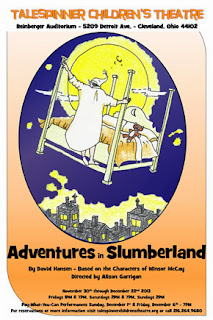
Talespinner Children's Theatre presents Adventures In Slumberland by David Hansen, Nov. 30 - Dec. 22, 2013.

Friday, November 22, 2013

Slumberland: Before Dress

Dream Master

Adventures In Slumberland opens a week from tomorrow. I had the opportunity to enjoy a run-through on Wednesday evening, the first opportunity they had to conduct one since the previous Sunday. The amount of work they had performed since my last visit, some ten days earlier, was remarkable.

Having the opportunity to share this comic strip, which had made such an impression on me and countless others, in a live stage performance, has been a, uh, well ... a dream of mine, for some time.

There have been other theatrical productions based on Little Nemo. In 2012, composer Daron Hagen and lyricist J.D. McClatchy were commissioned by the Sarasota Youth Opera to create such a work, and devised a two-hour opera, a hero's quest in which Emperor Sol seeks to destroy Slumberland by making it day all the time.

Lyrics include:
We need a world where things are different.
We need a world we can’t control, 
Where nothing is what it seems.
We need a world of dreams.
Even McCay himself produced a lavish stage production, with a cast of hundreds, of the kind only imaginable in the early 20th century opera houses or in university theater departments. My question was how could I write a script:
  • specifically for children
  • intended for a cast of half a dozen or so
  • produceable with a modest budget
  • running less than an hour
And even more important to me:
  • be always dreamlike
  • jump suddenly from place to place
  • feature a lot of characters
  • have no obviously coherent storyline
  • have always had a completely coherent storyline
  • NOT be a hero's journey
So much of what I adore about McCay's strip is that the language is completely bizarre. Maybe that was convention. Bill Watterson himself criticizes the actual writing in the strip, that the dialogue seems an after-thought. But I just find it all relevantly absurd.
NEMO: Santa Claus! What are you going to do? Where are we going? Where are your reindeer?
SANTA: Never mind, don't breathe.
Don't breathe? wtf?

I want to report here about all those items which are working so well in this expansive dream-in-miniature, but I am afraid of giving away anything. I can say this, every performer is filling his or her intended role just as I had hoped when we cast them.

Eight days now. They will be full days. Haven't even seen the costumes on them yet.

This is another dream I had.

Wednesday, October 23, 2013

Nemo (1989)

Grip that pole, Nemo.

There has been one full-length animated film based on Little Nemo in Slumberland and the characters of Winsor McCay. A Japanese-American co-production it was released in Japan (titled simply Nemo) on July 15, 1989.

The Miyazaki film Kiki's Delivery Service opened one week later, and as the McCay-inspired work is entirely tedious and predictable and Miyazaki is a fucking genius, Nemo was a box-office disaster. Perhaps its mediocrity has to do with the fact that Chris Columbus has co-credit as screenwriter and everything he touches is awful.

I had never watched Nemo until after the rehearsal process for our Adventures In Slumberland began last week. However, I knew exactly what it would be, and how it would fail, and in what shape I wanted my guide-script to take in order to avoid those obvious, traditional pitfalls.

I needn't have been worried. This film never concerns itself with homage, it's just a stupid, noisy kiddie flick.

Things that are awful about this movie include:
  • The first five minutes are a horrifying nightmare rife with nakedly Freudian "rushing train" symbolism.
  • Though McCay's entire concept is predicated on Nemo's desire to meet the Princess, here he finds the idea repugnant because she's a girl.
  • Flip is voiced by Mickey Rooney. 
I could go on. What is most disappointing is just how pedestrian it is. Slumberland is exotic, perhaps, but nothing dream-like. McCay's stationary comic strip images are packed with explosive subconscious imagination, and nothing in this Nemo movie comes close. Huffalumps and Woozles owes much more to Little Nemo than Nemo does.


Nemo (the motion picture) also inspired a popular video game, Pajama Hero Nemo which is virtually indistinguishable from all other cabinet video games released in 1990 (X-Men, The Simpsons) in which a stationary protagonist while the background moves from right to left (side-scrolling) who just kind of destroys everything that enters their line of vision.

"Adventures In Slumberland, a holiday play of Little Nemo" is available in paperback and eBook.

Monday, June 17, 2013

Winsor McCay: His Life and Art (book)


Zenas Winsor "Silas" McCay (c. 1867? – July 26, 1934) is the greatest comic strip artist of all time.* This I already knew, but I learned a whole lot more from John Canemaker's biography.

Yes, I knew McCay started at the New York Herald and later brought Little Nemo to the New York American, where he changed the name of the strip to In The Land of Wonderful Dreams. What I did not know were the circumstances or why his later dream-like comics were not as noteworthy as the work he did at the Herald.

McCay drew several comics at once for the Herald, including Dream of the Rarebit Fiend, which was like Nemo in that it dealt in dream imagery, but in this version the protagonist of each strip is a different, unnamed adult each week, who have troubled dreams, some of which are grotesque or downright horrifying. One is buried alive, their sleep mistaken for death, another drained of blood by a giant, opportunistic mosquito.


All William Randolf Hearst knew was that Winsor McCay was the preeminent cartoon artist in the America (indeed McCay was -- a star, a name, someone famous in his own time) and so he wanted him for the American. What he did not want were the comic strips. Hearst wanted the greatest comic draftsman to illustrate his worldview and send it across the world. In time he insisted that McCay concentrate solely on editorial cartoons, and paid the spend-thrifty artist enough to get what he wanted.

One other fascinating and not-generally-known aspect of his life and work is what he contributed to animated cartoons. He did not, as some had said and McCay himself often repeated, "create" the animated cartoon, but he was very good at them and pioneered many techniques which brought them from simple curiosities into the realm of serious storytelling.

Whereas someone like Georges Méliès would create fantastic images of non-realistic worlds, McCay aspired to use cartoon animation to document realistic events which could otherwise not be presented to the eye.


In 1918 he released The Sinking of the Lusitania, a photo-realitsic record of what contemporary accounts reported at the time was how the great ship was destroyed and sank. Debates continue as to whether this ship, which was secretly transporting munitions to Great Britain was a legitimate military target. Regardless, this is a surprisingly affective short -- in spite of two goofy fish "seeing" the oncoming torpedo and getting away quick.

It struck me as particularly troubling that this man, who contributed so much with his pen, was overcome with horror at the moment of his death, believing he was experiencing his greatest fear. He had suffered a brain aneurysm, and first felt his right arm -- his drawing arm -- paralyzed. He shouted out to his wife Maude, "It's gone, mother! Gone, gone, gone!" With that he fell to the floor, and died.

One of the more surprising discoveries in this book is an illustration not by McCay but one of his contemporaries and good friends, Ap Adams. The author does not give the rendering a title or an indication of its context, nor does he understand or feel necessary to explain its origin.

New York American cartoon by Apthorp "Ap" Adams
April 26, 1936

Father Time stands over one man as he progresses through his life as crying child, a schoolboy, young man with a handwritten love poem, a soldier, lawyer, old man and complete senescent. These are, of course, the seven ages of man as described by Jacques in Shakespeare's As You Like It.

I will be writing a great deal more about the Seven Ages in the months to come.

*But don't tell Bill Watterson that.

"Adventures In Slumberland, a holiday play of Little Nemo" is available in paperback and eBook.

Sunday, December 30, 2012

Little Nemo In Cleveland

Just prior to switching from the New York Herald to Hearst's New York American newspaper, in 1911 Winsor McCay sent Little Nemo, Flip and Imp on an airship tour of the United States, stopping in all the major American cities. Guess where they landed in March? Cleveland!

NEMO: We ought to have a good time here next week! Cleveland is a great city!

In the panel above, we see a photo-realistic image of the Public Square (pre-Terminal Tower) facing east. See the Soldier and Sailors Monument, Superior and Euclid Avenues stretching out to the horizon. If it were not for those three significant landmarks, the place would be unrecognizeable, none of these building still exist and so many were yet to be built. Even the May Co. building would not be constructed for another three years.

NEMO: Cleveland is a beautiful city!

A young volunteer leads Nemo around and shares a raft of statistics. For example:

"Cleveland has three thousand streets; over 300 miles of sewers, an' 200 miles of paved streets. We have sixty thousand dwellings, 18 big hotels, 3000 factories employing sixty-five thousand people! There are seventy-five public schools, 5 high schools, one thousand and five hundred teachers and 60,000 pupils!"

:::Sigh:::

The American Chicle Co. You're welcome.


This post has been updated.

Friday, December 28, 2012

Slumberland: It is happening again.

My mother-in-law loves me.

2:58 PM - Another day, another Donkey. Today the wife is not feeling well, but the kids already have a date to check out Monsters Inc. in 3-D with their aunt and grandmother, and so I have persuaded her to make our third journey into the Writers' Warren.

I have been storyboarding scenarios from Little Nemo, some of which are taken wholecloth from the strip, embellished from my own imagination and unhealthy nods to other McCay-inspired entities which include (but are not limited to) Sandman, In The Night Kitchen and maybe even Twin Peaks.

Also, too: This.

But they are disjointed and incoherent, as in a dream. Did I say that, or only imagine I did? In any case, that is the plan. Having just made stuff up off the top of my head, I will now make notes to put it into a logical, plot-like narrative. Which is the opposite of what I usually do. And that can be fun.

Did I mention my mother-in-law got me a proper, leather satchel for Christmas? Since I got my laptop, I have been permanently borrowing a prop from the Great Lakes Theater production of Julius Caesar (2004) where all the workers in the street  at the top of the show were vloggers and bloggers. That synthetic, black man-bag had a nametag reading "Nick K." in it.

4:01 PM - Bryan Ritchey will be my Carel Struycken.

And the owls are not what they seem.
http://www.talespinnerchildrenstheatre.org/performances/slumberland.htm
 The Dreaming:
Recently I was rehearsing for a professional production of one of Shakespeare's lesser-known works. Don't ask me which one it was, but I was a Lord. As part of the rehearsal process, the director was conducting a kind of free-form, staged read-through, where we walked into the middle of the rehearsal space and performed our particular soliloquy. It was one of Shakespeare's works where none of the characters talk to each other, they just just take the stage and share part of the narrative with the audience and exit. I read my piece twice. Each time I reached the word "egg" and then completely lost the thread of what I was saying. "Egg" was entirely out of context for this character, it didn't mean anything.

After my part of the rehearsal was through I went back to the Arden and looked up the longer notes, which I was embarrassed to learn I had not yet done. I assumed I knew what the words meant, but I was woefully unprepared. "Egg" was the most important word in the monologue. It was the core of my character, I had no idea what the hell I was doing.

These things are true. All of this has happened before. All of this will happen again.
4:43 PM -  Did you know Little Nemo visited Cleveland? Crazy, right? I have not yet read all of the comics as late as the 1910s. But I must, I must!


Today is a day for letting my mind wander and discover. Running this morning I came up with several ideas which I have tossed around and made note of. And now I just spinning some nonsense into script form.

5:44 PM - Time for dinner at Casa Nueva, suckers.

Talespinner Children's Theatre presents Adventures In Slumberland by David Hansen, Nov. 30 - Dec. 22, 2013.

Thursday, December 27, 2012

Little Nemo Meets the Princess

Sunday
July 15, 1906


All the servants of Slumberland have worked for over a year to bring Little Nemo to the Princess to be her playmate.


Their efforts have been thwarted by Flip Flap, jealous of the Princess's affection for Nemo. Just prior to this day Flip was rendered "awake" by Dr. Pill and taken away from Nemo and the Princess who met only briefly before Nemo woke up calling, "Aw mama, can't I sleep a little longer?"


Flip is nephew to the Dawn, and has previously asked his help in waking up Little Nemo.


~~ END ~~

Sunday, October 21, 2012

Twenty-Thirteen

Last night we attended the second annual Talespinner Children's Theatre benefit at Mahall's in Lakewood. Theme for the evening was "Glam Rock" which for some reason the kids today confuse with Hair Metal ... my wife almost cried when we had to explain to one of our party exactly who David Bowie is.

Regardless, it was a tremendous evening. My favorite moment of the night was before we'd even left my parents' house, watching the girl spraying my wife with glitter in the driveway. Precious moments. I knew I wasn't going to swing any kind of Lou Reed look, I can't fit into those pants right now. But a headpiece in the education department rehearsal space gave me an idea, and so I cobbled together an ensemble inspired by Ming the Merciless. I am glad to say there were several on hand who didn't even recognize me at first glance.

Followers of this blog may notice a certain slacking off since Styles closed last March. Henry VIII inspired numerous entries about production, and there were the occasional events which warranted mention in a Cleveland-writing blog. But there's not much research going on, not much to share Just my day-job, and my home-life. This will all change very shortly.

Next year will be busy indeed. I have three productions in 2013, one of which was announced at the benefit last night and I am now free to discuss all of them.

"DOUBLE HEART (THE COURTSHIP OF BEATRICE AND BENEDICK)"

Every year, Great Lakes Theater offers a free play which tours 21 locations in Cuyahoga, Summit and Lorain Counties that is tied to themes represented in one of its mainstage productions. This March they will present Shakespeare's Much Ado About Nothing. Several years ago I saw a production and a certain exchange jumped out at me:
Don Pedro: Come, lady, come; you have lost the heart of Signior Benedick.
Beatrice: Indeed, my lord, he lent it me awhile; and I gave him use for it, a double heart for a single one.
And their history as lovers, or one potential history, was revealed to me. I was elated when Daniel gave me the green light ... on one condition.

He asked, "Can you write it in verse?"

Uh. Sure! And that's what I have done. One hour tragic romance told in verse, including humor both high and low, a sword fight, and dancing! For those who can't get enough of me, I will be playing four different roles in this one. Sigh.

"THESE ARE THE TIMES"

Yes. At long last, the so-called "Cleveland Centennial" which inspired this blog will come to a stage near you. You have three chances, March 7, 8 & 9 to experience this fictional panorama of Cleveland during its heyday at Cleveland Public Theatre.

Ten years ago, CPT started its popular Big Box series, giving local artists the opportunity to showcase new works. That year -- 2003 -- I had the unique chance to share my first solo production, I Hate This (a play without the baby). I can't express how excited an apprehensive I am about having the chance to get a reaction to this new piece from a Cleveland audience.

"ADVENTURES IN SLUMBERLAND"

For the 2013 Holiday Season, Talespinner Children's Theatre will present this world premiere adaptation, based upon characters created by Winsor McCay for his groundbreaking comic strip Little Nemo in Slumberland. For Pandemonium I developed a five-minute treatment. It was a delightful experience, and made me feel confident that I could expand it into an hour-long piece for kids.

We decided not to use the name of the main character in the title, because everyone would think it was about a fish.

Last night at the benefit I won for Best Costume: Male. It's going to be quite a year.

Wednesday, September 12, 2012

Winsor McCay's Slumberland


This video was made of our second (out of three) performances last Saturday night, Sept. 8, 2012 at the Cleveland Public Theatre PANDEMONIUM benefit. The theme for the event was The House of Dreams.

The Parish Hall on the CPT campus was the fellowship hall for the adjacent Romanian Orthodox Church, which is very small, no doubt the congregation at one time required additional space for social events -- the Parish Hall is much larger than the church itself. But it’s not that large, either. At one end of the hall is a little stage, which CPT has made look absolutely lovely, with a new red curtain, neatly painted trim, a black back wall, the wood floor has been finished, and professional lighting. But as you can see -- it’s tiny! It’s so cute.

Nemo & Princess!
There were eight of us backstage, waiting in the limited wingspace. The hall itself was divided in half by a divider, which did not stop sound from travelling from the art exhibit on the other side of the hall, but I do love hearing all the sound coming in from everywhere on this video, it gives a sense of all the activity going on beyond the stage.

Marian made this video from one of the sixty-five available seats. I encouraged her to sit up close, you can just make out the “moon” light crafted by Ben Gantose -- which was a bonus, when we can in for tech. Love that moon!

Valerie plays the part of “Imp” which my daughter (who plays the Princess) describes as actually more like a monkey in McCay’s original. I will take some time before correcting her, McCay’s Imp is actually a grotesque African caricature.

Also, the original King Morpheus is a giant of a man, burly, bald, bushy-bearded, stripped to the waist with gold bands around his bulging, muscular arms. I asked Keith to dress like Neil Gaiman’s Morpheus, so there’s a little geeky joke there for you.

Prior to each performance, Valerie handed copies of the original strip to members of the audience. Before our third and final performance a man came in, greatly excited. He asked Valerie if this was really based on Little Nemo -- the cartoon handout confirmed this -- and waited after to talk to me about it. He was delighted to find that it was a legitimate adaptation, and not some kind of gag.

I found the music on YouTube, a fan of old timey music boxes has a series of videos playing their Edison wax cylinders and 78s. These recordings are from 18 ½ inch metal disc music boxes, including In the Good Old Summertime, Amoureuse Waltz and Come Take a Trip in My Airship.

Read the complete, five-minute version of Winsor McCay's Slumberland and the one-hour, full-length Adventures In Slumberland at New Play Exchange.

Saturday, September 8, 2012

Pandemonium 12

Tonight is the night. Many of my artsy friends are participating in Cleveland Public Theatre's Annual PANDEMONIUM benefit, including several actor-teachers. My production will happen in the Parish Hall at 7:45, 8:20 and 8:55. Here are a few sample panels from Winsor McCay's original strip that we incorporated into our brief tale.


During the first several months of publication (1905) Little Nemo In Slumberland was almost entirely about the continuing, fruitless attempts to get Nemo to Slumberland to be the playmate for the Princess.


The character of Flip acted as a kind of nemesis, intentionally waking Nemo up before he could reach his destination. In short time, however, he became a kindred spirit for Nemo, and a companion.


This evening's performance embodies the fears and anxieties present in those first few months of publication, and Flip remains an adversary. He is played by Al.

Thursday, September 6, 2012

Scenes From a Night's Dream

We populate your dreams.

Final rehearsal before Pandemonium. It's going to be a sweet, surreal, candy box of a dream. A Winsor McCay comic told on a dinky stage stage full of fears and fancy ... just a little over five minutes long.

Nemo! Get out of bed!
Don't tell me stories, I don't want to know!
Come on you sleepy head, we're waiting to go!

Okay, so this song, "Scenes from a Night's Dream" was my first introduction to Little Nemo. It's a little embarrassing. Bad enough to admit being such a huge fan of Phil Collins when I was in high school, without digging up what may be the worst song Genesis ever recorded.

Tuesday, September 4, 2012

House of Dreams

Little Nemo & the Princess.

Cleveland theater community (or at least the cool kids) are all bug-a-boo about this year's PANDEMONIUM! Actors, directors, playwrights, dancers, designers, devised-work-mediators all conspire for a feverish couple of weeks to bring together new works, works-in-progress, or the same crap they always to to entertain the masses and attain a golden ticket to the funkiest high-stakes fundraiser in Cleveland.

I am happy they keep asking me back to do stuff. This is my fourth contribution, dating back to the first Pandemonium in 2003. Last year I wrote a brief history of the event and my place in it, and the opportunity to stage one scene from the Cleveland history play (title TBA) which will debut at Big Box this March.


I was not planning on participating this year, things being so off-the-hook busy at work and at home, but what can I say? A personal invitation from Beth Wood is difficult to refuse. This year the theme is House of Dreams, which I found serendipitous as I have been preoccupied with Little Nemo in Slumberland. 

I wrote a brief piece, asked a few performers from Henry VIII to join me. My daughter asked if she could be the Princess, and roped a friend of hers from school to play Nemo. Then I connived his parents into playing the role of chaperone ... and then actual roles for the performance.

We had our forty-five minute tech rehearsal this evening (thank you, Rachael!) and will present this eight-minute-version of what I am calling Winsor McCay's Slumberland at 7:45, 8:20 and 8:55 in the Parish Hall.

Pandemonium is Saturday, September 8.

Wednesday, August 29, 2012

Winsor McCay, the Famous Cartoonist of the N.Y. Herald and his Moving Comics (1911)


http://www.talespinnerchildrenstheatre.org/performances/slumberland.htmOn April 8, 1911 this short film (popularly known simply as Little Nemo) directed by Winsor McCay and James Stuart Blackton had its debut. Only two minutes are actually animated, and the moving images repeat, and while fanciful, are of course very simply compared to anything we are used to. However, when you consider that McCay drew all four thousand pages himself, by hand, you have to admire his time, effort, and outstanding creativity.

This was not the first animated film, that honor goes to co-director Blackton, whose Humorous Phases of Funny Faces was released in 1906.


Talespinner Children's Theatre presents Adventures In Slumberland by David Hansen, Nov. 30 - Dec. 22, 2013.

Sunday, July 22, 2012

Bill Watterson on "Little Nemo"

Nemo is reacquainted with 1908 ... and meets 1909.

Winsor McCay's Little Nemo In Slumberland takes place entirely within the subconscious imagination of a small boy during the early 20th century. Only the last panel takes place in what we call the "real" world, or sometimes the first panel -- though sometimes that is hard to tell. Is he asleep yet? Mmmmaybe.

Because it takes place in dreams, Nemo has little control over the bizarre things that happens to him. And bizarre they are. Such a fantastical and graphically exciting landscape of possibilities also make one remember the comic strip Calvin & Hobbes, created by Cleveland Heights resident Bill Watterson.


The difference is, Calvin's adventures are the conscious, wide-awake production of his imagination. But the final panels depicted here are another example of an abrupt, disorienting and humorous (for the reader) reintroduction to the "real" world.

A book of Little Nemo reprints from the late 1990s, The Best of Little Nemo, was sorted by theme and each "chapter"given a preface by, well, every single comic artist who has ever touched my soul -- Watterson, Charles Schulz, Maurice Sendak, Chuck Jones and Art Spiegelman.

An Incredible Ride To the End
An appreciation by Bill Watterson (C) 1997.
from "The Best of Little Nemo"
Published by Stewart, Tabori, & Chang. pg. 195.

"Considering that, in a cartoon, anything can happen that the mind can imagine, the comics have generally depicted pretty mundane worlds. Sure, there have been talking animals, a few spaceships and whatnot, but the comics have rarely shown us anything truly bizarre. Little Nemo's dream imagery, however, is as mind-bending today as ever, and Winsor McCay remains one of the greatest innovators and manipulators of the comic strip medium. Nobody did fantasy like this before, and very few have tried it since.

"To be perfectly honest, however, I admire Little Nemo more than I actually like it. McCay was clearly more interested in his stage than in his actors, and a stage, no matter how grand, can't carry a play. The inventive visual effects notwithstanding, I can't read the strip without thinking how much more enchanting Slumberland would be if the characters, rather than the backdrops and costumes, advanced the story. Regrettably, the characters are cardboard dress-up dolls, devoid of spunk or wit.

"You know something is wrong when a man of McCay's obvious composition and drafting skills draws such pathetic-looking dialog balloons. The balloons themselves often impede the visual flow of the panel, and McCay rarely allowed enough space for the words. Were the words a complete afterthought? At best, the dialog is a series of exclamations and explanations made redundant by the pictures. With the possible exception of Flip, every opportunity to use a character's voice to reveal his personality is squandered, and I think the strip suffers for its unimaginative writing.

"I also find McCay's artwork more impressive in its industry than in its character. McCay's pictures are fancy, but they lack either whimsy or guts. His palaces, cityscapes and boulevards are sterile facades, and his Art Nouveau line keeps everything flat and decorative. Slumberland, like its inhabitants, is more surface than substance.

"That said, the strip is still one incredible ride. Every page is a marvel of design and ornament. The constant invention, the playful distortions, the subtle coloring, the panoramas of architectural splendor...never has another comic strip taken such full advantage of the visual possibilities for surprise. Eighty years after the strip was drawn, it not only continues to delight and awe, but it also provides a long forgotten glimpse of how exciting a comic strip can be."

Huh. "Devoid of spunk or wit ... unimaginative writing ... more surface than substance." In spite of its moments of praise, this is apparently some definition of the word "appreciation" I wasn't previously aware of.

This shirt is pirated.

"Adventures In Slumberland, a holiday play of Little Nemo" is available in paperback and eBook.

Friday, July 20, 2012

In The Night Kitchen (book)


When Dobama Theater Artistic Director Joyce Casey asked me to curate a late-night series of performances for teenage and young adult audiences, it didn't take me very long to choose a name for the project.  

The play I was currently writing, The Vampyres, was set in a goth-themed coffee house called The Night Kitchen. There a couple allusions to children's books in the play, in particular books that went to dark but dreamlike places.

When Dobama's Night Kitchen started I was twenty-seven. I had already put on the trappings of adulthood -- marriage, home-ownership, divorce -- finding each an ill fit. I was in a new relationship with a woman who encouraged me to re-discover the childhood I had always been determined to scorn, deny and suppress. My mission was to create works which respected and celebrated young people, from their point of view.

Joyce kept trying to thrust This Is Our Youth upon me to direct for DNK. I have a lot of respect for Kenneth Lonergan. I really like his movie. But stories about wasted people acting wasted are really boring ... I couldn't get past the stage direction describing as one of the kids "expertly rolls a perfect joint." Really? That must have been an amazing joint. I think it was eventually produced at Beck Center, but anyway.

We had a basement after dark, when the adults had checked out, to be creative. That was dreamlike in itself. And for this guy in his late-twenties it was a race against the clock, I started getting delirious around 12:30.

In The Night Kitchen was published by Maurice Sendak in 1970. Since publication it has remained controversial, and for all the wrong reasons. Well, there's one reason, and it's between Mickey's legs. There's a boy running around naked in it!

Yes, well. There's a boy running around in my house, naked, pretty much every day, but I wouldn't call that pornographic, and I would have some pointed questions for anyone who does. The child doesn't read In The Night Kitchen and think it is sexual, only a sad and ashamed adult does that.

And there was never any nudity in Dobama's Night Kitchen either, unless you count that time Peer's junk fell out of his pee jays during The Realistic World 3, but I wouldn't call that sexual, either.

In The Night Kitchen was inspired by, practically stolen from the classic, early 20th century comic strip Winsor McCay's Little Nemo In Slumberland. That comic featured a boy's dreams where anything could happen, and did, on his fruitless quest to reach Slumberland to take his place as rightful playmate to the Princess. More on that later. 

Remarkably, I received the second volume in a large-format, collectible edition of the strip which includes at least one strip in which Nemo appears naked. Because in dreams, this happens all the time.


The being naked part. Not being eaten by a polar bear. At least, not to me.

Sendak's In The Night Kitchen also does not include any polar bears. But it does include three, gigantic chefs who may look like Oliver Hardy, but that only softens the fact that each sports a "Hitler" mustache and attempt to bake the obviously circumcised Mickey in an oven. Yes, there are far more disturbing things to trouble a person's sleep than a small child's genitalia.

So this theater project was named for an often-timed banned children's book, and for three years it felt like a cozy playhouse, a respite from the adulthood I thought I'd wanted. Leah, who was in her teenage years back then -- in fact didn't even start attending DNK shows until after I'd stepped down as director of the project -- once recounted to me the feeling of excitement she always had walking down those steps into the basement, it was like a vibration, maybe because the music was always played a little too darn loud, not knowing what was going to happen that night.

A surprise farewell to the Night Kitchen, June 1998.