Showing posts with label Calvin and Hobbes. Show all posts

Friday, December 13, 2013

Pogo (comic strip)


Okay, in the past three days I have experienced as many shouts out to Walter Crawford Kelly, Jr. (August 26, 1913 – October 18, 1973). The documentary Dear Mr. Watterson (Joel Allen Schroeder, Director 2013) is playing at the Cedar-Lee, and so my son, who loves Calvin & Hobbes, wanted to see the trailer, which includes this brief comment from Berke Breathed:
My initial impression when I saw him was, the guy's making it harder for the rest of us. Because he's setting ridiculous standards of excellence that hadn't been seen since the 'Pogo' years.
http://www.talespinnerchildrenstheatre.org/performances/slumberland.htmAnd he was right. Like many comic strips, Breathed's Bloom County was facile and derivative and a complete rip-off of everything that had come before. Calvin & Hobbes may in fact be in the top 5 greatest comic strips ever made, but Breathed's unnecessary use of the word "ridiculous" before the phrase "standards of excellence" only serve to undercut the compliment, and betray a certain well-deserved shame for his own limp work.

What are the 5 greatest comic strips of all time? Well, before Calvin & Hobbes began its run a Pogo collection was released (The Best of Pogo, Fireside 1982) and foreworded by Doonesbury scribe Gary B. Trudeau, who described Pogo creator Walt Kelly this way:
In my opinion, Walt Kelly had only two peers in the pantheon department, Winsor McCay and George Herriman ('Krazy Kat'), and of the two, only Herrimann could write as well as he could draw ... Kelly, however, was a triple threat; 'Pogo' was beautifully drawn, exquisitely written, and enormously popular.
McCay's weakness as a writer would later be echoed by Bill Watterson himself, though I find it difficult to separate McCay's unfathomable inventiveness from the process of writing. His dialogue can seem less than sophisticated, but as I described in my interview with Dee Perry last week, since most of his work is a representation of dreams, it only makes sense that the dialogue is broken up and non-linear, like snatches of what you heard the day before being processed by your subconscious.

Then again, if you ever read any of his personal correspondence, you would also know that Winsor McCay possessed poor grammar and used what can respectfully be called creative spelling.

To sum up, however, this morning I came across this status update from my university movement professor:

I called him on his Pogo reference, but then my eight year-old told me it is actually Pogo possum's friend Churchy the turtle who is triskaidekaphobic.

For the record, I echo Mr. Trudeau's suggestion that if there is a "pantheon" of cartoonists, it should include Herrimann, McCay and Kelly, but also Watterson and inevitably Schulz, whose writing and popularity are unquestionable, and whose drawing skills are deceptively masterful.

But three Walt Kelly references in as many days, just as I have been introducing my son to his work is a little unsettling, and also thrilling, especially when the comparison is made to Winsor McCay. If there is one character who would slip easily into the Okefenokee Swamp it would be that of Flip Flap, whose slangy American vernacular echoes that of Kelly's band of swamp critturs. 

 
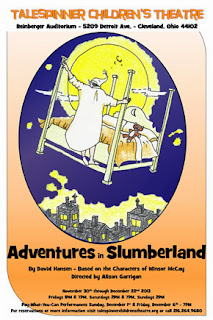
Talespinner Children's Theatre presents Adventures In Slumberland by David Hansen, Nov. 30 - Dec. 22, 2013.

Sunday, July 22, 2012

Bill Watterson on "Little Nemo"

Nemo is reacquainted with 1908 ... and meets 1909.

Winsor McCay's Little Nemo In Slumberland takes place entirely within the subconscious imagination of a small boy during the early 20th century. Only the last panel takes place in what we call the "real" world, or sometimes the first panel -- though sometimes that is hard to tell. Is he asleep yet? Mmmmaybe.

Because it takes place in dreams, Nemo has little control over the bizarre things that happens to him. And bizarre they are. Such a fantastical and graphically exciting landscape of possibilities also make one remember the comic strip Calvin & Hobbes, created by Cleveland Heights resident Bill Watterson.


The difference is, Calvin's adventures are the conscious, wide-awake production of his imagination. But the final panels depicted here are another example of an abrupt, disorienting and humorous (for the reader) reintroduction to the "real" world.

A book of Little Nemo reprints from the late 1990s, The Best of Little Nemo, was sorted by theme and each "chapter"given a preface by, well, every single comic artist who has ever touched my soul -- Watterson, Charles Schulz, Maurice Sendak, Chuck Jones and Art Spiegelman.

An Incredible Ride To the End
An appreciation by Bill Watterson (C) 1997.
from "The Best of Little Nemo"
Published by Stewart, Tabori, & Chang. pg. 195.

"Considering that, in a cartoon, anything can happen that the mind can imagine, the comics have generally depicted pretty mundane worlds. Sure, there have been talking animals, a few spaceships and whatnot, but the comics have rarely shown us anything truly bizarre. Little Nemo's dream imagery, however, is as mind-bending today as ever, and Winsor McCay remains one of the greatest innovators and manipulators of the comic strip medium. Nobody did fantasy like this before, and very few have tried it since.

"To be perfectly honest, however, I admire Little Nemo more than I actually like it. McCay was clearly more interested in his stage than in his actors, and a stage, no matter how grand, can't carry a play. The inventive visual effects notwithstanding, I can't read the strip without thinking how much more enchanting Slumberland would be if the characters, rather than the backdrops and costumes, advanced the story. Regrettably, the characters are cardboard dress-up dolls, devoid of spunk or wit.

"You know something is wrong when a man of McCay's obvious composition and drafting skills draws such pathetic-looking dialog balloons. The balloons themselves often impede the visual flow of the panel, and McCay rarely allowed enough space for the words. Were the words a complete afterthought? At best, the dialog is a series of exclamations and explanations made redundant by the pictures. With the possible exception of Flip, every opportunity to use a character's voice to reveal his personality is squandered, and I think the strip suffers for its unimaginative writing.

"I also find McCay's artwork more impressive in its industry than in its character. McCay's pictures are fancy, but they lack either whimsy or guts. His palaces, cityscapes and boulevards are sterile facades, and his Art Nouveau line keeps everything flat and decorative. Slumberland, like its inhabitants, is more surface than substance.

"That said, the strip is still one incredible ride. Every page is a marvel of design and ornament. The constant invention, the playful distortions, the subtle coloring, the panoramas of architectural splendor...never has another comic strip taken such full advantage of the visual possibilities for surprise. Eighty years after the strip was drawn, it not only continues to delight and awe, but it also provides a long forgotten glimpse of how exciting a comic strip can be."

Huh. "Devoid of spunk or wit ... unimaginative writing ... more surface than substance." In spite of its moments of praise, this is apparently some definition of the word "appreciation" I wasn't previously aware of.

This shirt is pirated.

"Adventures In Slumberland, a holiday play of Little Nemo" is available in paperback and eBook.

Saturday, January 21, 2012

Doonesbury


I drew cartoons before I knew Doonesbury. But only after knowing Doonesbury, did I start drawing comics.

Feb. 10, 1976

M*A*S*H indoctrinated this boy into a philosophy of relativism and secular humanism. Doonesbury taught me character, plot, humor, subtlety, sarcasm, and yes, it was where I got my news. Creator Garry B. Trudeau (b. 1948) may have ruined comic strips forever because of his flat, static drawing style, showing two people talking to each other but never moving (Calvin & Hobbies had great fun with this once) or worse yet, feeling so insecure about his ability to draw actual people realistically that he chose to depict the same drawing of the White House over and over rather than have to draw Nixon.

Calvin & Hobbes

But he also broke ground in what was generally thought of as the controversy-free zone of the comics page; treating drugs as a subject for humor, introducing the first openly gay character in comics, and in 1975, was the first comic strip to receive a Pulitzer Prize.

In Fall, 1976 Joanie Caucus is the campaign manager for her friend Ginny's run for Congress. They are defeated by the Republican candidate, Lacey Davenport, but the upshot is Joan's acquaintance with Washington Post reporter Rick Redfern, who is in California covering the race. After the election, they both let their guards down enough to begin flirting in earnest, and Trudeau created a legendary series of strips which involved Ginny trying to reach Joanie at her apartment.

On Monday we see the phone next to Joanie's unmussed bed ringing, and pan out of the bedroom window, as in a film. The next day we fly from her house, across town, finally zooming into the bedroom window of Rick's apartment:

Nov. 13, 1976

This technique of creating suspense, and taking time to play out a dramatic plot point was unique in the world of daily comic strips. It is not unique anymore, because Tom Batiuk, creator of Funky Winkerbean uses this form over and over again to ploddingly spell out horrible accidents and life-altering mistakes which have no suspense because you knew they were going to happen months earlier when the doomed character in question said, "Another drink wouldn't hurt," or "what's this lump?"

May 6, 2011

Batiuk actually used the same technique here -- exactly the same, in fact -- 35 years later, when Les has sex for the first time since his wife died. Same slow pan, on a house, to reveal an intimate post-coital moment ... only in this case it looks miserable and unhappy.

May 3, 1988

I did use this same technique myself in my daily strip in college, taking a week to illustrate my protagonist's struggle with insomnia.

May 5, 1988