Showing posts with label Doonesbury. Show all posts

Tuesday, September 15, 2026

Trudeau & Doonesbury: A Biography: The Cartoonist Who Turned the News Into Art (book)

Garretson “Garry” Beekman Trudeau (b. 1948) is the single greatest influence on my life as a writer. There have been others who have inspired me in my work, from William Shakespeare to George Bernard Shaw to Annie Baker, and also from Charles Schulz to Harvey Pekar to Alison Bechdel. Because comic strip artists have had as much of an impact on my life as any playwright.

For example, John “Derf” Backderf just released The Dissidents, his first graphic novel since the epic Kent State (2020) and this is a work no less expansive in scope, for which its creator has been doggedly journalistic in his pursuit of historic accuracy. In this case the events are so far in the past (a century!) he has had to rely entirely – I assume – upon the written record.

I’ve read it, and like Kent State or My Friend Dahmer, it should be added to the long list of recommended (and also then probably censored) reading for high school students across the nation. It’s brilliant, it’s timely, it’s important.

But what about this Trudeau guy? He was the creator of Doonesbury, and in the late 1970s, while my preadolescent friends were getting a fantastic, exaggerated and exploitative history of Vietnam watching films like Apocalypse Now and The Deer Hunter on cable teevee, I was desperately consuming the history of the war and the entire “Me” decade by scraping up every single trade Holt, Rinehart and Winston paperback I could get my hands on at Baluk’s bookstore in Westlake.

A prized possession.
His comic strips were remarkable at the time because of the so-called political content. Sure. At that time, the comic pages were reserved for silly jokes about beleaguered husbands and shrewish wives. The war and the Nixon administration had been reserved for the editorial page, but when Trudeau was recruited (due to his work producing the strip Bull Tales for a Yale publication) to create a comic for daily syndication, he became the first to address contemporary issues – sex, drugs and the war – in the daily comics.

I mean, he wasn’t. He was preceded by Walt Kelly (Pogo) and Al Capp (Lil’ Abner) and others, but he was the first BABY BOOMER to do so, and to be so literal about it. The timing was not remarkable, it was inevitable. It could have been someone else, fortunately it was Trudeau.

Because of his wit. His very dry wit. Decades later, I would be taken to task for my work in the Ohio University paper The Post because I just wasn’t funny. But like so many other would-be college paper cartoonists, I was simply emulating the style of Doonesbury, how the punchline was usually the second to last line, only to be undercut by the deadpan reaction.

Doonesbury, October 26, 1970

And it is this deadpan, dry reaction to humor that has led people to hate and fear me in everyday conversation. And it is the same kind of dialogue I have always incorporated into my plays. This summer I read Trudeau & Doonesbury: The Cartoonist Who Turned the News Into Art by Joshua Kendall, the first authorized biography of G.B. Trudeau, and one of the first delightful things I learned was that, as a child, the future Pulitzer Prize winning cartoonist was an aspiring impresario.
At the age of eight, he waxed entrepreneurial, establishing the Acting Corporation, which marketed and produced his own plays in the family’s home.

“We transformed the basement into a makeshift theater, with bunk beds as our balcony," [Trudeau] says. "My mother had red curtains installed as a Christmas present … I jerry-rigged the most dangerous lighting board imaginable, and I almost burned the house down. I also built sets from canvas flats. Our troupe comprised relatives and neighborhood kids.

“I was a little dictator who controlled all the elements. I wrote and directed the plays, composed the music, designed the sets and costumes, oversaw makeup, props, etc."
(pp. 15-16)
He was a theater producer who became a cartoonist, I was a cartoonist who became a theater producer. And this should not be a surprise. Because they have so much in common. While I had entertained notions of playwriting in high school, I had no idea how or where to begin. Creating the strip Breaking Point my sophomore year in college, I was constantly thinking about and writing dialogue and action (essentially, scripts) for a cast of fictional cartoon characters which I would then draft and have published for an audience.

Breaking Point, May 27, 1988

Trudeau did something surprising, but necessary, when he chose to take a sabbatical in 1983, stepping away from the drawing board to rethink the strip. It’s all cool that Hi and Lois, Blondie and Dagwood, and the Peanuts kids never age, but Michael, Boopsie, Mark, Zonker, B.D. and the rest were ostensibly Baby Boomers – all of whom were for some reason still undergrads in the early 1980s. That had to change if the strip was to remain relevant.

However, it was a working vacation, as Trudeau returned to his first love – the theater. He partnered with Elizabeth Swados (Runaways) to create Doonesbury: A Musical Comedy which opened at the Biltmore Theatre in late 1983. It wasn’t a sensation (Frank Rich called it “pleasant”) but even if it were, it’s intentionally dated, set squarely in that interregnum between the queasy late 1970s and the go-go 1980s. I’ve never heard of anyone else producing it. But do I have the original cast recording on vinyl? Yes, I do. Do I have it on CD? Yes, again. I am partial to the opening track (“Graduation”) and Michael’s gentle attempt to court his girlfriend J.J. (“Get Together”).

 
The most significant result of this endeavor was actually a downscale, downtown spin-off (a friendlier locale for such things) a cabaret in which to skewer Reagan era policies on a rotating basis. This was a format more in line with the daily criticism Trudeau was conducting, anyway.
Trudeau and Swados undertook a second theatrical collaboration … "Rap Master Ronnie," a one-hour "partisan revue"... which premiered at the Village Gate in the fall of 1984. Frank Rich was more kindly disposed to this venture, praising Trudeau's "ingenious lyrics, the bristling polemical wisecracks and a sparkling cast."

Trudeau (said), “With 'Doonesbury? Liz (Swados) played in my world— a mainstream Broadway musical with lovable characters. But with Rap Master Ronnie, a downtown political revue with complicated characters, I was in Lizworld. I came to prefer the latter, scrambling for money and audiences, huddling behind the bar at the Village Gate, reworking numbers on the spot, the kind of on-the-fly theater Liz was so brilliant at."
(p. 215)
I can dig it. I love those things, too.

The Dissidents: Autocrats! Vigilantes! Communists! And Cartoonists! By John Derf Backderf (Abrams Books) is now available in hardcover.

Friday, December 13, 2013

Pogo (comic strip)


Okay, in the past three days I have experienced as many shouts out to Walter Crawford Kelly, Jr. (August 26, 1913 – October 18, 1973). The documentary Dear Mr. Watterson (Joel Allen Schroeder, Director 2013) is playing at the Cedar-Lee, and so my son, who loves Calvin & Hobbes, wanted to see the trailer, which includes this brief comment from Berke Breathed:
My initial impression when I saw him was, the guy's making it harder for the rest of us. Because he's setting ridiculous standards of excellence that hadn't been seen since the 'Pogo' years.
http://www.talespinnerchildrenstheatre.org/performances/slumberland.htmAnd he was right. Like many comic strips, Breathed's Bloom County was facile and derivative and a complete rip-off of everything that had come before. Calvin & Hobbes may in fact be in the top 5 greatest comic strips ever made, but Breathed's unnecessary use of the word "ridiculous" before the phrase "standards of excellence" only serve to undercut the compliment, and betray a certain well-deserved shame for his own limp work.

What are the 5 greatest comic strips of all time? Well, before Calvin & Hobbes began its run a Pogo collection was released (The Best of Pogo, Fireside 1982) and foreworded by Doonesbury scribe Gary B. Trudeau, who described Pogo creator Walt Kelly this way:
In my opinion, Walt Kelly had only two peers in the pantheon department, Winsor McCay and George Herriman ('Krazy Kat'), and of the two, only Herrimann could write as well as he could draw ... Kelly, however, was a triple threat; 'Pogo' was beautifully drawn, exquisitely written, and enormously popular.
McCay's weakness as a writer would later be echoed by Bill Watterson himself, though I find it difficult to separate McCay's unfathomable inventiveness from the process of writing. His dialogue can seem less than sophisticated, but as I described in my interview with Dee Perry last week, since most of his work is a representation of dreams, it only makes sense that the dialogue is broken up and non-linear, like snatches of what you heard the day before being processed by your subconscious.

Then again, if you ever read any of his personal correspondence, you would also know that Winsor McCay possessed poor grammar and used what can respectfully be called creative spelling.

To sum up, however, this morning I came across this status update from my university movement professor:

I called him on his Pogo reference, but then my eight year-old told me it is actually Pogo possum's friend Churchy the turtle who is triskaidekaphobic.

For the record, I echo Mr. Trudeau's suggestion that if there is a "pantheon" of cartoonists, it should include Herrimann, McCay and Kelly, but also Watterson and inevitably Schulz, whose writing and popularity are unquestionable, and whose drawing skills are deceptively masterful.

But three Walt Kelly references in as many days, just as I have been introducing my son to his work is a little unsettling, and also thrilling, especially when the comparison is made to Winsor McCay. If there is one character who would slip easily into the Okefenokee Swamp it would be that of Flip Flap, whose slangy American vernacular echoes that of Kelly's band of swamp critturs. 

 
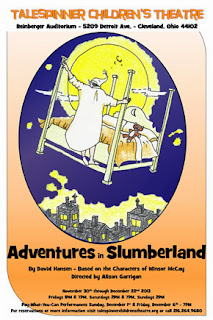
Talespinner Children's Theatre presents Adventures In Slumberland by David Hansen, Nov. 30 - Dec. 22, 2013.

Monday, July 1, 2013

8 (play)


I was raised a bigot. Pretty much everyone I knew was. It was the 1970s, I lived in suburbia, and hatred and ridicule of homosexuality was the social norm.

There were a few moments of education, like Billy Crystal’s Jodie in Soap -- which we watched religiously (I was nine years-old) and Good Lord, I saw the pilot episode of the TV sitcom Hot L Baltimore. But these were outliers -- as I have described in the past, I experienced A Chorus Line at the age of eight and saw a bunch of freaks.

As an insecure and weak adolescent, I was often tagged with homosexual insults. They were common. I remember when I was a sophomore, and I decided, for a change, to actually take care of my appearance, get a haircut, buy some stylish clothes. The specific reason was two-fold, I had a crush on a cute freshman, and I had just seen Footloose.

There was this complete douchebag who sat behind me in Spanish. That day he appraised my sartorial choices by calling me a “flamer” in front of his friends. You will notice I still remember that.

But that just means I didn’t want to be called that. I have called others worse, and much worse. When it comes to gay epithets, we are all Paula Deen.

Marriage means “one man-one woman” to you if you have only known that since birth. Homosexuality was not necessarily something you were against, but something of which you were ignorant. As with most of my kind, acceptance and understanding has come through familiarity, of association. It helps when you have an earnest desire to learn.

This is why I bristle when folks suggest the President is pandering to special interests or flip-flopped when he says his opinions have “evolved” regarding gay marriage. Any straight, young male born as late as the 1960s and raised in a Judeo-Christian household would have found the idea of two guys marrying incomprehensible, and if any of them grew up to be tolerant, loving, and welcoming to homosexuality, it would have required a significant “evolution”.

This is not a defense. This is an explanation, and it is an apology. People are raised this way, what is important is that people can, in fact, change. However, I will not ape those who espouse, for example, that back in the day people didn’t know any better -- for example, that slavery was a necessary evil. Ask yourself if you want to be enslaved, any human being can figure that one out. It was wrong. Hate is wrong. It is not be excused, but we can move forward.

Rehearsal on the stage of the Allen
(Photo: Kory)

On Sunday, I was privileged to be in the ensemble for a performance of Dustin Lance Black’s docudrama 8, a dramatization of the un-broadcast court proceeds of Perry v. Schwarzenegger, the case which struck down Proposition 8, California’s anti-marriage equality amendment. The Perry v. Schwarzenegger case was upheld by the Supreme Court last Wednesday, paving the way for a continuation of gay marriage in that state, and so this staged reading of 8 was considerably auspicious.

I played the role of David Blankenhorn, founder and president of the Institute for American Values, and a sadly deluded man. He had the great misfortune to evolve his positions on marriage equality while on the stand in a court of law while presumably the star witness … well, the only witness, really, defending Proposition 8.

In brief, he has spent his life arguing single parenting as one of the great ills of modern society, and championing two-parent marriage. When asked, under oath, if two gay parents were better for children than one parent, he had to say yes. He knew it to be true that adoptive parents can often -- due to the fact that while anyone can fuck, not everyone qualifies to adopt -- be not merely as good as, but better than biological parents. (He didn't use those exact words.)

Following the performance I was praised for being a right clown in last night’s show, a complete airhead. One man called me a dumb blonde. My walk of shame from the witness stand was called by one a “Charlie Brown” walk. Such compliments were the capstone to a tremendous, if brief experience working with a large number of Cleveland artists I truly admire.

Someone else who made the evening powerful was Dan Moulthrop, CEO of the City Club. God, he does his job well, namely to facilitate civil, open discussion. He is not afraid to ask the challenging questions, but he’s just so good at keeping everyone on track, and respectful.

I do not like post-show discussions, as a rule. Following the public reading of a new work, they can be entirely counter-productive. Following an issue-oriented play, they generally sound like a roomful of people saying “I agree” and patting each other on the back for over twenty-minutes.

So I was intrigued to hear that The Reverend Jimmy Hicks would be a member of the panel. In 2003, as a member of Cleveland Heights City Council, he sat in opposition to our creating a domestic partner registry (and doesn’t that term sound arcane.) Four days after the Supreme Court ruled on DOMA and Prop 8 and we were going to have an actual voice of opposition in the house!

To everyone’s credit, especially the Reverend’s, opinions were aired without rancor. There was one point where Rev. Hicks suggested recent school massacres were the direct result of prayer no longer being permitted in schools, a moment of great tension which was diffused with ease and humor by Mr. Moulthrop who, as I said, is really good at his job.

The night ended with Rev. Hicks standing his ground -- he cannot interpret the Bible his way and sanction gay marriage. That evening’s production included video of actual Vote Yes on 8 television advertisements from 2008. That term, “Religious Liberty” was used, one which became more familiar during the 2012 as it pertained to birth control of all things during the Presidential race.

Religious Freedom, as I see it, is the codification of religious doctrine into secular law. Love of God can be a powerfully positive thing, I see it in the people closest to me who believe. But the laws of God bind us to ancient hierarchies, which put certain classes of people in their place, including women and homosexuals. For years the Bible was used to justify and in fact enshrine slavery.

As the American experiment continues, the people work to undo the binds of ancient hierarchy, that is what freedom truly means. If establishing new, expanded freedoms threatens religious teachings, perhaps it is because the Bible isn’t about freedom.

I mean, really ... who ever said the Bible was about freedom?

The comparisons between Loving v. Virgina and Perry v. Schwarzenegger were on full display last night, though there are those who are unhappy with the comparison. I remember a Doonesbury cartoon from the mid-1970s where it is discovered that Andy is gay. Clyde says, “I hear you’re gay,” and Andy responds, “That's right, and I hear you’re black.”

Clyde explodes, “Yeah, but that’s normal!”

Andy says, “Didn’t used to be.”

Click on to enlarge.

The gay rights revolution has not been without horrible violence -- nothing filmed or put on video like schoolgirls denied access by National Guardsmen or crowds being hit with water cannons, but more often secret murders and lonely suicides and assaults too numerous to be known. But sitting onstage, the Allen Theater nearly full, knowing the audience had gathered to see and support a play not just about gay rights but about gay marriage, I truly felt we were reaching the climax of -- though by no means the conclusion to -- America’s Lavender Civil War.

The day after Election Day 2004, I overheard a colleague on the phone to a friend. He was truly unhappy -- not just because Bush defeated Kerry, this was much more personal. An anti-gay marriage amendment (Ohio Issue 1) had passed in the state of Ohio, one which stands today. It passed by 62% of the vote.

“It’s like they hate us,” he said. He sounded like he was about to cry. That’s what it feels like to be in the minority. I am trying to imagine what it might have been like back in 2004, if last night’s roles were reversed and it was Dustin Lance Black in a theater full of Ohio Issue 1 supporters, as the lone voice of marriage equality among a few hundred proponents of “religious freedom”. You will excuse me for finding it difficult to believe he would have been treated with the deference and respect Rev. Hicks received in the Allen last night.

Saturday, January 21, 2012

Doonesbury (comic strip)


I drew cartoons before I knew Doonesbury. But only after knowing Doonesbury, did I start drawing comics.

Feb. 10, 1976

M*A*S*H indoctrinated this boy into a philosophy of relativism and secular humanism. Doonesbury taught me character, plot, humor, subtlety, sarcasm, and yes, it was where I got my news. Creator Garry B. Trudeau (b. 1948) may have ruined comic strips forever because of his flat, static drawing style, showing two people talking to each other but never moving (Calvin & Hobbies had great fun with this once) or worse yet, feeling so insecure about his ability to draw actual people realistically that he chose to depict the same drawing of the White House over and over rather than have to draw Nixon.

Calvin & Hobbes

But he also broke ground in what was generally thought of as the controversy-free zone of the comics page; treating drugs as a subject for humor, introducing the first openly gay character in comics, and in 1975, was the first comic strip to receive a Pulitzer Prize.

In Fall, 1976 Joanie Caucus is the campaign manager for her friend Ginny's run for Congress. They are defeated by the Republican candidate, Lacey Davenport, but the upshot is Joan's acquaintance with Washington Post reporter Rick Redfern, who is in California covering the race. After the election, they both let their guards down enough to begin flirting in earnest, and Trudeau created a legendary series of strips which involved Ginny trying to reach Joanie at her apartment.

On Monday we see the phone next to Joanie's unmussed bed ringing, and pan out of the bedroom window, as in a film. The next day we fly from her house, across town, finally zooming into the bedroom window of Rick's apartment:

Nov. 13, 1976

This technique of creating suspense, and taking time to play out a dramatic plot point was unique in the world of daily comic strips. It is not unique anymore, because Tom Batiuk, creator of Funky Winkerbean uses this form over and over again to ploddingly spell out horrible accidents and life-altering mistakes which have no suspense because you knew they were going to happen months earlier when the doomed character in question said, "Another drink wouldn't hurt," or "what's this lump?"

May 6, 2011

Batiuk actually used the same technique here -- exactly the same, in fact -- 35 years later, when Les has sex for the first time since his wife died. Same slow pan, on a house, to reveal an intimate post-coital moment ... only in this case it looks miserable and unhappy.

May 3, 1988

I did use this same technique myself in my daily strip in college, taking a week to illustrate my protagonist's struggle with insomnia.

May 5, 1988