Saturday, October 8, 2011

The Taming of the Shrew (1993)


Guerrilla Theater Company
The Taming of the Shrew
Tablework, May 1993.

We sat at the long high school table, in the middle of the space. All signs of 'You Have the Right to Remain Silent!' had been stripped away. It was May, and it was starting to get warm. A large industrial fan kept the air in the place moving.

We were reading the famous "wooing scene" where Petruchio first meets Katherina and they make fun of each other. In particular, Petruchio keeps jamming on her name; he says everyone calls her "super-dainty Kate" because that's actually the opposite of the kind of thing everyone really does call her.

"'My super-dainty Kate,'" I read, "meaning my Kate who is extremely light, which is the opposite of what everyone else in town --"

"Go on," Torque agreed.

"'For dainties are all Kates, and therefore, Kate,'" I read, "which is a pun on the word 'dainty' which means something that tastes good, and the cakes which were called 'kates' and so, Kate --"

"All cakes were called kates?" Torque asked.

"Some cakes were called kates," I said.

"How do you know that?" he asked.

I said, "Everyone knows that."

"Did you look it up?" he asked, "are you sure it means cake?"

"I know they mean cake," I said.

Pause.

"Look it up," he said.

I tried not to sigh as Beemer slid me the humongous first volume of the portable Oxford English Dictionary.

"While you're at it," he said, "look up dainty."

"'Cate'" I said, "it's under 'c' ... a choice article of food, a dainty, a delicacy."

"So they both mean cake!" he said.

"Yes," I said. "'Take this of me --"

"Did you know dainty also meant cake?"

"I think I did," I said, "I'm not sure. 'Take this of me' ... Shall I continue?"

"Please."

"'Take this of me, Kate of my consolation' -- meaning 'accept what I am about the say as truth, Kate who consoles me' --"

"What?"

"You want me to look up consolation?" I asked.

"No," Torque said, "the first bit. 'Take this of me' ... take what of me?"

"What he's about to say," I said. "He's about to make a promise and he wants her to accept it."

"You sure he's not offering her cake?"

"What?"

"He's just made a double-pun on the word cake," Torque insisted, "is it possible he offers her some cake?"

I was stymied. "Uhb. Where would he, uh. What?"

"Maybe he pulls it out of his pocket."

"That's ridiculous."

"He's making jokes about cake, he says 'take this of me,' he wants her to take something from him --"

"His word."

"I don't get that from the text," Torque argued.

"But you get that he slings a piece of cake at her?"

"A Twinkie," Torque decided.

I sat dumb-founded.

"We're trying to ... That's ridiculous. Is that what Shakespeare meant, that Petruchio, in the midst of wooing Katherina, offers her a Twinkie?"

Torque leaned forward in his chair. "You have to convince me, through the text, that he didn't."
An '80s-infused' production of The Taming of the Shrew continues at Great Lakes Theater through October 29, 2011. There are no Twinkies, though there is one Whatchamacallit bar.

Friday, October 7, 2011

To End All Wars (book)

One of the signs of impending imperial collapse is the tendency of a dominant power to celebrate wholesale stupidity.

The Romans, awash in plenty, succumbed to decadence. One prime example was the phenomenon of the Gladiators. We know about the enslaved people who were subjected to violent arena games for the entertainment of the masses, but there were also the rich, pampered youth of the ruling class who, for want of the glory of combat subjected themselves to the public grindhouse for the sake of either glory or death, often both.

One of my father's favorite books is The Last Place on Earth by Roland Huntford, a chronicle of the "race" to the South Pole between Roald Amundsen of Norway and Robert Falcon Scott of England. It is a testament to the fighting British spirit that Scott's expedition, while a horrific failure, was celebrated by his countrymen as a shining example of English can-do resolve and daring. They also pasted Amundsen, who employed many modern techniques to get his crew to the Pole first and home safely (Scott and most of his men perished) as some kind of cheater. For example, the devious Norwegian used dogsleds and not horses.

Horses. Scott brought horses. To Antarctica. Hail Britannia.

Speaking of horses, I just finished To End All Wars by Adam Hochschild, a new history of World War I with a unique point of view; that the war was stupid and wrong. It covers not only the build-up to the "Great" war, and its execution (and that is an appropriate word to use) but also the British peace movement. There were loud voices against the war from the beginning, and they continued and built throughout, in spite of the draconian powers employed by the existing hierarchy to stifle them.

My education of WWI has been scant. Americans know a great deal about World War Two. It has been with us our entire lives. It shaped our nation. World War One ... not so much. For example, I have two uncles who served in the Pacific during WWII. One of my grandfathers was too young to have served in Europe in 1918, the other had a medical deferment. It is the war before talkies, before radio, before everything.

And yet, the war that started the 20th Century created the 20th Century. I was taught that the War was inevitable because of all of the interlocking treaties and that the assassination of Franz Ferdinand (I LOVE that band!) lit the bug. What we are not taught is that after two centuries of colonial expansion, the great powers of Europe believed themselves invincible, the Masters of Earth, and that war was an un-loseable game.

And so they attacked with machine guns and barbed wire, and there was nowhere to go but down. British generals longed for the day which never came, the day when they could finally open their enemies defenses wide enough to send in the cavalry. The actual cavalry. You know, with horses. That would be a glorious day. Instead each side murdered the other, for years. It was only when the U.S. joined the fight, so late in the game, that Germany capitulated. Not because there was anything special about the United States. But in a "game" where the only end in sight was the entire decimation of the others' population, it was only a war of numbers. Numbers of men. Sacrificial men.

World War One was a waste of absolutely everything, gaining no one anything, and it effects have reverberated through every single battle since, up to and including today's. And tomorrow's.

My adaptation of Agatha Christie's The Mysterious Affair at Styles goes into production soon. It takes place in the summer of 1917. Our narrator, Captain Arthur Hastings, is on medical leave from the Front. His friend Poirot is a Belgian refugee. Other characters are excused from battle for one reason or another, but contribute in their own way. Reading up on the period, I have discovered after the fact elements included by the author which were popular themes at the time - including the almost maniacal fear of German spies.

Styles was not published until 1920, during that period when hostilities were presumed over, but Great Britain was no longer so great, a point which is reflected in this story and all subsequent Poirot mysteries. Britain valiantly attempts to prevail, protesting its relevance in full-throated denial of things as they are.

A lesson to be learned, for every empire.


Happy Christmas.

UPDATE: My play adaptation of Agatha Christie's "The Mysterious Affair at Styles" is available from Playscripts, Inc.

Thursday, October 6, 2011

Death of a salesman


Every obituary I heard this morning celebrating the life of Steve Jobs compared him to Thomas Edison. This comparison is apt, because much like Milan, Ohio's favorite son, Jobs never invented anything. Thomas Alva did not first create the radio, movie camera nor the (gasp) light bulb, Steven Paul did not invent the graphic interface, mouse, nor the mp3 player. But Steve Jobs made you NEED them.

My first computer was an Apple II+ (see above.) My parents presented it to me on my fourteenth birthday, in 1982. We were on vacation, so they didn't lug the whole thing with them, they just gave me an apple with a Roman numeral "II" on it. See how elegant that is? How were they going to do that with a Trash-80? Every computer I have owned since has been an Apple. I even dealt with a horrid Apple IIci for six years, now that's devotion. You can't blame Jobs for that one, however, they made the IIci during the Apple's Dark Years (1985-1996).


I do not own an iPhone, I do not have an iPad. In spite of my seeing them everywhere, I do not need one ... not the way I NEED my iPod. An itinerant runner since I was 12 years old, it wasn't until the life-altering appearance of this wafer-thin music machine that I have been a consistent runner (did you know I also keep a running blog?)

Steve Jobs made it possible for me to complete a marathon.

The praise that I hear being heaped upon the man today is a bit overwhelming. He was a CEO, I thought we hated those. But he was credited during his lifetime as the man who made technology stylish, cuddly, as my wife put it this morning, Steve Jobs invented the cyborg, and made us like it. For better or for worse, Steve Jobs married humanity to the machine.

Mecha Yenta.

Monday, October 3, 2011

Days of Awe

From American Public Media ...

My brother and I closed the evening at Sweeney’s Saloon in the Selby/Dale neighborhood. Legend has it Sweeney’s was a favorite haunt of August Wilson’s during his time in St. Paul, a place for him to drink, smoke and write. The owner would turn the lights up when Wilson would come in so he could see better to do his work.

If this legend is so, I have to imagine things have changed a great deal in this neck of the woods. Last night it was a very popular place, packed with college students and hipsters, not the kind of place I could imagine anyone being able to concentrate and compose anything like Two Trains Running.

We sat at a table outside, enjoyed a local beer, and had a nice long talk. For me, this was the best part of the trip.

This morning was the Medtronic Twin Cities Marathon, The Most Beautiful Urban Marathon in America®. The race began at 8 AM, and at 10 AM the family and I walked two blocks to Fairview and Summit in time to catch the first few runners. It’s a bright, cool day today, perfect for running. I did not bother bringing my kit this trip, thought my time would be better spent available to my brother, but I did wonder out loud if I might not try the "Full Cleveland" this May.

Maybe you are not aware I also keep a running blog.

Church services at the Unity Church-Unitarian began at 11 AM. I joined Denny and Julie in marriage there in August, 2006. (Didn’t know I could do that, did you?) As a celebration of the High Holy Days, the theme for this morning was forgiveness. It was a painfully well-timed homily.

First step of forgiveness:
We must all give up hope of a better past.

It is a question we ask in The Crucible residency. What is forgiveness? Why is forgiveness necessary? Is it necessary? Who is the benefactor of forgiveness, those who give or those who receive it? Can you forgive and not forget?

“I forgive myself, I forgive you. We begin again in love.”

On our way to the airport, my brother gave me a tour of the MPR studios. It’s a very large, impressive facility, the central nervous system of NPR affiliates around the state, their news, classical and popular music stations. I think I am going to become a die-hard, online fan of The Current 89.3.

And now I am waiting at the gate, informed that my flight took off from Hopkins, and then abruptly turned around for a “maintenance issue.” My departure from MSP is in question, but I have a coffee, cash for dinner if I want it, and a very large book.

LATE UPDATE: Touching down at CLE, 12:30 AM.

We are brothers.

Sunday, October 2, 2011

Two Trains Running @ Penumbra Theatre

Penumbra Theatre was founded in 1976 by Lou Bellamy in the Shelby/Dale neighborhood of St. Paul to "create a forum for African-American voices." That is where my brother and I headed last night for opening weekend of August Wilson's Two Trains Running.

Before he died in 2005, August Wilson created ten plays, The Pittsburgh Cycle, chronicling the African-American experience through the prism of the Hill District. Each play represents one decade of the twentieth century. While I am shy to admit I have (until last night) read merely one of his works (Fences) by the end of the 2011-12 season I will have seen three, including Gem of the Ocean at Karamu and Radio Golf at the Play House.

Penumbra was responsible for Wilson's first professionally produced play, Black Bart and the Sacred Hills, and their relationship with Wilson remained strong throughout his life, and continues today, as the company decided following his death to produce the entire Pittsburgh Cycle, offering one or two of the works every season since 2007.

The facilities of Penumbra are very warm and welcoming, and the auditorium seats 250 but feels very intimate and close. The set for Lee's Restaurant circa 1969 was strikingly realistic.

While I was engaged by the entire ensemble, I most enjoyed sharing three hours in the same room as Abdul Salaam El Razzac (b. 1944) in the role of Halloway, a disciple of Aunt Esther, a man who has lived to the age of 65 by minding his own business. At turns kindly or fierce, this 6'5" grey-domed man in a comfortable suit keeps the top from blowing off Lee's ... or casually (but pointedly) makes his way out when he can't.

El Ra (as he is known to his friends) was born Allen Johnson II in Cleveland. Yes, he performed for Karamu, and graduated from East Tech High, the child of a postman and a "public servant." Right out of high school - during the Vietnam War - he joined the Air Force, moving to the Twin Cities after his service.

El Razzac means "service."

See: "Radio Golf" at Cleveland Play House

Sources:
Penumbra website
Star Tribune: The Mellowing of El Ra
Wikipedia

Saturday, October 1, 2011

Twin Cities


Great playwright (with Chekhov.)

Yesterday evening my brother Denny, who lives in St. Paul, rode his bike home from his job at Minneapolis Public Radio. He knew his wife was planning a birthday surprise for this weekend (my brother turned fifty last week) but he was not expecting to find me sitting on his back stoop, drinking a beer.

The Twin Cities has been Denny's home for over twenty years. I have been fortunate enough to have visited several times. Minneapolis and St. Paul coexist as models of a modern American metropolis. Lots of local, urban business, a thriving arts scene, gorgeous new uses for the majestic riverfront, and a couple of kooks.

For this morning my sister-in-law Julie proposed a tour of the new (2006) Guthrie Theatre, located on the banks of the Mississippi. I have seen some fun alternative theater in Minneapolis, most notably at the 2003 Minnesota Fringe Festival, but also at The Jungle, the Bryant Lake Bowl, and the Theatre de la Jeune Lune, which is no longer with us. The only I have ever stepped foot into the former Guthrie space by the Walker Arts Center was twenty-five years ago in 1986 to see The Rainmaker.


I was a little astonished to walk into the main theater space, and discover it was a near-replica of the original, or at least to my memory. Apparently they narrowed the angle at which the audience is arranged around the thrust stage. With seven hundred seats, it remains an intimate environment in which to see a show.

But that's not where we're are going to see a play tonight.


This afternoon Denny and my niece Ariel took me to O'Gara's Bar and Grill at the corner of Snelling and Selby, which is significant as the site of the barbershop owned by Carl Schulz, the father of Peanuts cartoonist Charles Schulz.


Little Red Haired Girl.

To be continued ...

Sunday, September 25, 2011

The Degenerate Art Exhibit

Exhibition catalogue
Opening July 19, 1937, "Entartete Kunst" or the Degenerate Art Exhibit opened in Munich. In an attempt to eradicate modernism, the Nazis seized over 5,000 pieces of art deemed threatening to the New Order. However, as in all things, Nazis were scholars of the past and established breathtaking, new forms of propaganda which have served as templates for every generation since.

Rather than simply destroy the offending works, they were put on display for the mockery of the general public, hung the wrong-way-round in some cases, improperly lit, cramped together, the walls festooned with mocking graffiti. "Insolent mockery of the Divine under Centrist rule" and "Deliberate sabotage of national defense" are two refrains which strike me as not-unfamiliar to today's vocabulary.

In this way, modern artists were denied any kind of martyrdom -- their worthlessness was firmly established in the public mind as thousand lined up to see the "degeneracy" and freely make up their own minds as to whether the work was offensive, obscene, immoral, blasphemous, or just plain bad. We curate, you decide.

"Self-Portrait as Soldier"
Ernst Ludwig Kirchner, 1915
Following the exhibition, the works were auctioned off, purchased by museums and individuals desperate to save them before they were destroyed. Though many works were lost, while living in Los Angeles in 1991 I had the opportunity to witness a touring exhibit of surviving pieces. If I had not already become driven to the brink of a nervous breakdown after four weeks in L.A. this experience put me right over the edge and I returned home to Cleveland for good soon after.

One example, Ernst Ludwig Kirchner's Self-Portrait as Soldier (1915) shows the artist, a World War I veteran, his painting hand severed. Kirchner had not actually lost an appendage during the war, rather the piece (painted during convalescence following a nervous breakdown) expresses his feelings that his war experience would rob him of his craft. The naked woman suggests he feared other war-related inadequacies.

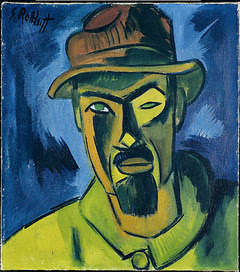
"Self-Portrait With Hat"
Karl Schmidt-Rottluff, 1919
639 of Kirchner's works were confiscated by the Nazis. This work was retitled Soldier With Whore for the Degenerate Art Exhibit. Kirchner died by suicide in June 1938. Fortunately for us, this work survives and you can visit it at the Allen Memorial Art Museum in Oberlin.

This work by Karl Schmidt-Rottluff (left) is part of the permanent collection at the Cleveland Museum of Art, also saved from the 1937 exhibition in Munich.

We saw Cabaret last night. It was very moving. There were no drunken, existential rants before bedtime. The first act closes with a spirited, patriotic round of Tomorrow Belongs To Me. My mother, seated next to me, remarked, "The Nazis did write good music," adding swiftly, "of course, they just stole a bunch of folk songs and changed the words."

"Cabaret"
(Great Lakes Theater, 2011)