Showing posts with label Cabaret. Show all posts

Saturday, December 17, 2016

On Cold

Devon Turchan is the Emcee in Cabaret (Blank Canvas Theatre)
We work in the city. The spaces we inhabit for our art and our the nourishment of our souls are made of cement and brick and glass, those man-made substances least likely to trap or keep heat. And yet, that is where we go, to occupy empty storefronts where we scheme and build, so close friends and friends we haven’t met yet can huddle against the elements to have our little moments before scattering to our various sectors once again.

Last week the wife and I went to the 78th Street Studios, once the design headquarters of American Greetings, then another largely vacant warehouse in the largely vacant near west side. Today it is a feature of the Battery Park district, an artists’ haven with spaces for galleries and also private functions (I have attended a wedding reception there) the site of several temporary Theater Ninjas installations and currently home to Blank Canvas Theatre.

We were attending a sold out performance of Blank Canvases’ acclaimed production of Cabaret. They had sent an email message to all those who had reservations (God, the things we could have done with email back in the day) warning us that parking would be an issue, as the entire building would be packed with interested shoppers taking the Holiday Bazaar. They recommended we arrive early, as to have time to find a parking space and then leisurely browse the wares of dozens of local artists.

I have seen a couple of shows at Blank Canvas, a tiny space with roughly ninety seats on three sides of the stage. Have you ever seen Cabaret in someplace the size of an actual cabaret? It is a rare treat, I will tell you that. They had a wait list, the best of their shows often do. It doesn’t matter how many seats a theater has, you want it full, people like to know they are part of something special, something in demand.

We (not me, the collective we) used to create these spaces, carving them out of the unhappy emptiness of urban abandonment. A storefront in Tremont with a single light over the door lighting a hand painted sign that read “The Actors’ Gym.” On any given Saturday evening we would wait for five or six the trickle in. Then there was the coffee shop carved out the space between two buildings with a metal roof over it, “The Brick Alley.” They offered folk music and the occasional dramatic offering.

John Coltrane's Christmas Meditation (Moko Bovo)
12 Bands of Christmas Sing, 12/22/1992 (Cleveland Public Theater)

Our new theater company used this space to produce a modern-dress yet otherwise pretty traditional three-hour Hamlet which was surprisingly well received and was also selling out its run, filling each of its ninety seats. People would drive in from their homes in the suburbs, park on St. Clair or 40th Street, see the show and then promptly vacate the area.

Cleveland used to have one major urban entertainment center at a time. Once, you had the Flats. Then it was the Warehouse District when everyone began fleeing the Flats, later East 4th. It was as though the number of people coming downtown weren’t enough to accommodate two neighborhoods at once.

Last week there was a public hearing regarding Cuyahoga Arts and Culture’s decision to eliminate the Creative Workforce Fellowship, and many opinions were expressed regarding how these individual artist grants contributed to the cultural strength and vitality of neighborhoods like Tremont, Ohio City, Gordon Square, Waterloo, Hingetown -- those last three are names that were made up in the past ten years, they used to be called the Detroit Shoreway, Collinwood and, uh, Ohio City (?) as they have each become distinctive downtown neighborhoods where people actually hang out instead of scurrying right back to their homes.

So, we were seeing Cabaret in this tiny space in the middle of a large warehouse. Audience members with beer and popcorn jostling for position in our seats, remaindered from some defunct movie theater, trying to find space for all of our large, poofy coats. It was happening, the dream is real. I was reminded of that strange opportunity we received, almost twenty-five years ago. This guy owned the Union Gospel Press Building and wanted our company to move in. He wanted us to do our work there, we’d be pioneers, the rent would be seriously cheap and we could do whatever we liked.

We also wouldn’t have a lease, because he didn’t believe in those. I can only imagine what it would have been like if we had moved the entire operation, lock and stock, into that space on the edge of Tremont, overlooking the only recently completed Interstate 490.

We would have had off-street parking but no one would have stepped foot into that place just to see us, and even if we were able to turn it into a success we’d be out on our asses the moment the guy decided he didn’t want us there any more. That's not urban homesteading, that's like subletting on the surface of the moon.

Jean-Jacques Sempé (2005)
The other night I began a new project in the service of another writer, we had our first read-through in a former storefront, part of the massive Cleveland Public Theatre complex. The mercury was in the teens, but a fragile pane of glass was keeping us from dense, muscle-deep and piercing cold. We gather together to read a new play script.

This evening my wife and I will welcome folks into our home for the final salon of the calendar year (more on that some time) building a wall against despair and disillusionment, against the cold. It's what we do. It is what we have always done.

One of my very favorite New Yorker covers is by Jean-Jacques Sempé. Published in January, 2005, it features a street in the city, winter, cold, snow falling. The neighborhood is dark except for one street-level club, the lights are on, the band is playing, people are heading in wearing their heavy winter coats.

Outside, it is winter. In there, it’s so hot.

Saturday, November 1, 2014

"TingleTangle" at Guide To Kulchur

“Ute Lemper sang Weimar Berliner Cabaret songs at the Almeida Theatre in Islington tonight. Opening night. Full house. Third row. It was wonderful.”
- Journal: June 10, 1997
My appreciation of Weimar Republic culture grew very slowly during the 1990s, from witnessing a revival of the Degenerate Art Exhibit in Los Angeles in 1991 to my (then) girlfriend’s decision on our first day together in London in 1997 to get tickets for an evening of cabaret songs.

Earlier that year we had visited the U.S. Holocaust Museum in D.C. which included a special display on the Berlin Olympics, beginning my fascination with that event, and Cleveland’s connection to it.

In 1998, the day after the Starr Report was published in the New York Times, we saw Sam Mendes’ Cabaret on Broadway. These two events are not unrelated in my mind. It was the first time I had ever seen any stage version of Cabaret, witnessing that with some semblance of historical context was not unappreciated.

(The 2000s were not Hitler’s Germany, however the Starr Report was an indication of the kind of casual Fascism that has become mainstream in today’s political-entertainment culture. Tsk tsk. Shame shame. We do not murder those who threaten us anymore, we mock them to the point of irrelevancy.)

To truly appreciate the music of Cabaret, you must understand what was being emulated. And it was a delightful surprise to learn, thanks to the remarkable and almost supernatural stylings of Ms. Lemper, how risqué and gay the Weimar Republic was, and far and away more overt than the Kander and Ebb musical it inspired.

The song Two Ladies is kinky when Joel Gray’s Emcee sings it with two women, as in the 1966 original. New boundaries were crossed when Alan Cumming’s Emcee first performed the song with one woman and one man in the 1993 revival. But it’s still one big double entendre.

However, when Ute sang Das Lila Lied or The Lavender Song (slipping in and out of German, she apologized in advance, she does that) you see a woman bravely announcing she is “queer and different” and boldly challenging her oppressors:
Round us all up, send us away
that's what you'd really like to do
But we're too strong, proud, unafraid
In fact we almost pity you
You act from fear, why should that be
What is it that you are frightened of
The way that we dress
The way that we meet
The fact that you cannot destroy our love
We're going to win our rights
To lavender days and nights
Cabaret’s Emcee is brash and obnoxious, to be sure, but he never had the stones to get into anyone’s face like that.

In Thursday evening’s performance of TingleTangle, Ray Caspio performs The Lavender Song quite differently, as a rock song, and using a microphone literally gets into the faces of the audience with this bravely defiant gay anthem.

TingleTangle is the latest production from Theater Ninjas, Ray Caspio is the Assoc. Artistic Director of the company, and this piece is both a very personal collection of stories and also a number of hilarious and sometimes beautiful cabaret sketches. The show is going on now at Guide To Kulchur.

Earlier this year my (now) wife introduce me to GTK, home to second hand books and zines -- remember zines? -- located in a Gordon Square storefront, adjacent to the Capitol Theatre on West 65th. Like all the best bookstores, it is small on ground level but features a large basement full of moe stuff.

The Sally Tatnall Black Box

The basement is your average, unfinished urban basement. Cement floors, brick walls. They have readings in what they call the “Sally Tatnall Black Box”. It’s homely state reminded me of personal episodes from mid-90s Tremont. Installations, happenings. It’s the kind of location I would like to see something theatrical “take place” in.

So of course I was thrilled to discover the Ninjas would be satisfying my desires with this production. They have created a neat little cabaret stage, crammed into one corner of the space, more than or only just enough room for their company of six to perform.

Just a brief description of TingleTangle (because there are many surprises and it is not my desire to ruin any of them) and that is that the show is about two things: Sex and Ray.  Not the two together (though that does come up) but that there is a great deal to Ray Caspio which is revealed in this production through his sincere storytelling, and then there's a lot of hilarious songs and comedy pieces about sex. And those are two things I would never have expected.

The monologues are breathy with an almost off-the-cuff quality, like I just have to tell you this story right now, okay? Which is very different from the ensemble pieces, some of which are fall on the floor funny (I have said this before, making sex funny is very, very difficult) while others are erotic in a manner which deftly compel you to watch and forget there are others around you.

Much of the personal material has to do with nothing so well-traveled as being gay. We live in a strange time, when marriage equality is an all but done deal in the U.S. (save the Deep South and, you know ... OHIO) and where the Cleveland Play House could rally all the local theater companies together to mount a staged reading of the politically charged play 8, only to have the appointed performance date fall less than a week after a Supreme Court decision had reversed Proposition 8.

This is not the Weimar Republic, and gays living openly will not be forced back into the closet. We have all come too far for that.

And yet. What do I know? What do I know about living openly? Nothing, I know nothing. What I do know comes to me from friends and colleagues and co-workers and storytellers. An hour into the show the lights came up and everyone was quiet and I was the first one to stand because I guess I thought the show was over. On my way out of the space one of their people said softly, "The intermission will be ten minutes," and I was so relieved because I didn't want it to be over.


TingleTangle continues through November 15.

Sunday, September 25, 2011

The Degenerate Art Exhibit

Exhibition catalogue
Opening July 19, 1937, "Entartete Kunst" or the Degenerate Art Exhibit opened in Munich. In an attempt to eradicate modernism, the Nazis seized over 5,000 pieces of art deemed threatening to the New Order. However, as in all things, Nazis were scholars of the past and established breathtaking, new forms of propaganda which have served as templates for every generation since.

Rather than simply destroy the offending works, they were put on display for the mockery of the general public, hung the wrong-way-round in some cases, improperly lit, cramped together, the walls festooned with mocking graffiti. "Insolent mockery of the Divine under Centrist rule" and "Deliberate sabotage of national defense" are two refrains which strike me as not-unfamiliar to today's vocabulary.

In this way, modern artists were denied any kind of martyrdom -- their worthlessness was firmly established in the public mind as thousand lined up to see the "degeneracy" and freely make up their own minds as to whether the work was offensive, obscene, immoral, blasphemous, or just plain bad. We curate, you decide.

"Self-Portrait as Soldier"
Ernst Ludwig Kirchner, 1915
Following the exhibition, the works were auctioned off, purchased by museums and individuals desperate to save them before they were destroyed. Though many works were lost, while living in Los Angeles in 1991 I had the opportunity to witness a touring exhibit of surviving pieces. If I had not already become driven to the brink of a nervous breakdown after four weeks in L.A. this experience put me right over the edge and I returned home to Cleveland for good soon after.

One example, Ernst Ludwig Kirchner's Self-Portrait as Soldier (1915) shows the artist, a World War I veteran, his painting hand severed. Kirchner had not actually lost an appendage during the war, rather the piece (painted during convalescence following a nervous breakdown) expresses his feelings that his war experience would rob him of his craft. The naked woman suggests he feared other war-related inadequacies.

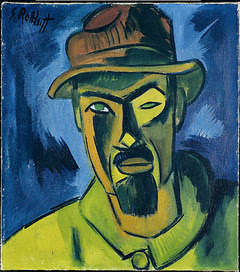
"Self-Portrait With Hat"
Karl Schmidt-Rottluff, 1919
639 of Kirchner's works were confiscated by the Nazis. This work was retitled Soldier With Whore for the Degenerate Art Exhibit. Kirchner died by suicide in June 1938. Fortunately for us, this work survives and you can visit it at the Allen Memorial Art Museum in Oberlin.

This work by Karl Schmidt-Rottluff (left) is part of the permanent collection at the Cleveland Museum of Art, also saved from the 1937 exhibition in Munich.

We saw Cabaret last night. It was very moving. There were no drunken, existential rants before bedtime. The first act closes with a spirited, patriotic round of Tomorrow Belongs To Me. My mother, seated next to me, remarked, "The Nazis did write good music," adding swiftly, "of course, they just stole a bunch of folk songs and changed the words."

"Cabaret"
(Great Lakes Theater, 2011)

Thursday, September 22, 2011

Joel Grey


Joel David Katz (b. April 11, 1932) was born and raised in Cleveland Heights, Heights High Class of '50. His father, Mickey Katz was a successful musician in a comical vein, performing for a time with Spike Jones. Joel got an early start in show business, performing the role of Pud in On Borrowed Time at Cleveland Play House at the age of 9. After graduating high school, he began a career in New York City under the name Joel Grey.

The role that has defined his career is that of the Emcee in the original 1966 Broadway production of Cabaret and the 1972 film version, for which he won a Tony and an Oscar for his performances. Grey returned to the role in 1987 for a Broadway revival.

Based on Christopher Isherwood's "semi-autobiographical" novel Goodbye to Berlin, which details his experiences in the Weimar Republic, Kander and Ebb's Cabaret long ago entered the kind of American pantheon of musicals which can safely be produced in high schools. My best friend from college performed the role of Emcee at Beachwood High in the mid-1980s. The most chilling moment of that production was the final image of the Emcee himself raising his hand in the Nazi salute ... with a swastika painted onto his palm, as if anyone in the room missed the point.


In 1993 Sam Mendes re-imagined the production for a new century, transforming the Emcee from Grey's androgynous elf into Alan Cumming's powerfully gay rentboy. Instead of a cheekily naughty dancehall, the Kit Kat Club was now a dangerous lair of sex and drugs. Berlin then, as always, is where you dance as fast as you can.

My girlfriend (at that time) and I visited New York City in 1998, another point is history where we were all feckless and gay, and when Nazis were again about to take power. A friend was swinging through Cleveland from Detroit and offered a ride, and so I got to enjoy the New York Times in its entirety, which that day happened to include the entire Starr Report. What the fuck was happening?

Mendes' Cabaret was in the midst of its hugely successful run on Broadway, Natasha Richardson had moved on and on the date in question Alan Cummings had excused himself from the matinee. No matter, the show was rock-solid with understudy Vance Avery in as the Emcee and replacement lead Jennifer Jason Leigh as Sally Bowles. Do not cry for me, I adore the JJL.

The devastation at the end of the show, however, is complete and left my date and I to squint in the late afternoon sun as we made our way to the Algonquin to have a few too many martinis. I spent a trying evening consoling her as the gin and the Holocaust and Van Gogh and Kenneth Starr reduced my partner into a howling mass of sad. The next morning we took a hungover bus ride all the way Uptown to Fort Tryon Park where I asked her to marry me.


This weekend the wife and I are going to see Cabaret when it opens this Saturday night at Great Lakes Theater. Wish us luck.

Sources:
Wikipedia
ClevelandSeniors.com
Cleveland Heights History (chhistory.org)