Question: How do you write in the style of an author whose work is intimately woven with life as they had experienced it in these United States when their life’s journey is not merely different from your own, but different as a direct result of the social structure that created the difference between theirs and yours?
To put it another way, their point of view made their writing what it is. For me to emulate that I should, what? I cannot pretend to be him. And I cannot write from my point of view simply emulating those elements of style which make his work unique; use of color, description of space, expanding of time, sense of alienation, anxiety, existential dread.
I cannot do this because the most important element, for him, his reason for writing, was protest. Expressing his walk of life, or mine, was not enough. The reader needs to be aroused, outraged, and moved to action.
Last Wednesday my professor asked the class how our writing was going, present progressive tense, as though it had already begun and is in process. I had not yet written a word. It’s an eight-page vignette that is due in a little over two weeks. But I have been engaging myself in these questions and finally arrived at a scenario, which I storyboarded yesterday and wrote the first pages this morning.
I may even use some of this post in my artist’s statement for that story.
The work on the play continues, just this week I had something of a revelation. Every piece, the play, the gothic short story, the protest vignette, has its own agenda. They each, however, require tension. For the play script I continue to be haunted by the observation of Joe Barnes, "It is hard to write a compelling play about two characters who are basically decent." They are decent, a mother-daughter duo who have (generally) open avenues of communication.
How to create conflict that does not involve men, men with a capital M. That it does not involve father, or boyfriend, or lover, that their struggle, if there is a struggle (there has to be a struggle) is between them, and not some other person. If you do not understand why this is important, you haven’t been paying attention.
How to explain to future generations what it was like not to have all your lifetime memories at your fingertips. What was it like to have a conversation and not to be able to find out immediately the name of that actor, the title of a movie, the correct lyrics of any given song?
For twenty-five years, I had the memory of a song, one I knew from a few weeks spent abroad in 1984. It was played often enough at that time that I could remember a series of notes that were whistled (or were at least, a whistle-like sound) as part of the chorus. I was pretty sure it was a song about breakdancing (there were actually several popular songs about breakdancing that summer) that it was an American song, though never a hit in America. I had lost it.
In 2009 I reconnected with members of the team that I had journeyed with a quarter-century prior (via Facebook, of course) and asked if anyone could help with this song, which was still stuck in the recesses of my mind. They could not, but it occurred to me then to do a Google search of “dance hits Spain 1984” or something along those lines and found it. Street Dance by Break Machine.
Not only did I find it, I immediately bought it on iTunes. And I can honestly say that the word I would use to describe this discovery is relief.
"Fraidy Cat" (ABC 1975) Life is terrifying. You will die.
The thing about childhood memories is that it used to be that unless they were somehow recreated in the form of a period film or television program, you just forgot them. Or they were there somewhere, but memory is fluid and they could change drastically. Maybe you'd doubt they ever existed as you remember them.
Was there really a Saturday morning cartoon about an alley cat on his “ninth life” who was terrified of death, and constantly haunted by his previous eight incarnations?
Yes, that was Fraidy Cat which had eighteen episodes on ABC in late 1975. I was seven. It was really terrible. But you can watch the entire thing right now on YouTube.
Personally, I had quashed a great deal of my childhood memory as I grew into adolescence. The youngest of three boys, my brothers were a constant reminder that my interests were childish (I was a child) and there was also the cultural pressure to discard the old and embrace the new. Disco is crap, buy this New Wave album.
Magazines, toys, posters, even records were sold at garage sales and clothes were given away. In my rush to be an adult I married too soon and bought a house. Twenty-five years ago, in 1995, I turned twenty-seven. I had lost the wife but kept the house, and my new girlfriend moved in. And together we began to rediscover childhood.
"Bummers" Art by Jared Lee
This was the era of Generation X nostalgia. We were all indulging in the trappings of the mid-to-late 70s. In Pulp Fiction a drug dealer eats from a box of Fruit Brute. Schoolhouse Rock was back on television. The Saturday Morning Cartoons album was released, featuring covers of TV theme songs by popular artists; this is where the Ramones doing Spider-Man comes from.
The thing is, these things weren’t in here, on our computers. Few had email in 1995, far fewer access to the “world wide web” or AOL. These things were out there, in the world, and we had to find them.
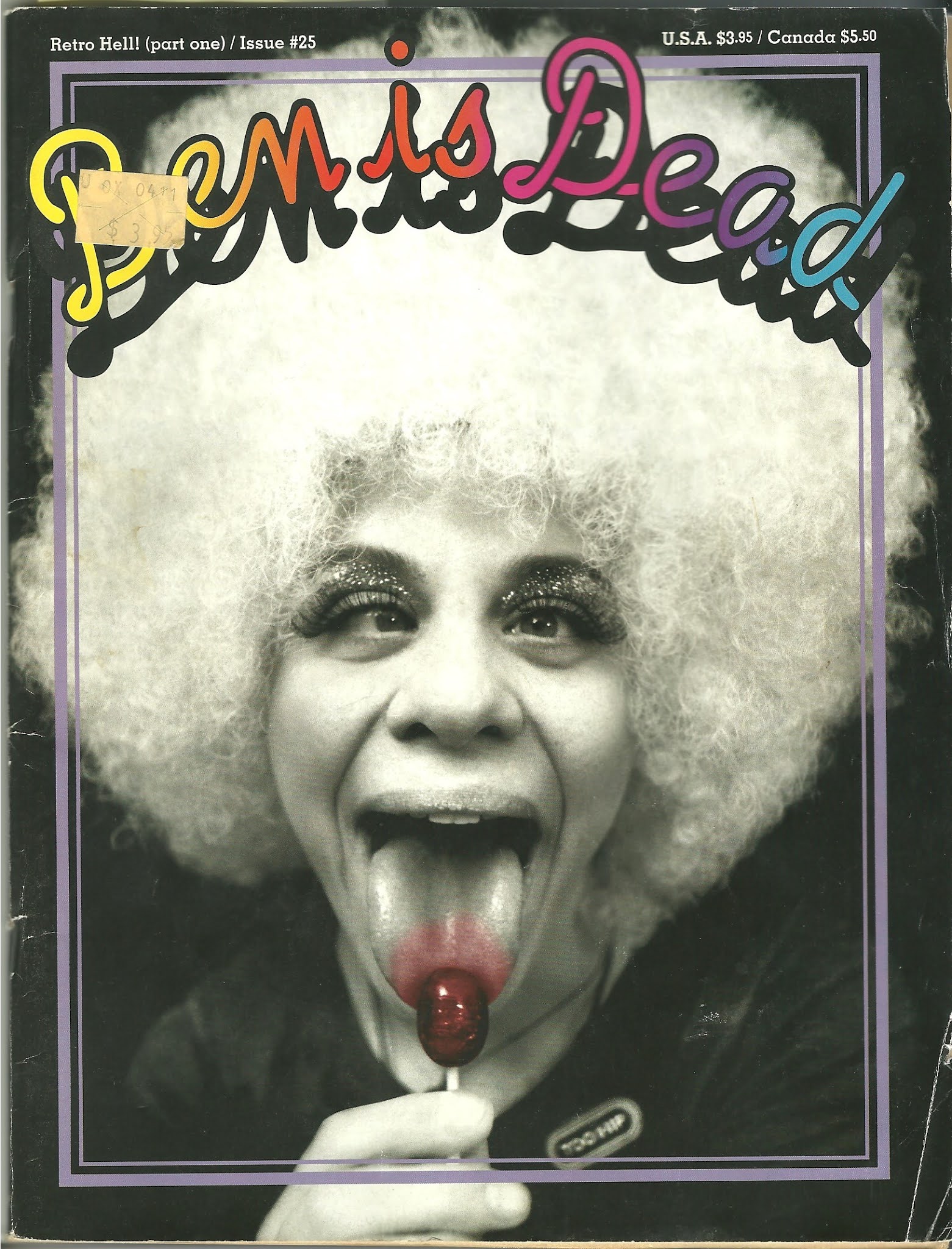
One of the valuable treasures I found, just as we began work creating the first Night Kitchen play Bummer (a collection of short plays about being a kid in the year 1980) were the “Retro Hell” issues of the magazine Ben Is Dead. The cover captured my attention at the local bookstore because the logo for that issue emulated the Scholastic magazine Dynamite.
Dynamite was an eagerly awaited item for me in every shipment of Scholastic books at Glenview Elementary because it was not only a fun activity book but was also a connection to popular culture, with interviews and features about TV and pop stars written for kids. It also included a regular single-panel cartoon called "Bummers" which was the inspiration for the title of our production in the Night Kitchen.
Ben Is Dead was a 90s, L.A.-based zine-turned-magazine that indulged in confessional essays by twenty-somethings (primarily written by the creator, Deborah "Darby" Romeo) as well as reviews, interviews and pop culture items. Each issue was based around a central theme. Retro Hell was originally intended to be two issues, which blossomed into three, and finally the book, Retro Hell: Life in the '70s and '80s, From Afros to Zotz (1997).
The first issue of this series alone (BID #25: 146 pages!) included personal reflections on Teen Idols (e.g., Brandon Cruz, Adam Rich) an interview with Debbie Harry, instructions on how to make a bubblegum wrapper wristband, recipes from the Woman’s Day Encyclopedia of Cookery, memories of a 1980s teenage lesbian, how to make a slam book and a cootie catcher, a list of incorrectly heard lyrics, a long list of games you can play with your hands (cheek pop, hand horn, vagina hole) and creepy LPs intended for children ... and so much more!
Also, the margins included a variety of long-forgotten catchphrases and put-downs like, “You think you’re hot shit in a champagne glass, but you’re really cold diarrhea in a Dixie cup.”
Editorial by Darby
Sensations can bring you back … Sometimes smells do it. There’s this one smell, of clammy hands and tar, that brings me right back to the elementary school auditorium where I was square dancing partners with Jimmy (I forget his last name now) - total babe.
The idea is that you can control this. These feelings don’t have to be random or accidental. They don’t have to be sentimental or emotional. They are a part of you forever and can be accessed on demand. You don’t need to be naïve or immature or go out with a person half your age to feel the force of youth … I guess it all depends on whether you’re going to utilize your past or just wallow in it.
Now these memories can literally be accessed on demand. At the time it wasn’t so easy, so having these volumes was extremely joyful. And shocking. It didn’t make me want to relive my past, but to better understand it. And believe me, I have utilized it.
“One of the best pieces of advice he had ever received as a rookie was to treat your station as one table. Check all the tables, see how they are, and then go get whatever they need all together. Be smart, save time.” - from Carl’s Last Night
My evenings are spent treating my graduate school work as one table. I keep track of time, reading for all three classes in equal measure, taking notes, and writing. Lots of writing.
This weekend I completed the first draft of a short story for my “gothic fiction” class which will be workshopped in a couple weeks. That one was heavily plotted, which is why I was able to bang it out so fast. There are stories in my head which have rolled around so long that, given the opportunity to actually write them down, I don’t need to think about what happens, and only need to concentrate on the words to share it accurately. This was one of those occasions.
My playwriting workshop will be reading twenty pages this week, twenty pages from the full length script I am writing for that class. That one is coming to me in bits and pieces. I have characters, and setting, but no obvious plot. But that works too, as our professor keeps reminding us, writing means quantity over quality. Don’t worry so much about writing the thing, just make sure you keep writing, and write a lot.
That third class, dedicated to the works of three prominent African American, male authors of the mid-twentieth century, has required a considerable amount of reading. An entire novel every two weeks. The writing for that one has not yet commenced, but will involve emulating the style of one of these authors, and not only their style, but their approach to social beliefs (but the emphasis is on the former.)
It is this assignment which is most challenging, and therefore most exciting.
I have not written a short story in a long time. I wrote a brief piece for a local magazine about ten years ago that I was happy with. I tried my hand at writing articles for Cleveland Magazine in the mid-aughts but they weren’t very good.
They were fine.
For my “dark fiction” class I need to turn in a short story in a couple weeks, one which includes elements ranging from the gothic and grotesque to the horrific and weird. Neither my writing fiction nor engaging in negative storytelling do I consider strong suits; hence, I took the class.
Creating and comprehending the plot of a mystery, specifically Sherlock Holmes Meets the Bully of Baker Street, inspired me to plot out the plot visually in a manner I had not attempted before. I created a chaotic flow chart, where I could drop things I knew must happen, in the order they must happen, at various points on a large, blank page, correcting them with arrows. The spaces in between were then filled with songs, puzzles, and other elements which I hoped to include and gave me a visual sense of pacing.
As a result, I could write the play in pieces-parts, without worrying about the order -- I could organize them according to the graphic later -- and concluded with a first draft that was coherent and largely complete. This was something which would have been useful crafting my previous mysteries, espcially those which had been adapted from pre-existing works.
The story I am working on for my fiction class is one I have been thinking of for twenty-five years. Seriously, I have had this tale rolling around in my head for decades, but have never written it. Because I never had the time or inclination to -- I did not know where it fit in my writing life. Now I do, and I cannot express how exciting that is.
Because it is an assignment. I have to do this, not for me, but for a class! Which is a much better reason for me to get it done.
Now summertime has come to an end
So I've gotta get back to my studies again
And make a grade so I can pass
And go-o-o up to the head of my class
I washed the dishes and scrubbed the floor
And taught me to love what I'd began before
Now I'm so glad the summers past
And school is in at last - Josie Cotton, “School Is In”
Our school district has committed to nine weeks, at least, of remote learning this fall. My children, a sophomore and a senior, are at their desks during the day for synchronous learning -- the girl at her desk less than the boy, as she is attending some in-person classes at the university downtown.
And I am also at school, taking three graduate school courses. So, in addition to my work Great Lakes (more on that in a moment) I am spending almost every waking moment either reading or writing. Mostly reading, though. And I feel more myself than I have in years. Or more like a person I remember wanting to be.
I was a mediocre student in high school, and a downright shameful one in college. I always enjoyed reading, but I resented assigned reading. I like to write, but writing assignments were a chore and a bore.
There was a little voice in my head, a child’s voice, saying, “No! I won’t do that! You can’t make me!” It was there far longer than it should have been. Now I spend my mornings, evenings and weekends, reading. Novels, short stories, and play scripts. And I am digging it.
My morning pages ritual remains, but the goal is the free-writing itself, not to produce a short play script. For the better part of a year I have been posting short plays at New Play Exchange, and I may actually take many (though not all) of them down. It was always an experiment in practice and motivation.
Attending weekly playwriting workshops, in addition to my theory and literature classes, I have not the time nor interest in extracurricular pursuits. The process is now focused on the craft of writing longer scripts.
I also have less time for ruminative blogging.
We have something very special in the works at my place of employment, though I suppose that is true pretty much everywhere. We are all and have been figuring out new and original ways to provide our services.
Since 2001, I have spent four September weeks in rehearsal for the school residency program. This year I am not. Instead, we have reimagined how to provide these lesson plans to area schools, and my colleagues and I have been dressing up as famous characters from Shakespeare, recording scenes in the park.
Tonight is a cool Saturday in September. My son and I sat out by the firepit, and together we read.
Brian Knoebel as Alma Tadema-Lawrence (CCPT, 2020)
Last night was a treat. Chennelle and Chelsea joined us for some late summer, socially-distanced deck time so we could watch the premiere of the Culver City Public Theatre (CCPT) production of Sherlock Holmes Meets the Bully of Baker Street.
This is the second production of that script. The folks at CCPT, who produced Rosalynde & the Falcon last year, were intending to offer performances of About a Ghoul to their audiences as their annual, free, outdoor summer show for families. Things being how they are, they thought a mystery might be better suited to the medium.
At first they considered a live “Zoom” performance, opting instead for something pre-recorded, with surprising results!
California is three hours behind us, so I made the mistake of thinking last night’s 6:00 PM showing would be during one of my classes. When I finally put it together that it would be, in fact, at nine (eastern) … well, then I thought I might see it. I might not. I haven’t been sleeping well. I might wait and see it this weekend.
Richard Rosales (left) in "Rosalynde & the Falcon" (CCPT, 2019)
I told all of this to Chennelle late in the afternoon and she invited herself over -- which was just all right with me! We rarely see each other (we all rarely see anyone anymore, of course) and besides, she originated the main character of Vicky for the inaugural production for Great Lakes Theater.
I don’t just mean she was the first to perform the role, either. I wrote it for her. I was so happy to get to watch this with her.
We all sat out on the deck, beneath the fairy lights, six feet apart, drinking seltzer in the open air, on an appropriately cool September evening, and were treated to an engagingly loopy COVID-era production.
Richard Rosales is the titular detective. He played the King in CCPT’s Rosalynde in the park, and brought his high haughty humor to the character of Sherlock Holmes as well, while Ashley J. Woods as Vicky is like a Covent Garden flower seller channeled by Catherine Tate’s schoolgirl Lauren Cooper, and they make a charming pair of sleuths.
King Edward busts a move.
Scene-stealers include Brian Knoebel who was killing it with his drag renditions of Miss Barnaby and boho artiste Alma Tadema-Lawrence (he left us cackling with glee) and the precious young Maggie McKissick as Annie, the orphan, in an actual curly red wig and moppet’s dress.
Director Marina Curtis Tidwell did not merely direct a play, she produced a TV show, complete with music and Pythonesque animations. Marina truly did a remarkable job keeping the edits tight and timely.
Each actor created their own scenes in their own homes, provided costumes, backdrops and set pieces by the company to give a coherent look. The production would not look out of place on your local PBS station, a playful mystery for kids with some historic educational value and a strong anti-bullying message.
First Reading (August 25, 2019)
They were even able to incorporate the “choices” that are intended to be offered to a live, child audience -- “should I do A or B?” In this case, the actor looks at the camera to consult the viewer (a Blue’s Clues moment) though in this case the outcome is predetermined.
It is shocking to me, shocking, that it was one a year ago that a number of us clustered together on our deck to hold the first reading of this script. Chelsea and Chennelle were there, too -- Chelsea reading Vicky and Chennelle the Barney track. If we knew then what we know now, right? It is a mystery.