Tuesday, November 1, 2011

Dialect


Arthur Miller: Brooklyn
"Seeing Red" (2008)

Stage performance requires a real-time transformation into a believably different person than who you are. And this can be an exciting transformation, for performer as well as audience member. Make-up when skillfully applied, impeccably accurate costuming, a swagger or carefully crafted physical disability can happily deceive the audience member into believing that are in a different time, or place, a sharing a moment with someone unique, someone other, and this kind of artistry is what live theater is all about.

The accent, however, the sounds of the words, can make everything just a show. I really, really hate listening to a fake accent. And I am stressed about delivering one. When I have it right, it becomes a part of me, and my character, and I believe myself. When I am making hash of it, even I don't buy it and I feel sorry for the audience that has to listen to it.

There's a twangy kind of tough-guy "tawk" that I slide into when I have no formal guidance. I got away with it in college, playing Dopey in Balm and Gilead, and I spent so much time delving into the world of that character that the cadences of Wilson's heroin-addled punk that my own voice sang back to me and I was all right with that. It helped that I was also permitted to smoke real cigarettes onstage. Weren't those the days.


Porlock: Romania
"On the Dark Side of Twilight" (2010)

Every other year, I am called upon to use an accent in the Great Lakes outreach tour. Four years ago I was playing Arthur Miller, performing an edited transcript from his HUAC testimony, and I knew the "New Yawk" crap was not going to fly. And so I visited my old friend, professor Chuck Richie at Kent State. Just because a voice is woiking class, does not mean it has to be in the nose. Miller spoke from the chest, he was a muscular guy.

Two years ago we met to discuss a proper accent for the vampire Porlock (On the Dark Side of Twilight.) In this story, the young Englishman Aubrey Porlock, transformed into a vampire, is stranded in the "wilds" of eastern Europe and settles in Romania for ninety years. We decided to go with an "acquired" Romanian accent, taking special care not to go the Bela Lugosi route. No "v's" turned into "w's" like Pavel Chekov.

Yesterday, we began work on a Belgian accent. Poirot is often confused for French, so we may assume he is from the region closest to France and not, say, Holland. Exploring the International Dialects of English Archive we discovered that while most of the substitutions are like those of French, the Belgians accents we listened to do not have the lilt or "sing-songy" inflections of a French speaker.


Next up: Mustache Maintenance.

Monday, October 31, 2011

Waiting For Lefty (2011)

The People's Theatre is not aligned with any political party. That is the euphemistic way of saying that it is not Communistic, and its organizers wish you to be clear about that. - William F. McDermott, The Plain Dealer, 1935
When I moved to Cleveland Heights we had three theaters. Name me another American suburb that can boast having three theaters. Well, anyway, time passed and by 2005 we had none. Ensemble lost their lease at the Civic, Dobama had been evicted from Coventry, and like all things Jewish, the JCC had moved from Cleveland Heights to Beachwood.

The new Mandel Jewish Community Center has many exciting new features, but theater? Eh, not so much. Dobama managed miraculously to maintain an identity in the wild before returning to the Heights at their fine new home in the CH-UH Library complex. And Ensemble has carved a new home out of the former Coventry Elementary School, and a really great space it is.

Two out of three? Not bad.

This afternoon I caught the closing performance of Ensemble's production of Waiting For Lefty, the first show in this new theater space. Life has not been kind to my wife's extended family the past several weeks, and in spite of wanting to catch numerous productions this fall, several closed this weekend without an opportunity for us to see them. At least I could catch this 70-minute program in my own backyard.

Seated in the front row, I invited Mike Partington to take the chair next to mine. It had been years since we had had the chance to talk, and this week I saw him both at Harvey's Tribute and in this place. Mike's got some years on me, our pre-show conversation had a lot to do with theater space, how he first reacted to the new Bolton Theatre at the Play House -- same as almost everyone else, really, stunned that they had dumped a thrust stage at East 77th Street to add yet another proscenium.

Ensemble Theatre has a thrust, with seating sections on three sides. It feels more like the old Dobama on Coventry than the new Dobama does. The platform stage is so close to the audience, and actors make entrances and exits through the house as well as through the wings. I love that.

I was very pleased to see such a large audience on a Sunday afternoon. Sunday matinees are notoriously depressing in Cleveland, with maybe ten to twenty people in the house. It was quite a full house!


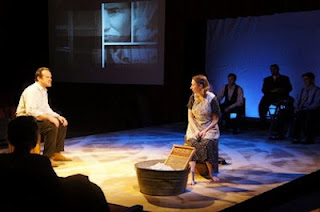
So. First time seeing Waiting For Lefty in its entirety. How does it hold up? Interesting! While employing period costumes and some kind of non-specific tough-guy New Yawk accents, the Ensemble production utilized their large video screen to bridge scene changes with footage and music from the future (HUAC testimony, Occupy Wall Street demonstrations) to empasize the continuing resonance of the work.

Remember: The Living Newspaper performances of the 1930s did use film projections and live music to bridge scene changes, and as commentary!

However, having just directed a staged reading of It Can’t Happen Here, I have been disabused of the notion that writing from the 1930s is dated, or must feel dated. Sinclair Lewis words, spoken by a contemporary cast, was suprisingly fresh, meaningful, humorous and resonance with our modern audience last Monday night. People were taken with the story, and moved by its conclusion.

A friend who caught the show reflected how much more slangy Lefty is, which explains why it is seems dated. Also, there’s no real story to be swept up in, it is a collection of vignettes on a common theme. It’s like Saturday Night Live without punchlines.

But that’s not the real problem with its presentation as a contemporary work. It’s one long debate, more like Greek drama than soap opera. For example, the tale of a young suitor, on a perfect summer’s evening, breaking up with his devoted gal because he can never be the man that she deserves in this economy, where the bosses and the company men keep the worker under his boot, where a guy can’t earn a crust while Uncle Sam stands idly by, doing as little as possible because the truth is The Man still mans the controls of government and always will, so the little guy is left to gasp meekly for dignity - let alone a dollar, and its high time we pulled together and rose up to demand what is coming to us, an eight hour day, a pension and a heart handshake, but until that day comes I will never be the kind of joe who can care for a girl the way she deserves to be treated, and not like some two-bit floozy, always promising, never committing, I mean what kind of life is that for a young American lady? The Masters of Power don’t care about these things, the velvet-gloved capitalist executive sees the workers as an endless supply of hands and muscle to hoist the gears that make the things that fill their endless, bulging pockets …

Hey, baby, where you going?


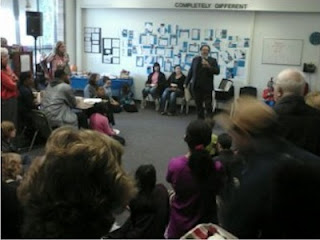
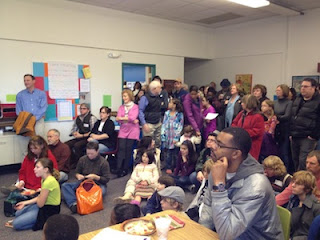
After the performance, the audience was invited into another part of Coventry Elementary (wait, do we have a name for this new community facility concept?) for a special event celebrating the opening of Lake Erie Ink.

What's that, you say? So glad you asked! It's a drop-on center for area youth with an emphasis on creative writing! HOW AWESOME IS THAT??? It's like an 826 Valencia for Cleveland Heights. I mean, it is an 826 Valencia for Cleveland Heights.


And wow-man-wow, there were a lot of people there! Cleveland Heights Poet Laureate Cavana Faithwalker represented, and world-renown hipster-shaman-beatnik-poet Ray McNiece was on hand to lead children in poetry exercises. There were a number of writing activities for young and old, I wrote a haiku on a paper pumpkin:

WORKERS THEATER
JUST SAW ‘WAITING FOR LEFTY’
LIKE AN UPPERCUT


Hey! You! Douchebag in the hat!

See also: Waiting for Lefty (1935)

Sunday, October 30, 2011

The Vampyres (1997)


Seventeen years ago the world ended. And another began. The summer of 1994 stretched on until deep into November. I was playing games I would never play again, making foolish decisions which would define the rest of my life. I have few friends that pre-date that time.

One day in January, 1995 I came home from my shift at the pizza restaurant to find half of the house was empty. There was no longer a piano, a dresser, a bed. It was time to rebuild.

The music was dark, the house was cold. I boarded a train to New York on most frigid weekend of the year, to visit my new girlfriend. I had a PowerBook. I had destroyed my theater company, I had destroyed my marriage. I was full of hope, and I feared there would be no future. I started to write a play.


By late 1996, life was rich and decadent. Long nights of drink and smoke, producing crazy theater on Coventry, live music shows, late hours at new friends’ apartments. I got the green light fo The Vampyres in Dobama’s Night Kitchen. We had tapped professional musicians to write rock songs for the show. The production was the greatest attempt to incorporate a DNK show into the mainstage, our set melded perfectly with theirs, transforming the humble, mid-century home of Beast on the Moon into the dark and stylish coffee shop called The Night Kitchen.

Critics hate this play. The protagonist is a former actor who cowardly abandons his career in the arts to pursue on in medicine, but he can’t help but comment on everything, judging the girl he hasn’t seen since high school for wanting to be an artist (even though he still wants to bang her,) transparently hits on the teenage barista, and displays naked jealousy of the two musicians that frequent the place who may, or may not, be real vampires.

Maurice Adams, Brian Pedaci

In the end, this pathetic wanna-be gets literally and figuratively fucked up the ass.

Christine Howey called it a "misbegotten effort."

The Free Times called it, "more hollow than haunting."

Tony Brown said it was "juvenile" and "infantile blathering."

The original production in 1997 was too long by half. Cleveland Public Theatre produced an edited version in 2005, and I was very happy to have the chance to present it with the most of the flab cut from it, but it was still such a nasty piece of work and I was no longer in that place. I find it difficult to reconcile my disconnect with this work that I spent so much energy living in. It’s obvious who wrote it. But I cannot believe there was ever so much anger and hurt in me.


In spite of critical derision, or perhaps because of it, it was a very successful run. One of the best attended Night Kitchen shows I produced. Houses were full, there were small tables on the stage for audience members to sit at to give the impression that The Night Kitchen (the coffee house) actually had customers in it. Elizabeth (as Claire the barista) was onstage during preshow serving coffee and pocketed the tips.

Cool Cleveland called The Vampyres, "Sinister, sexy, perverse and hilarious."

Anastasia Pantsios said it had “an intensity that makes the waters in which it wades feel very deep and dangerous indeed.

Dobama Artistic Director Joyce Casey didn't actually want me to produce the piece. She was concerned that it glorified cutting and drug-use. When I moved on from Night Kitchen, DNK Artistic Director Dan Kilbane produced Mark Ravenhill's Shopping and Fucking.

Cutting bad. Screwdriver-sodomy good. Got it.

Happy Halloween

Saturday, October 29, 2011

American Freedom Train


In the early 1970s a commodities broker and train enthusiast, Ross Rowland Jr., was concerned that the Bicentennial was approaching with little or no fanfare. The Vietnam War and the Watergate crisis had the nation in the grip of a malaise, and no one was feeling particularly patriotic -- or if they were, they were kind of aggressive about it.

To that end he worked to find corporate sponsors to fund a steam locomotive carrying 10 cars of artifacts central to America's history and identity. The red-white-and-blue engine dubbed American Freedom Train went from city to city, a traveling museum for families to enjoy in the run-up to the Bicentennial year. Rowland was inspired by a similar event in the late 1940s, also called the Freedom Train.

These displays included George Washington's own copy of the Constitution featuring his handwritten notes, clerical robes belonging to and worn by Dr. Martin Luther King, Judy Garland's Wizard of Oz costume, Joe Frazier's boxing shorts, and a moon rock. There were stops in each of the lower 48 states.

A pennant just like this one hung on my bedroom wall.

Seven million people boarded America's Freedom Train, and I was one of them when it was stationed just west of Cleveland Stadium from May 14-20, 1975. This is a hazy memory for me, as I wasn't yet seven, but I was aware it was a very special event. The attraction concluded on December 31, 1976 in Miami, Florida.


American Freedom Train from pixy on Vimeo

"President Ford strongly urged parents and teachers 'to make sure that your children and students take advantage of this wonderful opportunity.'"

All aboard, America!

Sources:
FreedomTrain.org
Wikipedia

Friday, October 28, 2011

Outlaw (video game)

"OUTLAW is a new concept in video entertainment. OUTLAW invites the player for the first time to physically match his skill against a video gunfighter in one of America's most traditional contests … the fast-draw shootout." - promotional advertisement
Atari introduced PONG in 1972, the first massively successful arcade video game. There were several imitators, and by Christmas 1975 they had created a home version, sold exclusively through Sears.

Outlaw was rolled out in 1976, and holds a place in history as the original First Person Shooter (FPS) game. It was a "quick draw" gun battle, featuring a mock Colt .45, holstered into the machine, and you could only draw it at appropriate times to fire at the desperado who charged out into the middle of Main Street to challenge you.
"Realistic animation, audio footsteps and gunfire add up to irresistible realism." - promotional advertisement
Outlaw

The console featured a plastic screen overlay, which gives the illusion of more sophisticated graphics. The cabinet Outlaw is not to be confused with the Atari 2600 version, which is much more like Taito arcade game Gun Fight (1975) which features players positioned at the right and left of the screen.

Gun Fight


My family had a Coleco Telstar. It was the most exciting game I have ever seen on my TV set.

Sources:
Skooldays.com
the-nextlevel.com
Wikipedia

Thursday, October 27, 2011

The Harvey Pekar Tribute (Yes on 6)

From Harvey Pekar's Cleveland
Art by Joseph Remnant
Zip Comics, (Publication Date: March 2012)
Used with permission.

The Harvey Pekar Tribute was held at the Cleveland Heights Main Library on Tuesday night. There was a great turnout, and many had the opportunity to share stories about the impact Harvey had on their life. Steve Presser was the master of ceremonies, but really, so was Joyce Brabner, as she offered her own insight into several of the reminiscences. Al Branstein told that awesome American Splendor piece about the sea mammal strapped to the roof of this guy's car, poems were read, there was laughter and tears, Toby was there, Ernie Krivda played Blues for Pekar.

Read about the Harvey Pekar Memorial Statue and how to contribute.

Joyce asked me to read from the as-yet-unpublished Harvey Pekar's Cleveland, which should be required reading everywhere. You may soon be able to acquire an illustrated history of Cleveland, dating back to the real Indians to the present, as well as Harvey's place in it all. I was struck by and delighted to read that he chose to include full-throated support for the CH-UH school system in this work.

These are my reasons for supporting this CH-UH School Levy, Issue 6:
I am a twenty-year resident of Cleveland Heights. This is the city my children will call their hometown. My daughter is eight, my son is six. They attend Noble Elementary, I am a member of the Noble PTA. My children are very happy at their school, and they are very proud of their school. And so am I.

For ten years I have worked with the education department at Great Lakes Theater, and through the residency program I have had the opportunity to visit private and public schools across Northern Ohio. Through this experience and my time as a member of our PTA I have learned that keeping our American schools strong requires constant attention, care and communication. That is true whether your school is a parochial school, a Montessori school or one of our public institutions, the public schools which make education available to every child, that give every child a chance.

The CH-UH School Board have shown that attention, and have put forth tremendous effort to craft a reorganization plan to improve our schools, schools that are already strong to begin with. This is a very exciting time for our schools, and it comes at a critical moment. And we need support from the community to make it successful.

Voting Yes on Issue 6 will improve your CH-UH schools. Improving the schools will add value to your neighborhood. It will increase the value of your home. Do I know these things to be true? Yes. Yes, I do. Because I have faith; faith in our school board, faith in the parents and teachers and administrators of Cleveland Heights schools, faith in my community. And my children have faith in all of us to do the right thing.

From a Cleveland Heights parent: Please vote Yes on Issue 6.
ELECTION DAY 2011 UPDATE: We won, and by a lot. So relieved, such a good feeling. Thank you, Heights, for stepping up for our children and our community.


Wednesday, October 26, 2011

Alhambra Theatre


The Alhambra was at 10403 Euclid at the corner East 105th Street. Built in just after the turn of the 20th century as a vaudeville house, legend has it the young Bob Hope was taken there by his parents when he was a boy. The young lad also hustled pool next door. In 1907 a church organ was installed, and they billed the place as "The House With the Organ." This was when the One-Oh-Five was called by some "Cleveland's Second Downtown."

As motion pictures took hold, the Alhambra became a movie palace. The place seated 1,100 in the mezzanine, with another 400 in the balcony.

The Hough and Glenville riots cemented the end of white Clevelanders relationship with the 105th Street district and it fell into steep economic decline. One black real estate developer, Winston E. Willis purchased a number of properties, opening small businesses to raise the level of opportunity in the neighborhood. However, the city took possession of property throughout the area by eminent domain to provide to the ever-expanding Cleveland Clinic.

1976

2011

Sources:
CinemaTreasures.org
Cleveland Historical.org
Cleveland Memory Project