Showing posts with label Cleveland Heights. Show all posts

Saturday, July 8, 2023

Forest Hill Park Footbridge

Under Construction, 1939-40
For better or for worse, I am a runner. There are a number of short routes which take me from my home in Cleveland Heights and through the neighborhood or the city, though many of those will include inclines which, depending on the day, can be welcome or not.

Some time ago I realized how close I was to Forest Hill Park, which spans both the Heights and East Cleveland. It’s almost exactly a mile there (and a mile back) and once there, I can take a few different paths to create a 5K, a four or even five miler. And the entire route is mostly flat.

Once upon a time, Forest Hill was the home of John D. Rockefeller. Featuring a bluff from which you could view the city of Cleveland, the estate was a summer retreat for the family until the mid-1910s. In 1939, J.D. Rockefeller Jr. donated the property to both cities for public recreational use. It was at that time that Works Progress Administration funds were employed to create a footbridge to span a 350-foot valley, through which runs Forest Hill Boulevard.

It’s a lovely bridge, built with a steel skeleton and faced with locally quarried Euclid bluestone. More recently, a cage-like addition was added to the middle section for safety. It has also kept the bridge free from tagging.

Photo: J. Mark Souther
I will often take the bridge from East Cleveland to Cleveland Heights and back on my runs, and once even incorporated the bridge into a script I wrote, a play which is intended to be performed live via cellphone, while running through the park.

Over recent years, the bridge at either end had been damaged, the stone walls knocked over, possibly by careless motor vehicles in the park, or in some cases, probably pushed over by mischievous hands.

A couple years ago, however, repair workers replaced and repaired the damage and now they look good again. I stopped in the middle of a run in October, 2021 to thank and compliment the guys who were employed for the project, for their work.

Sources:
Cleveland Historical

Monday, April 30, 2018

Play a Day: Fairfield

Eric Coble
For Monday I read Fairfield by Eric Coble, and available at New Play Exchange.

Two months reading a new play every day, and this is the first time I have presented the work of Eric Coble which is odd because we are friends. I am friends with playwright Eric Coble. Everyone hear that? Me and Eric Coble. Yes.

We met in college, I was completing my fifth year as an undergrad and he began his MFA in Acting at Ohio University so though I think of him as older we are the same age. He stopped acting in 1996, I was the marketing director at Dobama Theatre when he walked on stage for the very last time in Eric Overmyer's Mi Vida Loca. Coble is an excellent actor and I am sorry no one else has the opportunity to see that.

Because he was committed to becoming a playwright! And he has been most prolific and most successful. I had the great good fortune to perform in The Velocity of Autumn opposite Cleveland legend Dorothy Silver at Beck Center in Lakewood, before it moved to the Arena Stage and then Broadway, a production for which Estelle Parson was nominated for a Tony.

The Velocity of Autumn
(Beck Center, 2012)
I am dropping all the names today.

For ten years Eric and I have been colleagues in the Playwrights' Unit at the Cleveland Play House, where I have been blessed to receive Eric's guidance, advice and good humor as I have made my own journey as a professional writer.

I have also had the fortune to experience several of his works in progress, including Fairfield, as well as seeing the CPH premiere production in 2015. In the spirit of #NewDayNewPlay, however, I did re-read it before writing my recommendation!

Fairfield takes place in an inner-ring suburb somewhere in the United States. Except the only city like this one in the United States in Cleveland Heights, a magical fantasyland where an almost equal number of white people and black people (and a not insignificant number of Jewish people) live side-by-side and get into heated arguments about race and racism and yet never actually set fire to anything and we don't leave because we love it here. Except for all the racism.

Fairfield
(Cleveland Play House, 2015)
Eric was a member of our school board when he wrote this play (we both live in Cleveland Heights, the city of great writers) and after the table read I asked if he wasn't concerned about how it might be received. He just gave that carefree smile of his and told me he wasn't running for reelection, anyway.

Coble has an incomparable way of taking difficult contemporary issues to outrageously hilarious extremes, and Fairfield is a classic example of this. He explodes modern conversations about race, while still presenting engaging and (with one obvious exception) sympathetic, well-meaning, occasionally delusional characters who truly want to do the right thing, even if they only help make everything spin more wildly out of control.

As one of the parents whose children attend Fairfield might say, Eric Coble knows how to "use his words."

This month I have been heartened to read thirty great works by thirty tremendous playwrights. So many of them were recommended to me by other playwrights, dedicated individuals who proudly promote each other's work.

I am taking a short break from writing, however, as I concentrate on an outdoor, summer production of Shakespeare's Troilus and Cressida. Perhaps I will see you there!

Eric Coble is currently developing his new play, "The Girl Who Swallowed a Cactus" at the New Visions/New Voices Festival at the Kennedy Center in Washington, D.C.

Tuesday, November 1, 2016

Appletree Books (one)

That's me in the corner.
No, when I originally signed up to participate to write in the front window of Appletree Books on Cedar Road in celebration of NaNoWriMo, I did not imagine it would be seventy-five degrees, nor that the Cleveland baseball team would be one win way from the World Series. Honestly, I would rather have taken up my friend's invitation to enjoy a little of that energy over a cocktail at Hodge's or a beer at Parnell's.

Instead, I am sitting in the window of Appletree Books. Trying to write.

It's a little warm, but at least the front door, which is right next to me, because I am sitting in the front window, is open. I like the sound of the end-of-day-traffic. I also like to watch the people walking by. They smile. Why not? It's seventy-five degrees out and we are in the World Series and there's this guy, typing in the window of the bookstore. What's not to smile about?

Maybe that Donald Trump has a strong chance of winning the election one week from today. Try not to think about that. There is writing to be done.

I have also signed up to write in the window at Appletree Books in three weeks, when there may very possibly be snow on the ground. Not only within the bounds of possibility, that is a thing that happens here.

Sunset over Cedar Road
Anyhow, these are anxieties I have brought with me, and I am working to purge them now, in these first few minutes, because I actually like being here. My tiny space, set up high from the sidewalk, in plain view, creating.

What must they think? My God, what is that? That is a writer, my boy! Perhaps he is working on a novel, or if nothing so grand or important, we may assume he is perhaps writing a play. He looks far too approachable to be a poet.

Except I'm not. I am writing a blog. Ye gods, avert your eyes, my son. No one wants to see that shit.

I like this chair, it keeps my posture straight.

Okay, enough. There's a play to be considered.

Many thanks to the folks at Appletree for setting this up. See you on Tuesday, November 22.

Wednesday, February 13, 2013

Double Heart: The Alcazar

Happy company!

Double Heart (The Courtship of Beatrice and Benedick) opened at The Alcazar last night to a capacity crowd, there were over 100 people and not enough chairs to go around. Fortunately the grand ballroom has some comfortable window seats where the overflow crowd was able to find a good place to sit, while others were content to stand. Thank you, Cleveland Heights. You are my city.

Sigh no more.

Reaction from the opening night audience was very positive, we were called out for a second curtain call and I do not remember that happening at any tour I have participated in. While the audience at tonight's performance at Lorain County Community College was not as large as last year's, it was still a marked improvement in attendance over previous years. Word continues to build about these annual performances, and I guess the word is good!

Remember the page.

Both evenings there was at least once audience member who were outspoken enough to take issue with the actions of certain characters in the story, but I was looking forward to that and we have been able to turn them into some great, open discussions. On Tuesday night there was a question as to whether I (as playwright) wasn't belittling a tragic situation by having one of my characters behave selfishly. It was my position that creating a character who acts in his emotional self interest is not the same thing as endorsing that behavior.

Tonight one found it hard to believe that certain characters could enter into a Shakespearean comedy (Much Ado About Nothing) weighted with the kind of emotional baggage created in Double Heart. My question is, what was the capacity for forgiveness? Are there things that cannot be forgiven, ever? Can time, in fact, be a healer?


I mention these two examples because I like the criticism. But I also like all the praise which has been provided to the script. They like it, they like the poetry. You would imagine that trying to write a play in iambic pentameter, modeled on Shakespeare, would be considered presumptuous and arrogant, but mostly I think people are just impressed and enjoy the effort.

Tomorrow we have a private performance at a local high school. A Catholic high school. Very curious as to how all the dirty jokes are going to be received.

"Double Heart (The Courtship of Beatrice and Benedick)" is available from YouthPLAYS.

Wednesday, January 16, 2013

The Avenue As It Used To Be

 Company for "Bummer" - Dobama's Night Kitchen, 1995

Last night I had an hour-long conversation with a young man who is writing  book about the Coventry neighborhood, and how it is no longer cool the way it was when he was a teenager in the late 1990s. Over the course of this discussion, I was reminded of an article I had written in honor of Dobama Theatre's eviction from their former basement home.

There Goes the Neighborhood
by David Hansen
First published in Cleveland Magazine, June 2005

Coventry loses Dobama Theatre this month, but what does it gain?

The year 1968 was auspicious in Cleveland theater history for two big reasons: I was born, and Dobama Theatre opened its doors on Coventry Road in Cleveland Heights. In the intervening 37 years, we have each changed a lot, Dobama and I, together and apart, for better and for worse.

Our playgrounds could not have been more different back then. Somewhere between the eras of Marilyn Sheppard and Amy Mihaljevic, I could toddle around unmonitored in the front yard of my Wolf Road home in Bay Village with little fear of being snatched . . . or maybe my parents' "Ice Storm" generation really was kind of slow.

Coventry, meanwhile, was cementing its reputation, one that persists to this day, as a hangout for an "edgy" crowd. It was an inexpensive place to live and was an attractive spot for a lot of intellectuals, teachers and otherwise unsavory, forward-thinking pinkos to live, drink and presumably take a lot of drugs.

Founding artistic director Donald Bianchi signed the lease on the basement space at 1846 Coventry — then a bowling alley — in 1964. The landlord offered them (if you can believe this) free rent until their first show opened. The owner was obviously a communist. Even so, no one imagined then that it would take four years to get the space into shape.

When Dobama opened its first play on Coventry, Lorrainne Hansberry's "The Sign in Sidney Brustein's Window," an examination of race relations between blacks and Jews, there was a real-live biker bar across the street. Oooh, scary — big, hairy bikers!

This is funny because my father-in-law is a big, hairy biker, who owns a real-live biker bar in Athens, Ohio. But I digress.

Following a rather cushy upbringing and putting in the requisite five years at Ohio University, I came to Cleveland Heights in the early 1990s. It was the end of an era . . . and apparently the beginning of a new one. It still had a hippie-dippy vibe. Hang-abouts were still smoking cigarettes and playing Pente at all hours in the Arabica on the corner. My friends and I performed at open-mic nights in what they used to call The Yard out in front of that coffeehouse, a big open plaza where kids played hackey-sack and there was even more smoking.

It was also a depressed time. A friend who came to visit got his car broken into in the middle of the afternoon and has never been back. I was consistently hit up by a guy named Benny. Nice guy. He got most of my change, back when I still gave people change.

My introduction to Dobama was when I went to see "Nebraska" by Keith Reddin, a play about the effects of stress upon the men and women who work in nuclear weapons silos. Then as now, Dobama Theatre has been dedicated to plays with strong, left-leaning social messages.

The early '90s was also when Joyce Casey began her tenure as artistic director. Since then she has worked to maintain the theater's reputation for progressive-thinking plays, to reward her artists with pay (the performers, directors and artisans from the Age of Aquarius did it all for love, the amateurs) and to attract young, new audiences.

That's where I came in. In 1995 I was asked to create a late-night theater project — shows that would go up after the curtain came down on the mainstage shows — specifically to get teenagers and young adults into the seats. I also worked as the public relations director, to justify a paycheck.

Before I left Dobama in 1998, I developed a strong attachment to that theater. At that time, it was practically the only theater in town presenting the best modern plays to Cleveland audiences. "Angels In America," "Wit," the works of Suzan-Lori Parks and Paula Vogel — if you had seen the Cleveland premiere of a Pulitzer Prize- or Tony Award-winning play, or last year's great Off-Broadway or West End hit, the odds were very good you saw it at Dobama.

Their dedication to local playwrights is unequaled in Cleveland, presenting one world premiere a season. Eric Coble, Sarah Morton, Faye Sholiton, and, yes, even I have had new works presented for the first time either as part of the mainstage or Night Kitchen productions.

There have been detractors. Even I thought Joyce was high when she chose to produce Mart Crowley's "For Reasons That Remain Unclear" in 1997. A two-person, one-set drama featuring Mitchell Fields as a pedophile priest and Scott Plate as one of his now-grown victims who confronts him — in Rome! I thought it would be hooted off the stage. And I had to sell it.

Crowley, best known for the groundbreaking and gay-stereotype-setting "The Boys in the Band," had had one ill-received production of "For Reasons" in Washington a few years earlier. The Dobama production seemed sure to be its second.

It was a big, big hit for Dobama. The show's run was extended an additional weekend, which afforded the playwright, with his L.A. entourage (Crowley does a lot of writing for television), the opportunity to come to Cleveland and see his latest work be vindicated. I will never forget when Joyce announced the playwright's presence in the audience following curtain call. We could all hear Scott in the dressing room; he yelped like a little girl. It was yet another touching, transcendent moment in the history of this little theater.

Meanwhile, time was not kind to the glazed, white terra cotta building Dobama has called home. One morning I was working in the office, alone, when I heard someone turn on the shower in the men's room lobby — which has no shower. I stood in mute horror as the entire lobby flooded in a matter of minutes. Quite often I have watched in pain as productions would include actual rain, onstage. Conditions for producing professional theater became incrementally intolerable.

When the Winking Lizard restaurant moved in upstairs in 1998, the sounds of chairs scraping across the floor and newly installed toilets flushing directly over the audience's heads became a commonplace occurrence. Intimate, quiet productions have become almost impossible to consider for production, and Dobama has lost subscribers because of this, as well as all of the other inconveniences.

Meanwhile, the Coventry neighborhood has been evolving around this liberal bastion of free expression and authority-questioning drama. While the stalwart, funky and fun emporiums of the past (Tommy's Restaurant, High Tide-Rock Bottom, Mac's Back Paperbacks and Record Revolution among others) have held back corporate encroachment by consolidating into one co-operatively owned block in the middle of the street, new landlords at the extremes have done their best to maximize profit and lower the common denominator.

In the neighborhood where I used to get my eyeglass prescription filled, take tai chi lessons, get my groceries and ply my trade as a theater artist, I can now buy pizza, hoagies, sushi, burritos and ice cream. For every independent boutique that can't cut it, we get another place to stuff your face.

Worse still, it's like Coventry is eating itself. The chain coffee shop put the old Arabica out of business in 2001. The chain burrito place went up after the success of the locally owned Que Tal up the street, and Strickland's and Goodie's ice cream shops opened almost simultaneously to much consternation. The new sub shop will no doubt do damage to the long-established Grum's, and now there's a third pizza place.

The business model seems to be: You have clientele? I want it. No imagination, no plan for the future; it's just business.

Now, I have no illusion about the bohemian era for which Coventry is so celebrated. It's like Derf put it in one of his cartoons: "Coventry — it's just like Greenwich Village!!! (Only smaller and duller.)"

But it was once a neighborhood where I would go and stay, and not just to work. On a beautiful day, you could even walk up to The Yard and see who was there. No one does that anymore, either — the powers that be put giant, hideous planters there several years ago as part of some forgotten beautification plan. Now there isn't any room for people to play guitar or skateboard or attract any kind of crowd.

Dobama has been looking for a new home for some time, someplace warm and dry, where it can afford the rent, which has been rising exponentially up and down the street. The theater has been promised a new space in the old YMCA building across the street from the Cleveland Heights Main Library on Lee Road. And a proud new sign hangs on the building that reads "Future Home of Dobama Theatre."

Unfortunately, that place won't be ready until 2006. And J. Scott Scheel, Dobama's landlord since March 2003, gave management a "notice to vacate premises" in November 2004. It was only through a last-minute intervention by the city of Cleveland Heights that the theater could keep operating on Coventry through the conclusion of the 2004-2005 season.

For the next year — and hopefully only for the next year — Dobama will go "on tour," producing plays under the Dobama name at other venues around the city.

With Dobama gone, the moneymaking can really begin in that basement space. That is, once its spongelike ceiling is taken care of and an elevator is installed to take care of the problem that no one with a wheelchair or a heart condition can get down those steps. Scheel told me he is looking forward to putting "a comedy club, other live theater, a jazz club, a pool hall . . . or a restaurant" down there. He quickly added that a restaurant "is not our preference."

The last three retail stores to leave his iced wedding cake of a building have been replaced with places to eat. This is me holding my breath.

I feel Coventry is at a painful and difficult juncture. Perhaps the large crowds currently drawn to the sports bar and the other sports bar and the other sports bar don't really care that Dobama is leaving — or don't even know it's there, which is more likely. What troubles me is that I used to go to Coventry not just to work, but to see what was happening, to run into people, and to, you know, have a life.

If Coventry is going to win back any of its reputation as a cool place to be, it needs someplace like Dobama, if not the place itself. A place where folks from diverse backgrounds — bikers and bankers, punks and preps, white, black, straight, gay, Jew, gentile — come together for a communal experience. Not merely to consume, but to participate in some time-honored ritual. Entertaining, edifying, affordable and something uniquely Cleveland.

After 40 years, Coventry needs a new bowling alley.
 Join Death of the Cool: Decline of Coventry Village's Counter-Culture Scene Facebook Page.

"The Avenue As It Used To Be" is a play by Donald A. Bianchi (1976)

Thursday, October 27, 2011

The Harvey Pekar Tribute (Yes on 6)

From Harvey Pekar's Cleveland
Art by Joseph Remnant
Zip Comics, (Publication Date: March 2012)
Used with permission.

The Harvey Pekar Tribute was held at the Cleveland Heights Main Library on Tuesday night. There was a great turnout, and many had the opportunity to share stories about the impact Harvey had on their life. Steve Presser was the master of ceremonies, but really, so was Joyce Brabner, as she offered her own insight into several of the reminiscences. Al Branstein told that awesome American Splendor piece about the sea mammal strapped to the roof of this guy's car, poems were read, there was laughter and tears, Toby was there, Ernie Krivda played Blues for Pekar.

Read about the Harvey Pekar Memorial Statue and how to contribute.

Joyce asked me to read from the as-yet-unpublished Harvey Pekar's Cleveland, which should be required reading everywhere. You may soon be able to acquire an illustrated history of Cleveland, dating back to the real Indians to the present, as well as Harvey's place in it all. I was struck by and delighted to read that he chose to include full-throated support for the CH-UH school system in this work.

These are my reasons for supporting this CH-UH School Levy, Issue 6:
I am a twenty-year resident of Cleveland Heights. This is the city my children will call their hometown. My daughter is eight, my son is six. They attend Noble Elementary, I am a member of the Noble PTA. My children are very happy at their school, and they are very proud of their school. And so am I.

For ten years I have worked with the education department at Great Lakes Theater, and through the residency program I have had the opportunity to visit private and public schools across Northern Ohio. Through this experience and my time as a member of our PTA I have learned that keeping our American schools strong requires constant attention, care and communication. That is true whether your school is a parochial school, a Montessori school or one of our public institutions, the public schools which make education available to every child, that give every child a chance.

The CH-UH School Board have shown that attention, and have put forth tremendous effort to craft a reorganization plan to improve our schools, schools that are already strong to begin with. This is a very exciting time for our schools, and it comes at a critical moment. And we need support from the community to make it successful.

Voting Yes on Issue 6 will improve your CH-UH schools. Improving the schools will add value to your neighborhood. It will increase the value of your home. Do I know these things to be true? Yes. Yes, I do. Because I have faith; faith in our school board, faith in the parents and teachers and administrators of Cleveland Heights schools, faith in my community. And my children have faith in all of us to do the right thing.

From a Cleveland Heights parent: Please vote Yes on Issue 6.
ELECTION DAY 2011 UPDATE: We won, and by a lot. So relieved, such a good feeling. Thank you, Heights, for stepping up for our children and our community.


Monday, August 29, 2011

Potter Village

DID YOU KNOW ..?

Potter Village is the neighborhood within the seven connected streets of Castleton, St. Albans, Boynton, Radcliffe, Haselton, Woodridge and Edison (in the area between Monticello and Taylor). The name “Potter Village” comes from the fact that this neighborhood was once the location of a large farm owned by a family named Potter.

Beginning in 1923, the area was redeveloped into a residential neighborhood. At that time, the developer described it as “one of the most beautiful sections of the Heights.” Nevertheless, the neighborhood was mostly unpopulated until the late 1930s and early 1940s.

Today, almost 90 years after the establishment of the area as a residential neighborhood, these quiet tree-lined streets remain “one of the most beautiful” places in Cleveland Heights.
- Jim Goodluck, Potter Village Good Neighbor Association
Potter Village is not to be confused with Forest Hill, that expanse of land between Cleveland heights and East Cleveland which was once the domain of John D. Rockefeller -- home of Forest Hill Park and the Historic Heights Rockefeller Building ... Speaking of which, have you been to Rockefeller's for a cocktail or an intimate dinner yet? You should.

Whenever I mention where I live, someone invariably asks if its part of Forest Park, and I have to report that no, I live adjacent to Forest Hill in the less-fashionable South Of Monticello District ... or "SOMO." That was before our neighbor Jim discovered the neighborhood already has a name.

In 2009 after the collapse of the housing market and just before our eldest was about to start first grade, my wife took it upon herself to put out a call to the neighborhood to have a block party. At that time there were foreclosed or abandoned houses two yards to our left, three yards to our right, two across the street and two on the other side of our backyard fence. We wanted to know who our neighbors were, and at that time we'd been here almost sixteen years and really didn't know.

It's two years later. Last weekend we held our third annual Castleton-Potter Village block party with all of our friendly neighbors and friends. All those houses I mentioned now have people in them. Our youngest starts first grade in a week. The world spins.

Sunday, May 22, 2011

Chef Boyardee

Cleveland Press Collection
Cleveland State University Archives.  

My investigation into the 1950s seems to involve a lot of cheap food products.

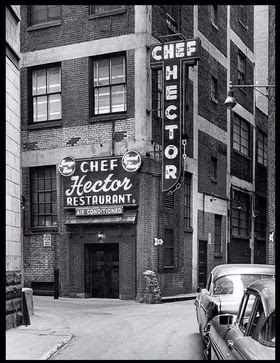
Ettore "Hector" Boiardi (October 22, 1897 – June 21, 1985) was born in Piacenza, Italy and passed through Ellis Island when he was 16 years old. By the time he was 20 years-old he was the head chef of the Ritz Carlton Hotel in New York City.

Really? That's what it says. Amazing, there's your American success story for you, right there. His abilities attracted the attentions of the owners of the Windham Hotel, who lured him to Cleveland. He must have been some kind of business entrepreneur because in 1924, before he was even close to 30, Boiardi has opened his own restaurant, Il Giardino d'Italia (The Garden of Italy) at the corner of East 9th and Woodland. He lived at that time at 2501 Arlington Road in Cleveland Heights.

Now, the foods we traditionally think of as "Italian" in this country are based on the simple, inexpensive meals prepared by the poor immigrants who were looking for a new way of life. Italian cuisine was and is diverse and interesting - in Italy. But in the United States in those days it meant pasta and sauce. Experiencing the relative cheapness of the basic ingredients only made the portions larger, not more adventurous.

As the Depression stretched on, spaghetti and the entire Italian food craze was in full swing, and Il Giardino was a hit. Citizens clamored to take home Boiardi's sauce, which he was happy to sell to them, originally in milk bottles with a bag of dry noodles and Parmesan cheese to go with. He soon built a factory to keep up with demand.


"Hello, may I come in?"
Chef Boyardee TV commercial, 1953

You make it look so good.
World War II was where the Chef really hit the big-time, creating easy-to-prepare canned spaghetti for the Allies. By this time, his well-known canned pasta products were selling under the name "Boy-Ar-Dee" in a successful attempt to get everyone to pronounce his name correctly.

Like so much else that gave "our boys" comfort during the war, demand continued when they returned to the States.

DID YOU KNOW ..? Self-adhesive stamps were designed to provide to soldiers during the 1991 Persian Gulf War because gummed stamps were useless to carry around in the deserts of the Middle East -- and that their domestic introduction was due to, you guessed it, demand from Iraq War vets? True story.

Though operations moved to Pennsylvania during the 1930s, he remained a dedicated Cleveland restaurateur, opening Chef Boiardi's in 1931, and becoming a part-owner in several other local establishments.

Chef Boyardee died in Parma. And haven't we all, at least once?

Sources:
Wikipedia
Cool History of Cleveland
Encyclopedia of Cleveland History
Cleveland Heights Historical Society

Wednesday, January 12, 2011

The Lady


I am a devoted Heights Schools parent. Perhaps I could do more to contribute to the betterment of my children’s education, but I am doing what I can. I attend PTA meetings, volunteer when possible. I cannot describe the joy I felt being able to bring the GLTF School Residency Program, to which I have devoted the past ten years of my life, to a school where my own child could experience it.

My daughter and my taxes go to Noble Elementary School.


Noble Elementary c. 1960

Last year when she was in first grade I heard there was going to be a Black History Month program, featuring a short play. Even then I began trying to come up with an idea for a play I could write which would be suitable, from the point of view of appropriate, and entertaining, and worthwhile content -- as well as something that was practical, that ten year-old could memorize and perform on a minimal (non-existent) budget.

What emerged is my new ten-minute play, The Lady. If the subject is Black History, then I didn’t just want to write about slavery, Harriet Tubman, Frederick Douglass or anything like that. Not that these stories aren’t important, they are. But I was reminded of my daughter’s American Girl dolls - the only African-American doll is Addy Walker, a runaway slave girl from 1864. No South Side Chicago girl doll from 1964, nor the Black daughter of a Republican Representative doll from 1994. Just the former slave girl doll. We have all come so far, and there are so many stories.

When it became evident that Michelle Obama would be our first African-American First Lady, historians went to work and discovered family history she herself was unaware of, stretching back to the pre-Civil War era on her mother’s side. Using the simple framework of an interview for my play, Mrs. Obama sets the scene for three vignettes which reference not only the voyage from slavery, but also the Great Migration and the rise of the Black Middle Class. In seven pages.

I met today with the Young Ladies of Noble, a group of select fifth grade girls, who will be performing this work in late February. They were all very excited. It was delightful to hear them read it out loud. I will be joining them several times in during the next six weeks to direct the piece. I think we are all going to have a lot of fun.

Friday, November 5, 2010

Oxford Elementary Murals

My daughter just started her first session of indoor soccer, which is led at one of the local elementary schools - but not hers. The last time I visited Oxford Elementary School was to hand out information before an election ... Jesus, was that in 2004? Never been inside.

So we're walking from the gym (where they held scrimmage) to one of the classrooms (where they would be conducting strategy, complete with an animated smartboard - classy!) and pass this wide, brightly painted mural.

"Wait," I said to the parent walking with me, "did that say W.P.A.?" I doubled back and sure as hell, there it was ...


"Federal Art Project
W.P.A. In Ohio"

Finding info on it online was not hard, and led me to a website I was previously ignorant of, a website for the Cleveland Heights Historical Society and an article about the numerous Federal Art Project murals and ceramics to be found at Oxford Elementary, an article written by Mazie Adams, the parent of one of my kid's schoolmates.

Oxford Elementary applied for and received funding for the creation of "two hydrocals (a type of extra-hard plaster) and thirty-five ceramics." In early 1937 the murals were painted directly to the walls by artist Gladys Carambella, the one I saw and that is featured above is of The Pied Piper of Hamlin.

In the 1970s as certain Heights schools were being torn down or renovated, the other mural, depicting the tale of Cinderella was almost destroyed. A little research revealed the forgotten origin of the works - and how federally-funded art is actually protected by the Federal Government. A layer of glue was applied to "save" the artwork, which made the formerly brightly colored work look much worse, and yellowed over the next quarter century. A grant from the Cleveland Foundation led to their proper restoration in 2000.

Source:
"National Art Treasures in Cleveland Heights" (Mazie Adams)
Cleveland Heights Historical Society

Sunday, October 3, 2010

The Alcazar Hotel


Located at the intersection of Surrey and Derbyshire Roads in the Cedar Hill neighborhood of Cleveland Heights, the "Moorish" styled and tiled Alcazar Hotel opened in 1923. The building is an irregular pentagon, has 175 rooms, and was inspired by the Hotel Ponce De Leon in St. Petersburg, Florida.

During the 1930s it was stylish hangout, where people could dine in the Patio Dining Room or have a cocktail in the Intimate Bar. You could take rooms by the evening or the month. During the Great Lakes Exposition, Johnny Weissmuller stayed here when he was performing in the Aquacade.

Was Cole Porter, in fact, inspired to write the lyrics to Night and Day when staying here in 1932? Who knows, I am just passing that along. But he, like Bob Hope, Mary Martin and George Gershwin did actually take rooms here, once upon a time.

And of course, William McDermott liked to drink here.

Alcazar means "home in a fortress."

Sources: cleveland.com
Alcazar website

Tuesday, July 13, 2010

My last Harvey Pekar story


Two years ago, Joyce Brabner and I collaborated on an event at the Unitarian Church, which featured a staged reading of a play I was working on about HUAC, and a talk from Harvey about a book he was working on about Joe McCarthy. Joyce was working overtime to keep Harvey’s spirits up, as he had recently fallen into a deep funk.

We ran into each other at Tommy’s around that time, Joyce with Harvey, and me with my two kids. We decided to get a table together and Joyce and I discussed logistics of the event, while Harvey could not stop talking to the boy.  My son was about three and a half at the time. Harvey just kept checking in with him, asking him questions.

I wasn’t used to seeing Harvey smile so much. His voice was very soft, and sweet, especially for him. I understand now he’s like that around children. I had no idea.

The second-to-last time I spoke with him, Harvey was at the library (of course) and I asked him about my project. Could he recommend any 1930s era labor rights books I might be unaware of? On that day, he looked at me like I was a stranger, like I wanted something from him. Maybe he was in thought and just didn’t want to be bothered, who knows. He said it wasn’t really his era and I thought that was that. As I walked away, he called me back and recommended the works of Ruth McKenney. It just so happened my wife already had a copy of Industrial Valley, and I started making my way through that two weeks ago (distracted by certain period playscripts.)

Last Thursday, my wife had water aerobics at the pool and the whole family went to splash around while she got her exercise in. It was only as the pool was closing that we walked past Joyce and Harvey, also headed out. Joyce stopped to chat and Harvey went to the gate to sit. She explained that Harvey had just been diagnosed with prostate cancer. This would be his third go-round with cancer. Then she got a call, and told me see you later.

I could have just waved to Harvey, but I wanted to speak to him. The boy was with me. I went over and thanked him for the Ruth McKenney recommendation, and that put a smile on his face, but not as much as the boy did, standing shyly behind my right leg. I asked if Harvey remembered him, and if he remembered Harvey. They had a brief exchange. And we went.

I got word about the death of Harvey Pekar yesterday as I was checking Facebook while I was at the library downtown. So, it wasn’t entirely out of the blue, but still stunning. We weren’t friends or co-workers or peers. I always found it awkward having any kind of conversation with Harvey. But his work has had a strong impact on me. I could not have written my two solo plays without the early influence of American Splendor. In fact, reaching back there were an awful lot of pieces I wrote for Guerrilla Theater Co. and other productions which were due to his philosophy of storytelling.

And he has been one of the many reasons I have been proud to call Cleveland Heights my home.

I had to take the kids to the pool yesterday afternoon for swimming lessons. I asked the boy if he remembered the nice old man we saw the last time we were there, just because I wanted to say something out loud about Harvey. The boy said he did, and I didn’t think anything else about it. At dinner that night my wife and I were talking about the news and the kids wanted an explanation, so I began telling them why he was important to me.

“He wrote comic books about his own life,” I explained, “about his ordinary life, and what he thought about things, and his relationships with other people.”

“But that’s not a comic book,” the boy said.

Critic.

When I went on to say that he was very sick, and that he had died, the boy was surprised. And then he was overwhelmed. And then he blurted out, “I wanted to see him again!” And then he cried for about ten minutes.

My kids know about death. They know about the death of their brother. We have had incidents with certain animals. But this was the first time he was struck by the finality of death. My boy likes repetition, he likes to play games he has played before, and watch shows he has seen before, and to see people he has seen before. And earlier I had reminded him of that nice old man, and that made him want to see him again.

Harvey Pekar has been an inspiration to me. And he is a man with whom I never had a satisfying conversation. But my strongest memory of Harvey will always be as that nice old man whose face lit up when he looked at my son, and that my son wishes he could see him again.

Monday, February 8, 2010

In The Heights

Laminated black-and-white photograph of the Heights Theatre in Coventry commercial district. Marquee says "Movietone" and "I Married a Doctor" and "Show Boat; Irene Dunne, Allan Jones." Another sign advertises a dry cleaner and "surgeon." Streetcar tracks are shown in foreground. Back of photo is labeled "2781 Euclid Heights Boulevard" and "Heights Theatre, Euclid Hts. Blvd. and Coventry." Scanned image has been lightened, as original photo is dark. (Cleveland Heights, Ohio) - Cleveland Memory
Black-and-white photograph of Cedar Lee Theatre taken in 1936. Includes signs on marquee for "Sylvia Scarlet" "The Garden" and "Murder Case." Also it reads "Shirley: Captain January!" Additional signs for Burrows, The Nut Shell, and Bowling. - Cleveland Memory
Scrapbook sheet of photos of Heights High band at their home football field and at Lakewood, dated 1936. In some photos they are in lines and other formations, including the "H" for Heights High. East Derbyshire Road in background. - Cleveland Memory