Showing posts with label Camino Real. Show all posts

Wednesday, June 8, 2022

England, 1997 (Week Two)

Shakespeare's Globe
Our second week visiting England in June 1997 was busier than our first, and in spite of developing something like a cold, we kept seeing shows and even took an overnight trip to Stratford-Upon-Avon. It helped that my brother and his family lived close to the city, which helped cut down on cost. We did a few things together, but they were also raising a sweet two year-old girl which kept them close to home.

Monday night we saw Ute Lemper sing Weimar Berliner cabaret songs at the Almeida Cabaret in Islington. She was a new surprise to us, though by the late 90s the German-born performer was already an award-winning actress on stages across Europe playing the leads in shows like Cats and Chicago.

Today I learned that if you were a German child in the late 1980s, she was the singing voice of your Ariel in Disney’s The Little Mermaid. On the evening in question she was singing and storytelling about the kinds of passionate and transgressive songs which inspired those created for Cabaret.
Mon, June 9: “Opening night. Full house. Third row. It was wonderful. Tall, red hair, high cheekbones, child-eating smile, arching eyebrows … humorous, passionate, amazing … English, German and French, beautiful and scary.”
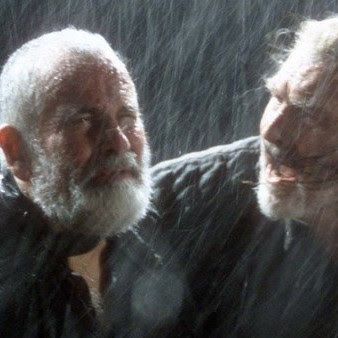
Ian Holm & David Burke
"King Lear"
(National Theatre, 1997)
Yes, it rained on stage.
Featuring songs with titles like Masculine/Feminine, Sex Appeal and Ich Bin Ein Vamp! Lemper shared the legacy of sexual liberation and gender fluidity which would soon be extinguished by a Fascist regime. (See also: The Degenerate Art Exhibit.)
“The Almeida is my theater, it’s the theater I want. Like a round, brick well, high-ceilinged … intimate. Fantastic space.”
The next day we were able to get rush tickets to see Ian Holm’s return to the stage after several decades, performing King Lear in the Cottesloe Theatre at the National.
Tue, June 10: “A cold, cold Lear. Holm came out of the gate intense and quick to anger … small man but a huge presence. I wish Dad could see it. Almost no music. Run on, act at your leisure, run off.”
We took an overnight trip to Oxford and Stratford. I was unwell but we pushed on.

With brother and his family.
Even Oxford had a tourist trap, and we do love tourist traps. We took a spin on The Oxford Story which is a straight-up dark ride, a maddeningly slow roller coaster ride through the history of England’s oldest university featuring lots of still marionettes. Narration was provided over headphones while we were shuttled along in cramped, little desks.
Wed, June 11: “And it’s sponsored, produced and sanctioned by the school! Can I blame the Americans? Our entertainments must be 3-D, automated, cold and tacky. The House on the Rock produced by the Corporation for Public Broadcasting.”
We spent the night in Stratford where we had dinner at the Glory Hole (yes) and took in a performance of Camino Real at the Swan Theatre, where I also saw “The Seagull” in 1990. 
“A live band made for most excellent music – a lot of Beat-era jazz, for example.”
"Phantasmagoria!"
(There is literally a guy on the floor,
covering his head.)
The next morning we saw more Shakespeare-oriented historical sights than the entire time I was there in 1990. Of course, much of my time there seven years earlier was to take workshops and to see shows, and it was very, very snowy. My partner said Stratford was the most delightful place we had visited so far.

We took the train back to London, and that evening, Henrik, Toni and I saw Anthony Neilson's The Censor at the Royal Court. Bad Epitaph would produce this play in September 2001. The run was cut short for obvious reasons.
Thu, June 13: “Great. Inspiring. Emotionally awful.”
On Friday we visited the Museum of the Moving Image (MOMI), a historical celebration of the science and craft of projected entertainment. I was particularly taken with the devices which created thrilling or unsettling imagery for unsettled audiences well before the invention of what came to be known as the motion picture.
Fri June 14: “The Phantasmagoria! … an 18th century slide [magic lantern] show – images, tinted slide drawings, projected on a screen in a darkened room, accompanied by spooky music, augmented by smoke cast before the lens, or slowly bringing it into focus, or casting one image the another, back and forth to give the impression of movement – or a sequence of two images (Adam and Eve biting the apple/being cast out of Eden) intercut by a lightning bolt flashing on and off, with appropriate sound effect. 

"And to appreciate how spooky this would be to an audience! It was great! So creative! I wish I could be half as inventive!”
Salieri's, seat detail.
That night was our only real “date night” with just the two of us and my brother and sister-in-law. We headed to the Warner Brothers Cinema on Leicester Square to see Big Night, a period film about Italian immigrant brothers who operate a restaurant on the Jersey Shore and starring Stanley Tucci and Tony Shaloub. My wife and I had already seen it when it was released in the US, and it remains one of our favorite films.

It only made sense that we close the evening with a long, indulgent dinner at Salieri’s, which Toni and I had discovered the week before. The decor was “a little ridiculous – everything is painted, the seats have scenes on them of cabarets and showgirls, so do the walls and the ceiling. Mermaids and seahorses and gambling dandys.”
Fri, June 14: “The harp player actually played La Colegiala.”
Saturday afternoon we took a tour of Shakespeare’s Globe Theatre, which was utterly remarkable. When our student group had visited Southwark in late 1990, it was just a big, muddy hole in the ground and our tour guide gave the impression that the thing would never actually get built. And here it was, a peg-by-peg and fully-practical reproduction of an Elizabethan theater.

The place hadn’t officially opened to the public yet, and in fact there was a major event going on that evening and ours was the last tour before the theater was closed for the festivities. We had a snack in the cafe as the place was filled with an assembly of formally dressed people, several of whom I recognized from stage and film. I noticed that Michael Maloney, one of Branagh’s favorite players, was seated at the table next to ours. He caught me gawking. That was embarrassing.

Juliet Stevenson & Nicholas Robinson
"Caucasian Chalk Circle"
(Théâtre de Complicité, 1997)
That evening we closed our journey by attending Caucasian Chalk Circle at the National Theatre, produced by Simon McBurney’s troupe Théâtre de Complicité (today simply Complicité) which is perhaps the greatest theatrical performance I have ever had the joy to witness.
Sat June 15: “Produced with a great sense of play, humor and adventure. In the round … using long poles they made spears and guns, but also a rickety bridge, and even made a river using them.”
One particular moment though, which always reminds me of the unique magic that is stagecraft: The child was portrayed by a succession of puppets, from the baby to the toddler and so on, and with each iteration the chorus would sing as the “younger” puppet was led off and the “older” puppet was introduced. A marionette the size of an eight year-old walked off and an impossibly big one, the size of a ten year-old was led on, operated by no fewer than six company members.

But as this one was walked by the puppeteers, each one stepped away, and as it walked on its own the last puppet operator pulled a skin-tight mask from its head as it was revealed to be an actual human actor. The audience gasped and applauded, it was marvelous. So glad we saw this show last. It is a shared memory my wife and I treasure to this day.

I was last in England five years ago, with mother to attend my niece's college graduation. How was that only five years ago? I worry I will never return.

Tuesday, April 10, 2012

On Interpretation

¿Donde está el Siete Madres?
in·ter·pret   [in-tur-prit] v.

to bring out the meaning of (a dramatic work, music, etc.) by performance or execution.
Often in the theater we use the word reinterpretation, which means "to interpret again." Which is to say ... to interpret. Perhaps, to interpret differently. But still, it is merely another interpretation.

Much has been made of the recent interpretation of Tennessee Williams' Camino Real at the Goodman Theatre. Apparently what they mean is adaptation because from all available description (and I have co-workers who have seen it and told me about it) a deeply heartfelt, if misunderstood, play by the greatest American playwright has been stewed, screwed and tattooed, festooned with artifice and sights contrived to offend. We aren't just talking design choices here, a text which traditionally runs close to three hours plays in less than two, which characters cut, collapsed or entirely replaced.

This should be galling to me, as I love this play. I love Williams' poetry, and his use of dreamlike imagery. It is wonderful and horrible, and no one saw it when it debuted on Broadway in 1953 and that may be another reason I like it so well. But it is precisely because so many have badmouthed it, I wish that I could see it. My expectations appropriately lowered, what could I lose? And after all, some of my favorite productions have been interesting, inspired interpretations of well-trod works. The Skin of Our Teeth at Cleveland Public Theatre comes to mind. Or, you know ... pretty much any single Shakespeare you and or anyone has ever seen.


Saturday night I left the kids at the in-laws and went Uptown to check out the Everything Is Terrible tour, which just happened to be in Athens that night. Since I was first turned onto this site (Josh? Brian? Who takes credit for this?) I have been enjoying their online video productions. Their mission is to collect professionally produced video tapes (they have to be from tapes) and carefully edit them to highlight the sheer awfulness of modern civilization.

You may notice a large amount of their subjects are made-for-TV movies, motivational videos, or locally produced broadcasting, created between 1988 and 1992. The George H.W. Bush era was truly the heyday of inexpensive, godawful filmmaking.

Unfortunately, I was not able to remain for the main event, the audience interactive film Doggie Woggiez! Poochie Woochiez! which also features live music. But I did enjoy the first hour, which was greatest hits collection, presented on a large screen at full-volume. This mash-up of deliriously edited, horrible terrible video included several scenes which have already been pulled from YouTube because of copyright violation. This included a horrifying ventriloquist dummy which the EIT folks had edited to lip-synch to Justin Bieber's Baby.

The introduction included an original video featuring a puppet explaining the definition of FAIR USE, in an appeal for understanding. EIT is covered by the First Amendment because their work comments upon the original. The manner in which they present the original critiques the original. Watch this shudder-inducing scene from the Rodney Dangerfield comedy, Ladybugs.


Okay. Once you have taken a shower to wash the shame away, ask yourself ... was that commentary, or is that scene inherently creepy on its own right, and the slasher-movie music therefore redundant?


As long as I am drawing a line from big-budget slash-ups of Tennessee Williams to hilarious, ghastly, ironic, online video montages, I would regret not bringing up Video Psychotherapy, which began in the 1980s as the brainchild of area cinematographer Ted Zbozien and broadcast late-night on the Mayfield Heights public access channel.

He took a store-bought ventriloquist dummy, suited it up with a black turtleneck, blazer and black sunglasses, had his friend Jeff Adams provide a mocking voice, and you had The Doctor, a fascistic mental overlord who submits his views to an endless reel of superfast edits featuring terrible screams, exploding heads, plummeting bodies and extended riffs of ordinance.

The Doctor's largely spontaneous rants are all the more delicious because they include the swingy stylings of the Art Institute of Chicago playing Dreaming of the Master from the album Nice Guys. Video of the original shows are hard to come by, even on YouTube, because Zbozien carefully guarded the tapes after the show's original run. Recently, however, he has reemerged online with a new puppet, made-to-order -- again, to avoid copyright infringement.


Late 1980s Video Psychotherapy

However, his use of existing clips from copyrighted works of film and video appear to fall more acceptably under the FAIR USE doctrine, because each clip is so brief, and cannot be taken to represent the whole. I mean ... I'm not a lawyer ...

The Republic of Gilead

Over the weekend I had the opportunity to spend long hours with The Famous History and Life of King Henry VIII (All Is True) written by William Shakespeare and John Fletcher, which I will directing this summer for the Cleveland Shakespeare Festival. This is one of Shakespeare's late works, the co-writing credit (which is widely accepted) an indication that he may have started writing it and abandoned it, or was too preoccupied with business matters to give it his entire attention, or if you believe such things, that he was already dead (i.e. not the Shakespeare of Stratford) and other writers were taking scripts he had barely fleshed out, expanding upon them and keeping his name on them.

Whatever you believe, what most people know about Henry VIII (the play) is that it was the one that was being presented when the original Globe Theatre burned to the ground in 1613. There are no quotations from it that went on to be famous. My personal favorite: "All hoods make not monks."

My plan is to edit the thing down to 90 minutes, the text hardly warrants anything longer. The major problem with cutting Henry VIII is that, as arcane courtly intrigues go, it's plot stands out as being at once terribly complex and stupifyingly boring.

However, as I have had almost a year to mull this puppy over, the one thing that strikes me as interesting is that if you took this play by itself, absent any knowledge of the English history that came before or after it, you would not be so impressed by Henry's break with the Catholic Church (arguably what the pay is all about) but rather the extent to which women do not exist as human beings. Catherine of Aragon, historically a great English ambassador, is relegated to the status of non-person when the King decides to divorce her. The First Divorced Woman, how does THAT make a girl feel?

The argument is that the King, now middle-aged, wants a male heir and Catherine can no longer provide him with children. So he dumps her for a pretty, much younger wife. And it's 2012 and I'm thinking, hell, thank goodness no fat, white, self-righteous Christian men of power do that anymore.

So I've been reading The Handmaid's Tale. And I am looking forward to how we may interpret this.


UPDATE: My bad, EIT's "Baby Doll" is, indeed, available online. More creepy dummy goodness!