Showing posts with label Eliot Ness. Show all posts

Monday, April 13, 2026

The Five (book)

When did serial killers become sexy? Why did serial killers become sexy? Or more to the point, when did they become interesting? Fascinating? A subject of intellectual discourse of heated debate? Because to a man, they are all complete losers.

There was great interest in these losers in the 1990s, due in some part, I guess, to the 1992 Academy Award Winner for Best Picture, The Silence of the Lambs. It is not, however, the subject of the manhunt, Buffalo Bill, who became iconic, but the already incarcerated murderer, Hannibal Lecter, as performed by Anthony Hopkins. He’s cool, eerie, stylish, witty, brilliant, and, some would say, sexy.

He wasn’t the first murderer to hold my interest, however. That would be David Warner as Dr. John Leslie Stevenson in the 1979 time traveling romp, Time After Time. Malcolm McDowell, playing against type, is the bespectacled, naive and charming H.G. Wells, who (in this fictional tale) invents an actual, functional time machine. The device proves advantageous when the police arrive to arrest Dr. Stevenson, who uses it to escape Wells’ home, the city of London and the 19th Century. For Dr. Stevenson also happens to be the man known as “Jack the Ripper.”

Warner’s character travels through time – and space! – to disco-era San Francisco, where he continues his compulsion for slaughtering sex workers.

Because that’s what we know about him, isn’t it? I queried my brother recently, what do you know about Jack the Ripper? Nothing, he told me. I asked who his victims were. He said sex workers.

Seriously, my sixty-four year old brother said sex workers, not prostitutes. We have Gen Z children, after all.

Warner’s “Jack” was cool, eerie, stylish, witty, brilliant, and, some would say, sexy.

We seem to ascribe an extraordinary intelligence to serial murderers, and I imagine we do so due to the fact that they get away with it. They are "always one step ahead of the police” or that some even manage to stay anonymous, forever.

In the mid-to-late 1990s I read both Torso: The Story of Eliot Ness and the Search for a Psychopathic Killer by Steven Nickel and Paul W. Heimel’s Eliot Ness: The Real Story. The Ness-Cleveland connection greatly interested me (duh) and exposed me to the so-called Torso Murders, a series of grisly killings which occurred in the 1930s, and primarily during Ness’s tenure as Safety Director.

Attempts to connect these crimes are specious, but that hasn’t prevented folks from crafting their own theories about a single perpetrator. I personally cleave to the belief that these murders are unrelated. I was particularly grateful when this theory was put into print by Cleveland true crime author John Stark Bellamy in his book The Maniac in the Bushes (and More Tales of Cleveland Woe) that in the absence of corroborating evidence these tragedies should be assumed to be the work of different individuals.

Much has been made of this one guy, a member of a well-placed political family, who wrote taunting letters to Ness, claiming to be the culprit. But what of that? I send taunting letters to the Vice President every week.

Regardless, this desire to tell stories about these violent criminals … before Dexter, a contemporary cable program in which the serial killer is the hero because he kills other killers (oy) there was the X-Files spin-off Millennium. An FBI agent played by Lance Henriksen has the ability to access the sight of criminals, to see what they see. The first season was all about the crimes of serial killers, and I checked out from that show pretty fast. A network program thick with images of pain and horror.

Because that’s what we’re talking about – pain and horror. And as with fictions (Silence of the Lambs, Millennium, Dexter) or reality (Kingsbury Run or Whitechapel) the focus is on the killer. Ostensibly, to discover who he is, but also, because – as they say – he fascinates us.

Except he doesn’t. If reality has shown us anything, it’s that actual serial murderers are not interesting. They aren’t surgical villains with a penchant for chianti. They are outcasts and losers. Like Jeffrey Dahmer, Wayne Williams and John Wayne Gacy, unremarkable sociopaths.

The Whitechapel murders of 1888 inspired the legend of Jack the Ripper. That’s not even a real name, it originates from an anonymous letter to the editor of a newspaper, and almost certainly fake. Popular subjects have included barristers, doctors, and – of course – those within the sphere of the Royal Family.

The single, unidentified person of “Jack” killed five women over a period of several months, and then never again. These five are referred to as “canonical” which, while accurate because it means – generally – to be accepted as part of a group, is offensive to me as it lends legitimacy to something that cannot be known and is likely to be false.

All five were women, and all five have always been said to be sex workers. My introduction to “Jack the Ripper” was the film Time After Time, and it begins with Warner’s doctor encountering and then murdering a woman who has made it clear that the encounter is meant to be transactional.

In her book, The Five, author Hallie Rubenhold does what no one thought to do before, which is to question the common wisdom and to investigate the lives of the victims. Contemporary police accounts state clearly that all five were “prostitutes.” Rubenhold thoroughly documents the prevailing assumption at that time that all destitute women were, or that they may as well be so.

In describing the lives of each woman, we understand each; their unique descent into penury – which brought each to this locale, a district of London which was just one center for the destitute and unhoused – and their commonality, namely that each had an addiction to alcohol.

Rather than slaughtered in the act of solicitation, the first four were much more likely to have been preyed upon while sleeping out-of-doors, while the fifth – also sleeping – was surprised in her bed, the door to her one-room, ground floor apartment easily opened. To ascribe a (still) socially unacceptable occupation has always diminished their personhood, adding “they asked for it” to their epitaphs. But they were human people, undeserving of their economic status as well as their horrifying demise.

This is an actual, mass-marketed
"Jack the Ripper" costume.
This throws some salt into the works for many “Ripperologists” (a hateful term) whose theories about who the murderer may have been, especially those bespoke theories about an assassin for the Man-mans; eliminating a cabal of sex workers who could bring down the Monarchy, or someone on a Messianic quest to purge the city of lechery.

When we understand who the victims were, their deaths seem random. Each was just a very unlucky woman, sleeping rough (as they say) in the wrong place at the wrong time. And conspiracy theorists hate randomness. In fact, Rubenhold has had to endure a great deal of criticism and abuse for this book, as it does not offer any new insight into who “The Ripper” may be, Worse, it tears down a few theories carefully crafted by men (always men) who fancy themselves experts in a rarefied field.

The point is, we don’t know. We’ll never know. Accepting what we do not know is a very difficult thing. Conspiracy theories are born when men strain to apply meaning to what they do not understand, and in doing so they lose sight of the victims.

Tuesday, April 2, 2019

Play a Day: Run Kingsbury Run

Tyler JC Whidden
For Tuesday I read Run Kingsbury Run by Tyler JC Whidden, and available at New Play Exchange.

First disclaimer: I know Tyler, he directed my play The Way I Danced With You at Ensemble Theatre, which you should see because his direction is fucking amazing and it is playing through this Sunday, April 7.

Second disclaimer: I know far too much about the history of the so-called "Mad Butcher of Kingsbury Run" and I am fucking tired of people trying to turn this hideous, sordid moment in Cleveland history into some kind of epic sequel to The Untouchables just because Eliot Ness is involved.

Okay. We got that out of the way.

Kingsbury is not about Ness, it's about the officers who do the work of trying to solve a grisly set of murders, and the psychological toll that can take. The unseen Eliot Ness is where he should be, off in the distance. An administrator, not a cop, and one whose own ambition rises above his need to protect the public.

But the main thrust of the narrative involves the pressure, the damage, and the wide-raging effect a public panic can have on the greater community. The "mad butcher" is the catalyst as three officers at a crime scene engage in intense psychological gamesmanship about reputation, responsibility, and the ghosts of our fathers.

Forensic science recently determined the most-likely suspect in the Whitechapel Murders of 1888, and the identity of "Jack the Ripper," and it only took one hundred and thirty years. Perhaps there is hope we may settle this saga once and for all.

Who should I read tomorrow?

Wednesday, January 11, 2012

Eliot Ness Campaign Sign


1938 campaign sign on building at 36th Street and Cedar Avenue, Cleveland
Frank J. (Frank John) Aleksandrowicz, Photographer
Summer, 1973

Recently came across this photograph, which I entirely love. The title is inaccurate, Eliot Ness did not run for Mayor of Cleveland until 1947.

Tuesday, April 5, 2011

The Death of Eliot Ness


Ness married sculptor Elisabeth Andersen Seaver in 1946. She was his third wife. They both drank. Since his failed run for Mayor of Cleveland in 1947, Ness' fortunes had dwindled until by the early 1950s he was accepting jobs as an electronics wholesalers, working as a clerk in a downtown bookstore (remember those?) and selling frozen hamburger patties to restaurants.

In 1949 they adopted a three year-old boy, Robert Warren Ness (July 10, 1946 - August 31, 1976) ... though his gravesite in Lakeview Cemetery reads Robert Eliot Ness. Not much is known about Bobby Ness, except what can be inferred from what we know about Ness. After failing to win the election, his drinking became a serious problem. The family lived in a rented house in Cleveland, Eliot spent too much money on a new car, too much time in hotel bars, and here he began inflating his responsibility in bringing down Al Capone to anyone who would listen.

In the early 1950s Eliot became a shareholder in Guaranty Paper Corporation - without going too much into the details, he was chosen through connections with persons who were trying to make a business out of a new watermarking process to make checks and other legal documents harder to counterfeit. They tagged Ness because of his connections in law enforcement. It was a good, regular job and supported his family.

In 1956 the operations of Guaranty were moved from Cleveland to Coudersport, PA, as a money-saving decision. The Ness' settled into a stable, middle-class existence. Bobby made friends with a boy across the street who had Down Syndrome. Coming home from work Eliot could be relied upon to play ball with the kids in the yard, and be a real sport.

Betty was less than happy to be a sculptor in rural Pennsylvania. They drank, they fought, the boy had to listen to it all.

There is a small cottage industry in Cleveland surrounding the so-called Torso Murderer. The Wikipedia entry for this unsolved murder case posits from time to time (depending on how recently it has been edited) that failure to solve this case destroyed Eliot Ness. He is referred to as "The 14th Victim" or some such nonsense.

The hit-and-run drunk driving accident Ness was involved in 1942 lost him his job as Safety Director. His ill-thought out run for Mayor in 1947 sealed his loss of reputation. He was a good cop, and a lousy businessman. He drank too much. These things happen. It's not as sexy as the myth. But myths are pat and dry and often teach us nothing. Easy, neat solutions make the world seem easy and neat. Learning how to deal with the messiness of real life is hard and unrewarding. Except for that is how we learn to deal with the messiness of real life.

Ness had a heart attack in his kitchen on May 16, 1957. He died at home, which is a fine place to die. He was 54 years old.

Sources:
Eliot Ness:The Real Story (Paul Heimel)
Squidoo

Monday, December 6, 2010

Bay Village


Eliot Ness and his wife Edna Staley Ness lived in a bungalow right on Lake Erie in the bedroom community of Bay Village, a town described in a 1936 edition of The Plain Dealer as "A little New England, west of Cleveland."

Eliot & Edna
Their cottage (pictured above) would have sat hidden from Lake Road, behind a much larger house. I have no idea what the address is, and the odds are very good it was torn down in the past decade to create a much larger house.

The Lake Shore Electric would make the trip downtown in about an hour. The Ness home was a gray, one-story affair with a reflecting pond, easy access to the water, a cozy fireplace and plenty of room for their six cats. However, Eliot did not usually get home before 10 PM.

Sources:
Bay Village (Virgina L. Peterson)
Eliot Ness, The Real Story (Paul W. Heimel)
Bay Village: A Way of Life

Friday, December 3, 2010

My Trip To Lubberland


Took advantage of MOCA Cleveland's "Free Fridays" admission to take in Duke Riley's exhibit, An Invitation to Lubberland. I was hoping for good art. I was looking for an education. I got a small amount of both.

The video part of the art event was a bit of a disappointment, a man in a bowler and frock coat (is he the man from the government who counts hobos, is he a hobo himself ... is he one who becomes the other ..?) was difficult to watch and included inter-titles which led to a conclusion which one unfamiliar to the history of Kingsbury Run might find interesting. They did not rise to the level set by the artist's very interesting and well-crafted drawings and mosaics (see above.)

I do not know why I have been put on this earth to be the guardian or avenger of Eliot Ness' tarnished reputation, or rather a "Speaker for the Dead" hell-bent on providing an depiction of his humanity, his goodness and his failings, free of all of the mythic bullshit. This exhibit goes so far as to state that it is because of Ness' failure to catch the so-called torso murder, and his torching of the shanty town that he lost the 1947 election. I have nowhere else seen this to be the case.

However, the claim (as etched into a Buffalo nickel) that the citizens of Cleveland were so appalled by the destruction of the hobo city of Kingsbury Run that during the election they threw mannequin parts up into the trees ... it is an evocative image, though I question whether many had their own mannequins lying around to expend on such public art.

By the way, I do not think it was actually part of the exhibit that the MOCA docent follow me around like a fucking stalker. That was really irritating. He kept bobbing in and out of my line of sight, or standing right behind me like I was going to swipe something. Get lost pal, you are creepy.

I did learn a very helpful hobo sign:
officer of the law lives here

UPDATE: The Plain Dealer really loved this installation:
"A triumph for him and for MOCA. It also sets a benchmark for any local art institution that commissions an artist -- local or otherwise -- to create something new. It's a mark that will not be easily surpassed any time soon." - Steven Litt, 12/14/2010

Wednesday, November 3, 2010

The Harvard Club Raid

Federal Bureau of Investigation
John Edgar Hoover, Director
May 12, 1936

MEMORANDUM FOR THE DIRECTOR

Re: Police Corruption in CLEVELAND, OHIO.

On January 10, 1936, the Prosecutor's Office of Cuyahoga County, Ohio, raided the Harvard Club. The Bueau has made no independent investigation concerning this raid, but slippings from the January 11, 1936 issue of the Cleveland Press discloses that John Sulzman, Sheriff of Cuyahoga County, took no part in the raid; that the County Prosecutor enlisted the cooperation and aid of twenty-five private detectives and armed with search warrants endeavored to serve such warrants at the Harvard Club.

They were met with formidable resistance, however, by Jimmy Patton, who threatened to "mow down" the raiding party with machine guns and held the raiding party at bay for six hours, during which time all the gambling equipment at the Harvard Club was moved away by trucks. It was finally necessary for the Safety Director of Cleveland to proceed to the Harvard Club, located just outside city limits, with a party of policemen to gain entrance to the Club.

This action was necessary because the Sheriff, when called by the Prosecutor's raiding party for aid, refused to send assistance, even though his office was notified that the Prosecutor's raiding party had been threatened with machine guns. It is evident, therefore, that the proprietors of the Harvard Club were closely connected with politicians and those in power in Cleveland.

It is desired to point out particularly the "hard boiled" attitude assumed by James "Shimmy" Patton, who threatened to "mow down" the raiding party. The newspapers setting forth this information are probably correct in the attitutde which was assumed by Patton as well be shown herein below:

[[TWO PAGES ARE REDACTED]]

On February 24, 1936, Mr. W.G. Harper, Operative in Charge of the United States Secret Service, Treasury Department, Cleveland, Ohio, was interview by Special Agent [[redacted]] Mr. Harper stated that when the Harvard Club was closed by the local authorities information is to the effect that the raid was so planned as to give Elliot (sic) Ness, recently appointed Safety Director of Cleveland, a political buildup.

The Cleveland newspapers have given a great deal of publicity to the raid and to the fact that Sheriff John M. Sulzmann refused to come to the aid of County Prosecutor Frank T. Cullitan, when Cullitan found it impossible to gain entrance into the Harvard Club. A news item appearing in the Cleveland Plain Dealer, dated January 11, 1936 is quoted as follows:
"For nearly six hours last night operators of the Harvard Club held County Prosecutor Frank T. Cullitan, his staff and twenty special constables at bay after they appeared at the expensive gambling resort in Newburg heights to raid it simultaneously with a surprise attack on the Thomas Club in Maple heights, which yielded without resistance.

From sunset until nearly 11 last night the prosecutor and his force of men were repulsed by threats from the operators of the Harvard Club to 'mow down' the constables with machine guns if they tried to batter in the doors.

The Harvard Club was stormed only after Safety Director Eliot Ness, acting, he said, 'as a private citizen,' took several police squads to the prosecutor's aid.

Cullitan pleaded in vain for help from the city police department and from Sulzmann, the country's chief law enforcement officer."
Entrance having been finally gained after a six hour seige, the prosecutor and his deputies found that all of the gambling equipment had been removed by the aid of trucks. The paper goes on to state that after entrance had been gained "Hebebrand and his aids walked into the money-counting room of the club on the pretext of getting their hats and coats, and escaped by climbing through a small window near the roof of the resort, and dropping ten feet to the ground outside."

The paper continues -
"A few minutes later Sheriff Sulzmann, ill in bed at his home, sent word to Cullitan, the prosecutor said, that he would not send aid or protection unless it was requested by Mayor Jerry Sticha of Newburh Heights, 'in accordance with my home rule policy.' Cullitan had previously tried time after time to reach Sticha at his home, but was told he was not there.
The paper gives the following details concerning the raid:
"Patton (James "Shimmy" Patton who is well known to this Bureau) cursing profusely, rushed toward Cullitan. Cullitan tried to accomplish his task peacefully.

'Anyone that goes in there,' Patton cried, 'gets their _______ head knocked off. You've got your _______ home at stake and we got our _______ property at stake.'

'I've tried every decent way I could --' Cullitan began.

'No, you haven't,' Patton broke in.

'This is my job to close this place,' Cullitan said.

'Why don't you quit your job?' Patton shot back.
The Cleveland News, dated January 11, 1936 stated as follows:
"Mr Cullitan also had 'nothing to say' when asked if he would take any action against village officials who allowed gambling joints to operate so openly in violation of law."
The Cleveland Plain Dealer, dated January 14, 1936 quotes Eliot Ness, Safety Director, as follows:
"'I did not know Sheriff Sulzmann excepting through the newspapers,' Ness said. 'I haven't met him yet, but I consider I know him thoroughly since his refusal to send deputies to the aid of County Prosecutor Cullitan.'

'When John Flynn, my assistant director, went to County Jail he found six deputies just sitting -- perhaps waiting for the millennium. He got no satisfaction from Jailer Murphy. Neither did I. We both pointed out Mr. Cullitan's plight, and we both got the answer: 'The sheriff stands by his home rule policy -- he must request from the mayor of Newburg Heights.'

'It Can't Happen Here', the title of one of our best sellers, would be true locally if applied to the sheriff rescuing the prosecuting attorney. Hence the recent raids became news here, although they would not have been news in many cities.

'I want to say seriously to you and to all of the better element, that we must have the public with us. That means good citizens must not neglect their full duty.'"
The above quotation was taken from a speech given by Eliot Ness at the Cleveland Athletic Club before the Odovene Club, composed of Ohio Wesleyan University Alumni.

That the raid conducted by Frank T. Cullitan is alleged to have its political aspects is shown in a news item appearing in the Cleveland Plain Dealer dated January 29, 1936, which is quoted as follows:
"County Prosecutor Frank T. Cullitan's recent raid on the Harvard and Thomas Clubs was described last night as a plot 'cooked up' by an assistant county prosecutor to embarrass Sheriff John M. Sulzmann's campaign for Congress in the Twentieth District and to benefit Congressman Martin L. Sweeney."
The news item goes on to state:
"The ward leaders voted to endorse Sulzmann for Congress and to call a meeting next week of the 277 precinct committeement in the district to submit Sulzmann's candidacy to them."
For your information Sulzmann was defeated in the primaries.

News items appearing in the Cleveland newspapers are very laudatory of the appointment and conduct of Eliot Ness as Public Safety Director of Cleveland. He was particularly praised for his action in assisting County Prosecutor Cullitan, "as a private citizen" during the raid on the Harvard Club. News items have also stated that numerous raids are being conducted by police squads in an effort to clean up gambling conditions in Cleveland.

The Cleveland News dated January 11, 1936, refers to Ness as follows:
It was Mr. Ness who, when Sheriff Sulzmann, from his sickbed, refused to send aid to Cullitan, took the bull by the horns and led 33 Cleveland police officers and men to the Harvard Club to protect Cullitan from possible violence."
Referring to Cullitan the same paper states:
"The prosecutor, his job of closing the two notorious gaming resorts done, offered no criticism either of Sheriff Sulzmann's refusal to help, or f the lethargy of Newburg Heights and Maple heights officials in failing to close the clubs."
Referring to Eliot Ness' move to clean up conditions in Cleveland, the Cleveland News dated January 9, 1936 is quoted as follows:
"On orders from Safety Director Ness a meeting of policy operators was called by Deputy Inspector Frank W. Story at the E. 35th St. - Longwood Ct. police station Tuesday night.

'Fold up of your own accord or we will fold you up,' Inspector Story told them.

Along lower Scovill Ave., once the most open vice district in the city, officers are visiting houses and ordering all transient girls to move out of the city. Only those who can provie their legitimate homes are in the houses are being permitted to remain.

Bookmakers still exist, doing a curb or telephone business, but the gambling resorts have disappeared. Gamblers who prospered in Cleveland last year are reported to have either left town or to be making plans to heads for other cities where the law enforcement is more casual.

The order has gone out for the cleanup.

The police department knows Director Ness means business."
In praise of the work of Safety Director Ness the Cleveland News of January 11, 1936 carries and editorial containing the following:
"While we're cherring, let's fill the air with three long hurrahs and nine sharps rahs for Eliot Ness."
Respectfully,
K.R. McIntire.
Source: Federal Bureau of Investigation (FOIA)

Sunday, October 24, 2010

Shorts


Ness Stamps Women’s Shorts O.K. For Street
Cleveland News: July 10, 1936

New York’s police crusade against women wearing shorts on the street is just water off a duck’s back in Cleveland. “They may wear all the shorts they want to on the street,” said Safety Director Ness.

Tuesday, October 5, 2010

An Invitation to Lubberland


kind woman lives here

Duke Riley: An Invitation to Lubberland

An exhibition at MOCA Cleveland through January 9, 2011. Brooklyn-based artist Duke Riley was introduced to Kingsbury Run, and became fascinated with chronicling his history of an unmapped landscape traveled through and inhabited by countless, unknown "hobos" during the early 20th century.

I did not know Clevelander had a reputation for being kind among itinerant workers, but it was. Kingsbury Run was home to numerous shantytowns and "hobo jungles". This came to an end in 1938, at the height of "Mad Butcher" paranoia, Eliot Ness ordered that every homeless person in Kingsbury Run be rounded up and fingerprinted, so any new victims might be identified. He then gave order for all of their makeshift shelters be burned to the ground.

There are those who believe that Ness's plan had less to do with the media's interest in these unrelated killings and more to do with having a good excuse for cleaning up what he saw as urban blight. Regardless, the people of Cleveland were appalled at this extreme action and forever tarnished the Safety Director's "boy scout" reputation.

Riley's exhibit includes "video, mosaic, drawing, found objects, and sculpture." I plan to check that out in the next few days.

Sources:
MOCA website
WCPN "Around Noon" 9/28/2010

Friday, August 20, 2010

Little Orphan Annie

My earliest experience with Little Orphan Annie was the 1977 Broadway musical. I saw a touring production (at the Hanna?) in the late 70s, a copy of the soundtrack shortly followed. The second time the tour came through I saw it then, too - I asked to. I am not saying this as an excuse, but I was only ten or eleven years old at the time.

>When the movie came out in 1982, like most people, I despised it. As a fourteen year-old this should not have been a surprise, finding something I liked as a kid to be cutsey and obnoxious, though I had developed an air for British actors and so convinced myself I was there only to see Albert Finney (because I was rakish and classy) and Tim Curry (because I was underground cool.)

What I knew I disliked at the time was how long it was, how boring it was, and how they changed the ending so much. Well. A couple years ago when we found ourselves with an evening in New York City and two very small, tired children on our hands (it was Easter evening, we had been parading all day) my wife slipped out to pick up something, anything at Border’s, and brought back that for the kids to watch on her computer DVD player.

If she had asked, I would have let her know about the 1999 for-TV version Disney made which is by all accounts superior. But today I learned something new about the original comic strip I did not know which throws a few things into perspective.

The 1982 version is the "Reagan" version, because it de-emphasizes the poverty, the Depression (like the Disney version, they cut the Hooverville song, which makes sense as it is the only song that is sung by an ensemble, and not by any of the main characters) and basically gives Warbucks’ grotesque wealth nothing to stand in contrast to.

One obnoxious added gag involves a “Bolshevik” attempting to throw a cartoon bomb into Warbucks’ mansion. After the bomber is dispatched (we won’t get into Punjab, who was at least an actual character in the strip, if not the musical) Annie asks Miss Grace why anyone would hate Mr. Warbucks.

Miss Grace sighs condescendingly and says, “He's living proof that the American system really works and the Bolsheviks don't want anyone to know about that.”

More glaring to me than that, when placed side-by-side with the Disney version, is how much the 1982 film wants to ignore New York City. You can’t even tell that’s where it’s set, it looks like California. When Warbucks decides to take Annie on the town, instead of singing a lovesong to “NYC” they sing an extended and wearying song (found only in this film) about how great the movies are, and he rents out Radio City for them to watch (get this) Camille.

And then (get this) we get to see a condensed, but not condensed enough, edit of Camille! Alone. In Radio City Musical Hall, all alone. An example of wealth and influence, but it looks cold to me.

The Disney version features Victor Garber singing (because Albert Finney really can’t) NYC and we get the whole thing. I mean, I get it, Disney bought Times Square and has been pushing the place ever since, but this is a pretty classy way to do it. And the 1999 version is a lot more sincere, less sloppy. The girl playing Annie is charming in her ordinariness, not obnoxiously optimistic like the freakishly freckled kid in the 1982 film.

And then there’s the matter of FDR, who is a honest-to-goodness superhero in the musical, as you know, he was in real life. In 1982 we do the FDR thing (including a hideous Eleanor impersonator who appears in no other version) but makes it clear he’s not relevant and we don’t see him again. In 1999 he’s front and center, the New Deal is the savior of the nation - and he even appears at the end, like Eliot Ness, with his G-Men blocking the door so the crooks can’t escape!

Now. The irony. Let us go over a brief history of Little Orphan Annie, the comic strip.

Created in 1924 by Harold Gray (following a number of “Little Orphan” variants by Gray and other cartoonists, ragamuffins with names like Little Orphan Otto and Little Orphan Rooney) creates an orphan girl with a doll named Emily Marie for a companion who escapes from the orphanage and survives in the street by sheer pluckiness.

A year later she meets Mr. - and Mrs. - Warbucks. Warbucks takes a shine to the little girl, and almost immediately urges her to call him “Daddy.” Mrs. Warbucks is a snoot who does not like the little girl, which eventually leads to Annie running away. Mrs. Warbucks eventually sees her selfish ways, apologizes … and then disappears from the strip, never to be mentioned again, as if she never existed.

Warbucks is the perfect picture of well-functioning capitalism. He despises snobs, treats his employees well and they all apparently adore him. It is this kind of world that Harold Gray approved of - one where those who were less fortunate would get ahead if they only applied themselves, and could one day be rich beyond their wildest dreams and perpetuate the cycle of endless prosperity.

He also approves of vigilantism and people getting what they deserve. As many storylines required getting in and out of scrapes with shady characters, Warbucks (and soon enough, Annie, too) would prefer to let criminals suffer any kind of grisly fate or terribly violent death than turn them over to the authorities.

Gray also made it clear through the comic that he despised the New Deal, FDR in particular, and the rise of the labor movement.

The 1977 Broadway musical, coming as it did during a bleak period in American history, was written to intentionally draw parallels between that time and the Depression, but to also offer optimism, and in the 30s a great deal of optimism arose from the promise of a “New Deal for Christmas.” Harold Gray luckily had passed away in 1968, or 9 short years later he surely would have heard that song and shot himself.

In 1936 the radio serial of Little Orphan Annie would broadcast a 15-minute episode on the Blue Network six days a week at 5:45 PM. It was the first children’s radio serial and wildly popular. The program was sponsored by … oh come on, you know who the sponsor was.

Monday, July 26, 2010

The Black Legion

The Black Legion was a KKK splinter group operating in the 1930s. Centered in Michigan the Legion was also active in Ohio.


AP described the organization on May 31, 1936, "as a group of loosely federated night-riding bands operating in several States without central discipline or common purpose beyond the enforcement by lash and pistol of individual leaders' notions of 'Americanism.'"

They were allegedly responsible for numerous murders of alleged communists and socialists.
Date unknown, paper unknown
Police Reopen Probe of Two Weird Killings
Anonymous phone call: “Look into the murders of those two men in the gully at E. 49th Street and you’ll find the Black Legion was responsible.”
Sources: Wikipedia
Eliot Ness personal scrapbook, property of Western Reserve Historical Society

Sunday, July 25, 2010

The Mad Butcher of Kingsbury Run


The facts:

On September 23, 1935 the bodies of two men were discovered at the foot of Jackass Hill in Kingbury Run, near East 49th Street and Praha Ave.

Edward Andrassy and a never-identified man were each murdered by decapitation, with their genitals severed from their torsos. The genitals were discovered together nearby. The heads were discovered buried nearby, in different places.

Andrassy was heavily involved in vice, his parents even receiving a phone call recently threatening to kill him if he didn’t stay away from the caller’s wife.

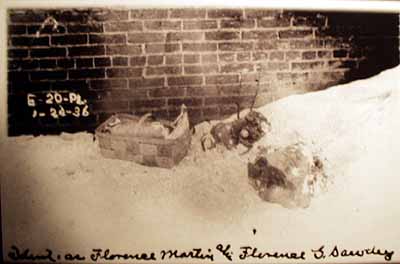
On January 26, 1936 a basket was found near East 20th and Central. This basket contained body parts wrapped in newspaper: an arm, two thighs and the lower half of a female torso. They belonged to Florence Polillo, a middle-aged woman, alcoholic, occasionally engaging in prostitution. The newspapers dated back between as recently as the day before and the previous August.

On February 7, in an abandoned lot on Orange near 15th Street, was discovered more of Polillo: upper torso, lower legs, left arm and hand. But no head. On February 8 a former associate of hers named Captain Swing jumped out a third story window, broke his heels, and “mumbling things that tended to implicate him in the killings.” (Cleveland Press)

On June 5, near the Kingsman Road bridge, some boys found a head rolled up into a pair of pants. The torso was found nearby, genitals intact. Like the first two men, the corpse was absent of blood indicating death (by decapitation) elsewhere and that the body was left where it was to be found. Never identified, this victim is known by its numerous tattoos.

July 22 turned up a badly decomposed male corpse near the tracks south of Clinton Road. Killed where it lay, it had been decapitated, and its clothes were found nearby. Its condition suggests it was murdered prior to the tattooed victim.

On September 10 a vagrant trying to catch a train tripped over the armless, headless torso of a man near the East 37th Street bridge. Soon police discovered the lower half of the torso, separated at the abdomen and the legs cut off at the hips. A stagnant pool nearby was fished, revealing his clothes. The man was emasculated, his genitals, arms and head never found. He was murdered by decapitation.

September 14: “I want to see this psycho caught. I’m going to do all I can to aid in the investigation.” - Eliot Ness

Or to put it another way, due to public hysteria created by a media-driven drive to sell papers, the Safety Director was called upon to comment on and meddle in affairs better left to detectives of the Police department.

Ness did bring it upon himself, raising his profile high above that of your average Safety Director (can you name your current Safety Director?) But the quote from Eliot Ness reflects to prevailing belief that these disconnected events were perpetrated by a single man. “This psycho.”

Really? The first two guys, sure. Polillo, not at all. The fourth, fifth and sixth victims had as little to do with each other, their similarities should easily have been written off as coincidence or intentional copy-cat crimes.

UPDATE: In 1937, the body of a second woman - eventually suggested to be Rose Wallace, an African-American prostitute who had disappeared the previous August - was found at the foot of the Lorain-Central (now the Lorain-Carnegie) Bridge. This body was dismembered, like Polillo's corpse, and bound in newspaper dated June, 1936. Wallace and Polillo went in the same circles, and even had One-Armed Willie, he of the jumping out the three-story window - in common. These two murders may have been committed by the same person. Parts bound in paper, female victim. But nothing like the other murders. Do you see how a craze comes about?

Source: The Maniac in the Bushes: More True Tales of Cleveland Crime and Disaster

Saturday, July 24, 2010

The Real Dick Tracy

Cleveland News April 4, 1936
Thousand Young Dick Tracys Thhrill and Cheer as Ness Tells How G-Men Got Capone Gang

Guns, criminals, hidden rooms, underground tunnels, G-men, deserted haunted houses --

Such things were woven by Safety Director Eliot Ness today into thrilling stories for nearly 1,000 of the latest recruits to the Dick Tracy Detective squad.

The howling, yelling, whistling crowd of youngsters filled every available inch of space in The News auditorium to listen to the former G-man and sign up for a Dick Tracy badge.

A BADGE LIKE HIS!

It was 15 minutes before Director Ness could quiet them down to the point where his voice could be heard. Then he took out his big gold police badge.

“You have a badge just like mine,” he said. More cheers. More shouting.

“Only maybe yours is a little bit smaller…. When you grow up to be a man with long pants perhaps your badge will grow up with you … And when that time comes I’d like to have you all working for me as real detective.”

The enthusiasm was uncontrollable.

TELLS OF CAPONE CHASE

Then the director held the boys and girls spellbound with stories of how he and other G-men ran down one-time lieutenants of Al Capone, Chicago gangster.

He told them also about an experience uncovering a large still in an underground passage beneath a deserted house when he was in charge of the government’s alcohol tax unit here.

Dick Tracy, the swashbucking detective who started all this, appears daily in a News adventure strip.
FYI - Shortly after Ness' departure from Chicago, the Tribune was the first paper to pick up Chester Gould's new strip Dick Tracy, which many have speculated was based on Eliot Ness' crime-busting legacy.

Thursday, July 15, 2010

Centennial!

The Plain Dealer - Thursday, July 23, 1936
32,720 Visit Expo As City Has Birthday
75,000 watch parade
Mayor Starts Cleveland on Second Century

Cleveland at midnight last night formally ended its first 100 years as a corporate city and turned to face its second century.

From her sister Great Lakes cities of Lorain and Erie came delegations to help Cleveland celebrate. At the formal anniversary ceremony in the Mall plaza the leaders of those delegations, Mayor E.A. Braun of Lorsain and J,.D. Parent, “Ambassador of good will from Erie,” told Clevelanders that their cities were vitally interested in the growth and progress of Cleveland: that the bond that shipping had created among the three would, they hoped, bring them even closer together in the next 100 years.

Speaking at the ceremony in the plaza, (Mayor Harold H. Burton) urged Clevelanders to look ahead with confidence, pointing to the progress and accomplishments of the city since 1836.

“Let us look into the future after our first 100 years. Our ancestors fought with courage and determination to gain control of this land. Now we must fight with the same courage to rid ourselves of the osbatcles in our path to future progress.”

The parade was a conglomerate of almost every parade that has ever been devised. It was led by the conventional mounted police and by infantrymen. There followed bathing beauties in jinrichishas, a lion in a cage, a midget band and midget performers, elephants, monkeys in tiny automobiles, actors from the Globe Theater dressed in Elizabethan costume.

Pygmies from the Belgian Congo there were and several hundred men and women in the costumes of the various communities respresented in the Streets of the World, and palmists and a Chinese dragon, Indians, dinosaurs, Yeomanettes, Conestoga wagons, streamlined trucks and busses, the original steam engine Tom Thumb and a replica of the Wright brothers’ first airplane from the Parade of Years.
Actors parading in Shakespearean costumes? How gay is that?

Also on tap for Cleveland's Centennial celebration:
Ness Orders Full Report In Bet Probe
Told 3 Sons of Deputy Inspector Worked At Track
Officer Defends Self, Family
(Deputy Police Inspector Timothy J.) Costello told a reporter last night that he thought it “highly unfair and unjust” to question his conduct as a police officer because three of his children worked at a dog track.

Seek Name of 5th Headless Corpse
Police Hunt Maniac Killer; Coroner Not Sure Man Was Murdered
“There is nothing to indicate that there was any violence on skull or body,” (Cornoner A.J.) Pearce said. “ The whole thing was so decomposed that it is possible for the head to have dropped off and have been carried a few yards by a dog or other animal.”

Friday, January 22, 2010

Hunt Fiend In 4 Decapitations

Once upon a time I was the artistic director of a late-night theater project at Dobama Theatre. Trying to decide what slate of original projects to create for the second season, I shared with my boss, Joyce, the artistic director of the theater proper, the idea of making a musical out of the Kingsbury Run murders.

We could call it TORSO! THE MUSICAL!

It was a joke. I made her actually gasp. But seriously ... it was a joke. Five years later, the Play House actually produced a musical about the Kingsbury Run murders. There is no satire any more, just cheese.

The first historical record of a decapitated body dumped into that ancient stream bed called Kingsbury Run was in November ... 1905. By 1935 we can deduce that the person who would eventually be called the Cleveland Torso Murderer (tm) would be no less than fifty years old.

We know this. An unidentified woman washed ashore in Beulah Park in September, 1934. Coroner Arthur J. Pearce said the expert level of butchery suggested that it was done by a medical expert. He later admitted the cutting was no, in fact, that professionally done.

In early 1936 the dismemberment of Florence Pollilo was described as "expertly" done by Coroner Pearce, except for the gashes to the pelvic area. Otherwise, only a professional could have severed a human like that. Her head was never found, unlike Edward Andrassy's head, they found that. They also found his penis, but that was in a can some yards away.

Unlike the "Tatooted Man" found on June 5, 1936, three days before the Republican National Convention began. His genitals were un-mutilated. For your interest, a "death mask" of his head was put on display at the Great Lakes Exposition but never identified - in spite having been viewed by thousands. They still have this plaster mask at the Cleveland Police Museum.

By this time the media was lumping all of these disparate murders together, and calling for action. Eliot Ness remained silent, leaving his detectives to do their work. By September, and the discovery of a "7th victim" he began to be more public in his assessment of what was happening. Thankfully, they could blame marihuana for the madness.
"There is a plentiful supply of this deadly weed in Cleveland" - Michael J. Collegeman, head of the local Federal Narcotics Bureau.
... to be continued.

Source: John Stark Bellamy II, The Maniac in the Bushes: More True Tales of Cleveland Crime and Disaster

Wednesday, January 20, 2010

Mayor Burton

Harold Hitz Burton (June 22, 1888 – October 28, 1964) served as the 45th mayor of Cleveland, Ohio, a member of the United States Senate and later Associate Justice of the Supreme Court of the United States. He was known as a dispassionate jurist who prized equal justice under the law. - Wikipedia
Bipartisanship is a quaint ideal. Burton was an Ohio State Representative and then law director of Cleveland before being elected as Mayor in 1935, running as a Republican. He held that position until 1941 when he was elected to the U.S. Senate where he met and befriended Truman. Harry S. made him a Supreme Court Justice in 1945.

As the 45th mayor of the city, he has been credited with rooting out organized crime and his pious public demeanor gained him the nickname the "Boy Scout Mayor."
When Burton became mayor of Cleveland in 1935, the city was infested with underworld mobs, riddled with police graft. He appointed young Eliot Ness safety director, started a clean-up which had spectacular results. One racketeer it dredged up was Albert Ruddy, who this week was convicted of shaking down building contractors for thousands of dollars during his 20-year reign as a union tsar. Burton earned for Cleveland, once a city shamed by its record of traffic deaths, the National Safety Award in 1939 and 1940. He turned his attention to public health, and this year Cleveland won the National Health Award. He has fought for free speech and tolerance. To Cleveland this year went the National Civil Liberties Award. - Time Magazine, Oct. 1940
He secured over $40 million in federal funds towards relief assistance, and championed Cleveland as a convention center - the Great Lakes Exposition and the Republican National Convention occurred under his watch.

I find it difficult to imagine he initiated those events, as they occurred in the first full year of his term.

Additional Soucres:
Ohio History Central
Encyclopedia of Cleveland History

Monday, January 18, 2010

The Torso Murders and Wikipedia


From the Wikpedia Cleveland Torso Murderer entry:
During the time of the "official" murders, Eliot Ness was the Public Safety Director of Cleveland - a position known in other cities as police commissioner. Ness was unsuccessful in the investigation, and despite his history of the capture of Al Capone, Ness's career as a detective ended shortly after the murders stopped. Because of what was seen as Ness' failure to capture the killer, it has been said that Eliot Ness was the Torso Murderer's 13th "victim".
"It has been said," indeed. Poetic, but false.

"The Public Safety Director had supreme authority over municipal law enforcement and ancillary services." (Paul Heimel, Eliot Ness: The Real Story) He was in charge of the police and fire departments, a responsibility broader than that of Police Commissioner. He was not a "detective" and though he was called upon to make comments about the so-called Mad Butcher it was not his "case."

Ness' career as Safety Director ended four years after the last in this series of murders ended in 1938. Following a few years of slipping popularity, on March 5, 1942 Ness was responsible for a hit-and-run accident. Witnesses suggest he had been drinking earlier that evening, yet Ness did not formally resign until April 30.

Some may say his increased use of alcohol may have been caused by his failure to catch the Mad Butcher. But his career path, though maybe a little tragic, is kind of ordinary.

LATER: I tried to clean it up a bit. How does this sound?
During the time of the "official" murders, Eliot Ness was the Public Safety Director of Cleveland, who has authority over the police department and ancillary services, including the fire department. Ness was unsuccessful in the investigation, and despite his history of the capture of Al Capone, Ness's career as a detective ended four years after the murders stopped because of a hit and run accident he was involved in that had nothing to do with these murders.
No? I'll keep working at it.

EVEN LATER: I love Wikipedia. Someone already polished my prose and removed the last bit about the hit-and-run accident ... which is fine by me, the accident is irrelevant. Trying to suggest these murders are what ended Ness' career is also a fun party game.

Wednesday, January 13, 2010

Eliot Ness

Eliot Ness (April 19, 1903 – May 16, 1957) was an American Prohibition agent, famous for his efforts to enforce Prohibition in Chicago, Illinois, as the leader of a legendary team of law enforcement agents nicknamed The Untouchables. - Wikipedia
"Famous for his efforts." It would be churlish to say he failed. Capone did, after all, go to prison - for tax evasion. The two individuals met once, Ness was head of the police detail which escorted Capone to the train that would take him away. There is no record of their exchanging any words.
Ness: "Did you ever think you wanted something more than anything else in the world and then, after you got it, it wasn't half as good as you expected? Has that ever happened to you?" - Eliot Ness: The Real Story
Ness is famous for another great failure. Departing him hometown of Chicago, he spent some time busting up stills and almost getting killed by hillbillies before becoming Cleveland's Safety Director in late 1935, responsible for overseeing the Police and Fire Departments. He was not a detective or a man on the street policeman, he was a political appointee with the responsibility of managing the safety of the sixth largest city in America.

Shortly before his tenure began, mutilated bodies were left, on occasion, around the city. They were eventually attributed one killer, the so-called Torso Murderer. Ness never caught this supposed serial killer, and there are those who claim this fact plagued him with doubt the rest of his life. Married three times and most likely infertile, Ness died a penniless alcoholic in Coudersport, PA. Like Ulysses Grant before him, he managed through a co-writer to squeeze out a biography before his death and it is that book that made it possible for him to be so popular, to this day, especially, it would seem, among hip-hop artists.

Of course, it is easy to simplify a man's life, someone else's life, just as it is to simplify a murder case - when you are looking for a particular narrative, you can bend the facts however you like. Ness was a successful Safety Director, bringing Cleveland up to the 1930s with modern police techniques that brought down crime and arguably improved the quality of life in the city.