Showing posts with label marketing. Show all posts

Wednesday, March 19, 2025

On Reservations (and online reservations)

Do you remember?
Once upon a time, and it wasn’t long ago (wait, no, it was long ago) you could make a reservation to see a play at a theater the way you could also make a reservation at a restaurant, by calling them on the phone and reserving seats and then just not show up, like you can with a restaurant, having put no money down and suffering no financial penalty to yourself.

This remained true for most small, community or nonprofessional theaters through the end of the twentieth century. When we started Bad Epitaph in 1999, we made an arrangement with a new, online ticketing service (which just happened to employ one of our company members) and took reservations this way exclusively. It was a bit of a shock to some of our patrons.

“Surely, I can call you and make a reservation and play with cash when I arrive, right?” one might ask, and I would respond, “If there are seats, you can purchase them for cash when you arrive.” Some found this impractical, even rude, and said so. After all, most had not yet purchased anything online, and the idea of typing their credit card numbers into their home computer made them uncomfortable.

They had every reason to feel uncomfortable, and really, we all still should, be we’re just used to it now, like eating while walking or wearing pajama bottoms to the grocery store.

And I did feel rude, asking people to do this, to pay for their tickets in advance, and online only. But it was the 90s. It was the new millennium. Things were changing. Today it might seem rude to contact a theater and attempt to make a reservation without paying in advance. You might not show up and just who do you think you are?

Fundraising, too, has gone digital. Every ticketing interaction includes an opportunity to kick in a little more, you know, for the education programming. For the children.

I have used the internet, several times, to make independent productions and projects possible. Bad Epitaph used to throw benefits (really high-tone rent parties) to raise necessary funds for pretty much each show. Some of them were surprisingly iconic, though each of them gave me a killer migraine. My 35th birthday party was actually a fundraiser to send I Hate This to Minnesota, which felt weird at the time. Still does.

More recently, however, we have used Kickstarter to get Double Heart to New York, and GoFundMe so I could attend a playwright’s conference in Alaska. I have not used either service more than once, not because they weren’t successful, but rather because I have found diminishing returns when doing the same thing twice.

"Double Heart" fundraising video (2013)

Right now I am conducting a stealth campaign for an upcoming project, and for that I have gone back to the egg. I am mailing letters. Through the mail. Using stamps! And I would very much like to send you one, if you would like to learn about the thing before anyone else, share your mailing address with me via pengo (at) davidhansen (dot) org and I will send you a letter. 

It's just that simple.

Sunday, July 14, 2024

Guerrilla P.R.

The other night I was at the Dark Room, and before the event began some of us were chatting about that eternal question, who do I have to fuck to get people to see my show?

Default promotion, in the old days, required purchasing advertisements in the paper. The quiet part was that if the theater didn’t pay, the paper wouldn’t review your play, and it was always the reviews which drove ticket sales, not the ads themselves.

Today, with the absence of print journalism, theaters pay for ads on Facebook or Instagram. Direct mail is also still a thing, and it is important, because at the very least you need to let people who have already shown an interest in your company about what is coming soon.

But, and this is the case for every single theater, from LORT A down to that immersive storefront production with ten folding chairs, to have a successful production you must go beyond. You need to appeal to non-regular theater goers, because there are never enough of those. There certainly aren’t enough theater artists to fill the seats at any house, and they shouldn’t be expected to, anyway, because they are busy doing theater.

So, how do you get the word out? How do you, as they say, let ‘em know?

As I have recounted before, I have always loved marketing, products and swag. In high school we started an improv troupe and I was much more interested in selling the buttons we had made for the troupe (buttons were big in the 80s) than rehearsing improvisation.

And who designed these buttons? I did, of course, using my brother’s brand new Macintosh computer. They did not go very well, however, not as well as the Guerrilla Theater Company pins we made years later, those sold very well though I still have a couple hundred of them in my attic.

At college, a graduate student who was put in charge of marketing for the school of theater approved of the comic strip I drew for the daily university paper, and especially liked when I would include references to current productions. He’d made an arrangement with a local pizza place to include flyers for the upcoming production of On the Verge by Eric Overmyer, but he wanted something original, that would engage someone who had just ordered a pizza.

I created a “chutes-and-ladders” style board game with paper cut-outs of the three main characters and you would roll a die and move your piece around a cartoon globe, traveling through time and space to opening night of the show!

Guerrilla Theater Company had a regular advertising deal with the Free Times, we’d buy the smallest advertisement we could, but we’d buy them pretty much every week. Not just to keep folks aware of the show, and not just to announce the theme of the weekend, but to continually flog the Guerrilla Connection.

The idea for the Connection came from Dial-A-Song, a service provided by They Might Be Giants since the mid-1980s, a phone number you can call to this day and hear an original song. We had a designated line which would have a different message every week, letting folks know the theme of the week, hear a short play, or important announcements.

It occurs to me only right now that we didn’t need a separate line to do this. The office line as xxx-9002, the Connection was xxx-9003. The message could have been the regular office line, why did we pay for two lines? I guess we thought it was to separate “business” from “the show.” Whatever.

But the advertisements weren’t enough to fill the house. That happened occasionally when we had a review, or when we were interviewed for the radio. We had a gorilla costume, and sometimes one of us, usually Torque, would don the suit and we would hand out small flyers for the show. On college campuses. At rallies.

Once, we mocked up fake parking tickets. They looked just like real City of Cleveland parking tickets, with VIOLATION in big letters at one end, and amusing fine print which promoted the show (and the Guerrilla Connection). Torque wore the gorilla suit and went around downtown, ticketing every single car we came across. No idea whether we attracted a single audience member through this gambit, but we did get one message to our office line threatening legal action, which we found hilarious.

When it came time to promote Bad Epitaph Theater Company’s first free, outdoor production, Kirk Wood Bromley’s The American Revolution, we returned to buttons. Only this time, we weren’t selling them. Company members were asked to wear large buttons featuring the first American President and the legend “ASK ME” in large letters.

The plan was that, when someone did, in fact, ask, said company member would not only fill in the inquirer about the details of the upcoming production, but would also take the opportunity to ask for a dollar to support the production – a Washington for Washington, as it were. Mind, this was in 2004, over ten years before the Hamilton $10 ticket lottery, known as Ham4Ham.

Yes, Bad Epitaph must have pulled in over fifty dollars through this gambit, but that wasn’t the point, it was to open a conversation about the show, with a random selection of people who may or may not otherwise have had any interest in seeing a play, this play, any play. And that’s what it’s all about, to move past impersonal modes of advertising, be they print advertisements, online invitations or email blasts, to get to the point where people, lots of people, are actually talking to each other about a show.

Note: The title of this post comes from the book Guerrilla P.R.: How You Can Wage an Effective Publicity Campaign...Without Going Broke (Harper Collins, 1993) which I unironically purchased after the disillusion of Guerrilla Theater Company, when I went to work as Director of Public Relations at Dobama Theatre. It was a handy primer on the basics of marketing though this edition is now almost entirely obsolete as it was written just before the rise of the Internet. Levine also produced a revision called Guerrilla P.R. 2.0, released in 2008.

Saturday, September 16, 2023

Acapulco Gold (book)

Pengo's 2023 Summer Book Club

I have always been in love with marketing. As a kid, I wanted to sell things. I don’t mean I wanted to make money (I’m still no good at that) I wanted to create product for others to acquire from me.

An artist does, too, but an artist is very particular about what they create. I wanted to make and to find an audience for things people wanted. I would design cereal boxes and candy wrappers. I made greeting cards. I wanted to be a graphic designer, I guess. 

I did try taking courses in design, at Ohio University, and at Kent. But I was never very successful. Mom said I should have gotten a job at American Greetings, and she was right.

I embraced my role making posters and other promotional materials for Guerrilla and Dobama. I was happier designing the posters for Bad Epitaph than I was directing the plays.

Long before becoming engrossed in the TV program Mad Men, which is ostensibly about the business of advertising, I had read a book in high school called Acapulco Gold by Edwin Corley. Written in 1972, it’s an in-depth description of one Madison Avenue advertising executive, told with the same kind of hard-drinking, hard-playing bravado of that aforementioned 21st century TV program, though this story focuses on the account of one firm working secretly to get the jump on federal approval for the recreational use of cannabis.

"Mind Your Own Business" poster
Guerrilla Theater Company (1994)
I drew this!
How would a commercial advertising firm promote weed?

The more amusing aspects of this fable set aside (are they amusing? I cannot tell if the casual racism, sexism and homophobia exhibited by the main protagonist is meant to comment on the mores of the time, or the author’s actual sensibilities and does it make any difference) as a teenager I was largely compelled by the occupation itself – how to create a campaign for the product.

Currently, I am writing the adaptation of a book, a different book, a book for children, and it also tells the story of a product (to be sure, an entirely different product) from first idea to development to marketing and national exposure. 

This children's book is tightly focused on the mission to succeed and how, as is often the case, the effect these decisions have on the lives of those around the actors involved can get lost. Capitalism creates many orphans.

Saturday, September 10, 2022

Guerrilla Theater Company: Thirty Years On

Guerrillas in the Professor Street Theater
Now we are here. Now it is time. Now we have come to rule you.

Dusk in Tremont. A tortured dog, a coat hanger wrapped around the base of his matted, entangled tail, ran down Professor, yowling in pain, followed by two or three other mutts. 

The dog stopped every few yards to turn around to snap at the metal dragging the ground, an entirely useless attempt, the coat hanger whipping around with it. The other dogs yapped in delight and surprise, also trying to bite at the wire hanger.

The seven of us emerged from the building for which Torque and I had recently signed a lease, the building we would soon call the Professor Street Theatre. We were going to rehearse one of our new short plays outdoors. I was anxious.

“Let’s do it over there,” Torque said, gesturing down the street with a mallet, toward the steps of St. John Cantius. Torque was wearing a bass drum, Wee-Bear had a pair of cymbals.

“Uhm,” I said. “Okay.”

We walked over to the church. I stood at the top of the steps, with Torque and Wee-Bear a few steps below, flanking me. The others stood around, scattered here and there, on the sidewalk, in the street, like they would do if they were standing among the crowd at the corner of Euclid Heights Boulevard and Coventry, or the Yard as it was called. The way we were going to do, there, in a little over an hour.

Torque beat out one loud rhythm on his drum, Wee-Bear a different one on her cymbals. And I began our first ever play, calling out into the darkness.

The view from the steps of St. John Cantius was not a particularly interesting one. It faced a vacant lot. There was a huge, grassy lot between our building and the boarded up delicatessen on the corner, where there were once three other buildings. You could see where the buildings had been because the land sagged in the middle. None of us ever walked across this lot for fear of popping into the ground and never being seen again.

I was shouting at a vacant lot. An abandoned storefront. The empty street. A Tremonster, just out for a walk. I felt like an idiot, calling into the night air. And if I felt stupid here, how would I feel an hour later, in front of actual people, in Cleveland Heights?

Earlier that day we had sent faxes to all the major news outlets -- Channels 3, 5 and 8, as well as the daily newspaper, the Plain Dealer -- announcing that Guerrilla Theater Company would be staging a “Hit on Coventry” at 10:30 PM that night, Thursday, September 10, 1992.

We had never performed in public before. We were still creating the show which we planned to open in late October. No one knew who we were. This was the reason we were doing this stunt, to announce our arrival. So all would know our name. 

Steps of St. John Cantius at night.
When no one called the office number (the one we called the Guerrilla Connection) for more information, we called them.

WKYC couldn’t find the release, and didn’t know what we were talking about. Ditto WJW and the Plain Dealer.

The guy at WEWS, when we pressed him as to whether or not we would get covered, asked smartly, “Do you believe your little stunt would be of any interest to 10,000 people?” We were unable to convince him that it would.

Screw it. We traveled in two cars out to Coventry Village, a fifteen minute drive from Tremont, and began the assault.

Coventry Yard was bustling, the tables were full of folks enjoying coffee from Arabica. Guitars were being plucked. Beemer and Jelly Jam wandered in from Coventry Road, and moved among the throng, passing out cryptic little flyers with the Guerrilla Logo on it, and the number for the Guerrilla Connection.

We had two phone lines, one for regular office use, and a second, the Guerrilla Connection, with a funny answering machine message on it that we promised to change once a week to encourage people to call back.

Mammy and Retro approached from Euclid Heights Boulevard, passing out these same flyers. The four of them mingled amongst the folks sitting out in the Yard, enjoying the last of the late summer weather.

Torque, Wee-Bear and I waited in the car.

“Do you see any cameras or anything?”

“No.”

“Well, forget it, let’s just do this.”

We strode in lock-step, I at point, my long, black, cotton jacket whipping behind me. Torque and Wee-Bear were at my corners with their instruments. Once into the Yard, I hopped up onto the topmost step of the long cement bankment and turned to face the crowd.

There may have been fifty people spread out around the patio, chatting, playing hacky-sack. Standing up there, aware of what I was about to do, I felt very tall indeed, and far from everyone but dreadfully exposed. I felt vertiginous.

Before I could think too hard, however, Torque and Wee-Bear were in their places, just below me, as we had rehearsed, and beating out their rhythms very, very loud. I had expected such an arrival to create a great hush amidst the throng, but I was mistaken. They looked up in surprise, but their response was louder than the normal cacophony of a crowd of voices. Some laughed, some said “What the hell?” I waited not an instant.

“I am here,” I said, loudly. Now they got a little quiet.

“I am here!” I repeated, as though I had not gotten the response I wanted. There were giggles.

“So what?” someone called back.

“Who are you?” Mammy, sitting at a table, called back to me.

“Yeah, who the fuck are you?” someone else said.

“I have come to lead you!” I yelled.

“Why should we follow you?” Jelly Jam said, standing close by, looking up at me.

“Because I know what's good for you,” I said, pointing at him. By now no one was heckling, some still laughed, but they were listening. It was a show!

“You know what's good for us?” Beemer and Retro said together.

“I have a plan to end the bad times we are currently suffering and start anew the good times we all remember,” I said.

“Where have you been?” said all four crowd-member Guerrillas. Torque and Wee-Bear stood silently at attention below me.

“I have been living life as one of you, making mistakes, achieving great victories, and now I am here,” I said. “Now it is time. Now I have come to rule you.”

“I’ll vote for you!” someone called out.

“Tell us more!” said the Guerrillas. They were slowly stepping towards me, through the Yard.

“The people who rule you now don't care about you!” I shouted. “I care about you!”

“You care about us!” they cried in disbelief.

“The people who rule you don't know how to make things better! But I know how to make things better!”

“Make things better!” they wept.

“Yes! I can make things better! And I need your help!” I said.

“What can we do?”

“I need your support!”

“We support you!”

“I need your money!”

“Take our money!”

“I need your trust! I need your love!”

“We trust you! We love you!”

Anchorman Ted
“And …” I said, looking down at them all, my hands outstretched “... I need you to love each other!”

They all stopped in their tracks and looked at each other. The crowd of strangers in the Yard waited for what happened next.

“Kill him,” they all agreed. Torque, Wee-Bear and I looked shocked and scared.

“Kill him!” they yelled again, and lunged for us, but we had turned around and were sprinting through the shrubs and bushes that blocked the way behind us. We tore through the traffic across Euclid Hts. Boulevard as Jelly Jam, Mammy, Beemer and Retro took after us, shouting with hate.

Who knows what happened at the Yard, we were too full of the notion that maybe we were being pursued, that perhaps our actions were somehow illegal, which they weren’t, but that maybe cops would try to stop us or something.

In any case, we jumped in our cars, and took off, back to Tremont.

We were putting things away at the building when my fiancée called.

“Turn on Channel 5,” she said.

“What? Why?”

“No time!”

So we all gathered in the sitting room and switched on the TV, and there was Anchorman Ted.

“From the strange to the bizarre,” said Anchorman Ted, “Impromptu theater took on new meaning tonight in town when a group of actors paid a very unannounced visit to the Arabica coffee shop on Coventry!”

The image on the screen switched to that of Torque, Wee-Bear and myself, striding past the Centrum movie theater towards the Yard.

“Oh my God!” Wee-Bear said.

“Can you qualify how ‘unannounced’ something is?” Mammy asked.

Anchorman Ted continued, “Happened around 10:30 tonight, the performers rushed into the restaurant, surprising absolutely all the patrons there …”

“We didn’t go inside!” Beemer said, squinting.

“Say our name!” Torque said.

“... they put on a short performance, then they rushed out again.”

The image switched abruptly to our running away from the scene, Wee-Bear clanging her cymbals, all of us dodging traffic.

“They missed the performance,” I sighed.

“Now from what we’ve been told,” Ted said, “troupes of actors in New York City have been staging similar performances like this one. No harm done, really, but it certainly comes as a surprise to those who see it happen.”

“Similar performances like this one?” Mammy said.

“Say the name!” Torque said.

“I wonder how our cameraperson found out it was going to happen?” Ted asked as the picture switched back to three happy TV people on the set -- Ted, Don the Weatherman and their newest arrival, Evelyn.

“Because we sent you a fucking press release?” I said.

“He’s sharp,” said Evelyn, the new female anchor, and significantly younger than Ted or Don. “Maybe Don is going to surprise us with some nice weather this weekend,” she said, making the perfect segue.

“You haven’t been around long enough to know,” cried the ancient meteorologist (he was fifty-four). “Only on Coventry!”

“Is that right?” she asked, appropriately interested.

“Uh yes,” Ted added, with fatherly insight, “Home of the strange and the unusual for over three decades now.”

“Ha ha ha.”

“Heh heh heh.”

“Anyway!” Don said, facing camera two.

Click.

“They didn’t say our name.”

Saturday, November 28, 2020

Dobama '96 Trading Cards

Twenty-five years ago I was working as the public relations director at Dobama Theatre. This was an accident. That summer I had been tapped to create the Night Kitchen, a series of late night theater programs for “the kids.” It wasn’t a salaried position, so when the recently-hired p.r. director suddenly quit, the artistic director looked to me and asked if I wanted a job.

I have been into marketing my entire life. When I was a kid I made greeting cards, and designed boxes of cereal. During the Guerrilla years I was responsible for contacting the media and read up to learn how to properly create a press release, where to find contact information for the papers and stations, who to call and when and what to say and how to say it.

My first big assignment was the holiday ask. You know how every non-profit contacts you around this time of year to hit you up for the annual fund. It’s a time of giving, it’s all the last month you can get those tax-deductible donations in.

"City of Terror" Trading Cards
Mark Beyer
(Raw #2 1980)
This year, my first in this new position, I had a brilliant idea -- brilliant in that I stole it from Françoise Mouly, Art Spiegeman and the crew at RAW Magazine. An alternative comics anthology from the 1980s, in one edition they included “City of Terror” baseball-type trading cards, complete with bubble gum. Each copy of the magazine included only one card, artist Mark Beyer had only created eight different cards but they were numbered as high as #76 to give the impression there were many more.

I proposed we include Dobama Trading Cards with the annual fund request. I would design a sheet of nine cards (“Collect all 60! Trade with your friends!”) each would feature one production photo from the theater’s history on the front, with data about that production on the back, even including a small note about what was featured on the next card, a card which did not actually exist.

Clever me, I even made one of the cards an ad for our upcoming show in the Night Kitchen, the improvised Realistic World.

This was my first big mailing job, and the most intricate use of Photoshop I had attempted to date (that’s PhotoShop 2.0) Our technology was very basic in those days, we only had PCs in the office, so I was designing this on my Mac at home, then driving to the Kinko’s in University Circle to use their laser printers. When I messed something up I would have to go home to edit it, then drive back out to Kinko’s to see if I had gotten it right. 

These things weren't even in color. It was a nightmare. I had a nervous breakdown. Joyce was extremely supportive. She also had to press me to complete the job on time because it was only the single most important mailing of the year. And we did, we got it out. 

I never proposed anything as irresponsibly clever for the rest of my tenure.

Thursday, August 6, 2015

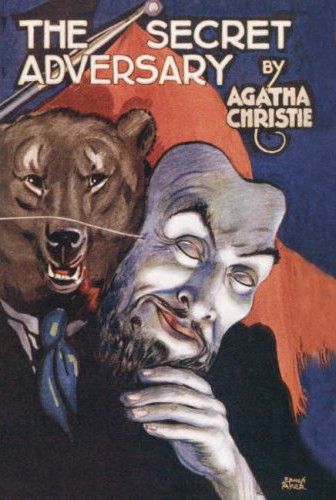
The Secret Adversary (book)

Dust jacket, first UK edition.
Emphasis on Bolshevism
Straining to relax, working to rest on the porch of the Barnstable, I finished reading Evelyn Waugh's entire absurd Vile Bodies and sitting next to me was a copy of Juliet Nicolson's The Great Silence.

Writing, eventually, would be in order. But research ... research is also important. Why, only just last year, at practically the same time I was burning through The Time Machine and A Brave Vessel as inspiration for The Great Globe Itself which was written, in large part, right there on that porch.

Nicolson's book details that period between the conclusion of the Great War and the beginning of the Jazz Age, as it occurred in Great Britain. (Side note: I really need to read an account of the war from the point of view of the Germans. Recommendations welcome.) The Secret Adversary takes place in 1921, at least according to Tuppence who recalls that her and Tommy's last meeting was five years hence in 1916.

Mid-century paperback edition.
Emphasis on MURDER!
Three issues of importance from that period resonate strongly in this work of Christie's; a general hatred for anything German, continued national deprivation and lack of employment (especially for the young) and with that a concurrent streak of labor unrest and a tangible fear of a Communist-backed revolt.

The Great Silence is an altogether demoralizing book. There is no finding reason in the great European conflict of 1914-18. Of all the horrific and plainly emotionally deadening facts paraded for our reflection, one stood out to me as most unhappy making.

Like many I have always assumed the war called "Great" was only classified as the "first" world war once there the "second" has established a succession. This is not the case. The term The First World War was first suggested in 1918 by an American academic writing about the conflict.

Recent, 21st century edition.
Emphasis on Lusitania.
That author was accused of cynicism, but history proves this person was merely striving for accuracy and was ultimately proved correct.

Deep knowledge of the "world of play" is not necessary for enjoying a work like Secret Adversary, but motivation and character is better understood with at least a basic education. Why are Tommy and Tuppence so obsessed with their next meal? Why is their banter of these two, young English people so blunt, wry, jaded and unapologetic?

And how on earth can an entire novel center on a single sheet of paper, one which ostensibly makes possible the toppling of the current Britain government and also pave the way for a wholesale Communist takeover without ever explaining exactly what the document says?

It is a mystery.

Friday, July 17, 2015

Station Eleven (book)

Reminiscent of The World Without Us
It is well-understood that watching emergency room dramas can be very frustrating for actual medical professionals. Lawyers are the first people who can tell you how unrealistic courtroom dramas are, and nobody has ever talked the way they do on The West Wing.

Writers have not only to write compelling stories, but they have the burden of accuracy. Even when writing a piece of historical fiction like The Great Globe Itself, I needed to know the facts before I could satirize them. Even when we are making things up there can be a desire to fact-check, but fact-checking only goes so far.

When writing The Vampyres I invited an actual goth rock band to a table reading, and they were entirely dismissive of the characters I had created. On the night in question, a certain local professional cartoonist and non-professional social critic also happened to be in attendance, and he thought their reaction was hilarious. He said, “No, actually, guys like you are exactly like that.”

So, uh. So there.

Fortunately for theater artists, no one really writes about our craft for popular media very much so there is little to be nitpick. One of the reasons the Canadian TV program Slings and Arrows is so popular among theater people is not for its accurate portrayal of “The Life” but more because we’re all squeally like – “OMG, they’re talking about us!!!!!!’

Shortly after college my father recommended that I might be interested in Light Thickens by Ngaio Marsh, a mystery where the murder takes place during a production of Macbeth. At that point my professional experience was not very deep, but I was immediately put-off by the director, whose opening comments about each character, delivered to each actor sitting around for the first read-through, were, I felt, horribly prescriptive. Add to that several actors expressed their strong difference of opinion, right off the bat, and engaged in a heated debate with the director, who insisted on the correctness of his opinion.

Of course, there are directors who come forcefully at their company like this, right at the start, though I am hard pressed to imagine the kind of counter-argument emerging from the acting company in response, at least not at the first blinking read-through. It just struck me as terribly false.

Let's read this corpse.
When in the first season of Slings and Arrows the avante-garde Darren Nichols begins his first rehearsal of Hamlet by pronouncing, “This play is dead,” it is hilarious because this is a comedy, and his is an extreme character. An extreme character much like directors we have known or worked with, perhaps, but still. Suspension of belief works differently for comedy than drama.

Recently, my wife checked out Emily St. John Mandel’s recent novel Station Eleven from the library, for us each to read. I had actually taken the book to North Carolina and back but was absorbed in other reading and actually didn’t get to it until our final night on the road, the night of the women’s final against Japan.

Looking into a vast, bright and shimmering television screen, transmitting images of a game of football being played entirely by women nearly three thousand miles away – the actual game itself attended by over fifty thousand people, an unimaginable number to be all in one place – myself lying between clean sheets in a hotel buzzing with people resting in safety and comfort, without weapons, twinkling ice in my plastic cup, drinking impossibly sweet and cool soda pop, the room alive with electricity and light after nightfall, the internet magically passing around us and through us, well-fed with warm pizza and fresh, green salads brought right to our room first by way of a gasoline powered vehicle and then the elevator. After a long day driving in a car, one cooled by air that just poured out a vent in spite of the eighty plus degrees outside, with clean water in a bottle, still cool, recently filled from a tap, available to all, and watching an exciting game, I read one page of this new work and promptly fell into a comfortable sleep, without care.

Read the book? You get it. Anyway.

This tale follows a caravan of actors and musicians, The Traveling Symphony, who roam a post-apocalyptic wasteland, making their living by playing and performing the works of Shakespeare.

They’re talking about us!!!!!!

I was most tickled by the different philosophies expressed by company members of the troupe, and how even after the end of everything actors and artists will be having the exact same debates about Shakespeare.

One player is confident in the idea that Shakespeare transcends time, and that more recent scripts are ground deep in a past that make them no longer comprehensible - let alone relevant - and that their decision to perform only his works, to the exclusion of all other texts, is the best artistic decision to make.

Another artist privately believes quite the opposite, that the works of Shakespeare are far too limited in their scope of human experience and besides she hates Shakespeare but will keep her opinion to herself because (ta-da) she works for a Shakespearean theater company.

There is also that age-old debate regarding costumes. Shouldn't the actors dress as their audiences do, in the decades-old, well-worn everyday wear of the past century? The thinking goes that if you perform Shakespeare’s text in contemporary dress, you bring the work closer to your audience. I have heard this argument. I have made this argument.

Other characters believe theater is a unique occasion, an opportunity to be transported to a different time and place, to see something special. As such, when the opportunity presents itself to ransack a long-abandoned home or school, to forage for any useful supplies, a useless dress or a disregarded men’s suit – unnecessary for survival –  is to them a valuable treasure.

John Wood, Alex Kingston
RSC 1990
One note, however, near the very beginning of the book struck me as entirely wrong. Departing a rather eventful performance of King Lear, just prior to that thing which makes the rest of the book happen, our narrator makes note of the poster, high above the Toronto streets. An image not unfamiliar to those who have ever seen this play; the bereft, ageing king, cradling his dead, grown daughter Cordelia.

I was shocked just to read it. I mean, uh, spoiler alert, Cordelia dies at the end of King Lear. Most know this and if you didn’t, well, so does Macbeth, Romeo and Juliet, Timon of Athens, Hamlet (and practically everyone he touches) as well as Julius Caesar, they all die.  Caesar doesn't even wait to the end, he dies in the third act.

But which fictional marketing director gave the green light to putting that image on the poster? Your main promotional image is the great tragedy at the very end of the play?

As our marketing department at Great Lakes has been conceiving of the season image for our Fall 2015 production, I have had the opportunity to take in dozens of other images from professional productions dating back a few decades.

Most are a dark, static depiction of an old man. I saw John Wood play Lear in 1990, the graphic was of the king prancing in madness, with a laurel of flowers on his head. A few include the Fool. Others are abstract; when we saw Ian Holm play the role in 1997 the image was of an eclipse of the sun.

The GLT season image for King Lear will not be released for a month or so, but they did principal photography last week. Here is an intriguing preview:

Via Facebook. What will happen?

UPDATE: "Station Eleven" is now a series on HBO Max.

Wednesday, December 3, 2014

The Great Globe Itself: Photo Shoot

Imagine Arthur is holding a Globe Theatre, and not a roll of tape.
Theater is a collaboration between artists. Creating a promotional photo is a collaboration between at least as many artists plus a lot of other people coming together for a brief moment in time to get something right to promote something that hasn't even been created yet.

I mean, the production is being created, as we speak. Yesterday, we had a production meeting where Esther revealed renderings ...

There are no less than fifteen distinct looks in this show.
... and Terry created a model. As you can see (below) there are a great many entrance and exit areas to play with. We decided to go with a theme of architectural renderings, rather than flats painted to look like walls in the Globe. Besides, which Globe? I am satisfied that this suggests the historic building without being too literal, and will have a sense of timelessness.


Esther was also present today today to help get our three actors into the looks she chose specifically for the shoot, each from one of the three time periods represented in the play - Kyle as Burbage (1613), James as Sam (1936) and Arthur as Clement (2005). Many thanks also to Kylee, who gave James a Clark Gable mustache that he wanted to keep.

Remember, this is what we were going for.
Todd and I and the team at TRG Reality tossed around ideas regarding the skyline. They had already put together a great mock-up that went from Jacobean England to Depression era-Cleveland to modern day London, and there were many questions as to what was most recognizable and how much or little would be seen behind each man.

See the Millennium Bridge? Do you know the Millennium Bridge?
The gentlemen from TRG put together a mock-up before our actors arrived to give Todd and I a sense of what the final image might look like. We also have to factor in the use of text in the final version.

It was a long afternoon, but a very successful afternoon. I was thrilled with how our actors looked, and surprised at how close to the original concept I think the finished product is going to appear.

I mustache you a question ...

Friday, November 21, 2014

The Great Globe Itself: Design Meetings

Suggested Poster Mock-Up
When I was a kid, more than anything, I wanted to sell things. This is not because I wanted to make money, my career choices should make that perfectly apparent. It is because I love packaging. I made posters and greeting cards and designed my own original cereal boxes and candy wrappers.

I did not have any concept of content, I looked up recipes for candy, and made a few, but the outside was much more important than what went in. While I have finally discovered what it is I truly want to sell, there is that part of me which is much more interested in making you want to buy.

I have written, directed and acted in plays, and even created a few sound designs. But as a stunted graphic artist, I have truly missed out on creating the visual components of theater. I took scenic, costume and lighting design in my freshman and sophomore years at school, and I was terrible at them. I wasn't particularly good at making posters either, and that really disappointed me.

However, that was a long time ago. And practical application of my abilities and the humility to stand and appreciate admire and the work of those who have made design their life has brought me into some very successful collaborations. We have employed the same team of designers for the past several years for the outreach tour (including Terry as scenic designer and Esther as costume designer) and I am consistently impressed, and delighted with the work, and grateful to get to work with them and it.

Wednesday we had our second production meeting for The Great Globe Itself. It is a new situation, acting as director and playwright, having shared the story and then being asked to weigh in on the creative decisions of others in its realization. This is where collaboration is such a relief, as we bat ideas around to discover how the costume design concept will play against the backdrop of the scenic design, how the colors will play, and can the set work with the limitations of three actors playing eighteen characters in forty-five minutes.

This is why it doesn't pay to walk in the room and say, boom. Here's what you get, take it or leave it. This is a manner in which theater is unique among the arts. This is why it never pays to scream at people.

Anyway, it was a very successful meeting and it made me smile. That afternoon, Todd and I had a different meeting, with the folks at TRG to discuss the promotional graphic for the brochure and the poster.

The first image I had, while composing the play (because, as I said, I am always thinking of packaging) was that of the character of Sam, facing the viewer, holding out a globe - a Globe Theatre - shimmering, floating just above his outstretched hand. In the background, the classic Cleveland skyline of the mid-20th century. One skyscraper, the Terminal Tower.

As the script took shape, with each age defined by its main character - Burbage, Sam, Clement - I saw each man, standing, laughing, collaborating, moving the Globe forward. Cleveland in the background is abstract, but present.

I created a mock-up using stock photos (see above) using the copy machine, scissors and tape, because I am old school and that I how I roll. This is what I shared with Todd, our marketing director, and the designers at TRG.

So far, all are supportive of the image. It is too much? We talked about these men being in a place, rather than in an abstract space, but where? Cleveland? Or Cleveland and London - and which London, 1613 or 2005? Or both? Will the final work come out like this, or something mind-blowingly different?

Photo shoot in two weeks.

Friday, August 16, 2013

Notes on Fringe (Day Nine)

Witches.

Another bright, beautiful day in New York City. For reals, we got rain dumped upon us on the drive into Manhattan last Thursday. Tuesday morning was cold and rainy and I did my laundry ... and then the skies were bright and clear and stayed that way.

Also, it has been warm, but not hot. I mean, the weather has been ideal. This morning James and I headed out to pass out palm cards at the Delacorte Theatre in Central Park. It's Friday, so I assumed the line for this evening's performance of Love's Labour's Lost would be long, but I had no idea. I mean, there were at least a hundred people in line who couldn't possibly have gotten tickets.

But still, morning in the park. Good times.

James and I passed out at least four hundred cards. No kidding. We ordered five thousand cards for this trip, they came in 20 boxes of 250. We have one more show, and we are down to two boxes, that is some good distribution work for six people. James and I emptied the better part of two just on the trip this morning.

I am always delighted when people ask questions about the show, that's a good sign, where, exactly, and when and what, who wrote it? James says it's in verse and someone asks, what kind of verse and I poke him and say, "Do Messina." He fills the air with:
Messina! Fair Sicilian burgh, at last! 
From northern climes I’ve soldiered, twice enlisted 
To defend this federated kingdom, Italy.
But leaving Padua I’ve never yet encountered sun so bright, 
Air so fresh and salty from the sea, 
The sight and scent of citrus, hanging low. 
If I must rest and recreate abroad, 
Why then, Messina is the place for me!
There was applause and smiles all around, because that's what you get for having a good voice in Central Park.

Shakespeare & Co. FringeNYC literature display.

How do you get people to come to your FringeNYC show, when you are not a New York company, have no local following? We have spent cash on advertising, well-placed advertising, but not an absurd amount of advertising. Mostly online, at various sites.

We hired a p.r. firm to bundle our materials with the rest of the FringeNYC press releases, which may or may not stand out, with so many others vying for attention. But Robert Muller's production photographs are solid, attractive, just what a blog or paper or magazine wants to see. Colorful, with costumes, a set, from a performance, not posed, lively. Interesting.

For these efforts we had advance notice in The New York Times, and Backstage.com. This is exactly what you want, what you need, to get noticed before the festival begins. And we met people on line at the Delacorte who said they'd seen it! In The Times!

And there are reviews, and those have been good. I get the impression that some people do not find my performances to their liking. They love our lovers, however -- and praise my writing, which is more important to me, anyway.

... and our attendance has ranged from 25 to 40. So, okay. Better than some. I was hoping for more. Asked prior to the Fringe, I said I wanted 50. Fifty per show. But what do I know from attendance, I have done solo shows at FringeNYC twice before, and each time I didn't come near what we have seen this year.

... and we're not done yet! One more show tomorrow. A Saturday at noon, not exactly when I'm out seeing theater, but pre-sale is as good or better than previous performances, so we have have a good showing. Or, you know. The same. Lots of friends are coming ... the question is whether people we met on line in Central Park will be joining them.


Today we all ventured back into the audience. Diana and her family went to see Spider-Man: Turn Off The Dark. Annie and her NYC friends went to see a cabaret -- it was later I was surprised and delighted to find they were seeing the majestic Ute Lemper!

Annie, Diana, her aunt and I all went to see a FringeNYC production -- Jen Bosworth's Why Not Me this afternoon at Subculture. We had been hoping to see her entire routine since both her show nd ours were featured in three promo events last weekend. Frankly, it was worth the price of admission just listening to her accompanist, Briar Rabbit, play and sing.

By the way, that's just a brilliant idea, ask a talented, young guitarist to vamp while you perform your solo work. It's like beat poetry. Solid. So glad to meet her and see her, she tells great stories, tells them well, she's hilarious, sincere and just really cool.

Tonight, however, James, Emily and I went to see Sleep No More. An immersive theatrical experience, SNM tells a 1930s version of Macbeth in an abandoned hotel, audience members are free to wander the entire space, taking in hours of dialogue-free movement events on three different floors.

I have been interested in seeing this for some time. Developed by a British theater company called Punchdrunk, it was supposed to run two months and has already run two years. I was curious as to how the concept might fare in a long-running circumstance, when it has moved from hip-and-hard-to-get-in-to, to move of a "hey, this looks weird, and there's naked chicks in it, wanna check it?" kind of event.

Regardless, the masks help. The audience members all wear masks, rendering themselves mostly anonymous, cargo shorts notwithstanding. Once engaged, I was taken by the performances, but also anxious that I was missing something on a different floor or in a different room ... until I was singled out by one of the witches, taken by the hand, and led into her room for a one-on-one event.

No, I won't tell you what happened. Or I might, in person, but not here.

Yes, I am very glad I went, and not just for the special attention. Also very glad to share it with James and Emily, who were ecstatic about their experience. Sometimes you get just what you expect, and maybe a little bit more, and that can be a very good thing.

Friday, August 9, 2013

Notes on Fringe (Day One)

FringeNYC 2013 is now open.

James and I just got back into our cozy L.E.S. apartment after spending an evening at Opening Night ceremonies for FringeNYC at The Cutting Room. We met many other Fringe performers and took in scenes from over a dozen different shows. We even did The Privy Song shortly after midnight.

Jen Bosworth w/Briar Rabbit from Why Not Me

This early morning begins almost 36 hours ago, when stage manager Diana and I loaded Andrew's van with the set for Double Heart. The forecast called for rain, so we bagged and double-bagged everything, and tarped the larger pieces.

Oh yes we did.

I did not sleep well last night, and James reported the same thing. We met downtown at 6 AM and made it safely to Manhattan in time to check into our apartment by 3 PM, except that it started raining like hell once we emerged from the Holland Tunnel. Rest assured, all was successfully waterproofed, and the folks at the Connelly were kind enough to let us load in the larger pieces before Tech (tomorrow -- er, today) so we did not need to haul them up our five story walkup. Thank you, Kimille!

 That makes me sweat.

From that point on it was merely matter of meeting up with Director/ACR Lisa and her husband Patrick at FringeCENTRAL to receive our Participant Badges, and then we were free to wander downtown and get some dinner before walking thirty blocks to the Cutting Room.

After midnight, we got our Metrocards, and took a subway back. Tomorrow ... handing out cards, welcoming the women company members to the apartment, Tech Rehearsal and a few other public performances. Also, picking up a couple copies of the New York Times.

Friday, October 14, 2011

7up "United We Stand" Cans (1976)


Anyone who has seen Dazed and Confused knows the Bicentennial was hardly 24-hour patriot extravaganzas and colonial soap-making workshops, although there was a lot of that. No, it was still the mid-70s, President Gerald Ford was the only un-elected President in American history* we were in economic doldrums and were still reeling from the end of the Vietnam War.

How best then to regain a sense of pride and uplifting nationalism? Bicentennial branding!

7*UP released a limited edition of cans, each featuring one of the fifty states on one side, and on the other side a cryptic, seemly random series of 7UPs in red or blue on white background.

Detail.
Collect them all — one featured a key for how to stack the cans — and you were treated to an optical illusion of a certain American icon! Collecting and stacking empty beer cans was a national hobby at the time, why not stack cans and celebrate our freedoms at the same time?

My brother Henrik collected all fifty. He didn't buy them all, he asked the guys at Village Pizza (two doors down from Bay Lanes) to hang onto empties anyone left around the place, and he would collect and wash them. I still have all 50 stored in my attic. I have no idea how rusted these steel cans may be, I have no looked for them in quite a while. I did find a complete collection on eBay going for $425.

I want YOU.

*For those too young to remember, Michigan House Representative Ford was appointed Vice President when Spiro Agnew resigned in disgrace, and became President when Richard Nixon resigned in disgrace.

UPDATE: I sold my brother's can collection in 2026, for $47.76.