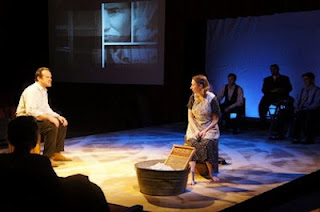
"About a Ghoul" (Talespinner Children's Theatre, 2019)
How do you get that next production? That’s a question. Without a name, without a history, when your work has largely been confined to your own community, without representation, how does one push their own work into the larger world?
In the gig economy, there are plentiful opportunities to attract attention to yourself, but there are thousands of others taking those same opportunities. Yes, there are many examples now of playwrights whose work has been discovered on New Play Exchange. For a moment I thought I was one of those.
In January, a small company in a large city cold-contacted me about one of my previously produced works. They really wanted it! I was interviewed by the artistic director. I was consulted about concept. They requested a contract, which I sent. Then … nothing.
I tried to reach out once, just a big hello? Are we on? No response. They announced their season in the summer, and no surprise, my play was not there. How disappointing. That’s not how you do that.
The entire year has been like that.
Casting spells in the rain. (Harry Potter World, Orlando)
The year literally began on the tarmac. After a significant delay, we touchdown in Orlando minutes before midnight New Year’s Eve, and rang in 2018 waiting to exit. It was a last-minute decision, to drop everything and scurry off to see Harry Potter and Mickey Mouse. After the horrors of the holidays, the wife just wanted time with her family.
What we got were four wet days in an amusement park, with temps in the mid-forties. But we were adventurous, we dined and played and loved together as a family under a dark cloud, because that’s a metaphor for everything these days.
New writing was under the radar this past year, I spent far more time doing crossword puzzles. It’s just a fact. However, works that have been in development or previously presented found their home, some more than one home.
The Way I Danced With You was presented as part of their Factory Series at Blank Canvas Theatre, and it was a very successful weekend. Funny, I did not think it was particularly well-attended. It’s not a big house, and it felt like there a lot of empty seats. And yet, the feedback was highly positive -- and it keeps coming. Since March numerous people, folks I didn’t even remember attending, have told me what an impression it made how much they are still thinking about it.
"The Way I Danced With You (Blank Canvas Theatre, 2018)
Last year I lamented how I had fallen away from writing, longhand, every morning. Well, it took most of the year, but I now have an established ritual of writing 30 minutes or three pages every single morning, without fail. And it makes a difference. I even pushed through an illness to keep covering the page.
Just last night, Talespinner Children’s Theatre announced their 2019 season, which will include the world premiere of About a Ghoul, my new play inspired by Moroccan folk tales.
On the publication front, I have two exciting developments. In an effort to control my own work, I decided to self-publish I Hate This on Amazon. Ten years ago there was a limited edition of that script released in Britain, with all profits going to a national charity. To my surprise, I have found copies of that script going for as much as $50 on various websites. So I have published a version for $5.95, which means pennies for me, but at least it is available to whoever wants it at a price they can afford. You can get an electronic version for even less.
The second publication is still in the works, and I look forward to announcing that soon.
"Screen Play" at Pandemonium Brian Pedaci & Toni K. Thayer
re·gret (rəˈɡret) verb 1. feel sad, repentant, or disappointed over (something that has happened or been done, especially a loss or missed opportunity).
noun 1. a feeling of sadness, repentance, or disappointment over something that has happened or been done.
Groundhog Day
Why does the movie Groundhog Day work? I mean, the premise is facile, but inspired. One person wakes up on the same day, day after day, seemingly for eternity.
It could easily be a horror film, like an episode of the Twilight Zone, a "No Exit" situation, in which our protagonist is driven to madness. When he is finally released and it is finally February 3rd, he’s a gibbering, quivering mess, or unleashes unspeakable violence on the citizens of Punxsutawney before being carted away in a loony wagon.
Instead it's a somewhat broad romantic comedy that includes one unfortunately dated homophobic gag.
Bill Murray plays the main character, and he's a complete jerk. But he’s not the only jerk, there's a lot of jerks in this movie. I couldn't help but imagine that piano teacher and her decision, every single time, to accept a sizable amount of money to kick her adolescent student out of the house. Man, that girl looks really sad and confused.
Also, Chris Elliott. That’s all, just, Chris Elliott.
Watching the film for only the second time the other night ("don't @ me") I was impressed by the structure. The different phases our man goes through, confused, manic, suicidal, resigned, driven. But I was not only amused by but disturbed by Murray’s performance. I’m not sure he changes as much as people want to believe he has.
He fails when he takes an easy route into into Andie MacDowell’s pants, by discovering and memorizing her favorite things, and then repeating them back to her. But aren’t his long-term efforts at becoming a full-actualized human being the same thing, only more sophisticated? Does he learn languages and philosophy and boogie-woogie piano because he wants to, or because that is what it will take to attain the acceptance of the only person in town he apparently can't bamboozle?
Nailed it.
He accumulates several lifetimes of experience and practice, an autodidact’s liberal education, but he’s still kind of a jerk. He bathes in his own cleverness. I mean, Bill Murray always does. However, I believe that fact is the film’s redeeming quality, that he does not become an entirely different person. He changes, yet he does not. The best that can be said is that he does not seem to hate himself anymore. It's not even about her. Do we not all hope for that kind of radical change?
“How old I will be by the time I learn to really play the piano/act/paint/write a decent play?" The same age you will be if you don’t.
- Julia Cameron, The Artist’s Way
Groundhog Day was released when I was twenty-five. Half my life ago, with so much in front of me, I wasn’t particularly touched by his dilemma. At the age of fifty, which of us would not -- barring the opportunity to actually go back in time and change things -- take the opportunity afforded from one single day, repeated over and over, to make up for lost time? Reliving, reliving, and recreating. The young man finds it amusing. The older man just sees his own life and thinks, what have I been doing with my many varied days?
Make no mistake, Groundhog Day is ultimately a movie about regret. Because there are no do-overs, we cannot relive a moment to get it right. It is a fantasy of longing for the one who got away.
Plays of Regret
Several of my plays have been inspired by brief, passing encounters, expanded upon and brought to their ultimate, extreme conclusion.
Twenty years ago, in 1998, four playwrights (David Bell, Suzanne Miller, Toni K. Thayer and myself) collaborated to create a new work for Dobama’s Night Kitchen titled Cole Cuts. Set in a trendy, late 90s cocktail bar, each fifteen minute piece was to include a lesser-known song by Cole Porter, performed live by the company, piano by the incomparable Michael Seevers.
"Cole Cuts: The Imaginary Date" directed by Dan Kilbane Featuring Adam Hoffman, Elaine Feagler, David Thonnings & Alison Garrigan Piano: Michael Seevers (Dobama's Night Kitchen, 1998)
In my scene, “The Imaginary Date,” a young man (Simon) is pressed into service, pretending to hit on a friend of his (Missy) to make her ex-boyfriend jealous. By the end of the short scene the gambit has worked -- the ex stomps off in a huff -- but Simon is left wounded by the connection he allowed himself to believe has been made with Missy on their “imaginary” date.
The convention of the complete, one-hour play (set in a bar called The Porterhouse) gave this scene additional impact, as Simon returns to the bar, continues to drink through two other scenes, and sadly staggers out near the end of the final piece.
Emotional role play is also a major plot point in The Way I Danced With You, in which a young couple attempt to rekindle a flagging relationship. This piece, which received a weekend of performances at Blank Canvas last March will have a complete, three-weekend run this season at Ensemble Theatre.
A few weeks ago, my ten-minute piece Screen Play premiered at Pandemonium, Cleveland Public Theatre’s annual gala. Two years ago I tried it out at CPT’s monthly public workshop, The Dark Room with Brian Pedaci reading the male character. This summer he asked if I wouldn’t pitch it for the party. I was surprised he remembered it. I was surprised they chose it. It’s a little kitchen sinky, but between he and my wife, Toni K. Thayer as she, it was taut, compelling, and we got some lovely responses from party goers.
"The Way I Danced With You" at Ensemble Theatre Sarah Blubaugh & Cody Kilpatrick Steele
Unlike those other two pieces, featuring youthful protagonists in the very midst of romantic decision-making, here we have two Gen Xers in their middle years, a quiet evening at home, on their screens. He googles a one-night stand from college, and his attempt at re-connection (an ill-thought impulse) is met with a less-than-positive response. The ensuing conversation with his spouse leads to several uneasy conclusions.
Dan Savage said, “every relationship you are in will fail, until one doesn't.” Is the success of an entire relationship defined by whether or not it ends? How many relationships hinge on a single word? Have you ever felt the regret that comes with doubting the choices you have made, and the possibility that one choice, one moment, one word -- stay -- may have created for you an entirely different life, a different world, a different you?
Theater artist Isaac Butler and journalist Dan Kois have contributed an historically important book with The World Only Spins Forward: The Ascent of Angels In America.
A comprehensive oral history, this exciting and easy-to-enjoy record traces the creative path of Angels In America by Tony Kushner, arguably the greatest play of the late twentieth century; from the script’s prehistory in the revolution for gay rights and the origins of the AIDS crisis, through the heady development process on both coasts of America and in England, its resounding though by no means guaranteed acclaim and lauds (and a surprisingly successful adaptation to film) and significant re-mounts, up to and including its recent revival on Broadway.
It even includes a chapter on the ill-fated 1996 Charlotte Repertory Theatre production, which was almost closed due to threats that the cast would be arrested for indecent exposure. The controversy began when the theater critic for the Charlotte Observer took the opportunity of a rare front page byline to announce to the community that this production would feature homosexual acts performed live on stage and full-frontal male nudity.
That those are two different scenes, and the fact that the character Prior Walter removing his clothes was for a medical examination, exposing to the audience his weakened state and many visible skin cancers, was not in the Observer's lede. The alarm was sounded, and it took a Superior Court Judge to allow the play to proceed without fear of legal action.
The controversy continued, a slate of arch conservatives were elected to the Board of Commissioners, and arts funding was -- briefly -- eliminated in the county of Mecklenburg. Shortly after the Charlotte Repertory Theatre would cease operations.
Pro-Angels protest. (Charlotte Observer, 1996)
A few short years later that theater critic, Tony Brown, who so titillated the readership of Charlotte, would move to Cleveland and begin an eleven-year tenure as chief theater critic for the Plain Dealer. He was either not asked, or declined invitation to be interviewed for this book.
One of the more startling images from Mike Nichols’ HBO miniseries adaptation is a scene between the doomed couple Harper and Joe, on the rooftop of their apartment in Brooklyn. The Twin Towers are clearly visible across the river. A trick of editing, this record of the play, created in 2003, was one of the early reminders that Angels is a period piece. I mean, it always was; it was and will always be 1985. But what we have gained and what we have lost in the years since, and as the years continue, will continue to mount and shape our perception of Kushner’s work.
And therein lies a question; does this play continue to be relevant? Almost every year a play receives a Pulitzer Prize for Drama, for not only great writing but also social relevance. Many go onto long histories of production, but do they maintain their relevance, do they speak to a modern audience? Plays so familiar that their titles can be reduced to one word -- Streetcar, Salesman, Picnic -- they may be emotionally compelling, but are they urgent?
Jason Isaacs & Daniel Craig as Louis Ironson and Joe Pitt (National Theatre, 1992)
When the HBO series debuted it, too, won numerous awards. It was well-done. But the dire warnings of the text were not as sharp. HIV/AIDS -- in America at least, for those who could afford it -- was under control. Eight years of Bill Clinton gave the illusion that the Reagan revolution of the 1980s and the Gingrich-led uprising of 1994 were just part of the natural cycle of politics, and that the Supreme Court the character Martin Heller predicted, one that by the 1990s would be “block-solid Republican appointees” had not come to pass and would never do so.
And yet. Here we are.
The question of whether a piece of writing transcends its own time, that its meaning can be interpreted to reflect the crises present in those whose paths are different from those represented in the original narrative, that is the test which determines whether a play is truly classic.
Arthur Miller directed Salesman in Beijing in the early 1980s, just as China was only beginning to enact minor Capitalist reforms. In doing so he found a wide, new audience for a decades old work which affected his audiences as though it were written for them.
Two years ago the Play House produced his Crucible with a multi-racial cast, and I had the opportunity to get into a polite debate about whether doing so changed the intended message of the play. He argued the play is about religious persecution, not racial persecution. I argued it was intended to be about the Red Scare, and about persecution in general, and the kind of heartbreak and death that attends the creation and subsequent destruction of perceived enemies.
"Part Two: Perestroika" (Ensemble Theatre, 2018)
The first production of Angels in Cleveland was at Dobama Theatre in 1998, a brisk, delirious event, with tiny sets flying in and out with breakneck speed and an indelible lead performance by Scott Plate as Prior Walter. It was a time when the word “Millennium” was très en vogue, the expectation of great or cataclysmic events just on the horizon. We were living in End Times that never ended.
As we limp further into the murky depths of the twenty-first century, Angels In America, with its deeply flawed but searching characters and lyrical wonderfulness, which provided rich humanity to a cohort of humans previously denied their rights or even their right to exist, has already shown itself to be open to vital reinterpretation. The great work begins. It is always beginning.
Sarah Blubaugh & Cody Kilpatrick Steele "The Way I Danced With You" (Ensemble Theatre, 2019)
Perhaps you are planning to catch The Way I Danced With You this weekend. I hope you are. But perhaps you were born after the year 1980, one of those "Millennials" people keep talking about.
Maybe when you hear the name "George Michael" you immediately think of Michael Cera. Maybe you've never been to Chicago. Maybe you don't even know where you are.
Here is a brief list of pop culture references which may help you appreciate and enjoy the performance.
Deerfieldis a village in Lake County, Illinois, approximately 25 miles north of Chicago. Deerfield High School is consistently one of the top high schools in the state. It is said Deerfield was a major inspiration for Shermer, Illinois, the fictional setting for several of John Hughes’ 1980s teen films.
"A Different Corner" is a 1986 song written and performed by George Michael. The song reached number 7 on the US Billboard Hot 100.
The Fly is a 1986 American science-fiction horror film directed and co-written by David Cronenberg. Starring Jeff Goldblum and Geena Davis, the film tells of an eccentric scientist who, after one of his experiments goes wrong, slowly turns into a fly-hybrid creature.
Footlooseis a 1984 American musical drama. It tells the story of Ren McCormack, an upbeat Chicago teen who moves to a small town in which, as a result of the efforts of a local minister, dancing and rock music have been banned.
Glencoeis an affluent suburb of Chicago, located on the shore of Lake Michigan. This village is also the setting for the 1983 film Risky Business.
Harold Washington College is a community college part of the City Colleges of Chicago system of the City of Chicago, in Illinois. Founded in 1962 as Loop College, the college was renamed for the first African American to be elected Mayor of Chicago, Harold Washington, after his sudden death in office in November 1987.
"Love on the Rocks" is a song written by Neil Diamond and Gilbert Bécaud that appeared in the 1980 movie The Jazz Singer. The single reached #2 on the Billboard Hot 100 for three weeks in January 1981.
Midlandis a city Michigan. In 2010, Midland was named No. 4 "Best Small City to Raise a Family" by Forbes magazine.
The Palmer House, Chicago
Mel Gibson was People Magazine’s “Sexiest Man Alive” in the year 1985.
Navy Pier is a boardwalk entertainment district on Lake Michigan in Chicago, which in 2018 encompasses more than fifty acres of parks, gardens, shops, restaurants, family attractions and exhibition facilities. Established in 1916, and not yet extensively renovated until the early 21st Century, by the 1980s it was a destination in decline.
A Night at the Opera is a 1935 American comedy film starring the Marx Brothers, A smash hit at the box office, A Night at the Opera was selected in 1993 for preservation in the National Film Registry by the Library of Congress as being "culturally, historically, or aesthetically significant."
Olderis the third solo studio album by George Michael, released in 1996. It was his first album since 1990's Listen Without Prejudice Vol. 1 – the six-year gap was due to the legal battle that Michael experienced with his record company. "Older" is also the title of a single from this album, released in 1997. The single peaked at number 3 on the UK Singles Chart. It did not chart in the United States.
The Palmer House (now the Palmer House Hilton) is a historic hotel in Chicago in the city's Loop area. It is a Historic Hotel of America member, the official program of the National Trust for Historic Preservation. It is one of the longest continuously operating hotel in North America.
“The Queen and the Soldier” is a song from Suzanne Vega’s eponymous, 1985 debut album.
The South Side of Chicago has a varied ethnic composition. It has great disparity in income and other demographic measures. Although it has a reputation for high levels of crime, the reality is much more varied. The South Side ranges from affluent to middle class to poor, just like other sections of large cities.
Wham ft. George Michael ("The Edge of Heaven")
Top Gun is a 1986 American romantic military action drama film directed by Tony Scott, Despite its initial mixed critical reaction, the film was a huge commercial hit. Additionally, the film won an Academy Award for Best Original Song for "Take My Breath Away" performed by Berlin.
“The Way I Danced With You” is a lyric from “Careless Whisper” (1984) by English singer-songwriter George Michael. It was released as a single and became a huge commercial success on both sides of the Atlantic and on both sides of the Pacific. It reached number one in nearly 25 countries, selling about 6 million copies worldwide.
Winelightis a 1980 album by jazz musician Grover Washington Jr. It received the Grammy Award for Best Jazz Fusion Performance in 1982. It is also the title of the first track of the album.
For the eighth year running, the boy and I have been left on our own for a weekend in July, a weekend we refer to as Boy Camp. The truth is, we have plenty of father-son time during the course of any given year. In January my wife and daughter headed to the Women’s March in DC and the boy and I - and Sarah - saw theater, ate poutine and attended the Science Fiction Marathon at Case.
But Boy Camp has become a strong tradition, something we both really look forward to. The weekend has not disappointed. True, we did not go bowling, but we have made a date for the near future. But other stereotypically testosterone-inspired events have transpired.
For example, yes. We began with a trip to Home Depot. Seriously. His call. He has wanted for some time to make his own practice swords, like those we employ in the residency program, and that required ½’ PVC pipe, foam and duct tape. He also bought a dangerous looking utility knife and almost immediately nicked himself with it. Lesson learned, I hope.
We also headed to Game Stop to remit a gift card he’s had, like, two years. His computer and phone have kept him away from that Xbox he bought at the police auction a year or so back, but he only had one controlled. Now he has two and we stayed up late Saturday night playing WWF Smackdown ‘13.
After shopping we headed to Ensemble Theatre, where The Whiskey Hallow was giving a free concert. It should have been out in Pekar Park, but was rescheduled for indoors under threat of heavy storms which never materialized. The bands includes on of the boy’s teachers from School of Rock and a former student, they’re pretty amazing and it was a great show. Wish it could have been outdoors, though.
However, it did afford us the opportunity to check out the ARTFUL artists studios on the second floor of the former Coventry Elementary space. Only two years ago we were rehearsing scenes for Timon of Athens up there, and there was nothing but open, wanting space. Now there are studios and classes, and real work going on.
Unfortunately, the school district plans to sell the building, which puts this new endeavor, Ensemble Theatre, Lake Erie Ink and another important local arts organizations out on the street. I should write a letter.
That evening he made a sword (cut his finger) and we watched three episodes of The West Wing before bed.
Saturday morning he indulged his father, joining me for a theater-related meeting and bearing through it pretty well. I had promised fried chicken and waffles, which is where we headed directly after - to Chicago’s Home of Chicken and Waffles. Folks in the office have been telling me about this place, and we had a fantastic lunch there. However, I think he learned that real pieces of chicken fry better than the boneless kind.
Then to Shaker Square Cinema for Spider-Man: Homecoming. It was the best of the Spider-Man movies. I never liked any of the previous Spider-Man movies.
Before dinner, some exercise. I ran, he biked, some three or so miles through town. We talk about anything on these runs, I am grateful for them. When he comes along on the bike I get water, and take a few breaks. The running has been very challenging the past several months.
Before dinner we had to get bananas, and of course some ridiculous-flavored ice cream. I planned to make fried banana and sunbutter sandwiches, but he persuaded me to slap a piece of cheese on them. He was correct.
We dined watching Most of Buckaroo Banzai. He really wanted to play Xbox but I suggested we watch something while our hands were occupied with the sandwiches, watermelon, Fritos, and Twinkies ice cream. He agreed, and we made it most of the way through the movie before his desire to lay the smacketh down became too overwhelming.
Now, I had made a promise the night before which I seriously did not feel like keeping this morning, which is this: he wanted to fish. I, having been ill for the past ten days, was delighted to not only sleep through the night, but to sleep late. By nine I had no intention to find somewhere to drop a line during the hottest part of the day.
Fortunately, before he woke some friends called asking if he didn’t want to go with them and their son for the day. And so, Boy Camp drew to a close - for me - a bit early, as I sent him to hang out with his best friend in the beautifully resurrected Edgewater Park.
There’s so much more summer in store. I am sure we will get out into it together soon.
John Lithgow (right) as Winston Churchill in "The Crown"
The problem with using the stage to make direct and obvious political statement is that the message can be misinterpreted, casually dismissed, or in the case of most local productions, singing to the choir or more often ignored entirely.
The first year of Guerrilla Theater Company our more obvious agitprop was leavened with playful absurdity, but as our more pointed statements we from time to time dismissed out of hand or criticized, we bent the rules of inclusion to force each of the performer-writers to defend the point of each brief vignette. In short order the creators of some of our most popular pieces decided to move on and our audiences dwindled.
When a company decides to present a classic piece of political theater, the language and situation would most likely not most obviously resemble contemporary concerns. When Ensemble Theatre presented Waiting For Lefty six years ago (to take one example) they strove for period accuracy in production in costume and design, but their video projections reflected the very recent Occupy Wall Street uprisings. And yet, the Great Recession was not the Great Depression and the pictures did nothing to change Odets' clumsy words. In spite of using David Bowie in the soundtrack, it was still more museum piece than think piece.
Timing is also important. Bad Epitaph produced Lysistrata in 2000, which was enjoyed as an absurd sex comedy, but as we were not currently engaged in an wars (at least not any we could see) the playwright’s original political intent was beside the point. We came a bit closer to the mark in 2004 when we produced Kirk Wood Bromley’s The American Revolution.
True, we made no obvious references to the present geopolitical situation, the early years of Bush’s war in Iraq, and the Colonial version of occupier and freedom-fighter, but just putting it out there seemed to make its own statement. As Plain Dealer critic Tony Brown put it, we didn’t need to be “ponderously obvious” about it, as that was his job.
“One imagines that if the revolutionaries were to say and do now some of things they said and did then, John Ashcroft probably would have them locked up without lawyers in the prison at Guantanamo Bay on terrorism charges,” said Brown.
Ladies and gentlemen, ponderously obvious.
The Trump era has invited a slew of productions of Julius Caesar, which has been an obvious go-to for those who would warn against tyranny in all it forms, for centuries. In New York this summer you can see a modern-dress production for free at the Delacorte in Central Park, or an Off-Broadway production by Access Theatre featuring an all-female cast and set in an independent, girls’ school.
Orson Welles' "Julius Caesar" (1937)
It is facile to swap out one political leader for another. Arguably when Orson Welles presented this work during the reign of Mussolini, that strongman must have appeared to be a literal incarnation of almighty Caesar. But Donald J. Trump more closely inhabits the strengths and failings of Caesar -- as conceived of by William Shakespeare -- especially in those scenes where he loudly protests his immutability even as he agrees with who ever spoke with him most recently.
But a military genius with an extensive record of victories on the battle-field? Darn that ankle spur.
The question remains whether or not political commentary on stage has any relevance at all. To those of us who are theater practitioners, of course it does. But most people do not see plays, are unaware of plays, are entirely unaffected by plays.
However, the extremity of the actions of and declarations from the Trump Administration have emboldened commercial entities, which would normally avoid controversy and offense. We live in a golden era of men in suits sitting at desks (and one woman standing in slacks) taking the piss out of the president every night of the week.
In fact, the word and actions of the young Trump Administration have been so extreme, and transparently anti-democratic, that any creative expression in regards to totalitarianism and propaganda in the service of such ends can appear to be intentional commentary on the current president.
Yes, sales of George Orwell’s 1984 spiked after the inauguration, but when Audible produced a television ad featuring Zachary Quinto performing an audiobook version, it created controversy. Reading passages from a seventy year-old book is commentary on Donald Trump? Whose fault is that, Audible’s, Orwell’s or Trump’s?
Hulu’s production of The Handmaid’s Tale includes scenes that appear to emulate the January 21, 2017 Women’s March, but production started last year, long before the election. How might this program have been received during a Hillary Clinton Administration? How significant is it a big screen Wonder Woman came out this past weekend and has broken all kinds of records including biggest opening for a female director. Has the disappointment and disillusionment of the past six months actually fed interest in such a vehicle?
Last week I started watching the Netflix series The Crown, which debuted four days before this past election. I like Peter Morgan, loved The Queen, The Audience. I’m an Anglophile, and my interest in the monarchy reaches beyond what is necessary to comprehend Shakespeare’s history plays.
With this series, dramatising the first months of the reign of Elizabeth II, Morgan seems to be a bit more heavy-handed with the exposition than with other treatises on Elizabeth Windsor, as though he assumes most of his audience will be American - or at the very least, not British. The idea of having to explain to the new queen that she chooses her royal name (her father George VI was born Albert, for example) is ridiculous, she knows that.
I’m loving John Lithgow as Winston Churchill, the first time I have seen any actor embody the character without doing a Churchill impression. Episode four, "Act of God," felt as though it too were mocking the new American President for his behavior, even though that episode, like the entire season, were all released on the same date, November 4, 2016.
The Great Smog of 1952
The Great Smog of 1952 was a bizarre weather event, an “anticyclone” which trapped air pollution - mostly the result of the use of coal for electricity and heat - over the Greater London area for several days. It was catastrophic, resulting in thousands or by some estimates over one hundred thousand deaths, due to either accidents due to low visibility or illness due to inhalation. These facts are a matter of historical record.
"Act of God" suggests Churchill, the Prime Minister, intentionally ignored scientific studies which made plain the health risks related to the coal-based power infrastructure and even reports that such a freak weather event were possible.
That I watched this episode on the very day President Trump announced the United States was withdrawing from the Paris Agreement wasn’t even the most alarmingly prescient element of this episode. That came when, in the midst of a national calamity, the Prime Minister was determined, during a cabinet meeting, on ranting about whether the Queen’s consort, Prince Philip, Duke of Edinburgh, should be allowed to train for a pilot’s license.
The comparison is ponderously obvious.
Source: Freedom Rings With An Edge in “American Revolution” by Tony Brown, The Plain Dealer, 6/23/2004 Great Smog of London, Wikipedia
New play development is a thing. It is as though almost every theater in town has its own playwrights ensemble or presents some new plays festival. Convergence-Continuum has the NEOMFA Playwright Festival, Ensemble Theatre the Columbi New Plays Festival, Dobama Theatre has a playwrights program called Playwrights’ GYM, and the Play House the Playwrights’ Unit, that last of which I am a member.
Reaching back twenty years, I was an actor for Cleveland Public Theatre’s new play festivals. That event included a prize for best play, the Chilcote Award, which would go on to receive a full production the following season. I was in the world premiere production of Lucy Wang’s Junk Bonds in 1995, and performed in both the festival (1997) and premiere (1998) production of Sarah Morton’s Love In Pieces.
In more recent years, when they produced an annual festival of works-in-progress called Big Box, I was afforded the opportunity to develop my own plays, including solo pieces I Hate This (2003) and And Then You Die (2009) among others. Each had life outside Big Box, but the assistance provided by CPT made them happen.
Of course, there are a wide variety of ways to develop a new script. You can invite friends to your house and read it. You can stage your own public reading, or submit it to a celebration of new works like the Playwrights Local Annual Cleveland Playwrights Festival or attach yourself or gain membership to one of our local theaters’ playwright collectives. You can even declare your script completed and submit it for production, here or anywhere, really. The internet has made it much easier to find companies across the country that actively seek new work.
This year, CPT is trying something new, by producing a trio of events designed to progress dramatic works at various stages of completing. The first stage of these, Entry Point, takes place this weekend. Over the course of two and a half hours, audience members can move between over a half-dozen locations on the CPT campus to witness - and comment upon - new works at various stages of development.
In addition, they are featuring panel discussions on Saturday afternoon. A number of my favorite artists and CPT stalwarts are presenting as part of this project, you can even sit in on a brand new work from Eric Coble. Also, there's free beer.
My friend and colleague Carrie Williams is working on a script titled Set Fire and Start Again, since the beginning of the year she has been directing our company of five to create a script-in-hand, twenty-minute performance of what she calls “fragments” of a larger piece that she’s working toward. I have had a wonderful time working with this crew, a lot of positive energy devoted to developing Carrie’s work, giving her what she needs, we hope, to drive this piece forward.
This is the project I was referring to when describing those of us who go into the cold to create. For some reason my sharpest memories of participating in the creation of someone else's work, generally as an actor, with highlit and marked up new pages in my hand, take place in deepest winter. During the rehearsal process I was standing in the wings, and turned to face the black wall of the Levin Theatre. Painted black, and repainted many times over, how many layers of paint dating back how many years. I touched its surface, which has born witness to so much new work.
When I was a youth, when I was in college, even, I was not interested in new work. My ignorance of the classics placed a premium upon them, they had staying power and pedigree, they had been endorsed by time and I assumed therefore those were “real” plays. And I considered myself a writer!
Since that time I have come to an entirely different conclusion. New writing is the lifeblood of civilization, and that working as a collaborator (even as an actor! yes!) in the pursuit of original plays is vital to the progress of culture. The open, creative exchange of ideas in a public venue. You like movies? You like TV? It all begins with the basic, local act of crafting the words to be spoken from one person to another, on a stage, before an audience. That is the basis of understanding.
In order to truly understand this play, the entire thing, it helps to already have a detailed knowledge of English history at that time. Shakespeare's (and Fletcher's) audience would have, and there are reference, sometimes casual references, to famous Lords and Cardinals. The work includes several Earls and additional Dukes.
This stripped-down version concerns itself with the machinations leading to fatal downflaws for Lord Buckingham, Cardinal Wolsey, and the near-downfall of Cardinal Cranmer. Three schemes to eliminate those close to the King, on that last of which fails because Henry finally sees how he has been manipulated, and steps in to say, no. Not this time.
Adapting this courtly, historical drama into a modern setting eliminates the possibility for the kind of pageantry one might expect from a party, a coronation and the birth of a princess. However, in discovering the work (even as we speak, during the rehearsal process) there will be three points that use music and/or movement to emphasize, illuminate or aggrandize key moments in the production. Or maybe more. But I will tell anyone who asks that there are only three.
Some will sing. All will be expected to learn the salsa.
The People's Theatre is not aligned with any political party. That is the euphemistic way of saying that it is not Communistic, and its organizers wish you to be clear about that. - William F. McDermott, The Plain Dealer, 1935
When I moved to Cleveland Heights we had three theaters. Name me another American suburb that can boast having three theaters. Well, anyway, time passed and by 2005 we had none. Ensemble lost their lease at the Civic, Dobama had been evicted from Coventry, and like all things Jewish, the JCC had moved from Cleveland Heights to Beachwood.
The new Mandel Jewish Community Center has many exciting new features, but theater? Eh, not so much. Dobama managed miraculously to maintain an identity in the wild before returning to the Heights at their fine new home in the CH-UH Library complex. And Ensemble has carved a new home out of the former Coventry Elementary School, and a really great space it is.
Two out of three? Not bad.
This afternoon I caught the closing performance of Ensemble's production of Waiting For Lefty, the first show in this new theater space. Life has not been kind to my wife's extended family the past several weeks, and in spite of wanting to catch numerous productions this fall, several closed this weekend without an opportunity for us to see them. At least I could catch this 70-minute program in my own backyard.
Seated in the front row, I invited Mike Partington to take the chair next to mine. It had been years since we had had the chance to talk, and this week I saw him both at Harvey's Tribute and in this place. Mike's got some years on me, our pre-show conversation had a lot to do with theater space, how he first reacted to the new Bolton Theatre at the Play House -- same as almost everyone else, really, stunned that they had dumped a thrust stage at East 77th Street to add yet another proscenium.
Ensemble Theatre has a thrust, with seating sections on three sides. It feels more like the old Dobama on Coventry than the new Dobama does. The platform stage is so close to the audience, and actors make entrances and exits through the house as well as through the wings. I love that.
I was very pleased to see such a large audience on a Sunday afternoon. Sunday matinees are notoriously depressing in Cleveland, with maybe ten to twenty people in the house. It was quite a full house!
So. First time seeing Waiting For Lefty in its entirety. How does it hold up? Interesting! While employing period costumes and some kind of non-specific tough-guy New Yawk accents, the Ensemble production utilized their large video screen to bridge scene changes with footage and music from the future (HUAC testimony, Occupy Wall Street demonstrations) to empasize the continuing resonance of the work.
However, having just directed a staged reading of It Can’t Happen Here, I have been disabused of the notion that writing from the 1930s is dated, or must feel dated. Sinclair Lewis words, spoken by a contemporary cast, was suprisingly fresh, meaningful, humorous and resonance with our modern audience last Monday night. People were taken with the story, and moved by its conclusion.
A friend who caught the show reflected how much more slangy Lefty is, which explains why it is seems dated. Also, there’s no real story to be swept up in, it is a collection of vignettes on a common theme. It’s like Saturday Night Live without punchlines.
But that’s not the real problem with its presentation as a contemporary work. It’s one long debate, more like Greek drama than soap opera. For example, the tale of a young suitor, on a perfect summer’s evening, breaking up with his devoted gal because he can never be the man that she deserves in this economy, where the bosses and the company men keep the worker under his boot, where a guy can’t earn a crust while Uncle Sam stands idly by, doing as little as possible because the truth is The Man still mans the controls of government and always will, so the little guy is left to gasp meekly for dignity - let alone a dollar, and its high time we pulled together and rose up to demand what is coming to us, an eight hour day, a pension and a heart handshake, but until that day comes I will never be the kind of joe who can care for a girl the way she deserves to be treated, and not like some two-bit floozy, always promising, never committing, I mean what kind of life is that for a young American lady? The Masters of Power don’t care about these things, the velvet-gloved capitalist executive sees the workers as an endless supply of hands and muscle to hoist the gears that make the things that fill their endless, bulging pockets …
Hey, baby, where you going?
After the performance, the audience was invited into another part of Coventry Elementary (wait, do we have a name for this new community facility concept?) for a special event celebrating the opening of Lake Erie Ink.
What's that, you say? So glad you asked! It's a drop-on center for area youth with an emphasis on creative writing! HOW AWESOME IS THAT??? It's like an 826 Valencia for Cleveland Heights. I mean, it is an 826 Valencia for Cleveland Heights.
And wow-man-wow, there were a lot of people there! Cleveland Heights Poet Laureate Cavana Faithwalker represented, and world-renown hipster-shaman-beatnik-poet Ray McNiece was on hand to lead children in poetry exercises. There were a number of writing activities for young and old, I wrote a haiku on a paper pumpkin:
WORKERS THEATER
JUST SAW ‘WAITING FOR LEFTY’
LIKE AN UPPERCUT