|
| Guerrillas in the Professor Street Theater |
Now we are here. Now it is time. Now we have come to rule you.
The dog stopped every few yards to turn around to snap at the metal dragging the ground, an entirely useless attempt, the coat hanger whipping around with it. The other dogs yapped in delight and surprise, also trying to bite at the wire hanger.
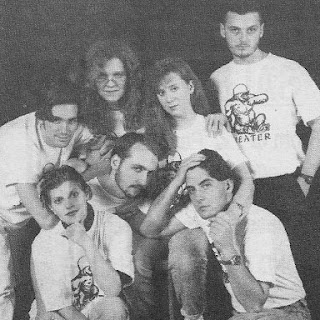
The seven of us emerged from the building for which Torque and I had recently signed a lease, the building we would soon call the Professor Street Theatre. We were going to rehearse one of our new short plays outdoors. I was anxious.
“Let’s do it over there,” Torque said, gesturing down the street with a mallet, toward the steps of St. John Cantius. Torque was wearing a bass drum, Wee-Bear had a pair of cymbals.
“Uhm,” I said. “Okay.”
We walked over to the church. I stood at the top of the steps, with Torque and Wee-Bear a few steps below, flanking me. The others stood around, scattered here and there, on the sidewalk, in the street, like they would do if they were standing among the crowd at the corner of Euclid Heights Boulevard and Coventry, or the Yard as it was called. The way we were going to do, there, in a little over an hour.
Torque beat out one loud rhythm on his drum, Wee-Bear a different one on her cymbals. And I began our first ever play, calling out into the darkness.
The view from the steps of St. John Cantius was not a particularly interesting one. It faced a vacant lot. There was a huge, grassy lot between our building and the boarded up delicatessen on the corner, where there were once three other buildings. You could see where the buildings had been because the land sagged in the middle. None of us ever walked across this lot for fear of popping into the ground and never being seen again.
I was shouting at a vacant lot. An abandoned storefront. The empty street. A Tremonster, just out for a walk. I felt like an idiot, calling into the night air. And if I felt stupid here, how would I feel an hour later, in front of actual people, in Cleveland Heights?
Earlier that day we had sent faxes to all the major news outlets -- Channels 3, 5 and 8, as well as the daily newspaper, the Plain Dealer -- announcing that Guerrilla Theater Company would be staging a “Hit on Coventry” at 10:30 PM that night, Thursday, September 10, 1992.
The seven of us emerged from the building for which Torque and I had recently signed a lease, the building we would soon call the Professor Street Theatre. We were going to rehearse one of our new short plays outdoors. I was anxious.
“Let’s do it over there,” Torque said, gesturing down the street with a mallet, toward the steps of St. John Cantius. Torque was wearing a bass drum, Wee-Bear had a pair of cymbals.
“Uhm,” I said. “Okay.”
We walked over to the church. I stood at the top of the steps, with Torque and Wee-Bear a few steps below, flanking me. The others stood around, scattered here and there, on the sidewalk, in the street, like they would do if they were standing among the crowd at the corner of Euclid Heights Boulevard and Coventry, or the Yard as it was called. The way we were going to do, there, in a little over an hour.
Torque beat out one loud rhythm on his drum, Wee-Bear a different one on her cymbals. And I began our first ever play, calling out into the darkness.
The view from the steps of St. John Cantius was not a particularly interesting one. It faced a vacant lot. There was a huge, grassy lot between our building and the boarded up delicatessen on the corner, where there were once three other buildings. You could see where the buildings had been because the land sagged in the middle. None of us ever walked across this lot for fear of popping into the ground and never being seen again.
I was shouting at a vacant lot. An abandoned storefront. The empty street. A Tremonster, just out for a walk. I felt like an idiot, calling into the night air. And if I felt stupid here, how would I feel an hour later, in front of actual people, in Cleveland Heights?
Earlier that day we had sent faxes to all the major news outlets -- Channels 3, 5 and 8, as well as the daily newspaper, the Plain Dealer -- announcing that Guerrilla Theater Company would be staging a “Hit on Coventry” at 10:30 PM that night, Thursday, September 10, 1992.
We had never performed in public before. We were still creating the show which we planned to open in late October. No one knew who we were. This was the reason we were doing this stunt, to announce our arrival. So all would know our name.
 |
| Steps of St. John Cantius at night. |
When no one called the office number (the one we called the Guerrilla Connection) for more information, we called them.
WKYC couldn’t find the release, and didn’t know what we were talking about. Ditto WJW and the Plain Dealer.
The guy at WEWS, when we pressed him as to whether or not we would get covered, asked smartly, “Do you believe your little stunt would be of any interest to 10,000 people?” We were unable to convince him that it would.
Screw it. We traveled in two cars out to Coventry Village, a fifteen minute drive from Tremont, and began the assault.
Coventry Yard was bustling, the tables were full of folks enjoying coffee from Arabica. Guitars were being plucked. Beemer and Jelly Jam wandered in from Coventry Road, and moved among the throng, passing out cryptic little flyers with the Guerrilla Logo on it, and the number for the Guerrilla Connection.
We had two phone lines, one for regular office use, and a second, the Guerrilla Connection, with a funny answering machine message on it that we promised to change once a week to encourage people to call back.
Mammy and Retro approached from Euclid Heights Boulevard, passing out these same flyers. The four of them mingled amongst the folks sitting out in the Yard, enjoying the last of the late summer weather.
Torque, Wee-Bear and I waited in the car.
“Do you see any cameras or anything?”
“No.”
“Well, forget it, let’s just do this.”
We strode in lock-step, I at point, my long, black, cotton jacket whipping behind me. Torque and Wee-Bear were at my corners with their instruments. Once into the Yard, I hopped up onto the topmost step of the long cement bankment and turned to face the crowd.
There may have been fifty people spread out around the patio, chatting, playing hacky-sack. Standing up there, aware of what I was about to do, I felt very tall indeed, and far from everyone but dreadfully exposed. I felt vertiginous.
Before I could think too hard, however, Torque and Wee-Bear were in their places, just below me, as we had rehearsed, and beating out their rhythms very, very loud. I had expected such an arrival to create a great hush amidst the throng, but I was mistaken. They looked up in surprise, but their response was louder than the normal cacophony of a crowd of voices. Some laughed, some said “What the hell?” I waited not an instant.
“I am here,” I said, loudly. Now they got a little quiet.
“I am here!” I repeated, as though I had not gotten the response I wanted. There were giggles.
“So what?” someone called back.
“Who are you?” Mammy, sitting at a table, called back to me.
“Yeah, who the fuck are you?” someone else said.
“I have come to lead you!” I yelled.
“Why should we follow you?” Jelly Jam said, standing close by, looking up at me.
“Because I know what's good for you,” I said, pointing at him. By now no one was heckling, some still laughed, but they were listening. It was a show!
“You know what's good for us?” Beemer and Retro said together.
“I have a plan to end the bad times we are currently suffering and start anew the good times we all remember,” I said.
“Where have you been?” said all four crowd-member Guerrillas. Torque and Wee-Bear stood silently at attention below me.
“I have been living life as one of you, making mistakes, achieving great victories, and now I am here,” I said. “Now it is time. Now I have come to rule you.”
“I’ll vote for you!” someone called out.
“Tell us more!” said the Guerrillas. They were slowly stepping towards me, through the Yard.
“The people who rule you now don't care about you!” I shouted. “I care about you!”
“You care about us!” they cried in disbelief.
“The people who rule you don't know how to make things better! But I know how to make things better!”
“Make things better!” they wept.
“Yes! I can make things better! And I need your help!” I said.
“What can we do?”
“I need your support!”
“We support you!”
“I need your money!”
“Take our money!”
“I need your trust! I need your love!”
“We trust you! We love you!”
“And …” I said, looking down at them all, my hands outstretched “... I need you to love each other!”
They all stopped in their tracks and looked at each other. The crowd of strangers in the Yard waited for what happened next.
“Kill him,” they all agreed. Torque, Wee-Bear and I looked shocked and scared.
“Kill him!” they yelled again, and lunged for us, but we had turned around and were sprinting through the shrubs and bushes that blocked the way behind us. We tore through the traffic across Euclid Hts. Boulevard as Jelly Jam, Mammy, Beemer and Retro took after us, shouting with hate.
Who knows what happened at the Yard, we were too full of the notion that maybe we were being pursued, that perhaps our actions were somehow illegal, which they weren’t, but that maybe cops would try to stop us or something.
In any case, we jumped in our cars, and took off, back to Tremont.
We were putting things away at the building when my fiancée called.
“Turn on Channel 5,” she said.
“What? Why?”
“No time!”
So we all gathered in the sitting room and switched on the TV, and there was Anchorman Ted.
“From the strange to the bizarre,” said Anchorman Ted, “Impromptu theater took on new meaning tonight in town when a group of actors paid a very unannounced visit to the Arabica coffee shop on Coventry!”
The image on the screen switched to that of Torque, Wee-Bear and myself, striding past the Centrum movie theater towards the Yard.
“Oh my God!” Wee-Bear said.
“Can you qualify how ‘unannounced’ something is?” Mammy asked.
Anchorman Ted continued, “Happened around 10:30 tonight, the performers rushed into the restaurant, surprising absolutely all the patrons there …”
“We didn’t go inside!” Beemer said, squinting.
“Say our name!” Torque said.
“... they put on a short performance, then they rushed out again.”
The image switched abruptly to our running away from the scene, Wee-Bear clanging her cymbals, all of us dodging traffic.
“They missed the performance,” I sighed.
“Now from what we’ve been told,” Ted said, “troupes of actors in New York City have been staging similar performances like this one. No harm done, really, but it certainly comes as a surprise to those who see it happen.”
“Similar performances like this one?” Mammy said.
“Say the name!” Torque said.
“I wonder how our cameraperson found out it was going to happen?” Ted asked as the picture switched back to three happy TV people on the set -- Ted, Don the Weatherman and their newest arrival, Evelyn.
“Because we sent you a fucking press release?” I said.
“He’s sharp,” said Evelyn, the new female anchor, and significantly younger than Ted or Don. “Maybe Don is going to surprise us with some nice weather this weekend,” she said, making the perfect segue.
 “You haven’t been around long enough to know,” cried the ancient meteorologist (he was fifty-four). “Only on Coventry!”
“Is that right?” she asked, appropriately interested.
“Uh yes,” Ted added, with fatherly insight, “Home of the strange and the unusual for over three decades now.”
“Ha ha ha.”
“Heh heh heh.”
“Anyway!” Don said, facing camera two.
Click.
“They didn’t say our name.”
WKYC couldn’t find the release, and didn’t know what we were talking about. Ditto WJW and the Plain Dealer.
The guy at WEWS, when we pressed him as to whether or not we would get covered, asked smartly, “Do you believe your little stunt would be of any interest to 10,000 people?” We were unable to convince him that it would.
Screw it. We traveled in two cars out to Coventry Village, a fifteen minute drive from Tremont, and began the assault.
Coventry Yard was bustling, the tables were full of folks enjoying coffee from Arabica. Guitars were being plucked. Beemer and Jelly Jam wandered in from Coventry Road, and moved among the throng, passing out cryptic little flyers with the Guerrilla Logo on it, and the number for the Guerrilla Connection.
We had two phone lines, one for regular office use, and a second, the Guerrilla Connection, with a funny answering machine message on it that we promised to change once a week to encourage people to call back.
Mammy and Retro approached from Euclid Heights Boulevard, passing out these same flyers. The four of them mingled amongst the folks sitting out in the Yard, enjoying the last of the late summer weather.
Torque, Wee-Bear and I waited in the car.
“Do you see any cameras or anything?”
“No.”
“Well, forget it, let’s just do this.”
We strode in lock-step, I at point, my long, black, cotton jacket whipping behind me. Torque and Wee-Bear were at my corners with their instruments. Once into the Yard, I hopped up onto the topmost step of the long cement bankment and turned to face the crowd.
There may have been fifty people spread out around the patio, chatting, playing hacky-sack. Standing up there, aware of what I was about to do, I felt very tall indeed, and far from everyone but dreadfully exposed. I felt vertiginous.
Before I could think too hard, however, Torque and Wee-Bear were in their places, just below me, as we had rehearsed, and beating out their rhythms very, very loud. I had expected such an arrival to create a great hush amidst the throng, but I was mistaken. They looked up in surprise, but their response was louder than the normal cacophony of a crowd of voices. Some laughed, some said “What the hell?” I waited not an instant.
“I am here,” I said, loudly. Now they got a little quiet.
“I am here!” I repeated, as though I had not gotten the response I wanted. There were giggles.
“So what?” someone called back.
“Who are you?” Mammy, sitting at a table, called back to me.
“Yeah, who the fuck are you?” someone else said.
“I have come to lead you!” I yelled.
“Why should we follow you?” Jelly Jam said, standing close by, looking up at me.
“Because I know what's good for you,” I said, pointing at him. By now no one was heckling, some still laughed, but they were listening. It was a show!
“You know what's good for us?” Beemer and Retro said together.
“I have a plan to end the bad times we are currently suffering and start anew the good times we all remember,” I said.
“Where have you been?” said all four crowd-member Guerrillas. Torque and Wee-Bear stood silently at attention below me.
“I have been living life as one of you, making mistakes, achieving great victories, and now I am here,” I said. “Now it is time. Now I have come to rule you.”
“I’ll vote for you!” someone called out.
“Tell us more!” said the Guerrillas. They were slowly stepping towards me, through the Yard.
“The people who rule you now don't care about you!” I shouted. “I care about you!”
“You care about us!” they cried in disbelief.
“The people who rule you don't know how to make things better! But I know how to make things better!”
“Make things better!” they wept.
“Yes! I can make things better! And I need your help!” I said.
“What can we do?”
“I need your support!”
“We support you!”
“I need your money!”
“Take our money!”
“I need your trust! I need your love!”
“We trust you! We love you!”
.png) |
| Anchorman Ted |
They all stopped in their tracks and looked at each other. The crowd of strangers in the Yard waited for what happened next.
“Kill him,” they all agreed. Torque, Wee-Bear and I looked shocked and scared.
“Kill him!” they yelled again, and lunged for us, but we had turned around and were sprinting through the shrubs and bushes that blocked the way behind us. We tore through the traffic across Euclid Hts. Boulevard as Jelly Jam, Mammy, Beemer and Retro took after us, shouting with hate.
Who knows what happened at the Yard, we were too full of the notion that maybe we were being pursued, that perhaps our actions were somehow illegal, which they weren’t, but that maybe cops would try to stop us or something.
In any case, we jumped in our cars, and took off, back to Tremont.
We were putting things away at the building when my fiancée called.
“Turn on Channel 5,” she said.
“What? Why?”
“No time!”
So we all gathered in the sitting room and switched on the TV, and there was Anchorman Ted.
“From the strange to the bizarre,” said Anchorman Ted, “Impromptu theater took on new meaning tonight in town when a group of actors paid a very unannounced visit to the Arabica coffee shop on Coventry!”
The image on the screen switched to that of Torque, Wee-Bear and myself, striding past the Centrum movie theater towards the Yard.
“Oh my God!” Wee-Bear said.
“Can you qualify how ‘unannounced’ something is?” Mammy asked.
Anchorman Ted continued, “Happened around 10:30 tonight, the performers rushed into the restaurant, surprising absolutely all the patrons there …”
“We didn’t go inside!” Beemer said, squinting.
“Say our name!” Torque said.
“... they put on a short performance, then they rushed out again.”
The image switched abruptly to our running away from the scene, Wee-Bear clanging her cymbals, all of us dodging traffic.
“They missed the performance,” I sighed.
“Now from what we’ve been told,” Ted said, “troupes of actors in New York City have been staging similar performances like this one. No harm done, really, but it certainly comes as a surprise to those who see it happen.”
“Similar performances like this one?” Mammy said.
“Say the name!” Torque said.
“I wonder how our cameraperson found out it was going to happen?” Ted asked as the picture switched back to three happy TV people on the set -- Ted, Don the Weatherman and their newest arrival, Evelyn.
“Because we sent you a fucking press release?” I said.
“He’s sharp,” said Evelyn, the new female anchor, and significantly younger than Ted or Don. “Maybe Don is going to surprise us with some nice weather this weekend,” she said, making the perfect segue.

“Is that right?” she asked, appropriately interested.
“Uh yes,” Ted added, with fatherly insight, “Home of the strange and the unusual for over three decades now.”
“Ha ha ha.”
“Heh heh heh.”
“Anyway!” Don said, facing camera two.
Click.
“They didn’t say our name.”