Showing posts with label convergence-continuum. Show all posts

Saturday, February 18, 2023

2023 NEOMFA Playwrights Festival (Week Two)

Isaiah Betts, Amaya Kiyomi
Photo: Rob Wachala
What if you stage a terrifying and absurd fever dream and no one cares?

Well, that would be awful. And that was my fear: will this, does this, this dream I wrote on paper and which is currently having its first workshop performances at convergence-continuum this weekend, will anyone have anything to say about it … or will they just be confused?

Or worse – bored.

And to my relief the answer was no, they have not been bored, they do care, they may be a little confused, but that part is fine.

Isaiah Betts, James Rankin
Photo: Neil Sudhakaran
Scenes From a Night's Dream a big, colorful fantasia full of movement and beauty and horror, where audience members claimed they weren’t sure when it was or was not appropriate to laugh, but laugh they did, and so did I.

Speaking of a “fantasia” … during intermission Thursday night, Robert Hawkes recounted attending a revival of the Walt Disney classic Fantasia some fifty years ago, and noticing a young man sitting on his own who was obviously high. The guy was giggling almost uncontrollably at the film, and when the hippos in tutus appeared he blurted out, “My God! What will happen next?!” I was pleased with the comparison.

Samantha Cocco
Photo: Neil Sudhakaran
One audience member remarked that all of the adults in the first act were “absolutely unhelpful” while another observed how the subject of the dream eventually becomes an unhelpful adult himself. This is where the conversation was most important, to me, if or how the two acts respond to and reflect each other. And certainly, they do. But people wanted more of it.

Now, there are already a couple déjà vu moments which are played for comedy. The question is whether or not the rich stew of subconscious ego in the first act can inform the second, that what seemed abstract or random can actually be helpful or instructive. After Friday night’s discussion, I had dialogue ready to go which I was aching to feed to the actors, but that would have been inappropriate. Still, I have it and I will incorporate it into the new revision.

A'Rhyan Samford, Isaiah Betts
Photo: Neil Sudhakaran
Also, folks seem to agree with my sentiment that the True Crime Industrial Complex is bad. And that I should lean into that a little more.

Driving home, my seventeen year-old son spent the entire drive picking apart the entire script, I mean that in a good way. He talks about my work like it’s important, that I am a playwright with a style, and with substance. He said, “Your grasp of nonlinear storytelling never ceases to amaze me.”

Which brings us to the ending, the phone call. Is it redemptive? Is it appropriate? It depends on how you feel about the protagonist.

Tim Keo
Photo: Neil Sudhakaran
The boy, a musician, compared the phone call to an imperfect authentic cadence, which is a resolution, though not a conclusive one. He said my plays end where they should end, but that the audience is left feeling as though the characters will continue. This is my son saying these things.

So, that was my Masters Thesis. I have never written so many stage directions into a play, and my greatest concern was that the company would be able to successfully execute them, which they absolutely did, no question. It was fast-paced and dizzying and the audience was able to follow the entire thing. It was all right there on the page, and they made it happen. I am satisfied.

Saturday, February 11, 2023

2023 NEOMFA Playwrights Festival (Week One)

"We Call It Family" by Laura Barbieri
(Convergence-Continuum, 2023)

The 2023 NEOMFA Playwrights Festival at Convergence-Continuum is now open! I joined a sold-out house on Thursday night to see the first two of three shows offered this year.

Interview plays were the thing this past semester. Eric Mansfield and I both composed interview-based plays for workshop (see: After Roe) while our colleague Laura Barbieri penned one for craft and theory. We Call It Family is the result of several in-depth interviews with couples and individuals who have participated in the foster care system.

Laura, Eric and I with our advisor
Mike Geither (far left)
Playwrights in their third year are expected to workshop a full-length play, most years the first and second year students offer a ten-minute play or one act. Because there were just the three of us, they each had the opportunity to offer a one hour work for this first weekend.

At the first read-through for Family, Barbieri told me she was mortified to discover her forty-eight page play read at over two hours! She wasted no time editing the piece, providing a new draft that runs neatly under an hour by the next rehearsal. Considering the subject matter, which can be distressing at times, the piece really moves, thanks to her great work in braiding the dialogue among six performers.

So, anyway, how do you stage an interview play? Director Emileo Fernandez took material which on the page is presentational – direct address to the audience – and made it kinetic. While some told their stories, others often assumed the role of the children who otherwise would not be seen, only spoken about.

Eric’s piece, Home Movie, centers on a quartet of siblings who discover an unhappy secret about their parents while clearing out their childhood home. Eric has carved out a fascinating niche for himself, using his experiences as both a journalist and a member of the armed forces to take ideas from true stories and shape them into drama with a lot of humorous interpersonal relationships.

He says what we saw this weekend was a shorter version of a longer piece, and I am very interested in whether that means it's the same story with more details, or we have only seen the first half of a two act play.

This entire first weekend of performances are sold out, next weekend it’s my play Scenes From a Night’s Dream and that Saturday night performance has already sold out! So that’s good news. For promotion, I asked members of our cast to tell me what they thought the play was about and rock star Con-Con multimedia artist Neil Sudhakaran created this video.
 
The 2023 NEOMFA Playwrights Festival continues at Convergence-Continuum through Saturday, February 18.

Saturday, February 4, 2023

Scenes From a Night's Dream (inspiration)

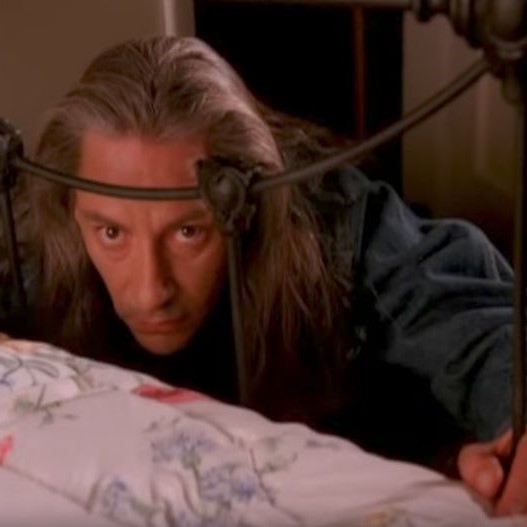
We were in a hotel room and she was in a box and she would not come out.
"He is Bob, eager for fun.
He wears a smile, everybody run."
(Twin Peaks)
Had the opportunity to attend a run-through of Scenes From a Night's Dream on Thursday night. The first act is a dream, and by that I mean it takes place inside a dream. There are so many entrances and exits, it's dizzying. But it's delightful. It's also horrifying.
My wife sent me to the basement to rub toothpaste on a couple of fuses. I went to the basement, the light was out, but I knew there was a fluorescent light on a cord down there, so I hurried down the stairs and found the light. I could just see the old fuse box, way across the room. I could see other things, too, and that scared me so I fled back up the stairs as fast as I could go.
The subject of my dreams has been a major part of my waking life, especially in the past couple of years. Is that true for others? Or is that incredibly self-indulgent? Musing on random imaginings which make sense only to me.
It was so big inside my parents’ house. Their bedroom was massive, with flocked wallpaper and Trompe-l'œil ceiling. But there was terrible mold and water damage. I offered that anyone who needed a place to stay the night might live there.
"Mama! Papa!"
(In the Night Kitchen)
In the past several years, between the death of my mother and the pandemic, these amorphous journeys have loomed large, featuring undocumentable trends which are difficult to trace.
With my brother and his wife in a crumbling old house. I was lecturing them about not setting the spider webs on fire.
During the lockdown, my subconscious was out there, in the world that I was visiting with much less frequency. For the past year or so, interiors have played a strong role in my dream space. And while they can be grandly spacious they are also worn and aged.
There was this rap act. They had a demo that they tried to re-record but it wasn’t as good so they made a video from the demo. For some reason, I held this particular act in contempt and used an app on my phone to change the lettering on the marquee to read “Comedians Rap Now.”
My parents stately home is often a location I return to. They may or may not be there, and the rooms are not actually the rooms as they were, but physical manifestations of the emotions those rooms represented. 
A large school many kids, flooding. High water. Lots of snacks. A beautiful schoolroom. So many kids.
Source: Cleveland Clinic Foundation
Returning to these neglected rooms, I lamented not having sold my parents' house when it was still in good order. I woke relieved because I had actually sold it. I once held a great sense of responsibility to keep the place, but that would not have made me happy. And so my dream actually reminded me that I had made a good decision, which is a useful thing for a dream to do.
Tooling down a street in my old neighborhood, noting homes that had been torn down we missed the turning and drove into the cemetery, which appeared from the opposite end to be a packed theater house.
The first act of Scenes From a Night's Dream tells a story where nothing is real but everything is true. James plays a menacing character (actually, he does that in both acts) and the other night he told me he'd unlocked the entire play in one line. I was shocked because he was absolutely correct, but I was unaware of it. You'll have to come see the show to figure out what that line is. 
Different rooms, different spaces. A big event. I was dressed as a mime, but I had to go around. Part of the performance included a shadow play in which a ballerina got stuck but was rescued by a fox with the voice of Prince.

Saturday, April 9, 2022

"Dog Act" at convergence-continuum

Denise Astorino in "Dog Act"
(convergence-continuum, 2022)
There is something about the apocalypse. I can’t watch the gruesome fantasy of a horror film, but there is something about certain tales of life post-civilization that I find thrilling, and in a way, comforting. Within any post-apocalyptic narrative is the supposition that humanity will endure. It may be painful, terrifying, and unspeakably difficult. But at least there is hope.

This week we were assigned Learning To Die in the Anthropocene (Reflections on the End of Civilization) by Roy Scranton. This book about the calamitous effects of global climate change offers no hope at all, at least not for humanity. That it is a rumination on the possibility of acceptance, that is the best it can offer.

Last night, my son and I went to see Dog Act by Liz Duffy Adams and directed by David L. Munnell at convergence-continuum. It’s about a small cohort of survivors in a future when the seasons can abruptly change from winter to summer in a snap. Our protagonists are a charming duo of scavenging vaudevillians who can sing and act, and speak in a rapid-fire patois of contemporary turns of phrases which have mutated far beyond their original meaning.

One of the more enjoyable aspects of this production is that the players (within the play) are actually talented, and that their brief performances (with the larger performance) are entertaining, amusing, and even affecting. Evidence of the lasting value and significance of live performance.

"Mister Burns, A Post-Electric Play"
(Cleveland Public Theatre, 2016)
This was bizarrely not the case in the HBO miniseries adaptation of Emily St. John Mandel’s novel Station Eleven. I am a fan of the book, and I really enjoyed the program (especially Himesh Patel as Jeevan Chaudhary, whose character is radically changed from the book into the character with the most affecting character arc) but I was dumbfounded by the actual performances of Shakespeare, which were unfortunately soporific.

Six years ago, Cleveland Public Theatre produced Mr. Burns, A Post-Electric Play by Anne Washburn and Michael Friedman, which is something of a lightning rod among my friends, several of whom do not like that play at all. I thought it was pretty incredible, the absurd conceit of the enduring mythos of certain animated television programs and the power of human storytelling, as folks produce stage adaptations of The Simpsons in a lawless and violent wasteland.

This year has been quite the existential hoot so far, viewing a stage production of Last Ship to Proxima Centauri (more on that), and reading Voices from Chernobyl by Svetlana Alexievich for class at the same time Russian troops have been using this most radioactive place on earth as a staging area for the invasion of nearby Kyiv, Ukraine, digging up radioactive material and presumably carrying it with them in their bones.

Sunday, February 13, 2022

The Ocean Breathes Salty (In Performance)

Hannah Woodside & Adam Harry
Writing has always been my superpower. First, I harnessed it as a tool against my enemies. I thought that was okay. I was wrong. When I learned how to use it as a force for good, things came into focus. I could tap into my mind, my heart and my soul, and I started to understand what I was meant to write about.

What is writing as a tool for good? Having an agenda, knowing what your agenda is, and that it is true. That it harms none. You put people you love onstage. You learn something.

Anything you might have to say to someone you love which might be harmful? Say those things in person. Or decide that it is not important. Know that about yourself, at least.

This was the first weekend for the 2022 NEOMFA Playwrights Festival, which featured two ten-minute plays – mine (The Ocean Breathes Salty) and one by Eric Mansfield – and a one-hour work by Gabby DiDonato.

Mine was the weird one. Mine is always the weird one. The others were clean in their narrative, mine was abstract. My wife approved but even she suggested it may be a bit underwritten. I was pleased with the results. 

Emmett Podgorski & Clare Scott
It was an experiment, I would normally have chosen to do one, single scene, instead opting for five short scenes which allowed characters to bounce off of each other in twos and threes. Perhaps more suitable for a full-length, but who knows. One of my professors commented that they liked the short scenes, these vignettes. I like them, too.

I saw the performances on Friday and Saturday night. There was a post-show talkback on Friday which, for my play focused entirely on the bunny. There’s a bunny in the play. What was the significance of the bunny? That was pretty much the entire discussion. There were also four human actors in the play who played characters with emotions and lives and things, but everyone was confused about the presence of the bunny.

I think my brother put it best when he said, “Sometimes a rabbit is just a rabbit.”

Thing is, there were several audience members who spoke to me, during intermission, after the show. They wanted to know what happened in the play, because they were unsure. I asked them what they thought happened, and each of them, somewhat hesitantly, told me what they thought had happened. And each of them were absolutely correct. They did understand the play. It just wasn't made obvious.

This week we're reading Sheila Callaghan, and I am digging the way she plays with reality. I need to decide what story I want to tell this semester, and this experience with The Ocean Breathes Salty has inspired me to move further in this direction. Playing with reality might be my new superpower. 

Many thanks to KR Jones, Adam Harry, Emmett Podgorski, Clare Scott and Hannah Woodside, who did beautiful work on my short play! 

Saturday, January 15, 2022

"The Ocean Breathes Salty" at the 2022 NEOMFA Playwrights Festival

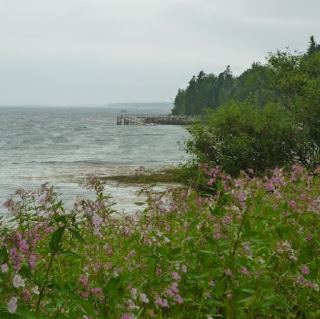
Hatchet Cove, Friendship, ME
The Ocean Breathes Salty
was originally a writing exercise for a class, but I was happy enough with the result to submit that for my entry into the 2022 NEOMFA Playwrights Festival.

I was unable to attend the first read-through on Wednesday, and so attended the second rehearsal on Thursday. The company inquired about backstory. I asked if they had any ideas about that themselves and they, the four-person cast, director and stage manager, said they had plenty, ideas that had come up the night before in my absence.

This was fine with me, more than fine. Any “backstory” I was to provide at that moment would have been stuff I was making up off the top of my head. I asked them to tell me what they had thought of, and objected to little, if anything. They had read the script, and were inspired by what was there to create more or less psychologically correct histories.

In his book True and False: Heresy and Common Sense for the Actor, playwright David Mamet opines that “backstory” is pointless bullshit, that there are only words on a page. Play the words and the play either works or it doesn’t, bringing your own ideas to the work is irrelevant. That is one very simple way to look at it.

Human beings think backward and forward in time and space, and just as the words I say (or write) are informed in the moment by what have experienced and what I expect, so, too, an actor wants to know what they have experienced and what they expect in order to speak a line or perform an act. It is, as they say, in our nature.

And this is a ten-minute play. How to interpret a line, any line, requires a little imagination. You could just speak the words on the page but it might not be very interesting. Like, you know, any of Mamet’s recent work.

The original title of this short play was brief and alliterative, but I didn’t feel it captured the “gothic romance” which I believe best describes the story. For this first production, I changed it to the title of a song by Modest Mouse, the lyrics of which are a direct address to one beloved who has died.

It wasn’t even a song I had been familiar with, I just Googled songs about death, and this one resonated with me, the mood and also the title, as this play takes place in a town on the coast of Maine. It's a bit of a mystery (as which of my plays are not) or as I have called it, a gothic romance. Director Kelsey Jones promises to make it weird, and I am here for it.

Friday, July 2, 2010

Spirochete


SPIROCHETE
A History
By Arnold Sundgaard


Two years ago the GLTF Outreach Tour was Seeing Red, written by Daniel Hahn, which included verbatim transcripts of HUAC testimony. The Festival was producing The Crucible that season, and so we created an original work that provided a context for Miller’s work.

It was through performing in that show that I began my education in the Federal Theatre Project, Hallie Flanagan and all the rest. Ms. Flanagan petitioned to testify before the Dies Committee/House Committee on Un-American Activities to defend the important work that was provided to unemployed artists through the program.

By 1938 the Project was under attack for giving voice to socialist and communist sentiments … or at the very least, making capitalism look bad.

Several FTP plays were mentioned in our production, including Injunction Granted! (which Ms. Flanagan defended, even though she was not happy with the production - a text I am hoping to get my hands on) and Spirochete.

In my role as Texas Representative Martin Dies, I ask about this play (pronounced spy-rho-KEET) and when Ms. Flanagan (performed so magnificently by Elizabeth Wood) explains that it is an educational device about venereal disease, Rep. Dies blanches and changes the subject.

I have now, finally, read Spirochete. And I was surprised by two things:
1. It is educational but also very interesting.
2. It is hilarious!
And when I say it is hilarious, I do not mean in that ironic, unintentional way. A good deal of it deals with the subject of syphilis with great, successful humor.

I do have two complaints. On is that the first act, a history of how Europeans contracted the disease from the native peoples of North America (okay, I am going to let that slide for the time being, that’s not the complaint) and leading up to the 20th century, which is broad, amusing, fast-paced, great fun. The second act, however, is about the journey to isolate and diagnose the virus, cure it and then de-stigmatize it in order to legislate testing to prevent it -- all worthy endeavors, but not handled with the same light hand.

The second disappointment is that the play does not come back to where it begins, with a young couple surprised and shocked that they must subject themselves to a blood-test before getting married. Trying to calm their nerves - and their offended sensibilities - is why we begin this journey, but we do not come back to them so it is never resolved.

Though this would never have made the cut in 1938 )when it was first produced) I would have loved to find out that one of them actually had it, if only because each are so offended by the very suggestion that they might.

Regardless. I could easily see this work directed by Raymond Bobgan at CPT or Clyde Simon at convergence-continuum, the non-linear narrative and moments of surrealism (not to mention a sad, recurring character called “The Patient” who suffers from the disease for over four hundred years) begs for either of these artists to raise this text to even greater levels of fantastic surprise and wonder.