Showing posts with label The Secret Adversary. Show all posts

Saturday, March 25, 2023

The Wild Party (book)

Queenie in "The Wild Party" 
(Art Spiegelman)
In February 1995, I traveled to New York City by train to visit my girlfriend.

My wife and I had separated, half of the furniture in the house we had purchased a little over year before was gone with her, and I had recently been diagnosed with a hernia for which I would receive surgery the following month. I was serving pizzas in an Uno’s in Lyndhurst, I had no theatrical prospects at all. I was twenty-six.

The train was comfortable, and warm, unless I leaned close to the window, which was frosted. The northeast was in a cold snap, NYC that week would be the coldest I have ever experienced. Still on the train, I opened my new laptop (with the last of the black and white screens) and began to write a play about vampires.

My girlfriend worked at the Shakespeare & Company at 81st and Broadway, the one featured in When Harry Met Sally (“Someone is staring at you in Personal Growth”) and while she was on I browsed and read and even bought, or walked around the corner to Café Lalo to sit and sip and write.

One book I picked up at that time was a recently released hardcover edition of the poem The Wild Party by Joseph Moncure March, and illustrated by Art Spiegelman (Maus). I’m not sure what caught my eye about it. Maybe it was Spiegelman. Maybe it was the claim that the poem was “lost”. Maybe it was the 20s. Maybe it was my 20s.

At that time I had only a passing interest in the 1920s, though it was piqued that week as we saw the Alan Rudolph film Mrs. Parker and the Vicious Circle at some little theater in the East Fifties which surely doesn’t exist any more. At that time I was into generational theory and turned onto the idea that the Lost Generation and that generation we call “X” had much in common. Aimless, rootless, artistic, unbound, nihilistic, you know … “whatever.”

Mrs. Parker & the Vicious Circle
As Spiegelman points out in his introduction, the Lost Generation “swilled gin” while ours “gulps Prozac.” Of course, the Lost Generation also experienced the horrors of World War One while ours had to, what? Make our own dinner? Learn about adult relationships from The Piña Colada Song?

Mrs. Parker is a biopic, starring the incomparable Jennifer Jason Leigh, and it was easy to overlook her personal disappointments and misery when she and Robert Benchley (Campbell Scott) were writing away at facing typewriters, creating threadbare stage performances, or trading witticisms in the Algonquin. 

We could do all of this, though standing in the smoldering remains of Guerrilla Theater Co. I no longer knew who “we” were. 

The Wild Party is told in rhyming, irregular couplets, March’s meter is what makes the piece sing, the timing of the rhymes is irreverent, in places obscene, always funny, and very funny. And the subject is so sordid! A showgirl named Queenie and a clown with a violent temper named Burrs decide to throw a wild party, and that’s really it.

There is drink, there is dance. There is an orgy. A teenager is assaulted, and the fighting begins. Burrs discovers Queenie having sex with another man, things go tragic. Then the cops arrive, the end.

Spiegelman doesn’t get in the way of the narrative, just promotes it with his graphic imagery. It has a hard-boiled quality, like Chester Gould’s Dick Tracy. Handsome guys have square jaws, Burrs is long and narrow like a villain. I do question why there is so much female nudity, but only female nudity.

The Secret Adversary
(A Tommy & Tuppence Adventure)
The 1920s were transgressive, folks were pushing back against their hopelessness with wildness and pleasure. The 90s were hardly hard times for us, but I certainly felt a little lost. 

I began casting about everywhere for inspiration, though it wasn’t until my two Agatha Christie adaptations, nearly twenty years later, that I took the opportunity to focus on the 20s. Tommy and Tuppence, however, are far too sweet and hopeful, especially as compared to the jaded Queenie and Burrs. 

In 1995, I channeled my nihilistic tendencies into the contemporary milieu of a vampire-themed coffee bar.

Thursday, July 18, 2019

Cat and the Canary (film)

I have adapted Agatha Christie mysteries for the stage, The Mysterious Affair at Styles and The Secret Adversary. However, it was my older brother Henrik who was mystery-obsessive. It was he who introduced me to Hercule Poirot, Nero Wolfe, Ellery Queen, and he was quite an expert on Sherlock Holmes.

I say he “introduced” me because though throughout my childhood these tales were in the atmosphere, I didn’t take an interest. I wasn’t into puzzles and plotting, and to be honest, mysteries scared me. Someone’s dead -- and we don’t know why or how it happened? The unknown is horrifying to me.

I understand that it is the solution to mysteries than many find so reassuring, they bring order to chaos, and suggest that every problem has an answer, that all loose ends will eventually be tied. These people are also probably have religion for the same reason.

I always flash back to that moment when the victim is dying, perhaps violently, shocked, and afraid and alone. The tragedy itself is not made softer by there existing an explanation. Perhaps I am an atheist for the same reason.

My brother took me to this film once -- twice, actually. He would have been fourteen, I was only ten. We went twice on two different days, probably over a weekend. Maybe we took the bus, maybe my parents dropped us at the mall, can’t remember, I was ten. The film was Cat and the Canary, a stylish, period remake of a film made famous as a Bob Hope picture in the 30s. This 1978 version was considerably more bloody. Grisly. It was the seventies.

Cat and the Canary is one of those "bumped-off-one-at-a-time" mysteries in which the house itself is the murder weapon. I was fascinated by the twists and turns, the disappearances, the horrible, clever ways people were separated from each other, and then craftily dispatched. I was also horrified. I was unable to sleep. I was terrified someone would come through my window or stab me through the bed.

My brother was scolded for taking me to see it, to see it twice. I protested that I had asked him to take me to see it again, and so attention was turned to me. I was made to feel foolish. “If it scared you so, why would you want to see it again?”

I carried this with me as I became an adolescent and we moved into the era of the slasher film -- and cable TV. From Michael Myers to Jason Voorhees to Freddy Kruger, I abstained. I just didn’t watch them.

Now, slasher movies aren’t necessarily mysteries, but mysteries can be slasher films (see: Psycho) and I have watched each, but it is the moments of isolation and despair which frighten me the most. The Vanishing comes to mind. Never seen it, know how it ends, that’s enough to keep me awake at night.

So when it came time to adapt a Sherlock Holmes mystery into a play for children, there was more than one reason to avoid plots featuring violent crimes -- or any violence at all. When we produced Jabberwocky three years ago, there is a scene where a child confronts a bully the wrong way, by hitting back. With a stick.

It was meant to be an example of making a bad choice. And yet, talkback after talkback, this was the kids’ favorite part. It was what they best remembered, it elicited the most joyful reaction. They loved seeing that one kids hit the other kids with a stick -- and they hadn’t even seen it! The beating took place off stage, with one child character chasing the other behind a curtain and then hearing the bully cry out in pain.

Now, many of Doyle’s mysteries are murder mysteries, so it couldn’t be any of those. There are a few thefts in his tales, but none presented situations that interested me -- or more importantly, supporting characters that would interest children.

The education department brainstorm non-violent crimes, which included theft, extortion, vandalism, fraud, embezzlement, forgery, pickpocketing, arson, the receipt of stolen goods, and counterfeiting.

For the past several months, these ideas have been simmering, and I have been making notes, and reading story after story, and stringing together original ideas for a brand new mystery of my own.

Because there was one very important element lacking in all of Sherlock Holmes’ adventures, and it was that which would not only set this story apart, but satisfying a great many details of the upcoming outreach tour.

Strong female characters.

To be continued.

Sunday, January 28, 2018

Here Are The High School Plays!

10 Ways to Survive the Zombie Apocalypse
(Zelda, left)
Several years ago, playwright and teacher Stephen Gregg, in his blog Playwright Now, put forth an argument that high school drama departments should stop producing hoary chestnuts of yesteryear.

Last year, as in most years of the late twentieth century, the top ten most produced plays in American high schools were crowded with scripts written at least a half-century old (or much older) including You Can’t Take It With You, Twelve Angry Men/Jurors, Our Town and The Crucible.

Add to that works of Shakespeare like A Midsummer Night’s Dream and Macbeth (which are at least on the curriculum) A Christmas Carol and Alice In Wonderland, and you only have room for two plays written in the past generation; Almost, Maine and Peter and the Starcatcher … that last an adaptation of Peter Pan.

Gregg’s point is not to put down the works of the past, or to place some kind of moratorium on Shakespeare (as some have suggested) or the works of Kaufman and Hart. One of the most basic disconnects between today’s professional stage and its high school equivalent is that economics have driven playwrights to create plays with small companies, where your average coach needs to cast as many kids as possible.

There is an opportunity here, for aspiring writers to create new works, geared towards the needs of your average troupe of teenage thespians.

My eldest is a high school freshman, and though I have roped them into performing a few ten-minute plays at Pandemonium, they have only this weekend performed in their first complete play -- a performance of 10 Ways to Survive the Zombie Apocalypse by Don Zolidis. This one-act play (it clocks in at about thirty minutes) is one of the most-produced short plays in America.

In fact, if you peruse the list of popular short plays, there is a much wider variety of contemporary work (including This Is a Test by none other than Stephen Gregg) several of which satisfy one of the needs described by Gregg, that works for high school stages should have many characters, and that these characters should be largely teenagers.

But that last point, however, leaves me unsatisfied. While it is true that classic plays can seem dated (obvs, how can it be classic if it ain't old) and designed to keep the manufacturers of spray-on gray hair color in business, the act of playing is the art of being someone else. And producing period work, if executed properly, can be an education in history, class, race, and much more.

Runaways (Bay High School, 1984)
We did a contemporary play when I was a junior in high school, Runaways by Jay Christopher (not the musical by Elizabeth Swados) about a shelter to keep kids off the street. But I was relieved to be cast as director of the shelter, and not as one of the teenagers. I already was a teenager. I wanted to be someone else.

So, why not have both? My recently published adaptation of Agatha Christie’s The Secret Adversary features two plucky protagonists barely in their twenties, and a variety of colorful characters who are not necessarily any specific age. It’s a large-cast show with thrills, comedy and romance. Also, you get to learn about the aftermath of World War One and the sinking of the Lusitania. Wins all around!

I agree, it is bizarre that one play in particular, You Can’t Take It With You, has remained on the most-produced list pretty much since the rights were made available. This, in spite of an increasingly long list of references which have faded from collective awareness and, of course, the problem with Donald and Rheba.

Heck, that was the first play I ever performed in, when I, too, was a high school freshman. And I have had colleagues speculate that certain plays and musicals remain in rotation is precisely because high drama directors did those shows when they were in school.

My recommendation would be equal parts of each; that drama directors should dig deeper into the classical repertoire, and produce and promote new work by contemporary playwrights.

Speaking of which, The Secret Adversary is available from YouthPLAYS.

Sources:
"Where Are The High School Plays?" by Stephen Gregg, Playwright Now (5/24/2015)
"The Most Popular High School Plays and Musicals" by Elissa Nadworny, NPR (9/15/2017)
"We Should Ban Shakespeare From The Stage For Five Years To Foster New Plays" by Lachlan Philpott, The Sydney Morning Herald (5/2/2016)
"Top 10 Most-Produced High School Plays and Musicals of 2016–2017 Revealed" by Adam Hetrick, Playbill.com (9/15/2017)

Tuesday, December 26, 2017

Twenty-Eighteen

Boxing Day, a day to assess, to look, forward, to make plans, to try and figure out where it’s all going.

I need to return to the regular habit of writing by hand every morning for thirty minutes. I used to think I need to create blocks of time -- hours, say, on a Saturday, to accomplish the writing. This is not practical, however, and was only rarely successful.

When I began writing longhand a little bit, every single day, the work mounted up. It was a highly productive time. But it takes discipline, and sleep, and each have been lacking the past two calendar years.

I have always written but since I began writing in earnest -- ten years ago -- the productions have begun, the publications followed, and the opportunity to engage and collaborate with numerous companies in town.

In the past year I had my third publication (The Secret Adversary at YouthPLAYS) revamped by website (Thank you, Dreamhost Remixer) and created work presented at the Maltz Museum of Jewish Heritage and Talespinner Children’s Theatre.

There are only a few things in the coming year that I am able to report, though I am in negotiation to revive previously produced works, and have made a few proposals for the coming season.

Chennelle Bryant-Harris and I are co-writing a new play, The Lost Diary, inspired by a notorious piece of white supremacist fiction. A fragment of this new work will be workshopped as part of Entry Point at Cleveland Public Theatre, January 18 - 20.

Also, this coming month, the Chattanooga Theatre Centre will present a three-week run of my adaptation of The Mysterious Affair at Styles, January 26 - February 11.

In addition to new writing (and there exists new writing) one thing I have wanted to do is return to old writing. It is not necessary, of course, to bring every old idea to some kind of fruition, you could go mad doing that.

But there are certain pieces which went through considerable revision and even successful workshops which were abandoned for other projects. These Are The Times was one of these, and I was very happy to return to that this past summer. There are one or two of those abandoned piece to which I would like to return.

Best wishes to you in all your endeavors in the coming year.

Tuesday, August 2, 2016

How Did I Get Here? (book)

Same as it ever was.
The past several years my time on vacation has been somewhat compromised by writing or business related to writing. Last year I was researching the years just after the Great War and writing The Secret Adversary. The year before that I was constructing The Great Globe Itself, and in 2013 spent an inordinate amount of time online promoting Double Heart for the NY Fringe.

Granted, there are fewer places I would rather be writing than sitting on the porch of Barnstable, doing my thinking while peering through the triple birch tree and into the cove beyond. But tethered as I was to my books, notepads and (ugh) the internet, I strained my own credulity in denying or deferring offers to walk in the woods, swim in the sea or take the motor out to trawl for mackerel.

Each of these writing responsibilities were for my job, commissions for the outreach tour, so even as they fed my creative desires they were constrained by deadlines and the need to follow strict parameters. Don’t get me wrong, strict parameters are to me rich compost, but it goes without saying that when I am writing A, I am not writing B, and the opportunities to stretch and explore are hampered.

Not so this summer, having just come off an additional outreach mini-tour -- Twelfth Night (As Told By Malvolio) -- and all the business surrounding the RNC, the plan was to read what I chose to read and to participate in whatever it is anyone else suggested I do. And I have! We have gone on kayak tours, watched fireworks from a lobster boat in the harbor, taken several brief fishing trips, gone on seal spotting expeditions and hiked up the side of a mountain.

And I have been reading How Did I Get Here? (Making Peace With The Road Not Taken) a memoir by novelist Jesse Browner. Inspired by his own feelings of middle-age remorse, the author decided to write this book upon turning the age of fifty in an effort to explain and justify his own feelings of inadequacy.

Put more specifically, as an author in the middle of his life, Browner is filled with deep regret for not being the person he believes he had the potential to be, a feeling which is familiar to untold creative peoples, including this one. The decisions we have made have added up to the people we have become, and if we are not entirely satisfied with who we are we must have made a mistake somewhere, perhaps many mistakes, decisions which, had they gone differently, would have led to our becoming the best of ourselves.

Last Tuesday was my forty-eighth birthday. I have two years to correct every single mistake I have ever made. Just kidding, that is not the point of this book. It is also not merely to come to terms with settling. It also doesn’t simply encourage happiness for its own sake.

Employing a number of examples of brilliant artists who were utterly miserable (most famously writer Franz Kafka and musician Elliott Smith) the author paints a picture of the life as a whole, illustrating not only how genius or talent or work does not necessarily add up to happiness, but that it is the unavoidable fact of not knowing keeps a human from being able to appreciate what is more than what might have been.

When I examine the facts of my own life (I do that a lot, you know) I can become bogged down by missed opportunities, opportunities which were passed upon because I am lazy or fearful or because I thought I was making the right decision but later regretted, decisions made in my own self interest (which are selfish) or in someone else’s interest (which are never duly appreciated) or for one of several other reasons.

I can also become obsessed and resentful for my upbringing, and for never having been adequately instructed or trained, merely told to stop making noise and get on with it, my act of seeking being treated as pestering until I no longer wished to bother anyone for guidance and assistance.

I think we're all bozos on this bus.
Taken together, the most satisfying conclusion I can make is that though I am not as great as I could be, I am most certainly greater than I should be.
“We want what we already have but fail to recognize it as the thing we want.” - Browner, p. 212
The book’s subtitle is a reference to that road not taken from Frost’s poem, a metaphor which he argues is not, as many believe, a paean to regret. If only I had ... whatever.

However, I long ago I realized (decided?) that my life was neatly cleaved between that which occurred prior to March 19, 2001 and everything had has happened after. The death of our first expected child was something happened to me, not an action I chose. However, it was a cause which had a profound effect, a life-altering effect.

The fifteen years since have been an ongoing, chaotic tumble as to what happens next, but there is no question that this road is utterly other than the one I was headed towards, and what I have chosen to do with it has led me to be much more accepting of life in general.

However, prior to that moment I would have said some other point was the dividing line in my life’s history. Marrying my wife, divorcing my ex-wife, starting Guerrilla, leaving L.A., changing my major, taking Accutane, and on and on and on.

This is my beautiful wife.
But it won’t be tomorrow, and it won’t be the day after that. The man says, “You’re fifty-two [or forty-eight] years-old. Do you think anything could help you change at this point?” (p. 164) but that’s not the point of his book. It is rather to see and accept all that is around you as the world that you made, and to continue to choose to make it work in the way that you do.

When I was approaching the age of forty, I had what I thought was my mid-life crisis, which manifest itself somewhat successfully in my solo performance And Then You Die (How I Ran a Marathon in 26.2 Years). However, it is a work I have often thought of coming back to, and with my recent happiness in revisiting I Hate This perhaps I will soon create the time to do so.

The play is only superficially about running, though there is an awful lot of that. It is as Browner states so directly in his book, my piece is also about choosing to "kill off your obsolete, petrified self-image, and fully embrace the happiness that is your due." (p. 260)

Saturday, April 9, 2016

I Hate This: Fifteen Years On

Don't you think I'm looking older?
As the new year began, I was struck by all the unique milestones, personal and public, that lay in our way in 2016. My daughter was to become a teenager. Shakespeare’s First Folio would be visiting Cleveland (and all those Republicans.) We would elect a new president.

I was also aware that our first child, stillborn in 2001, would turn fifteen. On the tenth anniversary of the events described in my solo performance, I Hate This, that play and a companion piece were produced at Cleveland Public Theatre. It was rewarding to expand upon the play in that way, and have the opportunity to widen the scope of what stories I could tell in a single evening.

For this birthday, however, I wanted to reconnect with I Hate This on its own. But how best to proceed? I considered intimate, private performances, maybe even hosted in my own house, or someone else’s house. Maybe a string of them, a series of appearances for an audience of ten at a time. Perhaps one day I will still attempt that.

I was actually about the abandon the idea. We were putting together The Secret Adversary tour, and soon I would need to begin rehearsals for a forty-minute abridgment of Twelfth Night we will be presenting as part of the First Folio proceedings. It just wasn’t the right time, you know? You can always tell yourself it isn’t the right time.

Then two things happened. First, my father died, and life itself took on a startling new dimension for me. Preparing a memorial service, physical contact with a deceased and beloved family member, making decisions you never imagined you would be called upon to make ... so much that had been buried into the past returned to the surface.

And shortly following that, I was accepted into the Last Frontier Theatre Conference, which I greatly wished to attend, but scarcely had the money to pay for. It made perfect sense to accomplish two goals at once, raise funds in exchange for which I would offer an entirely relevant premium -- my work. I would remount this play, with purposeful intent.

We have put together a production team, with Josh Brown adapting the multimedia he created for the CPT production (2011) and we will be including Dennis Yurich’s original score from 2003, which is now appropriately period.

Most significantly, I have asked Chennelle Bryant-Harris to re-stage the work. She has worked three seasons as an actor-teacher in the residency program, and we collaborated as co-directors for the Love In Pieces project two years ago. She is a talented, young director who will bring a fresh perspective to the work. Significantly, I suggest, for at least one important reason - unlike my previous collaborators, she wasn’t there. She did not know me then. Her experience is based entirely by what I set on the page, and so my words have to do much more work.

During the past two years I have watched with fascination as two other men have taken on the role, John Dayton and Brian Cook. Their interpretations gave me an opportunity to think of the text in new ways, have liberated me from thinking there was one way to perform this show. It’s my show, to be sure, but I was locked into a delivery, a certain cadence and choreography, which was established almost from the first reading in August, 2002.

When I polled friends on Facebook as to whether anyone would care to see either this play or And Then You Die (How I Ran a Marathon in 26.2 Years) again, Brian P. commented, “I'd be more interested to see how time and the vicissitudes of life has affected your approach to (I Hate This).”

So would I, Brian. So would I.

Click here to visit my GoFundMe page and make a donation and reserve your seat to see "I Hate This" on May 7!

Sunday, March 6, 2016

The Secret Adversary: In Review

Cleveland Sight Center

Yes, it has been over a month since my last entry. These things happen. However, for years I have posted updates about the outreach tour and how it is progressing. Unfortunately, I attended only two performances of this year’s play, my adaptation of Agatha Christie’s The Secret Adversary, before the sudden death of my father.

Family business and my own sense of disorientation and mourning kept me from the show for a week. Lisa and I were going to host and moderate the performances equally, and thankfully she was able to take all of them instead, in my absence.

Lakewood Public Library
As it happened, the afternoon performance at the Cleveland Sight Center occurred just when each of my brothers were in town, and the day before my father’s memorial service. We all attended together. My brothers have never before been in the audience together, and with me, for something I have written.

Not surprisingly, The Secret Adversary has been very well attended. The name “Agatha Christie” remains popular. Christie’s works are the third best-selling in the world after the Bible and Shakespeare.

We had to turn numerous people away at Clague Playhouse when all seats were taken, though a dozen or so stayed to watch the large video screen in the lobby that showed the performance. It was standing room only in Lakewood, but no one was required to leave.

Those turned away are no doubt disappointed, and post-show evaluations give certain audience members the opportunity to complain about crowded conditions or having to sit in the back. (Did I mention it’s free?) However, the overwhelming reaction to the production is very high.
"Your actors are amazing! Possibly better than what I've seen on touring Broadway casts."
- Student, Elyria Catholic High School

"The script was outstanding - this was a great adaptation!"
- Kendal at Oberlin audience member

“I really, really, really loved this play. I very much enjoyed the actors and actresses, the theme, the dialogue, and the ending scene was just beautiful.”
- Student, Hudson Middle School
Friday afternoon we performed in the new Cleveland School of the Arts building, in their “Black Box” space. Over 150 students in attendance, and they were wonderful, leaning forward, hanging on every word, getting every jokes, gasping at each revelation. After the show, their questions were all processed-based, about character, accents, physicality, even about the writing, adapting a novel into a play.

There will be a performance this afternoon in Cleveland Heights, which is home base for me. There are only three more public performances before we close, in Oberlin, Akron and Lorain.

The Secret Adversary opened on February 16, my mother's birthday. She and my father were in attendance, he was always a great reader and very fond of mystery novels and he provided and suggested numerous books that I used for research. And basically made me a person who would want to adapt a novel by Agatha Christie into a play. He enjoyed the show.

Tuesday, February 2, 2016

The Secret Adversary: Dialect & Slang

Ray with dialect coach Chuck Richie
This evening's rehearsal was for dialect. The Secret Adversary is an international thriller, so there are numerous dialects. Not only Standard British, but various working class English accents, Scottish and Irish. There are Russians and Germans, and one very modern young American.

Of course, when I say modern, I mean modern in the 1920s. The story takes place before the Jazz Age really got swinging (and it did swing on both sides of the pond) in that moment referred to once as the "Great Silence." However, we will be taking some liberties there, too.

Agatha Christie was keen to introduce some exciting, fun characters into her second novel. She felt that her first book, The Mysterious Affair at Styles, was peopled with a number of unpleasant individuals - not least of whom  was Hercule Poirot, one she personally always despised.

Adapting the work into this script I had great fun including many of the colorful turns of phrase she put into the mouths of her young adventurers. She went even further with the American, Mr. Julius Hersheimmer. Almost every line of his includes some bit of period slang.

However, over the course of the novel she did use many terms more than once, and while idiom doesn't become established without repetition, and that repetition can often be humorous in itself (see: the rule of three) I found a couple words and phrases were overdone and took great joy in finding authentic replacements.

Here are just a few examples of 1920s slang we will be including:

Bully for you! - good for you!
Put me wise - tell me the whole story
Put me on the trolley - see: put me wise
Jake - all right (e.g., "everything's jake!")
Turned up your toes - died
Kale - money
Swell - n. fellow with a lot of kale
Chunk of lead - an unattractive woman of a certain age
Brick - a reliable man (see also: duck)
Gold-digger - a woman who does not choose to associate with any broke fellows
We take a lot of killing. - we are unstoppable

The Secret Adversary opens February 16 at Talespnner Children's Theatre.

Friday, January 15, 2016

The Secret Adversary: Adaptation

I am trying to write an essay on adaptation. Perhaps you have heard this apocryphal story, attributed to Michelangelo.

The apprentice asked how the master was able to take a formless marble slab and transform it into something as soul-touchingly beautiful as David.

Michelangelo took a drag on his cigarette and said, "Chip away anything that doesn't look like David."

With The Secret Adversary I have had a second opportunity to tell the story of an entire novel with one set and five actors. Writing the script I tried not to concern myself with the set - at all - but I did need to think about the players, and how many would be able to appear on stage at the same time.

Surprisingly, this book was much more challenging that The Mysterious Affair at Styles, in spite of the fact that I had limited two of my actors (myself and James) to play one character each, James as the narrator Hastings, who barely leaves the stage, and myself as Poirot. One actor played the other three other male characters.

left to right: Ray Caspio as Boris Stepanov, Brittni Shambaugh as Rita Vandermeyer, James Rankin as Mister Carter
Design by Esther Haberlen

But Adversary just has so many characters, it was challenging to narrow it down. Putting the pieces together, I tried not to think very much about how fast the actors would need to change behind the set. In fact, I was so negligent that up until today I still had a scene in which Ray would enter with a gun in Ray's ribs.

The thing about Styles is that if there are too few characters, there are too few suspects. I like to think I struck a decent balance there, and was able to maintain Christie's mystery until the last few moments.

Adversary isn't really a mystery, though there is a major reveal, though for most of the tale it is pretty obvious that if "Mister Brown" exists, he is one, the other (or both?) of two characters. The story is an international thriller, with the protagonists getting into and out of scrapes, flying entirely by their wits.

I had to chip away anything that wasn't a one-hour play, but not too much that it was no longer The Secret Adversary.

Thankfully, we once again have the great joy of working with Esther, who not only has a great love of the period (England "between the wars") but also a tremendous talent at creating fabulous looks actors can slip in and out of with great speed.

British Intelligence, Member of Parliament, ageing socialite, American millionaire, Russian royalty, German Bolshevik, Cockney thug ... and that's maybe half of them.

Rehearsals begin in ten days.

Monday, December 28, 2015

Twenty-Sixteen

My hopes for the new year are for everyone else. My son will transition to middle school, my daughter to the rarefied arena of eighth grade. My wife is writing a new play for production. I would prefer the Presidential election not become much worse, but there is little hope for that. Civil unrest continues to rise, agents of death conspire to foment hate and oppression here and abroad.

In our small corner of the world we continue to make things bright, to love our neighbors, all of them, and to do that thing we do - create art. It is not on a grand scale. It’s the small stuff that makes every day worth living.

This time last year I was aware of two productions. As of today, I am aware of two productions. This winter the outreach tour will be my adaptation of Agatha Christie’s The Secret Adversary, and this summer my adaptation of Twelfth Night (as told by Malvolio) will be presented in association with the arrival of Shakespeare’s First Folio in Cleveland.


However, at this time last year I was unaware that there would be a new production of I Hate This which would make me consider at the piece in a fresh light. Surprises are welcome, too. The moment has passed in which I feel the urge to press things too hard, to force an action. It has hardly been effective for me, anyhow.

Current events are horrifying, and dispiriting. Yet I am not in that place to comment upon them. My musings are much more philosophical (or cast in a negative light, merely wistful) but these questions must also be asked. We are all complicit. We are all connected. For now, I will keep my focus tight.

Best wishes for a good new year.

MORNING UPDATE: Two nights ago I had a dream that my new play was selected to receive a staged reading at a festival curated by Lin-Manuel Miranda but when the reading of my play began they were actually performing "Hamilton."

Last night I dreamed that another new play I had written - a different play, a play that does not yet exist - was receiving a staged reading at a local playhouse. And nothing went wrong! It was a successful reading in a successful dream.

Two dreams about new works, and they are both about readings, not productions. What does this mean? How will this fadge?

Wednesday, November 25, 2015

The Secret Adversary: Photo Shoot

Tommy & Tuppence in Playhouse Square

Creating The Secret Adversary tour image created a special challenge. Great Lakes Theater Marketing Director Todd K., and I wanted to create a sense of motion, the impression of urgency. Our young detectives are working against the clock to stop an international criminal mastermind.


First, of course, we needed some charming young detectives, and found them in the persons of Devon Turchan and Deborah Cluts. Shortly after being cast they met with production costume designer Esther Haberlen, who created these c. 1920 looks expressly for the promotional shoot. She will be designing different looks for the tour.

Having decided upon an action shot, we needed to figure out where they were rushing to, and why. It had to be intriguing without any necessary knowledge of the story or characters involved.


A few guide images we shared were those of intrepid journalist Tintin and of course, the Doctor, (who has somehow been referenced somewhere in the past four outreach tours) both of whom have awesome coats.

We met with the design team at TRG Reality and threw ideas around. It was decided that to suggest action, our protagonists had to be on their way from somewhere to somewhere else. So the background could not be abstract, but we also wanted to avoid anything very complicated. Something that could be happening in the story, not some detail-laden plot point, but more exciting than, say, a city street or sidewalk.


At the start of the story they met at the top of the stairs at a stop on the London Underground. One afternoon, Todd and I skulked each of the Playhouse Square theatres (built in the early 1920s) in search of stairwells which could stand in for "the tube."

These stairs lead to the original balcony of the Allen Theatre, just off the grand rotunda. As they are no longer useful for accessing the theatre balcony (the Allen has been foreshortened by the Cleveland Play House) the stairs remain something of a hidden treasure, with those striking lights features crowning the rail posts.


The folks at TRG moved in and we all worked together to instruct Debbie and Devon to dash up the stairs ... again, and again, and again. We needed them to concentrate on numerous thoughts at once; Debbie spotted something at the top of the stairs, Devon is focused on her. He's trying to catch up with her, with a hand on her shoulder, and also to check his pocket watch. Also, we desperately did not want them to trip and fall.


Unedited rough image.

We had time to go over the unedited images back at the office and several staff members weighed in with their opinions (thanks, Kelly and Stephanie!) and this was roundly agreed to be the best picture of Debbie (thanks, also, to Dresden, who was our stylist that day). However, these are days of perfection and fantasy and we had suggestions for how to make the place look more like a subway ... and also whether or not we wanted to incorporate a different image for Devon.


The carpet (seen above left in the rough image) would be out of place in a public space like a subway. Also, some signage would better suggest the fact that they were even in a subway, and we looked over several images, like the one directly above, of the London Underground.


If possible, we wanted to keep Devon's hand, but chose a different one of his torso shots, so he would be more visible - especially wearing that awesome coat. Finally, we just wanted to whole thing flipped so the post was up left instead of right for the purposes of future cropping and typography for the poster.

The day before Thanksgiving we received this final promo image for The Secret Adversary. I am thankful to work with so many talented and thoughtful artists, at Great Lakes Theater and TRG Reality!

Final image - TRG Reality

Saturday, September 19, 2015

The Secret Adversary: First Reading

This paperback has been in my satchel for six months.
Historically, I have found it necessary or even desirable to be working on more than one piece at a time. This summer, however, one project in particular has created a distressing logjam, not only for my ability to write but also to think and conduct myself as an emotionally adult human.

During the past two weeks I held a rehearsal read of the work in question, a one-hour adaptation of Agatha Christie’s The Secret Adversary, and then presented it to the unit this past Wednesday. Just completing the draft suddenly made it possible for me to think about an entirely other work, one which I began a year and a half ago, and discover what needed to happen next with that script.

In addition, there was another piece, a project we are working on within the unit, a five minute scene, which I was able to create in short order (the turnaround itself was fortuitously brief) and about which I will write in some detail in the days or weeks to come.

The reading at the CPH offices was happily well-attended. It helped that every single GLT actor-teacher was present – all eight of them, most reading and the rest to provide support and enjoy the read. But there were also CPH staff, most of the unit, and several of our kids.

Feedback was reassuring, that I have successfully adapted the novel into a script which flies along and is mostly coherent. RL for example is a great fan of Christie’s characters Tommy and Tuppence and expressed how much she looked forward to the reading (prior) and how much the characters satisfied (after).

In fact there was helpful balance of positive response and critical comment and suggestion to keep me moving forward. The small company (3 men, 2 women) put some in mind of 39 Steps, suggesting the piece is going to be even more humorous in performance then I had previously imagined.

CH stated the transition from what is Christie’s dialogue to what is mine is pretty seamless, and in fact most of the lines which popped for folks were actually mine (or in one glaring case, Evelyn Waugh’s.)

One issue of great interest is the McGuffin, the “draft treaty” which puts the entire adventure into motion. Where it passed hands - on the deck of the sinking Lusitania – requires some explanation to our modern, American audience. Even more important, however, is how such a document could topple a government. I mean, it really doesn’t matter, that’s not why the adventure is exciting. But it does give the entire endeavor some kind of point. Christie didn’t need to explain this, but I do.

Something else I need to do is create a calendar of events. The book takes place over the course of about a month. The way I have abridged it, it’s more like one week, but I’d like specifics.

It’s been a long summer. I remember writing pages in Montréal and in Maine, day after day in Cleveland. I thought I’d never produce a draft, but kept moving, one page after another.

I’m running a marathon in two weeks. Running a marathon is easy. Writing is hard. 

Thursday, August 6, 2015

The Secret Adversary (book)

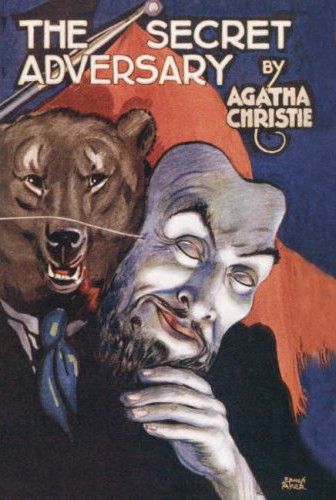
Dust jacket, first UK edition.
Emphasis on Bolshevism
Straining to relax, working to rest on the porch of the Barnstable, I finished reading Evelyn Waugh's entire absurd Vile Bodies and sitting next to me was a copy of Juliet Nicolson's The Great Silence.

Writing, eventually, would be in order. But research ... research is also important. Why, only just last year, at practically the same time I was burning through The Time Machine and A Brave Vessel as inspiration for The Great Globe Itself which was written, in large part, right there on that porch.

Nicolson's book details that period between the conclusion of the Great War and the beginning of the Jazz Age, as it occurred in Great Britain. (Side note: I really need to read an account of the war from the point of view of the Germans. Recommendations welcome.) The Secret Adversary takes place in 1921, at least according to Tuppence who recalls that her and Tommy's last meeting was five years hence in 1916.

Mid-century paperback edition.
Emphasis on MURDER!
Three issues of importance from that period resonate strongly in this work of Christie's; a general hatred for anything German, continued national deprivation and lack of employment (especially for the young) and with that a concurrent streak of labor unrest and a tangible fear of a Communist-backed revolt.

The Great Silence is an altogether demoralizing book. There is no finding reason in the great European conflict of 1914-18. Of all the horrific and plainly emotionally deadening facts paraded for our reflection, one stood out to me as most unhappy making.

Like many I have always assumed the war called "Great" was only classified as the "first" world war once there the "second" has established a succession. This is not the case. The term The First World War was first suggested in 1918 by an American academic writing about the conflict.

Recent, 21st century edition.
Emphasis on Lusitania.
That author was accused of cynicism, but history proves this person was merely striving for accuracy and was ultimately proved correct.

Deep knowledge of the "world of play" is not necessary for enjoying a work like Secret Adversary, but motivation and character is better understood with at least a basic education. Why are Tommy and Tuppence so obsessed with their next meal? Why is their banter of these two, young English people so blunt, wry, jaded and unapologetic?

And how on earth can an entire novel center on a single sheet of paper, one which ostensibly makes possible the toppling of the current Britain government and also pave the way for a wholesale Communist takeover without ever explaining exactly what the document says?

It is a mystery.

Thursday, July 23, 2015

Bright Young Things

The headline in The Onion ran;  4 Hours Scrolling Through Facebook Before Bed Referred To As ‘Winding Down’ (July 22, 2015) As is often the case, even now, twenty years on, their style of satire - which often consists of just saying true things pushed to logical extreme in flat, journalistic prose - exposing an Emperor who is already entirely exposed.

Last week I asked my wife to lock me out of Facebook, changing my password occasionally so I am denied access, like locking up the liquor cabinet.

I would prefer to have the wherewithal not to procrastinate, and to do the things I am meant to do. This summer I have been much more successful at reading, putting away three novels in the past month. Some has been research, but also fiction. Currently I am on my fourth summer novel, fiction which is also research; Vile Bodies by Evelyn Waugh.

Totally, odd ... I had asked my father for his copy and he forgot to bring it last weekend, but then as I was searching for a book for the girl to read I found his copy on one of our shelves at our house. I have no idea how that happened.

After a brief bit of confusion I have become entirely immersed in this tale of the "bright young people" in 1920s England. The picture of the Roaring Twenties from the other side of the Atlantic has similarities to that found in America, but like looking the wrong way through a telescope.

Young adults in Great Britain, for example, were the survivors of a generation slaughtered in the fields of France and Belgium during the Great War. Privation had taken a great toll on the established class system. They all just went a little nuts, drinking, taking drugs, throwing outrageous parties, pushing the boundaries of socially acceptable behavior.

I mean, America's "Lost" Generation was also behaving this way, only we seem so depressed and decadent, the British to be entirely disaffected and possibly demented.

As I continue my exploration of Agatha Christie's second novel The Secret Adversary, there are a few important elements which are drawing into focus. In the extremely helpful tome The Detective Novels of Agatha Christie by James Zemboy (MacFarland & Co., Inc., 2008), the author notes:
... unlike (her first novel) "The Mysterious Affair at Styles", ("The Secret Adversary's") characters are interesting and fun to read about ... the reader is treated right from the beginning to two loveable young people full of life and spirit ... (p.22)
Not monied as many of those real-life contemporaries written about by folks like Waugh and Nancy Mitford, Tommy was a soldier wounded in the war and now desperate for some kind of work, Also broke and with few prospects, Tuppence could return home to her family but as a modern young woman she would rather do absolutely anything else.

The manner in which they enter their business arrangement, which at first blush is practically an extortion scheme, retains the kind of disaffected pose that is so prominent in literature about young adults at that time. Christie herself was barely into her 30s when she wrote it and her dialogue is much more breezy and hip in this book than in her first.

There's also an awful lot of attention given to their eating, whenever possible, as thought they are constantly hungry, tearing into bread and tea when they have nothing, taking the opportunity for a meal whenever possible, and Tommy in particular obsessing about the time between feeding.

Tuesday, June 30, 2015

Dead Wake (book)

"It was 2 p.m. on the afternoon of May 7, 1915. The Lusitania had been struck by two torpedoes in succession and was sinking rapidly ..."
- Agatha Christie, The Secret Adversary (1922)
Fred Spear
Years pass, history accumulates, and as momentous events (those which appear to affect the widest number of people) occur writers will write about them, later writers will write about them, and still later writers will write about them, each either striving to create a more accurate account of just what happened, or to press a specific point of view about just what happened, or maybe just to make a buck.

Erik Larson has written several books that I should have read already, including Lethal Passage which traces the history of a single handgun (this, written twenty years ago) and In The Garden of Beasts, about the American Ambassador to Germany during the rise of the Third Reich. Each of these interest me a great deal.

What I have just completed is Dead Wake: The Last Crossing of the Lusitania, his most recent work, an account of the sinking of the RMS Lusitania. Released to coincide with the hundredth anniversary of the tragedy, Larson sheds new light on the sinking from the point of view of passengers who survived - and also from those who did not - as well as from the captain of the U-boat which destroyed it, and those in British intelligence who were monitoring the seas as best they could with early 20th century technology.

With this book he seeks to add to the historical account corrections, most significantly the fact that the German sub "U-20" had by its own account fired only one torpedo, not two. Survivors reported two explosions, in obvious succession, and their assumption was understood. However, British intelligence had intercepted U-20's communique about their attack and chose never to set the record straight. Even Winston Church, at that time First Lord of the Admiralty, intentionally repeated what he knew to be false in one of his books.

Larson does not solve the mystery of what actually called the subsequent blast, though he does have a well-educated theory which has much to do with the physics of calamity. Regardless, why did the British government perpetuate this significant falsehood? No doubt because if firing one torpedo at passenger liner with 2,000 innocent souls aboard was at that time unthinkable, firing two is worse.

This is hardly the only piece of misinformation perpetuated by British intelligence, and a good deal of Larson's work implies (though he never proves this) that they allowed the Lusitania - which had more than 100 Americans on board - be destroyed in the hopes of bringing the United States into the war.


While this plan, if true, may ultimately have been successful, it did not happen straight away. Woodrow Wilson had run a successful reelection campaign in 1916 based in part on his promise to keep the U.S. out of the war.

Cartoonist Winsor McCay, who had lofty and admirable ideas about the power of the new field of animation, was deeply affected by the event. He was at that time working for William Randolph Hearst, who also sought to avoid war with Germany, and compelled McCay to create anti-war editorial illustrations for Hearst papers.

McCay spent his own money to create what was at that time the longest animated cartoon - Sinking of the Lusitania - a photo-realistic recreation of the tragedy, which was of course not captured on any film or through photography. This was also the first time cartoon animation had been employed to depict serious, historical subject matter. He and his team took twenty-two months to create the work, which was released in July 1918. By that time, the United States had already been at war with Germany for more than a year.

Agatha Christie's second novel, The Secret Adversary, begins with a prologue set on the deck of the Lusitania as it was sinking. No mean feat, creating a fictional moment with which to begin a thriller set in a familiar historical context, one already well-reported at that time a mere seven years later. The ship sank in eighteen minutes, I would have imagined complete panic. Larson's book informs me that until the final moments a great many were relatively calm, and so Christie's brief exchange no longer feels unrealistic.

More on The Secret Adversary to come.