Showing posts with label Palace Theatre. Show all posts

Thursday, January 29, 2026

"Stereophonic" at the Connor Palace Theatre

The 77th Tony Awards, June 16, 2024
The KeyBank Broadway Series at Playhouse Square has something between forty- and forty-four thousand subscribers, which is the largest season ticket base in the country. If an average season is like this one, subscribers will have the opportunity to witness six new Broadway musical productions and one play.

For a short moment, when the kids were in their adolescence, we had a subscription. During the 2017-2018 season we had the chance to see the musicals Waitress and Hamilton and also Stephen Karam’s Tony-award winning play The Humans. And it was weird. On Broadway, the show, which takes place in a realistically rendered Lower East Side duplex apartment, played to an audience of one thousand. The Connor Palace seats nearly three times that, and seated as we were in the balcony and off to the side it was like watching someone’s Thanksgiving dinner from the far end of a football field.

Sometimes, subscribers get confused by these theatrical offerings, the ones without songs. Even I was surprised, though not unpleasantly, to learn that The Curious Incident of the Dog in the Night-Time was not a musical. That one, at least, was so full of visual stimuli that our seating was actually a blessing.

Andrew Gombas as Peter
This year, we were treated to Stereophonic, David Adjmi’s roman à clef about the turbulent creation of Fleetwood Mac’s classic 1977 album Rumours. Two years ago the show was nominated for a record number of Tony Awards, and won the Tony for Best Play. Best Play, not Best Musical. It’s not a musical, a fact which apparently left a great many subscribers, especially Baby Boomers and aging Gen Xers confused, and in some cases, outraged.

One old dude went on social media to decry his experience as “HORRIBLE” (yes, all caps) going on to report that “AT INTERMISSION THE AUDIENCE LEFT IN DROVES!! THIS IS NOT AN EXAGGERATION.” He concluded his rant with, “I am sorry to be so negative,” which I do not actually believe.

Before I go any further, I would like to report that not only is Stereophonic a good play, I think it is excellent. I saw it twice, the first week of the run, and then again last Saturday night. More on my experiences in a moment. Suffice to say, when thousands of folks buy into a series of productions, the vast majority of which are musicals, and you are presented with a show about a rock band, you might expect a rock musical. I wouldn’t have been surprised if some folks thought they were going to see a Fleetwood Mac cover band or something.

"Hedwig & The Angry Inch"
Cleveland Public Theatre, 2001
When I was public relations director at a certain local theater company in the late 1990s, they produced the intimate, three-person opera Bed & Sofa by Polly Pen & Laurence Klavan, inspired by the 1927 Soviet silent film of the same name. It was a beautiful production from top to bottom, the score, the singers, the set design (by the late Ron Newell) however, we were dinged by audiences and critics for advertising the show as a musical, and not as an opera. My boss thought the word opera would drive people away.

Stereophonic was advertised as a play, and it is a play with music, which is not the same thing as a musical. What else can one say? How else can one advertise? Except to emphasize that Stereophonic received the most Tony nominations in history, and even won the Tony for Best Play. Were they also supposed to tell stupid people not to come?

I was excited to see this show for several reasons which I will (eventually) enumerate. A couple years ago the podcast Decoder Ring with Willa Paskin produced “Making Real Music for a Fake Band,” an episode centering on the development of Adjmi’s new play. The conundrum; playwright wants to produce a work about the creation of an album which will eventually be regarded as one of the greatest of all time. If we are to hear that music, it better sound pretty good, right? And Adjmi is not a songwriter. But he found one in Will Butler, late of Arcade Fire, and together they wrote songs like Drive and Masquerade for the show which do amazingly capture that mid-70s Malibu sound.

Jack Barrett & Steven Lee Johnson
"Stereophonic" National Tour, 2026
Paskin’s episode also included references to other works that feature hits that never existed, like the film That Thing You Do and TV shows like Daisy Jones & The Six. What was not included in that list was another stage play, one which deftly blurs the line between play, musical and rock show, Hedwig & The Angry Inch

We saw the legendary 2001 Cleveland Public Theatre production of Hedwig, starring Dan Folino and Alison Garrigan, and soon after the film starring creator John Cameron Mitchell. The songs, co-written by Mitchell and Steven Trask, are entirely original, they do not sound like other songs, but they owe so much to the style, the substance – the vibe, if you will – of David Bowie, Elton John, Marc Bolan and so many others, that they trick you into thinking you already know them, and even love them, the very first time you hear them. And that’s what Adjmi and Butler were going for.

Matt Zitelli & Tim Keo
"The Vampyres"
Cleveland Public Theatre, 2005
I have also written a couple songs for my plays (plays that are not musicals) including the lyrics for “Come” and “Doctor” (music by Dennis Yurich) for the play The Vampyres, and both lyrics and music for “If You Were a Train” which was written for The Right Room. For that last I set myself a simple task, to create what David Byrne might call a “naive melody” or somewhat repetitious. I even included a fake biography in the program in an attempt to lead people to believe it was a real song by a real artist.

I always planned to see Stereophonic, the podcast was very persuasive, and anyway, I like plays. When I then found out my friend Andrew Gombas is an understudy on the tour, and that he was scheduled to play the role of Peter (do I get sued now if I call Peter the Lindsey Buckingham role) the last weekend of the Cleveland stand, I got a ticket to see it then.

Then I lucked into a pair of tickets for the first week of performances. Seeking someone to join me, I asked my friend Sarah, who is a singer and interpreter of late 20th century rock songs. She accepted the invitation gleefully, and over dinner I asked what she knew about the show and she told me she’d already seen it three times, including on Broadway. She loves this show!

During intermission David, one of my new work colleagues, joined us for a short chat, and I was intrigued. Sarah knew the show well, it was new to me but I was familiar with the source material (i.e. Rumours) and for David, who is in his mid-20s, it was all something new. I was very curious about his opinion and while he was engaged he wasn’t sure where it all was going. 

After, we three had drinks at Parnell’s where Sarah said something which stuck with me: Think of it like Chekhov. And that made great sense, because, like Chekhov, Stereophonic isn’t about plot, but about interesting characters and how they bounce off each other, in search of an elusive happiness. Chekhov is a vibe. And if you can’t dig that, well. You aren’t going to like it.

And by the way, happy birthday, Anton Chekhov.

I was very much looking forward to sharing the piece with Toni at the end of the run (and to see Andrew in it) but first we had the chance to see a special event, hosted by Playhouse Square, featuring the entire company, playing classic tunes from the 1970s like "Rebel Rebel," "Ventura Highway" and a breathtaking reinterpretation of "Being Alive" from Company. The absence of songs by a certain bi-national quintet was not a surprise.

Gombas was Emcee for the event, recalling how he had gotten his professional start as an actor-teacher with the school residency program, even calling out to me in the house to ask if it was in fact that very building we were in in which we rehearsed, and indeed it was.

Eli Bridges, Christopher Mowood & Andrew Gombas
January 12, 2026
Toni held off on listening to the songs that were to be created during the telling of the story of Stereophonic, but hearing each of these artists sharing their talents that evening meant she was even more excited for the actual production.

So what, after all, is Stereophonic about? This is what it is not about; it is not an episode of Behind The Music, a lascivious kiss-and-tell in which we are witness to orgiastic binges of passion and drugs and the total destruction of human souls and minds. No one throws a keyboard through the great glass window in that beautiful set. To the contrary, there’s even a character arc in which one goes from booze swilling degenerate into insufferable (not quite) ascetic.

No, it is – and if you have been paying attention, you know why I am attracted to this piece – about craft, about the act of creation, and how interesting characters bounce off of each other in the pursuit of that craft. Everyone is serious about the work, and they all have different ideas about how to make it happen.

The creation of Rumours is legendary, due in large part to the disintegration of the romantic relationships between the two couples in the group. But the group didn’t disintegrate, at least not right away. They even leaned into the controversy, agreeing to that Rolling Stone cover that shows them all in the same bed together. But this play doesn’t take place in bed, it takes place in the recording studio, and in that way it is a “locked door” play in which the players cannot depart until they are through completing their task, namely recording the album.

This is a story of a very specific time, when record labels would throw absurd amounts of cash at a band of young artists, giving them all the time they need with access to the best equipment available (as well as access to gallons of alcohol and mounds of blow) in the hopes of creating solid gold. For better or for worse, this particular time will not come again.

And time is a character in this piece. This is perhaps why a lot of subscribers “LEFT IN DROVES!!” at intermission, because the first act by itself is ninety minutes. Because that’s the time it takes. And when the music plays, it sounds really good.

Saturday, August 12, 2023

How I Spent My Summer (2023)

Heights High Graduation
We received an invitation to our friends’ annual Labor Day party and it sent me into an existential spiral. I’ve been doing all right so far, but the empty nest thing is real. We drive our son to university this week, and then, well. It will be the two of us, for the most part, from here on out.

Wow. That’s it? Twenty years, really? Okay, uh. Now what? And the idea of attending the Labor Day party, thrown by friends we only know because of our children, without our children. It kind of brought it all home to me.

Parade the Circle
We’ve been summering like hell in an overcompensation for years of sequestering ourselves, with our children, due to quarantine. Let’s get out and do all the shit. What I have failed to do is have people over very much, not since the end-of-year part of the residency program which sucks because the backyard looks awesome.

Angélique Kidjo
The summer kicked off attending commencement for our youngest, at the Wolstein Center, where I had also received my Master Degree two weeks earlier, followed by a flurry of grad parties, one for himself and more for his friends.

My wife and I have attended three Guardians games (so far) this season, with a variety of friends or on our own. I also had the chance to attend the first Parade the Circle that has been celebrated since 2019. The parade was shorter than usual, which was to be expected, I guess.

Go Guardians!
Theater camp was a big hit, I think we got that one mostly right. I was most delighted that we were able to incorporate a writing component into the camp, and I had several acolytes who were happy to join that rather than do craft.

The Tri-C Jazz Fest was another great public event, where not only did our son perform at one of the outdoor bandstands on East 14th Street, but we also saw Angélique Kidjo, Herbie Hancock and Trombone Shorty. Members of the Jazz Academy went nuts for that last show, almost bringing down the balcony of the Connor Palace.


Video: Jazz ensemble "floor3" at Larchmere PorchFest

Drinks at the Grand Pavilion
We also brought the boy to Cincinnati for orientation – this was all before the end of June.

Last summer I became enamored of the Hotel Breakers at Cedar Point. Not that the place is terribly fancy, it’s not. It’s basic and I like that, and also that it’s right there on the beach. I knew nothing about the Breakers growing up, often my folks would take us to the Point only for the twilight, discount hours. 

Young people in Maine.
When my family first visited the hotel last summer, and as my wife was checking us in, I was looking around, walked straight through the lobby and out the other side to find … the lake! The beach! It’s right there! I had no idea!

Location, location, location.

So we took the boy and his boyfriend for an overnight and while the younger pair of us went off to ride rides, we did something I had never had the chance to, namely: watch the shows. You know, all those shows, performed several times a day, every day, by college students and other young performers. And you know what? They were good!

Four votes against Issue 1
The middle of July, time seemed to slow down a little bit. I had pulled a muscle in my ribs on a ride at the park and my days were full of work business, and other theater-related matters. The last week of July we packed up for Maine, the journey I had missed last year due to retinal detachment surgery. This was also my first time back since we distributed mom’s ashes into the sea. The week was not without strong feelings.

We arrived home in time for the BorderLight Fringe Festival, and this past week the boy played his final gig as a student with School of Rock, the Super Seniors Show at the Mercury Music Lounge in Lakewood. Each of the artists got to choose a song for the ensemble to perform, and he chose Soul Coughing’s “Screenwriter’s Blues.” (see video below)


To round out this list, we attended the opening performance of Fun Home last night at Cain Park.* The production is really, really excellent. The boy said it’s the best production of a musical he’s ever seen. A poignant close to a manic summer, don't you think?

"Fun Home"
(Cain Park, 2023)
Photo: Every Angle Photography

*Did I mention we saw Rufus Wainwright at Cain Park in June? We also saw Rufus Wainwright.

Thursday, November 22, 2012

Staging Success: The PlayhouseSquare Story

 What I am truly thankful for.

One week ago, Thursday, November 15, WVIZ ideastream aired a one-hour documentary chronicling the history of theaters built during the 1920s on the north side of Euclid Avenue. Today the district is known as PlayhouseSquare, but in the intervening time Cleveland went through its steep decline from sixth largest city in America to where we are today ... which is where, exactly, I don't know. But it's not the late 1960s, when these opulent play houses were in terrible disrepair and on the verge of being torn down to -- literally -- put up a parking lot.

Throughout this blog I have told short stories about Cleveland in the 1930s, 1950s and 1970s ... research for me, but also my own education of this saggy metropolis into whose orbit I was born, and where I continue to live and thrive today. Understanding where we are and where we are going requires a knowledge of where we have been, otherwise nothing makes any sense. It's also pretty interesting stuff.

Got an hour? Watch the video. There are moments I actually cried. I miss the past I never experienced, but I more thankful to be where we are today.

Tuesday, August 9, 2011

My Summer Story (1993)


There's a lot of movie-making going on around town this summer. I am happy to say that some of it is taking place in Cleveland Heights. Like most cities these days, we can use the cash and I am getting a little irritated by the people griping about Coventry getting blocked off now and then to shoot scenes for Fun Size or I, Alex Cross. People, please.

The big story is The Avengers shoot, which began yesterday, downtown. I have a map on the corkboard in my office informing me off which streets are shut down when. I have a date for lunch on Friday, maybe we will head down the East 9th and Euclid and do some star-gazing.

Apparently they are making Euclid Avenue look like 42nd Street. Only, you know ... smaller.

There hasn't been this much Hollywood activity at one time since 1993, when we were host to not one but two big-budget films, Double Dragon and the much-anticipated sequel to A Christmas Story.

Double Dragon was notable for its cost and calendar overruns, and Mayor White had to finally kick them out of the city as two weeks of blowing stuff up on the Cuyahoga turned into three weeks and then four.

As for that other film, I wrote a piece about that five years ago for Cleveland Magazine:
Lost Summer
by David Hansen
First published in Cleveland Magazine, June 2006

(Thirteen years after "My Summer Story" was filmed here and forgotten, one of the movie's extras rediscovers a so-so sequel in the shadow of its famous forerunner.)

Remember at the beginning of “My Summer Story” when the narrator remarks how sometimes events in our lives come and go before we realize how important they are?

Wait. Back up. You’ve never heard of “My Summer Story?” It’s the movie based on Jean Shepherd’s boyhood memories of growing up in Depression-era Northern Indiana. It was filmed here during the summer of 1993 and many Clevelanders, including me, took part as extras.

Still nothing?

It was the sequel to the 1983 holiday classic “A Christmas Story.” I know you’ve heard of that one.

Last December, you couldn’t pop a Red Ryder BB gun without hitting some reference to “A Christmas Story.” From Big Fun to Flower Child, any shop that could justify it had a leg lamp glowing in the window. The Cleveland Play House presented a stage adaptation, some of the original movie’s supporting characters made a public appearance downtown and a California man announced his plans to turn the West 11th Street home featured in the film into a museum. Then there’s TBS’s annual 24-hour “A Christmas Story” marathon that has made the movie a holiday favorite no matter where you live.

So whatever became of the sequel? I don’t recall it ever appearing in theaters. I do remember seeing a full-page ad in Premiere magazine advertising its upcoming release in 1994. By then it had a new title: “It Runs in the Family.” Then nothing. Bupkiss, as they say.

When I recently stumbled upon the film again (restored to its original title of “My Summer Story” for its video release), I wondered why the movie had been so quickly cast aside when it seemed to have so much going for it.

It had not one, but two Culkins (Macauley’s younger siblings Kieran and Christian) in the roles of Ralphie and Randy Parker, as well as Mary Steenburgen as “Mother” and Charles Grodin as the “The Old Man.”

Like “A Christmas Story,” Bob Clark directed the movie and wrote the screenplay with Shepherd and Leigh Brown. And, like its predecessor, “My Summer Story” was filmed in Cleveland. In fact, most of it was shot here. People often forget that apart from the Christmas parade, scenes with Santa Claus and exterior shots of Ralphie’s house, much of “A Christmas Story” was filmed somewhere else.

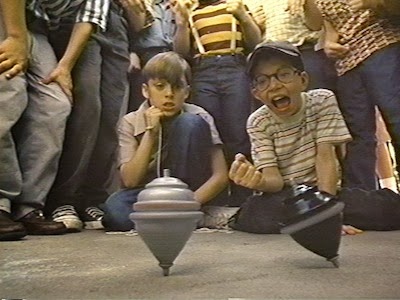
But for a few weeks in August 1993, “My Summer Story” took over downtown Cleveland. My involvement was brief. I was just a warm body in a costume as part of the Great Lakes Exposition scene (the part of the film where Ralphie buys a “killer top” from a gypsy). It was an impressively large set spread over the plaza beside Key Tower. (Look for me behind the camels. I’m wearing an orange Hawaiian shirt. Don’t blink.) Other shooting locales included the Palace Theatre, Wilbur Wright Middle School off 117th Street and Lorain Avenue, the industrial Flats and a large part of Tremont.

NewsChannel5 anchor Leon Bibb (then working for another station) was doing a story on the shoot and also worked as an extra. We were in the Expo scene together, so he and I meandered and chatted a little in the baking summer heat of Mall C, behind the camels.

“It was a long day,” Bibb remembers with a laugh. “Hardest $50 I ever made.”

Cleveland theater legend Dorothy Silver was one of the few Cleveland actors whose name appears in the film’s credits. She was “Neighbor No. 4,” in case you’re wondering.

“We had this long, long, long night shot,” Silver recalls. “I had no context for the scene; we didn’t know what was happening. It’s the ultimate impotence for an actor.

“I had a line or two — some kind of shouting, angry line. Not what I want on my gravestone.”

Whatever she said ended up cut from the film.

Local actor John Galbraith was only 15 years old when he played one of the Parker family’s numerous “hillbilly” neighbors, the Bumpuses.

“There were a lot of people of Irish descent there, and we shot around 4 in the morning,” he remembers. “This one woman brought out folk instruments, and we sang Irish folk tunes and it was pretty fun. … It was very Cleveland, the togetherness, the shoot — everything about it.”

What’s unfortunate is that none of those warm feelings come across while watching the movie. “A Christmas Story” leaves us to imagine the Bumpus family, because we only see their turkey-stealing hounds. What we get in “My Summer Story” is a caricature of the Appalachian poor that was better left in “The Beverly 
Hillbillies.”

“It didn’t have the charm the first movie had,” Galbraith says.

That’s a criticism I heard a lot while collecting people’s memories of “My Summer Story.” I felt the same way after watching it again with my 3-year-old daughter Zelda. For example, Charles Grodin says “son of a bitch” a lot for presumed comedic effect, while in “A Christmas Story” the old man’s cursing is a lot of mumbling nonsense that leaves us to imagine the worst.

There’s also a lot of stupid, cartoon-like violence in the movie. Getting your tongue stuck to a flagpole is funny. Getting shot in the hind end with your own Red Ryder BB gun (especially after receiving the legendary warning: “You’ll shoot your eye out”) and then howling in pain for a full minute? Not funny.

And then there’s the issue of Christmas versus summer. When the motion picture of the musical “Annie” was released in summer 1982, the Christmas ending was revised to a timely Fourth of July finale. I don’t care how patriotic you are. Is it “The Magic of Christmas” or “The Magic of Independence Day”?

Watching the whole thing again now, “My Summer Story” doesn’t seem worse than a lot of other nonsense I see on television. And there are a lot of sweet bicycling scenes, with Ralph and his pals Schwartz and Flick tearing all over Tremont. The opening is particularly promising, as Ralph’s teacher Miss Shields delicately gives him the third degree for a book report on a smutty novel. And the old man’s passive but earnest attempts to bond with his pre-adolescent son are truly touching.

No, “My Summer Story” isn’t terrible. It’s just not as good as “A Christmas Story.” And Kieran Culkin, who has grown into an interesting actor in films such as “The Dangerous Lives of Altar Boys” and “Igby Goes Down,” is not Peter Billingsley. The Great Lakes Exposition is not Higbee’s. A killer top is not a BB gun. Summer is not Christmas. And Charles Grodin is not Darren McGavin. Maybe they wanted to change the movie’s name because the film suffered so terribly in comparison to its predecessor.

In 1995 there was, at long last, a public showing of “My Summer Story” at the Cleveland Museum of Art. The film went down pretty well there, especially among the Bumpus clan.

“All the random extras, the nobodies, we enjoyed it,” Galbraith recalls. “It was very family-oriented, like ‘We’re the Cleveland people! We’re all Irish! We’re the Bumpuses!’ We were really a family.”

We’re still one big Cleveland family, sharing a forgotten summer story.
More on My Summer Story.

Monday, October 25, 2010

Lena Horne

Lena Mary Calhoun Horne (June 30, 1917 – May 9, 2010) was born in Bedford-Stuyvesant, and raised largely by her grandparents. Her family, with roots African, European and Native American, was part of the "Black Bourgeoisie" a stratum of well-to-do people of color. Horne's own parents were looked down upon by the extended family, her father a numbers runner and her mother a traveling actress.

She spent time in the South with her mother, and later with her uncle Frank who became an advisor to FDR. Returning to New York she attended a public high school before leaving school without a diploma. At age 16 she joined the chorus of the Cotton Club, yes she did, and by 1934 had a featured role in the Cotton Club Parade. The next year she began touring with Noble Sissle and his orchestra.

According to BlackClassicMovies.com she headlined with Sissle under the name Helena Horne because he thought Helena sounded "classier" than Lena. However, when they played The Palace in early October, she was billed as Leona Horne.
Clevelanders on Palace Stage
The Cleveland News, October 1, 1936

Noble Sissle, who left Central High back in 1912 for the war and later success down the dance lanes, isn’t the only local-boy-makes-good at the Palace tomorrow.

The habitues of the Cedar and Central Avenue hot spots will remember Billy Banks. They swore by this lad a few years back as he danced and sang his way up and down the town’s Harlem.

Included in Sissle’s “Savoy Stompers” revue are the dancing stars of the Harlem Cotton club, “Pops and Louie”, Leona Horne, songstress, and Buddy Doyle, who comes out of the band to clown, figure prominently in the show.
Sources:
Wikipedia
BlackClassicMovies.com
The Cleveland News

Wednesday, August 25, 2010

Crooked River Burning (book)

My city was dead before the day I was born.

Mark Winegardner’s 2001 novel Crooked River Burning weaves a love story through the most tumultuous years in the history of Cleveland, from its final arguable peak in 1948 (date of our last successful World Series appearance – as with everything in this city, success is defined by sports) through its 21-year descent into 1969. Dead city, dead river, dead lake.

I was born in 1968, not in Cleveland though everyone in the Cleveland area claims to be “from Cleveland.” Reaching the nadir does not necessarily mean we are now on the way back up. It just means we are at the bottom, and we may be here for a while. Perhaps forever.

I contacted a local historian about life in Cleveland in the Fifties (you didn’t know I was also researching the Fifties, did you) and she demurred, saying she was a suburban East Side girl and wouldn’t have anything of value to share about the City. She did recommend this book, among others. It has taken me about a week and half to read. I have for the most part been loathe to set it down.

At the start, I was worried that Winegarder’s trick – threading the true lives of historic figures from Cleveland’s past into his fictional narrative – would be daunting to me, because I had planned something similar. It is not a unique technique … but it is Cleveland … but seriously, this is not my play. Teamsters and City Council and Shaker Heights the halls of Cleveland are not my area of focus. Instead, it was inspiring to read, and fun. And as someone raised here (around here) in the Seventies and who never left, I found it hilarious and heartbreaking. (Insert Cleveland comparison here.)

There is a scene near the end, a wedding anniversary in the mid-60s spent catching a first-run movie at the Palace. It made me cry. His description of this 2,700 seat vaudeville theatre built in 1922, in its crumbling death throes, a dozen people in the house to gaze at a torn screen, the balcony and historic boxes condemned, was truly shattering.

I work here in the middle of Playhouse Square. I took my children to see The Muppet Movie in the Palace last Sunday, with a full house of families taking advantage of the five-dollar summer movie series. Many were in the restored balcony. My son complained there were no cup holders, but really, look around. The Palace is beautiful. It was saved. But only just in time. It had closed in 1969, and would not reopen for almost twenty years.

The things have without question improved in the past forty years ... or perhaps they are merely different.

Where our story ends, white people had stopped taking Hough Road to get downtown, speeding down Chester instead. On Sunday night I read the chapter on the Hough Riots. Yesterday I drove Hough Road, to see where it had all happened. My window was open. This is not 1966.

The wife used the word “race” at dinner the other night. Noticing the unusual use of a word he thought he knew, the boy – age 5 – asked “what is race?”

With a little confidence I said, “It is a word people use when they want to describe people who share a common origin or background. It is a made-up word. It doesn’t actually mean anything.” He was satisfied with this answer and dinner continued.

I am from Bay Village, a safe little homogenous bedroom community on the lake. No matter where I have been, I will always think of myself as a white kid from an middle-to-upper-middle class suburb. But my children are from the Heights.

What is better, what is worse, is subjective. The only thing certain is change.

Monday, January 25, 2010

Noble Sissle


Noble Sissle (July 10, 1889 – December 17, 1975) was born in Indianapolis, and moved with his family to Cleveland in 1906 when his father became minister of Cory Methodist Church at E. 35th & Scovill. At the age of seventeen he attended Central High where he played baseball and football, and sang with the glee club.
During World War I, Sissle entered the Army and became the drum major of an Army band that caused a sensation in France by playing a form of ragtime music. The 369th Infantry Band, led by Lt. James Reese Europe, began calling itself a "jazz band." Reese’s Army band not only helped popularize the new music among U.S. soldiers, but it was the first exportation of jazz, America’s new art form. Sissle said at the time, "The jazz germ hit France and it spread everywhere" they went. - Joe Mosbrook, Jazzed in History
Mosbrook also credits Sissle with discovering Sidney Bechet, and being part of a vaudeville act with Eubie Blake. Sissle composed the classic tune I'm Just Wild About Harry, and three years before The Jazz Singer created a short film with Blake called A Phonofilm that was first shown at the Palace Theatre in December, 1923. He had a history of breaking racial barriers, working clubs that had previously hired only all-white ensembles.

In 1935 Sissle hired a young chorus girl from the Cotton Club to sing with his Franco-Harlem Revue, and she was singing for them when they played in Cleveland for a week in October, 1936. Her name was Lena Horne.