Showing posts with label New York City. Show all posts

Friday, July 10, 2026

I Hate Memory! | BorderLight 2026

 "The past is a dick."

Esme Thorne (with Balint)
My brother introduced me to the works of Jim Jarmusch in the late 1980s. When I first visited his new St. Paul apartment in 1989 he had a handsomely framed poster of Stranger Than Paradise. It's one of his favorite movies, and we often quote that or Down By Law whenever it seems appropriate. And cousin Eva taught me about Screamin' Jay Hawkins.

Much later, I took my fourteen year-old son to see The Dead Don't Die, Jarmusch's 2019 zombie comedy film. I thought it was okay, but he really dug it. I thought I recognized Fern the waitress, and sure enough, that was also Eszter Balint. It was crazy. I have only ever thought of her as a teenager, but she's my age.

The other night she made an appearance at the Cinematheque, and you might ask why she would come to Cleveland for the screening of a film she made over forty years ago, or maybe you were already aware that her musical memoir I Hate Memory! is playing BorderLight.

A Hungarian immigrant, and the child of dissident theater artists, she first settled in New York City in the late 1970s. They lived at the Chelsea Hotel. No, really. She was in the thick of it, at that time, in that city, as an adolescent. As a child.

The show is a happening, as Balint tells stories, plays songs (great band) penned by herself ... and Stew! The young musician and actor Esme Thorne takes turns as the teenage Balint. The playwright's own vocal quality is a like a punk rock Blossom Dearie. There are projections and banter. It's a play, it's a concert.

It's a rough show. I mean that in any number of ways. It is a rare opportunity. Get there.

Monday, January 5, 2026

NYC EOY 2025 (part five)

Bryce Pinkham
Whether or not you enjoy or approve of this new book for the musical Chess, it all comes down to the Arbiter.

Our last full day in New York, we had breakfast in, a few items from the bodega around the corner and a casual lie-in in preparation for an entire day to be spent out. Has our President ever visited a bodega? I think he would have a nervous attack. He hates normal people, he wouldn’t know what he was looking at.

We spent a few hours in the Met. As many times as I have visited, there are still galleries I have never experienced, and of course, there are always new exhibits. We lingered in the American Wing, specifically among the Native American works. I was exposed to George Morrison in a show focusing on the midcentury work he created in NYC.

To add atmosphere, they were playing "So What" by Miles Davis on a loop. I know the song is over nine minutes long, but some of us spend more time than that in one exhibit, especially when they are high. I don’t know why they didn’t just play all of Kind of Blue, cats think it’s a hep side.

"Construction in Fantasy"
George Morrison, 1953
The day was cold, real cold. We avoided taxis the entire day, including a walk across Central Park to a subway station which was more of a march than a stroll. We took a pilgrimage to the Drama Book Shop, my first to this “new” location on 39th Street, where I picked up a recently revised edition of Born With Teeth by Liz Duffy Adams and a signed copy of Plague Play by Erin Proctor.

I am old enough to be familiar with two previous incarnations, including the second floor space on 48th Street, which I recall being a bit cramped and tatty. Nothing like this spacious and bustling locale with its cafe and seating.

Dinner was something of a misstep, at a rooftop spot in Times Square. I am sure that during the spring and fall it’s lovely, but even enclosed for the season it was fucking freezing. Finally: Chess.

Drama Book Shop
The last time we attended a Broadway musical, it was in 2023 for the highly successful revival of Merrily We Roll Along. And like Chess, the original Broadway production was a flop. Merrily director Maria Friedman provided her revival a focus to the story audiences had found difficult to follow due to its multi-year sequence of events which are told in reverse-chronological order. From the jump, she made it clear the play is all about the character of Franklin Shepard (Jonathan Groff) – we were to keep our eye on him. The tale was much clearer to understand, and we could enjoy the music and the performances.

With a new book for Chess, written by Danny Strong (co-creator of TV shows Dopesick and Empire) they have attempted to provide context to a Cold War era story which, by the Broadway run in 1988, was already at an apparent conclusion.

A narrator, who came as a surprise fourth lead of the production, played with hilarious comic timing by Bryce Pinkham, has been expanded to educate younger members of the audience – those forty and under, fans of Tveit and Michele from their apparent volume the night we attended – what the Cold War was, what was at stake, and what any of this might have to do with an international chess competition.

Nicholas Christopher
When a person is depicted wearing a mask in a TV show or movie or in a play, do we need to explain why they are? No, because we all understand what year it is. And so it was that forty years ago, if there was any competition between an American and a Soviet, everyone understood that it had additional weight, or baggage, if you will. I would be curious to know how someone who didn’t live through that era receive the news that the results of the act one match in Merano had a direct effect on the defeat of President Carter, or that the act two match in Bangkok played out against the backdrop of actual NATO war games in 1983 that almost started World War III.

Pinkham also steps into the story as the Arbiter, which is a referee for a chess match. The Arbiter has one of my favorite songs in the entire original recording, which is unfortunately there broken up into a longer piece called “Opening Ceremony.” A more complete version, called “The Arbiter” and sung by Björn Skifs, was released as a single, with an additional verse. Pinkham has been granted the uninterrupted, complete version as a star turn and makes a meal of it. If the original cast recording was this song alone I’d buy it.

What is most compelling, the reason the show is worth attending, are the epic solo turns by each of the three stars. I have heard of Aaron Tveit, but he’s not someone I have had the occasion to pay attention to. The several appearances he has made promoting the show on various morning or late night night shows, where he has invariably performed “One Night in Bangkok” did not impress, but through no fault of his own. It’s not a song which compliments an actual singer. It’s dated. Kinda cringey.

AND YET. In context, as part of the story, the act two opener, when we have already gotten to know who this guy is, and where he is, that he is a defeated American chess champion who is now a talking head for the game, in performance he was sexy, and hilarious, and big fun!

Aaron Tveit
But that’s not the best of his work here. In its original incarnation, the American and the Russian were types. Remember, this was a story told by two Swedes and a Brit, folks who were squeezed between two dangerous, dysfunctional opposites. The American, named Freddie Trumper (the Arbiter is quick to remind us this show was written in 1984) was originally merely an asshole, and unfortunately queer-coded. Tveit’s Freddie, we are told, is bipolar, and requires medication to help him function. His childhood trauma, reflected in the song “Pity the Child,” is achingly rendered by Tveit. When I was a teenager, I felt this song was a commentary on how Americans whine about how unfair the world is and blame our failings on our parents. As an adult, I have much more empathy for this character.

And that’s important to a modern audience, because the original basically told us this guy is the way he is because he is American, and that guy is the way he is because he is Russian. We are told the Russian, Anatoly Sergievsky, was taken from his parents when he was a child, that he was programmed to be a chess champion. But in his performance, the way he stands and walks and speaks, Christopher suggests he is also neurodivergent. Are these reasons or excuses for the men of Chess to behave the way they do?

Regardless, I had seen Nicholas Christopher bring down the house once in my life, now I’ve seen him do it not one more time, but two more times. He may be the least well-known of the three leads, but every audience who sees this leaves having seen him as a co-equal, or even the star. He crushes the act one closer, “Anthem,” and later received a mid-song ovation during “Endgame.”

Lea Michele
If Lea Michele suffers in comparison to these two performances, it is through no fault of her own. The character of Florence, the paramour of first Freddie and then Anatoly is problematic. They show her to be a brilliant chess strategist, her character exists to be a foil for the men. Her own story, that she was a Hungarian refugee as a child during the Budapest Uprising of 1956, and left in limbo as to the fate of her missing father – was he a dissident or a Soviet spy? – has always felt tacked on to the larger story.

In both professional iterations (West End 1986, Broadway 1988) Freddie and Anatoly receive somewhat satisfying conclusions, while Florence is left with nothing. News of her father’s fate never arrives. Here, we are provided a coda in which, in exchange for the defected Anatoly returning to Russia, Florence is reunited with her father. It was a bit jarring, as this elderly man  is led on stage by a CIA agent; first I thought, which sexy chorus member in old age make-up is that, and then, has he just been sitting backstage this entire time?

Michele does get her star turns, though, and they are epic. “Nobody’s Side” and “Heaven Help My Heart” are act one standouts. Unfortunately, for Florence and for Michele, there is or was only one featured number for the character in act two, and it’s a duet with Anatoly’s estranged Russian spouse Svetlana, “I Know Him So Well.” To add to her solo performances, Michele concludes with “Someone Else’s Story,” written for the West End production – to be sung by Svetlana. The song is literally someone else’s story.

Whether you enjoy this version of Chess depends, I believe, on whether or not you have a sense of humor. Since the holidays I have watched the original West End production on YouTube, and it has a light book, the story is mostly sung-through and like the concept album, and seems to take itself quite seriously. Even so, this modern version has its moments of head-scratching weirdness. It’s odd that they used a hydraulic lift to briefly show Florence and Anatoly in a literal bed together, and yet there is not one moment in the entire production when two people sit down at a table, however briefly, to play chess.

But I loved it.  

The next day was December 31. We headed to the airport and flew home. My wife and I have been in each other’s presence every New Year’s Eve since meeting in the streets of Athens, Ohio at the stroke of midnight, January 1, 1990. She’s my alternative girlfriend. And we have spent a couple NYE’s in NYC, but only a couple – 2022, 2023. Though we arrived on December 27, we decided it would be enough (and considerably less expensive) to return on the last day of the year, and after all, home is our favorite spot, anyway.

конец.

Sunday, January 4, 2026

NYC EOY 2025 (part four)

Photobooth, Lugo, Spain
(1984)
The summer of 1984, I spent several weeks in Spain as part of the Experiment in International Living (EIL). I had spent a few family vacations in England, France, and Norway when I was a child, so Europe was not entirely alien to me. But that was in the late 1970s, now Reagan was president, the Cold War was at a fever pitch. Also, there was a mass shooting (not a weekly occurrence in those days) at a MacDonald’s in San Diego while I was abroad and I was on my own to try to explain what exactly was wrong with my country. Almost forty-two years later, and I am still unable to.

Later that year, Benny Andersson and Björn Ulvaeus – half of ABBA – and lyricist released the concept album Chess. The single "One Night in Bangkok," led by Murray Head (who I was already familiar with from the concept album for Jesus Christ Superstar) was a hit in the United States, peaking at number 3 on American Top 40 in the spring of 1985, as I was finishing my junior year at Bay High School. Several other songs were hits across the world – "I Know Him So Well," "The Arbiter" – but not here. Those of us whose interests had been piqued by "Bangkok" bought the two-disc CD set, and many of us became enamored of the piece.

Murray Head
"One Night in Bangkok"
Like Superstar, the concept album was always intended to eventually become a stage production, and in 1986 Chess opened at the Prince Edward Theatre in the West End. Originally created as a dance-focused extravaganza directed by legendary choreographer Michael Bennet, the piece was brought to opening by Trevor Nunn when Bennet became too ill to continue. This version played for three years, and featured several of the artists who were on the original recording, including Head, Elaine Paige and Tommy Körberg. They never produced a cast recording of the West End production.

When it moved to Broadway in 1988, Nunn chose to revise the entire production, top to bottom, greatly expanding the book and removing many of the songs. This version was not well received and played for only 68 performances. I did purchase the original cast recording when it was released and still have it, though I believe I have listened to it once. Maybe once.

"Chess" (1988)
Original Broadway Cast Recording
(This design is terrible.)
So, what is Chess about? An international chess competition between an obnoxious American and a feckless Russian. The American’s second is a woman with whom he has a dysfunctional relationship, and who forms the third in a love triangle set against the backdrop of Cold War intrigue as well as an appropriate amount of social commentary and a lot of really great songs.

And really, it’s the songs. That’s why this very 1980s Broadway flop has remained in the contemporary consciousness at all, because of people like me who really, really love the original recording. But it’s dated. Like, really dated. "Bangkok" features the first guy to play Judas kind of rapping. Several songs are ABBA-esque, and that act wouldn’t receive their flowers until the early 21st century and the advent of Mamma Mia! 

The year 1984 (not for nothing, the title of Orwell’s book) was peak nuclear anxiety. This year alone there we listened to pop songs like "99 Luftballons," "Distant Early Warning," "Two Tribes," "This World Over," "Dancing With Tears In My Eyes," "Minutes To Midnight," "Forever Young," and on and on. But by the time the show bowed at the Imperial Theater on West 45th Street in spring 1988, Glasnost had been established and apocalyptic anxieties had cooled. The show wasn’t just bad, it was irrelevant.

"Hamilton" stage door
with Nicholas Christopher
(2016)
Which brings us to the present. When it was announced that there would be a Broadway revival of Chess, and not only that but that it would star Tony-winner Aaron Tveit, Glee’s Lea Michele and (wait for it) Nicholas Christopher, I told my wife this is the reason we’re going to New York for the holidays, I have to see this.

So, if you are not already familiar with Nicholas Christopher, we saw him as the first person to take over for Christopher Jackson as Washington in Hamilton. His rendition of "One More Time" brought the house down, raised the roof, and made me cry, no cap. Since then he has played several leading roles on Broadway including Seymour in Little Shop and Sweeney in Sweeney Todd. I would have loved to have seen him in those. He sold my ticket to see Chess.

To be concluded.

UPDATE: My wife questioned that I had purchased the concept recording on compact disc, rather than on cassette or vinyl. While it is true that the CD did not become dominant until the late 1980s, one of my father's clients was Telarc, an early adaptor of digital sound technology. By the mid-1980s he not only owned a CD player, but dozens of Telarc recordings of the Cleveland Orchestra. My first CD was Donald Fagen's 1982 solo album "The Nightfly" (DDD). I have never owned "Chess" (1984) on vinyl or cassette.

Friday, January 2, 2026

NYC EOY 2025 (part two)

My experience with LES theaters is limited to my several summers either witnessing or participating in the (former) New York International Fringe Festival. The last time I set foot in Under St. Marks Theater was in August 2001, to witness a solo performance, the coming out story for a queer individual of native ancestry. There was no air conditioning, it was a forty seat hotbox.

Nearly a quarter century later and in deepest December, it was a bit chilly in that space, which was only appropriate as we were attending a 5:00 pm performance of the RadioTheatreNYC production of The 15th Annual Edgar Allen Poe Festival, under the banner of Frigid NY. Directed by Dan Bianchi, the event was a live radio drama (with prerecorded music and sound effects) performed with creepy gusto by Frank Zilinyi and R. Patrick Alberty.

The selections performed included The Tell-Tale Heart, The Facts in the Case of M. Valdemar, The Masque of the Red Death, Berenice, and The Cask of Amontillado. Given the format, the words took center stage and while the performers did not disappoint, listening to the stories spoken aloud in this way allowed both of us to become more critical of Mr. Poe than reading him off of the page.

The Masque of the Red Death
 was the weakest of the set, as it describes a selfish millionaire who shuts himself away from a world ravaged by plague. When he throws a lavish party for his monied friends, the personification of pestilence arrives and murders everyone. Even in its telling, it’s not particularly suspenseful or scary, you know exactly what’s going to happen from practically the first word.

No, it was the one with which I was least familiar, The Case of M. Valdemar, that had me on the edge of my seat. A first person account (it was first printed without any indication the tale was fiction, creating something of a stir) the narrator claims that he mesmerized a man at the moment of death, essentially trapping the man’s consciousness inside a dead body.

What we fear is what touches us closest, and for me that is not dying, nor illness, nor ageing, not for me personally. No, it is the fear of caring for someone else who is dying, and doing it wrong. That we – I – cannot accept the death of someone we love when that death is inevitable, and necessary. And we prolong their suffering as a result.

After we had dinner and cocktails at Schmuck (yes) which was stylish yet unpretentious (yes) the kind of place where they pour your half-finished martini into a newly frosted glass. Without even asking. I’ve never experienced such a thing before.

We walked briskly back to our hotel – we’d spent an entire day without need for a cab or bus or train – exhausted and happy and feeling like it must be nearly midnight. Checking my phone I laughed out loud that it was only eight. All’s well, we had an early night.

To be continued.

Thursday, January 1, 2026

NYC EOY 2025 (part one)

Felix Empanadas
(Do you know this trio?
Would like to credit them.)
Since Covid, my wife and I have been making a point of visiting NYC at least once a year. It’s a city that holds so many important memories for both of us; primarily hers, she lived there for seven years. But Manhattan has changed so much since the 1990s, and we have spent a great deal of time there since, together and apart.

Toni finds the most amazing places to stay, this time it was the Historic Blue Moon Hotel on the LES, right across the street from the Tenement Museum. We checked in late on Saturday evening, and walked about the neighborhood to find necessaries (beer, wine, pain reliever).

Yes, it was Saturday night and yes, it was New York City, and yet I was surprised by the sheer density of clubs for which young people would stand in line in the freezing cold to access. As a trio of bright young things in short shirts passed us on the sludgy sidewalk, one observed, “I can’t feel my knees.”

Russ & Daughters Cafe
We passed a walkdown jazz club, we knew it was a jazz club because there was a sandwich board outside reading “Live Jazz” and though we were on a drug store mission we were both like, “Maybe? Maybe some jazz?” So when further down the street we noticed and then did a double-take on a trio wedged into one corner of a small empanada emporium, and were then waved in by a seated patron, we were primed to engage.

By then it was nearly midnight, we sat for a few numbers, an entertaining ensemble that warmed my bones and made the walk back to the hotel much more jolly. We promised each other to return for lunch before our time was through.

Sunday morning we took breakfast at Russ & Daughters Cafe and then made our first visit to the Tenement Museum, an institution which is a testament to everything the current administration hates and fears, a monument to the immigrant experience in America and to the working class in general.

The Tenement Museum
The Tenement Museum was founded in the late 1980s by two women, Ruth J. Abram and Anita Jacobson. 97 Orchard Street (later, 103 Orchard was also acquired) was built during the Slaveholder Rebellion (1861-65) in the style which had become prevalent, with four street front business spaces and four stories of apartments above, featuring a total of twenty apartments built specifically to accommodate the exploding immigrant population.

For the museum, many of the spaces have been restored to a state they may have appeared in when they were home to a variety of first generation Americans. Our first tour, Tenement Women: 1902, was to the home to the Levine family, when learned a great deal about the garment business, and of the Kosher Meat Boycott of 1902 for which the Jewish women of the Lower East Side united to mount a successful (if often violent) protest against a sudden rise in the price of beef.

Now a National Historic Site, 97 Orchard Street was required to maintain a number of spaces in the condition they were found at the time of their designation. As the landlord had decided in 1935 that bringing the residential spaces up to newly revised safety codes was no longer cost-effective, he chose rather to leave the apartments unoccupied and to only let the storefronts. You can imagine what state the apartments were in after fifty years of neglect.

It was just his kind of space – ceiling buckling, lath exposed, plaster cracked, wallpaper torn, no water, no heat, no electricity – that we can imagine being occupied by the denizens of the musical Rent, and it makes you wonder how many theatre kids would continue to fetishize “la vie Bohème” if they were forced to spend one night in such a squat.

God, I hate Mark.

To be continued.

Tuesday, January 7, 2025

I've Got the Shakes (play)

Jan Leslie Harding, Michael Osano, Mary McBride
"I've Got the Shakes" (1995)
Ontological-Hysteric Theater
Photo: Paula Court
Thirty years ago, I was twenty-six years old and all my ends were loose. My first adventure in self-production was buried in earth, my (first) wife was gone along with half the furniture, and I had a hernia.

That also meant I had a unique amount of freedom, and I also had a hot girlfriend living in Washington Heights. It was winter 1995. I took time off from waiting tables at a pizza restaurant in Lyndhurst, packed a bag, my Macintosh PowerBook, and boarded the Amtrak for a week-long stay in the big city.

There is a special kind of bitter frigidity that is standing on a subway platform during an NYC cold snap. On the street, cold can be an assault, a sudden movement of frozen air can seem so personally insulting, and dangerous. Waiting for a train the air does not move, so just stand and feel yourself in the midst of this unforgiving atmosphere as it affects your exposed extremities, and makes its way in. For me, this was a new New York experience, and entirely alien. But I took comfort in the fact that I was not alone.

We both had colds that week, and took it fairly easy due to my condition (I had an operation scheduled for March, she would join me in Cleveland to take care of me – and move here shortly thereafter) but we saw art and took meals and watched movies and listened to records and attended theater.

For over a quarter century (at that time) a hallmark of the New York new year was a new work written, directed and designed by Richard Foreman and produced by his Ontological-Hysteric Theater Company, located in St. Mark’s Church on the LES. Opening in January 1995, I’ve Got the Shakes was a great revelation to me in a year packed with revelations.

(click to enlarge)
I was seeking out the “next thing” I would attempt, seeking out unusual offerings wherever I happened to be, including Cleveland, too, yeah, and later Chicago, and Minneapolis. This turned out to be the only experience with Foreman (total coincidence and absolute humble-brag, my then-girlfriend/now-wife’s cousin was a Foreman player during the aughts, appearing in Zomboid! and Deep Trance Behavior in Potatoland, among others) and it left me fascinated but flummoxed, amused and uncomfortable.

Shakes centers on the character of Madeline X, a teacher who does not know how or what to teach, the set a deconstructed schoolroom with characters coming and going, without clear intention, as in a dream, a very lucid dream, though never a nightmare.

In spite of the rather small audience space, the (four) actors ere mic'd, so though each spoke in a whisper they were entirely audible. Madeline X herself spoke in a very constrained, high voice. The effect was to make the room, already crowded with detritus, even more claustrophobic. It was so quiet, I was afraid to move, or make a sound.

The dialogue was absurd, amusing in its subversion of expectation, and witty, but I don’t remember laughing. What did it mean? I wasn’t sure, but I was delighted to be confused by unconventional storytelling.

It also served to subvert sensorial sensation. I found myself leaning in, striving for understanding, to follow a thread, to get it, man, when there would come a loud CLANG and all the characters would spin off in different directions.

My wife remembers the audience rake to have been very severe. “I felt like the audience ay way above the stage,” she said, “looking down. It made me feel like I was watching dolls. Not puppets – dolls.”

We see a popsicle, it is white, you would expect it to be lemon, but then we are told it tastes like fish, and so it does.

This was my new curriculum, my course list was experiencing forms of theater that had not been covered in school. I was no longer satisfied with “going to the theater.” Now I had to learn something I hadn’t known before, Perhaps this is what it means to begin your late 20s.

A warning, included in our programs.
It could have been written today (but for the 900 number).

Source: Artforum

Saturday, September 21, 2024

"Oh, Mary!" at the Lyceum Theatre

Cole Escola in "Oh, Mary!"
(The Lyceum Theatre, 2024)
Last month, my wife and I took a whirlwind, twenty-four hour journey to New York City. The past several years, since the quarantine, we have tried to get back at least once a year. Life is too short and we have the miles.

Why now? For my birthday she got me tickets to see Oh, Mary! Cole Escola’s outrageous, ahistorical comedy, centering on the character of Mary Todd Lincoln. I have had a fascination with this show (and Escola) since it opened Off-Broadway earlier this year, a fascination bordering on obsession.

Clips of the show and interviews with its creator had popped up on my socials, and I followed the show as it went from the Lucille Lortel to the Lyceum, a Broadway upgrade for an absurd, profane and deeply queer little drag show.

I was shocked when I received her gift – I hadn’t thought to actually see it! A limited summer run had been expanded into November (and just announced, through January) and anyway, I was thrilled. My love takes me to the best places.

We’d fly in Saturday night, stay in Times Square, see a Sunday matinee and pop out again that night. I worried that on a Sunday matinee there may be an understudy (spoiler, there was not) and things being how they are, we were both concerned about the dependability of air travel, but there were no unpleasant surprises there, either.

I have never stayed in the Times Square district before, my spouse is always very good at finding places in interesting and much less absurd Manhattan neighborhoods. But it’s not like the 1970s, our room was immaculate and stylish (and tiny, of course, who cares) set high above the chaos.

Riding along on a carousel!
We dropped our bags in our room, freshened up and sought out The Rum House for cocktails, live jazz, and the most expensive dish of mixed nuts. The band was lively and engaging, a trio of men all somewhat older than myself, piano, trumpet and washboard, that last doubled as the singer, a scruffy ringer for Bobcat Goldthwait with beard and pork pie hat. The drinks were creamy and excellent, she watched the crowd and I kept an eye on the passersby on 47th Street.

No one smokes. I watched maybe a hundred people pass by the window, none of them were smoking, it really is amazing.

The next morning we were able to lie about a while and relax and talk (there is no one I would rather do nothing at all with) before having brunch at the hotel and taking a walk up and out of Times Square and into Central Park.

There are those who refer to NYC as an urban hellscape, but all I could see were families playing, folks running or biking, musicians and magicians, all on a bright beautiful late summer day.

There was a meadow, too, like a natural, untended meadow we found, one that has been recently established, and walked through. It did my heart good.

We had a moment of crisis waiting for a ride on the Central Park Carousel when I casually mentioned that Trump owns it – I don’t remember where I heard that – so she did some research and found that thought Trump Organization had once paid for maintenance of the carousel, following the events of January 6, the city broke all financial ties with the former president.

We took a delightful spin on the carousel.

Caption: Romeo & Juliet, 1995
The Lyceum is the oldest, continuously operating Broadway theater, designed in the Beaux-Arts style, which basically means its very fancy, ornately decorated and very fussy. The lobby and staircases feature photographs of the many storied entertainers who have played that stage over the past 120 years – but also, if you are paying attention, you will notice there are also currently photos of Cole Escola starring in fictional productions of Doubt, Fun Home, Romeo and Juliet, and many others. Captions attributed to the artist explain how each of these shows were complete economic and critical disasters.

Several of these photos were also on display above urinals in the gentlemen’s toilet.

Oh, Mary! Is about a frustrated former cabaret singer trapped in a loveless marriage to a closeted man who happens to be Abraham Lincoln and she the sixteenth First Lady of the United States of America.

When Seth Myers asked them about how much research they had done to write the script, Escola replied, “I did less than no research. I actively forgot things I knew about Mary Todd Lincoln.”

They went on to stress that the show is a comedy, and that they wanted it to be accessible to everyone, that there are no “in-jokes” about the life of Mary Todd Lincoln, though there is one big “in-joke” where the audience discovers the identity of the acting tutor Lincoln has hired to occupy his manic spouse.

Post-show cheeseburger.
Cleveland playwright Thomas P. Cullinan wrote another chamber play about the life of Mary Todd. Mrs. Lincoln premiered at the Cleveland Play House in 1968 and, like this newer play, was also held over six months due to its enormous popularity. That is where the similarity ends, however, as Mrs. Lincoln (starring Evie McElroy in the eponymous role) is a psychological drama about the years after the assassination when the historical Mrs. Lincoln was institutionalized.

Plain Dealer critic Peter Bellamy was effusive, calling Mrs. Lincoln, "an absorbing, engrossing and literate play" adding that" nobody could portray the mercurial Mrs. Lincoln with more theatrical effect that Evie McElroy. Her performance is a truly great one."

In his review for the Cleveland Press, Tony Mastroianni called Mrs. Lincoln, “an evening of theater that is both entertaining and informative.” And it is informative, indeed. It is a challenge balancing the forward momentum of a plot with facts.

From Mrs. Lincoln:
MARY: I’d as soon dine with Billy Herndon as with that man!
SALLY: Now who’s Billy Herndon?
MARY: My husband’s law partner.
Escola said they didn’t want to be writing jokes thinking “that’ll get a laugh because that’s where she was born!” Or because that's her husband’s law partner! I get it now. Of course, Cullinan was not writing an historical comic play ... but I have, or I have tried to. And mine are all a bit too heady.

From These Are the Times:
VOICE: Looks like you’re quite a baseball fan!
CHILD: You see this letter “C” on my cap? That stands for Cleveland, and it’s a logo I can be proud of!
VOICE: And HOW!
Cringe. I'm working on that.

The fictional protagonist of Oh, Mary! fares much better than Cullinan’s factual one, achieving her dreams of returning to the cabaret stage, though, who knows? Maybe she has also gone mad. But what a way to go!

My wife and I were both also delighted with Conrad Ricamora, who plays Lincoln starting at an eleven and going higher from there. The entire ensemble is a master class in comic tropes and timing. I'm so glad I got to see this show.
GUESS THE SHOW: 
A. "The character of Mrs. Lincoln is at once tragic, funny, pathetic and unbalanced."
B. "An acting style that’s as expressionistic as a silent movie or opera ... while at the same time imposing an almost balletic control over gesture and pose."
C. "There were times when a movement or intonation reminded me of the late Ruth Feather ..."
Sources:
"Mrs. Lincoln's Torment Staged" by Peter Bellamy, The Plain Dealer, 11/2/1968

Guess The Show:
A. Mrs. Lincoln (Mastroianni)
B. Oh, Mary! (Green)
C. Mrs. Lincoln (Bellamy)

Saturday, January 21, 2023

NYC NYE 2023 (part three)

"Room In New York"
Edward Hopper (1932)
The plan was to hit the TKTS booth and just see what they had to offer. But not all they had to offer, my wife has not been to the Whitney since they relocated, so we wanted an evening show, not a matinee, and on a Sunday those are few.

Times Square is absurd on the best of days, New Year’s Day most of all. I expected that, like the first of the year everywhere else, the streets would be empty and quiet. In fact, elsewhere in Manhattan, it was. But not Times Square, of course. It was crowded and messy. She got in line and I got coffee for us at the adjacent Starbucks. We both had a long wait.

None of the shows we had considered were having evening performances, but The Collaboration was. Written by Anthony McCarten, this new play about the brief and some might say contrived mid-80s artistic partnership between Jean-Michel Basquiat and Andy Warhol had only recently opened to mixed reviews. But hey – Paul Bettany and Jeremy Pope, live on stage? Why not?

Tickets purchased, we headed downtown, and to the Whitney Museum of American Art. Toni had friends who worked for the museum when it was on the Upper East Side, but she hadn’t visited the new site, down by the High Line. I had, with our eldest, when they were visiting New York schools.

Blue skies over the Whitney
First thing we did was head to the Studio Bar on the eighth floor. My wife loves museum cafes, and we have spent much happy time in them from London to Cleveland. It was a clear afternoon and we ventured onto the terrace to witness the downtown skyline. We appraised the design of the new World Trade Center and decided it was good.

The main exhibit was Edward Hopper’s New York. I didn’t know much about Hopper. I know Nighthawks, we all know Nighthawks. It’s as iconic (and parodied) as American Gothic or La Grande Jatte. The gist of Hopper’s work, as I understood it prior to this experience, was that of alienation, that his work was existentialist. Experiencing so much of not only his paintings, but also his sketches and his commercial work, I don’t believe that’s correct.

My favorite piece from the exhibit was Room In New York (see above). A couple are in the sitting room of an apartment building. He is reading a paper, she sits apart at a piano. But she’s not playing the piano, she’s sitting sideways, idling plinking keys. The fact that these two are not in commune with each other might suggest detachment.

"A Theater Entrance"
(or "Man Explains Play
to a Female")
Edward Hopper (1906)
But! The image is defined – literally defined – by the window frame at the left and bottom of the image. This is not their moment, but ours, because we are viewing them through a window. We are capturing a moment which is not ours, one second in the city, a passing glimpse into someone else’s apartment. Hopper makes us complicit voyeurs, and he did this again and again with each painting we experienced.

And I thought, wow. He really loves cities! I really love cities! And now I really love Edward Hopper.

We spent so much time taking in his work, it’s really the only exhibit we saw there, and that was fine with us. Light was fading, and we walked up to the High Line to experience it at night, which was a little awkward. Nice, but very crowded. I suggested we take the last stairs down before we made it to Hudson Yards, but she wanted to see where it ended. She later agreed that was a big mistake.

We tried to get to the street by cutting through “The Shops” at Hudson Yards, which is a late-stage Capitalism hellscape. I won’t get into it. Don’t go there.

Jeremy Pope & Paul Bettany
"The Collaboration"
(Manhattan Theatre Club, 2022)
And so, onto the Manhattan Theatre Club and The Collaboration. I do like plays about artists, and the artistic impulse. But I am tired of “biopic” plays, plays that read like a Wikipedia page. Did you know Andy Warhol was shot by Valerie Solanas? Some do, some don’t. The challenge for a playwright is how to share this information with people who do not (it’s relevant) without putting expositional dialogue into the mouth of the man who was not only the victim of this violence but also deeply, deeply traumatized by it, and yet make it seem effortless.

I have enjoyed John Logan’s play Red, about the painter Mark Rothko, in spite of its somewhat clunky structure. Rothko is at a difficult juncture in his career and has as his sounding board a fictional assistant. In The Collaboration two artists, one a hot property, the other coasting on decades of iconic success, at least they are both based on real people and over the course of the evening, joust with their ideas of what art means, what it’s for, why it matters, if it even matters.

Warhol elevated corporate iconography, Basquiat marked it and claimed it. They were both keenly aware of public perception of the art itself, even as they had differing ideas of whether or not they cared what people had to say about their work. Or maybe they were more alike than they knew.

Washington Heights
apartment lobby tree
Anyway, we had second row seats. Thank you, TKTS booth. It was delightful to watch the performances, Bettany’s Warhol had this tightly-wound disaffection, Pope’s Basquiat a manufactured confidence which masked an immense underlying anxiety.

Pro Tip: Both Broadway houses we happened to attend that weekend offered the European tradition of ordering “interval” drinks before the show, and we were literally the only people who did this. Folks stood irritated in long lines at the bar during intermission while all we had to do was sweep in and pick up our two lonely sippy cups waiting for us on the drink rail and enjoy the break.

After the show we sought a neighborhood trattoria. The basic joy of sitting with my love, next to a window looking out over Ninth Avenue, consuming house red and a simple chicken parm.

The next morning we met an old friend over some seriously mediocre brunch, and left for home. See you next year!

Saturday, January 14, 2023

NYC NYE 2023 (part two)

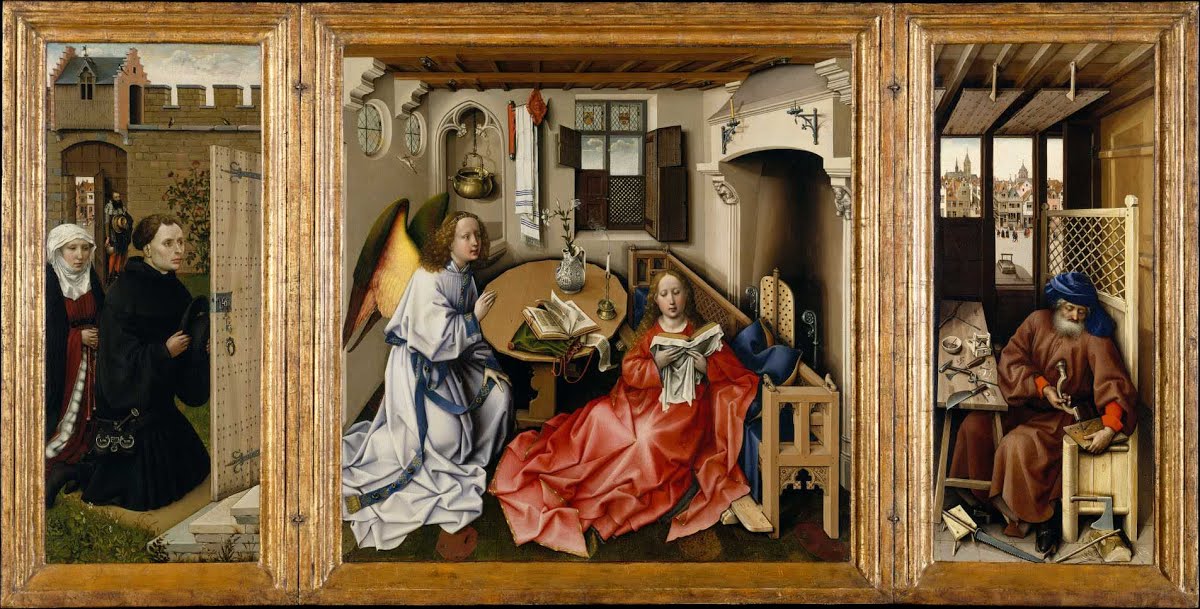
Annunciation Triptych (Merode Altarpiece)
Robert Campinca. 1427-32

Here’s the great thing about visiting New York with my wife. We don’t feel compelled to do anything, we can just be. Sure, we make plans, but it’s not like going somewhere new and strange and you feel anxious about timing, getting from place to place, or even what and when you are going to eat.

Manga comic wallpaper at Tampopo.
We’d already visited the local grocery store the night before and got a few things for the morning; coffee, cream, yogurt, bananas, granola. I was so wrung out from the events of the previous week (remember that bomb cyclone?) that I got up, ate, took a shower, and had a nap. And that was glorious.

By the time we got out, it was lunchtime, and we stopped in at Tampopo Ramen, which I first visited with our eldest three years ago. The noodles were fresh, our bowls fat with tempura. Crazy good.

New Year’s weekend in Manhattan this year, while not very cold, was certainly damp. We walked through Fort Tryon Park in the rain and mist, taking our time, wandering down to the Hudson River overlook where I proposed to her almost twenty-five years ago. You couldn’t even see the river, let alone the GWB, it was so foggy.

The Cloisters are preferable in the summer, when the gardens are in bloom and you are able to walk through them. That just meant we took more time enjoying the architecture and artwork.

I was curious, in this era where Westerners are more self-critical of our collective history of pillage and appropriation, as to when the curators of the Cloisters found in necessary to make clear, on every medieval doorway, window frame and artifact, that they were only taken from monasteries, priories and covenants that had been crumbling and abandoned ruins. Nobody cared about this stuff, okay?

Ceci n'est pas un lion.
The thing that really struck me this time around was how important the lion figured in medieval symbolism but how apparently no medieval artisans had ever seen an actual lion.

Then back to the crib for a disco nap, water and ibuprofen. These are my primary pieces of advice when visiting the big city; do only one or two things a day, stay hydrated, rest when you can, have pain reliever, pee before you leave wherever it is you are.

Finally, we embarked on our New Year’s Eve plans. There was this bro on the subway who had his headphones on and he was not selling it. That’s the thing about headphones, you really learn who knows their bars and those who do not. He was like, “hummanah-mummunah-mum O’CLOCK, mummunah-hummunah-mum MY COCK.” Keep working those rhymes, my dude.

Our New Year’s Eve dinner reservation was at Chama Mama, a Georgian restaurant on the UWS. We had seats outside, in a heated shed attached to the building. The heated shed is still a thing In New York City. It was a glorious meal, we ordered far more than was necessary, but we wanted to taste so many things. I was surprised at how (relatively) inexpensive the meal was, considering how many small plates we ordered.

First up and most notably was the khachapuri, a cheese-filled bread. Fresh baked bread in the shape of a boat, filled with a soft cheese, served very hot with an egg cracked on top. The server stirred in the egg and a pat of butter and we tore off bits of bread and cheese. I could have just eaten three of those.

Dream Big!
Unfortunately, it was raining consistently as we walked the fourteen blocks to Lincoln Center, where the Big Apple Circus was presenting a special New Year’s Eve performance of their current show, Dream Big.

What was unique about this performance, at least to me, were the videos before every act, where the circus artist provided a brief candid interview where they were able to share a little about their life and career as a performer. When do we know anything about circus performers? I thought it was nice. Most were members of extended circus families, most notably the new owner of the Big Apple Circus, the legendary Nik Wallenda.

At midnight we toasted the new year right there in the big top, and we were all invited to dance on the stage.

Saturday, January 7, 2023

NYC NYE 2023 (part one)

Mural, American Airlines Theatre Penthouse Lounge

New Year’s is a big deal for us. Not that we have traditionally been extravagant at the turning of the calendar. In fact, we have been quite modest the past few years. Even before the pandemic, we chose to stay home, alone. We only ever need each other, anyway.

Auspicious subway find.
We met on the street the year we rang in the 90s, headed to the same gathering, and have spent every NYE together since, for better and for worse. And last year we decided we would go to New York, where we fell in love and shared so many early relationship memories. Omicron be damned, and it was awesome.

When I missed the American Repertory Theatre production of 1776 in Boston this summer due to health issues, and they announced a Broadway run, I suggested we do it again – spent NYE in NYC. Maybe this is going to be our New Year’s tradition, from here on out. We would both be very happy with that. My wife scored first class seats, and we enjoyed Bloody Marys and held hands at 10,000 feet.

The wife found us a sweet little Airbnb where Washington Heights meets Inwood, and just a short walk to Fort Tryon Park. The place had a really nice reclaimed wood aesthetic. We asked our contact where we could get lunch and she suggested Koko Seafood, a Dominican joint on Nagle.

The ghosts of Steve & Eydie
hath appeared to me —
at Sardi's once ...
The guy dropped two menus but he also suggested we could have whatever they already had prepared, so we said yeah, what do you have back there? She got the stewed chicken, I got the grilled chicken, we each got red beans and rice. We were made very, very happy.

It was such a good meal that, following a much-needed nap (I think I got four hours of sleep the night before) we decided to skip dinner and just get drinks somewhere in Times Square. She asked if I’d ever been to Sardi’s, I said that I had not. We enjoyed cocktails seated next to a festooned caricature of Steve Lawrence, which was only appropriate.

Then onto the American Airlines Theatre for the Roundabout production of 1776. Here’s the thing about 1776, the original score for this show (music and lyrics by Sherman Edwards, book by Peter Stone) is part of my earliest memories. My father enjoyed it a great deal, and why wouldn't he. A lively celebration of the origins of our nation, created in 1969, possibly the worst point in our history. The vinyl was on regular rotation in my house growing up, I still have it somewhere. And the 1972 film was a must-see whenever it came on the TV, usually around Independence Day.

Festive NYC streets.
However, it has not aged well, as it sands down the sins of “our forefathers'' even as it attempts to address them. Even Lin-Manuel Miranda did this in creating Hamilton, entirely omitting the fact that Alexander Hamilton himself was once a slaver.

In subsequent productions of 1776, in community theaters and colleges around the country, people of color and women have been cast as members of a company of historical figures who were all white men. After the success of Hamilton, I wondered how long it would take before someone attempted a diverse professional production. The A.R.T. production (produced on Broadway by the Roundabout Theatre) features an acting company composed entirely of people who identify as women or non-binary.

This has not been without controversy, which was to be expected. I loved the production, I really did. You could say it had been produced for me or someone exactly like me, a privileged, middle-aged, liberal, white person – and one who already enjoys the score. Attending a performance like this would naturally soothe my sensibilities, as it would ideally present an opportunity for those affected by these men's actions, but not present in their decision making, to interpret and hopefully to provide context for the founders limitations.

Sara Porkolob in "1776"
(Photo: Sara Krulwich)
Company member Sara Porkolob, who plays South Carolina Congressman Edward Rutledge, started a firestorm among the theater community last October in which they dared to answer questions about the production with candor and honesty. They did not agree with the suggestion that the production is artistically fulfilling – for them – and even more aggressive comments for saying they only give 75% to this show a night.

Much, much more interesting, however, are their comments about the frustration of being a multidisciplinary performance artist who takes a job as solely a performer in someone else’s work. The fact that, in their opinion, the show still does not go far enough in critiquing the so-called “American experiment." It is a rich and interesting interview with an amazing artist, and I strongly recommend reading the entire thing.

The best excuse for being controversial, however, is when you are also brilliant. The most emotionally disturbing song in the entire show, no matter where you are seeing it, and the only part of the show which comes even close to addressing the massive errors in the American experiment which are still with us today, is the the eleven o’clock number Molasses to Rum, led by Porkolob, for which they say they give 90% and which they entirely walk away with. If what I heard that night was 90% of what they have to offer, I am literally frightened to experience their talent at full bore. I hope that someday I will.

Photo: TRG Reality
My one personal regret was that I did not get to see Elizabeth A. Davis as Jefferson, though the family did last summer. We were in the company of The Merry Wives of Windsor at Great Lakes together in 2005 as she was completing her studies at Case, and she participated in an odd “Mr. Shakespeare” photo shoot in which we first recreate the famous V-J Day photograph and then I apparently drop her (right.)  Maintaining the role in Boston on then Broadway while visibly and increasingly pregnant over the course of the fall, Davis left the production as scheduled around Christmas.