Showing posts with label Adventures in Slumberland. Show all posts

Thursday, April 14, 2022

End of Play (Week Two)

The reason working on these three different scripts is working is (I believe) because they are each a different kind of process, using a different part of my creativity.

One is purely generative, brand new. New characters, new ideas, new plot.

One is from original source material; a journal. I am not writing, so much as reshaping unedited thoughts into something more coherent and cohesive.

One is an existing piece which I am entirely retyping, and editing in chronological order based on my experience with having produced it as a workshop.

I can procrastinate working on one by working on another. Or doomscrolling Twitter.

The Wytches: Working in order, from beginning to end, retyping the entire script. Sections that need to be entirely rewritten I am skipping, and will come back to those. Not a surprise, they are all scenes that take place in the past.

Scenes From a Night’s Dream: I was very pleased when my professor mentioned Caryl Churchill’s Top Girls when discussing the new pages for this piece. The first act is a dream, it follows dream logic, but characters are introduced and something like change occurs for the protagonist.

The great Japanese animator Hayao Miyazaki was originally on the team that produced the film Little Nemo: Adventures In Slumberland, but was dissatisfied with the entire project. One of his main issues was that a dream is not real, and therefore holds no consequence, for anyone, including the dreamer. “A film that professes to be set in a dream world will only make the audience blank out.,” said Miyazaki

When I wrote a stage adaptation of Little Nemo for children, I took this challenge head on. There are three dream sequences (he wakes up twice in the night, it is, after all, Christmas Eve) and each time he learns something about himself and wakes with a fresh awareness.

The first act for my new work is also a dream, and then the audience is presented with a real world setting and situation, and they may be confused at first how the second act relates to the first. This is why Top Girls is relevant, as the first act is a coming together of women from throughout history for a luncheon. Only the host, the founder of a women’s employment agency, continues through the rest of the play, which is based in reality.

One revelation in the second act is, who is the dreamer? The actor who plays the boy (who for the moment I am calling Nemo) in the first act has not yet been seen. He will be, I promise. That doesn’t mean he is the dreamer.

Falling (new working title): I have transcribed those elements of the notebooks I kept while my mother lay dying which are relevant. They are written in present tense, as though they are diary entries from over the course of two months. Having set myself on this project, I am pleased so far that I was even able to do it. I had no idea what I would find in these notebooks. I was surprised by what was there. I was surprised by what was not there. My wife is looking it over, not only for style but also for errors. I want it to be accurate.

No, It was not easy to read these notebooks.

End of Play.® is an annual initiative, created by the Dramatists Guild, to incentivize the completion of new plays, scores, or songs over the period of one month.

Monday, December 10, 2018

Adventures In Slumberland (script)

Photo: Steve Wagner
NEMO: Can I help put up the tree? I want to go out into the street and sing carols and see all the people!
MAMA: No, no, no.
NEMO: I am missing everyone! They are missing me!
MAMA: Nemo, no one misses you, you are no-one.
Adventures In Slumberland was my first script for Talespinner Children’s Theatre, an adaptation based on characters created by the legendary comic strip artist and animator Winsor McCay.

Perhaps you are old enough to remember the animated film of the same name, which was released in 1989. If so, you have a poor idea of what the original comic strip (Little Nemo in Slumberland) was all about, trust me, my short play had little to do with that.

The great animator Hayao Miyazaki actually had a hand in that film’s production for a very brief moment before walking away. Among other problems he had with the production as it was developing, he reportedly could not get behind a story that literally takes place in a dream, because that means it isn’t real.

And he’s not wrong. You go to sleep, think a lot of amazing things, but in the morning you are still the same person you were when you went to sleep. None of it actually happened.

This, and other issues, were foremost in my mind when creating this play. If the protagonist is a five year-old boy, how might a dream actually change him?

And as it was to be a holiday play, shouldn't it all take place on Christmas Eve? But if the action takes place over the course of only one night, we would miss out on all those hilarious waking moments which concluded every single McCay Slumberland comic strip. I needed to resolve that issue, too.

Then there are all those so-called “Easter eggs” I was aching to include; nods to other pop culture references to Little Nemo, including those found in the comic book Sandman, lyrics from Genesis, and that more contemporary animation with a character named "Nemo." (Chennelle calls them Easter eggs, someone else might call them copyright violations.)

One of my favorite parts of McCay’s strip is how he was able to accurately depict what a dream looks like, how a dream works, how people talk in dreams. Also how maddeningly repetitive or frustrating they can be. Nemo spent years trying to reach the Princess, always failing just before waking -- because that’s what happens in dreams!

But meeting the Princess is a MacGuffin, not the actual goal of the adventure. Neither is finding Santa Claus. I loved including Santa Claus, but he’s not the main event, either! I am so subversive.

My first children’s play, Adventures In Slumberland, is a forty-minute, honest-to-goodness, Joseph Campbell-inspired hero’s journey toward self-actualization and personhood.

And it’s now available in paperback and eBook. Please share and enjoy with the literary manager of your local children’s theater, college or school.

Thursday, March 16, 2017

The Bechdel-Wallace Test

Alison Bechdel (b. 1960) is a MacArthur Grant Awarded cartoonist, creator of the long-running strip Dykes To Watch For and the graphic novels Fun Home and Are You My Mother? As a young theater artist in the 1990s reading Dykes in the Gay People’s Chronicle was a primer helping me to see beyond coarse stereotypes about lesbians when my circle of friends were either largely straight or closeted.

Click on to enlarge.
An edition of Dykes titled "The Rule" featured two friends discussing what movie to see. One explains she has three rules which dictate whether or not she’s interested in seeing a movie:

  1. One, it has to have at least two women in it,
  2. Who, two, talk to each other,
  3. about , three, something besides a man

Now generally referred the Bechdel Test, the cartoonist prefers joint attribution with the person who originally thought up the criteria, an old friend names Liz Wallace -- whose contribution, you will notice, was noted on the original strip. Though "The Rule" is thirty years old, the term has become a meme in the past decade and a starting point for discussion about gender parity across all spectrum of media.

Breaking Point (1989)
What do the results signify? You could deduce from the dearth of roles for women in film that the point is representation. You can also consider what those roles consist of; do the female characters exist merely as romantic foils or objects of sexual desire - do these female characters even have names?

The bigger question, and the question I have been asking myself of late, is what stories are we telling? It’s not about cramming more women into your movie, and it’s not even about employing more women writers - although that would go a very long way to ameliorating the discrepancy. We should be asking ourselves what stories we writers choose to present to the world.

Scripts written for the theater (call them plays) have a handicap when it comes to passing the test, if only because most plays by design will have fewer total characters. But the challenge remains the same, what story do we choose to tell?

The first play I tried writing was the one-act Breaking Point, based on my own college comic strip. One night, as I was conversing with my stage manager and fretting about the one female housemate in an apartment of four. She was as smart and smart-alecky as the rest of them in the strip, but distilling several months of story line into a thirty-minute play, I realized how all the male characters treated her like shit.

“I write terrible female characters,” I sighed.

“Yeah," she said, shaking her head somewhat sympathetically. "You do.”

The Vampyres (1997)
I didn’t have another play produced for the better part of ten years. When I finally started composing The Vampyres in the mid-90s (finally, as in, why wasn’t I writing plays before this?) I had a story I was burning to tell, about a cynical med-student and a couple of poseur vampires which also included a former crush of the protagonists and a teenage barista onto whom he transfers his affection.

No, the two women do not talk to each other. If they did, it would certainly have been about the men. However, by that time I was aware of sexism in my writing, even if I didn’t know exactly what to do about it. I strove to retrofit the character of Mary so that she was a strong women who had her own agenda as an artist, but really, in brief she fell in love with a male vampire because he was irresistible in the way we are all told we just have to accept.

The story belonged to the male characters. It was a struggle between he and the other two hes. And it was represented in a battle over possession of the two shes. Giving the female characters their own personal agendas does not change what was the central conflict of the plot.

More recently, I have been working on a two-hander, the as-yet unproduced The Way I Danced With You. There’s two people in this play, one man and one woman, so the Bechdel Test does not really apply. But is the story equally theirs? Is the pursuit of her goals on an equal footing with her pursuit of her own goals? I believe that it is, and it is important to me that it is -- and not merely to satisfy an agenda. As I reported previously, the reception of this play changed from the Valdez reading in June and the Cleveland reading in November.

My breakthrough in creating feminist plays, however, comes largely thanks to my work in children’s theater. Who knows why this is, perhaps because at a distance I can tell stories to children in which gender has the fluidity that children themselves possess.

White Garlic and Red Onion
Adventures in Slumberland featured a protagonist in the form of a five year-old boy, who could be a girl, and was, in fact, played by a woman, and probably usually should be. His hero’s quest ostensibly is to find the princess (this is eighty years before Donkey Kong) but that’s a McGuffin, it’s really about a child growing to appreciate their own personhood.

Rosalynde & The Falcon turns the princess story on its head, as a young woman is persecuted by her wicked stepfather the king, and escapes to the wood where -- instead of looking after a band of thieves (or dwarfs, what have you) she becomes the leader of the thieves, and eventually the ruler of her nation. There are two named female characters … I guess it’s funny that one of them doesn’t even speak until the very end, but they certainly do not talk about the men, they talk about governance.

My latest work, Red Onion, White Garlic, opens early next month. I hate to describe a play by what it is not, but I did not set out to create a feminist children’s play. It was not my intention to create a play which passes the Bechdel Test entirely and without qualification.

What I did do was investigate Indonesian folktales, arrive at one which centers upon the relationship of two sisters, and every moment I found myself searching for a new character to add to the narrative, she was always female. I even considered male characters, but they never made sense as part of the story. It is not that men are absent. The tale belongs to women.

Red Onion, White Garlic opens April 8, 2017 at Talespinner Children's Theatre.

Saturday, December 7, 2013

Adventures In Slumberland (performance)

Steve Wagner Photography

Adventures In Slumberland opened a week ago, on Saturday, November 30. The houses have been well-attended, the response from children (and adults) has been very positive. And we have gotten some great attention in local media.
  
Director Ali Garrigan and I had a lovely conversation with Dee Perry at IdeaStream this week. I get a bit tongue-tied by Ali keeps things pretty grounded as we discuss the psychology of Slumberland. Excuse me for saying so, but listening to this interview really makes me want to see this show.

Also, we never mention that fish. Also, too, we remember to mention Santa. You forget what kind of impression he makes, but children have been spotted leaning forward, wide-eyed when the man with the bag makes his brief appearance.
 
CoolCleveland
"If you have kids, you need to check this out." - Sarah Valek
Review

In her warm and enthusiastic review, Ms. Valek does point out that this Talespinner show (and she has seen all of them) "doesn’t have as strong as a storyline as past performances." I can't disagree with this, and excuse me for saying I meant to do that but that was one of my plans for Slumberland, that it resembles the episodic nature of a comic strip while also, eventually, getting somewhere.


Rave and Pan
"It's quite a treat." - Christine Howey
Review
 
Christine Howey mentions that Imp "speaks in a non-identifiable foreign tongue," and that was thrilling to me, because (and I believe Ms. Howey actually got this) Imp was a character I was most concerned about. McCay's original version is a grotesque racial stereotype, but while most adaptors have chosen to just leave him out, I thought he filled a necessary role as third. Third Marx Brother, third Stooge, or my case, third child.

Lauren B. Smith as Imp

Imp exists to embody the strange, unfamiliar nature of Slumberland, but that also means to know things that the outsider (Nemo) cannot know, and to comment on things without being understood. The children understand Imp, without actually understanding the words. Lauren is so marvelous with the character, and communicating Imp's language, it is flattering that Howey refers to it as a "foreign tongue" when all it is is entire sentences in English written backwards.

Sunday, November 24, 2013

Little Sammy Sneeze

HE JUST SIMPLY COULDN'T STOP IT
HE NEVER KNEW WHEN IT WAS COMING

http://www.talespinnerchildrenstheatre.org/performances/slumberland.htmWinsor McCay's first successful comic strip for the New York Herald was Little Sammy Sneeze. Like Slumberland's final image of Nemo waking up, the gag here was basically the same. Sammy sneezes, in doing so ruins something, and then he is beaten, kicked or otherwise driven from wherever he has caused his destruction.

Contrary to the subhead -- "he never knew when it was coming" -- he knew when it was coming for a good long while, and so does the reader, it's everyone else who is oblivious for four dialogue-stuffed panels. In one classic strip Sammy sits all alone, and when he sneezes he breaks the panel lines which crash around him. Meta McCay!

There is reference to Little Sammy in Adventures In Slumberland, which opens at Talespinner Children's Theatre this Saturday.

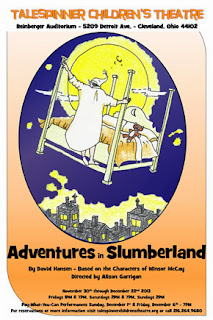
Talespinner Children's Theatre presents Adventures In Slumberland by David Hansen, Nov. 30 - Dec. 22, 2013.

Friday, November 22, 2013

Slumberland: Before Dress

Dream Master

Adventures In Slumberland opens a week from tomorrow. I had the opportunity to enjoy a run-through on Wednesday evening, the first opportunity they had to conduct one since the previous Sunday. The amount of work they had performed since my last visit, some ten days earlier, was remarkable.

Having the opportunity to share this comic strip, which had made such an impression on me and countless others, in a live stage performance, has been a, uh, well ... a dream of mine, for some time.

There have been other theatrical productions based on Little Nemo. In 2012, composer Daron Hagen and lyricist J.D. McClatchy were commissioned by the Sarasota Youth Opera to create such a work, and devised a two-hour opera, a hero's quest in which Emperor Sol seeks to destroy Slumberland by making it day all the time.

Lyrics include:
We need a world where things are different.
We need a world we can’t control, 
Where nothing is what it seems.
We need a world of dreams.
Even McCay himself produced a lavish stage production, with a cast of hundreds, of the kind only imaginable in the early 20th century opera houses or in university theater departments. My question was how could I write a script:
  • specifically for children
  • intended for a cast of half a dozen or so
  • produceable with a modest budget
  • running less than an hour
And even more important to me:
  • be always dreamlike
  • jump suddenly from place to place
  • feature a lot of characters
  • have no obviously coherent storyline
  • have always had a completely coherent storyline
  • NOT be a hero's journey
So much of what I adore about McCay's strip is that the language is completely bizarre. Maybe that was convention. Bill Watterson himself criticizes the actual writing in the strip, that the dialogue seems an after-thought. But I just find it all relevantly absurd.
NEMO: Santa Claus! What are you going to do? Where are we going? Where are your reindeer?
SANTA: Never mind, don't breathe.
Don't breathe? wtf?

I want to report here about all those items which are working so well in this expansive dream-in-miniature, but I am afraid of giving away anything. I can say this, every performer is filling his or her intended role just as I had hoped when we cast them.

Eight days now. They will be full days. Haven't even seen the costumes on them yet.

This is another dream I had.

Sunday, November 10, 2013

Slumberland: Valerie gets a haircut.


Twice before have I had the great fortune to engage the charming and talented Valerie C. Kilmer. First, when I directed Henry VIII for Cleveland Shakes (Valerie is an accomplished speaker of verse) and this past winter in the workshop production of my play, These Are The Times at CPT.


Because Talespinner holds auditions at the end of the calendar year for its entire season (auditions for the 2014 season will be December 8 & 9) Valerie had already been cast as Little Nemo for Adventures In Slumberland when we worked together on The Times last March. Before accepting the role we asked if she were willing to cut her very long, red hair for the role and she agreed!


On Friday evening, I brought my daughter with me to rehearsal, and to take these photos. When I told her Valerie was having her hair cut right there at the theater, she thought that was odd until I explain Ali would be acting as barber, and then it made perfect sense. She knows Ali can sing, act, direct my plays, create costumes, masks and dolls, and really great hats. (Emphasis: My daughter's.)


Wow!

Annie Perusek (Princess Camille), Valerie C. Kilmer (Little Nemo) and Tim Pringpuangkeo (Flip).

I am forgetting something. Valerie and I worked together one other time -- with my daughter -- at CPT's Pandemonium in 2012, when I wrote and directed a five-minute version of Slumberland. Valerie played the Imp, and my girl was the Princess.

Saturday, November 9, 2013

Slumberland: All Aboard for Dreamland


Adventures In Slumberland is the first script presented to Talespinner Children's Theatre which already included a few songs, chosen by the playwright.

All TCT productions include music and singing -- live music, produced with instruments played by the performers or using their voices. To date these songs have been discovered or created through the rehearsal process. And though I was prepared to yield to whatever fantastic and beautiful design ideas Ali and her crew would create, I wanted Slumberland to be in some way tied to the time-period of the comic strip itself.

Some of the dialogue includes period slang (though there are a few intentional anachronisms) and there is a certain turn of the 20th century "popular" music that I truly love. It's the kind of waltz-y, music box stuff you hear at the carnival, or on the Kimball organ before summer movies at the Palace.

All Aboard For Dreamland
Von Tilzer/Sterling (1904)
Performed by the "Adventures In Slumberland" company

Because this story is a dream, which takes place in a fantastic space, I was delighted to find so many Tin Pan Alley melodies of the early 20th century were themselves about remarkable places, or taking fantastic journeys in modern contraptions.

The first attempt to get Nemo to Slumberland is punctuated by a spirited rendition of All Aboard for Dreamland by Harry Von Tilzer (A Bird In a Gilded Cage) and Albert Sterling. The "Dreamland" of the song was in fact part of Coney Island, an attraction known for its wild animal acts and "freak" shows, a place where cartoonist Winsor McCay would no doubt have felt right at home, as he spent his early professional years creating posters for circuses and side shows.

Like many such travel songs (Come Take a Trip In My Airship is another, and in our performance sung by Santa Claus himself) the lyrics suggest a romantic adventure, replete with kissing and spooning and other indecent performances. I took the liberty of adapting such lines to reflect a more platonic experience, description of these intimate acts replaced with the enjoyment of candy.

Come Take a Trip in My Airship 
Ren Shields (1904)
Performed by the "Adventures In Slumberland" company

Sources
Wikipedia

Saturday, November 2, 2013

Slumberland: Rehearsal Process

  • en·sem·ble n. 1. A unit or group of complementary parts that contribute to a single effect.
I was once an actor for an amateur Shakespearean repertory company. It wasn't a repertory company, per se -- there were virtually no actors playing in both productions, but the shows were going to be performed in repertory, if you follow me. 

First night of rehearsal both companies came together for pretty much the only time, to meet and greet. The director of our production made his remarks, stating that he wanted this production to be different, that this would be a true "ensemble" of performers, working together to create this momentous work.

The other director began his remarks by announcing that unlike his colleague director's "ensemble" approach, he fully intended his production to consist of a company of insufferable divas.

Funny is funny, but point taken, and I have been careful not to casually throw the word ensemble around ever since. All acting companies can be called an ensemble, but what, as a director, do you mean when you claim some kind of unique intention to create one?

Nemo and Flip

What we create as playwrights for Talespinner is what Ali calls a guide script. I entered into this process with the complete understanding that what I wrote could be used in any manner she saw fit. This was actually very liberating in writing it. A playwright shouldn't worry very much as to the practicality of what they are writing (one of my favorite playwrights included a stage direction stated flatly that a woman pour the color blue out her shoe) but in this case I worried even less. Whatever I wanted to have happen, happens, and let Ali figure it out.

However, the extent to which she allows -- encourages -- her acting company to participate in the decision-making process is ego-shatteringly breathtaking. The first rehearsal following the first read-through, every company member (not just the actors) were expected to give a brief presentation of what they wanted. Everything was on the table, how would they produce this play, what did they want to see? She reserves the right to say no, of course. More often, however, I hear the word yes.


Come take a trip in my airship!

This kind of free-agency on the part of an actor is presumably what most actors want. One or two rehearsal reports have included the news that a line or two has been cut. I have not been asked whether or not this is okay, but I can tell you that it is, because I agreed that it would be.

Check the ADVENTURES IN SLUMBERLAND Facebook invitation.

Wednesday, October 16, 2013

Twenty-Fourteen


This time last year I posted about all of the exciting developments on tap for the coming year. Three works in the works -- Double Heart, These Are The Times and Adventures In Slumberland were happening. Even then I was in dread -- good fortune and good works only last so long, for then, what next?

What next, indeed.

Let me begin by stating what now. Slumberland began rehearsals last week. We met the company. We read the script. I am ecstatic! I have to respect the process, and will probably not have much to say in the coming weeks about how it is progressing.

Suffice to say, I had an agenda when I wrote this piece. I know what I wanted it to be. Not just what I did not want it to be, but I wanted it to be a different kind of children’s production, and one which reflects the spirit and style of the comic strip upon which it is based.

Having written said script, I have handed it off to Talespinner Children's Theatre Artistic Director Alison Garrigan, with complete confidence and trust that magic will happen. I do not believe I have ever had as little input into the world premiere of anything I have ever written, and never been so happy to have it so.

The acting company consists of people I have (with one exception) worked with before, most quite recently -- Double Heart, These Are The Times and before that Henry VIII. The designers have made their presentations, or at least announced their intentions, and it is all gonna be one big candy-colored, dreamlike, comic strip, holiday festival!

Meanwhile, the first draft has finally come together for the 2014 Great Lakes Theater outreach touring production, Seven Ages. Nine years ago, when GLT last produced Shakespeare’s As You Like It, seven area playwrights were invited to write a ten-minute play inspired by one of the “seven ages of man” as described by the melancholy Jacques (AYLI II.vii) That play was also titled Seven Ages.

This year seven different area playwrights -- Nina Domingue, Christine Howey, Mike Geither, Anne McEvoy, Michael Oatman, Toni K. Thayer and myself -- were given the prompt to create a brief tale inspired by each of these “seven ages” to be told by one of four characters from AYLI; Jacques, the fool Touchstone, the lady Rosalind (disguised as a man) or her cousin Celia.

The end result is a swift, playful night of storytelling. Each playwright has been wonderfully engaged in not only writing these origial tales, but also helping knit them together into a seamless narrative. After the hectic summer I have just had, I can’t tell you how happy I am to have this draft in my hands, and ready to share with our incredible artists and designers.

Finally, and most unusual, I was contacted by a British touring company, Freerange Theatre. They were searching for productions for their 2013-14 season. Their mission states that they produce classic and also new writing, but what caught my attention was their claim that their company is “fuelled by the belief that theatre can, and should, make a difference.”

This past year they found success producing Lee Hall’s Spoonface Steinberg, a solo performance dealing with issues related to autism and cancer in children. Searching for a new kind of solo work, one which speaks to different troubling medical issues. And thanks to the modern miracle of Google, they reached around the globe and found I Hate This.


Had I ever considered letting another actor perform my most personal solo work? If you had asked me ten years ago (and some did) the answer would have been no. I couldn’t imagine it, that would have seemed … odd. Maybe even wrong. Because it is my story to tell.

But I have told it. Two years ago CPT gave me the opportunity to tell it once more, and I said at that time that I was done with it. I had been working with it for seven years, I had no plans to make it a business, taking it to hospitals and community centers and theaters for years and years. I am in my mid-40s. It is the story of a younger man. And if a different, younger man wants to tell it, then why shouldn’t he?

And much as with Slumberland, I have confidence that this company will produce it in a manner which will make me happy. How could they not? Here is the audition notice:
DAVID - mid 20's - Late 30's. Angry yet funny, vulnerable yet strong, and a great observer. A man living in the aftermath of the stillbirth of his first child.

This requires an actor of great sensitivity, capable of holding a stage on his own. Only 'honest' and natural actors need apply. you must be able to tell a story 'without acting'. That said, your story will be interspersed by portrayals of  a range different characters so good physicality is essential.
My work is in good hands. They represent the age and gender, and that is all the story requires. Does it matter what race the man is? Not at all. Does it matter whether he employs an American accent? Now that I think of it, no it does not. The only suggestion I made upon agreeing to enter into this arrangement is that the show is supposed to be only an hour long.

Whatever happens, whoever they cast, wherever they go, I would dearly like to make the journey to see it.

What next?

Sunday, June 16, 2013

The Emperor's Ears


This year we continued what has become a Father's Day tradition: attending a show at Talespinner Children's Theatre. Their inaugural production, The Tale of the Name of the Tree had just opened last June and while my family offered to just leave me alone for the day (to go running, or go writing, any number of solitary pursuits) I preferred to spend time with my favorite people in the world, my wife and children.

This year they are presenting the Serbian folktale The Emperor's Ears. Last winter I sat in on the annual auditions for the 2013 TCT productions, because I wanted to be able to weigh on on casting for Adventures In Slumberland, which opens November 30. I watched as six sets of actors collaborated very fast to tell this same tale of a young prince born with goat's ears, I saw it reinterpreted six different times.

They were working from a brief synopsis, not the script as presented in this fully-produced version, written by Michael Sepesy (who also wrote Name of the Tree) and so I was excited to learn how it would play in an hour-long version, how Sepesy would put his special, sardonic spin on the language, and what beautiful costumes, dance, song and other tricks were going to be employed to bring the tale to life.

Not only did I have my own, immediate family with me, but I also brought my dad. We were all very delighted with the show, in particular I was so happy with all the actor-teachers in the company -- Andrew, Carrie and Katelyn. I thought Andrew was particularly in his element, unrestrained in his consummate goofiness, especially as big, grumpy, hirsute, fat guy.

Most of my glee, however, was for Cathleen O'Malley, who was so awesome at audition, she's the kind of actor who makes you want to write plays for them. 

It's a challenge, I think, to create a protagonist for a children's work. Many opt to make them bland ciphers, someone whose shoes child can theoretically step into easily ... only what child has no personality? But then, so many modern characters in children's stories and movies are just plain awful, too self-aware to have wonder.

Sepesy drew and O'Malley inhabits a young woman with a serious problem and together they are hilarious and very fun, especially when they have such great supporting characters to work against.

Tuesday, May 14, 2013

One Theatre World 2013


The One Theatre World conference came to Cleveland last week. Formerly a once every three year festival -- now biennial -- and produced by Theatre for Young Audiences/USA, OTW2013 coincided (on purpose) with the International Children's Festival at PlayhouseSquare.

I wasn't actually registered to attend the conference, I was fortunate enough to get an "all-entry" pass because I'm am a well-connected Cleveland writer person, and frankly I have been so wrapped up in annual gala benefit business and fringe festival business and two kids playing two instruments and playing on three different teams business to really notice the difference between the ICF and the OTW, anyway, I thought they were related not merely co-incident.

Regardless, by the end of the week, while I had experienced a couple great, international children's show, I saw all these excited theater people from everywhere walking places together with their Big Red Passes hanging from their necks, and the weather was perfect (unlike this weekend) and once more in my life I had the distinct and sinking impression that I was missing something.

On Friday morning I had the great good fortune to be crossing Euclid Avenue when I was and saw this guy who looked sixteen years older than a guy I knew sixteen years ago and the name "Marty" popped into my head and I looked at his Big Red Tag and it said "Marty" in large, readble letters, and I called out, "Marty?!" and recognized me, too, right away.

The first long-form improv we presented at Dobama's Night Kitchen was The Realistic World, and Marty was one of seven housemates in Tremont (people got confused ... no one was actually living together in a house in Tremont, it was a play we improvised.) The last I had heard of Marty, my wife and I were on the last night of our honeymoon in Fairbanks, Alaska. I saw a poster for a children's show posted in the Pump House. This play was directed by Marty Johnson. He is now Education Director for iTheatrics, the folks who edit and license all those "Jr." versions of hit Broadway shows.

This is the kind of thing I mean when I have the creepy feeling I am missing something. I knew there were workshops going on, but I just couldn't make time for those, but I was missing all the new, exciting people in my midst. Lucky for me to run into him, that was great catching up, and he introduced me to a few others and then I had to get back to my business in the Bulkley Building and that was okay.

But I cancelled previous plans for Friday evening, and the wife and I came downtown to skull around with our VIP passes. We stuck our noses into The Girl Who Forgot to Sing Badly so she could see what that was all about and then joined, well, everybody else to see ZooZoo. The Ohio Theatre was packed.

My goal was to catch Finegan Kruckemeyer's closing, keynote address that evening. Staff was scrambling to get everyone a seat, including all those like me (and many, many others) who had passes but no reservations. We were seated in a block of OWT participants -- right in front of Marty, as it turned out, and next to some kind folk from Pittsburgh, and behind Tim and Chris from Alvin Sputnik but I wondered allowed, given to delayed curtain, as to whether it were possible we might miss the address? The man sitting next to me motioned directed my attention to seats behind and to the right observing, "Fin's sitting right there, they can't start without him!"

If there is one thing I regret in life, it is that I have not had enough mentors. I cannot remember who gave me that advice, or when, but "Find a mentor, attach yourself to them, be near them, apprentice yourself," was once recommended and more than most I know I not only ignored this advice, but actively strove to achieve great things entirely unschooled and ignorant.

Joyce was a great inspiration to me, and I learned many things from her about management, communication, hard work, and unapologetically maintaining core beliefs. Daniel taught me honesty, responsibility, loyalty, dignity and joy. There were also many college professors and instructors who wisdom I heard, but failed to deeply plumb.

So having the opportunity to enjoin, engage and listen is to me (especially at this point in my life) some hard to come by by also deeply treasured. Attending a conference is like searching for a parent I never had.

Fin.

Last Spring (as I noted last week) Fin led a session on playwriting which was truly eye-opening, and I had high hopes for his address which were entirely satisfied. How much can you learn in one 45-minute lecture? An awful lot, actually, when the speaker is well-prepared, interesting and impassioned, as Fin was. His main point, which was not coincidentally the summation of my last post on the subject, is that as creators of children's drama (a subset of children's literature) many have become to concerned with the why or the how, instead of being solely immersed in the what.

As one whose occupation is in theater education -- and for the last four years not merely the facilitation of theater education, but one who writes grant proposals for corporate, government and foundation support of such work -- I knew of what he spoke. The justification for children's theater can be the wet blanket thrown over the art of simply telling the story, letting the story happen, after which someone else can determine its significance, its learning potential, how it satisfies key educational benchmarks for achievement.

Speaking from notes but flowing as though these thoughts were spooling out from the top of his head, Fin launched into numerous lists of companies and artists from around the world who satisfy the what in their work, and unreeled a panoply of premises for stories like he was that Dream-tortured author from Sandman.

We had the opportunity to chat only briefly following the talk, there was a babysitter to release, but I promised to send him the revised draft of Slumberland once I get to it, which I hope is sooner than later. Last week's reading, the variety of shows I had experienced last week, and Fin's closing address made me more confident in this new work, which is good. It would have only been too easy to look at the professional delights before me and think, Good Lord, what is this piece of crap I have spent so much time on? I am glad that this is not the case.

Recently, my daughter's violin teacher moved from the Heights to Orange. The girl self-started, almost three years ago she asked if she could learn the violin -- which was odd because my wife and I do not have an instrument ... true, on my wife's side there are some fine musicians -- and we said, oh, ah, of course. She is a dedicated pupil and her mother has added to her world of responsibilities the care and tending of daily practice.

Her teacher is quite excellent, and while we were at first a little concerned about the new, forty-five minute drive to lessons each week, it was really only twice the amount of time it took to get her across town. One family friend suggested we find someone else nearby, that our schedules are so full as it is to be worth the trip.

I would have imagined that ten would have been too young to already be advising my girl to "find a mentor". Having already found one, however, the least we can do is drive her there.

Thursday, May 9, 2013

International Children's Theater Festival (2013)


Last time I was Fringing in New York, I missed an opportunity to see The Adventures of Alvin Sputnik, Deep Sea Explorer. There were three companies that had arrived together from Perth, Australia, Tim Watts' Weeping Spoon, producer of Alvin Sputnik was one. Mark Storen (see below), whose A Drunken Cabaret I did get to see was another.

Watts' show received some very nice press, including an interview in The NY Times, and by the time it had come to my attention I was either scheduled for the same time or it had sold out. So I was surprised and delighted to see that it was on the slate of productions presented as part of this, the fourth year of PlayhouseSquare's International Children's Festival, a fantastic celebration of live theater arts which truly explore the vast possibilities inherent in and unique to live performance.

The festival proper opens today, May 9 and runs through Saturday but there are also school matinees, so yesterday I had an opportunity to sneak in and share this astonishing "solo" show with a roomful of kids that looked about my son's age.

The Adventures of Alvin Sputnik, Deep Sea Explorer

I used italics around the word "solo" because though Watts is the featured person -- the guy with the recognizable face -- he works with an small, experienced team of artists and puppeteers to make it all work. And I use the word astonishing not only because of the delightful and surprising use of puppets, screens, video, live music, sound effects and darkness, but also subject matter which is at once reassuring, sweet, loving, and very, very bleak.

Let me put it this way, without giving away too much -- the premise is based on ecological disaster on a global scale. That's at the beginning. But following the protagonist as he manages and copes with his world sets in motion a melancholy hero's journey driven entirely by love. There is also an eight-inch tall hand puppet in a diving suit that can breakdance.

Sitting in this darkened room, as one with children, and one who works with children, I was at once thrilled and terrified. Can you actually do this? Sure, most of these kids have seen The Avengers, destroying things is part of their daily roleplay. But this is different, isn't it? Or is it. The very real threat posed by global warming and rising sea levels. Will there be nightmares? Or resolution to change things? Maybe both, who knows. Is it an artist's job to worry too much about what will scare the children, or just to stay honest, be clear, and be gentle.

Because that's, at last, what I saw in Alvin Sputnik. It is honest, it is clear, and it is gentle.

The Girl Who Forgot To Sing Badly

Yesterday, we saw The Girl Who Forgot To Sing Badly, written by the Tasmanian Finegan Kruckemeyer and produced by the Irish TheatreLovett, which is not gentle, but rather brash, velocious, and has really great hair. Louis Lovett spins a yarn -- well, I mean, he unpacks it out of many boxes and then spins it, which is a terrible thing for me to have done to a metaphor -- and revels in his own personal awesomeness.

Though his work is very physical, he exhibits tremendous focus. It is very clear, inspiring movement work, and an inspiration to men like me, who do not think of themselves as lithe or graceful. I thought, I can do that. I really should try. Do not fear the clown, but set him free.

Because even though the production features a great set, comprised of boxes within boxes within boxes (even Lovett's costume is a box within a box within a box, if you follow me) and though Kruckemeyer has crafted an irresistible story (another box w/in a box which, like Alvin Sputnik features end-of-the-world elements) it is the direct, clear, concise, animated, fantastic and outsized storytelling of Lovett upon which the success of the piece rests.

These two pieces of children's theater -- which can be enjoyed by absolutely anyone, really -- acknowledge and honor their undersized audiences in two different ways. In Girl Who Forgot it is the weight of detail and demand for attention that puts kids on notice that there will be no dumbing-down, keep up, children, you will get this, and in Alvin Sputnik the almost absolute absence of narration for long stretches of the production where we all just watched spellbound as wonderful and even frightening things developed and played out in elegant ways.


But seriously, what does this all have to do with David? I am so glad you asked. On Monday evening I had the opportunity to hear Adventures In Slumberland read for the Playwrights' Unit. In general it was a reassuring success, most comments were very positive. The crew that had assembled to rehearse once and then read were instrumental in the reading coming off all right -- especially as there are several turn-of-the-last-century melodies which they learned on their own time, primarily by looking up ancient wax cylinder recordings on YouTube.

Having never before written more than something like a short sketch for children, I wanted to try something special and new, unpredictable ... but not so odd as to be incomprehensible. What are the lines? Where are the boundaries? How much will I allow myself to trust the child? Readers of this blog may expect to read more grappling in the months to come.

As should now be abundantly clear, a children's show can be anything, about anything, anywhere, or everywhere, or nowhere. Kruckemeyer himself held a workshop here a year ago (thanks Deb for chronicling his writing exercises) which cracked open my perception of what writing can be and how a story can be successfully built.


Tim Watts, Finegan Kruckemeyer and I have one mutual friend:
Ladies and gentlemen, Mr. Mark Storen.
NOT SAFE FOR CHILDREN

Friday, January 25, 2013

Double Heart: Commencement

We have arrived!

Throughout the holidays and on into the sudden bright harsh winter cold, I feel as though I have been in a creative holding pattern. The last several days, all three projects of the new year have opened themselves up, like a pale, fragile bloom pushing through deepest snow.

You like that? I am a writer.

Rehearsals for Double Heart began on Wednesday night, and yes it's true: I enjoy listening to people talk about my work as though I were Shakespeare. Just yesterday afternoon, set designer Terry Martin called me into the rehearsal hall to share the set he and his team just assembled there, and to describe to me exactly how it will come apart to pack into the van for the tour.

We are in Messina!

The set is elegant, simple, highly attractive, and will be perhaps the lightest, simplest to pack and move of any set we have used since 2009 when the Chekhov plays utilized the pipe and drape and four pieces of furniture.

Rehearsals for These Are The Times have resumed in earnest. The Big Box series began last weekend, and our historical Cleveland pageant is the final weekend, but that still seems awful close with so much to do ... until I think I need to rehearse an entire other play, tour it and wrap it up before Times even opens. That puts things in perspective. At least it does for me.  

More wonderful still, I threw out eleven pages of Slumberland to be read aloud during Playwrights Unit on Wednesday. Not such a big thing in the large picture, to have a few odd pages read, but there is something warm and reassuring about knowing what you wrote -- especially when it is packed with dream-shifting nonsense -- is something people can follow, holds their interest, even makes them laugh, and wanting to hear more.

So far it is, as Eric S. put it, "True to its own world." I think that is something I am good at.

"I am afraid of this performance."

We had a brief discussion about plot, and how plot can or cannot work within a dream. The first stage things are just "happening" with little rhyme or reason, though there is a goal, a basic goal, not an all-encompassing goal, but something to be accomplished before we can move forward. But is Nemo aware of that, or is he just be taken along for a ride? And is that all right?

We commence. We proceed. We move forward, in this and in all things.

Friday, December 28, 2012

Slumberland: It is happening again.

My mother-in-law loves me.

2:58 PM - Another day, another Donkey. Today the wife is not feeling well, but the kids already have a date to check out Monsters Inc. in 3-D with their aunt and grandmother, and so I have persuaded her to make our third journey into the Writers' Warren.

I have been storyboarding scenarios from Little Nemo, some of which are taken wholecloth from the strip, embellished from my own imagination and unhealthy nods to other McCay-inspired entities which include (but are not limited to) Sandman, In The Night Kitchen and maybe even Twin Peaks.

Also, too: This.

But they are disjointed and incoherent, as in a dream. Did I say that, or only imagine I did? In any case, that is the plan. Having just made stuff up off the top of my head, I will now make notes to put it into a logical, plot-like narrative. Which is the opposite of what I usually do. And that can be fun.

Did I mention my mother-in-law got me a proper, leather satchel for Christmas? Since I got my laptop, I have been permanently borrowing a prop from the Great Lakes Theater production of Julius Caesar (2004) where all the workers in the street  at the top of the show were vloggers and bloggers. That synthetic, black man-bag had a nametag reading "Nick K." in it.

4:01 PM - Bryan Ritchey will be my Carel Struycken.

And the owls are not what they seem.
http://www.talespinnerchildrenstheatre.org/performances/slumberland.htm
 The Dreaming:
Recently I was rehearsing for a professional production of one of Shakespeare's lesser-known works. Don't ask me which one it was, but I was a Lord. As part of the rehearsal process, the director was conducting a kind of free-form, staged read-through, where we walked into the middle of the rehearsal space and performed our particular soliloquy. It was one of Shakespeare's works where none of the characters talk to each other, they just just take the stage and share part of the narrative with the audience and exit. I read my piece twice. Each time I reached the word "egg" and then completely lost the thread of what I was saying. "Egg" was entirely out of context for this character, it didn't mean anything.

After my part of the rehearsal was through I went back to the Arden and looked up the longer notes, which I was embarrassed to learn I had not yet done. I assumed I knew what the words meant, but I was woefully unprepared. "Egg" was the most important word in the monologue. It was the core of my character, I had no idea what the hell I was doing.

These things are true. All of this has happened before. All of this will happen again.
4:43 PM -  Did you know Little Nemo visited Cleveland? Crazy, right? I have not yet read all of the comics as late as the 1910s. But I must, I must!


Today is a day for letting my mind wander and discover. Running this morning I came up with several ideas which I have tossed around and made note of. And now I just spinning some nonsense into script form.

5:44 PM - Time for dinner at Casa Nueva, suckers.

Talespinner Children's Theatre presents Adventures In Slumberland by David Hansen, Nov. 30 - Dec. 22, 2013.

Sunday, December 9, 2012

Alison Garrigan

Heather N. Stout is an evil queen in "Magic Flute"
(Talespinner Children's Theatre, 2012)

My friend Ali Garrigan has lived in the creative service of others, and by that I mean she has existed as collaborative partner in all manner of artistic endeavors, always providing an unending fount of positive energy and enthusiasm along with bottomless creativity and joy to whatever pursuit she is currently engaged in.

Quite often toward more than one project at a time. Sometimes twelve.

Since 1996, for this theater artist alone, she has created original music and created soundtracks for, performed in, directed others and directed me in plays I have written, designed and created costumes for and performed in plays I have directed, designed and created costumes for plays I have performed in directed by others, and we have performed in plays together.

We have collaborated in well over fifteen plays in fifteen years. That’s just with me.

This weekend the family traveled to see the second offering from Talespinner Children’s Theatre Magic Flute (a new adaptation based on the original folk tale written by Anne McEvoy) and remained after to witness auditions for the 2013 productions.

Ali’s skill at working as a great collaborator in others’ companies has prepared her for the most creative, collaborative, and positive-spirited environment I have walked into. She is “in charge” but only in the sense that she empowers all participants to step up and confidently contribute to the best of their ability.

It is astonishing how much sound, color, music, movement and magic is compact onto on small stage, with seven actors, in one hour during Magic Flute. The production does not represent one theatrical discipline, it samples from plenty, whichever suits the situation, from Far East to Africa to European folk tradition, with one or two contemporary quirks thrown in, but only one or two.

At the risk of quoting myself, she suits the action to the word, the word to the action.

I owe Ali a script for Adventures In Slumberland. It will come. Attending Magic Flute was necessary, even after witnessing The Tale of the Name of the Tree last summer. I wanted to pay attention to the text, and how much was text, and what they do with it. She calls our work “Guide Scripts” which I like. I like the opportunity to be that kind of collaborator, that the writing is as fluid as the direction or the performance, or any and all of the technical elements.

Watching her, as I am right now, leading actors who (in some cases) have never met, to discover how they move, and think, and collaborate, and take imaginative risks with each other … well, it’s a lot like auditioning to be a GLT actor-teacher, honestly (which means I am in my comfort zone) but unique to the task at hand, and unique to Ali, as director.

How often does someone have the opportunity to consider the company before writing the play? It happens. It is rare. It is a gift. I got a lot of dreams for Slumberland. I have confidence that Ali will make them reality.

UPDATE: Talespinner Children's Theatre presents "The Boy Who Stole the Sun," adapted and directed by Alison Garrigan, now through October 7 2019.

Sunday, October 21, 2012

Twenty-Thirteen

Last night we attended the second annual Talespinner Children's Theatre benefit at Mahall's in Lakewood. Theme for the evening was "Glam Rock" which for some reason the kids today confuse with Hair Metal ... my wife almost cried when we had to explain to one of our party exactly who David Bowie is.

Regardless, it was a tremendous evening. My favorite moment of the night was before we'd even left my parents' house, watching the girl spraying my wife with glitter in the driveway. Precious moments. I knew I wasn't going to swing any kind of Lou Reed look, I can't fit into those pants right now. But a headpiece in the education department rehearsal space gave me an idea, and so I cobbled together an ensemble inspired by Ming the Merciless. I am glad to say there were several on hand who didn't even recognize me at first glance.

Followers of this blog may notice a certain slacking off since Styles closed last March. Henry VIII inspired numerous entries about production, and there were the occasional events which warranted mention in a Cleveland-writing blog. But there's not much research going on, not much to share Just my day-job, and my home-life. This will all change very shortly.

Next year will be busy indeed. I have three productions in 2013, one of which was announced at the benefit last night and I am now free to discuss all of them.

"DOUBLE HEART (THE COURTSHIP OF BEATRICE AND BENEDICK)"

Every year, Great Lakes Theater offers a free play which tours 21 locations in Cuyahoga, Summit and Lorain Counties that is tied to themes represented in one of its mainstage productions. This March they will present Shakespeare's Much Ado About Nothing. Several years ago I saw a production and a certain exchange jumped out at me:
Don Pedro: Come, lady, come; you have lost the heart of Signior Benedick.
Beatrice: Indeed, my lord, he lent it me awhile; and I gave him use for it, a double heart for a single one.
And their history as lovers, or one potential history, was revealed to me. I was elated when Daniel gave me the green light ... on one condition.

He asked, "Can you write it in verse?"

Uh. Sure! And that's what I have done. One hour tragic romance told in verse, including humor both high and low, a sword fight, and dancing! For those who can't get enough of me, I will be playing four different roles in this one. Sigh.

"THESE ARE THE TIMES"

Yes. At long last, the so-called "Cleveland Centennial" which inspired this blog will come to a stage near you. You have three chances, March 7, 8 & 9 to experience this fictional panorama of Cleveland during its heyday at Cleveland Public Theatre.

Ten years ago, CPT started its popular Big Box series, giving local artists the opportunity to showcase new works. That year -- 2003 -- I had the unique chance to share my first solo production, I Hate This (a play without the baby). I can't express how excited an apprehensive I am about having the chance to get a reaction to this new piece from a Cleveland audience.

"ADVENTURES IN SLUMBERLAND"

For the 2013 Holiday Season, Talespinner Children's Theatre will present this world premiere adaptation, based upon characters created by Winsor McCay for his groundbreaking comic strip Little Nemo in Slumberland. For Pandemonium I developed a five-minute treatment. It was a delightful experience, and made me feel confident that I could expand it into an hour-long piece for kids.

We decided not to use the name of the main character in the title, because everyone would think it was about a fish.

Last night at the benefit I won for Best Costume: Male. It's going to be quite a year.