Showing posts with label Shakespeare's Globe. Show all posts

Monday, June 8, 2026

Our Unwanted Journey (2001)

“Soon after we got out of the hospital, my brother Harrol asked if we wouldn’t like to stay with him and his family in London. They had a couple of free weeks in June. June. We hadn’t thought of life past the due date. The summer was supposed to spent with a new baby. We accepted their invitation immediately.” - I Hate This (a play without the baby)
Father's Day, 2001
When we took our massive, three week Southern road trip in the year 2000, it was intended to be our last vacation for a while. We made plans. And God said, “Fuck you.”

Looking over our materials from that trip, I was surprised by many things, not least of which is how much made its way into I Hate This. I shouldn’t have been too surprised.
Sun., June 17: Father’s Day. No ties or socks, please. I’d just like my dead son back.

Finished “The Sparrow” late last night. Toni finished its sequel, “The Children of God” almost an hour before, and was very sad. That one ends with someone holding a baby.

Lots of things end with someone holding a baby. In fact, I may have said everything ends with someone holding a baby. Nothing ends with someone holding a dead baby. Maybe we should change that.
I hadn’t yet read Buried Child, but still. I was onto something.

I Hate This has been noted for my stoicism, or my dispassionate accounting. My journal from this trip tells another story, where I make note of no fewer than four times I had to excuse myself to go cry somewhere alone in one of the many rooms in the house my brother and his family were managing.

We also saw a remarkable number of plays, remarkable in that my wife didn’t feel like doing much of anything at all at that time, or not much more than to sit in parks and watch the birds. I was still (theoretically) managing a theater company, seeking inspiration and desperate for distraction. Also, our eldest brother had also joined us and what do you do on vacation but go and see things.

Carina Reich and Bogdan Szyber
"Night Manager"
Night Manager
created by Carina Reich and Bogdan Szyber (LIFT: the London International Festival of Theatre)
Wed. June 13: A boat ride down the Thames at dusk. We wore headsets and listened to poetry about life underwater (the fear, the subconscious) while attendants served us a mint, warm milk and spices, gave us a blanket, while we watched London drift by in the dark. It was a pleasant experience. (DH)
“Despite the discreet revelation of this stretch of the Thames at dusk … you find yourself gazing more at the dark grey water itself than at the cityscape on its banks. [Björner] Torsson's text encourages you to slip into reverie; after a while, the words are there not so much to be listened to as to maintain the semi-hypnotic state into which you have drifted.” 
- Ian Shuttleworth, Financial Times
Howard Katz by Patrick Marber (National Theatre)

I have already written about this. The timing was poor.
Thu., June 14: I like it better upon reflection than I did watching it … a modern cross between King Lear and the story of Job where one awful man loses everything … his epiphany comes as a result of remembering what it felt like when his son was born. It upset Toni a lot. Made for a shitty trip home. We did have hot chocolate and Bailey’s in the kitchen, the five of us, and a nice time talking there.
Stephen Mangan, Lynn Redgrave
"Noises Off" by Michael Frayn
Noises Off
by Michael Frayn (Piccadilly Theatre)

My junior year in high school, we conducted a workshop of first act of Noises Off and during my senior year the Cleveland Play House produced the first professional production I had seen. This was my second, a National Theatre transfer that now starred Lynn Redgrave and Stephen Mangan, who would later star in the fucking hilarious TV show Green Wing.
Fri., June 15: Lynn Redgrave. Man. She is a loon. First act was all right. The second they shouted too much. Gave me a headache.
Father’s Day proper we eschewed theater altogether, my brother and his wife thoughtfully proposing a drive to the New Forest Otter, Owl & Wildlife Park.
Sun., June 17: The park was very big; boards, wallabies, deer, ferrets, polecats – and lots of otters. Europeans, Asian, British, Canadian, big, small, swimming, galloping, dry, wet … very fun, very moving. We stayed a lovely, long time.

And then we had dinner at Outback Steakhouse.
Bill Nighy and Chiwetel Ejiofor
"Blue/Orange" by Joe Penhall
Blue/Orange
by Joe Penhall (Duchess Theatre)

Every time I see professional theater in Britain, inevitably one or usually more of the actors in any given production eventually become stars in America. They were probably already famous in Britain, on stage and the Beeb but I’d never heard of them.

I have caught more than one play about the National Health Service (NHS). Two years ago that would have been People, Places and Things by Duncan Macmillan, a quarter century ago it was Blue/Orange, a three-hander in which two doctors debate whether or not a man who claims to be the son of Idi Amin (and believes oranges are blue) deserves his state-sponsored hospital bed.

All three actors were very good. They also happened to be Chiwetel Ejiofor, Andrew Lincoln and Bill Nighy.

Remember when everyone was writing plays that had two word titles with a slash in the middle?
Tue., June 19: I read the new Neil LaBute, “The Shape of Things,” now playing at the Almeida. Honestly. What is wrong with that man? I think he is a good writer, he just doesn’t write good. Here he’s trying to write something like "Closer" only it’s closer to Oleanna in its lack of balance and treatment of women and his male protagonist doesn’t deserve anything that happens to him.
Jasper Britton and Eve Best
"Macbeth" by William Shakespeare
Macbeth
(Shakespeare’s Globe)
Tim Carroll, Master of Play

This was my first experience hearing a play at Shakespeare’s Globe, though as of 2026 I have only seen two productions there. 

We participated in a tour the last time we were in town, shortly before the grand opening in 1997. Since that time, and under the artistic direction of Mark Rylance, the company had distinguished itself by its dedication to historical accuracy in design and, as near as can be ascertained, performance.

This production of The Scottish Play, however, was controversial for its nontraditional conceit, the entire cast (including witches) dressed in tuxedoes, with the exception of Lady M. (Eve Best) in a silky, silver gown. The cool jazz score was composed by Claire van Kampen, and I am so grateful to have had the foresight to purchase that CD.

“It is welcome and right that the Globe should start to experiment and move on from what was in danger of becoming museum Shakespeare, but Carroll's production doesn't even tell the story clearly. There is too much paraphernalia, as if every bright idea has been indiscriminately incorporated rather than carefully considered. So we get blood and death represented not just by gold tinsel, but also by coloured feathers and pebbles thrown in buckets.”
- Lyn Gardner, The Guardian
Well. I enjoyed it a lot.

Peter Capaldi and Henry Goodman
"Feelgood" by Alistair Beaton
Feelgood
by Alistair Beaton (Garrick Theatre)

Not all political dramas have a freshness date, The Resistable Rise of Arturo Ui still holds up, but this one was a bit whiffy when it premiered. I was excited to see Nigel Planer (The Young Ones) live on stage, but the delight of the evening was Peter Capaldi (who?) as a frazzled No. 10 speech writer. It would not surprise me if this turned out to be his unintentional audition for The Thick of It a few years later.
Wed. June 20: Well. I am sick of bad playwriting. Saw "Feelgood” tonight. Wish I hadn’t. Left me depressed. Stupid, preachy, unfunny comedy. It’s a TV movie on-stage. I hate that.
School Play by Suzy Almond (Soho Theatre)

Our final production – in London. A play which puts the lie to the time-worn story of the teacher with a heart of gold who helps disenchanted students discover their true selves. What if the teacher isn’t actually very good, in a very real and troubling way?
“The situation is ripe with sentimental opportunities, all of which Almond strenuously resists. What she actually shows is two solitary misfits with a ruthless eye for each other's weaknesses.”
- Michael Billington, The Guardian
Returning home, we had made plans to spend a few days in NYC before taking a train home. This turned out to be an error, we were emotionally spent from our journey and ready to just not do anything.

And yet. We spent a lovely morning getting tickets to see Mary Zimmerman’s production of Measure for Measure at the Delacorte, starring Billy Crudup, Sanaa Lathan and Joe Morton. As it happened, we would be back in August to see the other free summer offering in the park, but to attend The Seagull we would need to spend the night.

See also:
Howard Katz (play)
The Seagull (2001)


Sources:
"Review: Macbeth" by Lyn Gardner, The Guardian, 6/7/2001 
"Review: School Play" by Michael Billington, The Guardian. 6/24/2001

Saturday, January 28, 2023

The Replacement Theory of Playwriting

Isobel Thom as Joan
"I, Joan" by Charlie Josephine
(Shakespeare's Globe, 2022)
Photo: Tristram Kenton
There are a few social media organizations that focus on the world of American theater and, like a lot of social media sites, generate poorly sourced and written articles which are promoted with headlines designed to drive visitors to their site and most importantly to their advertising.

This is called clickbait. But you knew that.

One of the more egregious offenders recently posted an article with the headline, [Shakespeare’s Globe Artistic Director] Michelle Terry Fears for Actors' Safety in 'Woke' Plays.

This headline is misleading. It leads one to believe that Terry fears for actors' safety when working in the company of something called a "woke play." It conjures images of actors being harmed in the rehearsal or performance of such plays, whatever they may be.

However, nowhere in the article does Terry herself use the term "woke" nor does the article attempt to describe what that word means. Her concern is for the safety of artists who are members of productions that have been defined by others as "woke."

From the article: "Some of [the Globe’s] recent productions have been accused of being 'woke'."

Really? Some have said this. Who are they? And what did they mean when they used the term "woke"? It is important to be clear about this, because these people, those "some" who have said this, they are the people who Terry believes may threaten the safety of her company of performers, and not as the headline implies, their participation in such productions.

Headline would better read: Michelle Terry Fears for Actors' Safety From Those Who Define Certain Plays as 'Woke'

The writer of this article does provide two examples of so-called "wokeism" at the Globe. One is last fall's production of I, Joan by Charlie Josephine in which the main character, inspired by the person of Saint Joan, identifies as non-binary, and a production of Romeo and Juliet which included a content warning about suicide.

It is true that I, Joan received a great deal of online bullying prior to opening from people who were angry that Joan de Pucelle was to be presented as non-binary and using they/them pronouns. They accused the playwright of "erasing" a famous woman. As far as I can see, Joan of Arc’s place in history is unaffected by the production (Shakespeare depicted her as a demon, didn't stick) though the visibility of a trans non-binary character at the center of a professional production was by itself historic and important. 

My brother, who actually saw the production, unlike any of those who decided they hated it before it had even opened or really knew anything about it, said I, Joan was, " Excellent, fun, ALIVE." It started raining the day he saw it, he says nobody left.
"The play is first and foremost about the trans experience. All the soliloquies were about identity and inclusion in very personal ways. The historical part was the body of the play but it kept coming back to Joan's experience out of time. They pondered why men are so hung up on pronouns, toilets and Twitter." - Henrik H. (my brother)
And providing a content warning for R&J? Who cares? In what possible way does taking the subject of suicide seriously, and alerting anyone unfamiliar to the conclusion of this classic play (yes, they exist and that's okay) disrupt anyone's enjoyment in watching it? And anyway, how is that "woke"?

When the article in question was posted a little over a week ago, there was a great deal of back and forth about what a shitty article it was, and I mean from a journalistic standpoint. Really stupidly written, sloppy and by extension, offensive. Written expressly to provoke, not to inform.

Read it, it's good.
#WeAreJoan
Leaping into the discussion midstream, one cishet, white, American guy on the thread (full disclosure, I am also a cis, white, American guy) attempted to define “woke” this way [brackets provided for clarity]:
"Woke people" are against a diversity of ideas and anything that questions their narcissism is deemed racist or ignorant. Actually, the majority of us don't identify as "woke" or even "anti-woke" 
We [which is to say people like this commenter, in comparison] focus on the individual responsibility of a persons (sic) instead of breaking everyone into groups based on religion, ethnicity, and whatever subgroups come out of that. We aren't interested in having a victimization contest. 
If you want a true diversity of ideas, it's best to be left of center. Reject ideology and become a complex vessel of ideas!
So many contradictions, it makes my head spin. He's true about one thing. The majority of us don't identify as "woke" because no one does that.

Further investigation (yes, I got creepy) revealed that this commenter is in fact a real-live, moderate, liberal Democrat, and not some bot or right-wing troll. It is because of him and people like him that my son is a complete Leftist.

It gets worse. Unlike some who have no particular interest but to thread-crash in order express their resentment and rage, this guy is an actual community theater director. Addressing me, specifically, he said this:
I happen to work in the performing arts as well. I can guarantee you [i.e. David Hansen] will have a harder time producing a play you've written in this climate. (Unless you live in an all-white area). Why should you give up your art to allow someone else to take your place? I think you should fight for what you've worked so hard to achieve and take a back seat to no one. Unless they prove that they have more skill.
Welp, he said the quiet part out loud. Take my place? What place is that? The assumption here is that white men remain the most-produced of playwrights because of their superior skill, that they have earned their position of supremacy, and that recent trends of centering marginalized voices are robbing these white men of their rightful place.

Here are a few reviews for the Globe Theatre production of I, Joan: 
"A rousing protest piece." - The Guardian

"A joyous celebration." - Time Out London

"Funny, fierce non-binary Joan of Arc proves sceptics wrong." - The Independent

"Joyful and unifying, this could be something of a game-changer." - Evening Standard
Does this not prove their skill? I think it doth. 

As I endeavor to get my own work produced, I am keenly aware that in a past era (maybe only five years ago) I would have had more opportunities for production. But not because my work was better.

Today’s emphasis on those whose voices have previously been ignored has inspired me to make my work more relevant, and hopefully to make me a better playwright. I want make work to be good enough and deserving enough to take my place with them.

Wednesday, June 8, 2022

England, 1997 (Week Two)

Shakespeare's Globe
Our second week visiting England in June 1997 was busier than our first, and in spite of developing something like a cold, we kept seeing shows and even took an overnight trip to Stratford-Upon-Avon. It helped that my brother and his family lived close to the city, which helped cut down on cost. We did a few things together, but they were also raising a sweet two year-old girl which kept them close to home.

Monday night we saw Ute Lemper sing Weimar Berliner cabaret songs at the Almeida Cabaret in Islington. She was a new surprise to us, though by the late 90s the German-born performer was already an award-winning actress on stages across Europe playing the leads in shows like Cats and Chicago.

Today I learned that if you were a German child in the late 1980s, she was the singing voice of your Ariel in Disney’s The Little Mermaid. On the evening in question she was singing and storytelling about the kinds of passionate and transgressive songs which inspired those created for Cabaret.
Mon, June 9: “Opening night. Full house. Third row. It was wonderful. Tall, red hair, high cheekbones, child-eating smile, arching eyebrows … humorous, passionate, amazing … English, German and French, beautiful and scary.”
Ian Holm & David Burke
"King Lear"
(National Theatre, 1997)
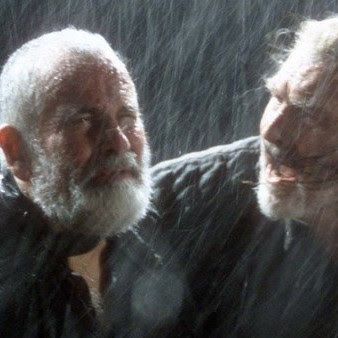
Yes, it rained on stage.
Featuring songs with titles like Masculine/Feminine, Sex Appeal and Ich Bin Ein Vamp! Lemper shared the legacy of sexual liberation and gender fluidity which would soon be extinguished by a Fascist regime. (See also: The Degenerate Art Exhibit.)
“The Almeida is my theater, it’s the theater I want. Like a round, brick well, high-ceilinged … intimate. Fantastic space.”
The next day we were able to get rush tickets to see Ian Holm’s return to the stage after several decades, performing King Lear in the Cottesloe Theatre at the National.
Tue, June 10: “A cold, cold Lear. Holm came out of the gate intense and quick to anger … small man but a huge presence. I wish Dad could see it. Almost no music. Run on, act at your leisure, run off.”
We took an overnight trip to Oxford and Stratford. I was unwell but we pushed on.

With brother and his family.
Even Oxford had a tourist trap, and we do love tourist traps. We took a spin on The Oxford Story which is a straight-up dark ride, a maddeningly slow roller coaster ride through the history of England’s oldest university featuring lots of still marionettes. Narration was provided over headphones while we were shuttled along in cramped, little desks.
Wed, June 11: “And it’s sponsored, produced and sanctioned by the school! Can I blame the Americans? Our entertainments must be 3-D, automated, cold and tacky. The House on the Rock produced by the Corporation for Public Broadcasting.”
We spent the night in Stratford where we had dinner at the Glory Hole (yes) and took in a performance of Camino Real at the Swan Theatre, where I also saw “The Seagull” in 1990. 
“A live band made for most excellent music – a lot of Beat-era jazz, for example.”
"Phantasmagoria!"
(There is literally a guy on the floor,
covering his head.)
The next morning we saw more Shakespeare-oriented historical sights than the entire time I was there in 1990. Of course, much of my time there seven years earlier was to take workshops and to see shows, and it was very, very snowy. My partner said Stratford was the most delightful place we had visited so far.

We took the train back to London, and that evening, Henrik, Toni and I saw Anthony Neilson's The Censor at the Royal Court. Bad Epitaph would produce this play in September 2001. The run was cut short for obvious reasons.
Thu, June 13: “Great. Inspiring. Emotionally awful.”
On Friday we visited the Museum of the Moving Image (MOMI), a historical celebration of the science and craft of projected entertainment. I was particularly taken with the devices which created thrilling or unsettling imagery for unsettled audiences well before the invention of what came to be known as the motion picture.
Fri June 14: “The Phantasmagoria! … an 18th century slide [magic lantern] show – images, tinted slide drawings, projected on a screen in a darkened room, accompanied by spooky music, augmented by smoke cast before the lens, or slowly bringing it into focus, or casting one image the another, back and forth to give the impression of movement – or a sequence of two images (Adam and Eve biting the apple/being cast out of Eden) intercut by a lightning bolt flashing on and off, with appropriate sound effect. 

"And to appreciate how spooky this would be to an audience! It was great! So creative! I wish I could be half as inventive!”
Salieri's, seat detail.
That night was our only real “date night” with just the two of us and my brother and sister-in-law. We headed to the Warner Brothers Cinema on Leicester Square to see Big Night, a period film about Italian immigrant brothers who operate a restaurant on the Jersey Shore and starring Stanley Tucci and Tony Shaloub. My wife and I had already seen it when it was released in the US, and it remains one of our favorite films.

It only made sense that we close the evening with a long, indulgent dinner at Salieri’s, which Toni and I had discovered the week before. The decor was “a little ridiculous – everything is painted, the seats have scenes on them of cabarets and showgirls, so do the walls and the ceiling. Mermaids and seahorses and gambling dandys.”
Fri, June 14: “The harp player actually played La Colegiala.”
Saturday afternoon we took a tour of Shakespeare’s Globe Theatre, which was utterly remarkable. When our student group had visited Southwark in late 1990, it was just a big, muddy hole in the ground and our tour guide gave the impression that the thing would never actually get built. And here it was, a peg-by-peg and fully-practical reproduction of an Elizabethan theater.

The place hadn’t officially opened to the public yet, and in fact there was a major event going on that evening and ours was the last tour before the theater was closed for the festivities. We had a snack in the cafe as the place was filled with an assembly of formally dressed people, several of whom I recognized from stage and film. I noticed that Michael Maloney, one of Branagh’s favorite players, was seated at the table next to ours. He caught me gawking. That was embarrassing.

Juliet Stevenson & Nicholas Robinson
"Caucasian Chalk Circle"
(Théâtre de Complicité, 1997)
That evening we closed our journey by attending Caucasian Chalk Circle at the National Theatre, produced by Simon McBurney’s troupe Théâtre de Complicité (today simply Complicité) which is perhaps the greatest theatrical performance I have ever had the joy to witness.
Sat June 15: “Produced with a great sense of play, humor and adventure. In the round … using long poles they made spears and guns, but also a rickety bridge, and even made a river using them.”
One particular moment though, which always reminds me of the unique magic that is stagecraft: The child was portrayed by a succession of puppets, from the baby to the toddler and so on, and with each iteration the chorus would sing as the “younger” puppet was led off and the “older” puppet was introduced. A marionette the size of an eight year-old walked off and an impossibly big one, the size of a ten year-old was led on, operated by no fewer than six company members.

But as this one was walked by the puppeteers, each one stepped away, and as it walked on its own the last puppet operator pulled a skin-tight mask from its head as it was revealed to be an actual human actor. The audience gasped and applauded, it was marvelous. So glad we saw this show last. It is a shared memory my wife and I treasure to this day.

I was last in England five years ago, with mother to attend my niece's college graduation. How was that only five years ago? I worry I will never return.

Monday, June 12, 2017

Sands UK Tour, Day Five: London

Ten years ago this month, the Stillbirth and Neonatal Death Charity (SANDS UK) sent my solo performance I Hate This (a play without the baby) on a seven date tour of Great Britain.

Tuesday, 12 June 2007

We were up last night until about 1 am. There so many reasons not to take a run today, but one too few, apparently.

My route took me down Euston to Regent's Park, down to and around the London Zoo and back. It was lovely and I was in no hurry. I have gotten a bit out of shape, however, and was a little hot and weary.

City running is very odd. But there are an awful lot of runners in central London. I stepped out of my hotel in time to catch a man and a woman going my direction, which was helpful, as I followed their lead down the city street, watching where they looked, and where on the pavement they kept their path. Not that there's much of a science to it, we're all salmon swimming upstream, dodging cars, people and other obstacles until we reach THE PARK. Returning, after seven on a Tuesday, I was like those folks yesterday in St. James, saying "excuse me" and trying not to get struck by a street sweeper.

Last night the children were left in the care of the in-laws so that our stage manager the wife, and I could steal off and see The Merchant of Venice at Shakespeare's Globe. I have only seen one other performance there, the "Fancy Dress Party Macbeth" which remains the best production of the Scottish Play I've ever seen.

For this production of Merchant, instead of rationalizing that WS was some kind of forward thinking egalitarian (he wasn't) they chose the other route, which was to make almost everyone else grotesque, too. Shylock is an evil, hunched, bearded, withered old Jew, played by John McEnery, the guy who played Mercutio in Zeffirelli's Romeo and Juliet the year I was born. The Duke of Morocco was a grinning, strutting, stuffed-codpiece jutting cartoon of an African, the Spaniard an English-mangling braggart, and they even managed to squeeze in a joke at the French where one doesn't exist.

As for the English, Christian characters, the masquing scene featured what could be construed as a Black Mass, though really it was more like a bunch of frat boys dressed as priests and bishops and popes in devils' masks, performing an obscene marriage. They profess Christianity, but flagrantly ridicule its leaders.

They mock the trappings of Christianity - Catholicism, to be precise - but hypocritically espouse a pure love for Christ. One of the funniest moments in the play is when Antonio insists Shylock must be made to convert. To Antonio it isn't a punishment (it wouldn't have been to Shakespeare, nor his audience) but a blessing. However, the look on Shylock's face can't be described. It was hilarious. And that's offensive. And I laughed really loud and I don't feel bad about that.

The one stereotype that remained unsatirised was that of the homosexual Antonio, and his affection for Bassanio. In a play with such obvious mockery, for everyone, that minority alone was treated with subtlety and respect. And that's a double-standard. I found this omission confusing.

I am not suggesting they should have had a mincing Antonio. But if the Duke of Morocco is made to look and behave like a cartoon Muhammad Ali, Antonio seemed like he was in a different production.

Big ups to Kristy Besterman and Pippa Nixon, who had to step up from (respectively) the roles of Nerissa and Jessica to the roles of Portia and Nerissa (with Ms. Nixon doubling in her usual role of Jessica) with book in hand to cover for the woman usually playing Portia. The book-in-hand thing was distracting for about two seconds as Ms. Besterman did know and awful lot of the part and was very good in the role.

God bless the understudies, without them we'd all have to go home.

Original blog posts
I Hate This Blog, June 12, 2007
Daddy Runs Fast, June 12, 2007

Sunday, December 28, 2014

The Great Globe Itself: Two Holes and a Plaque

Shakespeare might have been born in Stratford, died in Stratford ... but he really lived here in London. - tour guide, 1990
Twenty-four years ago as a young student taking a holiday university tour to England, on a rainy December morning, I witnessed a most unimpressive sight. A sooty plaque on the wall of a post-war factory building, indicating that the Globe Theatre, the very stage for which William Shakespeare had written his plays, was at one point in history around here, somewhere.

At that moment in time, there was also located nearby two large holes in the ground. Pits, really. One was the excavation site of the Globe's smaller competitor, the foundation of the recently-unearthed Rose Theatre.

And perhaps more significantly, another short walk down the south bank of the Thames, was a great muddy, vacant mouth, the groundwork for the as-yet unbuilt Shakespeare's Globe. Whether it ever would be built was even then uncertain. There were many at that time who found such a building project elitist and in fact entirely unnecessary.

Regardless, what they found at the Rose was auspiciously timed to excited the imagination about this new Globe, and also to provide valuable data on original construction. And if there is thing I hope to show in my new work The Great Globe Itself is the trajectory from Cleveland to that plaque to that sloppy hole in the ground.

Tuesday, March 25, 2014

Shakespeare's Globe


If there is one overriding theme in Barry Day’s This Wooden ‘O’, one which is made early and repeated ad nauseum, it is that not only did it take an American to build a fully-functioning Elizabethan Globe theater on old Bankside, but that only an American wanted to.

It is true that other replica “Globes” already existed prior to Shakespeare’s Globe, all over the world, even as far away as Japan, but to put one right there, in that place, was anathema to post-war British thinking. Valuable river-side property was to be used for offices, factories or public housing. End stop.

Besides, as described by the author, and easily understood if you think about it, it was a dumb idea and one which never should have worked. The first time I visited Southwark was in 1990, as a student.

A troop of us were taking a whirlwind, seven-day tour of London and Stratford. We took a walking tour of Surrey at an important period of transition in the project. The place looked a great deal as it did for Sam Wanamaker when he first skulked bankside and found the legendary, blackened plaque-on-the-side-of-a-brewery, that which was the sole indication that the playhouse for which Shakespeare wrote his plays had, at one time been … around here ... somewhere.


We saw the exact same plaque. But we also saw the construction area where they had recently discovered the remains of the Globe’s main competitor (for three years, anyway) Henslowe’s Rose Theatre.

Tearing down one factory in order to construct a new office block, they had expected to find evidence of the The Rose, but not with its foundations so well-preserved. The decision was yet to be made, in December 1990, as to what the fate of The Rose would be.

Meanwhile, the Globe was as yet a great muddy pit. We stared into the hole, and it stared back. Perhaps Wanamaker, who had not yet received the diagnoses of prostate cancer from which he would die in less than three years, stared at us through the windows of the nearby Shakespeare's Globe Trust, but that’s ridiculous.

The question, even then, as recounted by our tour guide, was why build this theater? They have so many great commercial theaters in the West End, new drama created for the Royal Court among so many others, and the National Theatre for the classics. What on earth would a replica Elizabethan theater provide? What if the work is just, you know, Shakespeare? You can get that absolutely anywhere in the world.


My next visit was on June 12, 1997 with my (then) girlfriend Toni. What we did not realize was that ours was the final tour through the completed Shakespeare’s Globe on the afternoon of the Royal Grand Opening. Seriously.

They had had a workshop season in the space the summer of 1995, and another in 1996. For two summers artistic director Mark Rylance and his company had been working the space, when the stage was still plywood, and the pit for the groundlings unfinished, testing the space for best use. How far apart should the posts supporting the stage be, how far from the edge of the stage? Are the doors to the tiring house working? There was time to correct these things, and best to do it prior to the office commencement of this new theater.


We received our tour, it all looked really good, but I never got to see a show there that summer. We were scheduled to leave in another two days and all the opening weekend performances were sold. After our tour we had tea in the adjacent restaurant, and as we relaxed the place began to fill with very important people in tuxedos and dresses.

Jesus, is that Michael Maloney? I stared at him for a moment as he talked to someone and he did a double-take at me, staring, and I looked away. Yeah, that was Michael Maloney. Later I saw him head into the loo and thought of cornering him to apologize but then I thought, wow, right, that would make the world such a better place, and didn’t do that.

If we had stayed any longer we would have been chased out, the Queen was coming. Seriously.


Visiting the theater, as built, made me want to experience a show there in a way that it had not when it was merely a theory or a dream. That opportunity did not come until 2001, and even then it was to see one of the few non-period productions from Rylance’s first few years, the much-maligned fancy dress party Macbeth.

This was actually an excellently performed production, featuring Eve Best as the best Lady M. I have ever seen. It was a thoughtful, cerebral production, performed entirely in tuxedoes, except for Ms. Best.
“The real horror is that this production has been allowed to reach the public in this state.The real horror is that this production has been allowed to reach the public in this state.” - The Guardian
The script was cut in a truly magnificent way, and did, in fact, highlight the special advantages of the Globe stage. One example I love to give when working with the residency actors, is how Act IV was collapsed into one scene, cutting back and forth between the Weird Sisters' apparitions, the murder of Macduff's family, and the scene between Malcolm and Macdfuff where he learns of their fate.

All three scenes climax, one after the other, making what would otherwise seem drawn out and obvious into a highly immediate event.

 There is a story here. I can't remember what it is.

My brother served as a steward at Shakespeare’s Globe for a time, what we might call a “Red Coat”. As such, he was able to get us into one of the less-offered Heaven and Hell tours of the Globe when we returned in 2006. As might be guessed, the “heavens” is the house above the stage, and Hell below. We also got to experience everything inbetween, including standing on the stage, which was a new, exciting experience.


By this time, Rylance had stepped down from his directorship, leaving it in the hands of the more traditional Dominic Dromgoole. Rylance raised a few eyebrows when he announced he was uncertain as to whether the “Stratford Man’ had in fact written the plays, Dromgoole stomped those eyebrows right down again, a committed Stratford champion.


Kelly and I attended The Merchant of Venice on 2007. You can read my thoughts here. In brief it was well-done, enjoyable … except I was troubled by the amount of “set” which had been added, including a platform set into the groundlings area, accessible from a short bridge, evocative of the canals of Venice. There was a great deal of set dressing, around the columns, the front of the tiring house, which I found distracting and not very pleasant to look at.

My brother has described to me the truly remarkable works presented at the Globe in its brief history, I am sorry not to have ever seen Rylance perform there, or any of the works he has directed - not even in New York, where he recently remounted his all-male productions of Twelfth Night, the hallmark of his career at the Globe.

Regardless, even with the mere two productions I have seen performed there, it was evident the unique relationship Shakespeare's words have with his stage, illuminating them in a manner which is challenging on a proscenium stage, and producing them with a greater accessibility to and relationship with the audience.

Sunday, March 23, 2014

This Wooden "O" (book)


Finally completed Barry Day’s This Wooden ‘O’ a book which is at once very interesting but also unsatisfying to read. This book remains as the only document of the struggles of Sam Wanamaker to have built what is now known as Shakespeare’s Globe, and as such was necessary reading.

Unfortunately, like many who write tales tangential to the works of Shakespeare, he indulges in a great many wearying verbal flourishes, and punctuates every page with quotes from the canon which are sometimes barely evocative of the subject at hand e.g.: the description of a minor 1970s city council appearance, juxtaposed with some obscure reference from Henry VI, presumably relevant because it has something to do with battle.

A couple years ago I expressed my frustration with the short shrift this author lends to Wanamaker’s experiences at the Great Lakes Exposition of 1936. As with much of the narrative, Day imagines what Wanamaker was thinking at any given moment in his life. There are very few quotes attributed Wanamaker, those evident are from available records. In other words (or, as Day would inevitably have written, “to wit;”) the author never met or spoke with his subject.

Sam Wanamaker (1936)
So he makes stuff up, as he did when denigrating Wanamaker’s Olde Globe Theatre experience in Cleveland. Day suggests that Wanamaker’s imagination was captured by the 1934 World’s Fair in Chicago, which the Chicago native may have attended. However, upon witnessing a model Globe he had commission to promote the project back in 1964, Wanamaker was quoted as saying, “The years rolled back and I was that kid again in Cleveland.” (emphasis mine)

The quest to build the Globe began in Cleveland, not Chicago. He said so.

Recently, we took the kids to see Mr. Peabody & Sherman. While I was surprised by the sheer volume of poop jokes, what surprised and delighted me was Sherman’s use of the word apocryphal. That tales you learn in school - in school, from teachers - might actually be entirely false, is something most are unaware of.

Perhaps these tales were originally devised to teach some valuable lesson about honesty or integrity (the example in the film is Washington chopping down a cherry tree) but that they are not shared as tales is irresponsible and even dangerous. That’s how religions get started.

It did not surprise me that Day would flog the old saw about Queen Elizabeth loving the character of Falstaff so much in the Henry IV plays that she requested Shakespeare write a new tale for him, one of “Falstaff in love” and so he penned The Merry Wives of Windsor.

Never mind the fact that if your Queen asked for a story of Falstaff-in-love and you gave her a story of Falstaff-as-lascivious-scheming-would-be-multiple-rapist ... Well, that would be rude. The cold fact is Nicholas Rowe first pulled this story of his ass in 1709, it’s fanciful nonsense, like so many other references to Shakespeare I found in This Wooden ‘O’.

What is truly disappointing is that the exact same story is recounted as truth in Players, a book which otherwise toils valiantly to dispel precious legends of Shakespeare.

Friday, January 8, 2010

Sam Wanamaker

Sam Wanamaker was born in Chicago on 14 June 1919.

His first job in the theatre was acting in Shakespeare, ironically in a representative Globe which was one of the highlights of the Great Lakes’ World Fair (sic) in Cleveland, Ohio. This early experience significantly influenced his entire career.

In 1949 Sam paid his first visit to the UK to star in (a) film.
- Shakespeare's Globe
Check the provided link for additional info on Sam and his cv, especially his British cv. The significance of his first visit to London, following his formative experiences in Cleveland, have become ensconced in myth.

He had apparently developed a burning desire to see the original theater where Shakespeare's plays had been performed, or what reconstruction thereof had been created to commemorate it. Shocked to discover that not only were there no functioning, or even non-functional Globe-like structure anywhere in the City, there was also merely a blackened plaque on the wall of a brewery to mark that Shakespeare's or anyone else's theater had even been near there.

And so began the almost fifty year drive of this Chicago-born, Cleveland-trained, Hollywood-employed and Washington-blacklisted, American theater artist to recreate a legitimate, accurate, professional recreation of Shakespeare's Globe Theatre. None would argue that due to his efforts, Shakespeare's Globe (which celebrates it's fourteen season this year - which was as long as the original Globe existed before burning to the ground) opened in the summer of 1997.

Wanamaker died in 1993.