Showing posts with label Republican Convention. Show all posts

Wednesday, August 24, 2016

How I Spent My Summer (2016)


The Cleveland Summer 2016™. This year the wife decided not to over-program the kids. For years it was necessary to book the kids into as many camps as possible.

When I was a boy my mother’s work was the home, and so she was there and so was I and with the exception of a trip to Maine and maybe a couple weeks at day camp, I was mostly left to my own devices, watching TV or playing behind the railroad tracks in the city dump.

We each used to work year round, so our small children had to go somewhere. Sport Camp, Art Camp, Science Camp, Zoo Camp (they hated that one) or even our Theater Camp, Camp Theater!

Now that the wife is a high school teacher, and acclimated to her position, she declared that there would be few if any camps, spontaneity would be the call of the season, and that she planned to “bite the ass of this summer.” (That’s a reference to the movie Big Night, which by the way was released twenty years ago. Twenty years. Jesus.)

And bite the ass of summer we did, with plenty of swimming at the pool and sleeping in. No, I did not get to North Carolina as they did, but it was a fair trade. I went to Valdez, Alaska for the Last Frontier Theater Conference. Not so much like summer camp, more like a very full week at school. After it was all through I made an absurd number of “friend requests” in a single day. For every one I thought, I didn’t talk to you enough. I am glad to at least stay in touch in this way.

While I was away, I watched the Cavs return from a 3-1 deficit, or rather I received real time messages from the wife on their progress during the day and caught bits of it at the Best Western as it was rebroadcast in the Alaska Time Zone.

If it hadn’t gone to Game Seven (go ahead, watch that last minute again) I would not have been able to watch “The Final” with my family in Cleveland. And I cried. God help me, I wept over a sporting event. Not for me, not really, because I’d never been that invested in winning a game or a championship. But I was overwhelmed with happiness for all those who I call my neighbors across the region who feel pathetic or depressed because we have lost so much, so many times, and take it personally, that we as a city have internalized and even accepted this sense that disappointment is just what happens to us.

I was happy for them, for all of them. I am sorry Dad missed it.

The wife and I went downtown that Wednesday for the parade, not without a little trepidation but now we can say we were there, two among a reported 1.3 million. Can’t say I expect to experience anything like that again.

While they were in Topsail Beach, I labored every day to stain the deck and in the evenings rehearsed Twelfth Night (As Told By Malvolio). Trucking our mini-tour from east side to west, the set (one school desk) all packed up in my tiny car in celebration of a very old booking sitting in the main public library downtown. We were just concluding our final performance right there in that library, in the center of town, as the maelstrom that was the Republican National Convention and a whole lot of kooks moved into our city.

In spite of weeks of dread and concern that there would be violence in our streets the likes which have not been seen since Chicago ‘68, the police and activists and media kept it cool. There were an non-traditional number of essays of congratulations in the paper and websites across the nation, thanking Cleveland for being so darn polite, remarkably hip, and a great place to visit.

And as Sunday is to the weekend, August is to the summer, beginning lethargic and slow, excitement peaking early and then just kind of stretching on interminably until it’s time to go to bed.

(Yes, Douglas Adams put it much better, but we have no American equivalent for “tea time.”)

In brief, we left town. Visiting Maine for the first time without father surprised me in many ways, in fact I surprised myself by become overwhelmed by emotion heading out by car before we had even left Cleveland Heights.

Schlepping our bags into Barnstable that first night in, the sun already set followed by a heavy rain, his absence was larger. Everywhere I looked in this most familiar of places, he was not.

But my brother was and his family, and later cousins and more friends and our time was full and active. We returned by way of Lexington, MA and some friends who used to live in the Heights, and then to see Harris and Liz in Westport, CT.

We took a day trip with their family to Coney Island, and the following day just the four us us went into the city, for shopping on Fifth Avenue, a trip to the Met, Pokemon Go everywhere, and to see Hamilton.

Yes. We made it happen. Months ago the wife and I decided to just bite it and get tickets, and for a time when we knew we would be in the area, anyway, with friends to provide housing and no additional transportation costs.

We also knew that by August most of the cast would probably have moved on, and so they have, but the new company members are remarkable and have become new favorites of the girl, who follows them all obsessively on Snapchat.

Some day I am sure I will have more to say about the performance, but I am myself dealing with the disconnect that comes with looking forward to something for an extended period of time, experiencing it … then having it pass. And it shouldn’t be like that, because it’s a play and the play continues and the album remains and who knows, perhaps we will see it in Chicago next year, or Cleveland.

And here I am sounding like one of those lunatics who catch Les Miz every time they have the opportunity, I mean, what is wrong with those people?

That night, a storm struck Cleveland Heights, what they called a microburst, downing numerous large trees and bringing down power lines with them. Fortunately our tree was not affected, though we did need to pitch everything in the fridge … which was an excellent opportunity to clean the fridge. See? Lemonade.

Returning home meant returning to work and to school, and to soccer games and music lessons and normalcy. And here we are.

Going back over my notebook, one which has taken most of the year to fill, one observation I made on the puddle-jumper to Anchorage, reflecting upon my week:
“Just realized I’m from the big city.”

Sunday, July 24, 2016

Boy Camp 2016

A low-key first night, but not without activity. First order of Boy Camp 2016, the boy needed a haircut. From there we proceeded to BD’s Mongolian Barbeque. Why? Because the girl won’t step foot in that place due to her peanut allergy. The boy has always been curious about it.

We ate way too much, so after window shopping at Big Fun for a few minutes we dragged our back ends home to watch Believeland on Netflix, the “Happy Ending” cut.

Believeland, a film by Andy Billman, lays out the humiliating defeats of each of Cleveland’s three major sports franchises in painful details, against the backdrop of urban decay and despair and unfortunate 1980s and 90s Midwestern hairstyles.

We played poker for a bit and then made an early night because I needed to take a friend to the airport first thing this morning. Of course, “early night” this summer means before midnight. We still had to watch the final Cleveland installment of The Daily Show.

After a relaxing morning and taking care of a few errands, we set out for the rest of the day. First up, the U.S.S. Cod, our resident World War Two submarine, located pretty much in the same location as a World War One submarine during the Great Lakes Exposition.

Thou lumpish, hasty-witted maggot-pie!
Then we headed to the library to join two actor-teachers, Shaun and Will, as they began conducting a Shakespearean comedy workshop in Brett Hall.

Had we really performed Twelfth Night (As Told By Malvolio) right there in that space, at that time, only one week ago? Crazy.

Boy Camp traditionally (though not always) commences with bowling. It’s always been at that place in Solon, but since we were already downtown, we made a spontaneous decision to go to Corner Alley on East 4th.

Yes, I know it’s fucking expensive. This is not your son.

Souvenir vendors up and down Euclid Avenue we selling the last of their RNC booty, but otherwise, downtown looked much more like itself, without any security barriers or barricades and none the worse for wear.

From there we moved to the near west side for dinner at XYZ Tavern (Broccoli tempura is totally a thing) and knocking around at Superelectric, which is the coolee-coolest place to have fun, be stupid 1970s nostalgic, and really not spend a lot of money.

I wanted to try all the different pinball machine, but the boy had seen a “shuffle bowling” machine at Corner Alley that didn’t work and when he found they have one at Superelectric he didn’t want to play anything else.

Assassins (Near West Theatre)
The major event for our evening was Assassins at Near West Theatre. A community theater in Ohio City, they recently opened a brand new facility right on Detroit in the heart of Gordon Square. I was excited to see this "problem" musical of Sondheim’s (aren’t they all, though, after all) performed by a large cast of performers between the ages of 16 and 25.

Really. They produced Assassins during a national political convention. Word!

And the performances were delightful, the design was tremendous. My major issue, unfortunately, is with the show itself. I had seen it once before perhaps a dozen years ago, and am a great fan of the Off-Broadway cast recording starring Victor Garber. The recording by itself tells a tight and compelling tale, clearly playing out the American obsession with guns and fame. A couple things trouble me about the production presented in full.

One is all the scenes that don’t feature music. All the pre-Kennedy assassins, who all killed their targets (except Giuseppe Zangara) are treated to set pieces with great Sondheim songs. John Hinckley, Jr. and Squeaky Fromme get a duet as well, but Fromme also participates in a few scenes with Sarah Jane Moore which are goofy (women, what are ya gonna do) and Sam Byck has two rambling monologues which, though amusing, merely explain the mindset of a deluded murderer which is already and much more successfully communicated through the songs and  lyrics.

The show now seems awkwardly dated. We are living in a time when gun worship is a society endangering mental illness. It’s not enough to discuss these figures from history in the context of their megalomania. Also no longer relevant is the special significance given to the legend of Lee Harvey Oswald, as though that assassination was more elevated, more significant, more holy than the rest.

This is the point of view of someone who personally experienced the event in 1963. No one under fifty has that experience. The assassination of John Kennedy was no more devastating to the people of his time than that of James A. Garfield to his. I mean, don’t tell a Baby Boomer that, you’ll never hear the end of it.

"Time Of The Apes"
The addition of a new song after the 1990 Off-Broadway production, Something Just Broke, was new to me. The penultimate number, it expresses the horror and sadness that grips the nation in the wake of such a loss. However, as the rest of the show is so arch, so satiric, and so dark, dealing exclusively until that moment with the assassins themselves, it felt a little late in the game to present earnest, real world grieving from everyday citizens.

After the show we considered ice cream, but Sweet Moses was packed. Besides, we were totally exhausted. No, we did not get around to everything he wanted to do this weekend. We did not make bacon dippers or chicken and waffles. But that didn't keep him from telling me what a great day it was.

Sunday morning we watched Mystery Science Theater 3000 because that is what you should always do on Sunday morning.

Thursday, July 21, 2016

2016 Republican National Convention (Wednesday)

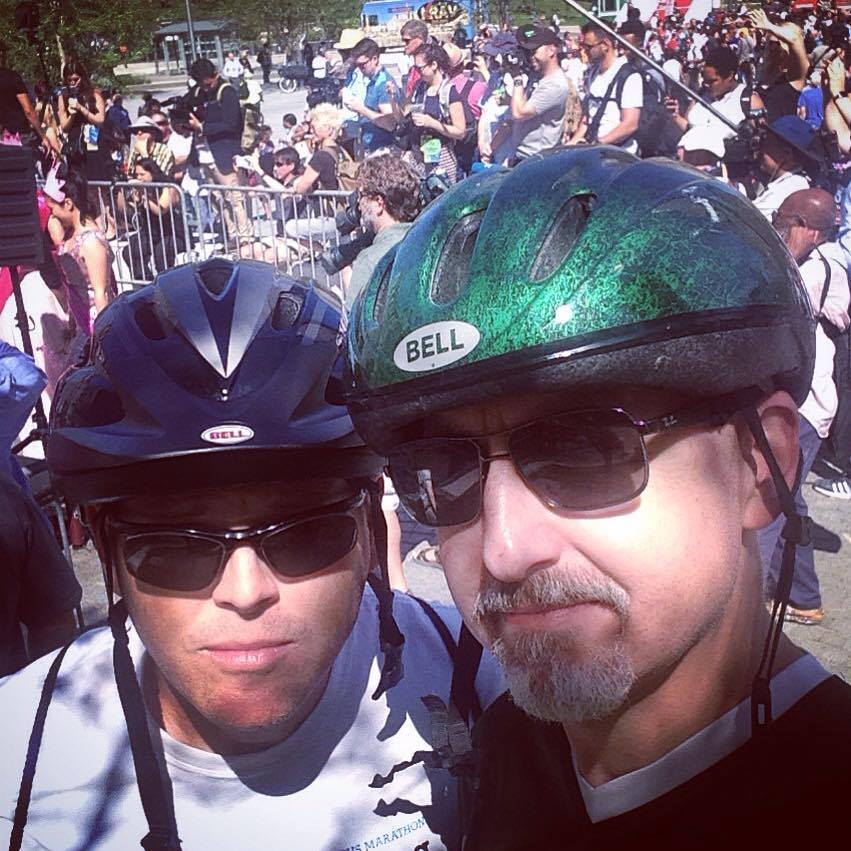
In the middle of last week, what seems like ages ago, this guy I know and I were watching the ball games at Jim Brennan Field in Forest Hill Park, Cleveland Heights. I was talking about changing up my exercise routine with a little cycling and he said he was thinking of riding his bike downtown during the convention, to check things out.

I thought this was a great idea, we’d be mobile in a way we could not trying to drive and park or by taking the rapid. I’d never ridden my bike downtown, though I have run across town when training for marathons. We made a date for Wednesday.

The first half was a familiar experience for me, only faster. Heading down Mayfield to Little Italy, I had my brakes on down the entire hill. I am not accustomed to propelling myself through the air with only a plastic helmet for protection. It has been a long time since I was a cyclist.

We took it easy through the cultural gardens and onto the Shoreway. I had suggested this route, rather than the more direct Euclid Avenue route he had suggested, because I noticed the city had just resurfaced North Marginal Road. I have run that road several times, and it is normally pitted and cratered. This day it was like like sliding on glass. Yay, public works!

Once we got to Ninth Street we had to figure out the best way to get to Public Square. Lakeshore was a Security Zone, and St. Clair. Passes only. Police officers were supernaturally polite in re-directing traffic. Superior was clear, and we rode past the library (did we really do a play there less than a week ago?) to the square, which was bustling with protesters, onlookers, officers, and a ridiculous amount of media.

The media were the sketchiest looking people, because everyone else was clearly identified as to who they were and what they were doing. Some reporters had stations ID'ed on their mics or cameras, but many did not, and any guy with a camera on a selfie stick and professional-grade mic attached could be broadcasting images to absolutely anywhere in real time.

We watched a few staged events. There is a platform stage surrounded by barricades in front of the statue of Moses Cleaveland, what some participants like to refer to as the Free Speech Pen, for scheduled performances. Code Pink presented the I Miss America Pageant in which contestants shared all the things they missed or would under a Trump presidency. Trump himself was present in the form of a participant in a suit made of money with an oversized papier-mâché head.

A team of protesters were handing out water, sports drinks, fresh fruit and handmade breakfast burritos, to everyone and anyone. We each had one of those, and though I would have asked for hot sauce had it been offered, they were really good, with a lot of egg, peppers and potato. They were also not poisoned or drugged. I know this because I am writing this blog post.

I witnessed one altercation which I had entirely misjudged, in which an organizer was getting into the face of a man in a suit, not exactly yelling at him, but he was heated. I have to admit, I assumed the protester was the aggressor, but when police intervened and quietly but forcefully walked away the man in the suit, I had to wonder just what the hell had happened.

However, while we were there, the events at Public Square appeared to be a well-organized, peaceful, if slightly disorienting event. People were getting their message out, would anyone care to hear them.

I needed to get back to take my son to an event back home in the Heights, and so my friend and I parted. He wanted to hang out a bit longer. I left just as a new team of participants in brick and chain link wall costumes were lining up to create one long barrier reading Wall Off Trump.

My friend recommended I try Euclid Avenue to save time, and I did and it was great fun. The bike lanes that start around East 30th Street are very helpful and though I made a few errors in timing I felt entirely safe. We took about an hour to get downtown, and it took forty-five minutes to get back -- and much of the last part was uphill. I wonder much more challenging the journey would be during a normal rush-hour commute. Perhaps I need to seriously take up biking for transportation.

Wednesday, July 20, 2016

2016 Republican National Convention (Tuesday)

Waiting for Trevor at the Breen Center.
Weeks ago, when it was first announced that The Daily Show would produce their show in Cleveland during the convention, I didn’t think twice. I just got the tickets and then told my wife I had done it.

The tickets were free, tickets to daily television programs traditionally are. They need to fill every single seat, every single day. Also, they ask from audience members extraordinary things, and the price tag makes it difficult to complain. After all, you aren’t an audience there to be entertained, as in a rock concert or a play, you are expected to be a participant, a performer even in the proceedings, behaving exactly as they ask you to. They should pay you.

This is not to suggest that they take the audience for granted, heavens no. The day before the Tuesday taping we received an email explaining in detail what we would need to do to receive the real tickets, an exactly when and where to arrive at the Breen Center where the taping would take place.

You see, making a reservation didn’t guarantee a ticket. They need every seat filled, so when the camera pans the auditorium, it is packed with smiling, excited people, so they take reservations for far more people than can be seated. We made plans to arrive early, to make sure we got in.

It was a beautiful day, and we read books and chatted with folks on line before getting our tickets at 2 PM. In the meantime, staffers came out and again explained how seating would work, that those who arrived first would be seated first, etc. They also handed out as much bottled water as we needed.

The wife and I were #24 and #25, so that was cool. Shortly after 2 PM we were able to walk over to West 25th and got a late lunch. Slight digression: I am so proud with how chill my city has been during the Cleveland Summer of 2016™. One million people descended upon East Ninth Street, city government seemed a little unprepared for that, yet everyone was really cool and happy.

So far, there has been little unrest among the activists, the police have been really friendly (and effective, swift and non-violent when things get a little out of hand) and basically the only really horrible things happening this week are all on stage at the Q.

The Daily Show with Trevor Noah (Comedy Central)
Now, I have no idea what it takes to run a daily comedy program inspired by current events. Twenty-four news channels just capture things on video and the describe what they think they are seeing and say what they think they should be saying about them. Comedy news shows have to watch all that crap and then make it funny.

After getting our seats (great seats, by the way) we waited around ninety minutes for the warm-up act to come out. The impression I had was simply that things were taking longer than usual, and in my imagination they were editing footage from that day on the fly.

Curiously, unlike the show they recorded for Wednesday night, Trevor Noah did not tell us who the guest interview would be at the top of the show. It turned out to be former Republican National Committee Chair Michael Steele. Perhaps he was late? Regardless, we all waited patiently. The air conditioning was not extreme and the playlist was upbeat and spirited.

The warm-up act performed a very funny Q&A with the audience (it took him a while to understand why so many guests sitting the the VIP section were priests, when it finally dawned on him that was hilarious) and taught us how to properly go nuts at the beginning and end of commercial breaks. He also expressed his love of Mitchell’s Ice Cream.

Seriously. I have never heard so many people talking about Mitchell’s in my life. On NPR, on CNN. When Trevor Noah came out for his pre-show Q&A the first thing he started talking about is that goddamn ice cream.

The show itself ran in sequence, the way you see it on TV. At breaks for commercials the host would confer with his producers, perhaps about what is going well, what needs to change, but the breaks were not much longer than actual commercial breaks.

If he wasn’t otherwise occupied by production, Noah would address us, the audience, thanking us, praising us for our contribution, and even continuing to comment on some of the issues raised in the previous segment.

And that was interesting, because it was evident that he, like Jon Stewart before him, is emotionally invested in the material he is presenting and commenting upon. Not just that it be funny, but that it represents a coherent worldview. In fact, the most startling moments of the program were when he would suddenly say something - scripted, on-air - which wasn’t intended to make us laugh at all. Where making his point was more important than being funny.

Michael Steele on The Daily Show (Comedy Central)
The appearance of Michael Steele as Noah’s interview subject was quite surprising, if only because I haven’t seen or heard anything from him since he stepped down as RNC Chair. I don't watch MSNBC, apparently he provides commentary for them now. The interview was long, nuanced and very interesting.

Noah began by asking Steele if he was black, which Steele confirmed, and then that he is a Republican, which Steele also confirmed, to laughs, but then Steele said something which passed without comment, “But I’m black first.”

Steele is no longer beholden to the party, and spoke freely about the things that concern him about Trump, about his own refusal to endorse prior to the nomination, the two spoke about many interesting things and Noah concluded by asking if he believed Clinton qualified to be president, to which Steele said reassuring, in a nutshell, of course she is.

That night, when we watched the broadcast, the interview was cut significantly for time, reduced primarily his introduction and this apparent approval if not outright endorsement of Hillary Clinton. Even I would find that disingenuous, though Comedy Central did something unusual, which was to flash a banner during Steele’s answer about Hillary, urging viewers to WATCH THE ENTIRE, FULL-LENGTH INTERVIEW ONLINE.

And you should, here is the link.

Throughout the program we were thanked for our excitement and enthusiasm, and generally praised by the host and all of his associates who addressed us for the wonderful treatment they were receiving as visitors to our city. Apparently, we were a little too enthusiastic, as they decided to edit one of the recorded packages and re-record ours and Noah’s reaction to it because our laughs and applause had made the show run long. At least, that’s what we were told.

Following the taping, it was odd to emerge into sunlight, but it wasn’t yet eight o'clock. A long day in Ohio City, the air now cooling, we chose to continue our day-long date by finding a place for a drink and appetizers, settling on the Black Pig.

We sat out on the sidewalk patio, taking our time, talking about the evolution of The Daily Show and the state of the nation in general.

I looked down the sidewalk and spied a squad of officers walking across the street as a mother and her two kids were headed the other way past them through the intersection. Yes, I noticed that she and her children were black. An officer exchanged words with her, I couldn’t hear what they were saying, but I do know there was joyful laughter.

To be continued.

Monday, July 18, 2016

2016 Republican National Convention (Sunday)

"Life Is Sharing The Same Park Bench" (1969)
Six years ago I spent a lot of time at the library reading newspapers from 1936, which was the last time Cleveland hosted a national political convention. Technically, it hosted three the same year, for the Republicans, the Socialists, and also Father Coughlin’s National Union for Social Justice.

Now, it wouldn’t matter whether the Republicans or Democrats chose to have their convention here this year, I did not anticipate getting involved. Not that I am not political. Of course, I am. But I am not a delegate, and political tourism is not my thing.

In fact, as it became more evident that Donald J. Trump would be their nominee, Cleveland’s moment in the sun began to look harsh and bleak. The kind of people who support Trump are angry people, and wilfully ignorant people. They admire him for the way he talks, which doesn’t make any sense because what he says is dull, obvious, arrogant, steeped in unearned entitlement and a braggadocchio that can only be appreciated by one who feels eternally at odds with perceived enemies.

There were rumors of hate groups from across the country, descending on Public Square, and legions of officers, and anarchists to oppose them. Downtown would be an unwelcoming police state. As the security fences began to go up, to keep all but those authorized from the convention venues, this possibility was appearing more evident.

Offices downtown declared they would be closed for the week, mine one of them. I would work at home and avoid this spectacle, which was a pity because the summer had started with such strength and hope. It seemed a shame to miss out on this historic moment, even if it was shadowed by an angry, orange cloud.

Can you imagine? In 1936 baseball games were happening in that great, new stadium on the lake (and yes, also League Park) adjacent to the Great Lakes Exposition, through which thousands of tourists passed daily, and the Republicans were able to accomplish their business in the Public Hall, which was within walking distance, and still take in, for example, the Marx Brothers performing live in a stand at the Palace Theatre. Everything! Downtown!

Sisters with different parents.
Yes, yes. I know. The good old days. What a simpler time.

As it has turned out, however, we have not stayed home. We have not even stayed on the east side. Since just before the convention began, we have been out, in the city, and all because these things are happening in our midst.

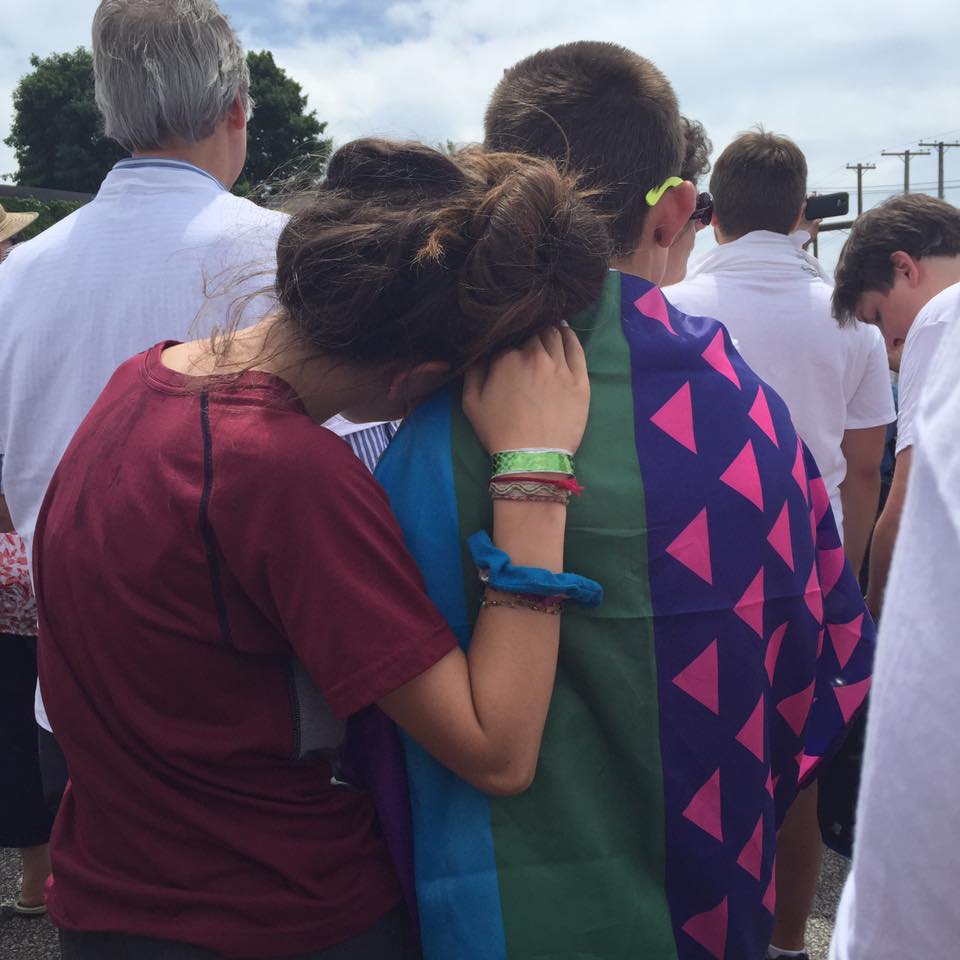
Sunday morning the entire family headed to the Near West Side to join thousands of others for a demonstration of peace and hope, called Circle The City With Love. Put simply, we were to span the Lorain-Carnegie Bridge, hold hands and be silent for thirty minutes. And we did. The moment was not without drama, as it was over eighty degrees and a few members passed out or nearly did so. But it was a surprisingly effective event and left me feeling a bit more optimistic.

Everyone who participated was invited to a free concert starring The Roots at the Wolstein Center. We didn’t know who the sponsoring producer was, it turns out to have been the AIDS Health Foundation and Keep the Promise USA to raise awareness and funds to combat HIV/AIDS around the world.

Keynote speaker was Dr. Cornel West, which was a major attraction for the wife. Early in the proceedings, however, I saw Brother Cornel and his associates fill out a row near the rear to enjoy the powerful gospel performance of Mary Mary. He was accompanied by a gaunt woman with a severe, silver cut.

Yes. It was Dr. Jill Stein, Green Party candidate for president. I was worried we had been punk’d into attending a Stein rally, but the AHF is a real thing, and though the good doctor introduced her, he didn’t say anything about her other than she is a candidate, and she said nothing at all. Anything perceived as campaigning would have violated FEC rules.

There were numerous acts, including B.O.B and Raheem DeVaughn, Teyana Taylor, and Questlove and The Roots played for about an hour. They were truly spectacular, a powerful, energetic musical ensemble. Their singer (I can’t find his name, not the lead rapper, he was like a special guest and I can’t find him online) sang a beautiful rendition of John Lennon’s Mother which was truly moving. It’s a powerful song, but I have never heard it performed by someone with a beautiful, clear singing voice. And in light of recent events, it was chilling.

I was surprised by my children. It was a long day, but they were awed by the event on the bridge, and thrilled by the long afternoon's concerts and speeches. It was quite an overwhelming day. Walking back to our car, down Prospect and through Playhouse Square with my family in tow, we could see black liveries with tinted windows veering down the streets, and there was a definite stillness in the air, a Sunday evening calm perhaps, or a calm before the storm?

Regardless, we were ready.

To be continued.

Sunday, July 17, 2016

Twelfth Night: The Final

Orsino
Photo: Catherine Young
The Great Lakes Theater touring production of Twelfth Night (As Told By Malvolio) in celebration of the First Folio has concluded, the set and costumes packed away until such time as they are required again.

There were high school teacher colleagues in attendance these past two weeks expressing interest in having the show visit their school. Why not? The duration (less than forty-five minutes) fits neatly into most school periods. If all four of our actors weren’t already booked as members of the residency program, that would work out quite easily. If the show is wanted, we’ll make it happen.

Transporting the play to sites on the near east side last week, to Shaker Heights and to Tremont were great fun, each a different experience in how the performance conformed to the space. Best of all, however, was when we produced a three day stand in Brett Hall this past weekend in the main branch of the Cleveland Public Library.

This has as much to do with time as place. You may have heard there’s lotsa stuff happening in Cleveland this week. That was part of the reason the Folger Library chose to send us the First Folio in July, for maximum visibility and impact, the arrival of the Republican National Convention.

What the RNC has also provided, however, has been an opportunity for the city to engage in the kind of public works which might otherwise be shouted down as a waste of money or a diversion from issues that might better be addressed. I do not agree with these opinions, they are the kind of argument people are always using to prevent progress.

To take one example, the redesign of Public Square was completed a few weeks ago and the park (I keep referring to it as a park, is that all right?) has opened to the people. It’s beautiful, and folks are coming and they are enjoying it.

Olivia
Photo: Catherine Young
For most of my life, Public Square has not been a destination for anyone. There was no there there, it was a site for demonstrations and for people to congregate who had little else to do. Yes, there was always the Soldier and Sailors Monument, and following its renovation in 2010 has itself been a glorious and historic site to visit.

I remember this thing that happened once. For a fee our high school marching band was part of a parade to gain a certain radio station broadcast rights to the Cleveland Browns. The station's plan was to start at Public Square and march down to Municipal Stadium and harass Art Model as he met with the interested parties at the stadium.

The entire event felt sketchy to me, our marching band for rent like this. I recall observing the dozens of people who had gathered downtown for the parade. It was the early 1980s. “It’s cool to see so many people out here,” I said, out loud. I was a sophomore. One of the seniors told me, “Hansen, don’t be an dupe. Look at them. None of these losers have a job.”

Just this past Saturday I sat with my kids on the steps at the large field watching guys plays Frisbee, my daughter sat in the shade of a tree and drew in her sketchbook.

Public Square
Earlier, we sat with my mother at a table at the recently opened Rebol, a cafe located right there on the Square, having lunch. My mother has lived on the West Side her entire life, primarily in Lakewood. She remembers the golden days when families walked Euclid Avenue for shopping, my father worked for Cleveland Trust, working in the tower which is now The 9. She knows downtown. But Public Square?

Mom looked up from her dish, on this cloudless summer’s day, kids a few yards away splashing in the fountain, the boy and I playing ping-pong at their outdoor table, and mused, “I never pictured myself eating lunch right here.”

She had just attended the final performance of our Twelfth Night. She took a bus downtown, saw a play at the library, met us on the corner and walked to the park for lunch, like you do, downtown in any major city.

Mom was one of three company mothers at the play on Saturday. Chelsea’s mom was also there, and Shaun’s folks. Each of Chennelle’s and Luke’s parents were at Shaker last Saturday. It was an exciting close, to be presenting the play so close to the actual book, the reason the production had been commissioned.

It was great fun to create this particular production, inspired not only by the John Hughes teen comedies and dramas of the mid-1980s, but also, for example, Just One of the Guys -- which is itself based on the plot of Shakespeare’s Twelfth Night.

Orsino & Viola
Photo: Catherine Young
During the pre-show speech I claimed that despite the abridgment, every word is from Shakespeare … well, most, uh, almost every word is from Shakespeare. There were also references to and song cues from Robert Palmer, Dream Academy, The Hooters, The Cure, Level 42, The Smiths, Duran Duran (two songs), Bronski Beat, Prefab Sprout, Whitney Houston, Spandau Ballet and Prince.

Why so 80s? Do you know that often as a warm-up, introductory exercise our actor-teachers wil ask, “What is your first name and what era from all of world history would you choose to live in if you could?” And when they do, a startling number of today’s high school students say they wished they lived in the 1980s.

I know, right?

Then there’s me. I graduated from high school thirty years ago, in 1986. It seemed auspicious to set the play a neat thirty years ago. It wasn’t a great year by the standards of popular culture. Science recently determined 1986 to be the worst year in the history of pop music, by which they mean that never before or since have so many songs in the Top 40 sounded so alike, or relied so entirely on electric keyboards.

That was also the summer the movie Howard The Duck was released. I saw it in the theater, twice, because I wanted to like it (see also: Lea Thompson.)

Whatever, okay? Just bogus. Time periods make me focus, and when I focus I can tell a coherent story. Fortunately, as I had intended, a great deal of our audience was in my age cohort -- or teenagers, and would you believe the kids today totally know the song Notorious and who Madonna was.

Interestingly enough, fall 1986 - my first semester in college, mind, I was not longer a high school student myself - was right when fashion turned to a darker palette, when those artists who were wearing white in 1984 were suddenly wearing black.

Malvolio & Olivia
Photo: Catherine Young
I was so excited when I saw this reflected in Zack’s costume design. A hipster like our Malvolio may have been wearing colors a few years earlier, but here he is almost monochromatic. The “yellow stockings” would not have been as out of character in 1983.

And poor Shaun. Zack crafted the perfect early-mid-late eighties ensemble for him, with pleated pants and a sweater vest festooned with geometric shapes. I, too, had a sweater vest then. Teenagers in sweater vests, like we were all about to have breakfast at Denny’s with our senior discount. That would be perfectly ironic today but we didn’t know what irony was.

Most enjoyable, I believe, was the opportunity, the challenge to take a play as richly complex and funny as Twelfth Night, to edit it without losing the color of the language, to streamline the story without losing the emotional impact, to be able to eliminate certain beloved characters without feeling you were really missing them, and most of all, to create a romantic comedy that made people both laugh and applaud the efforts of all four protagonists.

In adapting the piece to a playful, high school setting, we could make the emotions high while keeping the stakes relatively low. In the end, four paired off into two, and it was at once surprising and also made complete sense. Everyone has a date for Homecoming!

Like Joe Barnes said, I am such a fucking romantic.

First Folio - The Book That Gave Us Shakespeare is in residence at the Main Branch of the Cleveland Public Library through July 30, 2016.

Friday, July 15, 2016

Garrett Morgan

Version One
This large banner (seen right) posted on the side of the Six Six Eight Building on Euclid Avenue, was one of the larger banners popping up around Euclid Avenue in the past month, exhibiting civic pride prior to the Republican National Convention.

GARRETT MORGAN STOPPED THE WORLD IN 1914 WITH THE INSTALLATION OF THE FIRST ELECTRIC TRAFFIC SIGNAL ON EUCLID AVENUE.

Destination Cleveland, the visitors' bureau, created this and the several other banners, denoting the impact of important figures from Cleveland history, including Eliot Ness, Alan Freed, Bob Hope and many other men. (Yes, they are all men.)

Unfortunately, as we learned, this banner is not accurate. The first “traffic signal” is credited to James Hodge, at that is the one which was installed on Euclid Avenue on August 5, 1914. This banner in its original version (which is very large, about five stories high) was posted prominently and for several weeks before being edited.

Be edited, I mean that a flap of plastic with the word “Cleveland” was placed over the words “Garrett Morgan.” The inventor’s name had been literally covered up.

Version Two
CLEVELAND STOPPED THE WORLD IN 1914 WITH THE INSTALLATION OF THE FIRST ELECTRIC TRAFFIC SIGNAL ON EUCLID AVENUE.

The city itself had been credited with inventing the electric traffic signal.

Now, if that banner, if all of these banners, have been posted to induce civic pride, they have succeeded. I enjoy seeing them. I have even made a point of showing them off to visitors, and there have been many, many visitors these past few weeks.

I had drawn particular attention to the Garrett Morgan sign. I even took that picture of it. Because, you see, like a lot of local kids I had been taught that this was true, that Garrett Morgan had invented the first electric traffic light. It’s one of those you learn growing up in Cleveland; we invented the rock concert, Superman, the traffic light -- the traffic light invented by Garrett Morgan.

Garrett Augustus Morgan, Sr. (March 4, 1877 – July 27, 1963) was born in Kentucky, the son of a formerly enslaved person. He first moved to Cincinnati, and then to Cleveland in his late teens. His greatest accomplishments were in making things function much more successfully. He improved upon the sewing machine, the traffic light, and most notably the gas mask. These last two developments saved lives, though it was the first which led to his fortune, for his experiments with anti-scorching oils for use in electric sewing machines led to his developing products for the straightening of Afro-textured hair.

Just the weekend before the sign featuring his name was altered, I had indicated the sign to an old college friend who was visiting Cleveland for the first time, and her son, he of North African heritage. They were impressed. Her son knew about Garrett Morgan, but he didn’t know the inventor was from Cleveland.

My Version
I first noticed the change in this banner a few weeks back, just walking down the street, I looked up and saw it. It made me confused, then unhappy, and then kind of pissed off. I still had my previous photo in my phone, and so created a photo meme of before and after pictures (at right) with the hashtags #blackhistory and #whitewash.

The response was immediate. People first expressing the kind of wtf? that you find on social media. Very soon this turned to questioning the intent of those who first created and then edited the sign, and shortly thereafter emphasis on the fact that what was stated was not accurate in the first place.

Morgan did not invent the first stop light in 1914 (as stated on the sign) but improved on the original design with his version, which he patented in 1923.

As the meme I had created was widely circulated, I was accused of jumping to conclusions, that I was seeing racial injustice where none was present. Most galling to me was use of the incriminating hashtag #knowyourhistory because, mister, you know I know my history.

However, that huge banner had been up for over two weeks. It was already in place during the massive parade to celebrate the Cleveland Cavaliers on June 22, hundreds of thousands had the opportunity to read it featuring Garrett Morgan's name. I cannot be the only person who noticed the change. By merely covering the name of an historic, African-American inventor as a quick fix, they neutralized the intended power of the sign. Was the idea to celebrate the stop light, the city in which it was invented, or the man who invented it?

After all, there is an argument that the very first electric traffic signal with light was actually installed in Salt Lake City two years earlier.

SALT LAKE CITY STOPPED THE WORLD IN 1912 WITH THE INSTALLATION OF THE FIRST ELECTRIC TRAFFIC SIGNAL …

Did they edit the sign to say that? No, of course not.

Regardless, if I have not already made this obviously clear, Morgan’s name was also the only one on any of these banners commemorating a person of color. Surely the design team who created the original banner could create an alternate phrase to honor this important Cleveland inventor.

Well, today I had a very pleasant surprise.

It is true that the huge, edited banner remains in place at Six Six Eight. The Republican Convention has technically already started, there are too many last minute things going on, it's too late to change that now. I get that.

However, now placed amidst those other signs I mentioned, those touting the fame of Ness, Hope and Freed, decals which fill the vacant windows of the Cleveland Athletic Club at the intersection of Euclid and East 12th Street, a new sign had been put up in a doorway.

RED LIGHT? GREEN LIGHT? WAIT A MINUTE. CLEVELANDER GARRETT MORGAN PATENTED THE THREE-POSITION TRAFFIC SIGNAL IN 1923.

Thank you, Destination Cleveland. Best wishes for a successful convention.

#ownyourhistory #blackhistorymatters

Sunday, July 4, 2010

Republican National Convention Notes

Back in March I collected this data on the Republic National Convention (June 9 -12, 1936) but never incorporated it into an article or posted it. So here it is verbatim, with some nifty campaign buttons.

The Republican platform promised to speed up employment and maintain relief, but wanted relief responsibility returned to nonpolitical local agencies. It also favored a reduction in government expenses and the removal of production quotas contained in the National Recovery Administration and Agricultural Adjustment Act. - Encyclopedia of Cleveland History
Public Hall was renovated to accommodate the equipment and wiring necessary for broadcasting the event, and major speeches were scheduled for the late evening hours so that radio network programming would not be preempted. - Encyclopedia of Cleveland History
Landon proved to be an ineffective campaigner who rarely traveled. In the two months after his nomination he made no campaign appearances. As columnist Westbrook Pegler lampooned, ''Considerable mystery surrounds the disappearance of Alfred M. Landon of Topeka, Kansas.... The Missing Persons Bureau has sent out an alarm bulletin bearing Mr. Landon's photograph and other particulars, and anyone having information of his whereabouts is asked to communicate direct with the Republican National Committee.'' (Time, Aug. 31, 1936) - Time Passages Nostalgia Co.

Sunday, March 28, 2010

"America Is In Peril."

The welfare of American men and women and the future of our youth are at stake. We dedicate ourselves to the preservation of their political liberty, their individual opportunity and their character as free citizens, which today for the first time are threatened by Government itself.

The Administration+ has dishonored American traditions and flagrantly betrayed the pledges upon which the Democratic Party sought and received public support.

The powers of Congress have been usurped by the President. The integrity and authority of the Supreme Court have been flouted. The rights and liberties of American citizens have been violated. Regulated monopoly has displaced free enterprise.

The Administration+ constantly seeks to usurp the rights reserved to the States and to the people.

It has insisted on the passage of laws contrary to the Constitution.

It has intimidated witnesses and interfered with the right of petition.

It has dishonored our country by repudiating its most sacred obligations. It has been guilty of frightful waste and extravagance, using public funds for partisan political purposes.

It has promoted investigations to harass and intimidate American citizens, at the same time denying investigations into its own improper expenditures.

It has created a vast multitude of new offices, filled them with its favorites, set up a centralized bureaucracy, and sent out swarms of inspectors to harass our people.

It had bred fear and hesitation in commerce and industry, thus discouraging new enterprises, preventing employment and prolonging the recession+.

It secretly has made tariff agreements with our foreign competitors, flooding our markets with foreign commodities.

It has coerced and intimidated voters by withholding relief from those opposing its tyrannical policies.

It has destroyed the morale of many of our people and made them dependent upon Government. Appeals to passion and class prejudice have replaced reason and tolerance.

To a free people these actions are insufferable. This campaign cannot be waged on the traditional differences between the Republican and Democratic parties. The responsibility of this election transcends all previous political divisions. We invite all Americans, irrespective of party, to join us in defense of American institutions.

CONSTITUTIONAL GOVERNMENT AND FREE ENTERPRISE

WE PLEDGE OURSELVES:

1. To maintain the American system of constitutional and local self government, and to resist all attempts to impair the authority of the Supreme Court of the United States, the final protector of the rights of our citizens against the arbitrary encroachments of the legislative and executive branches of Government. There can be no individual liberty without an independent judiciary.

2. To preserve the American system of free enterprise, private competition, and equality of opportunity, and to seek its constant betterment in the interests of all.

REEMPLOYMENT

The only permanent solution of the unemployment problem is the absorption of the unemployed by industry and agriculture. To that end, we advocate:

- Removal of restrictions on production.
- Abandonment of all policies+ that raise production costs, increase the cost of living, and thereby restrict buying, reduce volume and prevent reemployment.
- Encouragement instead of hindrance to legitimate business.
- Withdrawal of Government from competition with private payrolls.
- Elimination of unnecessary and hampering regulations.

Adoption of such policies as will furnish a chance for individual enterprise, industrial expansion, and the restoration of jobs.

RELIEF

The necessities of life must be provided for the needy, and hope must be restored pending recovery. The administration of relief is a major failure+. It has been faithless to those who most deserve our sympathy. To end confusion, partisanship, waste and incompetence,

WE PLEDGE:
1. The return of responsibility for relief administration to non-political local agencies familiar with community problems.

2. Federal grants-in-aid to the States and Territories while the need exists, upon compliance with these conditions: (a) a fair proportion of the total relief burden to be provided from the revenues of States and local governments; (b) all engaged in relief administration to be selected on the basis of merit and fitness; (c) adequate provision to be made for the encouragement of those persons who are trying to become self-supporting.

3. Undertaking of Federal public works only on their merits and separate from the administration of relief.

4. A prompt determination of the facts concerning relief and unemployment.

SECURITY

Real security will be possible only when our productive capacity is sufficient to furnish a decent standard of living for all American families and to provide a surplus for future needs and contingencies. For the attainment of that ultimate objective, we look to the energy, self-reliance and character of our people, and to our system of free enterprise.

Society has an obligation to promote the security of the people, by affording some measure of protection against involuntary unemployment and dependency in old age. This Administration's+ policies, while purporting to provide social security, have, in fact, endangered it.

We propose a system of old age security....
- We propose to encourage adoption by the States and Territories of honest and practical measures for meeting the problems of unemployment insurance.
- The unemployment insurance and old age annuity sections of the present Social Security Act are unworkable and deny benefits to about two-thirds of our adult population, including professional men and women and all those engaged in agriculture and domestic service, and the self employed, while imposing heavy tax burdens upon all. The so-called reserve fund estimated at forty-seven billion dollars for old age insurance is no reserve at all, because the fund will contain nothing but the Government’s promise to pay, while the taxes collected in the guise of premiums will be wasted by the Government in reckless and extravagant political schemes.

LABOR

The welfare of labor rests upon increased production and the prevention of exploitation. We pledge ourselves to:
- Protect the right of labor to organize and to bargain collectively through representatives of its own choosing without interference from any source.
- Prevent governmental job holders from exercising autocratic powers over labor.
- Support the adoption of State laws and interstate compacts to abolish sweatshops and child labor, and to protect women and children with respect to maximum hours, minimum wages and working conditions. We believe that this can be done within the Constitution as it now stands.

AGRICULTURE

The farm problem is an economic and social, not a partisan problem, and we propose to treat it accordingly....

Our paramount object is to protect and foster the family type of farm, traditional in American life, and to promote policies which will bring about an adjustment of agriculture to meet the needs of domestic and foreign markets. As an emergency measure, during the agricultural depression, Federal benefit payments or grants-in-aid when administered within the means of the Federal Government are consistent with a balanced budget.

WE PROPOSE:

1. To facilitate economical production and increased consumption on a basis of abundance instead of scarcity.

2. A national land-use program, including the acquisition of abandoned and non-productive farm lands by voluntary sale or lease, subject to approval of the legislative and executive branches of the States concerned, and the devotion of such land to appropriate public use, such as watershed protection and flood prevention, reforestation, recreation, and conservation of wild life.

3. That an agricultural policy be pursued for the protection and restoration of the land resources, designed to bring about such a balance between soil-building and soil-depleting crops as will permanently insure productivity, with reasonable benefits to cooperating farmers on family-type farms, but so regulated as to eliminate the administration's+ destructive policy towards the dairy and livestock industries.

4. To extend experimental aid to farmers developing new crops suited to our soil and climate....

REGULATION OF BUSINESS

We recognize the existence of a field within which governmental regulation is desirable and salutary. The authority to regulate should be vested in an independent tribunal acting under clear and specific laws establishing definite standards. Their determinations on law and facts should be subject to review by the Courts. We favor Federal regulation, within the Constitution, of the marketing of securities to protect investors. We favor also Federal regulation of the interstate activities of public utilities....

GOVERNMENT FINANCE

The Administration+ has been characterized by shameful waste and general financial irresponsibility. It has piled deficit upon deficit. It threatens national bankruptcy and the destruction through inflation of insurance policies and savings bank deposits.

WE PLEDGE OURSELVES TO:
Stop the folly of uncontrolled spending. Balance the budget—not by increasing taxes but by cutting expenditures, drastically and immediately. Revise the Federal tax system and coordinate it with State and local tax systems. Use the taxing power for raising revenue and not for punitive or political purposes.

MONEY AND BANKING

We advocate a sound currency to be preserved at all hazards. The first requisite to a sound and stable currency is a balanced budget. We oppose further devaluation of the dollar. We will restore to the Congress the authority lodged with it by the Constitution to coin money and regulate the value thereof by repealing all the laws delegating this authority to the Executive. We will cooperate with other countries toward stabilization of currencies as soon as we can do so with due regard for our national interests and as soon as other nations have sufficient stability to justify such action.

CONCLUSION

We assume the obligations and duties imposed upon Government by modern conditions. We affirm our unalterable conviction that, in the future as in the past, the fate of the nation will depend, not so much on the wisdom and power of Government, as on the character and virtue, self-reliance, industry and thrift of the people and on their willingness to meet the responsibilities essential to the preservation of a free society.

Finally, as our party affirmed in its first Platform in 1856: “Believing that the spirit of our institutions as well as the Constitution of our country guarantees liberty of conscience and equality of rights among our citizens, we oppose all legislation tending to impair them,” and “we invite the affiliation and cooperation of the men of all parties, however differing from us in other respects, in support of the principles herein declared.”

The acceptance of the nomination tendered by this Convention carries with it, as a matter of private honor and public faith, an undertaking by each candidate to be true to the principles and program herein set forth.


- Republican Party Platform, 1936


+ Topical references have been removed. Read the unedited version at the link provided above.

Friday, January 22, 2010

Hunt Fiend In 4 Decapitations

Once upon a time I was the artistic director of a late-night theater project at Dobama Theatre. Trying to decide what slate of original projects to create for the second season, I shared with my boss, Joyce, the artistic director of the theater proper, the idea of making a musical out of the Kingsbury Run murders.

We could call it TORSO! THE MUSICAL!

It was a joke. I made her actually gasp. But seriously ... it was a joke. Five years later, the Play House actually produced a musical about the Kingsbury Run murders. There is no satire any more, just cheese.

The first historical record of a decapitated body dumped into that ancient stream bed called Kingsbury Run was in November ... 1905. By 1935 we can deduce that the person who would eventually be called the Cleveland Torso Murderer (tm) would be no less than fifty years old.

We know this. An unidentified woman washed ashore in Beulah Park in September, 1934. Coroner Arthur J. Pearce said the expert level of butchery suggested that it was done by a medical expert. He later admitted the cutting was no, in fact, that professionally done.

In early 1936 the dismemberment of Florence Pollilo was described as "expertly" done by Coroner Pearce, except for the gashes to the pelvic area. Otherwise, only a professional could have severed a human like that. Her head was never found, unlike Edward Andrassy's head, they found that. They also found his penis, but that was in a can some yards away.

Unlike the "Tatooted Man" found on June 5, 1936, three days before the Republican National Convention began. His genitals were un-mutilated. For your interest, a "death mask" of his head was put on display at the Great Lakes Exposition but never identified - in spite having been viewed by thousands. They still have this plaster mask at the Cleveland Police Museum.

By this time the media was lumping all of these disparate murders together, and calling for action. Eliot Ness remained silent, leaving his detectives to do their work. By September, and the discovery of a "7th victim" he began to be more public in his assessment of what was happening. Thankfully, they could blame marihuana for the madness.
"There is a plentiful supply of this deadly weed in Cleveland" - Michael J. Collegeman, head of the local Federal Narcotics Bureau.
... to be continued.

Source: John Stark Bellamy II, The Maniac in the Bushes: More True Tales of Cleveland Crime and Disaster

Wednesday, January 20, 2010

Mayor Burton

Harold Hitz Burton (June 22, 1888 – October 28, 1964) served as the 45th mayor of Cleveland, Ohio, a member of the United States Senate and later Associate Justice of the Supreme Court of the United States. He was known as a dispassionate jurist who prized equal justice under the law. - Wikipedia
Bipartisanship is a quaint ideal. Burton was an Ohio State Representative and then law director of Cleveland before being elected as Mayor in 1935, running as a Republican. He held that position until 1941 when he was elected to the U.S. Senate where he met and befriended Truman. Harry S. made him a Supreme Court Justice in 1945.

As the 45th mayor of the city, he has been credited with rooting out organized crime and his pious public demeanor gained him the nickname the "Boy Scout Mayor."
When Burton became mayor of Cleveland in 1935, the city was infested with underworld mobs, riddled with police graft. He appointed young Eliot Ness safety director, started a clean-up which had spectacular results. One racketeer it dredged up was Albert Ruddy, who this week was convicted of shaking down building contractors for thousands of dollars during his 20-year reign as a union tsar. Burton earned for Cleveland, once a city shamed by its record of traffic deaths, the National Safety Award in 1939 and 1940. He turned his attention to public health, and this year Cleveland won the National Health Award. He has fought for free speech and tolerance. To Cleveland this year went the National Civil Liberties Award. - Time Magazine, Oct. 1940
He secured over $40 million in federal funds towards relief assistance, and championed Cleveland as a convention center - the Great Lakes Exposition and the Republican National Convention occurred under his watch.

I find it difficult to imagine he initiated those events, as they occurred in the first full year of his term.

Additional Soucres:
Ohio History Central
Encyclopedia of Cleveland History

Saturday, January 9, 2010

Governor Alfred M. Landon

May 18, 1936
The Republican convention in Cleveland that June reflected the divide within the party: The most rousing speech came from ex-president Herbert Hoover, who told the delegates that Roosevelt's second term would result in the "violence and outrage by which European despotisms have crushed all liberalism and all freedom." 
The Hoover speech, reported the Times the next day, produced "wild and uncontrollable bursts of frenzy" in the partisan audience.

But the Republican nominee, Governor Alfred M. Landon of Kansas, did not share Hoover's apocalyptic vision or his ability to whip up the crowd. Alf Landon, a forty-eight year-old oilman who had built his reputation on fiscal austerity, was the only Republican governor to win election in the West in 1932, and he repeated the feat two years later.
 
He planned to attack the Roosevelt administration for overspending. But Landon was a bland candidate in every respect: a man of medium height with gray eyes behind rimless glasses. Although he was privately charming, his speech was flat and drawling and he had no gift for oratory. 
Father Coughlin, who should know, once described Landon as "a most honest man but the most colorless candidate in the history of the United States." 
- "Furious Improvisation: How the WPA and a Cast of Thousands Made High Art out of Desperate Times" p. 129-130
It should be noted that, in an attempt not to appear like a demigod, Landon accepted the nomination of his party in absentia on 11 June. Does this mean he was not even in Cleveland, at all, for the convention?