Showing posts with label Hamilton. Show all posts

Sunday, January 4, 2026

NYC EOY 2025 (part four)

Photobooth, Lugo, Spain
(1984)
The summer of 1984, I spent several weeks in Spain as part of the Experiment in International Living (EIL). I had spent a few family vacations in England, France, and Norway when I was a child, so Europe was not entirely alien to me. But that was in the late 1970s, now Reagan was president, the Cold War was at a fever pitch. Also, there was a mass shooting (not a weekly occurrence in those days) at a MacDonald’s in San Diego while I was abroad and I was on my own to try to explain what exactly was wrong with my country. Almost forty-two years later, and I am still unable to.

Later that year, Benny Andersson and Björn Ulvaeus – half of ABBA – and lyricist released the concept album Chess. The single "One Night in Bangkok," led by Murray Head (who I was already familiar with from the concept album for Jesus Christ Superstar) was a hit in the United States, peaking at number 3 on American Top 40 in the spring of 1985, as I was finishing my junior year at Bay High School. Several other songs were hits across the world – "I Know Him So Well," "The Arbiter" – but not here. Those of us whose interests had been piqued by "Bangkok" bought the two-disc CD set, and many of us became enamored of the piece.

Murray Head
"One Night in Bangkok"
Like Superstar, the concept album was always intended to eventually become a stage production, and in 1986 Chess opened at the Prince Edward Theatre in the West End. Originally created as a dance-focused extravaganza directed by legendary choreographer Michael Bennet, the piece was brought to opening by Trevor Nunn when Bennet became too ill to continue. This version played for three years, and featured several of the artists who were on the original recording, including Head, Elaine Paige and Tommy Körberg. They never produced a cast recording of the West End production.

When it moved to Broadway in 1988, Nunn chose to revise the entire production, top to bottom, greatly expanding the book and removing many of the songs. This version was not well received and played for only 68 performances. I did purchase the original cast recording when it was released and still have it, though I believe I have listened to it once. Maybe once.

"Chess" (1988)
Original Broadway Cast Recording
(This design is terrible.)
So, what is Chess about? An international chess competition between an obnoxious American and a feckless Russian. The American’s second is a woman with whom he has a dysfunctional relationship, and who forms the third in a love triangle set against the backdrop of Cold War intrigue as well as an appropriate amount of social commentary and a lot of really great songs.

And really, it’s the songs. That’s why this very 1980s Broadway flop has remained in the contemporary consciousness at all, because of people like me who really, really love the original recording. But it’s dated. Like, really dated. "Bangkok" features the first guy to play Judas kind of rapping. Several songs are ABBA-esque, and that act wouldn’t receive their flowers until the early 21st century and the advent of Mamma Mia! 

The year 1984 (not for nothing, the title of Orwell’s book) was peak nuclear anxiety. This year alone there we listened to pop songs like "99 Luftballons," "Distant Early Warning," "Two Tribes," "This World Over," "Dancing With Tears In My Eyes," "Minutes To Midnight," "Forever Young," and on and on. But by the time the show bowed at the Imperial Theater on West 45th Street in spring 1988, Glasnost had been established and apocalyptic anxieties had cooled. The show wasn’t just bad, it was irrelevant.

"Hamilton" stage door
with Nicholas Christopher
(2016)
Which brings us to the present. When it was announced that there would be a Broadway revival of Chess, and not only that but that it would star Tony-winner Aaron Tveit, Glee’s Lea Michele and (wait for it) Nicholas Christopher, I told my wife this is the reason we’re going to New York for the holidays, I have to see this.

So, if you are not already familiar with Nicholas Christopher, we saw him as the first person to take over for Christopher Jackson as Washington in Hamilton. His rendition of "One More Time" brought the house down, raised the roof, and made me cry, no cap. Since then he has played several leading roles on Broadway including Seymour in Little Shop and Sweeney in Sweeney Todd. I would have loved to have seen him in those. He sold my ticket to see Chess.

To be concluded.

UPDATE: My wife questioned that I had purchased the concept recording on compact disc, rather than on cassette or vinyl. While it is true that the CD did not become dominant until the late 1980s, one of my father's clients was Telarc, an early adaptor of digital sound technology. By the mid-1980s he not only owned a CD player, but dozens of Telarc recordings of the Cleveland Orchestra. My first CD was Donald Fagen's 1982 solo album "The Nightfly" (DDD). I have never owned "Chess" (1984) on vinyl or cassette.

Friday, December 16, 2022

On Understudies & Swings

Roger Allam & Susan Fleetwood
"Much Ado About Nothing"
(Royal Shakespeare Company, 1990)
Ms. Fleetwood does not appear.
One of my favorite theater experiences was when our school group was in Stratford-Upon-Avon in late 1990. A blizzard socked the area, and the roads were impassable.

The plan for the morning was a matinee of Much Ado About Nothing starring Roger Allam and Susan Fleetwood. We were staying at an inn right in town, but anyone who was driving in from anywhere to see the show were out of luck. So few were in attendance they announced it would be general seating, so instead of the balcony some of us chose the third row.

The stage manager came on stage to address the audience, looking bemused. She explained it may be an RSC record, with no fewer than six actors assuming roles for those performers stranded in the outskirts, and several members of crew. But the show was going on!

And it was marvelous. We saw actors whispering dance choreography to each other during the party scene, and I noted one time someone said a line twice. Other than that, they nailed it, including the comparatively young woman who stood in for Ms. Fleetwood as Beatrice.

This was when I learned a very important lesson: Without the understudy, there is no show.

Once upon a time we said, “The show must go on!” And actors with fevers and vertigo would pump themselves up with antihistamines and pain relievers would muscle through. It was expected. COVID has changed all that, and rightly so.

This does mean that, unfortunately, smaller theaters may need to close a show due to illness, and this has happened many times. Last year, as the Omicron variant was rising, theaters right here in Cleveland closed their holiday shows early, one after another.

Today, our professional theaters make more time to prepare understudies and also budget for swings.
“While an understudy is usually a smaller or ensemble role within the main cast of a production, a swing is an offstage performer who only goes on if someone in the ensemble is unable to do so. A swing most often does not cover principal roles in a show.”
- Dramatics Magazine
Desmond Sean Ellington crushed it.
Attending a show and discovering that an understudy is going on has become more and more common. I myself have made pre-show announcements this season, more than once, that someone other than listed in the program will be going on.

Last Tuesday, the family went to see the touring production of Hamilton at the KeyBank State Theatre. That night Burr was played by Desmond Sean Ellington who usually plays Mulligan/Madison (that role assumed by John Devereaux) and this was exciting to know; that something different was happening that night, just for us. He delivered a beautiful rendition of “Wait For It” and ferociously stuck the landing in “The Room Where It Happens” which are absolutely my two favorite songs in the show.

Opening weekend of the world premiere of The Land of Oz at Dobama Theatre, my good friend Sarah Blubaugh went on as Mombi the Witch. It’s exciting when a friend goes on, and others show to support them. In the past, I have made understudy announcements at the Hanna and there are cheers from supporters who attended just to see them.

I myself decided to attend opening night of Oz, which I did not have on my calendar, when Sarah gave me the word that afternoon that she was going on. Unfortunately, the power went out ten minutes into the performance. If you live in Cleveland Heights, you know. I did, however, get to see the entire show, with her in it, that Sunday night.

It’s a delightful show, Sarah was delightful in it, and if they didn’t have her as a swing, the entire first weekend may not have been possible.

Next time you hear there is an understudy, give a cheer! Because otherwise, you just wasted all that money on the babysitter.  

Thursday, July 9, 2020

Savory Taṇhā in Performance (Thursday)

Brian & Zyrece
Yesterday the New York Times published an essay with the unfortunate headline, Digital Theater Isn’t Theater. It’s a Way to Mourn Its Absence by Laura Collins-Hughes. Journalists and columnists don’t usually get to choose their headlines, there are people who specialize in that -- and a good thing, too, try writing one.

Unfortunately, while the mourning may be real, the phrase “digital theater isn’t theater” is a statement I have to take issue with. And why wouldn’t it be? I am currently the writer/director of a piece of live, if digital, theater.

Collins-Hughes accurately describes the thrill of live theater so; “Bodily immersed in an experience, sharing a single space, we emerge at the finish of those performances imprinted with sense memories.” Yes, we do. It’s why some of us chose this path, as opposed that of movies or television. It’s why I have spent the better part of two decades working on behalf of students to bring live performance right into their classrooms, another mission which has been suspended for the duration.

“Immersed.” That word makes me shudder. Remember immersive theater? An entire popular genre rendered suddenly extinct. They may try to open Broadway, but Sleep No More isn’t rousing any time soon.

And yes, we have enjoyed the recorded dramas that has been made available to us, especially the highly-anticipated Hamilton movie. But they really are just movies, aren’t they?

Hillary & Zach
“Even the Hamilton movie,” Collins-Hughes remarks, “a thrilling and democratizing testament to the power of stage performance, can’t capture the soul of theater, because that soul lives in the room.”

We saw it, we may even have watched it at the same time as LMM and the entire company the evening it debuted, joining in on a nation-wide Twitter commentary, a virtual lobby in which we could compare notes and share our thoughts and feelings.

But even in spite of this opportunity to commune over a piece of theater, even one as professionally executed as that, it was still only the document of a live performance, and not the thing itself.

Which brings me to Savory Taṇhā (sixteen short plays performed by a rotating ensemble), produced by Cleveland Public Theatre to be performed via Zoom, and enjoyed by a live audience of viewers. Not to be archived, not to be seen again. To heighten that sense of immediacy, each night different members of the five person ensemble will be performing different roles from the same sixteen scripts.

We had our first performance tonight, and it went very well. We had a wonderful audience, somewhere between thirty and forty people. They get to see and greet each other before the performance, and also after. It is true, audience mics and cameras are turned off for the performance, so we miss out on any possible laughs or other audience reactions, a necessary sacrifice.

The post-show discussion, however, was very nice, and a warm validation of what I was hoping to accomplish. They commented on the connection between actors, and the great intimacy. In rehearsal I emphasized how, in spite of its many limitations, this medium provides an opportunity for intimacy and closeness that a live performance in front of a hundred audience members cannot, and that we should take advantage of that.

Anne
One commented on how though each character has a unique voice, they are still people that you know personally. And that some of them are you.

Finally, it was so great to see colleagues and friends I have made who I have never met in person, but with whom we have shared work, audience members watching from Virginia, Los Angeles and elsewhere, and having the opportunity to share this work with them. Oddly enough, I am currently in North Carolina.

And I challenge you to tell me what we're doing isn’t theater.

UPDATE: Cleveland Public Theatre presents the Zoom Premiere of "Savory Taṇhā (sixteen short plays performed by a rotating ensemble)" featuring Anne McEvoy Zyrece Montgomery,  Zach Palumbo, Brian Pedaci & Hillary Wheelock, February 17 - March 6, 2021.

Source: Digital Theater Isn’t Theater. It’s a Way to Mourn Its Absence (The industry’s show-must-go-on smile masks a harder truth: that there is no substitute for the live interaction between performer and audience) by Laura Collins-Hughes, The New York Times (7/8/2020)

Sunday, May 26, 2019

On Death

This post includes spoilers for William Shakespeare's four hundred and thirteen year-old play KING LEAR.
“Thou wilt come no more.
Never, never, never, never, never.”

- LEAR V.iii
Gloucester (Anne McEvoy) and Lear (Robert Hawkes)
My phone has this odd bug … I’ll be listening to a podcast and the Music app will suddenly start up, playing some song I purchased from iTunes at some point in the past fifteen years.

Today, before rehearsal, that song was "You’ll Be Back" from Hamilton. What an exciting time that was, three years ago, discovering this new musical, this national craze, at the same time as my seventh grade daughter.

I haven’t listened to this score for, what? Half a year? Since summer vacation last? So I had to ask myself, why this feeling of sadness, of melancholy, especially in reaction this, one of the lightest, most frothy tracks on the album?

Ah yes, always. Hamilton is steeped in melancholy for me. We purchased it shortly before my father died one February Friday morning. The year 2016 was dizzying, thrilling, full of anticipation, promise, and fear. And all year I was keeping my chin up, deep in mourning.

All the celebrity deaths that year. “Let’s all make a protective circle around Betty White!” I didn’t find it amusing. You know what I found amusing? That moment in Oh, Hello On Broadway when George St. Geegland (John Mulaney) says, “Ladies and gentlemen, it behooves you when a famous person dies, blame it on the year and make it about you.”

Just as we were adjusting to the new normal, death of a father, death of democratic norms, came the call. My father-in-law had cancer, the kind you don’t get better from. We were still in it, only my father dropped dead one day. They were all correct, those who said that was better. Yes, Chris hung on, danced at his daughter’s wedding. But his care took such a toll on my wife, on my mother-in-law.

My wife gently reminds me she wouldn't have traded those seven months with him for anything.

When he passed that December, my son was ashamed that he didn’t grieve in the same manner he had for my father. He didn’t openly weep, he was numb. We tried to reassure him. My father was a shock, a surprise. You knew this was coming.

But my son lost both grandfathers in as many years. I am glad he was close to my dad. But Chris was supposed to teach him so much more.

Kent in the stocks.
I am in therapy. I am having difficulty moving on, of making sense of all of this. Turning fifty, watching my children move into the last stage of childhood. I realize I may not have much longer, I didn’t used to be able to see the end, and now I can.

What have I accomplished? What have I yet to do? Will I do it?

And what will oblivion be like? I will miss this world, I want to see so much more. That is why I have been investigating Buddhism, to make peace with the void.

Performing in King Lear exacerbates this anxiety, especially in the role of Kent, working to help and protect those he loves from harm and then watching helpless as, in spite of his best efforts, they are all dragged down to their doom.

Kent survives, but Albany’s appeals for the nation to move forward do not compel him. He will die soon, too, of a broken heart.
“I have a journey, sir, shortly to go.
My master calls me, I must not say no.”

- LEAR V.iii
Have a beautiful Memorial Day.

Beck Center for the Arts presents "King Lear" directed by Eric Schmiedl, May 31 - June 30, 2019

Friday, July 27, 2018

How I Am Spending My Summer (2018)

last nite.
And what's it you do again?
Oh I'm a reminder
The hobbled veteran of the disk shop inquisition
Set to parry the cocksure of mem-stick filth
With my own late era middle-aged ramblings

- tonite, LCD Soundsystem
Sitting on the porch of Barnstable (or to some, “The Barnstable”) on the day after my fiftieth birthday, I am weighted with a feeling of loss. Not merely the loss of an old friend, or that sorrow that has followed our family, like a train, as we have lost fathers and heroes and our sense of hope for the future.

It does not help that I am currently reading Lincoln In The Bardo.

Topsail Island
This place is filled with memories, but also doubts. I carry with me the fear that I have failed or continue to fail in my efforts to be an active, engaged parent. As years pass and traditions fall by the wayside, or as I watch the moments tick by in which I am not actively creating or facilitating an activity, like fishing, or a game, like a treasure hunt.

Those moments in which I have intentionally passed on the opportunity to hold my children in a form of stasis, have encouraged them to grow up too soon, to make their own play and not to lean so heavily on mine. It is like a crime. I have such regret.

Seriously, I may need to set this book aside.

Each summer is marked by moments, those events we have scheduled and look forward to, signposts which I see approaching fast by the side of the road, and then catch in the rear-view as they pass at one thousand miles an hour.

With Joseph Morales (A.Ham)
Theater camp, outdoor Shakespeare, then North Carolina and Virginia. Pre-college, Hamilton, and now Maine. My birthday come, now gone, and we, too, will go, in forty-eight hours time. One million miles an hour.

The women were unavailable to attend Girl Camp this summer, and so for the first time since my son was five we have no opportunity for Boy Camp, which has always been a strange mystery. We will make up for that in other ways, at least I hope we do.

And yesterday I was gifted with tickets to see David Byrne at Jacobs Pavilion in two weeks! Another signpost. I am looking forward to that. And then, more or less, our summer will conclude. We are blessed with love and activity, but not enough time.

Friday, March 30, 2018

Jesus Christ Superstar (musical)

John Legend (2018)
The summer 1979 production of Jesus Christ Superstar at Huntington Playhouse in Bay Village may have been the greatest theatrical event of the 20th century. I couldn’t say for sure. I was ten, going on eleven. But as far as I was concerned, it was beyond compare.

We had albums for musicals in our house. My father really liked Godspell. That one’s a poppy, upbeat revue of parables and lessons without any real narrative structure except for some reason one of them gets murdered.

Superstar tells the story of Holy Week with a few loud guitars which has led some to call it a “rock opera” and it is, in the way Rent is a “rock musical,” which is to say it’s really not.

We had a copy of the original, pre-production concept album version, which we did not get as much play in our house as the Godspell record, and for good reason. Every track sounds like a first take, and for rock music they chose a lot of guys who aren’t very good at hitting the high notes.

I mean, Murray Head can’t sing. Am I the first person to notice that? The guys from ABBA figured this out when they gave him “One Night In Bangkok” from Chess and had him rap. I mean, Murray Head can’t rap, either. I digress.

In performance, it’s really Judas’s play. If there were another character in musical history who could be compared it’s Burr in Hamilton. He’s the narrator, we get to hear his version of events, he feels entirely justified in his actions, and he makes a terrible mistake that he immediately regrets.

In addition to making Judas into an anti-hero, Superstar pisses off some of the devout because it ends with Jesus’s burial (spoilers alert) and no resurrection. Judas is the one who gets to come from the dead for a reprise with newfound cosmic awareness of future events, to ridicule and snark. Good ol’ Judas.

I have rediscovered my turntable.
My brother was about to start his sophomore year in high school, and he was in the pit band situated in the wings of our community theater; a grand, old, moldy barn located right across the street from the lake. He was playing vibes, and I had literally nothing to do those summer evening’s but play or watch TV. It was summer!

He’d shown me how to sneak into the loft next next to the tech booth. There were couches and pillows and you could lounge and view, high above and just behind the audience. Must have been a make-out paradise, but I could not tell you.

So I went up there to watch. And I was compelled. I had been raised protestant, I was familiar with the gospels the way most Americans are -- vaguely. I knew the characters and the plot. And this way the late 70s, so sympathizing with a hip, charismatic Jesus with complexities and even hypocrisces was not a stretch, not even for the pre-adolescent mind.

I cannot remember who played Jesus, however. No one ever does. Judas, however, was performed by the late Tom Castro, a beloved educator from Lakewood. I already knew him from when he played Ogg the Leprechaun in Finian’s Rainbow, the same show in which my brother played Sunny, the mute sharecropper’s child … and we should leave it right there.

Unlike the recording with which I was marginally familiar, Castro was an indelible presence as Judas, a powerful singer, occasionally followed by a shadow, a female dancer dressed from toe to crown in a black leotard (SATAN?) I can see him now, and I will never forget him. I wanted to be him.

A couple of nights I watched the how from the loft. Then I asked my brother if I could sit backstage to watch the show. Just sit next to him, in the “pit” band in the wings (there was no actual pit.) It was a community theater production, there was no one around to say, no, that’s dangerous. Or no, that’s foolhardy. Or just plain, no.

So, I sat in a chair by the band one night, and for the first time, I saw how it was all done.

I saw the characters become actors once they crossed into the wings. I saw the tasty-looking food on trays and in baskets were fake. I saw the stage hands and I saw them moving the set around. I saw actors slipping into and out of costume pieces -- nothing risque, but it was suggestive enough that I thought I was seeing something I should not have been.

These things I also remember; the band was tight. High school students and adults, and they were good. One thing I love about the score of Superstar is how creepy it is, not just haunting but spooky. Atmospheric with lurking evil. It’s thrilling!

NBC's version of the last supper (2018)
By my second night backstage I was on my feet. Walking around, staying out of the way, I understood the traffic pattern. I would hide in the wings, getting as close to the action as possible. I was a kid, but not much younger than some of the other players. I could do this. I wanted someone to invite me onstage. I had a fantasy of some company member saying, here! Put this on and join us!

This did not happen, of course. My mom and dad came for closing night, and got me a ticket. We sat in the third row. I had not yet sat in a seat in the audience. It wasn’t as good.

Sunday night, NBC will present Jesus Christ Superstar as one of their live musical events. I don’t understand the appeal of these productions, most likely because I’m not really that much into either musicals or broadcast television. The thrill is in seeing them pull off a stunt like a multi-set, large cast musical production, on the night with millions of people watching.

I have heard such terrible things about them, too. They must make for tremendous ratings, because the abuse on social media is astronomical.

However, when they announced this one, I got excited. Because I do love Superstar. And I don’t like anything else Andrew Lloyd Weber has ever written. Nothing. Hate Dreamcoat, hate Phantom, despise Cats. And yet I have never been inspired to see a production again because my memories of that first are so indelible. Besides, most professional touring companies feature desiccated prog rock stars who are well-more than twice the age of Christ when he died.

The thing is, unlike A Christmas Story Live, or Hairspray Live or Grease Live, there’s no book to ruin in Superstar, there’s no acting. It is a sung through piece (inviting the comparison to opera, sure) and unless they find some way to pad it out interminably, all they need to do is to sing, but sing very, very well.

They announced the cast one at a time over the course of weeks. Alice Cooper as Herod is a stunt, they always get someone like him for that one scene, that one song. But then they said John Legend is playing Jesus! Not some fly-by-night pop star, they got John Legend! Well, okay!

Brandon Victor Dixon (2016)
And Sara Bareilles! I’ve heard of her!

But who was going to play Judas? That’s the role, right? Surely they’d get someone famous from one of NBC’s past sit-coms or procedural dramas. Someone with character, but no chops. Because that's what they do for these modern, televised musicals.

No. They got Aaron Burr.

They tapped Brandon Victor Dixon, who assumed that role in Hamilton after Leslie Odom Jr. stepped down. A name as-yet unfamiliar to the ear (he’s not even mentioned in the promos) yet with high credentials in playing another of the greatest, knowing, conflicted anti-heroes ever conceived for the musical stage.

He also lectured the Vice President, you remember that, right?

I’ll be watching. Have a good Friday.

NBC presents "Jesus Christ Superstar" Live In Concert, Sunday April 1 at 8:00 PM

Saturday, March 10, 2018

On Royalties

(Pay for the) Work!
One high school in Indonesia did what every high school in America is waiting patiently to do until rights are available, they mounted a fully-realized production of Hamilton.

It might be easy to throw up your hands and say, what are ya gonna do? The creators of Hamilton have made their nut many times over, and anyway it can be challenging to enforce copyright in a foreign land and besides, it's done.

Dismissing an outright crime aside, this happens all the time to the less-know writers of less-known works, all across this country. I am constantly amazed by drama directors in American schools who believe they can cut corners from their admittedly meager budgets by cheating the playwright -- either by not paying royalties at all, or lying about how many performances are being produced.

Perhaps they believe they are cheating a non-person, like a faceless publishing company, unaware of the fact that with many rights management agencies the performance fee goes in large part to the playwright. The person who is being cheated is the writer whose name is on the script.

Perhaps they believe if they do not charge admission, they shouldn't have to pay royalties. That's like saying because I'm giving away the cookies, I can just steal the ingredients.

For the non-Lin-Manuel Mirandas of the world, the royalties from every performance are important. That's our income. I support the arts in schools, it's my life's work. But everyone must be paid.

Secure the rights. Pay the royalties. All the royalties.

Source:
An Indonesian School Produced 'Hamilton' Last Year and No One Noticed Until Now, by Chris Peterson, OnStage Blog (3/7/2018)

Sunday, October 1, 2017

Hurricane (song)

Let us now sing the praises of the lighting designer.

The most mercurial of theatrical craftspersons, the light designer, put simply, illuminates the space. This was an element of stagecraft of which I was entirely ignorant as I entered college. I had literally never considered what if any thought went into the lighting of a stage -- and I had even directed plays in high school. Someone else took care of it for me, and I remained uneducated.

I thought you just, well. Turned on the lights.

Light design was a course I took my freshman year and I began to understand color and shape and their countless variation. I learned what a gel was, could tell the difference between a Leko and a Fresnel (and how to pronounce them.) I developed a fetish for gobos. But my appreciation for light has been slow. It is always the very last thing I think of.

Touring I Hate This the very first thing I did was get rid of the bed special, a rectangular light which would appear when my character was in the hospital, and disappear when he wasn’t. It was impractical for such a basic tour. Video I needed, and sound. But just turn the lights on, a general wash, that will be fine. Light design is a luxury.

When Double Heart went from touring to the New York Fringe, someone reminded me that the tour never employs a light designer (general wash, please) and that we would need one for the Connelly. Couldn’t we just use some other show’s plot? Seriously, I wanted to get away with that. Lucky for me I’d met Cris a few years earlier, a professional designer living in New York and he was able and amenable not only to do the work, but made us all look so much lovelier in the production.

Double Heart tech rehearsal
Light design by Cris Dopher
Watching Hamilton at the Richard Rogers last summer was a bit of a blur, not least of which because we were seated high in the galleries, but the light made me see and appreciate a trope which got by me when first listening to the score, that of the eye.

The set for the production is deceptive in its simplicity, it is a big, open room. Tables and chairs are brought in, sometimes the mere suggestions of tables - a board held by company members - and so the light has a lot to do to set mood, to isolate areas of the stage, and people. And there are those two turntables which sweep people and set pieces around the stage, sometimes quite fast. The action swirls, and light swirls with it.

In the first act, when Washington first sings history has its eyes on me, the turntable is ringed with blue, but the unlit (black) center shrinks, and you realize you are seeing a great eye, the pupil constricting.

In the second act, this effect is mirrored when Hamilton sings “Hurricane.”

This used to be my least favorite song on the recording. There’s always that song in the second act, the low-point song (and yes, I know the show goes lower) which is slow, reflective, and usually, somnabulant. Lin-Manuel Miranda has a fine voice, but speaking honestly I feel he wrote this one for someone else to sing.

Lucky for us, someone else did sing it the night we were there, the incomparable Javier Muñoz, and it was downright operatic. But if the singing raised my estimation of the song and its place in the production, the choreography - and the light - gave the words the emotional weight which was intended.

As Hamilton is struggling with his choices as he confronts a potentially career-ending scandal, he recalls his childhood in St. Croix, and the hurricane which nearly destroyed the city. “In the eye of a hurricane,” he sings, “there is quiet - for just a moment. A yellow sky.”

The eye returns, a sickly yellow, dilating, slowly rotating circle. As he describes the chaos and destruction of the disaster, a tragedy whose record he created as a young teenager, and which record created the conditions for his education in colonial America, company members hoist and hold props and furniture - tables, quills, chairs, books, paper - and people, slowly and unnaturally held in the air and swept around the circle, caught in the maelstrom. Helpless.

The hurricanes come, and we prepare for them as best we can. What follows after is the definition of how successful and competent we are as a civilization. The current administration was swift to respond to Hurricanes Harvey and Irma, which struck Texas and Florida, respectively. But Trump’s response to Hurricane Maria, which devastated the American territory of Puerto Rico has been shamefully slow.

When President Trump chose to rage-tweet at San Juan Mayor Carmen Yulín Cruz for criticizing these efforts, Miranda - the son of native Puerto Ricans - jumped into the fray.


This was surprising, because the artist is notably polite, positive, and generous on Twitter. After the curtain speech for Vice President-Elect Mike Pence, Miranda kept his cool, telling Terry Gross:
“I don’t get engage in a tweet battle with anybody. Twitter is optional, y'all!” 
It is a fine show of character not to respond to personal insults directed at one’s self. But the president’s drawing politics into this humanitarian crisis was apparently a step too far, and Miranda’s response has made headlines.

You, too, can assist, Miranda has been promoting the Hispanic Federation, which has two funds that are going directly to on-the-ground relief in both Puerto Rico, and also in response to Mexico’s recent devastating earthquake. Donate today.

Saturday, December 31, 2016

Top Ten Events of 2016

Obligatory "Hamilton" sidewalk selfie.
There are those who have suggested that 2016 is the worst year in recent memory. They are generally referring to the deaths of numerous pop culture figures from the 1980s and the election of Donald J. Trump.

My father died this year. In fact, two of my great friends from my youth, their fathers also died this year. Everything else can go hang, it has been a year of personal mourning, it’s all subjective, ask the children in Aleppo how this year has gone. Kind of puts the death of the inventor of the Red Solo Cup in perspective.

Every year sucks. Every year is amazing. Here is my entirely subjective top ten list (in chronological order) of the most amazingly awesome things that happened to me this year, and only a few of the incredible people with whom they happened.
  1. I Hate This (a play without the baby): This one-night-only, 15th anniversary performance, directed by Chennelle Bryant-Harris, was an eye-opening rediscovery of a work I thought I knew, and I got to share it with a wonderful audience.
  2. Cleveland Marathon: Chris Fornadel and I survived the CLE Half Marathon through an absurd, freak mid-May snowstorm. Could not have done that without this hilarious running partner, but that was crazy.
  3. Last Frontier Theater Conference: Playwright Kevin Armento was an inspiring and encouraging lead panelist for my new script. Also glad I got to see a performance of his Good Men Wanted at the conference, his personal philosophy of writing is one I can get behind.
  4. Cavs Victory Parade.
    The Chosen One.
  5. Twelfth Night (As Told By Malvolio): Celebrating the First Folio in Cleveland, I adapted and directed a 45-minute version of Twelfth Night with some of my very favorite young actors, which we toured to Cleveland public libraries around the city.
  6. Saw fucking Hamilton.
  7. Cleveland Playwrights Festival: Playwrights Local presented a script-in-hand workshop of my new work, The Way I Danced With You, directed by Melissa T. Crum, who, with Chennelle, has been instrumental in my development of this script. Response was very positive and the entire weekend of events was an instructive experience.
  8. Tony Kushner & Sarah Vowell: This Think Forum event, ostensibly an open discussion about the life of Abraham Lincoln, the evening was a bleak, hilarious and ultimately reassuring post-election balm.
  9. Reception: My wife and I began holding a salon of arts and ideas at our home late in the year, and we seem to have discovered a wonderful coven of brilliant hopeful minds.
  10. 28th Annual Great Lakes Theater A Christmas Carol Writing Contest: Always a delight and an honor to help shepherd this contest for Cleveland middle school students, this year’s winners all felt particularly poignant, their interpretation by performers from GLT's production A Christmas Carol delightful. Have you listened to the broadcast yet?
He judges my blogging.
This list only mentions a few people and barely scratches the surface of the productions, festivals, parties, personal moments, journeys, concerts, school, neighborhood and campaign events, and all the details which make up a year well-spent.

There was so much pain in 2016, from the very first day (when I have have to admit I was terribly hungover) to this day. Well, not today, actually, today has been pretty calm and relaxing. 

I hope you have also been blessed with good times this past year, walking between the raindrops (as they say) and wish you great and wonderful things in 2017.

Thursday, December 29, 2016

Burr (book)

Leslie Odom Jr. as Aaron Burr in "Hamilton" (2015)
We have spent the week vacationing with my in-laws. There are several ways to reach Athens, Ohio from Cleveland, none of them anything like a straight line. Though it is quicker to take I-71 through Columbus no one hates themselves that much, so we usually take 77 to Marietta and the one of a number of ways to get to 50 West.

A newly completed bridge, part of state road 50, spans the Ohio River, and lately we have taken that route. Connecting Parkersburg and Marietta (yes, you actually go through West Virginia for a few miles) it vaults over the western tip of Blennerhassett Island, site of an historic meeting which would doom the island’s Irish namesake and also the political aspirations of that most mercurial of American icons, Aaron Burr.

Blennerhassett Mansion, where the one-time Vice President and murderer of Alexander Hamilton met Harman Blennerhassett and his wife Margaret to make plans for an expedition down the Mississippi to New Orleans, was located at the opposite end of the island. An historic recreation of the mansion is there to visit today. Twenty-five years ago I performed in a musical inspired by these events, Eden of the River, which was presented on that site.

Driving or flying, as it were, over that island, as we do most times we visit my in-laws, I am reminded not only of all the time I spent on it, but how little of it I explored. It’s not a very large piece of land, yet the only time I stepped away from the boat landing or the area immediately surrounding the mansion was that afternoon I and another chorus member escaped to the woods to make out.

We didn’t go far and we did not stay long. You can interpret that as you will.

What was it like in December 1806, two hundred and ten years years ago, when Burr returned to Belle Prairie (today pronounced BELL-pree) to raise men, funds and supplies -- yet no weapons -- for his ill-fated expedition party? There was no bridge to the island, there still isn’t, this one goes over it, as I said, not to it. How dense the forest, how passable the terrain? Were there any native peoples in the vicinity, how isolated were the Blennerhassett from Western civilization?

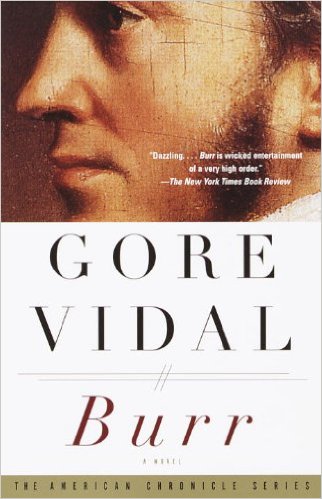
The characters of Harman and Elizabeth do play an important role in Gore Vidal’s Burr (1973) an historical novel told from the point of view of the young Charles Schuyler (a fictional character and no relation to the Schuylers in the musical Hamilton) and the book is one part of a collection of American histories the author wrote and named Narratives of Empire.

Never read Vidal before, have to admit, I know him as a talking head in The Celluloid Closet, commenting on his own work as one of numerous writers for the screenplay for Ben-Hur (1959) starring Charleton Heston. Vidal's personality as an arch literary satirist of the twentieth century has largely come to me via osmosis. My father's shelves, which we are currently culling, include several of his works. I am under the impression that any man of my father’s generation with a standard liberal arts education would be wanting without them, though my father was better read than most. Certainly better than I.

The book has taken months for me to read, not because it is not compelling -- it is -- and a satisfying read. My days have been so long, my responsibilities continuous and varied, and though I would pick it up most nights I would only make it through three or so pages before being overwhelmed. I even tried reading a few pages that long, dark night of November 8, when my thirteen year-old daughter was so crestfallen over the election that she could not rest and we compelled her to sleep with us.

True, this novel's content pertains to history, American history, but removed as it was from current events it provided a mild distraction.

The girl with Nik Walker (Aaron Burr on tour in "Hamilton")
Cleveland, Playhouse Square (2018)
In fact, it is because of current events that the novel itself comes as something of a comfort. Vidal is a member of a bygone era, Vulture called him a “dapper, left-wing bomb thrower” -- not a literal bomb-thrower, but that kind of old-school gadfly who could verbally cut you to the quick and leave you incoherently enraged. But first you have to a) be listening and b) understand that you have been insulted. Today’s right-wing demagogues owe their present success by simply refusing to do either.

Burr, the novel, provides the author the advantage of furnishing savage commentary upon icons of American history from a vantage point twice removed, from either his main subject, once Senator, then Vice President, but always “Colonel” Aaron Burr, or from his narrator, Mister Schuyler, a young man who in the course of just a few years rises from a desperate, penniless, inexperienced newspaper writer to a comfortable position in the the Van Buren administration.

Schuyler’s commission is to write a memoir of the ageing Burr (now eighty, some got half as many) and over their time together not only develops great admiration for the Colonel, but also absorbs his worldview, restrained temperament and even to some degree his remarkably subtle wit.

It is this wit, however, in recounting Burr’s version of the American Revolution and all that came after, that provides the subject, and in fact the author, to portray George Washington as a colossal failure on the battlefield, exhibiting terrible judgement (and apparent fantastically large buttocks) winning only one battle -- Yorktown -- and not without foreign assistance.

Later it is Jefferson, not Burr, who appears to hold no moral center, shifting any position necessary to keep the nation a loose confederation of states, denying strong federal power and yet as President freely violating or proposing to violate any of new bill of rights to maintain the status quo (i.e.: slavery) or to destroy his perceived enemies (i.e.: Aaron Burr.)

Tony Fabio as Aaron Burr in "Eden on the River" (1989)
The legendarily soft-spoken Jefferson, always clearly articulating his position, is rendered a slippery cipher, always scheming, fiddling with his inventions, and in constant opposition to Burr, who, by his own description of events, made the appropriate decisions necessary for Jefferson to become President. For the sake of the nation.

Of course, this is Burr speaking. And he speaks to an impressionable man who develops such admiration for him, delighted by his “exquisite irony” and “serene good humor.” It takes a moment to realize that the true object of such compliments is Vidal himself.

And this is comforting how? Donald Trump has made a mockery of American history with his arrogant run for President. Assuming he would never win, he was also more successful as a sloppy, right-wing bomb thrower, capitalizing on resentment, anger and outright racism to propel himself to be the loudest and most visible opponent to Barack Obama. His goal was self-aggrandizement, but unfortunately for him and the rest of us, he now needs to lead, something he has never been successful at doing.

It is demoralizing to imagine we are ending an era in which a young Puerto Rican-American with a Broadway musical under his belt could be granted an audience with the President of the United States to rap a song about the largely unregarded first Secretary of the Treasury which caused a YouTube sensation which inspired him and a company of talented artists to create a new musical which sparked a national conversation on what it means to be American, to be America.

Donald J. Trump does not inspire confidence, he can’t make anything great, and the only artwork he has ever inspired in my neighborhood was a great, hideous nude statue someone dumped on Coventry last summer.

Vidal wrote Burr in the era of Nixon, his novel reeking of cynicism, every player a player, twisting words and circumstance to his own advantage. His America of the early 19th century is a murky backwater where the rich stuff their faces and drink and smoke and spit and talk and talk and talk.

"The Emperor Has No Balls"
Ginger (2016)
He chooses a protagonist in Aaron Burr, worshipped by the common people, heralded wherever he goes, once he has been exiled by proper society for the murder of Alexander Hamilton.* In tearing down icons and exalting this scoundrel, Vidal makes you reconsider all you believe you know about the Founding Fathers. Good Lord, the man even suggests Davy Crockett was raped first before being killed at the Alamo.

So, the United States of America has elected to be its Chief Executive a scoundrel, a self-serving villain who will do what he can to subvert the Constitution to maintain the status quo and destroy his enemies, again. We got this far, citizens. The Republic will prevail.

Exactly how we will overcome, that is a terrible mystery and one which we carry into the new year. It has been suggested that Vidal’s type of scorched earth criticism of those with whom he disagrees has brought us to our current level of discourse. For when your facts are correct, but you are arrogant about it, why would your opponent even respond with an intellectually supported response? Why not just say,”Fuck you, you’re wrong.” and listen to the multitudes cheer? It certainly worked in 2016.

*About that; Lin-Manuel Miranda’s Hamilton taunts Burr to mention a “specific grievance” from over “thirty years of disagreements” for which he should apologize, there was one specific, heinous, personal insinuation made by Hamilton in mixed company and behind Burr's back, an insinuation which had absolutely nothing to do with Burr’s political or professional machinations, which might lead one, were they so inclined, to challenge one to a duel.

 This post has been updated to include a photo from 2018.

Friday, December 2, 2016

On Race (three)

Alia Shawkat as Alexander Hamilton (Drunk History)
Here is the billion dollar question about Hamilton, moving forward. What happens when this “wonderful American story,” (to quote the message from the company to the Vice President-elect made two weeks ago) which was created to be performed told by “a diverse group of men [and] women of different colors, creeds, and orientations” (again from last Friday’s speech) is licensed to be produced at colleges and high schools across the nation?

My high school alma mater is part of a community which is not terribly diverse. Largely Caucasian, almost entirely Christian This did not prevent Bay High from producing Fiddler on the Roof a few years ago. No idea how it was received, that’s a good play, great song, I am sure it was fine. No doubt an educational, experience, too. Let’s face it, the cast photo of those teenagers wearing fake beards looks no more or less ridiculous than if it were of a company of teenagers from Beachwood High wearing fake beards.

What happens, however, should my hometown high school chose to produce In The Heights? That’s an important story about an American community, and if the community that tells it does not have significant Latino representation, then that, too, is an educational opportunity, correct? Or is it something else? What is the difference between performing as a person who is Jewish and a person who is Hispanic?

I mean, we're talking about representing a diverse number of Latino characters, it's not like producing Bye Bye Birdie.

Good Lord, I hate Bye, Bye Birdie.

My own personal memories of racist moments in theater are painful to recollect. We presented Anything Goes my senior year and in the final scene my character disguises himself as one of the several Chinese converts who had been shuffling around after a Western missionary, replete with straw hat and uttering brief statements in “pidgin” English.

When my brother was a child actor, I saw him perform once in yellowface and once in blackface. That was wrong. Last week, however, we saw An Octaroon at Dobama Theatre where we saw a black man in whiteface, a white man in redface, and a brown man in blackface. That was satire.

So. where are we in our cross-cultural American experiment? Can a white actor can play a role created for a Latino or Black actor inspired by an historical white person? Can a woman?

As part of the school residency program, our actor-teachers perform scenes from classic literature. They also cast students to perform roles in these scenes with them. We provide scripts and costumes, and we have a few ground rules.

For example, students are asked to use their own voice, and not to put on a false voice. Part of this is honesty. If you are acting fake, you can't come close to the true emotions and decisions. Part of this is to avoid uncomfortable circumstances.

Yes, we present scenes from Lorraine Hansberry's Raisin In The Sun in rural Ohio. Once I was asked if a white student playing Lena Younger could use a Southern accent.  I said, "No, because this is Chicago." That seemed to him to be a satisfactory answer.

Our actors also have what we call our non-specific gender policy, to wit; “Boys can play the girls roles, girls can play the boys roles.”

Recently, however, our people have reported to me the increasing number of self-identified trans and non-binary students they have been encountering, from elementary school on up. The old instruction seems no longer appropriate. It is arcane, even.

After all, this is theater. Theater is play. And anyone can play anything.

Saturday, November 26, 2016

On Race (two)

Nicholas Christopher & fans.
The casual irony of my friend's meta Facebook post (see yesterday) is that Christopher Jackson is no longer playing George Washington in the company of Hamilton, having stepped down in October. In fact, Jackson did not perform the night we saw the show in early August.

Immediately following the first anniversary of its premiere on Broadway, it appeared that every original cast member of Hamilton who was still part of the production at that time (Renée Elise Goldsberry, Anthony Ramos, Mr. Jackson) had taken the week off.

No matter, we saw the remarkable Javier Muñoz in the lead role (Google him and you will receive the suggested search string “javier munoz fierce”) and had the unique opportunity to witness the performance of Nicholas Christopher as Washington just as he was joined the production.

Yes, he is strong and majestic, as the role requires, and you will excuse the hyperbole, but his rendition of One Last Time lifted me two inches above my seat.

Christopher was the only performer to come out to sign autographs that night, a Tuesday. No doubt many of performers needed to rest up for their Wednesday double. I was standing in the crowd near the stage door as the kids excitedly waited to hand Christopher their programs while my wife, waiting by the main entrance, watched as Muñoz and others surreptitiously made their way out the front and into waiting cars.

By a strange twist of fate, after the crowd had dispersed and we had crossed the street, discussing whether or not we would eat something or just head for the train, I found myself separated from the rest of the family by several yards, walking up the street to catch them. Who comes walking down the street the other way but Mr. Christopher, who had obviously just signed his last program and crossed the street at the other end, and was now heading back across West 46th Street to anonymously continue with his evening.

Spotting him, walking by himself down the street and then recognizing him, I began blurting like a fanboy. “Oh, it’s you, in the, the [gesturing stupidly over my shoulder at the theater] Thank you so much! That was. You were truly amazing.” He was sincerely gracious and we shook hands and then continued our different ways down the street.

Several of the company members that night were either swings (company members whose only responsibility is to be available to take over for lead performers in case of absence) like Austin Smith as Aaron Burr, or understudies who were now regularly taking roles which were soon to be filled permanently by new actors, like Andrew Chappelle as Lafayette/Jefferson.

One of the most interesting put-ins for the night was Thayne Jasperson in the role of Laurens/Philip. Jasperson had been an ensemble member with the company since its premiere, and can be heard on the original score as Samuel Seabury in The Farmer Refuted. He is a remarkably talented performer, a triple-threat, as they say.

He’s also white. He’s like, really, really white. He’s from Utah white.

During intermission we were discussing how the performance was going and specifics about each actor and when the conversation turned to the guy playing John Laurens, I noted that it was odd. My eleven year-old son asked, "What does that mean, why is it odd?" and I said, "Because you know."

And he said, "No, I don't know."

And I said, "It’s just that he’s. I mean, he’s not uhm. What I mean is.

"Only Tories are white."

Before the boy could ask, what the hell does that mean? I added,"Look. He’s great! Let’s read our programs," before I could say another totally ignorant thing.

It takes constant vigilance not to impress upon your children your own narrow worldview so that they may have the best opportunity to first see the world as it actually is.

To be continued.

Friday, November 25, 2016

On Race (one)

Christopher Jackson & friends.
Yesterday, the family was sitting around watching the Macy’s Thanksgiving Day Parade. The Sesame Street float rolled up and who was riding up top, singing the song Try a Little Kindness but Christopher Jackson, he who originated the role of George Washington in the Broadway musical Hamilton.

My friend Grant soon posted on the Facebook, “Kindness? Sesame Street is totally biased and should be canceled. Shameful!” Indeed, even on this day of family unity it is impossible to see every moment as a prism through which to refract this entire American moment.

How to easily unpack this coy bit of FB snark for one entirely unaware? Grant was modeling President-elect Trump’s response to the company of Hamilton having addressed Vice President-elect Pence with a brief speech from the stage of the Richard Rogers Theatre, one week ago tonight.

"The Theater must always be a safe and special place. The cast of Hamilton was very rude last night to a very good man, Mike Pence. Apologize!" tweeted Donald J. Trump

What was actually said in those prepared comments did not become the controversy. In fact, it was an entirely respectful speech addressing the concerns a large part of the electorate has about the new direction this nation will take under a Trump Administration. It was a plea from the diverse peoples of America to be seen and to be heard.

What many actually heard was the Vice President-elect being booed by a large part of the audience as he entered the hall, and what they saw was an actor of color lecturing him as he exited the hall.

I got into a dust-up with someone on social media who commented, “Pure Bullying! By definition, it was. Plain & simple. He had a microphone, on his ground, with his gang.”

I not only provided this individual the actual definition of bullying but also pointed out that not all black people are in “gangs.”

He responded, “Who said anything about black people?”

Theater humor.
Of course. We have heard the dog-whistles for so long, and I myself am quite learned in the blunt tools of trolling and misdirection, but I walked right into that one. He who used the code-word "gang" went on to accuse me of race-baiting.

But let us ask the question: Was addressing Mike Pence in that manner appropriate? Was it fair? Did an actor have the right to single out an individual like that while attending the theater? Should not performing artists stick to their job of singing and dancing, and leave the speeches to others in a more appropriate venue? Does everything, after all, have to be about politics?

Well, the play in question is Hamilton, which has invited discussion of controversial issues such as race and immigration in America, and its creators have never shied away from their opinions on such matters. Brandon Victor Dixon, the actor currently playing Aaron Burr, was acting on instruction from the producers, and was provided the speech by them. Lin-Manuel Miranda himself (currently across the sea filming a movie for Disney) is said to have helped write it.

For days I was trying to remember a similar situation, as presented in a play, one in which an actor was intending to make a political speech from the stage without the permission and agreement of the company with whom he shared the stage. Yesterday, I finally realized that I was trying to think of a play that I, myself, had written.

In that play, the artistic director of a company, who is also acting in his final performance at that company in late 2005, is thought to be planning to speak out against the Iraq War following his final bows.
ANDREW
I hear tonight, instead, he might make a speech. 
BENJAMIN
A speech about -- 
ANDREW
About Iraq, yeh. 
BENJAMIN
Can’t say I’d support that. 
ANDREW
Nah? 
BENJAMIN
Not his place to do that. We got people from all across the globe coming here, tourists. Everyone knows someone in Iraq. It’d be insulting to them. 
ANDREW
It’s his last night as artistic director, his last performance -- 
BENJAMIN
It’s not right. He runs the place, he doesn’t own it. It’d be totally unprofessional. We’d have to take it up with the union. 
ANDREW
It’s just words.
BENJAMIN
Man steps out, speaks his mind, appears he speaks for all of us, init? Doesn’t matter if he says he doesn’t. I might even agree with him, don’t matter. He didn’t ask. 
David Hansen © 2015
That is from The Great Globe Itselffirst produced was in 2015. Had our production followed the Hamilton-Pence controversy rather than preceded it, our post-show discussions might have seemed a bit more pertinent.

To be continued.