Showing posts with label The Maniac in the Bushes. Show all posts

Monday, April 13, 2026

The Five (book)

When did serial killers become sexy? Why did serial killers become sexy? Or more to the point, when did they become interesting? Fascinating? A subject of intellectual discourse of heated debate? Because to a man, they are all complete losers.

There was great interest in these losers in the 1990s, due in some part, I guess, to the 1992 Academy Award Winner for Best Picture, The Silence of the Lambs. It is not, however, the subject of the manhunt, Buffalo Bill, who became iconic, but the already incarcerated murderer, Hannibal Lecter, as performed by Anthony Hopkins. He’s cool, eerie, stylish, witty, brilliant, and, some would say, sexy.

He wasn’t the first murderer to hold my interest, however. That would be David Warner as Dr. John Leslie Stevenson in the 1979 time traveling romp, Time After Time. Malcolm McDowell, playing against type, is the bespectacled, naive and charming H.G. Wells, who (in this fictional tale) invents an actual, functional time machine. The device proves advantageous when the police arrive to arrest Dr. Stevenson, who uses it to escape Wells’ home, the city of London and the 19th Century. For Dr. Stevenson also happens to be the man known as “Jack the Ripper.”

Warner’s character travels through time – and space! – to disco-era San Francisco, where he continues his compulsion for slaughtering sex workers.

Because that’s what we know about him, isn’t it? I queried my brother recently, what do you know about Jack the Ripper? Nothing, he told me. I asked who his victims were. He said sex workers.

Seriously, my sixty-four year old brother said sex workers, not prostitutes. We have Gen Z children, after all.

Warner’s “Jack” was cool, eerie, stylish, witty, brilliant, and, some would say, sexy.

We seem to ascribe an extraordinary intelligence to serial murderers, and I imagine we do so due to the fact that they get away with it. They are "always one step ahead of the police” or that some even manage to stay anonymous, forever.

In the mid-to-late 1990s I read both Torso: The Story of Eliot Ness and the Search for a Psychopathic Killer by Steven Nickel and Paul W. Heimel’s Eliot Ness: The Real Story. The Ness-Cleveland connection greatly interested me (duh) and exposed me to the so-called Torso Murders, a series of grisly killings which occurred in the 1930s, and primarily during Ness’s tenure as Safety Director.

Attempts to connect these crimes are specious, but that hasn’t prevented folks from crafting their own theories about a single perpetrator. I personally cleave to the belief that these murders are unrelated. I was particularly grateful when this theory was put into print by Cleveland true crime author John Stark Bellamy in his book The Maniac in the Bushes (and More Tales of Cleveland Woe) that in the absence of corroborating evidence these tragedies should be assumed to be the work of different individuals.

Much has been made of this one guy, a member of a well-placed political family, who wrote taunting letters to Ness, claiming to be the culprit. But what of that? I send taunting letters to the Vice President every week.

Regardless, this desire to tell stories about these violent criminals … before Dexter, a contemporary cable program in which the serial killer is the hero because he kills other killers (oy) there was the X-Files spin-off Millennium. An FBI agent played by Lance Henriksen has the ability to access the sight of criminals, to see what they see. The first season was all about the crimes of serial killers, and I checked out from that show pretty fast. A network program thick with images of pain and horror.

Because that’s what we’re talking about – pain and horror. And as with fictions (Silence of the Lambs, Millennium, Dexter) or reality (Kingsbury Run or Whitechapel) the focus is on the killer. Ostensibly, to discover who he is, but also, because – as they say – he fascinates us.

Except he doesn’t. If reality has shown us anything, it’s that actual serial murderers are not interesting. They aren’t surgical villains with a penchant for chianti. They are outcasts and losers. Like Jeffrey Dahmer, Wayne Williams and John Wayne Gacy, unremarkable sociopaths.

The Whitechapel murders of 1888 inspired the legend of Jack the Ripper. That’s not even a real name, it originates from an anonymous letter to the editor of a newspaper, and almost certainly fake. Popular subjects have included barristers, doctors, and – of course – those within the sphere of the Royal Family.

The single, unidentified person of “Jack” killed five women over a period of several months, and then never again. These five are referred to as “canonical” which, while accurate because it means – generally – to be accepted as part of a group, is offensive to me as it lends legitimacy to something that cannot be known and is likely to be false.

All five were women, and all five have always been said to be sex workers. My introduction to “Jack the Ripper” was the film Time After Time, and it begins with Warner’s doctor encountering and then murdering a woman who has made it clear that the encounter is meant to be transactional.

In her book, The Five, author Hallie Rubenhold does what no one thought to do before, which is to question the common wisdom and to investigate the lives of the victims. Contemporary police accounts state clearly that all five were “prostitutes.” Rubenhold thoroughly documents the prevailing assumption at that time that all destitute women were, or that they may as well be so.

In describing the lives of each woman, we understand each; their unique descent into penury – which brought each to this locale, a district of London which was just one center for the destitute and unhoused – and their commonality, namely that each had an addiction to alcohol.

Rather than slaughtered in the act of solicitation, the first four were much more likely to have been preyed upon while sleeping out-of-doors, while the fifth – also sleeping – was surprised in her bed, the door to her one-room, ground floor apartment easily opened. To ascribe a (still) socially unacceptable occupation has always diminished their personhood, adding “they asked for it” to their epitaphs. But they were human people, undeserving of their economic status as well as their horrifying demise.

This is an actual, mass-marketed
"Jack the Ripper" costume.
This throws some salt into the works for many “Ripperologists” (a hateful term) whose theories about who the murderer may have been, especially those bespoke theories about an assassin for the Man-mans; eliminating a cabal of sex workers who could bring down the Monarchy, or someone on a Messianic quest to purge the city of lechery.

When we understand who the victims were, their deaths seem random. Each was just a very unlucky woman, sleeping rough (as they say) in the wrong place at the wrong time. And conspiracy theorists hate randomness. In fact, Rubenhold has had to endure a great deal of criticism and abuse for this book, as it does not offer any new insight into who “The Ripper” may be, Worse, it tears down a few theories carefully crafted by men (always men) who fancy themselves experts in a rarefied field.

The point is, we don’t know. We’ll never know. Accepting what we do not know is a very difficult thing. Conspiracy theories are born when men strain to apply meaning to what they do not understand, and in doing so they lose sight of the victims.

Sunday, July 25, 2010

The Mad Butcher of Kingsbury Run


The facts:

On September 23, 1935 the bodies of two men were discovered at the foot of Jackass Hill in Kingbury Run, near East 49th Street and Praha Ave.

Edward Andrassy and a never-identified man were each murdered by decapitation, with their genitals severed from their torsos. The genitals were discovered together nearby. The heads were discovered buried nearby, in different places.

Andrassy was heavily involved in vice, his parents even receiving a phone call recently threatening to kill him if he didn’t stay away from the caller’s wife.

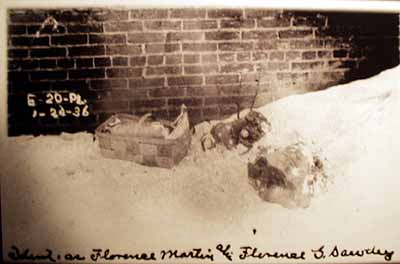
On January 26, 1936 a basket was found near East 20th and Central. This basket contained body parts wrapped in newspaper: an arm, two thighs and the lower half of a female torso. They belonged to Florence Polillo, a middle-aged woman, alcoholic, occasionally engaging in prostitution. The newspapers dated back between as recently as the day before and the previous August.

On February 7, in an abandoned lot on Orange near 15th Street, was discovered more of Polillo: upper torso, lower legs, left arm and hand. But no head. On February 8 a former associate of hers named Captain Swing jumped out a third story window, broke his heels, and “mumbling things that tended to implicate him in the killings.” (Cleveland Press)

On June 5, near the Kingsman Road bridge, some boys found a head rolled up into a pair of pants. The torso was found nearby, genitals intact. Like the first two men, the corpse was absent of blood indicating death (by decapitation) elsewhere and that the body was left where it was to be found. Never identified, this victim is known by its numerous tattoos.

July 22 turned up a badly decomposed male corpse near the tracks south of Clinton Road. Killed where it lay, it had been decapitated, and its clothes were found nearby. Its condition suggests it was murdered prior to the tattooed victim.

On September 10 a vagrant trying to catch a train tripped over the armless, headless torso of a man near the East 37th Street bridge. Soon police discovered the lower half of the torso, separated at the abdomen and the legs cut off at the hips. A stagnant pool nearby was fished, revealing his clothes. The man was emasculated, his genitals, arms and head never found. He was murdered by decapitation.

September 14: “I want to see this psycho caught. I’m going to do all I can to aid in the investigation.” - Eliot Ness

Or to put it another way, due to public hysteria created by a media-driven drive to sell papers, the Safety Director was called upon to comment on and meddle in affairs better left to detectives of the Police department.

Ness did bring it upon himself, raising his profile high above that of your average Safety Director (can you name your current Safety Director?) But the quote from Eliot Ness reflects to prevailing belief that these disconnected events were perpetrated by a single man. “This psycho.”

Really? The first two guys, sure. Polillo, not at all. The fourth, fifth and sixth victims had as little to do with each other, their similarities should easily have been written off as coincidence or intentional copy-cat crimes.

UPDATE: In 1937, the body of a second woman - eventually suggested to be Rose Wallace, an African-American prostitute who had disappeared the previous August - was found at the foot of the Lorain-Central (now the Lorain-Carnegie) Bridge. This body was dismembered, like Polillo's corpse, and bound in newspaper dated June, 1936. Wallace and Polillo went in the same circles, and even had One-Armed Willie, he of the jumping out the three-story window - in common. These two murders may have been committed by the same person. Parts bound in paper, female victim. But nothing like the other murders. Do you see how a craze comes about?

Source: The Maniac in the Bushes: More True Tales of Cleveland Crime and Disaster

Friday, January 22, 2010

Hunt Fiend In 4 Decapitations

Once upon a time I was the artistic director of a late-night theater project at Dobama Theatre. Trying to decide what slate of original projects to create for the second season, I shared with my boss, Joyce, the artistic director of the theater proper, the idea of making a musical out of the Kingsbury Run murders.

We could call it TORSO! THE MUSICAL!

It was a joke. I made her actually gasp. But seriously ... it was a joke. Five years later, the Play House actually produced a musical about the Kingsbury Run murders. There is no satire any more, just cheese.

The first historical record of a decapitated body dumped into that ancient stream bed called Kingsbury Run was in November ... 1905. By 1935 we can deduce that the person who would eventually be called the Cleveland Torso Murderer (tm) would be no less than fifty years old.

We know this. An unidentified woman washed ashore in Beulah Park in September, 1934. Coroner Arthur J. Pearce said the expert level of butchery suggested that it was done by a medical expert. He later admitted the cutting was no, in fact, that professionally done.

In early 1936 the dismemberment of Florence Pollilo was described as "expertly" done by Coroner Pearce, except for the gashes to the pelvic area. Otherwise, only a professional could have severed a human like that. Her head was never found, unlike Edward Andrassy's head, they found that. They also found his penis, but that was in a can some yards away.

Unlike the "Tatooted Man" found on June 5, 1936, three days before the Republican National Convention began. His genitals were un-mutilated. For your interest, a "death mask" of his head was put on display at the Great Lakes Exposition but never identified - in spite having been viewed by thousands. They still have this plaster mask at the Cleveland Police Museum.

By this time the media was lumping all of these disparate murders together, and calling for action. Eliot Ness remained silent, leaving his detectives to do their work. By September, and the discovery of a "7th victim" he began to be more public in his assessment of what was happening. Thankfully, they could blame marihuana for the madness.
"There is a plentiful supply of this deadly weed in Cleveland" - Michael J. Collegeman, head of the local Federal Narcotics Bureau.
... to be continued.

Source: John Stark Bellamy II, The Maniac in the Bushes: More True Tales of Cleveland Crime and Disaster