Showing posts with label Encyclopedia of Cleveland History. Show all posts

Saturday, July 8, 2023

Forest Hill Park Footbridge

Under Construction, 1939-40
For better or for worse, I am a runner. There are a number of short routes which take me from my home in Cleveland Heights and through the neighborhood or the city, though many of those will include inclines which, depending on the day, can be welcome or not.

Some time ago I realized how close I was to Forest Hill Park, which spans both the Heights and East Cleveland. It’s almost exactly a mile there (and a mile back) and once there, I can take a few different paths to create a 5K, a four or even five miler. And the entire route is mostly flat.

Once upon a time, Forest Hill was the home of John D. Rockefeller. Featuring a bluff from which you could view the city of Cleveland, the estate was a summer retreat for the family until the mid-1910s. In 1939, J.D. Rockefeller Jr. donated the property to both cities for public recreational use. It was at that time that Works Progress Administration funds were employed to create a footbridge to span a 350-foot valley, through which runs Forest Hill Boulevard.

It’s a lovely bridge, built with a steel skeleton and faced with locally quarried Euclid bluestone. More recently, a cage-like addition was added to the middle section for safety. It has also kept the bridge free from tagging.

Photo: J. Mark Souther
I will often take the bridge from East Cleveland to Cleveland Heights and back on my runs, and once even incorporated the bridge into a script I wrote, a play which is intended to be performed live via cellphone, while running through the park.

Over recent years, the bridge at either end had been damaged, the stone walls knocked over, possibly by careless motor vehicles in the park, or in some cases, probably pushed over by mischievous hands.

A couple years ago, however, repair workers replaced and repaired the damage and now they look good again. I stopped in the middle of a run in October, 2021 to thank and compliment the guys who were employed for the project, for their work.

Sources:
Cleveland Historical

Tuesday, October 25, 2011

Randall Park Mall

Benjamin bear looks for his girl Missy in Randall Park Mall.
"Cleveland Is A Warm, Fuzzy Place" (1977)
"There's going to be a transfer of power ... from the central city to the southeast part of Cleveland ... I believe that after today the forces that want to keep downtown Cleveland intact had better get on their horse and start riding real fast."
- Randall Park Mall Developer Ed DeBartolo, 1973
Two million square feet of shopping ecstasy, the Randall Park Mall opened to the public on August 11, 1976. At the time it was the largest indoor shopping mall in the world. The city of North Randall had a population of 1,500. Randall Mall Park employed 5,000.

Randall Park didn't have one, but FIVE department stores; Higbee's, The May Company, Sears, JC Penney, and the Joseph Horne Company. The place was so big, some stores had two locations, one on each floor! There were over 200 hundred stores in all. And it was stylish -- marble columns, real tile floors, beautiful ceilings and futuristic ramps and crossovers.

The joy was short-lived however. With two years, the Beachwood Mall opened, siphoning away well-heeled customers, and the place began losing any of its original luster before the end of the 1970s. The place was just so vast, and little thought had gone into long-term maintenance. Attending the movie theater (and using its bathrooms) required trips up and down many staircases, and the theater (and its bathrooms) were filthy and dysfunctional. By the mid-1980s the mall was considered downright dangerous, and suburban residents began to refer to it as Vandal Dark Mall ... "dark" because, you know, the lights were out in all the closed storefronts.

Randall Park Mall closed in 2009.


UPDATE: Found this PD op-ed piece celebrating the opening of Randall Park Mall from August 1976.

Sources:
Wikipedia
Outside Cleveland, Snapshots of Poverty’s Surge in the Suburbs New York Times, 10/25/2011
DeadMalls.com
NewsNet5.com
The Encyclopedia of Cleveland History

Friday, July 22, 2011

Arthur Loesser


Arthur Loesser (Aug. 26, 1894 - Jan. 4, 1969) was born in New York City and began playing piano at age six. A graduate of Columbia and the Institute of Musical Art (later known as Julliard) he toured the world as a concert pianist beginning in 1913.

During World War II he was an officer and a Japanese interpreter, and later became the first American to appear in Japan after the war, with the Nippon Symphony.

Loesser had joined the faculty of the Cleveland Institute of Music in 1926, becoming head of the piano department in 1953. He was program editor and annotator for the Cleveland Orchestra (1937 - 1942), and a music critic for the Cleveland Press (1938 - 1956).

He also wrote popular books on music, Humor in American Song (1943) and Men, Women, and Pianos: A Social History (1954).

DID YOU KNOW ..? Loesser tells us the reason the piano became the most acceptable instrument for genteel ladies in the Western World is because of all of the things women aren't required to do to play one. They need not purse their lips, nor wrap them around anything, spread their legs or crane their necks. They just sit up straight and tap their fingers. But then, Loesser never saw Tori Amos.

In 1968, Loesser was awarded a special citation from the Cleveland Arts Prize for Distinguished Service to the Arts.

Arthur was the elder half-brother to Broadway composer Frank Loesser. It was Arthur who referred to himself as "the evil of two Loessers," a line Frank would steal and use in reference to his first wife.

Sources:
Encyclopedia of Cleveland History
Wikipedia
Cleveland Arts Prize

Sunday, May 22, 2011

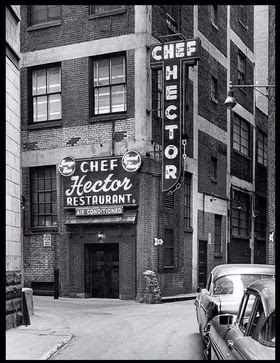
Chef Boyardee

Cleveland Press Collection
Cleveland State University Archives.  

My investigation into the 1950s seems to involve a lot of cheap food products.

Ettore "Hector" Boiardi (October 22, 1897 – June 21, 1985) was born in Piacenza, Italy and passed through Ellis Island when he was 16 years old. By the time he was 20 years-old he was the head chef of the Ritz Carlton Hotel in New York City.

Really? That's what it says. Amazing, there's your American success story for you, right there. His abilities attracted the attentions of the owners of the Windham Hotel, who lured him to Cleveland. He must have been some kind of business entrepreneur because in 1924, before he was even close to 30, Boiardi has opened his own restaurant, Il Giardino d'Italia (The Garden of Italy) at the corner of East 9th and Woodland. He lived at that time at 2501 Arlington Road in Cleveland Heights.

Now, the foods we traditionally think of as "Italian" in this country are based on the simple, inexpensive meals prepared by the poor immigrants who were looking for a new way of life. Italian cuisine was and is diverse and interesting - in Italy. But in the United States in those days it meant pasta and sauce. Experiencing the relative cheapness of the basic ingredients only made the portions larger, not more adventurous.

As the Depression stretched on, spaghetti and the entire Italian food craze was in full swing, and Il Giardino was a hit. Citizens clamored to take home Boiardi's sauce, which he was happy to sell to them, originally in milk bottles with a bag of dry noodles and Parmesan cheese to go with. He soon built a factory to keep up with demand.


"Hello, may I come in?"
Chef Boyardee TV commercial, 1953

You make it look so good.
World War II was where the Chef really hit the big-time, creating easy-to-prepare canned spaghetti for the Allies. By this time, his well-known canned pasta products were selling under the name "Boy-Ar-Dee" in a successful attempt to get everyone to pronounce his name correctly.

Like so much else that gave "our boys" comfort during the war, demand continued when they returned to the States.

DID YOU KNOW ..? Self-adhesive stamps were designed to provide to soldiers during the 1991 Persian Gulf War because gummed stamps were useless to carry around in the deserts of the Middle East -- and that their domestic introduction was due to, you guessed it, demand from Iraq War vets? True story.

Though operations moved to Pennsylvania during the 1930s, he remained a dedicated Cleveland restaurateur, opening Chef Boiardi's in 1931, and becoming a part-owner in several other local establishments.

Chef Boyardee died in Parma. And haven't we all, at least once?

Sources:
Wikipedia
Cool History of Cleveland
Encyclopedia of Cleveland History
Cleveland Heights Historical Society

Wednesday, March 23, 2011

WEWS Channel 5


Elizabeth Taylor on "What's My Line?"
November 14, 1954

What's My Line? was a CBS program, which means this particular broadcast would have been seen in Cleveland on WEWS Channel 5, which was a CBS affiliate until 1955.

WEWS was Cleveland's first television station, only the 16th in the nation, and went on the air December 17, 1947. The calls letters come from the original owner, Edward Wyllis Scripps. WEWS was the flagship station of the Scripps-Howard Broadcasting Company, who headquarters were located behind the Sterling-Linder-Davis Department Store.


Sources:
YouTube
Encyclopedia of Cleveland History
Cleveland Classic Media

Tuesday, January 11, 2011

Tremont


The Cleveland neighborhood called Tremont sits west of the Cuyahoga and South of Ohio City. It is a stunning, ramshackle, exciting and sometimes dangerous downtown industrial/residential neighborhood, featuring over a dozen attractive churches including Pilgrim Congregational UCC (founded in 1859), St. Michael the Archangel Church (1888), St. Augustine (1893), St. John Cantius (1898), and St. Theodosius Russian Orthodox Cathedral (1912). It is also home to Lemko Hall.

It was the site of the short-lived Cleveland University in the 1850s, a fact which gave name to the still-extant Literary Rd. and Professor and College Avenues. The neighborhood was called Cleveland Heights, then University Heights, and finally Tremont after the Tremont School, founded in 1910.

Homebase to a fastener manufacturer, the neighborhood was home to working-class immigrants following a familiar cycle -- the Irish and Germans in the late 1800s, followed by Poles, then Greeks by the end of the century, and also Syrians and by the 1950s a large population of Ukrainians. By 1954, Puerto Ricans were joining the population, and they play an important part of Tremont's neighborhood today.

Lincoln Park is a center of public activity, bounded by West 14th and West 11th Streets and Kenilworth and Starkweather Streets. A memory of Lincoln Park ...
"Sundays people would gather on the grass and benches to chat with friends or play cards, checkers, dominos and chess on the picnic tables. Some would bring picnic baskets from home while others stopped after church. Children played soccer or played at the pond that was in the center of the park, they also had a carousel and swings, too.

"Water fountains were at the corners of the park off Kenilworth/West 11th and West 14th and Starkweather. There were bushes completely around the whole park and Post Lamps that lit up the park at night. They had toilets, but Mom remembers them being dirty. Mom seemed to think there were no sidewalks on the inside of the park in the early days, but brother Mike says there were always there.

"I remember goldfish in the pond and Mike says they broke ground in 1957 to put the swimming pool in that still stands today. Swimming was free from 7 years old and up, but you had to sign in your name and age before getting in. They would check our toes and make us take a quick outside shower spray before getting through the bar gates. Wednesday was Family night for swimming where parents could come. Teenagers would climb the fence and skinny dip late nights, too."
- Maria Cairns-Yuras
Sources:
Wikipedia
Encyclopedia of Cleveland History
Cleveland Memory Project
Tremont History Project

Sunday, January 9, 2011

Musicarnival


There was a fad sweeping the post-War American - the tent theater! I had no idea. In Warrensville Heights that meant the establishment of the venerable MUSICARNIVAL in 1954.

The mast-and-cable tent structure remained year-round (next to Thistledown racetrack) but only in the temperature months would the tent go up, providing cover for musical acts and originally produced productions for a potential 1,500 patrons (when it originally opened - this number would grow to 2,500 in later years) seated in the round.

The first production, Oklahoma! opened on June 25, 1954.

Sunday afternoon jazz concerts were very popular.

Sources:
Encyclopedia of Cleveland History
Doing Hard Time in Shaker Heights
The Music Went 'Round and Around (John Vacha)

Sunday, December 12, 2010

Cedar-Lee Theatre

"Mae? MAE! Bring me some reefers!"


Go on, it's storming outside. Watch the whole thing.


The Cedar-Lee Theatre (located at the corner of...) opened on Christmas Day, 1925 with a screening of The King of Main Street. It was originally a single, 1,100 seat house.

Just this past December 1 they celebrated their 85th anniversary with a showing of The Gold Rush. Tickets were twenty-five cents. I love that.

In spite of contemporary accounts suggesting the movies were an excellent value and source for escape during the Great Depression, theaters did indeed have to take special action to ensure the audiences kept arriving. One popular attraction was Bank Night, where a lottery was held for a cash prize. In 1936, thirty Cleveland area theaters challenged and defeated an existing police ruling that this was an illegal practice.

There was also Crystal Night and China Night, an event dramatized in the little seen My Summer Story, that little-seen sequel to A Christmas Story.


They used the lobby of the Palace for the lobby scene, but this scene was shot in the Ohio.

Hey, while we're at it ... here is a scene from that forlorn mess, shot in large part in Cleveland during the sweltering summer of 1993 and released never:


Skip the opening bit, what you want starts at 2:06 - the World Exposition. No, no, not that Exposition. In spite of what most Clevelanders believe, the tales of Ralphie Parker take place in Indiana, not Cleveland. And this World Exposition supposedly took place in Chicago. There was, of course, a 1934 Chicago World's Fair, but calling it an exposition in this movie leaves me wondering if they were trying to cut some kind of difference. When do these movies take place, anyway? There is nothing in A Christmas Story to suggest Depression-era hardship. The sequel does in a ham-fisted way (okay, you can watch this whole clip if you want to feel that.)

However. I like to think they did capture some of what it felt like to be squeezed in a "Streets of the World" exhibit, complete with live camel.

And oh, did I mention I'm in the camel scene? You won't see me. I am the young man with thinning hair in the loud shirt, visible from 4:50 to 4:56. No, really, you can't see me.

Wait. What was I talking about?

Sources:
YouTube
imdb.com
cleveland.com
Encyclopedia of Cleveland History

Thursday, December 9, 2010

Western Reserve University


Western Reserve College was founded in Hudson, Ohio in 1826. Hudwas at that time the most populated area of the region. "Reserve" as it was known was the first college in Northern Ohio.

In 1882, railroad baron Amasa Stone donated half a million dolars to move the institution to Cleveland, where it became a "University." The site was adjacent to the Case School of Applied Science (founded 1880) and the two institutions worked together, sharing buildings and staff, long before they merged into a single entity in 1967.

WRU's undergraduate men's college was named Adelbert College after Amasa's son Adelbert who drowned when a student at Yale. In 1888 WRU establied the College for Women, which in 1932 was named Mather College in honor of Flora Stone mather, the college's second council president. Mather was a liberal arts school which also offered courses in home economics and education.

Sources:
Encyclopedia of Cleveland History
Wikipedia

Wednesday, November 10, 2010

Streetcars


Huron at Euclid Avenue
(facing what is now PlayhouseSquare)

Cleveland streetcars were operated by the Cleveland Railway. In the late 1800s "electrified" streetcars, which were three times faster than horse-drawn streetcars, expanded suburban development out from the city for ten miles in every direction (except, you know, North.) People working in the city could escape the major influx of Southern and Eastern European immigrants and industrial-strength pollution.

Beginning in the 1890s we soon had the incorporation of East Cleveland (1895), Lakewood and Cleveland Heights (spiritual sister cities, each founded in 1903) and by the 1930s we saw the villages and new suburbs of Bedford, Berea, Euclid, Garfield Heights, Maple Heights, Parma, Rocky River and Shaker Heights all attain city status.


Sources:
Wikipedia
Encyclopedia of Cleveland History

Sunday, July 11, 2010

William F. McDermott

William F. McDermott
(Feb. 17, 1891 - Nov. 16, 1958)
Born in Indiana, attended Butler College, McDermott came to Cleveland in 1921 to become drama critic for The Plain Dealer. In addition to writing theater reviews for the Cleveland and New York stages, and making travels to Europe to interview literary luminaries, he also wrote columns on various issues of the day.

The Encyclopedia of Cleveland History notes that he wrote against censorship in the 1950s, I'd like to know more about that. Much has been made of a certain doting actress restaging an entire production from the Hanna in his living room in Bratenahl when he was too ill to make it to the theater.

What McDermott and I disagree on - the value of federally funded theater. What we agree on - the brilliance of Tennessee Williams.

According to Dennis McDougal the young Louis Wasserman worked to ascend the rungs of Cleveland nightlife by plying local journalists with liquor ("buying them drinks, partying with them at the Alcazar Hotel, escorting them home") and occasionally writing their items for them when they got too loaded. The list of theater critics Wasserman claims to have ghosted for is all-inclusive, including Mr. McDermott.

Sources:
The Last Mogul: Lew Wasserman, MCA, and the Hidden History of Hollywood
The Encyclopedia of Cleveland History

Monday, July 5, 2010

White Motor Company


The White Motor Company was an outgrowth of the White Sewing Machine Company. The company's founder dismissed the important of the automobile, and so his sons created this new company in 1906 on Canal Street in the Flats. They concentrated on trucks during the Great War, and temporarily merged with Studebaker in the early 30s before reorganizing as the White Cotor COrporation, becoming a major producer of heavy-duty trucks and buses.

At this time, the local Communist Party turned its attention to auto workers at both the White Moror Co. and at the GM Fisher Body Plant on Coit Rd. Party member Wyndham Mortimer, a worker at White, formed the Cleveland District Automobile COuncil (CDAC.) This organization was noted for its discipline and unity. They organized a sit-down strike at the local Fisher Plant on December 28, which spread throughout GM, and ended in Feb. 1937 with the recognition of the Uniter Auto Workers (UAW). However, the UAW was working throughout the 1930s & 40s to rid the union of Communist influence.

Sources: Encyclopdia of Cleveland History
The Cool History of Cleveland

Republic Steel


Founded in Youngstown in 1899, the headquarters of Republic Steel were relocated to Cleveland in 1936, and the company entrenched itself as the nation's Number Three steelmaker, behind US Steel and Bethlehem Steel.

Thomas Patton, a private attorney who worked on the merger that formed Republic Steel was hired in 1936 to form Republic's internal legal department. As general counsel in the 1930s and 1940's, he negotiated for Republic during the steel strikes.

Thomas Girdler became Republic's first president and board chairman. Republic became a major producer of light alloys, with profits exceeding $87 million between 1936-43. Girdler first supported Pres. Roosevelt's Natl. Industrial Recovery Act, establishing a representation plan for Republic's employees, but when the Wagner Act outlawed such plans and promoted negotiations with regular unions, Girdler lost all affinity for the New Deal. He refused to bargain with the CIO; though conceding the need for collective bargaining, Girdler refused to do so by government edict.

Source: Teaching + Learning Cleveland
The Western Reserve Historical Society
Encyclopedia of Cleveland History
Wikipedia

Sunday, July 4, 2010

Republican National Convention Notes

Back in March I collected this data on the Republic National Convention (June 9 -12, 1936) but never incorporated it into an article or posted it. So here it is verbatim, with some nifty campaign buttons.

The Republican platform promised to speed up employment and maintain relief, but wanted relief responsibility returned to nonpolitical local agencies. It also favored a reduction in government expenses and the removal of production quotas contained in the National Recovery Administration and Agricultural Adjustment Act. - Encyclopedia of Cleveland History
Public Hall was renovated to accommodate the equipment and wiring necessary for broadcasting the event, and major speeches were scheduled for the late evening hours so that radio network programming would not be preempted. - Encyclopedia of Cleveland History
Landon proved to be an ineffective campaigner who rarely traveled. In the two months after his nomination he made no campaign appearances. As columnist Westbrook Pegler lampooned, ''Considerable mystery surrounds the disappearance of Alfred M. Landon of Topeka, Kansas.... The Missing Persons Bureau has sent out an alarm bulletin bearing Mr. Landon's photograph and other particulars, and anyone having information of his whereabouts is asked to communicate direct with the Republican National Committee.'' (Time, Aug. 31, 1936) - Time Passages Nostalgia Co.

Saturday, February 6, 2010

The Red Salute


"True! Timely! Terrific! See the effect RED teachings have on the youth of today!"

The Circle Theater was located at Doan's Corners, the area at Euclid Avenue and 105th & 107th Streets. Originally the Hoffman Theatre, Loew's assumed management of this 2,000 space and converted it from a live theater to a movie house. Bought by Max Marmostein in 1935, he made it a space for live performances and film.

In 1936 there was a showing of The Red Salute, which attracted the kind of protests this movie also found in other large cities. Starring Barbara Stanwyck, this anti-Communist "screwball comedy" really pissed off left-leaning college students at Western Reserve University. An army brat (Stanwyck) is in love with a Commie agitator, so her father, a General, arranges to have her kidnapped (by an aunt) to Mexico where she falls in with an AWOL soldier (Robert Young) but after returning to the States she reunites with the Communist boyfriend. However, in the end the dopey dogface convinces her that a) Democracy rules in spite of b) comparing Democracy to Communism is like comparing Christianity to Vegetarianism.

This area that was Doan's Corners has, of course, been swallowed by the Cleveland Clinic. Interestingly, I once performed I Hate This at the W.O. Walker Rehabilitation Center, which stands in virtually the same location.

Sources:
Red Scare Filmography
Encyclopedia of Cleveland History

Wednesday, February 3, 2010

Maternal Health Association

The Maternal Health Association opened its first branch on the West Side in 1936. Founders Dorothy Hamilton Brush and Hortense Oliver Shepard attempted to provide birth control at area hospitals and clinics, but their efforts were in vain, due to fear of the Comstock Act (which made it illegal to send "obscene, lewd, and/or lascivious" materials - including information regarding contraception - through the mail) and Cleveland's large Roman Catholic population. They provided contraception to married women (though not abortion) as well as marriage counseling. My grandmother worked for the Maternal Heath Association.

In 1966, the MHA changed its name to Planned Parenthood of Greater Cleveland.

Sources:
Encyclopedia of Cleveland History

Wednesday, January 20, 2010

Mayor Burton

Harold Hitz Burton (June 22, 1888 – October 28, 1964) served as the 45th mayor of Cleveland, Ohio, a member of the United States Senate and later Associate Justice of the Supreme Court of the United States. He was known as a dispassionate jurist who prized equal justice under the law. - Wikipedia
Bipartisanship is a quaint ideal. Burton was an Ohio State Representative and then law director of Cleveland before being elected as Mayor in 1935, running as a Republican. He held that position until 1941 when he was elected to the U.S. Senate where he met and befriended Truman. Harry S. made him a Supreme Court Justice in 1945.

As the 45th mayor of the city, he has been credited with rooting out organized crime and his pious public demeanor gained him the nickname the "Boy Scout Mayor."
When Burton became mayor of Cleveland in 1935, the city was infested with underworld mobs, riddled with police graft. He appointed young Eliot Ness safety director, started a clean-up which had spectacular results. One racketeer it dredged up was Albert Ruddy, who this week was convicted of shaking down building contractors for thousands of dollars during his 20-year reign as a union tsar. Burton earned for Cleveland, once a city shamed by its record of traffic deaths, the National Safety Award in 1939 and 1940. He turned his attention to public health, and this year Cleveland won the National Health Award. He has fought for free speech and tolerance. To Cleveland this year went the National Civil Liberties Award. - Time Magazine, Oct. 1940
He secured over $40 million in federal funds towards relief assistance, and championed Cleveland as a convention center - the Great Lakes Exposition and the Republican National Convention occurred under his watch.

I find it difficult to imagine he initiated those events, as they occurred in the first full year of his term.

Additional Soucres:
Ohio History Central
Encyclopedia of Cleveland History

Friday, January 15, 2010

The People's Theatre

The People's Theatre was a short-lived workers' theater established in Cleveland during the Depression. Modeled after New York's Theatre Union and Workers Laboratory Theatre, it was begun by Howard Da Silva, a native Clevelander who had returned after being raised and trained in New York. The Peoples Theatre made its debut ca. July 1935 with the first Cleveland production of Clifford Odets's strike drama, "Waiting for Lefty". After 2 more programs of proletarian plays given before predominantly union audiences, it opened its own theater in a former club at 4300 Carnegie Ave. on 23 Dec. 1935 with a production of Rudolf Wittenberg's anti-war play, "The Ostriches". Espousing the drama of social problems over that of escapism as its aim, it listed such names as Odets, Eva Le Gallienne, John Howard Lawson, and K. Elmo Lowe on its advisory board. The troupe of aspiring professionals and devoted amateurs gave at least 2 programs of one-act plays early in 1936, but Da Silva's return to New York left it without experienced leadership. "Class of `29", presented in Nov. of that year, was apparently its final production. - Encyclopedia of Cleveland History

Monday, January 4, 2010

John L. Severance

Assembling my library ... there were several volumes of Cleveland history I had picked up during the 1990s, the heyday of Cleveland history tomes, apparently. I already own the Encyclopedia of Cleveland History, the Encyclopedia of Cleveland Biography, and Fine Arts In Cleveland though I was unaware they were all created by the same people. Duh.

Flipping through Fine Arts in Cleveland: An Illustrated History (The Encyclopedia of Cleveland History, Vol 3) while the kids tumbled off to sleep is a refresher course in theater of the period, so instead I was opening my eyes to areas in which I am weaker, the art museum, the orchestra, and so on.

SEVERANCE, JOHN LONG (8 May 1863-16 Jan. 1936), industrialist. Born in Cleveland, he graduated from Oberlin College in 1885 and returned to Cleveland to work for Standard Oil. In 1899 he was instrumental in founding American Linseed Co., into which Cleveland Linseed was merged. In 1901 he organized and became president of Colonial Salt Co. His other business connections included serving as chairman of the board of Cleveland Arcade Co. and Youngstown Steel Door Co., and as director of Cleveland Trust Co. and Youngstown Sheet & Tube Co.

Philanthropically, he was president of the Cleveland Museum of Art and Musical Arts Association. Besides being a liberal benefactor to the art museum during his life, at his death he left it a collection valued at over $3 million. In 1929 he gave the city $1.5 million to build a concert hall for the Cleveland Orchestra; in 1930 increasing his donation to $2.5 million in memory of his wife, who died in 1929. Severance died childless in Cleveland and is buried in Lake View Cemetery.

- Encyclopedia of Cleveland History
He lived a block from my house, where the big-box-mall Severance Center now stands. His considerable art collection was donated to the museum, a grand fountain from the interior of his home is now a piece of exterior art near the Police Station. Fine Arts in Cleveland says he died penniless.

Looking forward to re-reading: IT CAN'T HAPPEN HERE (playscript)