Showing posts with label Stephen Sondheim. Show all posts

Sunday, December 12, 2021

Ten Most Visited Posts from 2021

Since beginning this blog in 2010, I have used it as a repositority for research, to report on works-in-progress, to flog productions and publications, promote the work of others, file book reports, to keep track of my progress pursuing my MFA, and to opine about matters pertaining to the world of theater.

Some posts go viral, most do not. I have a dedicated following of about two dozen folks (hello.) Every now and then something catches everyody's attention, and that's nice.

For some odd reason, the most popular posts of the year were written in the past couple months. You'd think I would have accumulated more views for stuff from the beginning of the year. I think I have had a lot to say this season. Might have something to do with going the fuck outside. 

Here now, my most visited posts from the year 2021.
10. On Execution
You move just a finger,
Say the slightest word,
Something’s bound to linger.
Be heard.
9. “Hadestown” at the Walter Kerr Theatre

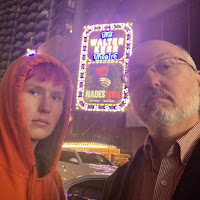
Having the opportunity to take my sixteen year-old to New York to attend a Broadway show was a highlight of the year. My own excitement to be back in the city was leavened by how much I learned about him during our brief stay.
Brian Pedaci
"Savory Taṇhā"
8. On Clichés

When does it become all right not to tell the entire fable, but just to reference it? You know what story I’m talking about. It’s in your nature.

7. “Savory Taṇhā” at Cleveland Public Theatre

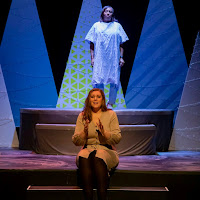
As the shutdown lifted (for better or for worse) and live, in-performance resumed, I realized I was not as overwhelmed by the experience of re-engaging in theatrical performance as so many others, and much of this is due to the opportunity afforded my by Cleveland Public Theatre, presenting Savory Taṇhā live via Zoom, first as a weekend of workshops in summer 2020, and then as a full three-week run early this year.
Sylka Edmondson
Katie Wells
"10 Minutes to Midnight"
6. 10 Minutes to Midnight: 9 Quirky Plays for the Holidays

This is still playing and you should see it!

5. 2021 Shubert Fendrich Memorial Playwriting Award

This was a delightful surprise, receiving this award, and since the announcement, Sherlock Holmes Meets the Bully of Baker Street has been licensed for production in schools in the United States and Canada.

4. On Trigger Warnings

Things have changed. Things have absolutely changed, and the world is divided into those who have the agency to say we must do things differently and those who say no, I want to do things the same way we always have. I find that those who oppose content warnings do not present compelling arguments for why they shouldn’t exist. 
3. Juke Box Hero

Part of my rock and roll fantasy (I mean – it’s all part of my rock and roll fantasy) has been to be able to play drums successfully with a band, and one night this fall I had my shot and I took it.

2. The “I Hate This” Series

When our video recording of I Hate This (performed by James Rankin) is released some time in the new year it will have been worth the wait. Several posts documenting the process of creating this work would individually take several places on this list, so in the interest of variety I added them up to represent one single entry. I am grateful this story has attracted so much attention.
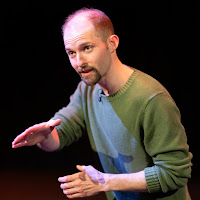
James Alexander Rankin
"I Hate This"
Photo by Cody York
1. Philip Johnson (Revisited)

Upon the announcement that the Cleveland Clinic plans to bulldoze the edifice which former housed the Cleveland Play House (which should have come as a surprise to absolutely no one) there were a few days of outrage express not only by those who have strong memories of their time in the space, but also many who have no personal interest in Cleveland theater history but felt it necessary to malign the Clinic on principle.

Many argued that the space should be kept and maintained as an arts facility (though none would volunteer to shepherd such a project) and were unimpressed when I suggested that if the largest performing arts organization in the region found the place financially untenable, Lord knows some coalition of small arts organizations would also.

Sunday, November 28, 2021

On Execution

There's all the work that needs to be done
It's late, for revision
There's all the time and all the planning
And songs, to be finished

- LCD Soundsystem, “Someone Great”
Stephen Sondheim
(1930 - 2021)
Losing a great person of art provides a moment of reflection. You hold for five, and look around and appraise not only what they have done, but also the impression they have made, what else may be absent had they never begun. Perhaps even more significant, when you are made aware of what currently is.

Because, oh! There is a revival of a musical by Stephen Sondheim on Broadway right now, and not just any revival, but one for which he actively participated, recentering the central protagonist to be a woman; Company.

A few openly gay playwrights have bristled as their works were psychoanalyzed for queer themes. If George and Martha were meant to be a gay couple, said Edward Albee, I would have written them as a gay couple. This is also the case with Company, which many have interpreted as centering a gay man who cannot acknowledge his sexuality.

If we must make Company autobiographical (and Sondheim would prefer we not) it touches not on the creator’s sexuality, but perhaps instead his inability to commit to a relationship, which his biography suggests may be true, up to a certain age.

There are no doubt people from all walks of life for whom the solitary life of Bobby/Bobbie is very familiar.

Reimagining the character as a woman who cannot commit, he had no problem with that, at least not during his final years. And that he would be engaged in the process, in his late 80s. He did not need to do that. But of course he did.

Of the many videos people are sharing today, one features Sondheim accepting his 1972 Tony Award for Follies, when he quoted the playwright David Trainer. He said that theater is “the only medium that acknowledges the presence of the audience, and that is why it will never die.”

I believe the theater will never die because of its fluidity. It resists definity. No, maybe Shakespeare did not intend Hamlet to be a woman, Iago to be black, Antonio to be gay (I mean, Antonio is totally gay) but they can be. You can do that production. I have seen them.

You can stage Into the Woods in an attic, Sweeney Todd where the actors play all the instruments, Assassins with a company of teenagers. Just remember: Having just the vision's no solution, everything depends on execution.

Yesterday, my friend Brian compared Into the Woods to Hamlet. “I'll see any production, any time and still find something new.” That, I believe, is the definition of a classic. Not that it can survive interpretation, but that it thrives on interpretation. 

Wednesday, October 25, 2017

Best Worst Thing That Ever Could Have Happened (documentary)

Lonny Price, Ann Morrison and Jim Walton
(Merrily We Roll Along, 1981)
A documentary on the creation of Hamilton would, of course, be very exciting, especially if you are a fan of Hamilton.

But it wouldn't have much of a dramatic arc, would it? Acclaimed young theater artist sets out to create a musical based on the life of a little-regarded figure from American history ... and he succeeds.

Wouldn't you be more interested in the creation of Moose Murders?

Well, they haven't made that film yet. But I remember seeing Moon Over Broadway, the Pennebaker/Hegedus documentary about the creation of Ken Ludwig's farce, Moon Over Buffalo. That production, though an eventual success, was initially hampered by set-backs and interpersonal tension which makes for compelling backstage drama.

Netflix, which has apparently cornered the market on quirky, at-home theatrical events like the Disney musical Newsies and Oh Hello On Broadway, has made available Best Worst Thing That Ever Could Have Happened. Directed by Lonny Price, this is a film about the original and ill-fated 1981 production of Stephen Sondheim's Merrily We Roll Along. Mr. Price knows a great deal on the subject, as he was one of that production's starring performers.

Time has been extremely kind to Merrily We Roll Along, and several Sondheim's standards were created for it, including "Old Friends," "Our Time," and "Not a Day Goes By."

Joseph Dunn
(These Are The Times, 2013)
Adapted from the 1931, George S. Kaufman and Moss Hart classic of the same name, the story follows the lives of a trio of friends, writers and performers, from aspirational youth to jaded success and disappointment — only going backwards, scene by scene, from middle-age to college graduation.

Sondheim's musical follows this same reverse-chronological timeline. As if that conceit weren't challenging enough, the Broadway premiere of was cast with a team of very young performers, to play aged at the beginning of the play, and younger as they go.

When the production closed after only sixteen performances, we can lament the end of the professional team of Stephen Sondheim and director Hal Prince … but you know they've done just fine. What of the company, the eldest only twenty-five, and some as young as sixteen?

Their lives in the time since may provide meaningful solace to those given to regret of the road not traveled. The lead performers went on to good lives as actors, educators, and journalists … but even Merrily company member Jason Alexander, featured performer in the wildly successful sit-com Seinfeld, even he has regrets over the failure of this important first work in their careers.

I was describing the documentary to my twelve year-old son as I walked him to the bus stop this morning. "Huh," he said. "Sounds like the plot of the musical."

Tomorrow night I host a private reading of a newly revised version of These Are The Times, my Cleveland history play which received a workshop at Cleveland Public Theatre almost five years ago.

Tony Award | Best Revival of a Musical (2024)
The first act of Times is presented as a Federal Theater Project “Living Newspaper,” presenting the events of 1936 -- and in the 2013 workshop these events also occur in reverse-chronological order, as in Kaufman & Hart’s Merrily We Roll Along, which was produced at the Cleveland Play House that year. There's even a reference to the Play House production during one scene in the act, as if explaining that show would give the conceit additional clarity.

“It’s just too complicated to tell a story backwards,” laments Harold Prince in Best Worst Thing.

In the newly revised version, my first act now proceeds in proper chronological order. Note taken, Mr. Prince. Note taken.
 
UPDATE: BorderLight Theater Festival presents The Right Room, a new play by David Hansen and directed by Jasmine Renee, July 16 - 19, 2025. Help support our production by dropping a donation on our GoFundMe campaign! 

Sunday, July 24, 2016

Boy Camp 2016

A low-key first night, but not without activity. First order of Boy Camp 2016, the boy needed a haircut. From there we proceeded to BD’s Mongolian Barbeque. Why? Because the girl won’t step foot in that place due to her peanut allergy. The boy has always been curious about it.

We ate way too much, so after window shopping at Big Fun for a few minutes we dragged our back ends home to watch Believeland on Netflix, the “Happy Ending” cut.

Believeland, a film by Andy Billman, lays out the humiliating defeats of each of Cleveland’s three major sports franchises in painful details, against the backdrop of urban decay and despair and unfortunate 1980s and 90s Midwestern hairstyles.

We played poker for a bit and then made an early night because I needed to take a friend to the airport first thing this morning. Of course, “early night” this summer means before midnight. We still had to watch the final Cleveland installment of The Daily Show.

After a relaxing morning and taking care of a few errands, we set out for the rest of the day. First up, the U.S.S. Cod, our resident World War Two submarine, located pretty much in the same location as a World War One submarine during the Great Lakes Exposition.

Thou lumpish, hasty-witted maggot-pie!
Then we headed to the library to join two actor-teachers, Shaun and Will, as they began conducting a Shakespearean comedy workshop in Brett Hall.

Had we really performed Twelfth Night (As Told By Malvolio) right there in that space, at that time, only one week ago? Crazy.

Boy Camp traditionally (though not always) commences with bowling. It’s always been at that place in Solon, but since we were already downtown, we made a spontaneous decision to go to Corner Alley on East 4th.

Yes, I know it’s fucking expensive. This is not your son.

Souvenir vendors up and down Euclid Avenue we selling the last of their RNC booty, but otherwise, downtown looked much more like itself, without any security barriers or barricades and none the worse for wear.

From there we moved to the near west side for dinner at XYZ Tavern (Broccoli tempura is totally a thing) and knocking around at Superelectric, which is the coolee-coolest place to have fun, be stupid 1970s nostalgic, and really not spend a lot of money.

I wanted to try all the different pinball machine, but the boy had seen a “shuffle bowling” machine at Corner Alley that didn’t work and when he found they have one at Superelectric he didn’t want to play anything else.

Assassins (Near West Theatre)
The major event for our evening was Assassins at Near West Theatre. A community theater in Ohio City, they recently opened a brand new facility right on Detroit in the heart of Gordon Square. I was excited to see this "problem" musical of Sondheim’s (aren’t they all, though, after all) performed by a large cast of performers between the ages of 16 and 25.

Really. They produced Assassins during a national political convention. Word!

And the performances were delightful, the design was tremendous. My major issue, unfortunately, is with the show itself. I had seen it once before perhaps a dozen years ago, and am a great fan of the Off-Broadway cast recording starring Victor Garber. The recording by itself tells a tight and compelling tale, clearly playing out the American obsession with guns and fame. A couple things trouble me about the production presented in full.

One is all the scenes that don’t feature music. All the pre-Kennedy assassins, who all killed their targets (except Giuseppe Zangara) are treated to set pieces with great Sondheim songs. John Hinckley, Jr. and Squeaky Fromme get a duet as well, but Fromme also participates in a few scenes with Sarah Jane Moore which are goofy (women, what are ya gonna do) and Sam Byck has two rambling monologues which, though amusing, merely explain the mindset of a deluded murderer which is already and much more successfully communicated through the songs and  lyrics.

The show now seems awkwardly dated. We are living in a time when gun worship is a society endangering mental illness. It’s not enough to discuss these figures from history in the context of their megalomania. Also no longer relevant is the special significance given to the legend of Lee Harvey Oswald, as though that assassination was more elevated, more significant, more holy than the rest.

This is the point of view of someone who personally experienced the event in 1963. No one under fifty has that experience. The assassination of John Kennedy was no more devastating to the people of his time than that of James A. Garfield to his. I mean, don’t tell a Baby Boomer that, you’ll never hear the end of it.

"Time Of The Apes"
The addition of a new song after the 1990 Off-Broadway production, Something Just Broke, was new to me. The penultimate number, it expresses the horror and sadness that grips the nation in the wake of such a loss. However, as the rest of the show is so arch, so satiric, and so dark, dealing exclusively until that moment with the assassins themselves, it felt a little late in the game to present earnest, real world grieving from everyday citizens.

After the show we considered ice cream, but Sweet Moses was packed. Besides, we were totally exhausted. No, we did not get around to everything he wanted to do this weekend. We did not make bacon dippers or chicken and waffles. But that didn't keep him from telling me what a great day it was.

Sunday morning we watched Mystery Science Theater 3000 because that is what you should always do on Sunday morning.

Friday, December 26, 2014

Into The Woods (musical)

 
ONCE UPON A TIME … Ohio University was on a quarter schedule and the college more or less shut down between Thanksgiving an New Year’s. Six weeks to work, lie about, or travel.

December 1990 the school of theater arranged a trip for England which included tours and shows in London, followed by several days of workshops and shows in Stratford-Upon-Avon with members of the Royal Shakespeare Company.


Our first night in we had reservations for some West End show, reservations which we lost for some reason, and our ticket broker gave the tour a choice of two alternatives - Man of the Moment by Alan Ayckbourn, or the original London production of Stephen Sondheim’s Into the Woods.

Ayckbourn’s work I was familiar with, and enjoyed. Of Sondheim, I knew nothing. If you do not count West Side Story, I had never seen or heard any of his work. Please forgive me, I was only 22, and by the age of 22 I had pretty much lost interest in musical theater entirely.

And yet, I chose to see that, in large part because like everyone else in the company I was suffering from jet lag, having been awake for over 24 hours straight. I thought a musical would more successfully keep me awake.

Nigel Planer as Neil in "The Young Ones"
 Note: I missed the chance to see Nigel Planer live onstage in "Man of the Moment", though I did eventually see him in "Feelgood" (for better or worse) ten or so years later.

Into the Woods in its original London production was very odd. The New York premiere (1987) featured legit Broadway talent such as Bernadette Peters and Joanna Gleason. In the West End the cast was composed of several famous television personalities, like presenter Nicholas Parsons as the Narrator and Julia McKenzie as the Witch who, though an experienced stage performer (and recognizable as today’s version of TV’s Miss Marple) did not look much changed when stripped of her witchy old-age make-up.

Yes, I am ashamed to have written that. But there it is.

Just appearing on stage these actors received applause. The problem was (and the soundtrack recording gives proof of this) many of them could not sing.

However, I did find the music infectious, as Sondheim’s work invariably is (“There's not a tune you can hum.” my ass.) It was colorful and interesting, and very funny. All these folk tales wrapped up rather neatly, and the title song reprise made it clear, after almost ninety minutes and no intermission, that the show was over. Except for the Narrator adding To Be Continued and the lack of any curtain call.

As you know, if you are familiar with the work, “Happy ever after!” is not how the show ends, and I soon discovered there was, in fact, a second act. This second part was confusing, disorienting, ill befalling absolutely everyone, their mistakes magnified. I did not understand the point of this second act, which I felt was maudlin, mawkish, somnambulant (literally so, I pinched the soft parts of my own hands very painfully to stay awake) and a tale or two too far.

But it kept with me. Later, I got the Broadway cast recording, still later the West End disc (Rapunzel’s Prince has the most bizarre accent) and even recorded the Great Performances production onto VHS, which I still have.

Listening to the albums I grew to appreciate the emotional ambiguity of the second act. Also, on Mandy Patinkin’s eponymous album (1989) he does a heart-wrenching cover of No More.

Tom Ford and Jodi Dominick (center) as the Baker and his wife.
In 2008, Great Lakes Theater inaugurated the “Re-Imagined” Hanna Theatre with a repertory of Macbeth and Into the Woods. I had children of my own by then, aged 5 and 3, and already they enjoyed love theater. We brought them to opening night, but left at intermission - by design. I felt the ending was too upsetting from a child. All the characters they loved were made unhappy (or always were) some would be killed, and horribly, the songs more complicated about complicated, adult issues. There would be a time for such challenging stuff, but not yet.
“Stay a child while you can be a child.”
The Great Lakes production was excellent (the Wall Street Journal called it a “tour de force”) introducing CLE audiences to performers who would develop long-standing relationships with the company (Jodi Dominick as the Baker’s Wife stands out in my memory) and gorgeous turns by returning actors whose work at GLT are becoming legendary (Tom Ford who played the Baker would go on to create a truly bizarre Sweeney Todd at the Hanna as well as a show stealing Monsieur Thénardier in this season’s record-breaking Les Miz).

It was disappointing to know my kids would only receive half of this particular production, and never have the opportunity to see the entire thing. I didn’t see the entire GLT production myself until it was almost closed.

Isn't it nice to know a lot?
Fall 2008 I had used vacation time to canvas in Beachwood, convincing elderly voters that Obama was not, in fact, a Muslim. The day before Election Day, I walked about neighborhoods in Euclid, encouraging likely voters to get out and vote. It looked as though every other house in what was otherwise a well-kept neighborhood was for sale, foreclosed, or abandoned.

November 4, Election Day itself, I was an emotional wreck, despondent in my fear that someone as willfully uneducated as Sarah Palin could attain high office, and demoralized by the fear-mongering and purely racist rumors. The economy was in free-fall that warm, bright fall day, and I did not know what kind of world these children would be left.

I could not even think that day, so I attended a student matinee of Into the Woods.

The second act clicked into place for me. The path from The Last Midnight to No More to No One Is Alone was a map of the psyche of a doubt-ridden parent. I sat in the front row on the balcony (there were fortunately no students in the balcony that morning) and tears, many tears, streamed down my face.

I’ll just come out and say it, Into the Woods doesn’t make sense if you have never had children. Tell me I’m wrong, that’s fine. Sondheim doesn’t have children. My argument can’t be substantiated.

However, just today on Facebook, colleagues far and wide, in speculating upon their decision to attend a showing of the new Disney film adaptation, have remarked upon the original version’s “eeeeendless, repetitive second act” (thank you for that, Henson.) Those who have shared this opinion, within my sphere, are uniformly child-free.

Conversely, my wife says she was always emotionally affected by the entirety of Into the Woods, even before having children. I would argue this is because she has very troubling issues relating to her father. I was never introspective about about my relationship to my own parents, my father was just this guy. I thought myself a solitary man, until the impending birth of and subsequent loss of my first child, a son.

So, allow me to rephrase my original statement … Into the Woods didn’t make sense to me until I had children.

For Christmas we went to see this new film adaptation, which was very enjoyable and arguably the most successful adaptation of a musical from stage to screen ever made. That that is a very low bar to hurdle does not render my praise in any manner faint.

TO BE CONTINUED!