Showing posts with label Cleveland Magazine. Show all posts

Saturday, September 26, 2020

Process II

This is my one hundredth post for 2020.

I have not written a short story in a long time. I wrote a brief piece for a local magazine about ten years ago that I was happy with. I tried my hand at writing articles for Cleveland Magazine in the mid-aughts but they weren’t very good. 

They were fine.

For my “dark fiction” class I need to turn in a short story in a couple weeks, one which includes elements ranging from the gothic and grotesque to the horrific and weird. Neither my writing fiction nor engaging in negative storytelling do I consider strong suits; hence, I took the class.

Creating and comprehending the plot of a mystery, specifically Sherlock Holmes Meets the Bully of Baker Street, inspired me to plot out the plot visually in a manner I had not attempted before. I created a chaotic flow chart, where I could drop things I knew must happen, in the order they must happen, at various points on a large, blank page, correcting them with arrows. The spaces in between were then filled with songs, puzzles, and other elements which I hoped to include and gave me a visual sense of pacing.

As a result, I could write the play in pieces-parts, without worrying about the order -- I could organize them according to the graphic later -- and concluded with a first draft that was coherent and largely complete. This was something which would have been useful crafting my previous mysteries, espcially those which had been adapted from pre-existing works. 

The story I am working on for my fiction class is one I have been thinking of for twenty-five years. Seriously, I have had this tale rolling around in my head for decades, but have never written it. Because I never had the time or inclination to -- I did not know where it fit in my writing life. Now I do, and I cannot express how exciting that is.

Because it is an assignment. I have to do this, not for me, but for a class! Which is a much better reason for me to get it done.

Wednesday, January 16, 2013

The Avenue As It Used To Be

 Company for "Bummer" - Dobama's Night Kitchen, 1995

Last night I had an hour-long conversation with a young man who is writing  book about the Coventry neighborhood, and how it is no longer cool the way it was when he was a teenager in the late 1990s. Over the course of this discussion, I was reminded of an article I had written in honor of Dobama Theatre's eviction from their former basement home.

There Goes the Neighborhood
by David Hansen
First published in Cleveland Magazine, June 2005

Coventry loses Dobama Theatre this month, but what does it gain?

The year 1968 was auspicious in Cleveland theater history for two big reasons: I was born, and Dobama Theatre opened its doors on Coventry Road in Cleveland Heights. In the intervening 37 years, we have each changed a lot, Dobama and I, together and apart, for better and for worse.

Our playgrounds could not have been more different back then. Somewhere between the eras of Marilyn Sheppard and Amy Mihaljevic, I could toddle around unmonitored in the front yard of my Wolf Road home in Bay Village with little fear of being snatched . . . or maybe my parents' "Ice Storm" generation really was kind of slow.

Coventry, meanwhile, was cementing its reputation, one that persists to this day, as a hangout for an "edgy" crowd. It was an inexpensive place to live and was an attractive spot for a lot of intellectuals, teachers and otherwise unsavory, forward-thinking pinkos to live, drink and presumably take a lot of drugs.

Founding artistic director Donald Bianchi signed the lease on the basement space at 1846 Coventry — then a bowling alley — in 1964. The landlord offered them (if you can believe this) free rent until their first show opened. The owner was obviously a communist. Even so, no one imagined then that it would take four years to get the space into shape.

When Dobama opened its first play on Coventry, Lorrainne Hansberry's "The Sign in Sidney Brustein's Window," an examination of race relations between blacks and Jews, there was a real-live biker bar across the street. Oooh, scary — big, hairy bikers!

This is funny because my father-in-law is a big, hairy biker, who owns a real-live biker bar in Athens, Ohio. But I digress.

Following a rather cushy upbringing and putting in the requisite five years at Ohio University, I came to Cleveland Heights in the early 1990s. It was the end of an era . . . and apparently the beginning of a new one. It still had a hippie-dippy vibe. Hang-abouts were still smoking cigarettes and playing Pente at all hours in the Arabica on the corner. My friends and I performed at open-mic nights in what they used to call The Yard out in front of that coffeehouse, a big open plaza where kids played hackey-sack and there was even more smoking.

It was also a depressed time. A friend who came to visit got his car broken into in the middle of the afternoon and has never been back. I was consistently hit up by a guy named Benny. Nice guy. He got most of my change, back when I still gave people change.

My introduction to Dobama was when I went to see "Nebraska" by Keith Reddin, a play about the effects of stress upon the men and women who work in nuclear weapons silos. Then as now, Dobama Theatre has been dedicated to plays with strong, left-leaning social messages.

The early '90s was also when Joyce Casey began her tenure as artistic director. Since then she has worked to maintain the theater's reputation for progressive-thinking plays, to reward her artists with pay (the performers, directors and artisans from the Age of Aquarius did it all for love, the amateurs) and to attract young, new audiences.

That's where I came in. In 1995 I was asked to create a late-night theater project — shows that would go up after the curtain came down on the mainstage shows — specifically to get teenagers and young adults into the seats. I also worked as the public relations director, to justify a paycheck.

Before I left Dobama in 1998, I developed a strong attachment to that theater. At that time, it was practically the only theater in town presenting the best modern plays to Cleveland audiences. "Angels In America," "Wit," the works of Suzan-Lori Parks and Paula Vogel — if you had seen the Cleveland premiere of a Pulitzer Prize- or Tony Award-winning play, or last year's great Off-Broadway or West End hit, the odds were very good you saw it at Dobama.

Their dedication to local playwrights is unequaled in Cleveland, presenting one world premiere a season. Eric Coble, Sarah Morton, Faye Sholiton, and, yes, even I have had new works presented for the first time either as part of the mainstage or Night Kitchen productions.

There have been detractors. Even I thought Joyce was high when she chose to produce Mart Crowley's "For Reasons That Remain Unclear" in 1997. A two-person, one-set drama featuring Mitchell Fields as a pedophile priest and Scott Plate as one of his now-grown victims who confronts him — in Rome! I thought it would be hooted off the stage. And I had to sell it.

Crowley, best known for the groundbreaking and gay-stereotype-setting "The Boys in the Band," had had one ill-received production of "For Reasons" in Washington a few years earlier. The Dobama production seemed sure to be its second.

It was a big, big hit for Dobama. The show's run was extended an additional weekend, which afforded the playwright, with his L.A. entourage (Crowley does a lot of writing for television), the opportunity to come to Cleveland and see his latest work be vindicated. I will never forget when Joyce announced the playwright's presence in the audience following curtain call. We could all hear Scott in the dressing room; he yelped like a little girl. It was yet another touching, transcendent moment in the history of this little theater.

Meanwhile, time was not kind to the glazed, white terra cotta building Dobama has called home. One morning I was working in the office, alone, when I heard someone turn on the shower in the men's room lobby — which has no shower. I stood in mute horror as the entire lobby flooded in a matter of minutes. Quite often I have watched in pain as productions would include actual rain, onstage. Conditions for producing professional theater became incrementally intolerable.

When the Winking Lizard restaurant moved in upstairs in 1998, the sounds of chairs scraping across the floor and newly installed toilets flushing directly over the audience's heads became a commonplace occurrence. Intimate, quiet productions have become almost impossible to consider for production, and Dobama has lost subscribers because of this, as well as all of the other inconveniences.

Meanwhile, the Coventry neighborhood has been evolving around this liberal bastion of free expression and authority-questioning drama. While the stalwart, funky and fun emporiums of the past (Tommy's Restaurant, High Tide-Rock Bottom, Mac's Back Paperbacks and Record Revolution among others) have held back corporate encroachment by consolidating into one co-operatively owned block in the middle of the street, new landlords at the extremes have done their best to maximize profit and lower the common denominator.

In the neighborhood where I used to get my eyeglass prescription filled, take tai chi lessons, get my groceries and ply my trade as a theater artist, I can now buy pizza, hoagies, sushi, burritos and ice cream. For every independent boutique that can't cut it, we get another place to stuff your face.

Worse still, it's like Coventry is eating itself. The chain coffee shop put the old Arabica out of business in 2001. The chain burrito place went up after the success of the locally owned Que Tal up the street, and Strickland's and Goodie's ice cream shops opened almost simultaneously to much consternation. The new sub shop will no doubt do damage to the long-established Grum's, and now there's a third pizza place.

The business model seems to be: You have clientele? I want it. No imagination, no plan for the future; it's just business.

Now, I have no illusion about the bohemian era for which Coventry is so celebrated. It's like Derf put it in one of his cartoons: "Coventry — it's just like Greenwich Village!!! (Only smaller and duller.)"

But it was once a neighborhood where I would go and stay, and not just to work. On a beautiful day, you could even walk up to The Yard and see who was there. No one does that anymore, either — the powers that be put giant, hideous planters there several years ago as part of some forgotten beautification plan. Now there isn't any room for people to play guitar or skateboard or attract any kind of crowd.

Dobama has been looking for a new home for some time, someplace warm and dry, where it can afford the rent, which has been rising exponentially up and down the street. The theater has been promised a new space in the old YMCA building across the street from the Cleveland Heights Main Library on Lee Road. And a proud new sign hangs on the building that reads "Future Home of Dobama Theatre."

Unfortunately, that place won't be ready until 2006. And J. Scott Scheel, Dobama's landlord since March 2003, gave management a "notice to vacate premises" in November 2004. It was only through a last-minute intervention by the city of Cleveland Heights that the theater could keep operating on Coventry through the conclusion of the 2004-2005 season.

For the next year — and hopefully only for the next year — Dobama will go "on tour," producing plays under the Dobama name at other venues around the city.

With Dobama gone, the moneymaking can really begin in that basement space. That is, once its spongelike ceiling is taken care of and an elevator is installed to take care of the problem that no one with a wheelchair or a heart condition can get down those steps. Scheel told me he is looking forward to putting "a comedy club, other live theater, a jazz club, a pool hall . . . or a restaurant" down there. He quickly added that a restaurant "is not our preference."

The last three retail stores to leave his iced wedding cake of a building have been replaced with places to eat. This is me holding my breath.

I feel Coventry is at a painful and difficult juncture. Perhaps the large crowds currently drawn to the sports bar and the other sports bar and the other sports bar don't really care that Dobama is leaving — or don't even know it's there, which is more likely. What troubles me is that I used to go to Coventry not just to work, but to see what was happening, to run into people, and to, you know, have a life.

If Coventry is going to win back any of its reputation as a cool place to be, it needs someplace like Dobama, if not the place itself. A place where folks from diverse backgrounds — bikers and bankers, punks and preps, white, black, straight, gay, Jew, gentile — come together for a communal experience. Not merely to consume, but to participate in some time-honored ritual. Entertaining, edifying, affordable and something uniquely Cleveland.

After 40 years, Coventry needs a new bowling alley.
 Join Death of the Cool: Decline of Coventry Village's Counter-Culture Scene Facebook Page.

"The Avenue As It Used To Be" is a play by Donald A. Bianchi (1976)

Saturday, August 11, 2012

Eggshelland

Eggshelland 2009
Walking on Eggshelland
by David Hansen
Cleveland Magazine, April 2006

When the last sand grain was blown from the floor of City Hall’s rotunda last October, the collective image of that Tibetan Buddhist mandala remained forever burned into the memory of all those who had seen it. Dyed fragments of pulverized stone, brought together for a brief moment in time, then scattered forever.

That’s a lot like Eggshelland, Lyndhurst’s greatest artistic achievement and my favorite harbinger of spring. For almost 50 years, Betty and Ron Manolio have decorated their front lawn with grand mosaics of colored eggs.

You can’t rely on those nutty Buddhists. But every Palm Sunday the Manolios will have laid out a grand, rainbow cross, shimmering in the sun with the bright palette that only high-gloss enamel car paint offers.

On their tiny patch on Linden Lane, you can also expect the latest hit animated film to be represented, and as this year’s theme is “Animal Antics,” it wouldn’t be hard to guess that “Madagascar” gets the featured space closest to the sidewalk. Betty tells me it will be joined by characters from “Blue’s Clues,” “Dora the Explorer” and, of course, the Easter Bunny. Eggshelland is nothing if not about the kids.

But is it art? Of course it is, don’t be a snob. If for no better reason, Eggshelland invites a sense of wonder. Wonder what they’ll surprise us with this year; will it be another sports tribute or the head of Montel Williams? Wonder if it will blizzard the day after the Manolios have painstakingly set (this year) 34,424 eggs onto little wooden pegs, the snow destroying many of them.

Fragility. Impermanence. At one with children and animals. There’s no need to go to Tibet. It’s all right there on a cul-de-sac in Lyndhurst.
Ron Manolio died Tuesday at the age of 82. Eggshelland 2013 will be the final display, and a celebration of his life and dreams. (8/11/2012)

Wednesday, November 2, 2011

The Armpit of the Nation

"Mistake on the Lake" hurts. But not as much as "Armpit of the Nation."

In 1976, the four year-old Cleveland Magazine decided that since Cleveland was entirely unable to clean up its own mess (and this was before the default) the classiest course of action was to piss on some city sorrier than we were.

Hence, The Great Cleveland Magazine Scapegoat Contest. Nice. The "winner" was, for no particular reason, Dayton.

Reader Tess Muharsky of Willowick wrote, “In Dayton they think Ibsen stars in the Beverly Hillbillies and the Nutcracker Suite is a wrestling hold. So culturally void is it that locals insist Twelfth Night is when lovers exchange a dozen lords-a-leaping. And only in Dayton are shrimp cocktails ordered ‘up.’”

Okay. And yet, Johnny Carson did not get the message. Some guy from Euclid sent a plunger labeled Key To The City of Buffalo.

Urban Dictionary states plainly that the nation's armpit is currently New Jersey. Feel better?

Source:
Cleveland Magazine
Urban Dictionary

Tuesday, August 9, 2011

My Summer Story (1993)


There's a lot of movie-making going on around town this summer. I am happy to say that some of it is taking place in Cleveland Heights. Like most cities these days, we can use the cash and I am getting a little irritated by the people griping about Coventry getting blocked off now and then to shoot scenes for Fun Size or I, Alex Cross. People, please.

The big story is The Avengers shoot, which began yesterday, downtown. I have a map on the corkboard in my office informing me off which streets are shut down when. I have a date for lunch on Friday, maybe we will head down the East 9th and Euclid and do some star-gazing.

Apparently they are making Euclid Avenue look like 42nd Street. Only, you know ... smaller.

There hasn't been this much Hollywood activity at one time since 1993, when we were host to not one but two big-budget films, Double Dragon and the much-anticipated sequel to A Christmas Story.

Double Dragon was notable for its cost and calendar overruns, and Mayor White had to finally kick them out of the city as two weeks of blowing stuff up on the Cuyahoga turned into three weeks and then four.

As for that other film, I wrote a piece about that five years ago for Cleveland Magazine:
Lost Summer
by David Hansen
First published in Cleveland Magazine, June 2006

(Thirteen years after "My Summer Story" was filmed here and forgotten, one of the movie's extras rediscovers a so-so sequel in the shadow of its famous forerunner.)

Remember at the beginning of “My Summer Story” when the narrator remarks how sometimes events in our lives come and go before we realize how important they are?

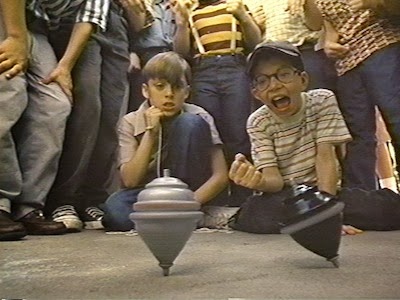
Wait. Back up. You’ve never heard of “My Summer Story?” It’s the movie based on Jean Shepherd’s boyhood memories of growing up in Depression-era Northern Indiana. It was filmed here during the summer of 1993 and many Clevelanders, including me, took part as extras.

Still nothing?

It was the sequel to the 1983 holiday classic “A Christmas Story.” I know you’ve heard of that one.

Last December, you couldn’t pop a Red Ryder BB gun without hitting some reference to “A Christmas Story.” From Big Fun to Flower Child, any shop that could justify it had a leg lamp glowing in the window. The Cleveland Play House presented a stage adaptation, some of the original movie’s supporting characters made a public appearance downtown and a California man announced his plans to turn the West 11th Street home featured in the film into a museum. Then there’s TBS’s annual 24-hour “A Christmas Story” marathon that has made the movie a holiday favorite no matter where you live.

So whatever became of the sequel? I don’t recall it ever appearing in theaters. I do remember seeing a full-page ad in Premiere magazine advertising its upcoming release in 1994. By then it had a new title: “It Runs in the Family.” Then nothing. Bupkiss, as they say.

When I recently stumbled upon the film again (restored to its original title of “My Summer Story” for its video release), I wondered why the movie had been so quickly cast aside when it seemed to have so much going for it.

It had not one, but two Culkins (Macauley’s younger siblings Kieran and Christian) in the roles of Ralphie and Randy Parker, as well as Mary Steenburgen as “Mother” and Charles Grodin as the “The Old Man.”

Like “A Christmas Story,” Bob Clark directed the movie and wrote the screenplay with Shepherd and Leigh Brown. And, like its predecessor, “My Summer Story” was filmed in Cleveland. In fact, most of it was shot here. People often forget that apart from the Christmas parade, scenes with Santa Claus and exterior shots of Ralphie’s house, much of “A Christmas Story” was filmed somewhere else.

But for a few weeks in August 1993, “My Summer Story” took over downtown Cleveland. My involvement was brief. I was just a warm body in a costume as part of the Great Lakes Exposition scene (the part of the film where Ralphie buys a “killer top” from a gypsy). It was an impressively large set spread over the plaza beside Key Tower. (Look for me behind the camels. I’m wearing an orange Hawaiian shirt. Don’t blink.) Other shooting locales included the Palace Theatre, Wilbur Wright Middle School off 117th Street and Lorain Avenue, the industrial Flats and a large part of Tremont.

NewsChannel5 anchor Leon Bibb (then working for another station) was doing a story on the shoot and also worked as an extra. We were in the Expo scene together, so he and I meandered and chatted a little in the baking summer heat of Mall C, behind the camels.

“It was a long day,” Bibb remembers with a laugh. “Hardest $50 I ever made.”

Cleveland theater legend Dorothy Silver was one of the few Cleveland actors whose name appears in the film’s credits. She was “Neighbor No. 4,” in case you’re wondering.

“We had this long, long, long night shot,” Silver recalls. “I had no context for the scene; we didn’t know what was happening. It’s the ultimate impotence for an actor.

“I had a line or two — some kind of shouting, angry line. Not what I want on my gravestone.”

Whatever she said ended up cut from the film.

Local actor John Galbraith was only 15 years old when he played one of the Parker family’s numerous “hillbilly” neighbors, the Bumpuses.

“There were a lot of people of Irish descent there, and we shot around 4 in the morning,” he remembers. “This one woman brought out folk instruments, and we sang Irish folk tunes and it was pretty fun. … It was very Cleveland, the togetherness, the shoot — everything about it.”

What’s unfortunate is that none of those warm feelings come across while watching the movie. “A Christmas Story” leaves us to imagine the Bumpus family, because we only see their turkey-stealing hounds. What we get in “My Summer Story” is a caricature of the Appalachian poor that was better left in “The Beverly 
Hillbillies.”

“It didn’t have the charm the first movie had,” Galbraith says.

That’s a criticism I heard a lot while collecting people’s memories of “My Summer Story.” I felt the same way after watching it again with my 3-year-old daughter Zelda. For example, Charles Grodin says “son of a bitch” a lot for presumed comedic effect, while in “A Christmas Story” the old man’s cursing is a lot of mumbling nonsense that leaves us to imagine the worst.

There’s also a lot of stupid, cartoon-like violence in the movie. Getting your tongue stuck to a flagpole is funny. Getting shot in the hind end with your own Red Ryder BB gun (especially after receiving the legendary warning: “You’ll shoot your eye out”) and then howling in pain for a full minute? Not funny.

And then there’s the issue of Christmas versus summer. When the motion picture of the musical “Annie” was released in summer 1982, the Christmas ending was revised to a timely Fourth of July finale. I don’t care how patriotic you are. Is it “The Magic of Christmas” or “The Magic of Independence Day”?

Watching the whole thing again now, “My Summer Story” doesn’t seem worse than a lot of other nonsense I see on television. And there are a lot of sweet bicycling scenes, with Ralph and his pals Schwartz and Flick tearing all over Tremont. The opening is particularly promising, as Ralph’s teacher Miss Shields delicately gives him the third degree for a book report on a smutty novel. And the old man’s passive but earnest attempts to bond with his pre-adolescent son are truly touching.

No, “My Summer Story” isn’t terrible. It’s just not as good as “A Christmas Story.” And Kieran Culkin, who has grown into an interesting actor in films such as “The Dangerous Lives of Altar Boys” and “Igby Goes Down,” is not Peter Billingsley. The Great Lakes Exposition is not Higbee’s. A killer top is not a BB gun. Summer is not Christmas. And Charles Grodin is not Darren McGavin. Maybe they wanted to change the movie’s name because the film suffered so terribly in comparison to its predecessor.

In 1995 there was, at long last, a public showing of “My Summer Story” at the Cleveland Museum of Art. The film went down pretty well there, especially among the Bumpus clan.

“All the random extras, the nobodies, we enjoyed it,” Galbraith recalls. “It was very family-oriented, like ‘We’re the Cleveland people! We’re all Irish! We’re the Bumpuses!’ We were really a family.”

We’re still one big Cleveland family, sharing a forgotten summer story.
More on My Summer Story.

Sunday, April 25, 2010

Guardians of Traffic


The Lorain-Carnegie Bridge was completed in 1932, reaching 5,865 feet across the Cuyahoga River, connecting the east and west sides. It features fabulous art deco statues, carved from Berea sandstone, and designed by sculptor Henry Hering and architect Frank Walker, facing in both directions at either end of the bridge. Each of the "Guardians of Traffic" (so they are actually called - I have always mistakenly referred to them as guardians of transportation) hold some wheeled vehicle; a car, truck or wagon of some kind. They each specify the "spirit of progress through transportation," said the bridge designer, WIlbur Watson.

They evoke several different styles all at the same time, from the wings of an Assyrian bull, the winged helm of the Greek god Hermes, and the striking angular, art deco fashion that was demanded at the time. The funding was approved in 1927, before the economy soured, and a lowered level dedicated to commercial traffic was scrapped.

In the 1980s it was renamed the Hope Memorial Bridge, after the father of legendary funny man Bob Hope. William Henry Hope was Cleveland-area stonemason.


Sources:
20th Century Society of the North Carolina Mountains
Cleveland Magazine
Wikipedia

UPDATE 7/25/2021: The Cleveland MLB team is now officially the Cleveland Guardians!