Friday, May 27, 2022

The History of Western Civilization (play)

Following a number of mass shootings in 1993, my colleague Rich "Torque" Weiss wrote a piece titled "The History of Western Civilization" for our weekly social satire program Mind Your Own Business. It was a big hit and one we kept in the show for some time.

Torque was always more successful than I was at writing short plays that did not include spoken dialogue at all. I found it very hard to make my point without including one or two lines of dialogue at the end.

In this piece, a Guerrilla (usually him) would keep time on a marching bass drum as the rest of the team evolved from apes to humans to inventing the gun.

Having invented the gun, we all struggled to hold and keep it until eventually everyone had been shot dead, including the drummer. The last person holding the gun looked around, saw what they had done, put the weapon in their own mouth and then the scene would end before the final blast.
What started as amusing ended as a horror. Perfect, short piece.

We do not have video of this performance, the photo (above) depicts the struggle. Notice how one actor has his hands on the other's shoulders, and not around their actual neck. The piece was carefully choreographed.

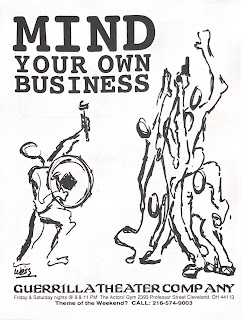
The second image (right) is program cover art by Torque which we used for most of early 1994.

Did you know that when assault rifles were banned in 1994, mass shootings dropped by 43%? The 1994 Assault Weapons Ban expired in 2004, and mass shootings have since increased by 243%.

There are many causes of gun violence. But they all include guns.

Saturday, May 21, 2022

Bedtrick (book)

Pengo’s 2022 Summer Book Club

“At least there’s no plague this year, “Johnny said as we enter the Globe for our rehearsal of 'Julius Caesar'.
Last week, the New York Times published a poorly written essay titled Let Actors Act by Pamela Paul, former editor of the Times Book Review, in which she chose to offer her opinion on the modern debate on representation on American stages.

“It’s called acting,” she said, a sarcastic and tired way of telling people to just shut up already, anyone can play anything. But while it is true that anyone can play anything, it is another question as to whether they should. And that is a nuanced and interesting conversation Paul apparently does not wish to participate in.

I have my own thoughts on the matter, perhaps someday I will share them. It is enough to say, for now, that each individual production warrants its own thoughtful discussion. But did you know that during Shakespeare’s time, women were not permitted to perform on public stages?

Presumably no people of color, either. That doesn’t mean they did not, only that they were not legally permitted to. However, people do not always follow such laws, and for their own individual reasons.

Jinny Webber’s novel Bedtrick begins with a trope explored in the film Shakespeare In Love (and elsewhere I’m sure) in which a woman passes as a boy to play female roles on stage at a time when that was forbidden in England. Taken to its extreme, however, the person in question would have to live each day as a man, forming relationships and connections – and always under threat of discovery.

What follows is a queer fantasty, inspired by true events and peopled with historical characters, which has great resonance today as we navigate the limits of LGBTQIA+ acceptance in the 21st century.

At center is Alexander “Sander” Cooke, which was the name of a player in the Lord Chamberlain’s Men (Shakespeare’s company) and in Webber’s imagination, born female and presenting as male from a young age. Only passing, though. She presumes herself heterosexual, as evidenced by her attraction only toward men (notably, a relationship with the poet John Donne) until she enters into a marriage of convenience with her close friend, the seamstress and shop-owner Frances, when she, Frances, has become pregnant with Johnny, Sander’s older brother. Johnny is also a player in the company, and refuses to marry Frances.

Surely, that’s impossible, historians may protest. It would not be permitted, a woman living day to day, assuming the identity of a man. And that is the argument, whether it could be possible. Those who are oppressed have always relied upon an uneasy alliance with those with the privilege for assistance, people who either support or do not have an interest one way or the other in non-codified avenues of living. This is as true today as it has ever been.

This includes the character of William Shakespeare who is one of several people who know Sander’s secret and keeps it. This does not make him an ally, he has a very talented actor who he believes can best originate roles such as Portia, Viola, Gertrude, Isabel and most notably, Rosalind. It is in his own interest that Sander is not found out, not hers.

The main interest, however, lies in how the relationship between Sander and Frances evolves over the years, through friendship, passion, loss, heartbreak, and finally a true affection which rivals that of any successfully married couple. Are they lesbians? Bisexual? Is Sander transsexual? These were not terms used at that time nor are they employed here, and without such labels we simply see these two for who they are, in their own private, unique relationship, figuring out how best to live and be happy.

See also: Shakespeare On Stage

Source: "Let Actors Act" by Pamela Paul, The New York Times, 5/15/2022 
Interesting, the URL for this page reads "Acting-Representation-Identity" as if it were a placeholder for a complete different editorial.

Saturday, May 7, 2022

Process LXV

and you and you and you ... and you were there! 
Monday was the second first reading (first second reading?) of my new script. This time the entire class read the piece via Zoom, and the response was again very positive. More significantly, through their feedback I am now able to articulate what the piece is really about.

It is a mystery, but it is not confusing. There are a couple fakes in there, and some chills. It’s all about the second act; the first is a deep dive into the subconscious, the second carries the weight of having actual significance in the real world.

There was again the comparison to Caryl Churchill’s Top Girls, but I was again reminded of the influence of Cloud 9, in regards to the significance of double casting. The Wizard of Oz was also mentioned, and how the farmhands Hickory, Hunk and Zeke come to represent Dorothy’s friends.

The white, male protagonist has a secret, which is common to us, that we harbor fears of dominance and abuse and that we have the potential to become, or that we have already become, that thing we fear the most. How we deal with that struggle is the central conflict in the play.

The question is one of resolution, and there were many helpful suggestions as to how I might alter the action but there wasn’t one of them I hadn’t already considered and found wanting. Churchill includes callbacks in Cloud 9, where characters from the first act intrude late into the second, as if to remind us of things we haven’t actually forgotten yet.

The dream is the dream, and readers believe it is a realistic dream. Reality is reality, and must remain reality. I don’t want anyone to leave asking about the bunny.


Also this week, I have been editing the Falling monologue for the class on illness narratives, and recording myself reading them in various locations, to suggest the passage of time. I may need to revise the text further before submitting the written piece, but just reading them aloud has provided guidance to judicious cutting.

Saturday, April 30, 2022

Process LXIV

May 2021
Last year I made a good decision which seemed a little stupid at the time; I took a summer class. It didn’t occur to me that sixteen weeks of instruction would be condensed into six, and what that would mean. Thank goodness we did not have a theater camp, or journeys planned, or what was merely very challenging would have been impossible.

As a result, however, I do not need to take any classes this summer. I need two more classes, which I will take next fall. Then my thesis, then I am done. That is a year from now, and yet. I mean, wow.

Now, can I turn my focus outward for a little while. There is housework to be done, some projects that have waited for more time and good weather. Physical and mental health. I do not have any plays scheduled for development or production any time in the near future. That can be a downer.

Free your mind. Hang onto your ego.

Friday, April 29, 2022

On Solo Performance

Clyde Jevne in "One-Man Hamlet"
(Theatre Inconnu, 2011)
The best production of Hamlet I have ever seen was a solo performance created by Dr. Clayton Jevne, Founding Artistic Director of Theatre Inconnu (Victoria, British Columbia). Titled One-Man Hamlet, it was one of the several productions I attended at the Minnesota Fringe in 2003.
“... Nick, Denny and I went to see One-Man Hamlet at Bryant-Lake. That kicked ass, the man is a freak, and not only that, but a Canadian freak and we sat in the dark eating cheeseburgers and drinking pints of Summit and watching this guy charge around the stage with music stands with balloons on them representing all the different characters, it was a whoot.” - I Hate This Blog, 8/9/2003
The cheeseburger was only part of what made it special. The Bryant-Lake Bowl in Minneapolis is a bar and grill, bowling alley and cabaret theater all under one roof. We’d placed orders before the show and fifteen minutes in, a server brought my dish and it was passed down to me by friendly audience members.

"I Hate This (a play without the baby)"
(Red Eye Theatre, 2003)
I wasn’t the only one served. This is totally a thing that they do at Bryant-Lake.
“... Denny and I are going to see Heretic [a solo performance by Niki McCretton] this evening at 6. Toni got to see [Staggering Toward America, a solo performance by Rik Reppe] this afternoon ... and I did my last performance.” - I Hate This Blog, 08/10/2003
That would be my last performance for I Hate This. My trip to Minnesota nineteen years ago was the first time I brought my solo performance on stillbirth to an audience of almost complete strangers.
“Forty people in the house, a strong Sunday afternoon showing … Clayton the One-Man Hamlet man was in the house, and his lovely wife. Our midwife's daughter made the show! And there were rumors ... maybe Matthew Everett made it (and his mom) [more on that here]. I am grateful for the attention.” - I Hate This Blog, 08/10/2003
The solo performance is a particular kind of drama, but it can be so many different things. Ten years or so ago there were several traveling shows in which one guy would tell all of The Lord of the Rings or the entire Harry Potter saga in a single evening, which is a kind of parody. It’s for the fans, but it’s also meant to be hilarious.

Jevne’s One-Man Hamlet is much more than that. It is very funny, to be sure. But he’s playing something like an addled street performer with the least expensive props possible and what is remarkable is how he just keeps going, playing all the characters, telling the entire story. 


My favorite part is how he takes all of those moments that a character describes something that happened in the recent past (Ophelia telling her father what Hamlet did in her closet, Hamlet telling Horatio about the pirates) by opening a foot locker pulling out puppets and miniatures.

Sometimes a solo performance is in the service of a familiar tale, like Jevne’s, or when we saw local artist Terry Canendonk perform I Dreamed of Rats, his adaptation of the Inspector General. Or it is autobiographical, like Reppe’s Staggering Toward America, in which he told the true story of his journey across the nation after 9/11. He becomes the people he met along the way, but it’s no different than a good friend telling a great yarn over a fire. There’s a personal connection necessary in these kinds of performances, and Reppe’s personality was big and he embraced the crowd with it.

Nina Domingue
"The Amazing and Absolutely True Adventures
of Ms. Joan Evelyn Southgate"
(Cleveland Public Theare, 2002)
While we’re on the subject of solo shows I saw almost in Minnesota almost two decades ago, Heretic was yet another kind of one person performance, a play with one character, and little or no text. Utilizing video, a big open stage and a large aquarium, McCretton is a woman who has been exiled to the surface of the moon for the crime of having religious belief, and may not return until she has filled the fish tank with her tears.

It’s a flex, standing on stage, by yourself, for an hour or so. You are the only person holding the attention of an entire audience.

My good friend Nina Domingue has written and performed several solo shows, most recently The Amazing and Absolutely True Adventures of Ms. Joan Evelyn Southgate, which opened to a full house at Cleveland Public Theatre last weekend. Watching Nina play is a masterclass in catching and keeping an audience, not only skilled in portraying all manner of characters, but also staying in tune with and reacting to the assembled.

I have written and performed two solo shows. This spring I have been writing an essay, meant to be read aloud, about my mother’s death, called Falling. I have no idea what I might do with it, though I am glad to have written it.

Thursday, April 28, 2022

End of Play (Week Four)

Yeah, so. #EndOfPlay. I charged into this month fired up to get a lot of writing done. And I did it. The past week I have really wound down, relaxing, taking care of other business. Also, we have residency auditions coming soon. Also, the semester is almost over. Also, this. Also, that.

Scenes From a Night’s Dream: Following the first reading I took the opportunity to expand several moments in the second act. More clarity, more context, more history. Language and slang.

Next Monday this will be read, this slightly revised first draft. I am excited for that!

Falling: Tuesday night we were sent to breakout rooms to workshop our illness narrative, and I received helpful observations from two classmates, one who I only recently met and another who is familiar with my work because he is another playwright.

It was suggested I employ a central metaphor. But there is a central metaphor - the title, falling - but I never included it. That, and many other suggestions will be employed this weekend. Then I will record the entire thing to video.

The Wytches: Work on this script has been interrupted, until I can engage a few more of the participants of last month’s workshop. I believe I will be able to resume in May.

And that’s all she wrote! Pens down.

Monday, April 25, 2022

Scenes From a Night's Dream: First Reading

dissociation n. the disconnection or separation of something from something else or the state of being disconnected. In psychiatry: separation of normally related mental processes, resulting in one group functioning independently from the rest, leading in extreme cases to disorders such as multiple personality.
No matter the project, be it for a writers group, as a commission, or the final project for one of MFA classes, I will hold a pre-reading reading with a cadre of close friends and colleagues to hear it in a safe space. Last fall that was in my living room, a year before that via Zoom. But it always happens.

Sunday night a delightful crew of friends (not an unsurprising amount either present or former actor-teachers) gathered on our patio, in perfect weather, to read Scenes From a Night’s Dream.

Random thoughts: Given all the messed up things that happen, some people were most upset by the dead goldfish. “The party downstairs” also set some on edge. The second act is too short (my opinion) which affords the opportunity to address some confusion as to what the company - "Morpheus" - actually does.

New rules:
When holding a post-reading discussion (or in fact, the talkback following the workshop of a new work) the playwright must not answer any questions. You’ll never learn anything about how your play works if you do.

We started and I immediately got one question directed to me and I said, Oh. I’m not answering any questions. What followed was something like forty-five minutes of the assembled going over everything that had just happened.

The disconnect, the dissociation, the dream.

Last fall I mentioned how Mark Ravenhill was sharing 101 tips on playwriting over Twitter. That has developed into the 37 Plays podcast sponsored by the Royal Shakespeare Company where he interviews other playwrights and they discuss their own tips on writing. 

This week, writer and director Chinonyerem Odimba brought up Ravenhill’s Tip #12: There’s something cruel about constructing a play, putting characters in situations that are everything from awkward to very painful. Don’t shy from this cruelty but use it responsibly, explore all its ramifications and don’t use it cynically or for effect. 

This is a thing. I don’t normally indulge in cruelty in my plays. Or not since The Vampyres, anyway. And yet, I failed to provide any kind of content warning as we began reading. I immediately regretted that as we started reading. Sometimes people make light of or in fact scorn or ridicule such advance warning, but those people are children.

Now, I have a page of notes and an entire week to tweak the script before we read it in class. So glad!

UPDATE: A workshop of "Scenes From a Night's Dream" will be presented as part of the 2023 NEOMFA Playwrights Festival at Convergence-Continuum, February 16, 17 & 18, 2023.