Showing posts with label Charles M. Schulz. Show all posts

Friday, December 13, 2013

Pogo (comic strip)


Okay, in the past three days I have experienced as many shouts out to Walter Crawford Kelly, Jr. (August 26, 1913 – October 18, 1973). The documentary Dear Mr. Watterson (Joel Allen Schroeder, Director 2013) is playing at the Cedar-Lee, and so my son, who loves Calvin & Hobbes, wanted to see the trailer, which includes this brief comment from Berke Breathed:
My initial impression when I saw him was, the guy's making it harder for the rest of us. Because he's setting ridiculous standards of excellence that hadn't been seen since the 'Pogo' years.
http://www.talespinnerchildrenstheatre.org/performances/slumberland.htmAnd he was right. Like many comic strips, Breathed's Bloom County was facile and derivative and a complete rip-off of everything that had come before. Calvin & Hobbes may in fact be in the top 5 greatest comic strips ever made, but Breathed's unnecessary use of the word "ridiculous" before the phrase "standards of excellence" only serve to undercut the compliment, and betray a certain well-deserved shame for his own limp work.

What are the 5 greatest comic strips of all time? Well, before Calvin & Hobbes began its run a Pogo collection was released (The Best of Pogo, Fireside 1982) and foreworded by Doonesbury scribe Gary B. Trudeau, who described Pogo creator Walt Kelly this way:
In my opinion, Walt Kelly had only two peers in the pantheon department, Winsor McCay and George Herriman ('Krazy Kat'), and of the two, only Herrimann could write as well as he could draw ... Kelly, however, was a triple threat; 'Pogo' was beautifully drawn, exquisitely written, and enormously popular.
McCay's weakness as a writer would later be echoed by Bill Watterson himself, though I find it difficult to separate McCay's unfathomable inventiveness from the process of writing. His dialogue can seem less than sophisticated, but as I described in my interview with Dee Perry last week, since most of his work is a representation of dreams, it only makes sense that the dialogue is broken up and non-linear, like snatches of what you heard the day before being processed by your subconscious.

Then again, if you ever read any of his personal correspondence, you would also know that Winsor McCay possessed poor grammar and used what can respectfully be called creative spelling.

To sum up, however, this morning I came across this status update from my university movement professor:

I called him on his Pogo reference, but then my eight year-old told me it is actually Pogo possum's friend Churchy the turtle who is triskaidekaphobic.

For the record, I echo Mr. Trudeau's suggestion that if there is a "pantheon" of cartoonists, it should include Herrimann, McCay and Kelly, but also Watterson and inevitably Schulz, whose writing and popularity are unquestionable, and whose drawing skills are deceptively masterful.

But three Walt Kelly references in as many days, just as I have been introducing my son to his work is a little unsettling, and also thrilling, especially when the comparison is made to Winsor McCay. If there is one character who would slip easily into the Okefenokee Swamp it would be that of Flip Flap, whose slangy American vernacular echoes that of Kelly's band of swamp critturs. 

 
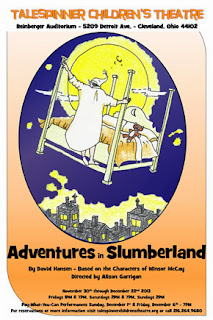
Talespinner Children's Theatre presents Adventures In Slumberland by David Hansen, Nov. 30 - Dec. 22, 2013.

Saturday, October 1, 2011

Twin Cities


Great playwright (with Chekhov.)

Yesterday evening my brother Denny, who lives in St. Paul, rode his bike home from his job at Minneapolis Public Radio. He knew his wife was planning a birthday surprise for this weekend (my brother turned fifty last week) but he was not expecting to find me sitting on his back stoop, drinking a beer.

The Twin Cities has been Denny's home for over twenty years. I have been fortunate enough to have visited several times. Minneapolis and St. Paul coexist as models of a modern American metropolis. Lots of local, urban business, a thriving arts scene, gorgeous new uses for the majestic riverfront, and a couple of kooks.

For this morning my sister-in-law Julie proposed a tour of the new (2006) Guthrie Theatre, located on the banks of the Mississippi. I have seen some fun alternative theater in Minneapolis, most notably at the 2003 Minnesota Fringe Festival, but also at The Jungle, the Bryant Lake Bowl, and the Theatre de la Jeune Lune, which is no longer with us. The only I have ever stepped foot into the former Guthrie space by the Walker Arts Center was twenty-five years ago in 1986 to see The Rainmaker.


I was a little astonished to walk into the main theater space, and discover it was a near-replica of the original, or at least to my memory. Apparently they narrowed the angle at which the audience is arranged around the thrust stage. With seven hundred seats, it remains an intimate environment in which to see a show.

But that's not where we're are going to see a play tonight.


This afternoon Denny and my niece Ariel took me to O'Gara's Bar and Grill at the corner of Snelling and Selby, which is significant as the site of the barbershop owned by Carl Schulz, the father of Peanuts cartoonist Charles Schulz.


Little Red Haired Girl.

To be continued ...

Monday, June 20, 2011

Peanuts

This is really dark.
(Click on to enlarge.)
 

The comic strip Peanuts (October 2, 1950 - February 13, 2000) is the best comic strip ever made, and there are few who would disagree with that statement whose opinions really matter. Created by Charles M. Schulz and drawn by him and only him every single day for fifty years (I'm look at you, Jim Davis) Peanuts did for the comic strip was improvisation did for comedy, arriving at roughly the same time and redefining their genre for the second half of the 20th century.

I have discovered that my own appreciation of Peanuts follows the same path as many others, loving it as a child (I had Peanuts bedsheets, among a million other related materials) with many collections of strips on my bookshelves which I could recite by heart, as well as a love of the animated cartoons, which began to suck when Vince Guaraldi died.

What does the music have to do with it, you ask? Good grief.

As I became an adolescent I found cartoons about kids to be silly, and moved onto Doonesbury, returning to Peanuts as an adult when I finally realized that arch, ironic, sometimes bleak humor Doonesbury could never have existed without Schulz making it possible. Because I got the strip on one level as a child, relating to it but not knowing why I related to it, and then really being destroyed by it as an adult.

Speaking of which, have you seen 3eanuts yet?
Charles Schulz's Peanuts comics often conceal the existential despair of their world with a closing joke at the characters' expense. With the last panel omitted, despair pervades all. - 3eanuts
Very clever, great fun, and the reason it is funny is because its basic argument is true. Unlike parodist online cartoon experiments like Dysfunctional Family Circus or Garfield Minus Garfield, 3eanuts doesn't change the artists' work or even his original intention. It just exposes how the humor works, and how brilliant Schulz really was.


DID YOU KNOW ..?
Linus was first depicted holding his "security blanket" on June 1, 1954.


First appearance of Pig-Pen.


Sources:
Wikipedia
3eanuts
Moody Radio Cleveland