
Okay, in the past three days I have experienced as many shouts out to Walter Crawford Kelly, Jr. (August 26, 1913 – October 18, 1973). The documentary Dear Mr. Watterson (Joel Allen Schroeder, Director 2013) is playing at the Cedar-Lee, and so my son, who loves Calvin & Hobbes, wanted to see the trailer, which includes this brief comment from Berke Breathed:
My initial impression when I saw him was, the guy's making it harder for the rest of us. Because he's setting ridiculous standards of excellence that hadn't been seen since the 'Pogo' years.
 And he was right. Like many comic strips, Breathed's Bloom County was facile and derivative and a complete rip-off of everything that had come before. Calvin & Hobbes may in fact be in the top 5 greatest comic strips ever made, but Breathed's unnecessary use of the word "ridiculous" before the phrase "standards of excellence" only serve to undercut the compliment, and betray a certain well-deserved shame for his own limp work.
What are the 5 greatest comic strips of all time? Well, before Calvin & Hobbes began its run a Pogo collection was released (The Best of Pogo, Fireside 1982) and foreworded by Doonesbury scribe Gary B. Trudeau, who described Pogo creator Walt Kelly this way:
In my opinion, Walt Kelly had only two peers in the pantheon department, Winsor McCay and George Herriman ('Krazy Kat'), and of the two, only Herrimann could write as well as he could draw ... Kelly, however, was a triple threat; 'Pogo' was beautifully drawn, exquisitely written, and enormously popular.McCay's weakness as a writer would later be echoed by Bill Watterson himself, though I find it difficult to separate McCay's unfathomable inventiveness from the process of writing. His dialogue can seem less than sophisticated, but as I described in my interview with Dee Perry last week, since most of his work is a representation of dreams, it only makes sense that the dialogue is broken up and non-linear, like snatches of what you heard the day before being processed by your subconscious.
Then again, if you ever read any of his personal correspondence, you would also know that Winsor McCay possessed poor grammar and used what can respectfully be called creative spelling.
To sum up, however, this morning I came across this status update from my university movement professor:

I called him on his Pogo reference, but then my eight year-old told me it is actually Pogo possum's friend Churchy the turtle who is triskaidekaphobic.
For the record, I echo Mr. Trudeau's suggestion that if there is a "pantheon" of cartoonists, it should include Herrimann, McCay and Kelly, but also Watterson and inevitably Schulz, whose writing and popularity are unquestionable, and whose drawing skills are deceptively masterful.
But three Walt Kelly references in as many days, just as I have been introducing my son to his work is a little unsettling, and also thrilling, especially when the comparison is made to Winsor McCay. If there is one character who would slip easily into the Okefenokee Swamp it would be that of Flip Flap, whose slangy American vernacular echoes that of Kelly's band of swamp critturs.

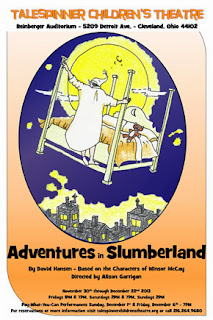
Talespinner Children's Theatre presents Adventures In Slumberland by David Hansen, Nov. 30 - Dec. 22, 2013.


