Saturday, July 31, 2010

How the British see it ...

Sam Wanamaker in Cleveland

The only true account of Wanamaker's life is one which really ties his life together with that of Shakespeare's Globe on Old Bankside. Whereas the Cleveland papers of the era raved about the painstaking efforts towards authenticity of this reduced-size Shakespearean theater, and went ga-ga over the high-energy, if abbreviated productions, this is what a British historian has to report sixty years later:
(Wanamaker) talked his way into the prestigious Goodman Theatre School at the Civic Repertory and made a precocious debut at seventeen. Prophetically he joined the Globe Shakespearean Theatre Group and a photograph of him taken only a year later shows him heroically posed in front of a sign board next to a plywood replica of the Globe in which the company was to perform. It was half size and a pretty slapdash job, by all accounts a gift from the British government to the 1936 'Great Lakes Festival (sic)' in Cleveland, Ohio.

Probably estimating audience interest all too accurately, each of the plays performed was cut down to 30 minutes. It was 'fast food Shakespeare'. Whatever its shortcoming, the pseudo-Globe caught his imagination. So what if the structure was somebody's best guess and the plays being performed severely truncated - the words were the real thing and he was there to hear them.

When he returned to the Goodman in his Fall vacation, not only was he the only 'professional' actor in the school by somehow acquiring an Equity card, he was now considered to be an authority on Shakespeare. Ironic since, to the end of his life, he never claimed Shakespeare expertise - simply enthusiasm.
In hindsight, it is easy to dismiss the events at the Old Globe at the Expo as cut-rate Shakespeare - but that's why those with authority in history (and I am not claiming to have such expertise - merely enthusiasm) owe it to themselves to read up on what people were saying at the time. What really got under my skin is how the author is on such a disdainful roll that he can't help but wonder at an actor's obtaining an Equity card "somehow" when the evidence of a long summer spent performing shows an average of six hours a day, six days a week isn't entirely obvious.

"'Professional,'" he says, in quotes. That's "right." Now excuse me, I need to finish reading your "book."

Source, Barry Day, This Wooden "O"

Thursday, July 29, 2010

It Was A Setup

When I was last in New York I had the unique opportunity to drop in on the rehearsal of a new work written by a playwright I admire. In 2004 I directed The American Revolution by Kirk Wood Bromley, artistic director and playwright-in-residence for Inverse Theater. He specializes in modern verse plays, often creating five-act compositions in iambic pentameter. This most recent piece, It Was A Setup is a brief, personal piece of work, and one I have made plans to see when it debuts next month.

I contacted Bromley earlier in the year — I hadn’t spoken with him since our production of AM REV. At that time, I was delighted when he and a number of his crew journeyed to Cleveland to witness the production. A few months ago I asked if he had anything in the works, and he let me in on this new work. I read the script a few days before visiting in late June, and joined him and the company at his place in the Gowanus neighborhood of Brooklyn for the rehearsal.

It Was a Setup is a three-person play, inspired in part by the work of Bromley’s collaborator in this project, Leah Schraeger. She creates “phoems” — or photograph poems. She is also the choreographer for this piece. The script does not consist of realistic dialogue, but the rather the honest, emotional expression of a relationship is crisis. It is poetic, satiric, acidic, forlorn, angry, hilarious … but upon first read I have to admit I had no idea how one could stage it.

The night in question I was privileged to witness the most challenging scene of the piece, the least “obvious” of the scenes, where it was not clear to me, reading the script, exactly what was happening. It was fascinating, having this opportunity to watch and listen as the director-playwright explained, negotiated, and shaped the intentions and action of these three performers. Having the chance to watch a rehearsal as an entirely disconnected observer, with nothing at stake as writer, director, performer or designer was truly a unique opportunity, and I am extremely grateful all of the artists involved allowed me to be there.

It was, I felt, a very successful night. There appeared to be a great deal at stake, and after an extremely swift three-hours, these disjointed thoughts had the semblance of a through-line that could be carried forward into the next rehearsal. In brief, Charise and Tim have a relationship which has stalled, and is put into crisis by the appearance of a third character, Juliet. In this scene she is not actually there, but she is, if you follow. This is a sensation which is not unfamiliar to me.

The performance is scheduled to take place in an equally intimate space, identical to the one in which they rehearsed (location to be announced only when you purchase tickets — sweet.) The close proximity of the performers gives the piece an uncomfortable intensity. I cannot imagine how it will feel with twenty other audience members present — for that is all the space will hold.

Today we finalized my plans to return to NYC two weeks from tomorrow, in addition to attending this production I hope to revisit the Performing Arts Library, and maybe even check out the shows at the New York Fringe Festival.

UPDATE: BorderLight Theater Festival presents The Right Room, a new play by David Hansen and directed by Jasmine Renee, July 16 - 19, 2025. Help support our production by dropping a donation on our GoFundMe campaign! 

Monday, July 26, 2010

The Black Legion


The Black Legion was a KKK splinter group operating in the 1930s. Centered in Michigan the Legion was also active in Ohio.

AP described the organization on May 31, 1936, "as a group of loosely federated night-riding bands operating in several States without central discipline or common purpose beyond the enforcement by lash and pistol of individual leaders' notions of 'Americanism.'"

They were allegedly responsible for numerous murders of alleged communists and socialists.
Date unknown, paper unknown
Police Reopen Probe of Two Weird Killings
Anonymous phone call: “Look into the muders of those two men in the gully at E. 49th Street and you’ll find the Black Legion was responsible.”
Sources: Wikipedia
Eliot Ness personal scrapbook, property of Western Reserve Historical Society

Sunday, July 25, 2010

The Mad Butcher of Kingsbury Run


The facts:

On September 23, 1935 the bodies of two men were discovered at the foot of Jackass Hill in Kingbury Run, near East 49th Street and Praha Ave.

Edward Andrassy and a never-identified man were each murdered by decapitation, with their genitals severed from their torsos. The genitals were discovered together nearby. The heads were discovered buried nearby, in different places.

Andrassy was heavily involved in vice, his parents even receiving a phone call recently threatening to kill him if he didn’t stay away from the caller’s wife.

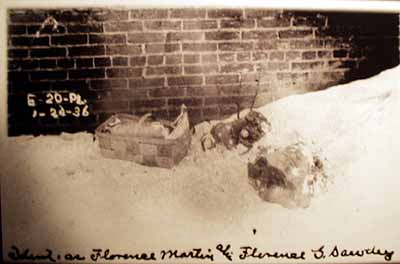
On January 26, 1936 a basket was found near East 20th and Central. This basket contained body parts wrapped in newspaper: an arm, two thighs and the lower half of a female torso. They belonged to Florence Polillo, a middle-aged woman, alcoholic, occasionally engaging in prostitution. The newspapers dated back between as recently as the day before and the previous August.

On February 7, in an abandoned lot on Orange near 15th Street, was discovered more of Polillo: upper torso, lower legs, left arm and hand. But no head. On February 8 a former associate of hers named Captain Swing jumped out a third story window, broke his heels, and “mumbling things that tended to implicate him in the killings.” (Cleveland Press)

On June 5, near the Kingsman Road bridge, some boys found a head rolled up into a pair of pants. The torso was found nearby, genitals intact. Like the first two men, the corpse was absent of blood indicating death (by decapitation) elsewhere and that the body was left where it was to be found. Never identified, this victim is known by its numerous tattoos.

July 22 turned up a badly decomposed male corpse near the tracks south of Clinton Road. Killed where it lay, it had been decapitated, and its clothes were found nearby. Its condition suggests it was murdered prior to the tattooed victim.

On September 10 a vagrant trying to catch a train tripped over the armless, headless torso of a man near the East 37th Street bridge. Soon police discovered the lower half of the torso, separated at the abdomen and the legs cut off at the hips. A stagnant pool nearby was fished, revealing his clothes. The man was emasculated, his genitals, arms and head never found. He was murdered by decapitation.

September 14: “I want to see this psycho caught. I’m going to do all I can to aid in the investigation.” - Eliot Ness

Or to put it another way, due to public hysteria created by a media-driven drive to sell papers, the Safety Director was called upon to comment on and meddle in affairs better left to detectives of the Police department.

Ness did bring it upon himself, raising his profile high above that of your average Safety Director (can you name your current Safety Director?) But the quote from Eliot Ness reflects to prevailing belief that these disconnected events were perpetrated by a single man. “This psycho.”

Really? The first two guys, sure. Polillo, not at all. The fourth, fifth and sixth victims had as little to do with each other, their similarities should easily have been written off as coincidence or intentional copy-cat crimes.

UPDATE: In 1937, the body of a second woman - eventually suggested to be Rose Wallace, an African-American prostitute who had disappeared the previous August - was found at the foot of the Lorain-Central (now the Lorain-Carnegie) Bridge. This body was dismembered, like Polillo's corpse, and bound in newspaper dated June, 1936. Wallace and Polillo went in the same circles, and even had One-Armed Willie, he of the jumping out the three-story window - in common. These two murders may have been committed by the same person. Parts bound in paper, female victim. But nothing like the other murders. Do you see how a craze comes about?

Source: The Maniac in the Bushes: More True Tales of Cleveland Crime and Disaster

Saturday, July 24, 2010

The Real Dick Tracy

Cleveland News April 4, 1936
Thousand Young Dick Tracys Thhrill and Cheer as Ness Tells How G-Men Got Capone Gang

Guns, criminals, hidden rooms, underground tunnels, G-men, deserted haunted houses --

Such things were woven by Safety Director Eliot Ness today into thrilling stories for nearly 1,000 of the latest recruits to the Dick Tracy Detective squad.

The howling, yelling, whistling crowd of youngsters filled every available inch of space in The News auditorium to listen to the former G-man and sign up for a Dick Tracy badge.

A BADGE LIKE HIS!

It was 15 minutes before Director Ness could quiet them down to the point where his voice could be heard. Then he took out his big gold police badge.

“You have a badge just like mine,” he said. More cheers. More shouting.

“Only maybe yours is a little bit smaller…. When you grow up to be a man with long pants perhaps your badge will grow up with you … And when that time comes I’d like to have you all working for me as real detective.”

The enthusiasm was uncontrollable.

TELLS OF CAPONE CHASE

Then the director held the boys and girls spellbound with stories of how he and other G-men ran down one-time lieutenants of Al Capone, Chicago gangster.

He told them also about an experience uncovering a large still in an underground passage beneath a deserted house when he was in charge of the government’s alcohol tax unit here.

Dick Tracy, the swashbucking detective who started all this, appears daily in a News adventure strip.
FYI - Shortly after Ness' departure from Chicago, the Tribune was the first paper to pick up Chester Gould's new strip Dick Tracy, which many have speculated was based on Eliot Ness' crime-busting legacy.

Friday, July 23, 2010

How I Spent My Summer Hiatus

This is the problem with me. My obsessive compulsive disorder. I have to put things in boxes in order to be able to concentrate, to look at them and to understand them. This is fine when it comes to things that can be put into boxes, like paper or cats. It does not work well for me when it comes to things like time.

This year is my “Fellowship Year,” when I have been given a special responsibility by the Community Partnership for Arts and Culture to develop my career as a playwright. I have been able to manage this in many ways, including packing and delivering previous work to rights distributors, to apply for awards, to interest theater companies in producing my work. I have actually been successful at two of these three pursuits, so far, and you know what they say about two out of three things.

My relationship with my employer allowed me the opportunity to take time off to pursue a special project, the CENTENNIAL project. Four weeks to do, well, whatever. To do those things I cannot do working a nine-to-five.

Others have traveled around the country, or the world, to conduct research, to work with mentors, the get the lay of whatever land they wanted to write or create about. Silly me, I told everyone I wanted to write a play about Cleveland. That meant staying in Cleveland. Oops.

Seriously, however. For years I have wanted to spend time in the Cleveland Public Library, reading newspapers, or discover the library at the Western Reserve Historical Society. I have done these things. What I have not done - yet - is write. Anything.

I am trying not to feel bad about that.

What I have logged into this blog is only a small part of what I have learned, just by reading. And that is most of what I have been up to this month. Reading. Reading a single year’s worth of newspapers, and books, and plays. And in doing so I have retrained myself to read. I have always had poor reading habits, and have not read the smallest part of what most people who know me assume I have.

The number of plays I have ever read is shameful. I am still playing catch-up after blowing off Dr. Condee’s theater history class my sophomore year. To put it another way - I am still playing catch-up from blowing off all of my sophomore year.

The good news is I have successfully spent four weeks reading, and a lot. And I have connections to the time I have spent this month that will stay with me especially into the long Cleveland winter. Sitting crouched on a marble slab near the fountain in front of the 1916 wing of the Cleveland Museum of Art. Feeling the back of my neck bake at 9 in the morning on a bench further away from the museum, by the lagoon. Taking in the Ness family memorial, and walking over to Wade Lagoon to read there. The reading garden outside the Cleveland Public Library, where I first got the news about Pekar. The impossibly chilly microfilm rooms in the library, and at the Western Reserve Historical Society.

And where it all started, in late June, in the New York Public Library Performing Arts Library at Lincoln Center. It took over an hour - seriously - to get situated, knowing which room to go to, who to hand reference slips to, finding out I needed to get a temporary library card, waiting for the materials to come. I think I actually looked over materials for ninety minutes.

But what a valuable ninety minutes. I found an article in Variety magazine about The Living Newspaper in Cleveland, which led me to the names of the authors of that plays, which led me to articles they had written, which pointed my research in an entirely new direction. I wasn’t aware of it yet, but those ninety minutes set me on the course for the entire hiatus, ninety minutes which gave this fragmented mind focus.

The other day I took a walk with someone from work down Euclid Avenue to Fourth Street for lunch. I have walked that stretch many, many times. It makes me sad, wistful, to think of this street, Main Street Cleveland, as it used to be. The recent restorations are promising, there is a lot of rehab going on, we have have hit bottom and are on the way back up. But seriously, it will never be the way it was, not in my lifetime.

Reading the daily newspapers - the Plain Dealer, the Press, the News - and the Call & Post, and the Gazette and Citizen, is to read about a large, teeming metropolitan city. Many were poor, struggling to get by, but they were together, there, in a city which no longer exists. I occupy the same space, but the earth has turned so many times since then and so much has changed. I would like to recapture some of that for the stage, to latch onto a story to tell, about real people in a real place, and make it feel like what I have felt reliving it for these four weeks.

When I draw, I remind myself to make my hand create my eye sees. Now in order to write this, I need to make my hand create what my heart feels.

Thursday, July 22, 2010

Lil' Abner


The comic strip Lil' Abner, created by New Englander Al Capp, was two years old in the year 1936. The strip's namesake was a 6'3" sweet-faced lunk of a Southern 19 year-old living in the horribly impoverished town of Dogpatch. Making light of poverty, guile and inbreeding only scratches the surface of Capp's comedy stylings.

Born to Russian-Jewish immigrant parents, Capp (formerly Caplin) lost a leg to a trolley accident when he was nine, contributing along with his own youth lived in squalor to his dark, satiric humor. His father was a failed illustrator who taught him drawing as a kind of therapy. He was living in Greenwich Village, ghost-drawing Joe Palooka when he came across the idea of a strip based on the kind, stupid, goiter-laden folk he encountered while hitchhiking through West Virginia.

The humor of the strip comes in large part from a) the simple-mindedness of the inhabitants of Dogpatch and 2) how they are able through American-grit and stubbornness to overcome any and all adversity that comes their way from city slickers or politicians who attempted to take advantage of them.

Capp is often confused for having been liberal during conservative times, and conservative during liberal times, but that only means he always worked to make fun of what ever the contemporary trend was. In short, a self-serving satirist.

(Took the kids to catch the Mercury Summer Stock production of Lil' Abner: The Musical at the Brooks Theatre tonight. We had a great time, it is a super-fun production - it closes Saturday night, check it out!)


Source: Wikipedia

UPDATE: "Lil' Abner" ran in the Cleveland Press.