|
| The Dark Lady of the Sonnets with Magdalyn Donnelly & Anne McEvoy Great Lakes Theater |
Not tired of his work, that I am still quite fond of. I am tired of William Shakespeare, the man. A man about whom we know less than we know about any other individual about whom we have decided it is important to know things.
We know where he was born (not exactly when, though) when he died, a little bit about his family, and that he wrote thirty-eight plays. Respectable scholars are even still debating about that last bit.
For someone about whom we know nothing, there is an ever-expanding industry in making shit up about him. Each biography gets fatter than the last, containing greater amounts of conjecture, and the slightest potential new discovery turns out to be inconsequential or downright fantasy.
Someone found a painting in Canada twenty years ago of a young man, the artifact carbon-dated to the late 16th century. Bares a slight resemblance to Shakespeare, must be him.
More recently, however, is the cottage industry in stage plays, films or TV shows in which Shakespeare the man is a character. It began, more or less, with George Bernard Shaw, who wrote not one but two plays featuring the Bard in a lead role.
 |
| Oh, look. Shaw is lecturing. |
The Frogs, adapted from Aristophanes by Stephen Sondheim and Burt Shevelove in 1974, stole the "Shakespeare-against-Shaw" debate conceit entirely, drawing it out and making it much less amusing. But I digress.
Decades earlier Shaw wrote The Dark Lady of the Sonnets (1910) which was created expressly to promote the idea of England creating a federally-funded theater, which they eventually did with the National Theatre, though Shaw never lived to see it.
Dark Lady runs about a half-hour, and presents a blocked Shakespeare creeping around the streets of London after hours, searching for his mistress (about whom he writes in the Sonnets) and stealing inspiring snatches of dialogue from passersby for use in his future works. He eventually runs into not only his “dark lady” but also a sleepwalking Queen Elizabeth I, whom he first mistakes for his love. Comedy ensues.
The last third of this short play concerns Will’s efforts to persuade the Queen to establish what he calls a “national theater.” Most of the wit, however, involves the phrases uttered by the night watchman, the “dark lady” and the Queen herself -- familiar from Shakespeare’s canon-- which the frustrated playwrights jots down in a notebook for inclusion in his plays later. So the comedy depends upon these lines being familiar to the audience.
 |
| Mr. Shakespeare |
Perhaps you are.
“All the perfumes of Arabia”?
Yes, no? What is it from?
How about, “a snapper up of unconsidered trifles”?
No, of course you aren’t. Even I had to look that up.
Great Lakes produced Dark Lady for the outreach tour in 2006, and I played the role of Shakespeare. This was not a stretch, I had been playing the role of “Mr. Shakespeare” as a promotional gimmick for the company for two years by that point, making public appearances at art festival and rib cook-offs. I was their “unofficial mascot” for seven years. The costume shop created for me a beautiful, velvet doublet in the company’s signature purple.
The thing I learned performing Dark Lady … it isn’t funny. I mean, it would be, if the audience were composed entirely of those well-versed in the canon. Ever see The Complete Works of William Shakespeare (abridged)? It’s not funny because of references to Shakespeare. It’s funny because there’s a stoner in a dress and they rap Othello.
Actually, Complete Works isn’t funny, either. But I digress.
But therein lies the problem with plays about Shakespeare. We know nothing about him, we feign familiarity with him through his work, and inevitably we lean on the work itself to carry the narrative the pathos, and the humor.
Yeah, I saw Something Rotten. It’s funny, if it’s funny, because of the song about musicals. But "Will Power" is really painful to sit through. I know the idea of Shakespeare as a rock star is the joke, but is it? There’s this pretentious notion, flouted by complete nerds, that the man from Stratford was some kind of celebrity in his own time. Listening to Adam Pascal (who played him at the Palace) growl through “shall I compare thee to a summer’s day” like some kind of Jim Morrison or something isn’t funny, it’s embarrassing.
It’s like that SNL sketch where Lin-Manuel Miranda plays a substitute teacher at a high school, determined to turn the kids onto how cool Shakespeare is, and they’ve heard it all before.
That’s actually part of a play I wrote once for an educational outreach tour, comparing verse to rap music. It was very awful and I will never mention it again.
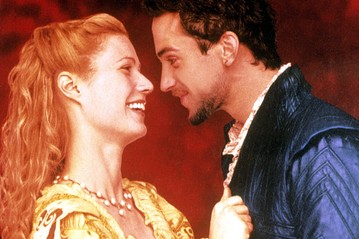
Which brings us to the most produced American play of the 2017-18 season (as determined by American Theater) Shakespeare In Love, adapted for the stage by Lee Hall, from the screenplay by Marc Norman and Tom Stoppard.
 |
As in the film, this is a purely fictionalized tale of a young William Shakespeare, like so many of us in the mid-90s (in his case, the 1590s) slacking and suffering writer’s block. He’s trying to write a new play titled Romeo & Ethel, the Pirate’s Daughter. A great deal of the charm and interest hangs on seeing Shakespeare as fallible, flawed, with the same passions and potential for falling short as the rest of us. Kind of the way he’s represented in The Dark Lady of the Sonnets.
He has to work at writing, it doesn’t come easy. The best stuff is taken whole cloth from someone else (kind of like in Dark Lady) in this case usually Kit Marlowe.
And just as with Dark Lady, over one hundred years earlier, much humor is dependent upon the audience being well-versed in Shakespeare. When I was in an audience for the Cleveland Play House production they definitely enjoyed the dog, while somewhat familiar Shakespearean allusions bounced awkwardly off their heads in silence.
When Will is asked for new pages of the script and he promises them “tomorrow and tomorrow” and his producer adds, “... and tomorrow?” there was a general if somewhat delayed chuckle of recognition and the woman behind me tittered, mumbling, “heh heh, ‘creeps in this petty pace…’”
I turned around and said, “oh, you got that one?”
Now, I enjoyed the film of Shakespeare In Love, too. But I also enjoyed Anonymous, which tells an alternative history based on a popular conspiracy theory that the works of Shakespeare were actually written by Edward de Vere, a nobleman about whom there is a deep and rich biography available. A man who was actually once captured by pirates.
HE WAS CAPTURED BY PIRATES.
My colleagues who abhor such theories dismiss that film out of hand, because it’s utter nonsense. One critic even pointed out that a flashback from the mid-1500s featuring the young de Vere performing a scene from “his” A Midsummer Night’s Dream was preposterous because there is no possible way Dream could have been written before the early 1590s.
Yeah, well? Shakespeare In Love is how the man from Stratford created the story to Romeo & Juliet, based on his own personal romantic experiences, when Arthur Brooke’s poem "Romeus and Juliet" had been in heavy circulation since 1562, and even that is not the original tale.
But Shakespeare In Love is a comedy, Anonymous is meant to be taken seriously.
Really. Is it?
But what about the children, they cry. Someone might see Anonymous and think that it’s true. Yes, and I am sure there are those who believe Shakespeare In Love is true -- not in it’s every particular, but in the larger sense that the playwright and poet William Shakespeare was charming, passionate, and had lots of friends. Only he didn't.
The real reason people want to believe Edward de Vere, the 17th Earl of Oxford wrote Shakespeare's plays is because he is the kind of exciting character we want William Shakespeare to be. Only he wasn't.
Couldn't we at least, then, present the unfaithful horn dog in Shakespeare In Love, a man who spends far more time partying and having sex than actually writing, as the opportunistic, litigious, status-obsessed striver with the weak chin, beady-eyes and receding hairline that the available historical record makes evident?
Instead we get another fictional yet admittedly extremely handsome, roguish-yet-self-effacing charmer, like the one who played him in the CPH production, pictured here, resplendent in his beautiful, velvet doublet.
Wait. Where did you get that doublet?
He has to work at writing, it doesn’t come easy. The best stuff is taken whole cloth from someone else (kind of like in Dark Lady) in this case usually Kit Marlowe.
 |
| Rhys Ifan as Edward de Vere Anonymous (2011) |
When Will is asked for new pages of the script and he promises them “tomorrow and tomorrow” and his producer adds, “... and tomorrow?” there was a general if somewhat delayed chuckle of recognition and the woman behind me tittered, mumbling, “heh heh, ‘creeps in this petty pace…’”
I turned around and said, “oh, you got that one?”
Now, I enjoyed the film of Shakespeare In Love, too. But I also enjoyed Anonymous, which tells an alternative history based on a popular conspiracy theory that the works of Shakespeare were actually written by Edward de Vere, a nobleman about whom there is a deep and rich biography available. A man who was actually once captured by pirates.
HE WAS CAPTURED BY PIRATES.
My colleagues who abhor such theories dismiss that film out of hand, because it’s utter nonsense. One critic even pointed out that a flashback from the mid-1500s featuring the young de Vere performing a scene from “his” A Midsummer Night’s Dream was preposterous because there is no possible way Dream could have been written before the early 1590s.
Yeah, well? Shakespeare In Love is how the man from Stratford created the story to Romeo & Juliet, based on his own personal romantic experiences, when Arthur Brooke’s poem "Romeus and Juliet" had been in heavy circulation since 1562, and even that is not the original tale.
Really. Is it?
 |
| Shakespeare In Love Charlie Thurston as Will Shakespeare Cleveland Play House Photo credit: Roger Mastroianni |
The real reason people want to believe Edward de Vere, the 17th Earl of Oxford wrote Shakespeare's plays is because he is the kind of exciting character we want William Shakespeare to be. Only he wasn't.
Couldn't we at least, then, present the unfaithful horn dog in Shakespeare In Love, a man who spends far more time partying and having sex than actually writing, as the opportunistic, litigious, status-obsessed striver with the weak chin, beady-eyes and receding hairline that the available historical record makes evident?
Instead we get another fictional yet admittedly extremely handsome, roguish-yet-self-effacing charmer, like the one who played him in the CPH production, pictured here, resplendent in his beautiful, velvet doublet.
Wait. Where did you get that doublet?