Showing posts with label King Lear. Show all posts

Saturday, June 8, 2024

Three Very English Plays


“This is great! The last time you took me to a musical, it was Always.”

That’s what my brother said as we reentered the hall at the Gillian Lynne Theatre for act two of Standing at the Sky’s Edge. And it’s true. Way back in 1997, when my wife and I were first visiting England together, I chose the first show, and it remains the worst British musical I’ve ever seen (and I’ve seen Diana.)

This is why I let my wife choose the shows. That way I can say I told you so, but I never have to say I told you so. She choose a lot of things because her track record is unimpeachable.

We saw three shows over four days during our brief stay in the UK. We had arrived via the Queen Mary 2, a transatlantic crossing to celebrate our silver anniversary, and spent some time in a canal boat Airbnb before flying home. The shows we saw were each uniquely British, and all exceeded expectations.

"People, Places & Things"
(Trafalgar Theatre, 2024)
Friday we took the train to Maidstone, near Kent, to see the Russett Players production of A Bunch of Amateurs by Nick Newman and Ian Hislop. An “am dram” production, directed by my sister-in-law Brenda and featuring my brother Henrik, it was opening night for a two-day run (two shows on Saturday) and I was delighted how absolutely packed the hall was.

The play is about an arrogant Hollywood actor whose career is on the downslide who decides to brush up his resume with a classic credit, not realizing he has been roped into a production of King Lear at community theater in Stratford – but not that Stratford, England has a lot of Stratfords. It was a celebration of the form and high hilarity ensued.

Saturday, back in London, we attended a revival of People, Places and Things by Duncan Macmillan at Trafalgar Theatre, starring Denise Gough, Sinéad Cusack, Malachi Kirby and a strong ensemble of performers. A tale of addiction and recovery, it’s loud (and sometimes very loud) and frenetic, with swoops and turns and tricks which are disorienting for the audience as well as the protagonist, and a marathon for the lead performer, who was aggressive, vulnerable and deceptive.

"Standing at the Sky's Edge"
Gillian Lynne Theatre, 2024
But oh my, we loved Standing at the Sky’s Edge (book by Chris Bush, songs by Richard Hawley) at the Gillian Lynne Theatre. A musical which chronicles three generations at Park Hill, a brutalist housing estate in Sheffield, North Yorkshire. Taking place from 1960 to 2020, with each timeline thoughtfully threaded, we experience the decline of empire told from the vantage point of its most vulnerable subjects. It’s about class and race and gender and family and hope and despair and so much love. So so so much love.

The piece won the Olivier for Best Musical, 2023. It's a vast ensemble, impossible to point to one standout performance, the songs are gorgeous, the choreography is mesmerizing, but there’s no chance it will transfer to America. Its so entirely about England. Laughter in the crowd clued this Anglophile in on the many references I could not catch. But we bought the cast recording on CD and when was the last time we bought a CD?


UPDATE: BorderLight Theater Festival presents The Right Room, a new play by David Hansen and directed by Jasmine Renee, July 16 - 19, 2025. Help support our production by dropping a donation on our GoFundMe campaign! 

Thursday, July 21, 2022

On Sight (Pre-Operative)

Image of my Future Foretold
Self as Kent in "King Lear"
(Beck Center, 2019)
The good news is I will now be in town for the Borderlight Festival!

That’s a joke. I was going out of town for the week, now I am staying home to have surgery to repair a detached retina, so I’m not going anywhere. Jokes really do suffer when you explain them.

The Borderlight Festival, for those of you who are unaware, is an international theater and performing arts festival that takes place in downtown Cleveland and the only reason you haven’t read anything about it here is because it has always taken place when I am out of town.

I can’t tell you how much it pains me that there is now an international theater and performing arts festival in Cleveland, Ohio and that I am not part of it. But my family comes first, and I have no regrets about that. I have tried this year to flog a few of their offerings on social media, and hope someday to attend or even submit a production.

And up until yesterday afternoon, I was planning to leave town. A week long vacay with the entire family. They were ready to suspend travel, at least until I had undergone surgery, but I insisted they go. My son has a college trip schedule for tomorrow morning in upstate New York, and we have tickets to see the A.R.T. revival of 1776. That was my idea, I so wanted to see this production. But it would be a shame for everyone to miss it, I need them to report back to me how it plays.

Then onto Maine. My family vacation spot. My brother’s family is coming, my eldest will be joined by their partner – whose parents are also joining us (I mean them) ostensibly for my birthday, which is Tuesday. And the cousins, the cove, the view from the deck of the Barnstable.

One week out of the year, every year. Not this year, not for me. Having them miss it too would have made me even more miserable than I currently am.

Yesterday a doctor examined my eyes, prodding them with a medal stick. It was very painful. She remarked at how well I managed, so calm. My blood pressure, my pulse were normal, better than normal. My wife said she watched me breathe during this examination, that my hands and arms were relaxed. I was practicing my breathing. But it hurt. It hurt a lot. I did my crying later.

Today I am lying on my left side, so the damage doesn’t increase. After the procedure, I am to lie on my right side for the week. This is not a vacation. I cannot do anything.

So, I am depressed about not being with my family. I am extremely apprehensive about the procedure itself. I am anxious about not being able to run for the foreseeable future. 

And I am very, very worried about being alone with my thoughts for an entire week. Because I do not like being alone. I do not like being alone at all.

Wednesday, June 8, 2022

England, 1997 (Week Two)

Shakespeare's Globe
Our second week visiting England in June 1997 was busier than our first, and in spite of developing something like a cold, we kept seeing shows and even took an overnight trip to Stratford-Upon-Avon. It helped that my brother and his family lived close to the city, which helped cut down on cost. We did a few things together, but they were also raising a sweet two year-old girl which kept them close to home.

Monday night we saw Ute Lemper sing Weimar Berliner cabaret songs at the Almeida Cabaret in Islington. She was a new surprise to us, though by the late 90s the German-born performer was already an award-winning actress on stages across Europe playing the leads in shows like Cats and Chicago.

Today I learned that if you were a German child in the late 1980s, she was the singing voice of your Ariel in Disney’s The Little Mermaid. On the evening in question she was singing and storytelling about the kinds of passionate and transgressive songs which inspired those created for Cabaret.
Mon, June 9: “Opening night. Full house. Third row. It was wonderful. Tall, red hair, high cheekbones, child-eating smile, arching eyebrows … humorous, passionate, amazing … English, German and French, beautiful and scary.”
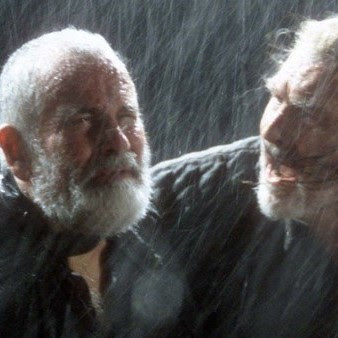
Ian Holm & David Burke
"King Lear"
(National Theatre, 1997)
Yes, it rained on stage.
Featuring songs with titles like Masculine/Feminine, Sex Appeal and Ich Bin Ein Vamp! Lemper shared the legacy of sexual liberation and gender fluidity which would soon be extinguished by a Fascist regime. (See also: The Degenerate Art Exhibit.)
“The Almeida is my theater, it’s the theater I want. Like a round, brick well, high-ceilinged … intimate. Fantastic space.”
The next day we were able to get rush tickets to see Ian Holm’s return to the stage after several decades, performing King Lear in the Cottesloe Theatre at the National.
Tue, June 10: “A cold, cold Lear. Holm came out of the gate intense and quick to anger … small man but a huge presence. I wish Dad could see it. Almost no music. Run on, act at your leisure, run off.”
We took an overnight trip to Oxford and Stratford. I was unwell but we pushed on.

With brother and his family.
Even Oxford had a tourist trap, and we do love tourist traps. We took a spin on The Oxford Story which is a straight-up dark ride, a maddeningly slow roller coaster ride through the history of England’s oldest university featuring lots of still marionettes. Narration was provided over headphones while we were shuttled along in cramped, little desks.
Wed, June 11: “And it’s sponsored, produced and sanctioned by the school! Can I blame the Americans? Our entertainments must be 3-D, automated, cold and tacky. The House on the Rock produced by the Corporation for Public Broadcasting.”
We spent the night in Stratford where we had dinner at the Glory Hole (yes) and took in a performance of Camino Real at the Swan Theatre, where I also saw “The Seagull” in 1990. 
“A live band made for most excellent music – a lot of Beat-era jazz, for example.”
"Phantasmagoria!"
(There is literally a guy on the floor,
covering his head.)
The next morning we saw more Shakespeare-oriented historical sights than the entire time I was there in 1990. Of course, much of my time there seven years earlier was to take workshops and to see shows, and it was very, very snowy. My partner said Stratford was the most delightful place we had visited so far.

We took the train back to London, and that evening, Henrik, Toni and I saw Anthony Neilson's The Censor at the Royal Court. Bad Epitaph would produce this play in September 2001. The run was cut short for obvious reasons.
Thu, June 13: “Great. Inspiring. Emotionally awful.”
On Friday we visited the Museum of the Moving Image (MOMI), a historical celebration of the science and craft of projected entertainment. I was particularly taken with the devices which created thrilling or unsettling imagery for unsettled audiences well before the invention of what came to be known as the motion picture.
Fri June 14: “The Phantasmagoria! … an 18th century slide [magic lantern] show – images, tinted slide drawings, projected on a screen in a darkened room, accompanied by spooky music, augmented by smoke cast before the lens, or slowly bringing it into focus, or casting one image the another, back and forth to give the impression of movement – or a sequence of two images (Adam and Eve biting the apple/being cast out of Eden) intercut by a lightning bolt flashing on and off, with appropriate sound effect. 

"And to appreciate how spooky this would be to an audience! It was great! So creative! I wish I could be half as inventive!”
Salieri's, seat detail.
That night was our only real “date night” with just the two of us and my brother and sister-in-law. We headed to the Warner Brothers Cinema on Leicester Square to see Big Night, a period film about Italian immigrant brothers who operate a restaurant on the Jersey Shore and starring Stanley Tucci and Tony Shaloub. My wife and I had already seen it when it was released in the US, and it remains one of our favorite films.

It only made sense that we close the evening with a long, indulgent dinner at Salieri’s, which Toni and I had discovered the week before. The decor was “a little ridiculous – everything is painted, the seats have scenes on them of cabarets and showgirls, so do the walls and the ceiling. Mermaids and seahorses and gambling dandys.”
Fri, June 14: “The harp player actually played La Colegiala.”
Saturday afternoon we took a tour of Shakespeare’s Globe Theatre, which was utterly remarkable. When our student group had visited Southwark in late 1990, it was just a big, muddy hole in the ground and our tour guide gave the impression that the thing would never actually get built. And here it was, a peg-by-peg and fully-practical reproduction of an Elizabethan theater.

The place hadn’t officially opened to the public yet, and in fact there was a major event going on that evening and ours was the last tour before the theater was closed for the festivities. We had a snack in the cafe as the place was filled with an assembly of formally dressed people, several of whom I recognized from stage and film. I noticed that Michael Maloney, one of Branagh’s favorite players, was seated at the table next to ours. He caught me gawking. That was embarrassing.

Juliet Stevenson & Nicholas Robinson
"Caucasian Chalk Circle"
(Théâtre de Complicité, 1997)
That evening we closed our journey by attending Caucasian Chalk Circle at the National Theatre, produced by Simon McBurney’s troupe Théâtre de Complicité (today simply Complicité) which is perhaps the greatest theatrical performance I have ever had the joy to witness.
Sat June 15: “Produced with a great sense of play, humor and adventure. In the round … using long poles they made spears and guns, but also a rickety bridge, and even made a river using them.”
One particular moment though, which always reminds me of the unique magic that is stagecraft: The child was portrayed by a succession of puppets, from the baby to the toddler and so on, and with each iteration the chorus would sing as the “younger” puppet was led off and the “older” puppet was introduced. A marionette the size of an eight year-old walked off and an impossibly big one, the size of a ten year-old was led on, operated by no fewer than six company members.

But as this one was walked by the puppeteers, each one stepped away, and as it walked on its own the last puppet operator pulled a skin-tight mask from its head as it was revealed to be an actual human actor. The audience gasped and applauded, it was marvelous. So glad we saw this show last. It is a shared memory my wife and I treasure to this day.

I was last in England five years ago, with mother to attend my niece's college graduation. How was that only five years ago? I worry I will never return.

Saturday, March 14, 2020

"Love's" in the time of COVID-19

Thou art a boil, a plague-sore, an embossed carbuncle, in my corrupted blood.
- LEAR II.iv

In the midst of life we are in death, et cetera.
- The Smiths, Sweet & Tender Hooligan
Woke this morning to discover "King Lear” is trending on Twitter.


Scott Crim & Jane Plishka
"Love's Labour's Lost"
(Rubber City Theatre, 2020)
The theaters closed due to an outbreak very early in Shakespeare’s career, in 1592. That was very early in his career, when he was collaborating with Marlowe and writing his epic poems.

Outbreaks continued over the following years, and when the Globe Theatre was closed in 1603 Shakespeare was the height of his abilities. It is speculated that he wrote King Lear at that time.

The very idea that theaters would cease operation due to an outbreak of contagious infection (let alone, professional sports teams) was to my understanding a thing from the past, not something that could possibly happen in my lifetime.

And yet, here we are. Closer to home, the company that I work for, Great Lakes Theater, took the difficult and unprecedented step of cancelling an entire production. The company was hard at work on a production of my favorite of Shakespeare’s comedies, Much Ado About Nothing, due to open the last weekend in March.

As Ohio Governor DeWine decreed, all public events with an audience of more than one hundred persons must be suspended, GLT and companies across the city joined theaters across the nation in closing.
Orders, thought meet by his Majesty, and his Privy Council, to be executed throughout the counties of this realm, in such towns, villages, and other places, as are, or may be hereafter infected with the plague, for the stay of further increase of the same.

Also, an advice set down by the best learned in physic within this realm, containing sundry good rules and easy medicines, without charge to the meaner sort of people, as well for the preservation of his good subjects from the plague before infection, as for the curing and ordering of them after they shall be infected.

- James I, “Order for Plague” (1603)
Theaters closed due to an outbreak of plague. - March 2020

As with all the rest, Akron’s Rubber City Theatre suspended performances for their production of Love’s Labour’s Lost after opening just last weekend. The show, directed by my dear friend Kelly Elliott (she who directed last summer’s Henry V for CSF) had already received an excellent notice from Cleveland Scene, which said it was “engaging” and “exuberant.”

As a farewell they decided in short order to stage one last, closed performance last night with an invitation-only audience of company members and a few friends who have a reputation for laughing loudly and in all the right places. My wife and I were glad to be part of that number.


Following the performance we learned over one hundred people were watching it live. As of this morning, the event shared by local media outlets, views have gone into the thousands. Even Terry Teachout, critic for the Wall Street Journal tuned in.


Sitting in the audience, I was reminded of Love’s Labour’s Lost as produced by Great Lakes Theater in early 2016. It was also an engaging and exuberant performance. Shakespeare's script is quite the farce; the first half can be quite dense and you have to keep up with a remarkably self-indulgent amount of word play on the playwright’s part, but when you stick with it the pay-off in the second half is so pleasurable.

The "Nine Worthies" scene in the Rubber City production rose to a joyfully riotous argument, the Great Lakes production four years ago to something like a wildly playful bacchanal. But as is the case in all productions, the fun, the games, the play within the play, are suddenly broken by the announcement that the King of France, father to the female romantic lead Katherine, has died.

A very real and heartbreaking moment in the midst of a very silly play. I found the sentiment quite timely.

The theaters have closed, as they have many times before. They will reopen, too.

Rubber City Theatre presents "Love's Labour's Lost" (2020)
Photo: Terry Teachout, Wall Street Journal

UPDATE: The postponed Great Lakes Theater production of "Much Ado About Nothing" opened March 25, 2022.

Sources:
Order for Plague, Shakespeare Birthplace Trust

Boys Will Be Boys, But They Learn a Lesson Too in Rubber City Theatre's Joyful 'Love's Labour's Lost' by Elaine Cicora, Cleveland Scene (3/10/2020)

UPDATE: What We Miss When Broadway Goes Dark by Terry Teachout, Wall Street Journal (3/18/2020)

Monday, July 1, 2019

This Band of Brothers

"What is this castle call'd?"
HENRY V, IV.vii
The transformation of Public Square has been remarkable. For four summers (the redesign officially opened in time for the 2016 Republican National Convention) folks have been playing in the fountain, dining in the shadow of the Terminal Tower, and attending performances -- and protests -- on the lawn. It’s a far cry from when the square was largely pavement and planters and nowhere to really hang out.

My friend Jeff (he who recently played The Fool in King Lear at Beck Center) and I once entertained the idea of staging free Shakespeare in Public Square. This was some fifteen or so years ago, when you would find very few establishments open in the vicinity of the Terminal Tower after four pm, any day of the week. The plan was to perform one act from some Shakespeare play every day at lunchtime. Five acts, five days. People would come back day after day to see what happens next!

People who put on plays by Shakespeare think like that.

Things downtown have changed, Public Square has changed, and I very much hoped my friends at the touring Cleveland Shakespeare Festival would add this site to their roster of performance sites. They wasted no time. Since 2017 they have produced free Shakespeare in spitting distance from the site of long-lost, 19th century Cleveland theaters such as the Lyceum and the Euclid Avenue Opera House.

Why yes, even my own production of Troilus and Cressida played there last summer, though I was out of town at the time.

Immediately following the closing, matinee performance of the aforementioned Lear (and after a farewell toast with the company; I must recount my experiences in this production soon) I hightailed it downtown to finally catch a CSF show on Public Square.

On Sunday, that performance was Henry V, in a production conceived by Kelly Elliott, the first such production of that play that CSF has attempted since their second season, twenty years ago in 1999.

Her choice to cast all women in this production is not only in keeping with adaptations in American and England and elsewhere, but a call to action to all young, male-identified performers everywhere.

In her director’s notes Kelly explains, “I did not set out thinking I was going to cast this production of Henry V with all women. But I did.” She goes on to describe a scenario I am all too familiar with; too many skilled and eager women at auditions, too few men, and those who deigned to offer their services all too confident of their inclusion in a play written for a large cast with only four named (and minor) female roles.

"Strip his sleeve and show his scars!"
HENRY V, IV, iii
So fuck it. She cast those who, apparent to me and the audience, were best suited to each role and to the ensemble. Of this there is no question. They’re great, starting with the bold, and might I say fierce, Shley Snider as young King Harry on down.

Let me mention a few things I loved about Kelly’s work on this production, her first directing for CSF, and if I am dissing all previous directors of their work that includes me, so, you know. Get over it.

PROJECTION. The show starts with the Chorus (Jenny Hoppes) beginning the performance from the back of the stage. The mics only pick up the actors onstage, she began bellowing “O, For a Muse of Fire” from the rear of the “house” and her voice carried through the crowd until she reached the front and did not need to try so hard -- though she and all other company members remembered throughout they were working al fresco and we were never at a loss for their text.

I recall a free a performance of Much Ado About Nothing in Fort Tryon Park in NYC that my wife and I saw way back in 2002, produced by Gorilla Rep. No mics. They just shouted for two hours. It was amazing. The sun went down (the show started at 8:00 PM) and the acting company used flashlights to keep each other lit. That shit was bargain basement but it was raw, it was big. They didn’t need no stinking sound system.

CSF has a sound system, but these girls were BIG, and by that I mean they filled that space.

REGARDING SOUND. The sound check alone, before the performance took some time. Kelly brought the tiring tents close, and used a curtain between them to create a close backdrop. The show was close, which hard to accomplish in an open space. And they made sure the sound system worked for the actors and the audience, that neither they nor we had to compromise.

That’s sound and also set, for those keeping track. Kelly created a tiny set, with instant entrances, the timing was excellent. I was in the middle of a wide open space and yet my focus was contained. And, as the old people like to bray, I could hear every word!

HUMOR. Jesus God. These women were funny. A playwright friend of mine made a jape recently on social media about how it’s not really Shakespeare without at least one crotch grab. We had one of those in Lear (sorry, Jeff) but they didn’t need one in Henry V. Instead, we were treated to a racy conversation from the French nobles about the merits of horse-riding which could only have been imagined by women.

It may be the best CSF production I have ever seen, and I directed Timon of Athens, which was legendary. You owe it to yourself to get out next week, and to see one of the final three performances. I recommend Tremont this Saturday because I would.

Cleveland Shakespeare Festival presents "Henry V" directed by Kelly Elliott, at various locations through July 7, 2019.

Saturday, June 8, 2019

My Own Private Dramaturge

Calvin G. Thayer & Toni K. Thayer
circa 1985
My wife’s grandfather, Calvin G. Thayer, was a professor of English at Ohio University. When he died in 2004, his widow, Mary, thought it was only appropriate that we take his theater books. The collection included a large if incomplete set of hardbound Arden edition Shakespeares.

These baby-blue covered books have proven invaluable to me in the time since, as I have returned to them, again and again, for assistance in my work in education, and in directing the plays of Shakespeare.

Students of Shakespeare know Arden editions to be extremely helpful in understanding text, as they include footnotes on every page, sometimes so many notes that they take up more space than the text itself.

These copies, however, are unique in that they include Calvin G.’s handwritten notes in the margins, and it is his particular wry insight and commentary which made him the man he was, and remains on the pages of these volumes.

During the process of rehearsing for King Lear, as directed by Eric Schmiedl for Beck Center for the Arts, he was my own personal dramaturge. As I studied my lines for the role of Earl of Kent, often I would find CGT's cramped hand, commenting in one way or another on the proceedings.

The King banishes Kent for standing up to him in court, insisting Lear “revoke (his) gift” or change his sudden decision to punish the princess Cordelia. Instead of leaving the kingdom, however, Kent chooses to disguise himself and remain available to assist the ageing monarch.
KENT: Now, banish'd Kent,
If thou canst serve where thou dost stand condemn'd,

So may it come, thy master, whom thou lov’st,
Shall find thee full of labors. (I.iv)
In red ink CGT writes, “Why does Kent love his master?” He then answers his own question in green ink, quoting Sonnet 116:
Love is not love.
Which alters when it alteration finds …
"Why does Kent love his master?"
Sonnet 116 is one of the few Shakespearean sonnets you can quote in a marriage ceremony (and I have) because it is one of the few expressions of pure, unconditional love to be found in them. You love because you love, and situation does not change that fact.

Why does Kent love Lear? Because he does. Understanding this informed my entire performance, including and especially Kent’s outburst in the first scene.

Kent is also a verbally aggressive character, and his hatred toward the servant Oswald (one who felt confident enough in the new power structure to be dismissive of Lear) leads to this hearty exchange:
KENT: Fellow, I know thee.

OSWALD: What does thou know me for?

KENT: A knave; a rascal; an eater of broken meats; a base, proud, shallow, beggarly, three-suited, hundred-pound, filthy, worsted-stocking knave; a lily-liver'd, action-taking, whoreson, glass-gazing, superserviceable, finical rogue; one-trunk-inheriting slave; one that wouldst be a bawd in way of good service, and art nothing but the composition of a knave, beggar, coward, pander, and the son and heir of a mongrel bitch;one whom I will beat into clamorous whining, if thou deny the least syllable of thy addition.

OSWALD: Why, what a monstrous fellow art thou, thus to rail on one
that's neither known of thee nor knows thee!

KENT: What a brazen-fac'd varlet art thou, to deny thou knowest me!
Is it two days ago since I beat thee and tripp'd up thy heels before the King? (II.ii)
Kent goes on. CGT writes,“One of the few truly satisfying passages in the play.” He underlines satisfying, which I take to mean (because he surely believes the play as a whole to be a great work) that it satisfies, that it feels good.

"King Lear" at Beck Center for the Arts
Photo by Andy Dudik
In our production Eric has done a tremendous job streamlining the text; he abridges it, yes, but also takes liberties with where lines fall and in what order. While it is greatly enjoyable to hear a fine actor vent Kent’s spleen in its entirety, this is not that show. My line as delivered goes like this:
KENT: A knave, a rascal, and eater of broken meats; a base, proud, shallow, lily-livered glass-gazing son of a mongrel bitch that I tripped up and beat before the king.
Purists will take issues, and that is what purists do. For me, I find the line at present to be immensely satisfying.

Speaking of edits, in Act II, scene iv, Lear discovers Kent shamed, languishing in the stocks (for having assaulted Oswald) and demands an explanation. In the unexpurgated  tale, which Eric had lightly edited, Kent tell of how he had gone to deliver letters from the king to his daughter Regan.

It’s a bit wordy, describing how Kent had kneeled appropriately, but had been ignored, how another servant had arrived, one from Goneril, who had received proper attention, and how Kent had waited patiently while everyone was rude to him.

This little drama is new to the audience, as it is a scene that Shakespeare didn't actually choose to dramatize. CGT comments,“I suppose we must take his word for it.”

Kent then goes on to describe the issue at hand, his altercation with Oswald, and imagining myself sitting on the floor, feet in stocks, whining about that other event, the one we haven’t even seen, and I suggested to Eric we cut it and stick to the stuff we’re already familiar with.

Yes, I am an actor who actually suggests saying less. I suppose you must take my word for it.

Finally, I had a note of my own. Near the end of the play the king reconciles with Cordelia, in prison, accepting responsibility for his actions:
LEAR: When thou dost ask me for blessing, I’ll kneel down
And ask of thee forgiveness. (LEAR V.iii)
Shakespeare says almost the exact same thing in Hamlet, only this time to son is reconciling with the mother:
HAMLET: And when you are desirous to be blest,
I'll blessing beg of you.
(HAM III.iv)
I don’t know why, but I always have such difficulty getting my young actors to understand what that means, and why it’s important, and at that moment in the play. I am grateful to know how much more clearly it is stated in Lear, and that I can use that in the future.


One last story about Calvin G. If you have seen or read my play I Hate This (a play without the baby) you know we named our first born son Calvin, and that was in honor of my wife’s grandfather. Following the very first performance, sixteen years ago, a local poet came up and asked about the name, because it was too much of a coincidence. Calvin Thayer-Hansen? Did we know Calvin Thayer, the English professor? And of course, we did.

This man went on to explain how he had been a pre-med student at Ohio University, and took a class his freshman year in medieval literature. Calvin Thayer was his professor, and saw in him something other than medicine. Calvin recommended him to the honors tutorial college. He took CGT’s Shakespeare History class, and was his advisor on his honors paper -- the subject, none other than King Lear.

Thanks to Calvin G. Thayer we may have one fewer doctor in the word. But we do have internationally-renown poet, performer and educator Ray McNiece.

Beck Center for the Arts presents "King Lear" directed by Eric Schmiedl, now through June 30, 2019

Sunday, May 26, 2019

On Death

This post includes spoilers for William Shakespeare's four hundred and thirteen year-old play KING LEAR.
“Thou wilt come no more.
Never, never, never, never, never.”

- LEAR V.iii
Gloucester (Anne McEvoy) and Lear (Robert Hawkes)
My phone has this odd bug … I’ll be listening to a podcast and the Music app will suddenly start up, playing some song I purchased from iTunes at some point in the past fifteen years.

Today, before rehearsal, that song was "You’ll Be Back" from Hamilton. What an exciting time that was, three years ago, discovering this new musical, this national craze, at the same time as my seventh grade daughter.

I haven’t listened to this score for, what? Half a year? Since summer vacation last? So I had to ask myself, why this feeling of sadness, of melancholy, especially in reaction this, one of the lightest, most frothy tracks on the album?

Ah yes, always. Hamilton is steeped in melancholy for me. We purchased it shortly before my father died one February Friday morning. The year 2016 was dizzying, thrilling, full of anticipation, promise, and fear. And all year I was keeping my chin up, deep in mourning.

All the celebrity deaths that year. “Let’s all make a protective circle around Betty White!” I didn’t find it amusing. You know what I found amusing? That moment in Oh, Hello On Broadway when George St. Geegland (John Mulaney) says, “Ladies and gentlemen, it behooves you when a famous person dies, blame it on the year and make it about you.”

Just as we were adjusting to the new normal, death of a father, death of democratic norms, came the call. My father-in-law had cancer, the kind you don’t get better from. We were still in it, only my father dropped dead one day. They were all correct, those who said that was better. Yes, Chris hung on, danced at his daughter’s wedding. But his care took such a toll on my wife, on my mother-in-law.

My wife gently reminds me she wouldn't have traded those seven months with him for anything.

When he passed that December, my son was ashamed that he didn’t grieve in the same manner he had for my father. He didn’t openly weep, he was numb. We tried to reassure him. My father was a shock, a surprise. You knew this was coming.

But my son lost both grandfathers in as many years. I am glad he was close to my dad. But Chris was supposed to teach him so much more.

Kent in the stocks.
I am in therapy. I am having difficulty moving on, of making sense of all of this. Turning fifty, watching my children move into the last stage of childhood. I realize I may not have much longer, I didn’t used to be able to see the end, and now I can.

What have I accomplished? What have I yet to do? Will I do it?

And what will oblivion be like? I will miss this world, I want to see so much more. That is why I have been investigating Buddhism, to make peace with the void.

Performing in King Lear exacerbates this anxiety, especially in the role of Kent, working to help and protect those he loves from harm and then watching helpless as, in spite of his best efforts, they are all dragged down to their doom.

Kent survives, but Albany’s appeals for the nation to move forward do not compel him. He will die soon, too, of a broken heart.
“I have a journey, sir, shortly to go.
My master calls me, I must not say no.”

- LEAR V.iii
Have a beautiful Memorial Day.

Beck Center for the Arts presents "King Lear" directed by Eric Schmiedl, May 31 - June 30, 2019

Friday, May 3, 2019

Family Theater Day (2019)

20,000 Leagues Under the Sea
(EnTechneVision Inc.)
The temperature spiked twenty degrees, and with it, face-ripping winds, ripping down Euclid Avenue. Because that is spring in Cleveland!

Spring also means the opportunity to check out some incredible, international touring companies share their work at student matinees in the days prior to Family Theater Day, this Saturday May 4 at Playhouse Square.

“Playwriting reached its peak with Shakespeare’s King Lear,” or so says Captain Nemo in the EnTechneVision, Inc. production of 20,000 Leagues Under the Sea from Canada, a seriously intense production happening in the Ohio Theatre.

The reference to Shakespeare's mad king is echoed in a great storm scene in which the captain rails at the sea and sky with, "Blow winds, and crack your cheeks!"

Utilizing three live performers, puppets, actions figure and some seriously beautiful projections, this is a wild adventure perfectly suited for a third-to-sixth grade audience. The language is dense and the subject matter heady (the first children’s play I have seen to introduce the concept of nihilism) it has a strong message about ecological disaster, and urging humankind to find a balance between technology and nature.

Conversely, another program that questions our dominance over wildlife is Shh! We Have a Plan by the Northern Ireland troupe Cahoots, gently told with light and sound, puppets and pantomime and absolutely no dialogue.

There were several short plays we composed for Guerrilla Theater Company which did not include dialogue, though I have to admit I wasn't very good at it, not when I was twenty-five.

Dance of the Demented includes signs with words on them, and I still felt I needed there to be dialogue at the end. One piece I composed which was entirely choreographed (titled, without irony, The Dance) about the importance of human connection, was misinterpreted to be homophobic.

Torque wrote the best of our wordless scripts, The History of Western Civilization, which you can read more about that play here.

Plays that do not include language must be deceptively sophisticated. You must be understood, and we are acclimated to leaning heavily upon language to make ourselves clear. To tell an entire story, to communicate not only emotions but also plans and ideas, takes great plotting, and planning, and rehearsal and physicality and just, you know, everything that makes up live theater.

Now I want to write an hour-long, dialogue-free children's play.

Playhouse Square presents Family Theater Day this Saturday, May 4, 2019

Monday, April 29, 2019

Play a Day: King Lear

This is a year of many auspicious anniversaries.

Thirty years ago I performed my first Shakespearean role, that of Friar John in Romeo and Juliet. Twenty-five years ago I directed my first Shakespeare, which was also Romeo and Juliet. In that production I provided a recorded voice over for Prince Escalus.

Twenty years ago I directed Hamlet, and did a walk-on as the Ghost of Hamlet’s father.

I have performed a few other Shakespearean roles. Petruchio in the Guerrilla Theater Company production of The Taming of the Shrew. Bardolph in Henry IV for Cleveland Shakespeare Festival. Pistol in the Merry Wives of Windsor at Great Lakes Theater, and also in The Tempest as Adrian.

What? You don’t know who Adrian is? He is the least-consequential named character in all of Shakespeare. He has a name, "yet--" he does nothing and provides absolutely no information we do not already know. In this production his signal contribution was to get his head bitten off by a harpy.

The fact is, in spite of being regarded as a Shakespeare guy, I have performed very little Shakespeare. This summer, however, I will be playing one of my very favorite roles, that of the Earl of Kent in the True Chronicle Historie of the life and death of King Lear and his three Daughters, or as more popularly known, King Lear.

As Adrian with Dougfred Miller as Antonio
The Tempest, Great Lakes Theater (2007)
Is it just me, or is this play going through something of a renaissance in the 21st Century? Is it because the Baby Boomers are entering their final years and want to redefine him for a new age?

I have had the opportunity to witness a couple iconic performances of King Lear in my time. In 1990 we and a college group visited London and Stratford and saw Lear performed by John Wood, who most Gen X Americans would know as Professor Falken from the motion picture War Games. The two standout performances were that of the non-yet-famous Ralph Fiennes and Alex Kingston as Edmund and Cordelia, respectively.

Several years later, Toni and I were in London and saw Ian Holm play Lear at the National, following his long hiatus from the stage. On that trip I picked up a copy of the book Shakespeare Made Fit: Restoration Adaptations of Shakespeare edited by Sandra Clark.

In that I learned of Nahum Tate’s adaptation of Lear, in which he created a much happier conclusion, one in which Edgar and Cordelia (who never speak to one another in Shakespeare’s original) fall in love and overthrow Edmund to live as King and Queen of a united England. Published in 1681, “Tate’s Lear” was the favored version until around 1863, when William Macready staged the first truly popular restoration of Shakespeare’s original tragedy.

David Troughton as Tom, right
With Penelope Wilton
The Norman Conquests, BBC (1977)
It was Tate’s version that was to be my third Shakespearean production, announced for Cleveland Shakespeare Festival’s 2000 summer season. When it became necessary to abridge that year’s production schedule from three productions to two, Tate’s Lear was cancelled. We had a wonderful cast who were tremendously disappointed, and it still pains me to remember that I let them down, having made the proposal myself not to move ahead with the production.

Ironically, perhaps, one of the other two productions that year was a compact and modern production of Love’s Labour’s Lost, directed by Eric Schmiedl. Referred to as “The GQ Love’s Labour’s,” Eric had cut the text down to just the lovers’ story (no Don Armado, sorry, no Holoferenes) punctuating the narrative with a few passages from popular magazines describe what the modern person wants in a relationship.

My relationship with Eric goes back to our tenures briefly overlapping at Karamu in the early 90s, later we were in the Cleveland Play House Playwrights’ Unit. He has directed me in Sarah Morton’s Night Bloomers, Eric Coble’s The Velocity of Autumn, David Sedaris’s The Santaland Diaries, and now we are entering the rehearsal process for a streamlined, studio production of King Lear at the Beck Center for the Arts.

Kent is such a desirable role for a man my age, and I hope I can do him justice. He has the first line of the play, and it is entirely unassuming, one of the rare circumstance in Shakespeare when the action just starts, right in the middle of a conversation, Kent speaking with the Earl of Gloucester about a point of interest which has marginal bearing upon the issues of the narrative.

He is pressed into action, having to suddenly bridge a confounding gap and is forced into action he couldn’t have considered five minutes previously. He is not particularly remarkable, except for his absolute devotion to those he loves, sharp wit, and his ability to kick a young man’s ass.

David Troughton as Earl of Kent, right
With Linda Kerr Scott and John Wood
King Lear, Royal Shakespeare Company (1990)
I have seen two men whose performances as Kent rest upon my shoulders. The first was David Troughton, whose work I had first seen when he played Tom in the BCC production of Alan Ayckbourn’s The Norman Conquests. Why a ten year old would be watching a British comedy about intimate relationships you can blame on my brother, regardless I remembered him when our school group visited Stratford that 1990.

Troughton was a then-member of the RSC, and in addition to leading workshops and acting as a mediator between our team and the company, he and his wife Alison welcomed us into their home and they were just remarkably kind and thoughtful people.

He and Ciarán Hinds conducted the final battle between Achilles and Hector (respectively) from Troilus and Cressida for us during a stage combat workshop. I saw him play Holoferenes in Love’s Labour’s Lost onstage, and he was Kent to John Wood’s Lear.

It was a remarkable week.

Most recently, I saw the production at Great Lakes Theater, directed by Joseph Hanreddy. That was four years ago. Hanreddy has done such marvelous work with our company, and this was no exception, a towering performance by Aled Davies in the lead role. His Kent, his "Caius" was Dougfred Miller.

I first met Doug the summer of 2005, when we played Merry Wives of Windsor at Great Lakes. Doing summer shows, my birthday often overlaps rehearsal or performance (this has happened numerous times) but I don't tell anyone. There's too much, I want it to be about me. That July 26 I walked into Becky's after rehearsal, on my own, prepared to drink a solitary toast to my own 37th anniversary. Doug was there at the bar and invited me to sit with him -- I hadn't really gotten to know anyone in the cast yet, and he expressed a deep, sincere interest in me, which was very gratifying on such a day.

Dougfred Miller as Earl of Kent, right
With Cassandra Bissell
King Lear, Great Lakes Theater (2015)
The next year we created a great moment together on stage for The Tempest -- the one in which I played the least consequential named character in Shakespeare. Doug was Antonio, the usurping Duke. Director Andrew May had stage these moments where Ariel was literally playing with us -- we were like puppets on strings. She paused us as I (as Adrian) had made a fist, as to strike Antonio. We were released and I hit him, Doug (as Antonio) reeled from the impact, as our "strings" were cut, sending us crashing to the floor.

Not remembering having been in this state, I rose from the floor, rubbing my hand as he rose rubbing his chin. We looked at each other -- and then away. A marvelous take. If anyone in the audience caught the exchange, I have absolutely no idea.

A performer possessed in equal measures great compassion, dedication to craft, an unparalleled wit and god-like sense of comic timing, his Kent was to me emblematic of Doug's work at its finest.

As we begin rehearsals for King Lear this evening, I enter the only way I could, following the example of such generous men, with humility and hope.

Beck Center for the Arts presents "King Lear" directed by Eric Schmiedl, May 31 - June 30, 2019.

Saturday, February 16, 2019

Letters From an Actor (book)

GUILDENSTERN: O, there has been much throwing about of brains.
- Hamlet II.ii
William Redfield (left) and Clement Fowler in "Hamlet"
Fifty-five years ago, to celebrate the four hundredth birth anniversary of William Shakespeare, Richard Burton asked John Gielgud to direct him in a production of Hamlet, intended for a Broadway run. This 1964 performance at the Lunt-Fontanne Theatre was an iconic mid-century production, the design suggesting a professional rehearsal, with contemporary costumes and the mere suggestions of a set.

Burton here set a record, with over 180 performances of one of the most grueling characters a person can play. For a few evenings the performance was “broadcast” in something they called Electronovision (you know … Electronovision) to movie theaters across the country, reaching some four million additional audience members.

Burton ordered all copies of this recording destroyed, as it was a theatrical performance, and not meant to be a permanent record. However, in 1991 his widow discovered Burton had kept a copy for himself and thankfully she allowed it to be reproduced. It is a remarkable production, and I spent the summer of 1998 watching a VHS copy as a guide for cuts to the text which I would employ in a version of Hamlet that I directed myself the following winter.

Prior to that, there were two unauthorized accounts of the 1964 production from behind the scenes, each with titles remarkably straight-forward; John Giegud Directs Richard Burton In Hamlet by Richard L. Sterne (1967) and Letters From an Actor by William Redfield (1966).

Sterne’s account, subtitled "A Journal of Rehearsals," is the more sinister of the two; a non-speaking player (“Gentleman,”) Sterne secretly brought a tape-recorder into the rehearsal hall and reported the proceedings in detail, a shocking violation of even the most basic tenets of trust and understanding between artists.

Most impressive is sneaking a mid-sixties reel-to-reel recorder into the rehearsal hall unnoticed every day, but the admiration ends there.

Redfield fares only slightly better in the ethics department. William Redfield was a journeyman actor, first appearing on Broadway at the age of nine, he worked consistently on stage, TV and in film. Accepting the thankless role of Guildenstern in Gielgud’s production, he wrote letters to a colleague throughout the rehearsal process and also the run of the production, first in try-outs in Toronto, then Boston and finally New York. It is those letters which constitute his book.

Both memoirs are casually mentioned in Gielgud’s authorized biography by Sheridan Morley, and I had intended to read these books for almost twenty years. The irritation I have felt taking in Redfield’s work has made me lose my stomach for Sterne’s, though that time may come. Unquestionably Redfield’s book is enjoyable, the way dishing on celebrities can be enjoyable; he takes great delight in recounting those several encounters he had with Elizabeth Taylor (who became “Mrs. Richard Burton” during the rehearsal process) in which he flatters her incessantly, and himself by implication.

But his essays about the craft acting of acting in specific and the art of performance in general would not sound unfamiliar to anyone who had to listen to the sophomore-aged me going on about such matters over drinks in the basement of CJ’s, circa 1988.

The book were better titled “While the Grass Grows the Horse Starves,” (HAM III.ii) as Redfield drives himself to distraction searching for direction or more specifically attention from his director. For weeks he feels adrift in his role while Gielgud says “you’re fine” (that’s not a quote, Gielgud makes that same comment numerous times, but says it differently and with greater pith every single time) and when his director does finally give him a note, he objects to it. It’s the worst note he’s ever received, and he checks in with absolutely everyone -- his Rosencrantz (Clement Fowler), Burton, even Hume Cronyn, who by the way is legendary as Polonius, YouTube that when you get the chance.

It’s like, dude. You’re Guildenstern. Take the note and move on.

One gets the sense that Matt Weiner could, should he want to, create a backstage miniseries about this production based on this book, re-utilizing all the costumes and props from Mad Men. Not just that these events took place in the mid-sixties, but apparently all the same laws applied to Broadway as to Madison Avenue, as the author slouches through various actors' rooms, always lighting cigarettes, cocktails described and consumed in exacting detail.

He even makes a disturbing allusion to propositioning the actress playing Ophelia, and then dismissing her existence when she objects. Late that same evening he goes so far as to suggest there is some other man in her room, casually slut-shaming her in absentia. If Richard Burton is Don Draper in this show, William Redfield is certainly our Pete Campbell. Drinking, smoking, and (not) screwing.

Did I mention that at the time Redfield was married? Married with children? Total Pete Campbell.

Redfield in "One Flew Over the Cuckoo's Nest"
Okay, look. I neither read this book nor did I begin this blog post just to dump on this one actor. Film buffs might remember him in One Flew Over the Cuckoo’s Nest, in which he played the hyper-intellectual and probably closeted patient Harding. It was during the production of this film that he was diagnosed with leukemia, and died soon after at the age of 49. The New York Times called his final film performance here “close to brilliant.”

But reading Letters From an Actor was a constant frustration. Setting aside the enjoyable, gossipy kink factor, this book is useful to your interested actor not as an instructive guide to the performing arts, in spite of the author’s best intentions, but rather the potential pathology of simply being an actor. Especially one with a minor role in a major work, absent his spouse and children, and with far too much time on his hands.

He rants about his flighty, precious director (I was frankly surprised at the near-absence of homophobic comments) and when the time comes for previews to be reviewed in Canada, he takes the almost universal pans as vindication for his own feelings of doubt about the production, and specifically his own place in it. As a member of the company he concludes, early on, that the show is a disaster.

Remember: Burton set a record with this production, there were 137 performances at the Lunt-Fontanne alone. The previous record for modern professional performances of Hamlet was set by John Barrymore at 101.

As you might expect, he spends some time eviscerating the very career of criticism, trotting out the kind of basic dissection you might expect to hear (in the basement of CJ’s, circa 1988) about how theater critics can’t possibly understand or describe what they are not talented enough to execute.

When he personally (finally) receives a positive notice during the Boston previews, he takes them as the notes he felt he never received from his director. A critic for the Harvard Crimson praised his (and Fowler’s) cold-bloodedness, and so he chose to lean into that for several performances.

He took a note from a non-professional, collegiate theater critic.

Gielgud, returning from an absence, noticed the change and politely suggested, “Let’s toddle on back to what we had, shall we?”

"Toddle." How deliciously mortifying.

Richard Burton & John Gielgud
From John Gielgud's "Director's Note" from the program for Hamlet:
This is a HAMLET acted in rehearsal clothes, stripped of all extraneous trappings, unencumbered by a reconstruction of any particular Historical Period. This performance is conceived as a final run-through, as actors call it.
- John Gielgud
Having already proved a success on Broadway, where it was almost universally praised (so much for “Canada-nice”) Redfield should be commended for publishing a book where so many of his fears were proved wrong. But he should have known better in the first place. John Gielgud, classically-trained as he was and already a Shakespearean legend, was trying to do something new and fresh with a text he justifiably felt he owned. He’d performed it himself at Elsinore Castle, for God’s sake, in 1939. Any director needs an actor's trust and this director was beyond deserving of that trust.

This spring I will enter into a rehearsal process which promises to be no less challenging, playing Kent in King Lear in an intimate production at the Beck Center, directed by Eric Schmiedl. I don’t act very often, and -- surprise -- I have never had a role in any Shakespearean performance as prominent as this. Reading Letters From an Actor feels much like a cautionary tale; of what not to do or think as a member of an ensemble.

See also:
Hamlet & Me (Part I)
Hamlet & Me (Part VIII)
Hamlet & Me (Part XII)
Salesman之死 (play)

Sources:
Letters from an Actor by William Redfield, Viking Press (1966)
John Gielgud, The Authorized Biography by Sheridan Morley, Hodder & Stoughton (2001)
William Redfield Dead at 49; A TV, Stage and Movie Actor by Emanuel Perlmutter, The New York Times (8/18/1976)

Friday, July 17, 2015

Station Eleven (book)

Reminiscent of The World Without Us
It is well-understood that watching emergency room dramas can be very frustrating for actual medical professionals. Lawyers are the first people who can tell you how unrealistic courtroom dramas are, and nobody has ever talked the way they do on The West Wing.

Writers have not only to write compelling stories, but they have the burden of accuracy. Even when writing a piece of historical fiction like The Great Globe Itself, I needed to know the facts before I could satirize them. Even when we are making things up there can be a desire to fact-check, but fact-checking only goes so far.

When writing The Vampyres I invited an actual goth rock band to a table reading, and they were entirely dismissive of the characters I had created. On the night in question, a certain local professional cartoonist and non-professional social critic also happened to be in attendance, and he thought their reaction was hilarious. He said, “No, actually, guys like you are exactly like that.”

So, uh. So there.

Fortunately for theater artists, no one really writes about our craft for popular media very much so there is little to be nitpick. One of the reasons the Canadian TV program Slings and Arrows is so popular among theater people is not for its accurate portrayal of “The Life” but more because we’re all squeally like – “OMG, they’re talking about us!!!!!!’

Shortly after college my father recommended that I might be interested in Light Thickens by Ngaio Marsh, a mystery where the murder takes place during a production of Macbeth. At that point my professional experience was not very deep, but I was immediately put-off by the director, whose opening comments about each character, delivered to each actor sitting around for the first read-through, were, I felt, horribly prescriptive. Add to that several actors expressed their strong difference of opinion, right off the bat, and engaged in a heated debate with the director, who insisted on the correctness of his opinion.

Of course, there are directors who come forcefully at their company like this, right at the start, though I am hard pressed to imagine the kind of counter-argument emerging from the acting company in response, at least not at the first blinking read-through. It just struck me as terribly false.

Let's read this corpse.
When in the first season of Slings and Arrows the avante-garde Darren Nichols begins his first rehearsal of Hamlet by pronouncing, “This play is dead,” it is hilarious because this is a comedy, and his is an extreme character. An extreme character much like directors we have known or worked with, perhaps, but still. Suspension of belief works differently for comedy than drama.

Recently, my wife checked out Emily St. John Mandel’s recent novel Station Eleven from the library, for us each to read. I had actually taken the book to North Carolina and back but was absorbed in other reading and actually didn’t get to it until our final night on the road, the night of the women’s final against Japan.

Looking into a vast, bright and shimmering television screen, transmitting images of a game of football being played entirely by women nearly three thousand miles away – the actual game itself attended by over fifty thousand people, an unimaginable number to be all in one place – myself lying between clean sheets in a hotel buzzing with people resting in safety and comfort, without weapons, twinkling ice in my plastic cup, drinking impossibly sweet and cool soda pop, the room alive with electricity and light after nightfall, the internet magically passing around us and through us, well-fed with warm pizza and fresh, green salads brought right to our room first by way of a gasoline powered vehicle and then the elevator. After a long day driving in a car, one cooled by air that just poured out a vent in spite of the eighty plus degrees outside, with clean water in a bottle, still cool, recently filled from a tap, available to all, and watching an exciting game, I read one page of this new work and promptly fell into a comfortable sleep, without care.

Read the book? You get it. Anyway.

This tale follows a caravan of actors and musicians, The Traveling Symphony, who roam a post-apocalyptic wasteland, making their living by playing and performing the works of Shakespeare.

They’re talking about us!!!!!!

I was most tickled by the different philosophies expressed by company members of the troupe, and how even after the end of everything actors and artists will be having the exact same debates about Shakespeare.

One player is confident in the idea that Shakespeare transcends time, and that more recent scripts are ground deep in a past that make them no longer comprehensible - let alone relevant - and that their decision to perform only his works, to the exclusion of all other texts, is the best artistic decision to make.

Another artist privately believes quite the opposite, that the works of Shakespeare are far too limited in their scope of human experience and besides she hates Shakespeare but will keep her opinion to herself because (ta-da) she works for a Shakespearean theater company.

There is also that age-old debate regarding costumes. Shouldn't the actors dress as their audiences do, in the decades-old, well-worn everyday wear of the past century? The thinking goes that if you perform Shakespeare’s text in contemporary dress, you bring the work closer to your audience. I have heard this argument. I have made this argument.

Other characters believe theater is a unique occasion, an opportunity to be transported to a different time and place, to see something special. As such, when the opportunity presents itself to ransack a long-abandoned home or school, to forage for any useful supplies, a useless dress or a disregarded men’s suit – unnecessary for survival –  is to them a valuable treasure.

John Wood, Alex Kingston
RSC 1990
One note, however, near the very beginning of the book struck me as entirely wrong. Departing a rather eventful performance of King Lear, just prior to that thing which makes the rest of the book happen, our narrator makes note of the poster, high above the Toronto streets. An image not unfamiliar to those who have ever seen this play; the bereft, ageing king, cradling his dead, grown daughter Cordelia.

I was shocked just to read it. I mean, uh, spoiler alert, Cordelia dies at the end of King Lear. Most know this and if you didn’t, well, so does Macbeth, Romeo and Juliet, Timon of Athens, Hamlet (and practically everyone he touches) as well as Julius Caesar, they all die.  Caesar doesn't even wait to the end, he dies in the third act.

But which fictional marketing director gave the green light to putting that image on the poster? Your main promotional image is the great tragedy at the very end of the play?

As our marketing department at Great Lakes has been conceiving of the season image for our Fall 2015 production, I have had the opportunity to take in dozens of other images from professional productions dating back a few decades.

Most are a dark, static depiction of an old man. I saw John Wood play Lear in 1990, the graphic was of the king prancing in madness, with a laurel of flowers on his head. A few include the Fool. Others are abstract; when we saw Ian Holm play the role in 1997 the image was of an eclipse of the sun.

The GLT season image for King Lear will not be released for a month or so, but they did principal photography last week. Here is an intriguing preview:

Via Facebook. What will happen?

UPDATE: "Station Eleven" is now a series on HBO Max.