Saturday, August 22, 2015

How I Spent My Summer (2015)

Actor-Teachers (2014-15)
Today we will be celebrating the close of summer in our neighborhood by attending the annual block party. The date is generally the penultimate Saturday before school begins. So many other districts have started already, it feels like ours are the only children without classes to attend.

The other day one of the kids said they were pretty much exhausted with traveling. The girl and her mother have traveled more than the boy and I, and all of them together more than me. The wife took them to Ottawa for the first weekend of the Women’s World Cup and of course there was Girl Camp.

Cleveland Shakespeare Festival
The unofficial start of summer for me is always the end of the school year party for the actor-teachers. This year we tried something different, eschewing the traditional potluck at either mine or Lisa’s house, and instead having a bowling party.

At that time, we had already begun rehearsals for the Cleveland Shakespeare Festival production of The Life of Timon of Athens. Now, I was pretty confident we would create an entertaining show, but I was surprised at how successful the company was in taking this rather odd and somewhat bitter text and creating a lively, funny and actually kind of touching story.

Camp Theater Improv Club
Recently I wrote a piece about improvisation which detailed my happiness with the work we created at Great Lakes Theater’s Camp Theater! The high emotions left me feeling very positive about the summer and what lay ahead.

Finding the right balance of time on and time off for the children has been a continual challenge, especially now that they (as we) can easily pick up a device and zone out for hours on end. The girl attended camps in music and soccer, while the boy concentrated on his efforts as part of his baseball league.

TCG National Conference Weekend
The Theatre Communications Group national conference was held in Cleveland this June, and I was happy to play my part as an ambassador for GLT, hosting a dinner at Sokolowski’s and then taking some new friends for an impromptu walking tour of my old theatrical stomping grounds in Tremont.

By the middle of June I began training for the Twin Cities Marathon (in October) and you can just read all about that here. We closed out the month taking what has become a much beloved annual trip to Topsail Beach in North Carolina.

Indepedence 5K (Topsail Beach)
Boy Camp continued, which included not only bowling and theater but also an extended bike/run and even his playing drums for a School of Rock performance at the Cain Park Art Festival.

We all saw the Cleveland Shakespeare Festival production of Merchant of Venice. We all saw American Idiot at Beck Center together. And then it was time to take the second part of our summer vacation … which is normally a road trip to Maine, though this year we started by heading through Canada instead of upstate New York.

One night in Niagara Falls and then onto Montreal. We spent three nights and two days in a funky part of town in an even funkier apartment. For my forty-seventh birth we attended a daytime house party on an island and then an outdoor performance of Twelfth Night.

Repercussion Theatre (Montréal)
Maine is to me eternal, though every year I wonder if it will be the last … for me, not for Maine. Maine will remain. The children have grown older, and while they have always been content with staying in the cove, near the water, fishing, catching crabs off the dock, their worldview has expanded so that we were able to take a touristy visit for window shopping and movies. Our interests meld.

Now we are in a kind of holding pattern, or I am, anyway. As I said, waiting for school. Waiting for friends. In the boy’s case he’s waiting to shake a terrible cold he developed several days ago. Last days of summer and you’re too weak to go out, that sucks big time.

My son and my father. (Flood's Cove)
But I have not been moved to review the events of summer before on this blog, not like this. Why? I am always moved by nostalgia, much to my own regret (there’s a snake that eats its own tail) but life has moved with such speed these years, I much naturally rather to look forward.

However, these days have been particularly hard on me, and it has been exceeding hard to focus. Some stems from within, but also from without, with some hard knocks striking at me from strange and surprising directions.

Perhaps I needed to give myself a brief reminder of how successfully things can go and how important it is not to forget that.

Friday, August 21, 2015

"Double Heart (The Courtship of Beatrice and Benedick)" now available from YouthPLAYS


Double Heart (The Courtship of Beatrice and Benedick)
was recently published by YouthPLAYS, and is available for production.

For more information check out the Double Heart page on the YouthPLAYS website. 

Double Heart imagines two of William Shakespeare’s most beloved characters, the quick-witted lovers Beatrice and Benedick, as they may have first met as impetuous, young teenagers. A brash young soldier (Benedick) meets a young lady with an independent streak (Beatrice), and they quickly learn to see each other as equals among fools. Their relationship deepens until world events and war intrude and hearts get broken.

Written entirely in verse, this Shakespearean “prequel” features dancing and swordfighting, and walks the line between romance and comedy..

Suitable for high school and older performers, and middle school and older audiences.
“Beautiful turns of language and a touch of weirdness.”
- TIME OUT NEW YORK

"You don’t have to know a thing about Much Ado to get a major buzz from Double Heart ... The language is funny and at times quite elegant and wise about issues of the heart."
- RAVE AND PAN
YouthPLAYS is a publisher of award-winning professional dramatists and talented new discoveries. They license one-act and full-length plays and musicals, including works both for teen and pre-teen performers, as well as adult actors performing for young audiences.

Thursday, August 6, 2015

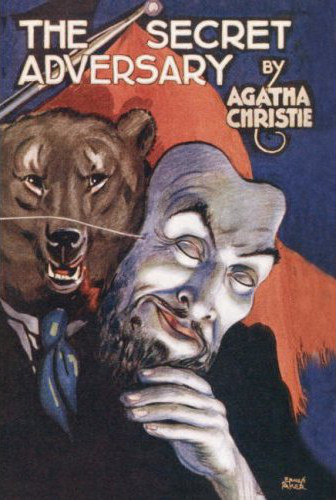
The Secret Adversary (book)

Dust jacket, first UK edition.
Emphasis on Bolshevism
Straining to relax, working to rest on the porch of the Barnstable, I finished reading Evelyn Waugh's entire absurd Vile Bodies and sitting next to me was a copy of Juliet Nicolson's The Great Silence.

Writing, eventually, would be in order. But research ... research is also important. Why, only just last year, at practically the same time I was burning through The Time Machine and A Brave Vessel as inspiration for The Great Globe Itself which was written, in large part, right there on that porch.

Nicolson's book details that period between the conclusion of the Great War and the beginning of the Jazz Age, as it occurred in Great Britain. (Side note: I really need to read an account of the war from the point of view of the Germans. Recommendations welcome.) The Secret Adversary takes place in 1921, at least according to Tuppence who recalls that her and Tommy's last meeting was five years hence in 1916.

Mid-century paperback edition.
Emphasis on MURDER!
Three issues of importance from that period resonate strongly in this work of Christie's; a general hatred for anything German, continued national deprivation and lack of employment (especially for the young) and with that a concurrent streak of labor unrest and a tangible fear of a Communist-backed revolt.

The Great Silence is an altogether demoralizing book. There is no finding reason in the great European conflict of 1914-18. Of all the horrific and plainly emotionally deadening facts paraded for our reflection, one stood out to me as most unhappy making.

Like many I have always assumed the war called "Great" was only classified as the "first" world war once there the "second" has established a succession. This is not the case. The term The First World War was first suggested in 1918 by an American academic writing about the conflict.

Recent, 21st century edition.
Emphasis on Lusitania.
That author was accused of cynicism, but history proves this person was merely striving for accuracy and was ultimately proved correct.

Deep knowledge of the "world of play" is not necessary for enjoying a work like Secret Adversary, but motivation and character is better understood with at least a basic education. Why are Tommy and Tuppence so obsessed with their next meal? Why is their banter of these two, young English people so blunt, wry, jaded and unapologetic?

And how on earth can an entire novel center on a single sheet of paper, one which ostensibly makes possible the toppling of the current Britain government and also pave the way for a wholesale Communist takeover without ever explaining exactly what the document says?

It is a mystery.

Saturday, August 1, 2015

Improv High

Questionable promotional graphic (1994)
Annually I am in the position of auditioning young adults for a position in arts education. They are generally actors who aspire to the position, and volunteer the desire - sometimes without even being asked - to teach children.

"I have a lot to teach children," they will say. It is not necessary for me to ask from where they acquired this ability with a Bachelor's Degree in Acting. I can look at their resume and see where they have taught, if they have ever taught at all, and that is what I will ask them about.

There are those of us, myself strongly included, who felt at a young age that we have something to share, to teach, wisdom to impart. Our arrogance is in believing that the desire to teach makes one a teacher, that having done something right once means you have the talent and skill to instruct others.

I know many teachers. They went to school to learn how to do that.

Perhaps many actors believe they can teach for the same reason they believe they can act, because they like to stand in front of people and to be the center of attention. My own desire to show how smart I am led my younger self into many embarrassing situations for which I was entirely unprepared.

I signed up to teach improv at the regional Thespian conference my freshman year in college. There I was, standing in front of students who were basically the same age as I, and they did not view me with any special kind of respect or awe. They were there to learn something. And I was whimsically unprepared. I had taken, maybe, one improv class, once, when I was a sophomore in high school. We'd played improv games in high school, and I thought I'd jump up and we'd play some but pretty much all of these students had already played them.

I had no commentary, no notes to offer them. I was unaware of technique, why one thing worked and another did not. It was a long forty-five minutes.

I did take improv classes in college, we all took a basic improv course freshman year and a year or so later one of the most important acting classes I received at school, taught by George Sherman, Head of the MFA Directing program at O.U. (Read my 1988 interview with George.) There we learned more than games, we learned theory, a philosophy and also a certain amount of history. I was compelled to read books on the subject.

Rupture, Improv Comedy (1988)
We performed club improv in bars and coffee houses at school, but played the same old games, for laughs. The kind of improv George taught us was long-form improv, and though it was very successful in the classroom, creating actual drama from premise and character, there was never any thought of performing that stuff in front of an audience. We just never considered it.

The one year I worked for Karamu's Drama/Theatre for Youth project, we were each assigned a Saturday morning children's theater class, for which I neither received nor thought to request any kind of lesson plans. These were extremely unhappy Saturday mornings in which I worked for forty-five minutes to get thirty ten year olds (okay, there were only eight of them) to sit in a circle to play a concentration exercise, which was akin to drop a handful of marbles on the floor and then yelling at them as they scatter under the furniture.

I made mid-class hallway trips for the kids to drink water and go to the bathroom last for twenty minutes.

As I bounced from youth education project to youth education project two things were becoming abundantly clear. First, you need a lesson plan. Like, you need to plan ahead. That was a hard lesson for me.

Second and a bit more disheartening, I was never going to be the cool teacher. I am many things, but being someone that teenagers or even small children want to be around, that would never be me. I could instruct, but I would not be loved. I learned to be content with merely getting it right.

By our second year producing as Guerrilla Theater Company, we began discussing additional projects to be produced under the GTC banner. The Guerrilla Youth Theater project was launched in late 1993 in Bay Village (why not?) in which Torque and I taught classes for elementary-to-middle school aged kids. We had lesson plans. Mine were lifted entirely from Viola Spolin's Improvisation for the Theater. The class was arranged through the city recreation department.

We believed we had produced a decent eight-week curriculum and even staged an event at the end of the session in which we shared the exercises and games we had been working on with the kids parents. We promised to build on the work we had done in the winter session and were absolutely flummoxed when absolutely no one signed up for the winter session.

That spring we developed a concept in which I would teach high school students how to do perform long-form improv. The project was called IMPROV HIGH (see graphic above) and the promise was to create an inter-district high school improv troupe. Announcements were made, flyers were distributed.

We had two high school aged colleagues, both students at Cleveland School of the Arts. Bud was our most devoted audience member and Digit ran the sound for our late night show, Mind Your Own Business. They each did their part to sell their classmates on the project but the day of the first class they were the only two who showed up.

So I cancelled the whole thing. How could I create an improv troupe with two actors? This would not be the first time I would just walk away from something, even when there were dedicated participants ready to follow my lead, nor would it be the last. I regret that decision. They were there, you can do improv with two people. I could have joined in, we'd have three. I was afraid. I made a mistake.

The following summer GTC was done and I had a tentative agreement with Dobama Theatre to create a late night project there. My girlfriend and I were taking our first road trip together through the upper Midwest, twenty years ago this summer, in fact. I was yearning for an education in styles of theater which I might incorporate into this new project. In Chicago we saw the Neo-Futurists, yes, but also my first evil clown show (Die Hanswurst Klown), Danny Hoch's Some People and my first trip to Improv Olympic to see a Harold.

In Minneapolis we visited the Bryant Lake Bowl and saw an improvised, musical science fiction comedy titled The Young and the Weightless. It was a pretty educational theatrical exposition and it was my intention to attempt to approximate technique I had witnessed but had never really been schooled in. Dobama's Night Kitchen would be an education for me, as well.

The Realistic World (1996)
Some day I may take the time to cover that grand, flawed experiment which was The Realistic World. It may have been the world's first long-form improv based on the world's first reality show, but I can't prove that. It was the first time I had trained, coached and directed actors to perform any kind of improvisation onstage for a paying audience that was not an entire disaster.

Since that time, from time to time in my role as part of the School Residency Program I have led workshops in improvisation for middle and high school aged students, but these are brief and are usually only game-based improvs. You know, for fun. There isn't time to develop character or to dig very deep.

There's another problem, too, and that is my responsibility to the students and also to their teachers. Improv means trust and I can't encourage them to take risks but also be in the position of having to censor their behavior.

Actually, I can. I should. It's a skill, and it has been the hardest lesson to learn - how to say no. Improv has rules, of course it does, just because you do not have a script does not mean you do not have a structure. You cannot violate the reality of the scene. There is also the acceptance rule, that you take what is offered you and you agree to work with it and build on it.
For the uneducated:
WOMAN: I brought home a rhinoceros.
MAN: No, you didn't. (invalidation, bad choice)

MAN: Yes, and where are we going to keep this one? (good choice!)
The director, however, can say no. It's a director's job to say no. Rehearsal is not performance and when an actor breaks a rule, or does something unnatural - something intended to entertain or be funny - it is the director's job to call them on it. Not to humiliate them, just to stop the scene, address the issue, and either start a different scene or simply ask them to make a different choice.

As many times as possible. As many times as necessary.

But it is not easy. Invalidating an actor is not an action I take lightly. George was skilled in ending a scene when a rule has been broken. He was also good at letting an actor hang himself with his own rope if he made an asinine choice which did not actually break a rule.
Scene: A hardware store.

1. First actor establishes the store. They are organizing shelves.

2. Second actor establishes relationship by entering as a customer with a complaint above a defective purchase.

3. But then a third actor decides to burst in as a rather exaggerated example of a “robber” and holds the place up. 

However, we had been working with the rule that once you enter an improv, you cannot leave. So, having held the place up, he needed to come up with a reason to stay and the others had to deal with him. The decision to provide a character to the scene who was not actually a character but only a gag was clearly and painfully exhibited for the entire class to cringe at as the scene limped along.

For several years GLT has produced a summer theater arts camp at Berea-Midpark High School - Camp Theater. We teach those as young as four up through high school ages in a variety of games, exercises, scenes and disciplines such as combat choreography and stage make-up.

I was initially self-resistant to include much improv, apart from the very basic kinds of games, due to the constraints of time. The camp consists of two, week-long sessions. Some kids are only there for one week and for a few years our time with them were half-day sessions, perhaps two and a half hours. Improvisation, valid and valuable improvisation is not possible if you give it sixty minutes a day for five days.

We expanded to day long sessions last summer, continuing this year, and so I had the opportunity to work with the middle and high school aged campers in one group for two and a half hours each morning. They would split into two groups, one for middle school and one for high school in the afternoon to concentrate on scene work. But I would be working with them on my own all morning, and believed that with this time we might actually be able to create something wonderful right away.

Last summer was an experiment, one in which I was too limiting in the kinds of exercises we would perform, each performance based, skill based, character building. Not for performance. You see, each class would be presenting the scenes they had been working on at the end of the day Friday for their families. I had no intention for them to perform improv for an audience after such a brief period of work. It was technique-based work, and the students responded accordingly.
It was no fun.

Camp Improv (2015)
After all, these are kids – smart kids, to be sure, but not already skilled actors. They do not know how to “make choices” because they have never been asked to, they do not yet know how.

This summer, I flipped it. We would work towards sketch based improv. Very clear conflicts were assigned, characters were described and provided. Definite parameters were set, scene games which have a prescribed beginning and ending. They brought their own personalities to set scenarios and played them successfully and instead of having some vague sense of accomplishment from improving their skill set, they had the immediate satisfaction of making their peers laugh and successfully navigating a story.

And I said no. A lot.
Scene: You are lost in the city, and need money for bus fare.

Camper runs up to other actor screaming, “Give me a dollar!”

Hold please. Take that again, make a different decision this time.

Camper runs up to other actor screaming, “Please, give me a dollar!”

Hold please. If you were asking a stranger to give you a dollar, you would run up to them screaming, they’d run away. Try that again.

Camper runs up to other actor screaming, “Hey, can you help me!”
Hold please. No seriously, your goal is to get the dollar, not to frighten the person. Do something different to successfully get them to pay you.

Camper walks up to other actor and says, “Excuse me, I know you don’t know me –"

Other actor says, “Who are you, stay away, I have pepper spray!”

Camper says, “That’s cool, really, I’m just a guy, the thing is –“
And the scene started to click.

For our final morning together, I asked them to bring drinks and snacks and we created a bar. We closed the stage curtains creating a narrow space which we crammed with mismatched chairs found around the school. A stage was clearly marked to one side of the stage with tape. Colored stage lights were turned on giving the space a clubby vibe and I had brought Christmas lights which the students draped behind the stage.

Camp Improv (2019)
The kids performed about an hour of club improv, scenarios they had worked on and also games. I acted as MC as they sat around eating chips and drinking pop and performing their bits. In between set-ups many of them volunteered to sing their favorite songs a capella and I was surprised by how good their voices were. Even the boys sang.

It was a performance no one else had the honor of experiencing, it was private where they could tell the same jokes we’d been telling all week and not be judged by the other campers or anyone else. They were confident and did confident work. Just before lunch I had the unhappy task of closing the show and asking them to break down the show.

They were called into a circle and I was just going to make some brief remarks about keeping their energy up to prepare for their afternoon performance when one of the older students, one who had attended for several years now, she rose her hand demanding to speak. She said, “I just have to say! This has been the best week of camp ever!”

Oh.

Uh, I said. Uh. That’s good, uh ... that wasn't –

Another blurted out, “Come on, man -- we love you, David!”

I was just trying to get it right.

Thursday, July 23, 2015

Bright Young Things

The headline in The Onion ran;  4 Hours Scrolling Through Facebook Before Bed Referred To As ‘Winding Down’ (July 22, 2015) As is often the case, even now, twenty years on, their style of satire - which often consists of just saying true things pushed to logical extreme in flat, journalistic prose - exposing an Emperor who is already entirely exposed.

Last week I asked my wife to lock me out of Facebook, changing my password occasionally so I am denied access, like locking up the liquor cabinet.

I would prefer to have the wherewithal not to procrastinate, and to do the things I am meant to do. This summer I have been much more successful at reading, putting away three novels in the past month. Some has been research, but also fiction. Currently I am on my fourth summer novel, fiction which is also research; Vile Bodies by Evelyn Waugh.

Totally, odd ... I had asked my father for his copy and he forgot to bring it last weekend, but then as I was searching for a book for the girl to read I found his copy on one of our shelves at our house. I have no idea how that happened.

After a brief bit of confusion I have become entirely immersed in this tale of the "bright young people" in 1920s England. The picture of the Roaring Twenties from the other side of the Atlantic has similarities to that found in America, but like looking the wrong way through a telescope.

Young adults in Great Britain, for example, were the survivors of a generation slaughtered in the fields of France and Belgium during the Great War. Privation had taken a great toll on the established class system. They all just went a little nuts, drinking, taking drugs, throwing outrageous parties, pushing the boundaries of socially acceptable behavior.

I mean, America's "Lost" Generation was also behaving this way, only we seem so depressed and decadent, the British to be entirely disaffected and possibly demented.

As I continue my exploration of Agatha Christie's second novel The Secret Adversary, there are a few important elements which are drawing into focus. In the extremely helpful tome The Detective Novels of Agatha Christie by James Zemboy (MacFarland & Co., Inc., 2008), the author notes:
... unlike (her first novel) "The Mysterious Affair at Styles", ("The Secret Adversary's") characters are interesting and fun to read about ... the reader is treated right from the beginning to two loveable young people full of life and spirit ... (p.22)
Not monied as many of those real-life contemporaries written about by folks like Waugh and Nancy Mitford, Tommy was a soldier wounded in the war and now desperate for some kind of work, Also broke and with few prospects, Tuppence could return home to her family but as a modern young woman she would rather do absolutely anything else.

The manner in which they enter their business arrangement, which at first blush is practically an extortion scheme, retains the kind of disaffected pose that is so prominent in literature about young adults at that time. Christie herself was barely into her 30s when she wrote it and her dialogue is much more breezy and hip in this book than in her first.

There's also an awful lot of attention given to their eating, whenever possible, as thought they are constantly hungry, tearing into bread and tea when they have nothing, taking the opportunity for a meal whenever possible, and Tommy in particular obsessing about the time between feeding.

Monday, July 20, 2015

Boy Camp 2015


The summer has been eventful, so eventful, so full of activity that I have not had the time nor energy to report upon BOY CAMP. (For details see 2011, 2012, 2013 and 2014.)

The boy and I have had many opportunities, even this summer, for time on our own. The women in the family have already had one away camp (Blue Lake outside Muskegon, MI) but this weekend has for six years carried special significance for the boy and I since the wife and daughter first headed out to Girl Camp in 2010. As the boy is now ten, it is only fitting that our relationship to the weekend changed significantly this summer.

After making an afternoon maternity ward visit to friends with brand new twins, we decided to heard directly to the bowling alley. Bowling was the original, signature event way back in 2010 and so it was imperative. However, it was not satisfying as he struggled to make do without bumpers, perhaps for the first time. I was as positive as possible, and tried to guide him to improve his play, without much success. We made a plan for the rest of the weekend to look up from there.

We had the bowl early – if at all – because he his baseball team was in the playoffs. The season had stretched on much longer than scheduled, as many games had been cancelled due to all the rain. We lost the game, but it was hard fought. (His team had been undefeated until the playoffs, only to lose twice in double elimination in the final to this same team later in the week.)

For dinner in manly style we had hotdogs and cole slaw while watching The Terminator. Yes, we watched The Terminator. I was concerned it might be too violent – and it is – but not much more so than what he already takes in on network TV. The boy said it was excited but very smart, and I have to agree with him. Everything is so fast these days, fast and loud and active, the boy was very intrigued by the mystery of the story. That’s the problem with sequels, there’s no mystery to them, you know the world, you know the situation. There may be surprises, but surprise and mystery are not the same thing.


Saturday was given over to rock and roll. The entire day. He had his private lesson at noon at School of Rock and then a ninety-minute rehearsal with the band. They are working on a complete set of Joan Jett numbers for September, but would be debuting a small number of them at the Cain Park Arts Festival. The boy was extremely nervous about playing the Evans which is a very large space, but the crowd was small compared to the size of the venue, folks coming and going giving it a laid back vibe. He played very well after a false start, he keeps a rock steady beat (he's the drummer) and I am proud of him.

That night we stayed up and watched This Is Spinal Tap. He’s seen a number of rock music documentaries and films so I thought he’d “get it” and he did so far as it goes. What I underestimated was his appreciation of the many levels in which it is satirical (the Lick My Love Pump gag went clear over his head) and exactly how its improvisational elements are so amazing.

So, uh. So there. Wheep whomp.

Sunday morning was not one for lying in, however. I am training for a marathon and wanted to get in a ten mile but I did not want to leave him at home to watch videos of ADHD Millennials comment on Minecraft. So he biked and I ran, through Lakeview Cemetery and the Uptown neighborhood (i.e. CWRU environs) down to the Cultural Gardens. Two and a half hours of leisurely running, biking, walking and talking.

Finally, and this is a fine tradition, we visited the Lantern Theatre in the Big Red Barn, taking in another original theatrical event focusing on local history. This year it was Eric Schmiedl’s Johnny Appleseed featuring himself, his son Arthur, the surprisingly versatile Bill Hoffman and the always delightful Valerie C. Kilmer.

The boy and I do get to spend a good deal of time together, alone in each others' company. And he’s constantly challenging me, constantly debating me. We have great conversations and even some intense arguments. But we have a really good thing going.

Saturday, July 18, 2015

The Rose Café

The phone rings twice as a pre-dawn wake-up call which is enough to pull him off the couch, the couch made as a bed, his bed, to rouse him into another day of possibility, or chance.

He doesn't think, really, not even to process his dreams, just strips the sheets, folds them up to tuck them away until this evening. He swiftly dresses and shaves, within minutes striding across the cul-de-sac to his companion's idling car, heading off for the daily ritual, to hike to the peak of the Santa Monica Mountains and dash down the other side.

That accomplished, they retire to The Rose for strong, strong coffee.

The Rose - on Rose, of course - is another comfort, a place to reassure him that things are happening. It's a coffee shop, to be sure, a place to relax, but no one is relaxed his companion points out. Everyone is writing the screenplay (longhand - this is 1991) or pitching the screenplay, talking the good game.

Everyone has a project, she says. She's made a game out of it, walk up to a stranger, pretend like you know them, ask them how "the project" is going and they'll tell you, they'll tell you all about it.

In walks that b-level actor, he's been in some dumb movies, and more recently a supporting player on last year's hot TV show which may or may not have ceased production. He's someone or no one but his mere presence - a guy like that - validates the joint as a place for those who work, who make it happen.

Our man has a banana nut muffin. She, his companion, told him bananas contain potassium, which naturally alleviates anxiety, and though he would be much better served eating an actual banana, this moist, delicious treat has become his defacto power breakfast. It goes much better with coffee. He can justify the caloric intake by skipping lunch, daily.

No one is fat in L.A.

He never smoked in L.A. Never took drugs in L.A. He only drank when out, never in the apartment. Never cut his hair, either, which was a mistake. Wrote a postcard daily to his ex-girlfriend back home which was also a mistake.

The act of happening is happening. Doing the work. Sending the work. It helps if the work is good, but does it matter? Why not create the work and set it aside? Why publish? Why publish! Publication is reality. Publication is fact. Publication says I am here.

This evening they will skulk film shoots, walk the beach, hit Tower Records, it's all part of the work. She's having a reading for a script for Roseanne she's working on. He's never seen it, there's one line that doesn't make sense to him why it's funny. She says it's because he needs to hear John Goodman say it.

He is working on a newsletter, Notes From L.A., a collection of essays and cartoons about how lost and disillusioned he is with the the city. Matt Groening got started this way. He will print it and send it home and that will mean that it is all happening for a reason, that he is happening.

Pungent, black coffee. An empty muffin cup. Bright sunlight. Job interview at Friday's at 1:30 PM. That's in four hours. Writing can wait, time to hit the beach.