Showing posts with label editing. Show all posts

Saturday, March 4, 2023

The Great Globe Itself (revisited)

"I'll come in again."
Recently I have been digitizing a lot of materials at the office. That includes the prompt books for outreach tours, going back decades, a number of which I have written.

So, yes. I have been lingering over my old scripts, because they're interesting. They include sound cues, stage directions — and edits. Lines that were added, lines that were cut, lines that were changed.

These changes would make their way into the final draft of my script. But one line change caught my eye, from The Great Globe Itself, first produced in 2015. It's a significant edit, because it answers a question, central to the third act, which I had failed to address when we started rehearsal.

"They come to hear the gods, not me."

I checked the version I had posted to New Play Exchange and was surprised to find that I had not included it in the final draft. All the other changes were there, but not that one. It makes a difference, and I'm glad I caught the mistake.

"The Great Globe Itself" is available at New Play Exchange, or contact me directly.

Friday, August 26, 2022

I Hate This (First Reading, 2002)

Twenty years ago today, August 26, 2002, we held the first public reading of I Hate This (a play without the baby).

To recap, my wife and I suffered a stillbirth in early 2001. And I wrote about it. And wrote about it. My journal was a form of solace and understanding. We mourned, we talked, we traveled. We wanted things to stand still for a while but they kept moving forward.

My wife had a show in the New York Fringe that August and I saw a lot of shows, many of them solo performances. As I drove a van of sleeping teenagers and young adults back to Cleveland I had a lot of time to think and I realized then that I was going to write a show about this experience.

It had only been five months. I told myself to wait, not to think about it again at least until the new year. The wife had invited me to join her writers’ group which met at that coffee shop in University Circle. In 2002 I began to share pages for what would become my first solo performance.

Early that summer I met for lunch with Joyce Casey, Artistic Director of Dobama Theatre. As I had worked there for three years she was my former employer and mentor, and also a good friend. I had shared the script with her and she asked how she could help with the piece and I said I wanted to hold a reading, an invitation-only event and could I use the space. She agreed.

This was something I had never done before. I hadn’t actually written many plays. I’d never had a public-private showcase of a work I had just written. Maybe a few folks invited over to my house to read and comment. I planned to invite a wide variety of people, friends and close artistic colleagues, but also directors of other theater companies and most importantly to extend an invitation to those we had met on our journey, others who had lost children and were familiar with this grief.

I made postcards to send through the mail or to hand out. I must have sent emails, too.

Tom Cullinan was director, he would go on to direct the original staging of the play. We worked in various rooms in my house to create a shape for this performance. It was script-in-hand but there was also blocking. In the end what we created was the basis for the stage play I would eventually perform, on and off, for the next five years.

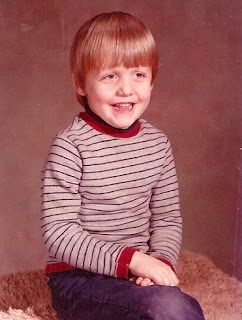
There were no slides, I read the title for each scene. There was no music or sound effects, those would come later. There were a couple music stands so I could place the script for longer passages. It was a staged reading. I wore the sweater.

The version dated June, 2002 is remarkably similar to the final version. I have edited and edited as the years have gone by, but its shape was established from the beginning. There are uninteresting details which were cut, and inaccuracies.
“I sang to it on Friday and I swear it was listening to me.”
That line may be poetic, or possibly emotion-evoking. It is not accurate. I changed that passage before the first reading. There were many, many f-bombs, and other obscenities which were unnecessary.

There is a scene where my brother and I are in the Cloisters in Upper Manhattan, observing the Annunciation Triptych. I compare myself to Joseph, the blithely ignorant father: “He has no idea what’s about to happen to him.” In the original draft I go on to describe other famous men who have lost children:
“God lost His son. Did you know the guy that writes Doonesbury, his wife had a stillbirth. And John Lennon and Yoko Ono had a number of miscarriages. And Luis Guzman. He’s that guy, you know, in 'Traffic' … yeah, you know, that guy, him, too. Read it somewhere. Really fucked him up for a while. Isn’t he great?”
That passage was struck from the August, 2002 version, the one I used for the reading. I had wanted to share what a widely-felt experience child loss is, and examples of famous men who have was one way to do that, I guess. But the scene is long and bends from topic to topic and we needed to draw a narrower focus.

Trying to describe our visit to Great Britain to see my other brother that summer, I originally read this:
“I don’t know what we wanted our trip to London to be, but it wasn’t what we wanted. I love that city, it bleeds history, and you’re surrounded by people from all over the world, rushing through its narrow streets, the places just pulses with music and art and exciting smells and noise. But it was still scary to even step outside and you know, there are newborn babies everywhere, even in England.”
Press to play.

But that wasn’t right. That’s some sexy but entirely vague explanation of how I feel when I am in any large city, and when things are entirely normal. It didn’t describe that place at that time, the way we were experiencing it. It was revised for the premiere.

The turnout was very good, all things considered. Sixty people? Maybe seventy? Following the reading I changed and sat in the back while Tom led a post-show discussion about the script.

I mean, here’s the thing. Everyone in the room knew me, most likely knew both me and my wife. They knew we’d lost a pregnancy. I knew no one was going to be very critical of the work. But I didn’t know what I’d written. Was it a play? Was this a story anyone wanted to hear? Would they say, I am glad you got that off your chest?

Well, no. No one said that, at least not yet. And there were generous questions about form and clarity. Someone suggested I cast other actors to play the characters I impersonate which was interesting and while that was not something I wanted to do you it has been done that way.

One theater colleague, a playwright (I did not yet call myself a playwright) marveled at the fact that I would even attempt something like this. She said there was this conventional wisdom that it takes ten years before someone can successfully write about tragedy, and yet I just went ahead and did it.

And Randy Rollison, Artistic Director of Cleveland Public Theatre asked if I had any plans for it. I said I had not. He asked if I would like to participate in a new works program he was planning, called Big Box. I said I would.

My wife and I were already four months pregnant with our next, and living child. They would be a month old when this new play would would premiere at CPT in February 2003. And that is how two decades can pass without your really noticing.

Sunday, February 27, 2022

The Witches (process)

"The Witches" at Pandemonium
(Cleveland Public Theatre, 2019)
History is marked with terror, in America as it is in the rest of the world. There are monuments and memorials to moments of great suffering and tragedy which are peaceful sites of reflection, like the Vietnam Veterans Memorial, or the Salem Witch Trials Memorial.

Then there are the museums, houses of artifacts and exhibits. Some are an attempt to rectify previously unacknowledged history, as they have been working to do at Monticello; some are meant to memorialize recent events like the National September 11 Memorial Museum in Manhattan. These efforts have also received their share of criticism.

What does it mean that there are for-profit tourist traps and wax museums exploiting such curiosities as Bonnie & Clyde’s Death Car, the actual mummified remains of mental health patients, and, of course, the Salem Witch Trials?

Two and a half years ago we workshopped the first scene I had written for The Witches at Pandemonium, the annual gala for Cleveland Public Theatre. It was there that I understood (once again) the inherent difficulty in pairing comedy with horror.

Salem Witch Dungeon Museum
We are attempting to walk the line between satire (n.: the use of humor, irony, exaggeration, or ridicule to expose and criticize people's stupidity or vices, particularly in the context of contemporary politics and other topical issues) and the reality of misogyny, generational trauma, capital punishment, child abuse, and on and on. It’s not funny, this being burned alive business.

In spite of having to miss a week’s worth of rehearsals due to class, family obligations and the playwrights festival, I have been engaged in the process of revision, listening to our actors, trying to make it all clear. I can be obtuse, you know. Editing has happened.

I wrote speeches. Some work. Some do not. There were also a number of Hamilton references which in 2022 are embarrassing like naked baby pictures are embarrassing. No one wants to see that shit.

There’s a lot of stuff in the words, and yet, not enough stuff. There’s also jokes. I am going to be sitting in the back next weekend, paying close attention to what gets laughs – and what does not.

To be continued.

Tuesday, February 22, 2022

On Self-Control

One of my notable character traits, which I assume is related to my being the youngest in a trio of brothers, is my sharp tongue. 

The eldest sibling doesn’t need to prove their dominance, they simply are; always bigger, always stronger. The middle child is the mediator, to be sure, and also circumspect. Like Janus, they sees both ways, being younger and older, and yet not definitively either.

The youngest, this youngest, exerted his personhood the only way he could. With his mouth. If he got physical, his older brothers could always smother him with a pillow until he could no longer fight. This is a thing that happened. Why throw a punch, when depriving the offending child of oxygen is so much more effective and doesn’t leave a bruise.

So, I had a big mouth. Witty, but also vulgar. And when cornered, I lashed out. I graffitied, writing with soap on mirrors, pencil on desks, chalk on boards, carving into wet cement. When, in sixth grade, I was caught writing something particularly nasty about someone on a table in the library, a panel was convened to try and channel my impulses.

My guidance counselor asked if I was interested in creating a middle school newspaper. 

"Sure!" I said. 

Fine, he said. Create one.

Unfortunately, I am not an eldest child, I had no sense of independent initiative and required guidance, not knowing how to ask for it and none was provided. I continued to stew in silent resentment through my middle school years.

The high school did have a weekly newspaper and I was finally able to express myself through cartoons. I also wrote the occasional story or opinion piece which were inevitably disastrous, my penchant for unfortunate and often irrelevant metaphors distracting from whatever point I was trying to make.

Words can be an ugly tool. Worse, when you have an affinity for using them but only for the expression of resentment and spite. These were the early  plays I wrote to either drive a wedge between myself and people who cared about me, or to kick them in the ass on the way out the door. I need not elaborate. Some saw their way onto area stages, others did not, but they were read. It was ugly. And stupid. And embarrassing.

Practicing restraint is one thing, it requires constant vigilance. My wife deserves all the credit, not for teaching me restraint, but for sharing with me more a open engagement and understanding of the world and the people in it. It’s humbling, and this humility has helped me to finally, as so many before had recommended, think before I speak. And to edit, edit, always edit. And also to know when its best to delete.

Thursday, January 23, 2020

On Editing

We have corsets!
Revision is an act of change, or alteration. Re-writing is as or can be even more important than original writing. The version of Sherlock Holmes Meets the Bully of Baker Street I presented to the touring company was only the third draft, play scripts can go through many more revisions before production.

Editing, however, is an altogether different enterprise. Editing and revision can be synonymous. In this case, however, we are talking about cutting, excising, weeding. You can only assume how long a text might take to perform until it’s actually read, and even then you need to account for set changes, the use of music or the arrangement of song.

And then there are the words themselves. Until you hear them, hear actors perform them, you might not understand how they are received. And editing will be required to provide clarity, eliminate repetition or redundancy, drop jokes or turns of phrase than simply do not land, eliminate repetition or redundancy, and in general, to make the thing shorter.

We want, we need a fifty minute show. That’s what we’re selling, and schools need to account for the actual duration of the performance. To that end we have already struck out entire verses from almost each of the five songs. Not that the songs are terribly long, each first lasted a little over two minutes. Now they run between a minute and ninety seconds.

221B Baker Street
Does this bother me? Not at all. Yes, the verses are delightful and fun to hear. But we’re telling a story and each song is a means to an end, they are not the thing itself.

And then there’s the text. At the end of every rehearsal we ditch a few lines, or entire exchanges. And I say yes, thank you, to each and every one.

Lines you won’t hear in performance:
VICKY: … you will have to excuse me if I am skeptical about your … reformation.
SHERLOCK: Good word, “reformation.”
VICKY: Thanks.
SHERLOCK: Good for you.
VICKY: Stop it.
It’s a funny exchange, it speaks to the nature of their relationship at that moment. But a similar exchange happens again, a little bit later, and with greater significance.

At another moment we hear the description of an incident in New Jersey harbor, in which the hold of a ship was packed with asphalt, and during a sudden heat wave the cargo melted, sinking the ship. This is something which did in fact happen at the turn of the century, has happened several times in maritime history, in fact. It’s all very interesting, I guess, but who cares? The ship sank. No one died. All cargo was destroyed. Moving on.

This is why I do not like to direct my own work. I have written several tours for Great Lakes, including On the Dark Side of Twilight, The Mysterious Affair at Styles and Double Heart, and in each case judicious editing made the plays so much better than if we had proceeded with the draft provided. These productions were directed by Andrew May and Lisa Ortenzi, and in each of these cases overseen by my supervisor at the time, Daniel Hahn. They each provided vital contributions to editing the script, and so did the acting companies involved.

The Great Globe Itself (2015)
The only time I have directed an outreach tour was The Great Globe Itself, which I also wrote. And the experience reinforced my belief that I am my own worst director. Don’t get me wrong, it was a funny play. The actors, Arthur, James, and Roderick, they each did tremendous work. The designers and builders, our choreographer and our dialogue coach, and our interns who created the educational materials, it was all spot-on and well-executed.

But the script wasn’t sure what it wanted to be. I had thrown so much into the pot, arcane history about the Globe Theatre, the Great Lakes Exposition, Doctor Who, it’s like my every minute, personal artistic interest had been chucked in a blender.

It wouldn’t have taken much, it wasn’t a terribly long play. It was just that much too long, speeches should have been trimmed, gags dumped, and someone, anyone, could have asked, what are you trying to say here? It is a mistake I hope not to repeat.

To be continued.