Showing posts with label comic strips. Show all posts

Tuesday, September 15, 2026

Trudeau & Doonesbury: A Biography: The Cartoonist Who Turned the News Into Art (book)

Garretson “Garry” Beekman Trudeau (b. 1948) is the single greatest influence on my life as a writer. There have been others who have inspired me in my work, from William Shakespeare to George Bernard Shaw to Annie Baker, and also from Charles Schulz to Harvey Pekar to Alison Bechdel. Because comic strip artists have had as much of an impact on my life as any playwright.

For example, John “Derf” Backderf just released The Dissidents, his first graphic novel since the epic Kent State (2020) and this is a work no less expansive in scope, for which its creator has been doggedly journalistic in his pursuit of historic accuracy. In this case the events are so far in the past (a century!) he has had to rely entirely – I assume – upon the written record.

I’ve read it, and like Kent State or My Friend Dahmer, it should be added to the long list of recommended (and also then probably censored) reading for high school students across the nation. It’s brilliant, it’s timely, it’s important.

But what about this Trudeau guy? He was the creator of Doonesbury, and in the late 1970s, while my preadolescent friends were getting a fantastic, exaggerated and exploitative history of Vietnam watching films like Apocalypse Now and The Deer Hunter on cable teevee, I was desperately consuming the history of the war and the entire “Me” decade by scraping up every single trade Holt, Rinehart and Winston paperback I could get my hands on at Baluk’s bookstore in Westlake.

A prized possession.
His comic strips were remarkable at the time because of the so-called political content. Sure. At that time, the comic pages were reserved for silly jokes about beleaguered husbands and shrewish wives. The war and the Nixon administration had been reserved for the editorial page, but when Trudeau was recruited (due to his work producing the strip Bull Tales for a Yale publication) to create a comic for daily syndication, he became the first to address contemporary issues – sex, drugs and the war – in the daily comics.

I mean, he wasn’t. He was preceded by Walt Kelly (Pogo) and Al Capp (Lil’ Abner) and others, but he was the first BABY BOOMER to do so, and to be so literal about it. The timing was not remarkable, it was inevitable. It could have been someone else, fortunately it was Trudeau.

Because of his wit. His very dry wit. Decades later, I would be taken to task for my work in the Ohio University paper The Post because I just wasn’t funny. But like so many other would-be college paper cartoonists, I was simply emulating the style of Doonesbury, how the punchline was usually the second to last line, only to be undercut by the deadpan reaction.

Doonesbury, October 26, 1970

And it is this deadpan, dry reaction to humor that has led people to hate and fear me in everyday conversation. And it is the same kind of dialogue I have always incorporated into my plays. This summer I read Trudeau & Doonesbury: The Cartoonist Who Turned the News Into Art by Joshua Kendall, the first authorized biography of G.B. Trudeau, and one of the first delightful things I learned was that, as a child, the future Pulitzer Prize winning cartoonist was an aspiring impresario.
At the age of eight, he waxed entrepreneurial, establishing the Acting Corporation, which marketed and produced his own plays in the family’s home.

“We transformed the basement into a makeshift theater, with bunk beds as our balcony," [Trudeau] says. "My mother had red curtains installed as a Christmas present … I jerry-rigged the most dangerous lighting board imaginable, and I almost burned the house down. I also built sets from canvas flats. Our troupe comprised relatives and neighborhood kids.

“I was a little dictator who controlled all the elements. I wrote and directed the plays, composed the music, designed the sets and costumes, oversaw makeup, props, etc."
(pp. 15-16)
He was a theater producer who became a cartoonist, I was a cartoonist who became a theater producer. And this should not be a surprise. Because they have so much in common. While I had entertained notions of playwriting in high school, I had no idea how or where to begin. Creating the strip Breaking Point my sophomore year in college, I was constantly thinking about and writing dialogue and action (essentially, scripts) for a cast of fictional cartoon characters which I would then draft and have published for an audience.

Breaking Point, May 27, 1988

Trudeau did something surprising, but necessary, when he chose to take a sabbatical in 1983, stepping away from the drawing board to rethink the strip. It’s all cool that Hi and Lois, Blondie and Dagwood, and the Peanuts kids never age, but Michael, Boopsie, Mark, Zonker, B.D. and the rest were ostensibly Baby Boomers – all of whom were for some reason still undergrads in the early 1980s. That had to change if the strip was to remain relevant.

However, it was a working vacation, as Trudeau returned to his first love – the theater. He partnered with Elizabeth Swados (Runaways) to create Doonesbury: A Musical Comedy which opened at the Biltmore Theatre in late 1983. It wasn’t a sensation (Frank Rich called it “pleasant”) but even if it were, it’s intentionally dated, set squarely in that interregnum between the queasy late 1970s and the go-go 1980s. I’ve never heard of anyone else producing it. But do I have the original cast recording on vinyl? Yes, I do. Do I have it on CD? Yes, again. I am partial to the opening track (“Graduation”) and Michael’s gentle attempt to court his girlfriend J.J. (“Get Together”).

 
The most significant result of this endeavor was actually a downscale, downtown spin-off (a friendlier locale for such things) a cabaret in which to skewer Reagan era policies on a rotating basis. This was a format more in line with the daily criticism Trudeau was conducting, anyway.
Trudeau and Swados undertook a second theatrical collaboration … "Rap Master Ronnie," a one-hour "partisan revue"... which premiered at the Village Gate in the fall of 1984. Frank Rich was more kindly disposed to this venture, praising Trudeau's "ingenious lyrics, the bristling polemical wisecracks and a sparkling cast."

Trudeau (said), “With 'Doonesbury? Liz (Swados) played in my world— a mainstream Broadway musical with lovable characters. But with Rap Master Ronnie, a downtown political revue with complicated characters, I was in Lizworld. I came to prefer the latter, scrambling for money and audiences, huddling behind the bar at the Village Gate, reworking numbers on the spot, the kind of on-the-fly theater Liz was so brilliant at."
(p. 215)
I can dig it. I love those things, too.

The Dissidents: Autocrats! Vigilantes! Communists! And Cartoonists! By John Derf Backderf (Abrams Books) is now available in hardcover.

Wednesday, January 6, 2021

The History of Underground Comix

When Ohio University announced its first graduate level course in sequential art, The History of Underground Comix, I was still an undergrad. It was 1988, Fall quarter of my junior year. But if there was going to be a course on independent comics, by God, I was going to be taking it.

I was, at that stage in my life, immersed in comics. I had been reading commercial comics or “floppies” since I was a kid, and the 1980s were a golden time for the superhero genre; reconsidering it, turning it inside out, and creating the template for today’s Industrial Superhero Film Industry. Books like Watchmen, The Dark Knight Returns, and the heyday of the "Uncanny X-Men." 

Also, I had been drawing a daily strip for the college paper and though my art was pretty crude, I was not only taking inspiration from mainstream comics. I had begun to discover alternative works, including those of Harvey Pekar (American Splendor), Matt Groening (Life In Hell), Art Spiegelman (Maus) and those artists that appeared in Spiegelman and Françoise Mouly’s Raw anthologies.

So, if there was going to be a course on comics, then I, David Hansen, creator of the controversial strip Breaking Point, would have to be accepted. 

Breaking Point (1988)

This was a mistake. Fall quarter my junior year was a disaster for me for a number of confluent reasons. I was cast in an extremely challenging mainstage show which conflicted with much of my attendance for this evening class. I underwent something of an emotional breakdown as I negotiated my poorly-managed interpersonal relationships. 

And the fact is I had always been a bad student. I skated through my classes. I knew enough to pass, even occasionally to do well. But I was never a deep study, or a good reader, of texts. Pleasure reading, sure. Not work that was assigned.

Cover, "401"
Art: Ken Kastely
The professor was skeptical. An undergrad can’t just take a graduate level course. I had to submit a portfolio, and a letter of intent. Only then was I grudgingly assigned a slot. 

But there were texts to be read and papers to write, and debate in class and a final project which involved the class collaborating on creating an original, physical comic book.

The comic, titled simply “401” after the class's room number in Siegfried Hall, was a missed opportunity for me, one in which I could have pushed myself and broken form. As it was, I drew two pieces involving suicide (I didn’t know at this time how thoughtlessly trite that was) and a third which was just a cheap shot at one of my classmates, a woman with a strong feminist agenda.

This one is a single panel depicting myself reading Kate’s final monologue from The Taming of the Shrew as my “humorless” classmate approached from behind wielding a baseball bat. No, I will not be sharing that image here.

It was my beef with the women in the class that I am most ashamed of. There were, to me, a surprising number of women in the class; self-possessed, confident, intelligent women, who were into comics and had an agenda to explore and expand the form. I was a young, callow, white male of privilege and I was challenged by them, or should I say I felt challenged by them.

Another signifiantpart of our grade was a class presentation, for which I planned a take-down of Dr. Friedrich Wertham’s seminal work, Seduction of the Innocent, which documents a direct connection from comics to juvenile delinquency.

I cannot imagine I actually read the book. Worse yet, I had a performance the night of my presentation. I provided a booklet of photocopied images from the book, images from horror and superhero comics of the kind Dr. Wertham asserted were the cause of sociopathic behavior, and also a cassette recording of a stream-of-consciousness rant in which I quoted Wertham's claims and then just said that he was wrong.

The next class, the final class, I avoided anyone’s gaze and received my materials back from the professor. The cassette itself has been recorded over by members of the class to provide their response. I think I got a couple minutes into it. I never listened to the entire thing The tape began with a lecture from one of the women (a woman of color, if I recall correctly) describing how unprofessional my work was and spelling out in no uncertain terms the errors in my scholarship.

I dropped the cassette into the wastebasket, not out of resentment but shame. I had fucked up, and I knew it.

There’s always that guy in any class, you know the one. Often absent, does substandard work. You don't know who they are or what may be going on with them, but you do wonder, why is this person even here? For that class, that guy was me. I got a D for the course, which I believe was generous. 

Why am I sharing this humiliating piece of personal history? Because this semester I am taking a graduate level course in Comics Studies and Queer Theory. Among other goals, I plan to make up for past failures.

Tuesday, June 3, 2014

Breaking Point (1989)


This entry is adapted from a piece originally composed in Spring, 2008. The source material for the work that is the subject of this piece was a comic strip I created for The (Ohio University) Post for two quarters in early 1988.

In spring 1988 (before the strip concluded) Scott K. asked for material to use in his radio production class. I adapted the original short story for which I created a character named "Kael" -- something I wrote freshman year -- into a brief script for his radio production class.

The story involved Kael and a mysterious woman named Carolyn with whom he was "psychically linked." Yes, very romantic. I wrote a paper on astral projection senior year in high school and used a lot of the business I picked up during interviews as the basis for my nonsense.

Scott produced the piece which featured himself, Ben D., Monique W., Andrea W. and myself. Kael was played by a friend of Scott's whose name I forget, but I remember his face (which you cannot see in this picture) because he was the drummer in The Humbert Humberts in Springfest series of strips.

Photo: Does the pose look familiar? See below.

As my junior year progressed, I became increasingly obsessed with my comic, which was cancelled without explanation at the end of the school year. I decided to propose a studio production of an adaptation of the Carolyn story, crossed with the Bob/Barbara series for Spring quarter, 1989. So, in addition to performing on main stage in a small role in Romeo & Juliet and a core acting requirement of a Shaw one-act with an MFA director, I was offering to not only write, but direct my first play at O.U.

The faculty actually called me in for a meeting - just me and all of my professors and advisers, where they told me they didn't think I could manage this. I told them I could. Somehow I convinced them. I do not know how.

Having almost suffered a nervous breakdown in fall 1988, this turned out to be the best thing that could have happened to my psyche. I had little sleep, but I spent all my time dedicated to these three productions (skipping Elvis Costello at Mem Aud!!!) learning how to take effective, ten-minute naps, and just having absolutely no social life whatsoever. It kept me out of the apartment, in which the atmosphere was entirely toxic at this point, and that was a good thing, too.

My friends were sick of the strip. When the play was accepted into the spring playwrights' festival, one said, "Good, good. And then will you drop it?"

Did I deserve that? Of course I did.

Promo photo by Sal, which was duplicated on stage for pre-show (see below.)

The play takes place during the same period as the strip - spring 1988. I even incorporated some text from the practice strips I did in 1987 as a flashback. Our cast consisted of fellow school of theater people like David L. as Simon, Nancy F. as Cheryl, and Jill C. as Barbra and Carolyn. That's right, one woman played both love interests because all women are the same woman ... except Cheryl, who is just a doormat. This was something I became embarrassingly aware of during this process, my inability to write women.

We also met some non-theater majors who always wanted to try acting, like Jon M. as Wilson (a big, TALL, imposing Wilson) and the unbelievably awesome Ron C. as Bob. Scott appeared as Roger, which was fabulous because he not only did the best impression of himself, but he also played guitar between scenes in "The Tavern" with drummer Keith H., who we all met through the radio program Sunday Progressions on WXTQ.

And finally, casting Kael. Originally I had promised to role to a good friend. But I discovered very late in the game that due to his poor studies, he had been banned from performance for the year.

Photo: Final dress, from left: Drummer Keith, Ron heading to front door, Brendan on couch, Jill and Jon at right. Note Keith's Church T-shirt.

Instead, a friend suggested Brendan M., who I had met at School Kids Records. Not an actor, Brendan was quiet and unassuming, and not at all the type I would have imagined as the lascivious twerp from the strip. He was sweet, slinky, and game.

Keith and Brendan met through this production, and shortly afterward formed the band Bingo Smith, for which Brendan played bass.

The most important member of the team was my stage manager, Maiharriese. I'd never had a stage manager before. I didn't know what they could do for you. She took full responsibility for assembling a team of artists to do the tech work, which shocked me because I figured I would be doing all of that because, well, who else would?

I was a junior. In the theater department. I still had no idea how these things worked.


The space was what was used to be called the "Little Theatre" in Kantner Hall, which was a tiny, proscenium stage with a working curtain and fifty seats fixed in position facing the stage. In the early 90s it was remodeled into a proper, fully-flexible black box, much more suited to a professional theater school.

The big question was whether or not anyone would see it. Sure, my fellow theater chums would, and that might be enough. There was no money to be made, these were free performances, open to anyone, it's a school, after all. But few outside our community generally attended these studio productions, if they even knew about them.

Opening night, Sunday, May 14, attracted about half a house. That was good. But the next day, there was a photo in the A-News of Brendan as Kael lying on the floor from an overdose of muscle relaxants. That afternoon, we had to turn people away.

For what was supposed to be our final performance on Tuesday, there were enough people in the courtyard to fill another house. And so we were given permission to announce an additional performance the next afternoon.

None of this suggests the show is any good, just that there was real publicity for it. Even THE POST was caught off-guard, reading in the A-News that a comic strip from their paper had been turned into a play. They sent a photographer for the final performance and I got an interview out of it, after the show had closed, which was a delightful vindication.

In addition to directing, which I was terrible at (pacing was really slow) I did all the graphic designs myself ... stand-ups of the characters, the Peter Gabriel and Cure posters, The Tavern logo, all life-size. I remember working on the floor of the Little Theater, by myself, listening to Oranges & Lemons, Three Feet High and Rising, Disintegration and the soundtrack to The Last Temptation of Christ. Vanessa's costumes were just perfect in spite of her working against the fact that so many of my characters wore nothing but jeans and white T-shirts. Bob's chino-commando outfit was particularly brilliant, and Ron wore it so well.

By the time it was through, I guess I really was ready to "drop it." And I had made it through the most taxing quarter of my career at O.U. getting As in every course - except R&J for which I got a B+ because I missed one costume call. Or because I am a terrible actor. Who cares, it was twenty-five fucking years ago.

Through Facebook I have managed to reconnect with many of the original company members.

Brendan died of Non-Hodgkins Lymphoma in 1997.

Friday, December 13, 2013

Pogo (comic strip)


Okay, in the past three days I have experienced as many shouts out to Walter Crawford Kelly, Jr. (August 26, 1913 – October 18, 1973). The documentary Dear Mr. Watterson (Joel Allen Schroeder, Director 2013) is playing at the Cedar-Lee, and so my son, who loves Calvin & Hobbes, wanted to see the trailer, which includes this brief comment from Berke Breathed:
My initial impression when I saw him was, the guy's making it harder for the rest of us. Because he's setting ridiculous standards of excellence that hadn't been seen since the 'Pogo' years.
http://www.talespinnerchildrenstheatre.org/performances/slumberland.htmAnd he was right. Like many comic strips, Breathed's Bloom County was facile and derivative and a complete rip-off of everything that had come before. Calvin & Hobbes may in fact be in the top 5 greatest comic strips ever made, but Breathed's unnecessary use of the word "ridiculous" before the phrase "standards of excellence" only serve to undercut the compliment, and betray a certain well-deserved shame for his own limp work.

What are the 5 greatest comic strips of all time? Well, before Calvin & Hobbes began its run a Pogo collection was released (The Best of Pogo, Fireside 1982) and foreworded by Doonesbury scribe Gary B. Trudeau, who described Pogo creator Walt Kelly this way:
In my opinion, Walt Kelly had only two peers in the pantheon department, Winsor McCay and George Herriman ('Krazy Kat'), and of the two, only Herrimann could write as well as he could draw ... Kelly, however, was a triple threat; 'Pogo' was beautifully drawn, exquisitely written, and enormously popular.
McCay's weakness as a writer would later be echoed by Bill Watterson himself, though I find it difficult to separate McCay's unfathomable inventiveness from the process of writing. His dialogue can seem less than sophisticated, but as I described in my interview with Dee Perry last week, since most of his work is a representation of dreams, it only makes sense that the dialogue is broken up and non-linear, like snatches of what you heard the day before being processed by your subconscious.

Then again, if you ever read any of his personal correspondence, you would also know that Winsor McCay possessed poor grammar and used what can respectfully be called creative spelling.

To sum up, however, this morning I came across this status update from my university movement professor:

I called him on his Pogo reference, but then my eight year-old told me it is actually Pogo possum's friend Churchy the turtle who is triskaidekaphobic.

For the record, I echo Mr. Trudeau's suggestion that if there is a "pantheon" of cartoonists, it should include Herrimann, McCay and Kelly, but also Watterson and inevitably Schulz, whose writing and popularity are unquestionable, and whose drawing skills are deceptively masterful.

But three Walt Kelly references in as many days, just as I have been introducing my son to his work is a little unsettling, and also thrilling, especially when the comparison is made to Winsor McCay. If there is one character who would slip easily into the Okefenokee Swamp it would be that of Flip Flap, whose slangy American vernacular echoes that of Kelly's band of swamp critturs. 

 
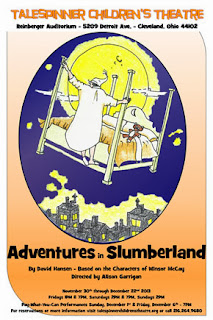
Talespinner Children's Theatre presents Adventures In Slumberland by David Hansen, Nov. 30 - Dec. 22, 2013.

Sunday, November 24, 2013

Little Sammy Sneeze

HE JUST SIMPLY COULDN'T STOP IT
HE NEVER KNEW WHEN IT WAS COMING

http://www.talespinnerchildrenstheatre.org/performances/slumberland.htmWinsor McCay's first successful comic strip for the New York Herald was Little Sammy Sneeze. Like Slumberland's final image of Nemo waking up, the gag here was basically the same. Sammy sneezes, in doing so ruins something, and then he is beaten, kicked or otherwise driven from wherever he has caused his destruction.

Contrary to the subhead -- "he never knew when it was coming" -- he knew when it was coming for a good long while, and so does the reader, it's everyone else who is oblivious for four dialogue-stuffed panels. In one classic strip Sammy sits all alone, and when he sneezes he breaks the panel lines which crash around him. Meta McCay!

There is reference to Little Sammy in Adventures In Slumberland, which opens at Talespinner Children's Theatre this Saturday.

Talespinner Children's Theatre presents Adventures In Slumberland by David Hansen, Nov. 30 - Dec. 22, 2013.

Sunday, December 30, 2012

Little Nemo In Cleveland

Just prior to switching from the New York Herald to Hearst's New York American newspaper, in 1911 Winsor McCay sent Little Nemo, Flip and Imp on an airship tour of the United States, stopping in all the major American cities. Guess where they landed in March? Cleveland!

NEMO: We ought to have a good time here next week! Cleveland is a great city!

In the panel above, we see a photo-realistic image of the Public Square (pre-Terminal Tower) facing east. See the Soldier and Sailors Monument, Superior and Euclid Avenues stretching out to the horizon. If it were not for those three significant landmarks, the place would be unrecognizeable, none of these building still exist and so many were yet to be built. Even the May Co. building would not be constructed for another three years.

NEMO: Cleveland is a beautiful city!

A young volunteer leads Nemo around and shares a raft of statistics. For example:

"Cleveland has three thousand streets; over 300 miles of sewers, an' 200 miles of paved streets. We have sixty thousand dwellings, 18 big hotels, 3000 factories employing sixty-five thousand people! There are seventy-five public schools, 5 high schools, one thousand and five hundred teachers and 60,000 pupils!"

:::Sigh:::

The American Chicle Co. You're welcome.


This post has been updated.

Thursday, December 27, 2012

Little Nemo Meets the Princess

Sunday
July 15, 1906


All the servants of Slumberland have worked for over a year to bring Little Nemo to the Princess to be her playmate.


Their efforts have been thwarted by Flip Flap, jealous of the Princess's affection for Nemo. Just prior to this day Flip was rendered "awake" by Dr. Pill and taken away from Nemo and the Princess who met only briefly before Nemo woke up calling, "Aw mama, can't I sleep a little longer?"


Flip is nephew to the Dawn, and has previously asked his help in waking up Little Nemo.


~~ END ~~

Thursday, November 15, 2012

Flash Gordon (1936 serial)

Warhol, Ming ... and R2-D2.

A couple weeks back, Talespinner Children's Theatre held its 2012 Glam Rock Benefit. Recently the kids and I took in Queen's Flash Gordon Theme music video, and I made a connections between Freddie Mercury's high-pitched "ah-ahs!" and the sheer unadulterated magnificent awesomeness of Max Von Sydow to cobble together some kind of Ming the Merciless get-up, replete with skullcap, dyed beard and eyebrows and green eyeshadow.

DEATH TO MING

Tim reminded me afterwards that the character is another grotesque Asian stereotype, so I feel a little bad about that. But I did win for best male costume. So I got that going for me.

Buck Rogers, a World War I veteran exposed to radioactive gas and hidden in a collapsed mine shaft only to be reanimated five hundred years later, was created in 1928. The success of this popular comic strip character inspired the creation of Flash Gordon in 1934. A dashing young polo player (*snigger*) Flash and his girl Dale Arden are kidnapped by Dr. Hans Zarkov, who is obsessed with finding the origin of great firey meteors that are striking the Earth. They arrive at the planet Mongo, ruled by aforementioned grotesque racial stereotype Ming the Merciless.

The strip more or less follows the adventures of Dale being continually rescued from capture by Ming, and trips to all manner of surrounding planets, defined as all planets are in science fiction by a single weather pattern or dominant animal-inspired lifeform with one, primary emotion (see: Star Trek, Star Wars, and so on.) Sharkman, Hawkman, Lionman, Treeman. You get it.


The first film serial of Flash Gordon debuted in that most-amazing year of 1936. Olympic athlete Buster Crabbe assumed the role of Flash for 13 episodes, and another two serialized series in 1938 and 1940. The video above includes the arrival of Flash, Dale and Dr. Zarkov on planet Mongo, and the introduction of Ming the Merciless. Ming looks pretty stylish for 1936 ... and then he opens his mouth.

Anyone familiar with the 1980 film -- starring not only film legend Von Sydow but also Broadway star Topol, and classically trained British actors Timothy Dalton and BRIAN BLESSED -- might reconsider the "cheesiness" of the costumes and special effects, and appreciate instead the extent to which they created a faithful, cheery modern adaptation of the original short films.

FLASH GORDON:JOURNEY TO GREATNESS BY FLASH GORDON (DVD)

Sunday, July 22, 2012

Bill Watterson on "Little Nemo"

Nemo is reacquainted with 1908 ... and meets 1909.

Winsor McCay's Little Nemo In Slumberland takes place entirely within the subconscious imagination of a small boy during the early 20th century. Only the last panel takes place in what we call the "real" world, or sometimes the first panel -- though sometimes that is hard to tell. Is he asleep yet? Mmmmaybe.

Because it takes place in dreams, Nemo has little control over the bizarre things that happens to him. And bizarre they are. Such a fantastical and graphically exciting landscape of possibilities also make one remember the comic strip Calvin & Hobbes, created by Cleveland Heights resident Bill Watterson.


The difference is, Calvin's adventures are the conscious, wide-awake production of his imagination. But the final panels depicted here are another example of an abrupt, disorienting and humorous (for the reader) reintroduction to the "real" world.

A book of Little Nemo reprints from the late 1990s, The Best of Little Nemo, was sorted by theme and each "chapter"given a preface by, well, every single comic artist who has ever touched my soul -- Watterson, Charles Schulz, Maurice Sendak, Chuck Jones and Art Spiegelman.

An Incredible Ride To the End
An appreciation by Bill Watterson (C) 1997.
from "The Best of Little Nemo"
Published by Stewart, Tabori, & Chang. pg. 195.

"Considering that, in a cartoon, anything can happen that the mind can imagine, the comics have generally depicted pretty mundane worlds. Sure, there have been talking animals, a few spaceships and whatnot, but the comics have rarely shown us anything truly bizarre. Little Nemo's dream imagery, however, is as mind-bending today as ever, and Winsor McCay remains one of the greatest innovators and manipulators of the comic strip medium. Nobody did fantasy like this before, and very few have tried it since.

"To be perfectly honest, however, I admire Little Nemo more than I actually like it. McCay was clearly more interested in his stage than in his actors, and a stage, no matter how grand, can't carry a play. The inventive visual effects notwithstanding, I can't read the strip without thinking how much more enchanting Slumberland would be if the characters, rather than the backdrops and costumes, advanced the story. Regrettably, the characters are cardboard dress-up dolls, devoid of spunk or wit.

"You know something is wrong when a man of McCay's obvious composition and drafting skills draws such pathetic-looking dialog balloons. The balloons themselves often impede the visual flow of the panel, and McCay rarely allowed enough space for the words. Were the words a complete afterthought? At best, the dialog is a series of exclamations and explanations made redundant by the pictures. With the possible exception of Flip, every opportunity to use a character's voice to reveal his personality is squandered, and I think the strip suffers for its unimaginative writing.

"I also find McCay's artwork more impressive in its industry than in its character. McCay's pictures are fancy, but they lack either whimsy or guts. His palaces, cityscapes and boulevards are sterile facades, and his Art Nouveau line keeps everything flat and decorative. Slumberland, like its inhabitants, is more surface than substance.

"That said, the strip is still one incredible ride. Every page is a marvel of design and ornament. The constant invention, the playful distortions, the subtle coloring, the panoramas of architectural splendor...never has another comic strip taken such full advantage of the visual possibilities for surprise. Eighty years after the strip was drawn, it not only continues to delight and awe, but it also provides a long forgotten glimpse of how exciting a comic strip can be."

Huh. "Devoid of spunk or wit ... unimaginative writing ... more surface than substance." In spite of its moments of praise, this is apparently some definition of the word "appreciation" I wasn't previously aware of.

This shirt is pirated.

"Adventures In Slumberland, a holiday play of Little Nemo" is available in paperback and eBook.

Monday, January 23, 2012

Funky Winkerbean (comic strip)

Funky Winkerbean, Dec. 13, 1976

In 1972, Akron native Tom Batiuk (b. 1947) created Funky Winkerbean which was the "high school" comic strip alternative to Doonesbury's "college" comic strip. Before either strip developed characters with any deep sense of personality or history, they were really all about the 1970s experience of attending a school.

Reading Funky every day as a kid (and having a few paperbacks in the house) I was impressed most by Les Moore's getting stuck at the top of the climbing rope overnight, Crazy Harry's living in his locker, the hall monitor with a machine gun (imagine that being funny in today's comics) and best of all, the haplessly unhip teacher who tried to stage a "rap session" with "the kids." She asks what anyone wants to talk about and when one student calls out "SEX!" the teacher develops an unstoppable case of the hiccups.

In general, however, it was a gag a day strip, often groaners, but the deadpan faces of the characters (pre-smirk era) taught me how to, you know. Deadpan.

STUDENT: Can I get a pass to the restroom?
TEACHER: Yes you may.
STUDENT: (deadpan) Good. I need a rest.

Wish I could find that one. It was funny.

Recently found this adaptation of a Winnie The Pooh comic, which best illustrates what went wrong with Funky Winkerbean after its angst-ridden 1992 relaunch:


Whew. Didn't know what was going to happen there. Can't wait until tomorrow.

Sources:
Comic Strip Fan.com
Son of Stuck Funky

Saturday, January 21, 2012

Doonesbury (comic strip)


I drew cartoons before I knew Doonesbury. But only after knowing Doonesbury, did I start drawing comics.

Feb. 10, 1976

M*A*S*H indoctrinated this boy into a philosophy of relativism and secular humanism. Doonesbury taught me character, plot, humor, subtlety, sarcasm, and yes, it was where I got my news. Creator Garry B. Trudeau (b. 1948) may have ruined comic strips forever because of his flat, static drawing style, showing two people talking to each other but never moving (Calvin & Hobbies had great fun with this once) or worse yet, feeling so insecure about his ability to draw actual people realistically that he chose to depict the same drawing of the White House over and over rather than have to draw Nixon.

Calvin & Hobbes

But he also broke ground in what was generally thought of as the controversy-free zone of the comics page; treating drugs as a subject for humor, introducing the first openly gay character in comics, and in 1975, was the first comic strip to receive a Pulitzer Prize.

In Fall, 1976 Joanie Caucus is the campaign manager for her friend Ginny's run for Congress. They are defeated by the Republican candidate, Lacey Davenport, but the upshot is Joan's acquaintance with Washington Post reporter Rick Redfern, who is in California covering the race. After the election, they both let their guards down enough to begin flirting in earnest, and Trudeau created a legendary series of strips which involved Ginny trying to reach Joanie at her apartment.

On Monday we see the phone next to Joanie's unmussed bed ringing, and pan out of the bedroom window, as in a film. The next day we fly from her house, across town, finally zooming into the bedroom window of Rick's apartment:

Nov. 13, 1976

This technique of creating suspense, and taking time to play out a dramatic plot point was unique in the world of daily comic strips. It is not unique anymore, because Tom Batiuk, creator of Funky Winkerbean uses this form over and over again to ploddingly spell out horrible accidents and life-altering mistakes which have no suspense because you knew they were going to happen months earlier when the doomed character in question said, "Another drink wouldn't hurt," or "what's this lump?"

May 6, 2011

Batiuk actually used the same technique here -- exactly the same, in fact -- 35 years later, when Les has sex for the first time since his wife died. Same slow pan, on a house, to reveal an intimate post-coital moment ... only in this case it looks miserable and unhappy.

May 3, 1988

I did use this same technique myself in my daily strip in college, taking a week to illustrate my protagonist's struggle with insomnia.

May 5, 1988

Saturday, October 22, 2011

Howard the Duck (comic strip)


On June 6, 1977 Marvel began publishing a daily comic strip of their hit title Howard the Duck. For almost a year, in addition to the monthly book and additional responsibilities (the legendary KISS comic book, anyone?) Steve Gerber scribed this daily attack on the sensibility of the conservative Plain Dealer reader with his demented commentary on daily American life.

Thank God he had Gene Colan and Val Mayerik to work with, or there would not have been a chance in hell of cramming HTD's signature attention to absurd and gritty detail into those tiny little panels.


Letter to the Editor of the Toronto Star, August 1977:
"The idea of anyone getting one ounce of enjoyment out of (this strip) is more than I can bear ... there is no reason for you to continue printing this strip." - Simon Ives, President, Howard the Duck Hate Club
I am not unfamiliar with hate mail to the editor.

Less than a year later, as Gerber's relationship with Marvel was unraveling, due to his extensive workload, (see HTD ish #16) he was pulled from the book and also the strip. From that point on the execrable Marv Wolfman was given writing responsibilities for both, and illustration for the strip was handled by Alan Kupperberg, whose work is simply horrid.


I have a hazy memory of this guy, a TV character on Channel 8 (I believe) who did the intro to Mary Hartman, Mary Hartman or something, which ran after the 11 o'clock news. He would read that day's Howard the Duck comic strip out of the Plain Dealer like some kind of Mayor Laguardia. If anyone can clear flesh that out for me I would appreciate it.

The comic strip was discontinued in October, 1978 after a sixteen-month run.

Sources:
nemsworld.com