There was this interesting phenomenon in the mid 90s when Gen X so-called “alternative” acts were making this deep dive into our collective unconscious. This was all part and parcel with our generation rising into adulthood and reclaiming (and declaiming) our maimed childhoods.
Weezer’s "Blue" album (1995) includes nods to KISS and Kitty Pryde. Smashing Pumpkins' “1979” is a yearning paean to adolescence. Ben Folds Five reminded me that they’ve got my old ID and I’m all dressed up like The Cure.
Then there was the Canadian quintet Barenaked Ladies. We were first told that their name originated when founders Steven Page and Ed Robertson wanted to create songs that make you feel the way you did the first time you saw a bare naked lady.
I can’t remember where I heard that explanation, but I heard it at the same time I was exposed (yes) to their first LP Gordon, and I got it. It reflected a yearning which is, supposedly, devoid of malice, if only because when you are an adolescent, you are too small and weak to act upon it, to do any harm, you just want. And you want badly.
The problem is, we don’t remain small forever. And like a Stephen King character who transforms from a bullied, spotty nerd into a strong, attractive stud (see: Arnie Cunningham or Harold Lauder) the protagonists of Barenaked Ladies' songs treasure amusingly geeky and nostalgic touchstones. Listen to "Enid," or "Grade 9."
But – as in a Stephen King novel – this arrested emotional development can be a defense for wretched, toxic behavior. Yes, I fell into Gordon as though it had been written for me. From the first strains of "Hello City," which I experienced as a young man trudging through the snow-packed sidewalks of Cleveland, producing and promoting underground theater in a remote storefront, I was lost in these emotions. They get me! They get us! Our crowd is making the music, and it’s really good!
I was also aware of the abuse that is inherent in the lyrics. “I put my hands around your neck / you wrap your arms around me.” It wasn’t subtle, but you know. Guys feel like that sometimes, it’s just a song, you know?
Their second album, Maybe You Should Drive, was released in August 1994, and if I thought their first album was written for me, this one was as though they were stalking me. By that time in my life I was playing an unwinnable game, balancing my relationship with the woman who would soon be my ex-wife with the woman who would become my life partner and the mother of my children.
I love you … intermittently.
A is for asshole, I’m sorry.
She’s my alternative girlfriend.
Jane doesn't think a man could ever be faithful,
Jane isn't giving me a chance to be shameful.
I mean.
For a guy who is not much of a live music guy, I have seen this act more than most. At the Odeon in 1994, Jacobs Pavilion in 1995, at the Lakewood Civic Auditorium in 1996. The second single from their third album, I Was Born on a Pirate Ship (say it while holding your tongue) and released during the Night Kitchen years, was “The Old Apartment.” It’s an aggressive song about a man reminiscing about an abusive relationship – he is the abuser. The music video is incongruous, depicting a young couple trashing an apartment together. But the song is about a violent, abusive man missing his lost love and regretting his behavior. He doesn’t sound changed.
Why is this important? Why has this stuck with me? Because it's not merely cognitive dissonance, this melding of sweet melancholy, loopy humor, and aggressive tendencies. It's not honest, it's gaslighting, making excuses for poor behavior. I'm not a bad guy, look how silly I am, I'm not a bad guy, I said I'm not a bad guy didn't you hear me?? It's Incel Rock.
"One Week" was fun, I remember it being used for the opening of 10 Things I Hate About You. But that was in 1998. By then I was thirty, and past this second childhood, it was time to get serious, to become a man. Ideally, a good man. That is for others to decide.
Nicholas Chokan & James Alexander Rankin "Step Nine" (Give me your keys, 2023)
Last year, James Rankin asked me to write a short play for his new theater project, “Give me your keys.” Specifically, he wanted a piece that could be performed in a bar by two men in their thirties, and by a bar he meant an actual bar. A site-specific piece.
The play I wrote is called Step Nine, an intensely private conversation between two old friends and artistic collaborators who share shameful and complicated secrets. I could have called it You’re So Vain, because of the several people who came to see it performed this weekend, former and present collaborators who thought this play might be about them.
The piece was performed four times this past weekend as part of the BorderLight Fringe Festival, a new and exciting eclectic festival of works produced by artists from near and far. It was a dizzying weekend, and I was delighted to see several other shows but not nearly as many as I would have liked to. And the shows I did attend, most were filled to capacity. There were so many folks downtown for this festival!
Step Nine was set in the Snug at Parnell’s Pub in Playhouse Square, which also happens to be where I celebrated my fiftieth birthday. The Snug is indeed snug, an alcove off the main room, and though the show was free you could say we “sold out” as for each thirty minute performance the place was packed.
James directed the piece, and until Thursday evening I hadn’t even seen a rehearsal. Nick Chokan played one character, the other by three other actors who cycled through the performances, including James himself, Jason Leupold and Luke Brett. They spoke at a conversational level, motivating the audience to lean in.
Folks who arrived late and couldn’t fit into the room craned their necks through the doors, some on Friday night opting to wander away to the bar and instead contribute to the cacophony which had made it hard for them to hear.
“I thought, while watching it, and for long afterwards, whether I could forgive. Whether I can. Whether I should.” - Samantha C.
Standing outside the Snug on Friday night, someone confided it felt inappropriate to bring drinks into a room for a “step nine.” That’s one of the twelve steps outlined by Alcoholics Anonymous where you apologize to those you have wronged. I understand it’s one of the most difficult steps.
Reaction to the piece was very positive. Even when I couldn’t hear the actors (after the first show I stood outside the room) I could hear the laughter. I could see what was happening. And when the performance concluded the applause was loud and generous. But folks also said it was disturbing. I think I need to accept the fact that I write disturbing plays.
This past weekend we visited Athens, Ohio. To celebrate my mother-in-law's birthday. Also, to drop our eldest back at school. A second-year. A sophomore. There is much I could say about my sophomore year at Ohio University. It is enough to say I never accomplished as much as they have their first year, and I lazed away my first summer break from college while they worked and worked and worked. They are my inspiration and my motivation.
I have continued to recuperate from my eye surgery. There are good days and bad. Sleeping remains a challenge. And writing. And reading. I spend a great deal of time on social media, because that is easy. But even my relationship to social media has changed this summer.
July: Deck Time
Last month, someone contacted me via Twitter to let me know they have been made aware that something they had posted on that social media site I have reposted onto my professional Facebook page.
I post all manner of things on my Facebook page, related to playwriting, to spur conversation, sure. But also to generate attention.
However, I don’t know this person. Another playwright, yes. But they are not a famous person. What right did I have to repost their thoughts somewhere else for my own purposes? None at all. It was a mistake. I was wrong. I took down the post and I apologized.
This exchange occurred just as my family was leaving on vacation without me the day before I would undergo surgery on my left eye was extremely helpful. It meant that instead of spending the day feeling sorry for myself, I could spend the day hating myself.
July: Zoom Reading
Feeling sorry for myself means something beyond my control happened to me, that I am a victim of circumstance. And as far my eye is concerned, perhaps that is true.
But I do shit like this all the time. Social media has only enabled me to cast a wider net of people to hurt. Hating oneself, at least, places blame squarely where it belongs.
The ten days I spent on my own I had the chance to do a lot of viewing. I watched Under the Banner of Heaven, completed BoJack Horseman, a friend came over and we watched The Moderns, another joined me to watch Magnolia. Each and every one of these stories are about men who plow thoughtlessly through their lives, only tangentially aware of their own sense of entitlement. Viewing or reviewing them, I was acutely aware of my own failings.
July: College Visit
I have both thoughtlessly and also with intention damaged personal items that were meaningful to my ex-wife. I have ended friendships with one carefully chosen sentence. I have complicated relationships by saying things I should not have said.
I have transgressed. I have been inappropriate. I have failed to return that call. I have pretended to be asleep.
Early in the social media era, long before the #MeToo era, this guy I know posted something on Facebook along the lines of, “If you are a woman I have hurt, I want to apologize.” That was it. I was incredulous. I’m sure I wasn’t alone. No one responded. Because cringe?
August: Birthday Reunion
But, you know, I understood the impulse. We know we have done bad things. We want people to believe we are good. But we’re really not. I wasn’t when I was a sophomore at Ohio University. And also last month. When will I hurt someone next?
This is not really an account of how I spent my summer, except to say that I have been going through some things. Convalescing has provided an awful lot of time to go through them. My final year of grad school begins next week, and I wonder what I will be writing.
Several years ago, we had the opportunity to hear Ben Vereen speak as part of an arts education event sponsored by Cleveland State. Following his address, I met him and had a picture. I told Mr. Vereen that when I was a child, one of my favorite movies was All That Jazz and he gave me the most peculiar look.
All That Jazz is an autobiographical film, directed by Bob Fosse, ostensibly a version of his own life and career -- from his own point of view, of course.
My brother’s copy of the soundtrack album was in constant rotation in our house, all through the year 1980. That was my gateway to the movie, through the music, which I knew by heart well before knowing anything about the content of the film. Snatches of dialogue included on the record, like “It’s showtime, folks!” “Pretty pictures,” and “You can applaud if you want to,” became catchphrases, dropped into conversation among the many young people who frequented our home.
It premiered on cable in the summer of 1981, just as I had turned thirteen, and it was an event screening. A crowd was invited to our place to watch. Here my troubles began.
Roy Scheider & Ben Vereen (All That Jazz, 1979)
The story, in brief: Broadway director Joe Gideon (Roy Scheider) has been courting Death (personified by Jessica Lange) his entire life. He’s overworked, strung out on pills, cigarettes and alcohol, oppressed by his ex-wife and ex-girlfriend, producers, rival directors, and the critics. Through it all, however, he maintains a sense of humor, style, and above all, he is cool.
One very bad lesson this impressionable adolescent took away from the film, aware even then that it was based on the life experiences of the filmmaker, is that your personal life is fair game in the creation of your work.
And not by half -- Ann Reinking, aforementioned ex-girlfriend, plays a version of herself in the movie. How much more permission do you need to use facts from your own deeply personal or intimate moments in your stories, comic strips, plays? You don’t even need to ask permission.
Of course, that makes you a terrible person. But even that’s okay, because you are surrounded by terrible people. But you alone are cool.
Ann Reinking, center (All That Jazz, 1979)
Last summer, All That Jazz was playing on the big screen at the Palace, and I brought my daughter to see it. She was sixteen. I didn’t think the subject matter was more adult than anything she regularly watched on her screen.
Driving home, however, she said, “I don’t know why you wanted me to see that.” I knew what she meant. It doesn’t hold up. I mean, I think it’s hilarious. But in 2019, with my engaged and empowered teenager next to me, I was aware of how toxic the character of Joe Gideon is. How entitled, how arrogant, how terrible he is, to everyone. Unapologetic and manipulative.
It is just another Great Man story, where time and again Gideon (i.e. Fosse) is shown to take bad writing, bad performance, bad situations, and turn them into art. All by himself.
And then there is his long, drawn-out, graphic death. And we have all had enough death in this family.
Since the start of the pandemic, the wife and I have been making our way through TV series. Watched High Fidelity in March or April, very disappointed it won’t continue.
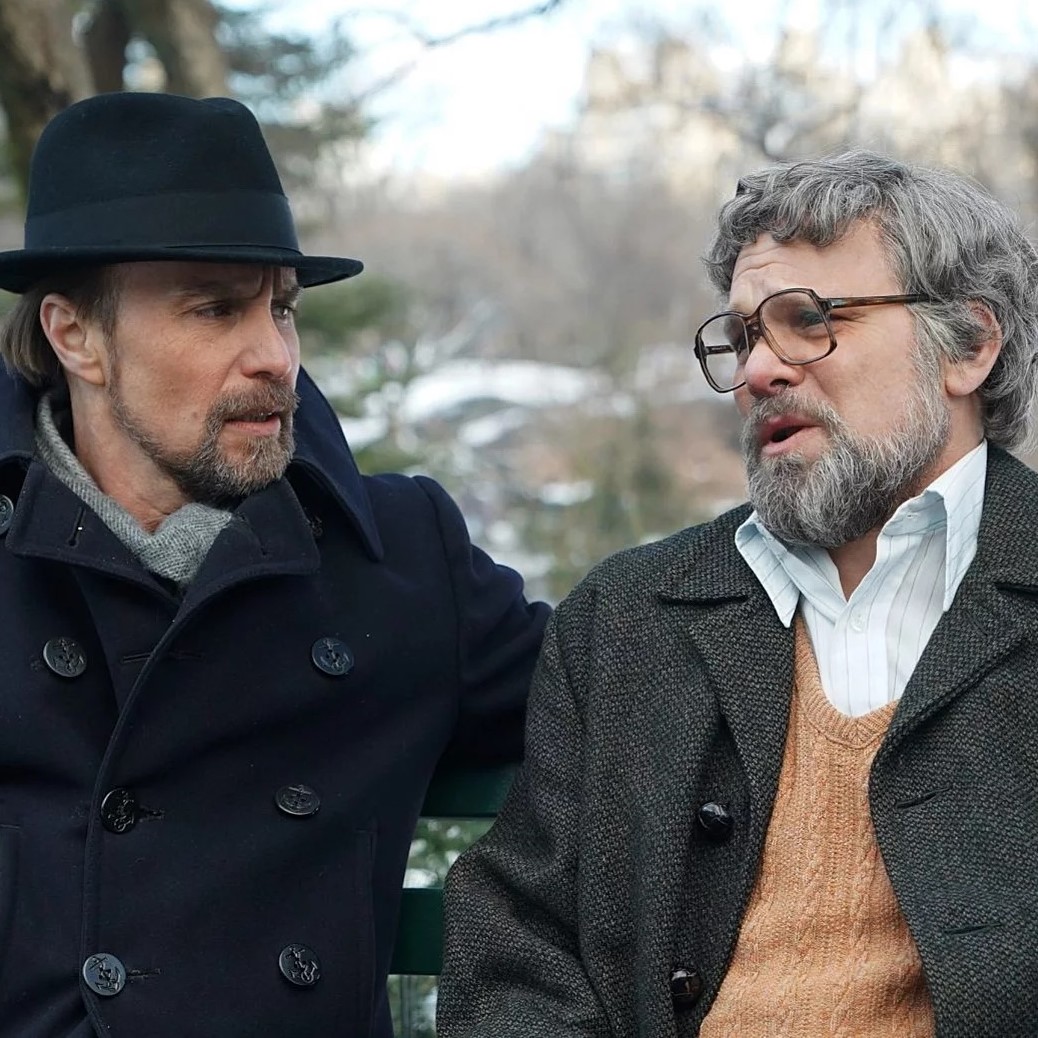
The past two weeks we consumed Fosse/Verdon, a high-profile event from last year, produced by the creative team from Hamilton, with a mission to set the record straight on Bob Fosse (played by Sam Rockwell), to incorporate the story of Gwen Verdon (Michelle Williams), his muse, collaborative equal and partner, ex-wife, and mother of his only child, into his creative legacy, a place where she by all accounts rightfully belongs.
Sam Rockwell & Norbert Leo Butz (Fosse/Verdon, 2019)
The eight-part program also passes judgment on All That Jazz, revealing it to be the flawed, solipsistic, and disingenuous thing that it truly is, Palme D’Or notwithstanding.
In the final episode, which focuses largely on the production of that movie, Fosse’s best friend, writer Paddy Chayefsky (Norbert Leo Butz) provides strongly worded and helpful criticism on the script, prior to production.
“The problem with your movie, Bob, is very simple. Your character doesn’t change. Your hero doesn’t change … none of your characters ever change, which is why your endings are always shit, I say this as a friend.”
This helpful piece of advice, “Storytelling 101,” says Chayefsky, is not heeded. Gideon dies at the end (a full eight years before Fosse himself actually did, in 1987) with everything a mess, his movie, his musical, his relationships, and everyone feels sorry for him. But death is not redemption. It’s just another number. Then Merman starts singing, “There’s No Business Like Show Business,” roll credits. Death is a joke. The ending really is shit.
Sam Rockwell as Bob Fosse Lin-Manuel Miranda as Roy Scheider (Fosse/Verdon, 2019)
The final moments of Fosse/Verdon, which portrays Fosse’s actual death, is just sad. A sixty year-old man has a fatal heart attack on the sidewalk, while his creative and life partner watches, helpless. Sad. That’s the problem with life histories, they always end in death. But the hero still hasn’t changed.
However, let’s back up a bit. In setting the record straight, Fosse is stripped of the cool with which he bestowed upon Gideon. Just-Bob is revealed to be terribly insecure, racked with doubt, and in constant need of emotional and artistic assistance from Verdon, a woman who is driven, determined, and very smart, who herself needs to appeal to the men who hold power -- most notably Bob Fosse -- to achieve her dreams.
She’s not a perfect mother, but Fosse is a horrible father (unlike Joe Gideon, of course) they are each negligent “Ice Storm” generation parents, it’s eleven o’clock and they have no fucking idea where their children are.
Here’s the thing, I really enjoyed Fosse/Verdon. I mean, I would watch both Rockwell and Williams in anything, anyway. It's gorgeous, it's dramatic, it's witty. But in the end, the series felt like a long, drawn out, somewhat depressing version of All That Jazz. Only now we have reasons for toxic behavior.
Sam Rockwell & Michelle Williams (Fosse/Verdon, 2019)
The behavior itself is not excused, but providing reasons, backstory, we do lean into forgiveness. And I am not sure that is warranted.
People without number have been molested as children, emotionally abused by their parents, had difficulty bearing offspring, but who are not themselves reprehensible in their behavior. Some of them are even great artists.
And while this may be the right time to reassess the life and artistic contribution of Gwen Verdon, once again she does the heavy lifting in a program which still feels like its mission is to rehabilitate the reputation of its more dominant, "Great Man" protagonist.
When I was a kid in the late 1970s, my brothers introduced me to a Dungeons & Dragons knock-off called Tunnels & Trolls. Like Marvel at that time still positioned itself as the younger, hipper version of DC comics, T&T was an RPG with an attitude, and a sense of humor which was absent in its rival.
T&T originated out of Scottsdale, Arizona as a mail order RPG where their DMs would play games with folks in far-flung areas by mail. Campaigns took some time, I can tell you. To more easily facilitate game play for those who did not yet have a cohort of players they created the “solo adventure,” like a non-lineal book that took you from one page to another, back and forth, by a roll of the die.
For the record, the first T&T solo adventure, Buffalo Castle, predates the first Choose Your Own Adventure book by at least a year, in case Netflix wants to use that in their defense in the Bandersnatch lawsuit.
The version of Here Be Dragons I have read is a draft version, one currently in process, but it is an exciting concept with a troubling premise, and one I hope the playwright pursues and takes to greater extremes. The “game master” character presents the audience with several opportunities to either alter the outcome of certain circumstances, or to see exchanges from varying points of view, through the use of dice, or other decision-making devices.
The subject is toxic masculinity within the gaming community. The bros have always lorded over alternate worlds (much as they have this one) often with tragic results. My first solo T&T adventure was Lee Russell’s Labyrinth. The cover art features a muscular hirsute Minotaur holding a maiden by the wrist. She is wearing a dress featuring a breast-exposing bodice, and her face is turned away. I first played this game when I was ten.
This is an intriguing narrative, not just about abuse but complicity, and the kind of mania which can overtake an individual when an imaginary world holds more interest, excitement -- and safety -- than reality.