Showing posts with label It Can't Happen Here. Show all posts

Friday, July 29, 2022

Our Missing Hearts (book)

Pengo's 2022 Summer Book Club
“All the King’s Screenwriters, 1946: A drama of how Fascism might even come to this country.”
- Firesign Theatre, "Dear Friends"
First, a quick update on my health; I’m good. It’s difficult to see out of my left eye, which looks like a disgusting bloody mess, but it feels fine, a little sore for the additional use. A friend came over yesterday and we watched Magnolia. Man, does that thing hit different once your parents are dead.

But, okay. So. On June 24, 2022, the day Roe v. Wade was overturned by the Supreme Court, a playwright on Twitter recommended all those who were moved to write about this disastrous historical event concentrate on the future, not the present. Two wit; write about the effects this will have on people in the future, not about what is happening today.

Which is to say, speculate. Speculative fiction.

Recently, my fourteen year-old niece was reading The Handmaid’s Tale, the 1984 novel that surged with attention after the 2016 election and the Hulu television adaptation that followed. Author Margaret Atwood created an America in the not-too-distant future in which conservative politics and a very real calamity in the human birthrate combine to create a nation where women are regarded primarily as chattel for breeding.

If you could imagine such a thing.

The success of her work, and stories like this, is in its believability. It is grounded in a reality based on laws which have passed, behaviors which have been exhibited, things that have happened.

Dystopian fictions like 1984 (1949, or did I just confuse you) are extreme in their depiction of the future and so lean more into the realm of science fiction, with their guesses at future technologies. As if you can imagine a world where there are screens in every room which watch you just as you watch them, or that screaming at one would be limited to two minutes a day.

With It Can’t Happen Here (1935), novelist Sinclair Lewis set the events of an authoritarian America in his present. With Mussolini’s reign firmly established and Hitler on the ascendant, Lewis sought to shake the United States from the naïve assumption that our democratic systems take care of themselves and that we would never willingly elect a tyrant.

Art: Hartley Lin
The New Yorker, July 31, 2022
Philip Roth put a spin on Lewis’s novel with The Plot Against America (2004), a revisionist history in which the charming hero and Christian Nationalist Charles Lindbergh runs for President in 1940 and wins.

Imagining an alternate Roth family based on his own, this tale centers on an American family that suffers under the Antisemitism which, previous expressed in more subtle and one might say normative manner, is unleashed in naked fury by an American populace emboldened by their new leader.

If you could imagine such a thing.

This summer I had the opportunity to read an ARC (advance review copy) of Our Missing Hearts by Celeste Ng, which will be released in October. As described in advance promotional materials, Ng has created an America which has been “governed by laws written to preserve ‘American culture’ in the wake of years of economic instability and violence.” 

Reading this on the beach in North Carolina the the days immediately following Dobbs v. Jackson, in a season when inflation and gas prices may have more effect at the polls than the daily revelations of just how far our former President went to subvert the 2020 election, her work might also have the more immediate title, It Is Happening Here. Or that it has.

It’s the kind of book I would like to imagine being added to the middle school curriculum of every middle school in the nation, if we weren’t living in a land where the reading lists are currently being culled rather than expanded.

Penguin Random House releases "Our Missing Hearts", a new novel by Celeste Ng, on October 4, 2022.

Friday, September 4, 2020

The Plot Against America (HBO)

Ten years ago I wrote this brief reader response to The Plot Against America, today I finished viewing the miniseries adaptation for HBO. Like their recent reinterpretation of Watchmen, HBO has produced another high-concept "alternate history" drama which sings with contemporary importance.

Roth wrote his novel during the Bush era, and was frank about his having been inspired by the run-up to the Iraq War. Little did he know how events would play our during the final years of his own life. Having read the book myself during the Obama years, you can see how affected I was by the lies propogated by the "birther" movement, who sought to delegitimize the President.

And here we are. They did not need to work very hard to create images for this television adaptation which put one in mind of the Unite the Right rally in Charlottesville three years ago, and city streets in Minneapolis, Portland, and Kenosha.

What I did not mention in my decade-old blog post was how disappointed I was with the conclusion of Roth's book. Lindburgh flies to Berlin, a special election is called, FDR wins, and history as we know it continues. It is all too pat, too sunny.

This adaptation has a superior ending, and one which leaves me chilled. We hear Sinatra's rendition of The House I Live In, a lovely call for American tolerance and acceptance, and see people of all walks of life coming together to vote for a President.

We also see men in black removing voting machines from precincts, claiming they are broken, and white men burning ballots in abandoned fields. The Plot Against America program debuted on March 16 of this year, as the country was shutting down for the pandemic, and before the President began his most recent agenda, casting doubt on our elections and dismantling the post office.

It is far too late to suggest that it can't happen here.

Wednesday, June 26, 2013

Around Noon

Dee Perry and I producing the radio drama
adaptation of"I Hate This" for Around Noon (2005)

This Friday, June 28, 2013 will be the final broadcast of WCPN 90.3 FM's award-winning, northeast Ohio arts and entertainment program, Around Noon. The good news is that Dee Perry and her crew are moving to the 2 PM time slot, Monday through Thursday, with a new program called The Sound of Applause.

I guess this is a thematic melding of WCPN and the PBS station WVIZ and that station's long-running arts show Applause, which has been hosted by Dee since the two stations merged into Ideastream in 2001.

Change can be good. And people can complain. I remember when WCPN made the radical switch from largely jazz programming to mostly news and talk in the mid-1990s, and what a fuss people made at that time. It was forward-thinking, however, and as much as I am sick of talk radio, the NPR programs broadcast on WCPN and locally produced shows like The Sound of Ideas do provide for moderation and common sense discourse which is unavailable elsewhere.

And then there was Around Noon. I remember when I was public relations director at Dobama Theatre, and were were first contacted by the program in early 1997. I mean, they contacted us, looking for stories and interviews, because this was going to be a daily, hour-long radio program about arts and culture in the region. Usually it was me, begging attention from the print media, which even then, with two weekly papers and a full-functioning daily, appeared to regard arts coverage as some kind of charity work.

Cleveland Historian John Vacha and I chat with Dee about "It Can't Happen Here"
October 24, 2011

This was unique, this dedicated arts reporting, and it still is. It is a shame that in order to accommodate the new schedule they must drop their Friday shows (and for Ira Flatow of all people, I can't even listen to him) especially as they fall right before the weekend. But it's a gift, and in today's media climate, the people of greater Cleveland are lucky to have it.

Today is my wife and my fourteenth wedding anniversary (ivory, sweetheart, we'll skip the presents) but on our fifth anniversary (June 26, 2004) we joined 2,700 of our friends in getting naked in the shadow of the Steamship Mather for photo installation artist Spencer Tunick, and we worked with the folks at Around Noon to make an audio diary of the entire event. How cool is that?


Spencer Tunick: The Naked Truth

Best wishes to Dee and to the producers of The Sound of Applause, for many, many more years of excellence in arts reporting.

Thursday, November 3, 2011

It Can't Happen Here (The Final)


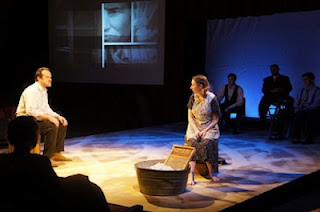
Cleveland Public Theatre hosted the Cleveland staged reading of "It Can’t Happen Here" on Monday, October 24, 2011. The event was directed by David Hansen and featured Case Western Reserve University adjunct professor John Vacha, author of "Showtime In Cleveland," the definitive history of Cleveland theater.

The company represented a cross-section of regional, professional theater. Dremus Jessup was performed by Dr. Michael Mauldin, head of the Cleveland State University theater department. Mary Greenhill was read by Cleveland Play House Associat Artistic Director Laura Kepley, and Dr. Fowler Greenhill by Ms. Kepley’s real-life husband, acclaimed playwright George Brant. Company also included Great Lakes Theater actor-teachers Brian McNally and Tim Keo, Cleveland Public Theater Associate Artistic Director Elizabeth Wood, as well as local professionals Myles Byrd, Mark Cipra, Elisa Hanna, Hester Lewellen, Brian Pedaci and Lew Wallace.

This reading, free and open to the public, was attended by 50 audience members. The evening opened with a “curtain raiser,” a reading of a ten-minute comic scene from David Hansen’s "Cleveland Centennial." This brief “Living Newspaper” style scene describes a fictional backstage account of the actual opening night of "It Can’t Happen Here" in Cleveland in 1936, but also includes actual quotations from Hallie Flanagan, Sinclair Lewis and local and nation critical response to the production. Presenting this scene was an entertaining way of providing historical context of this event to that evening’s 2011 audience.

Following this, John Vacha shared a 5-minute presentation including slides from opening night of the Cleveland production at the Carter Theatre at East 9th and Prospect. The full “September, 1936” version of "It Can’t Happen Here" was read with one, ten-minute intermission. Read with intensity, speed, humor and pathos, the running time of the reading itself was less than two hours, playing something like a “radio drama.” After the reading was concluded, Hansen and Vacha fielded a few questions from the audience. Some familiar with the book pointed up differences between that and this stage version, and asked if any changes had been made to make the story take place in Ohio (there were, as was done for the Cleveland production in 1936.) They wanted to know how successful the Cleveland production of "It Can’t Happen Here" was (it was very successful, and only closed because of scheduling.)

Response to the play itself was very, very positive. Many were impressed at how topical the script remains, and asked if there were any plans for a fully-staged production.


Earlier in the day Hansen and Vacha were interviewed on the local NPR affiliate, WCPN.

Monday, October 31, 2011

Waiting For Lefty (2011)

The People's Theatre is not aligned with any political party. That is the euphemistic way of saying that it is not Communistic, and its organizers wish you to be clear about that. - William F. McDermott, The Plain Dealer, 1935
When I moved to Cleveland Heights we had three theaters. Name me another American suburb that can boast having three theaters. Well, anyway, time passed and by 2005 we had none. Ensemble lost their lease at the Civic, Dobama had been evicted from Coventry, and like all things Jewish, the JCC had moved from Cleveland Heights to Beachwood.

The new Mandel Jewish Community Center has many exciting new features, but theater? Eh, not so much. Dobama managed miraculously to maintain an identity in the wild before returning to the Heights at their fine new home in the CH-UH Library complex. And Ensemble has carved a new home out of the former Coventry Elementary School, and a really great space it is.

Two out of three? Not bad.

This afternoon I caught the closing performance of Ensemble's production of Waiting For Lefty, the first show in this new theater space. Life has not been kind to my wife's extended family the past several weeks, and in spite of wanting to catch numerous productions this fall, several closed this weekend without an opportunity for us to see them. At least I could catch this 70-minute program in my own backyard.

Seated in the front row, I invited Mike Partington to take the chair next to mine. It had been years since we had had the chance to talk, and this week I saw him both at Harvey's Tribute and in this place. Mike's got some years on me, our pre-show conversation had a lot to do with theater space, how he first reacted to the new Bolton Theatre at the Play House -- same as almost everyone else, really, stunned that they had dumped a thrust stage at East 77th Street to add yet another proscenium.

Ensemble Theatre has a thrust, with seating sections on three sides. It feels more like the old Dobama on Coventry than the new Dobama does. The platform stage is so close to the audience, and actors make entrances and exits through the house as well as through the wings. I love that.

I was very pleased to see such a large audience on a Sunday afternoon. Sunday matinees are notoriously depressing in Cleveland, with maybe ten to twenty people in the house. It was quite a full house!


So. First time seeing Waiting For Lefty in its entirety. How does it hold up? Interesting! While employing period costumes and some kind of non-specific tough-guy New Yawk accents, the Ensemble production utilized their large video screen to bridge scene changes with footage and music from the future (HUAC testimony, Occupy Wall Street demonstrations) to empasize the continuing resonance of the work.

Remember: The Living Newspaper performances of the 1930s did use film projections and live music to bridge scene changes, and as commentary!

However, having just directed a staged reading of It Can’t Happen Here, I have been disabused of the notion that writing from the 1930s is dated, or must feel dated. Sinclair Lewis words, spoken by a contemporary cast, was suprisingly fresh, meaningful, humorous and resonance with our modern audience last Monday night. People were taken with the story, and moved by its conclusion.

A friend who caught the show reflected how much more slangy Lefty is, which explains why it is seems dated. Also, there’s no real story to be swept up in, it is a collection of vignettes on a common theme. It’s like Saturday Night Live without punchlines.

But that’s not the real problem with its presentation as a contemporary work. It’s one long debate, more like Greek drama than soap opera. For example, the tale of a young suitor, on a perfect summer’s evening, breaking up with his devoted gal because he can never be the man that she deserves in this economy, where the bosses and the company men keep the worker under his boot, where a guy can’t earn a crust while Uncle Sam stands idly by, doing as little as possible because the truth is The Man still mans the controls of government and always will, so the little guy is left to gasp meekly for dignity - let alone a dollar, and its high time we pulled together and rose up to demand what is coming to us, an eight hour day, a pension and a heart handshake, but until that day comes I will never be the kind of joe who can care for a girl the way she deserves to be treated, and not like some two-bit floozy, always promising, never committing, I mean what kind of life is that for a young American lady? The Masters of Power don’t care about these things, the velvet-gloved capitalist executive sees the workers as an endless supply of hands and muscle to hoist the gears that make the things that fill their endless, bulging pockets …

Hey, baby, where you going?


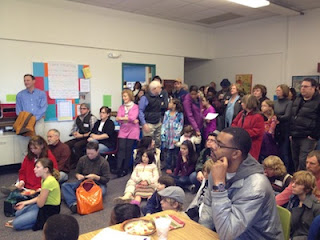
After the performance, the audience was invited into another part of Coventry Elementary (wait, do we have a name for this new community facility concept?) for a special event celebrating the opening of Lake Erie Ink.

What's that, you say? So glad you asked! It's a drop-on center for area youth with an emphasis on creative writing! HOW AWESOME IS THAT??? It's like an 826 Valencia for Cleveland Heights. I mean, it is an 826 Valencia for Cleveland Heights.


And wow-man-wow, there were a lot of people there! Cleveland Heights Poet Laureate Cavana Faithwalker represented, and world-renown hipster-shaman-beatnik-poet Ray McNiece was on hand to lead children in poetry exercises. There were a number of writing activities for young and old, I wrote a haiku on a paper pumpkin:

WORKERS THEATER
JUST SAW ‘WAITING FOR LEFTY’
LIKE AN UPPERCUT


Hey! You! Douchebag in the hat!

See also: Waiting for Lefty (1935)

Monday, October 24, 2011

History Repeating

This week, 22 theaters (see listing below) in the United States and Great Britain will present It Can't Happen Here in celebration of the 75th Anniversary of its debut on October 27, 1936 in 21 theaters across America as part of the Federal Theatre Project.
 
I am very glad to say that Cleveland, one of the original cities to present this work, will be represented.

TONIGHT! FREE AND OPEN TO THE PUBLIC! Seriously, no reservations will be accepted, please come to Cleveland Public Theater tonight at 7 PM for all the fun. We will begin with a brief, ten-minute play I wrote about backstage jitters prior to the opening night at the Carter Theater at East 9th and Prospect (fiction) and critical and popular reaction to the production (non-fiction.)

Also featured will be Cleveland historian John Vacha, to share images from the original production and special insight into the Federal Theater Project.

Then the main event, a staged reading of the drama as written by Sinclair Lewis and John C. Moffitt for the 1936 productions. If you have ever seen or read the dramatic version of It Can't Happen Here, you most likely have not read this one. He rewrote the entire thing for a professional (non-Federal Theater) production two years later, and that is the one available through Dramatists Play Service.

I am extremely pleased with the company for tonight's reading, some of my favorite performers in Cleveland, from many different Cleveland area theaters.

Even more important, I am more impressed with the script, now that I have heard it read aloud by professionals. I think this play would have seemed hopeless dated fifteen years ago, but now I am no longer sure. There are certain passages that fill me with a great deal of unease. 1936 was a turning point in the Great Depression, FDR was up for reelection and there were those who feared he had gone too far -- and the unequaled landslide victory he received a week after the premiere of this play I am sure made some feel even more concerned about one man having too much power.

Tomorrow Vacha and I will appear on WCPN's Around Noon, which will feature the performance of a scene which includes this passage; young Julian Falck has joined Presidential candidate, Senator Buzz Windrip's band of Corpos, who act as Windrip's own corps of Brownshirts:
Julian
I've worked exactly four months during the past year --and that' s better than most of my classmates. Youth today isn't asking for a cinch or looking for glory! Youth is yelling for a job! And the Corpos will find one for me! They'll tell me what to do, and they'll feed me! They'll shake off this bungling "Democracy" and order things so that we'll get a living. When that happens -- I'll get a sweet, wholesome girl, and stop playing Romeo to a vacant balcony. We're not bandits! We're realists. We're through sitting around being Parlor Pinks. We're working together -- behind Buzz Windrip, the Man on Horseback.
Tea Party or Occupy Wall Street? A little bit of both. Not sure I can tell.

Be there.

IT CAN'T HAPPEN HERE - NATIONWIDE READING

Sponsoring Theatres:
Dell'Arte International, San Francisco Mime Troupe
Consideration provided by:
Dramatists Play Service, New York

SCHEDULE OF CONFIRMED READINGS

MONDAY, OCTOBER 17th - 7:00 pm


The Living Theater in collaboration with the Accidental Repertory Theater
... The Living Theatre, 21 Clinton St., NYC

SUNDAY, OCTOBER 23rd - 7:00 pm


presented by Burning Clown Productions in concert with the Workshop Theater Company
Ellington Room, Manhattan Plaza, 400 W 43rd St., 2nd Floor, NYC

MONDAY, OCTOBER 24th - times vary (see each listing):

San Francisco Mime Troupe - 7:00 pm
855 Treat Ave., San Francisco CA

Cleveland Public Theatre - 7:00 pm
6415 Detroit Ave., Cleveland OH

Bruka Theatre - 7:00 pm
99 N. Virgina St., Reno NV

Mitchell Theatre, Vilas Hall - 7:00 pm
University of Wisconsin - Madison, WI

Museum of History & Industry - 7:00 pm
presented by Global Works
2700 24th Ave. East, Seattle WA

Syracuse University Drama Department - 7:00 pm
Archibald Theatre, 820 E. Genesee St., Syracuse NY

Spotlight "Still Got It" Players - 7:00 pm
Village Theatre at Cherry Hill
5400 Cherry Hill Rd., Canton, MI

Atlantic Stage, 79th Avenue Theatre - 7:30 pm
900 79th Ave N, Myrtle Beach SC

Great Basin College - 7:30 pm
1500 College Parkway, Elko NV

Dell'Arte International - 8:00 pm
Carlo Theatre, 131 H Street, Bluelake CA

Random Radio People broadcast - 8:00 pm
KMUD radio 91.1 FM

The Blank Theatre's Living Room Series - 8:00 pm
2nd Stage Theatre, 6500 Santa Moncia Blvd., Hollywood CA

The Desert Rose Playhouse - time TBD
6921 Montgomery Blvd. NE, Albuquerque NM

Le Petomane Theatre Ensemble - time TBD
Iroquois Ampitheater, 1080 Ampitheater Rd., Louisville KY

The Rogue Theatre - time TBD
300 E. University Blvd., Tucson AZ

The Ghost Road Company & Trade City Productions --7:30 PM
The Village Green Clubhouse
5300 Rodeo Road, Baldwin Hills, CA 90016 www.facebook.com\ghostroadcompany

Fuse Theatre Ensemble--7:30 PM
Arena Stage, Theater
Portland, OR

TUESDAY, OCTOBER 25th - 6:30 pm

Locust Productions, Kirkwood Theatre
400 Walnut St., Des Moines IA

WEDNESDAY, OCTOBER 26th - 8:00 pm

The Antaeus Company, DeafWest Theater
5114 Lankershim Blvd., North Hollywood CA

THURSDAY, OCTOBER 27th - 1-6 pm (GMT)
ARTEL (American-Russian Theatre Ensemble Laboratory), Leeds
Alec Clegg Studio, Leeds, UK

Saturday, September 17, 2011

Federal Theatre Project In Cleveland

Triple Bill: A Little Fowl Play, No Left Turn, United We Sat (Repertory Unit, 2/29/36) The Living Newspaper (Repertory Unit, 3/11/36)
Mississippi Rainbow (Negro Unit, 4/18/36)
Marionette Show: Three Wishes (Children’s Unit, 5/15/36)
Triple-A Plowed Under (Repertoy Unit, 6/2/36)
The First Legion (Repertory Unit, 6/24/36)
Double Bill: End of the Row, Soul Gone Home (Negro Unit, 6/27/36)
The Trial of Mary Dugan (Repertory Unit, 7/20/36)
Conju’ Man Dies (Negro Unit, 8/12/36)
The Bad Man (Repertory Unit, 8/17/36)
R.U.R. (Repertory Unit, 9/7/36)
Noah (Negro Unit, 10/5/36)
It Can’t Happen Here (Repertory Unit, 10/27/36)
Nathan Hale (Repertory Unit, 2/17/37)
Chanticler (Repertory Unit, 3/13/37)
Chalk Dust (Repertory Unit, date unknown)
The Emperor’s New Clothes (Federal Theatre for Youth, 4/24/37)
Sir Frog Goes A-Travelin’ (Federal Theatre for Youth, 10/1/37)
Shepherd In The Distance (Federal Theatre for Youth, 11/17/37)
A Christmas Carol (Federal Theatre for Youth, 12/6/37)
Remember The Day (Federal Theatre for Youth, 2/27/38)
The Ivory Door (Federal Theatre for Youth, 8/25/38)
Pinocchio (Federal Theatre for Youth, 10/14/38)
Twelfth Night (Federal Theatre for Youth, 3/28/38)

The Federal Theatre for Youth was based at 1224 Huron, and 2362 Euclid Avenue.

Source:
Cuyahoga Community College, Cleveland Festival of the WPA, 1992 (John Vacha)
George Mason University Libraries

Friday, September 2, 2011

Friday, August 26, 2011

Artist McGaw Sketches Federal Players

"It Can't Happen Here"
Cleveland Press, Wednesday, October 28, 1936
Artist: John McGaw


... why does everyone look so creepy?

Tuesday, August 23, 2011

"Doremus Jessup can never die."


Be a Corpo! Kick the crap out of somebody.

Now, if you have read the stage adaptation of It Can't Happen Here, you have most likely not read the one which was performed by the Federal Theatre Project as part of a cross-country effort to open the same show on the same night - October 27, 1936. That version was co-authored in great haste by Sinclair Lewis and John C. Moffitt. Lewis was unhappy with the outcome, and revised the script for publication.

Lewis' 1938 version (available from Dramatists Play Service) has sixteen characters, performed in six scenes spread across three acts.

The original 1936 version, presented in Cleveland at the Carter Theatre, features no fewer than 27 names characters as well as numerous extras, performed in fifteen scenes - most of them entirely different sets.

It is this version, one entirely impractical to stage as a full-production but entirely within our means as a staged reading, that we will present on Monday, October 24 beginning at 7 PM at the Cleveland Public Theatre.

At first I thought, what the hell, just do the later version. It is a tighter script, no doubt. But there are several strong artistic and practical reasons to stage the original version.

First of all, what a unique experience! An historic occasion deserves a little reach.

Second, it doesn't matter that there are more actors, a staged reading is easily double-cast.

Third, the revised edition streamlines the course of events, but leaves out a great deal of outrageous detail, including the decent into madness of President "Buzz" Windrip, and the fate of Pastor Paul Peter Prang, a character loosely-based on (or entirely meant to represent) Father Coughlin.

SPOILER ALERT

But the real selling point for me is the ending. The 1938 edit leaves Doremus Jessup and Eppingham Swan face to face, each certain to die very shortly, but a shining ray of hope hanging over the proceedings as his daughter and grandson safely pass into Canada. The original version was much more dire, with Jessup escaping a concentration camp to an unknown fate while the imprisoned Prang prays over the dying form of a fellow inmate, while at the same time its Jessup's daughter Mary who holds the gun on Swan, allowing her boy to escape.

The 1938 revision is more Hollywood. The original 1936 version is much more interesting, inspiring, and non-traditional, and by that I mean less obvious macho bullshit. The original script is a big, beautiful, sprawling mess. And I think it's better that way. And that's what we're going to do.


Sources:
All images from one of the New York City productions of "It Can't Happen Here," 1936.
Franklin D. Roosevelt Library & Museum

Saturday, August 20, 2011

It Will Happen Here


1936 Cleveland Production, Carter Theatre

Last week the good folks at Cleveland Public Theatre were appraised of a special event with Cleveland historical significance -- theaters around the nation are celebrating the 75th anniversary of the Federal Theatre Project’s nationwide opening of It Can’t Happen Here, the stage adaptation of the 1935 best-selling novel by Sinclair Lewis.

Brief background: The prove the scope of the Federal Theatre was capable of, and of its organizational abilities, it was suggested that a large number of participating theater across the nation open the exact same play on the exact same night. Why this particular play?
“Because it is a play about American life today, based on a passionate
belief in American democracy.”
- Hallie Flanagan, Federal Theatre Director
Enough said. The synopsis is simple enough; the good people of the United States, in dire economic straits, elect an attractive, populist senator as
President of the United States, who immediately begins a number of social programs which we might recognize as Fascist (see: Mussolini, Hitler.) Newspaper are closed, unions are centralized by the federal government. The entire story is told from the perspective of a small town in Vermont, and how these changes affect the citizens there.

In presenting the work is 21 different theaters in 18 cities across the nation, each theater was encouraged to adapt the work to their locale, so long as the design did not strain to emulate specific persons or political parties.
“Avoid all controversial issues … Our business is wholly a job of theatre.” - Federal Theatre Policy Statement
Good luck with that.

It Can’t Happen Here opened on October 27, 1936 in Cleveland at the Carter Theatre (redubbed “Federal Theatre”) at East 9th and Prospect in downtown Cleveland, kitty-corner from the Gateway, exactly where Marvel/Disney has been blowing up cars and buildings just this past week. The run was so successful it was sold out for three weeks and only closed because a children’s puppet show was scheduled to take its place in December.

Last week Cleveland Public Theatre contacted me to direct the staged reading scheduled for Monday, October 24, 2011 to celebrate this anniversary, and I was only too happy to get involved. I will provide details of the event as it develops.

This reading will be free and open to the public.


Photo from the Cleveland production.

Tuesday, January 18, 2011

Poster


Wow. Don't know how I missed this.

Source: Special Collections & Archives (SC&A), George Mason University Libraries

Wednesday, November 3, 2010

The Harvard Club Raid

Federal Bureau of Investigation
John Edgar Hoover, Director
May 12, 1936

MEMORANDUM FOR THE DIRECTOR

Re: Police Corruption in CLEVELAND, OHIO.

On January 10, 1936, the Prosecutor's Office of Cuyahoga County, Ohio, raided the Harvard Club. The Bueau has made no independent investigation concerning this raid, but slippings from the January 11, 1936 issue of the Cleveland Press discloses that John Sulzman, Sheriff of Cuyahoga County, took no part in the raid; that the County Prosecutor enlisted the cooperation and aid of twenty-five private detectives and armed with search warrants endeavored to serve such warrants at the Harvard Club.

They were met with formidable resistance, however, by Jimmy Patton, who threatened to "mow down" the raiding party with machine guns and held the raiding party at bay for six hours, during which time all the gambling equipment at the Harvard Club was moved away by trucks. It was finally necessary for the Safety Director of Cleveland to proceed to the Harvard Club, located just outside city limits, with a party of policemen to gain entrance to the Club.

This action was necessary because the Sheriff, when called by the Prosecutor's raiding party for aid, refused to send assistance, even though his office was notified that the Prosecutor's raiding party had been threatened with machine guns. It is evident, therefore, that the proprietors of the Harvard Club were closely connected with politicians and those in power in Cleveland.

It is desired to point out particularly the "hard boiled" attitude assumed by James "Shimmy" Patton, who threatened to "mow down" the raiding party. The newspapers setting forth this information are probably correct in the attitutde which was assumed by Patton as well be shown herein below:

[[TWO PAGES ARE REDACTED]]

On February 24, 1936, Mr. W.G. Harper, Operative in Charge of the United States Secret Service, Treasury Department, Cleveland, Ohio, was interview by Special Agent [[redacted]] Mr. Harper stated that when the Harvard Club was closed by the local authorities information is to the effect that the raid was so planned as to give Elliot (sic) Ness, recently appointed Safety Director of Cleveland, a political buildup.

The Cleveland newspapers have given a great deal of publicity to the raid and to the fact that Sheriff John M. Sulzmann refused to come to the aid of County Prosecutor Frank T. Cullitan, when Cullitan found it impossible to gain entrance into the Harvard Club. A news item appearing in the Cleveland Plain Dealer, dated January 11, 1936 is quoted as follows:
"For nearly six hours last night operators of the Harvard Club held County Prosecutor Frank T. Cullitan, his staff and twenty special constables at bay after they appeared at the expensive gambling resort in Newburg heights to raid it simultaneously with a surprise attack on the Thomas Club in Maple heights, which yielded without resistance.

From sunset until nearly 11 last night the prosecutor and his force of men were repulsed by threats from the operators of the Harvard Club to 'mow down' the constables with machine guns if they tried to batter in the doors.

The Harvard Club was stormed only after Safety Director Eliot Ness, acting, he said, 'as a private citizen,' took several police squads to the prosecutor's aid.

Cullitan pleaded in vain for help from the city police department and from Sulzmann, the country's chief law enforcement officer."
Entrance having been finally gained after a six hour seige, the prosecutor and his deputies found that all of the gambling equipment had been removed by the aid of trucks. The paper goes on to state that after entrance had been gained "Hebebrand and his aids walked into the money-counting room of the club on the pretext of getting their hats and coats, and escaped by climbing through a small window near the roof of the resort, and dropping ten feet to the ground outside."

The paper continues -
"A few minutes later Sheriff Sulzmann, ill in bed at his home, sent word to Cullitan, the prosecutor said, that he would not send aid or protection unless it was requested by Mayor Jerry Sticha of Newburh Heights, 'in accordance with my home rule policy.' Cullitan had previously tried time after time to reach Sticha at his home, but was told he was not there.
The paper gives the following details concerning the raid:
"Patton (James "Shimmy" Patton who is well known to this Bureau) cursing profusely, rushed toward Cullitan. Cullitan tried to accomplish his task peacefully.

'Anyone that goes in there,' Patton cried, 'gets their _______ head knocked off. You've got your _______ home at stake and we got our _______ property at stake.'

'I've tried every decent way I could --' Cullitan began.

'No, you haven't,' Patton broke in.

'This is my job to close this place,' Cullitan said.

'Why don't you quit your job?' Patton shot back.
The Cleveland News, dated January 11, 1936 stated as follows:
"Mr Cullitan also had 'nothing to say' when asked if he would take any action against village officials who allowed gambling joints to operate so openly in violation of law."
The Cleveland Plain Dealer, dated January 14, 1936 quotes Eliot Ness, Safety Director, as follows:
"'I did not know Sheriff Sulzmann excepting through the newspapers,' Ness said. 'I haven't met him yet, but I consider I know him thoroughly since his refusal to send deputies to the aid of County Prosecutor Cullitan.'

'When John Flynn, my assistant director, went to County Jail he found six deputies just sitting -- perhaps waiting for the millennium. He got no satisfaction from Jailer Murphy. Neither did I. We both pointed out Mr. Cullitan's plight, and we both got the answer: 'The sheriff stands by his home rule policy -- he must request from the mayor of Newburg Heights.'

'It Can't Happen Here', the title of one of our best sellers, would be true locally if applied to the sheriff rescuing the prosecuting attorney. Hence the recent raids became news here, although they would not have been news in many cities.

'I want to say seriously to you and to all of the better element, that we must have the public with us. That means good citizens must not neglect their full duty.'"
The above quotation was taken from a speech given by Eliot Ness at the Cleveland Athletic Club before the Odovene Club, composed of Ohio Wesleyan University Alumni.

That the raid conducted by Frank T. Cullitan is alleged to have its political aspects is shown in a news item appearing in the Cleveland Plain Dealer dated January 29, 1936, which is quoted as follows:
"County Prosecutor Frank T. Cullitan's recent raid on the Harvard and Thomas Clubs was described last night as a plot 'cooked up' by an assistant county prosecutor to embarrass Sheriff John M. Sulzmann's campaign for Congress in the Twentieth District and to benefit Congressman Martin L. Sweeney."
The news item goes on to state:
"The ward leaders voted to endorse Sulzmann for Congress and to call a meeting next week of the 277 precinct committeement in the district to submit Sulzmann's candidacy to them."
For your information Sulzmann was defeated in the primaries.

News items appearing in the Cleveland newspapers are very laudatory of the appointment and conduct of Eliot Ness as Public Safety Director of Cleveland. He was particularly praised for his action in assisting County Prosecutor Cullitan, "as a private citizen" during the raid on the Harvard Club. News items have also stated that numerous raids are being conducted by police squads in an effort to clean up gambling conditions in Cleveland.

The Cleveland News dated January 11, 1936, refers to Ness as follows:
It was Mr. Ness who, when Sheriff Sulzmann, from his sickbed, refused to send aid to Cullitan, took the bull by the horns and led 33 Cleveland police officers and men to the Harvard Club to protect Cullitan from possible violence."
Referring to Cullitan the same paper states:
"The prosecutor, his job of closing the two notorious gaming resorts done, offered no criticism either of Sheriff Sulzmann's refusal to help, or f the lethargy of Newburg Heights and Maple heights officials in failing to close the clubs."
Referring to Eliot Ness' move to clean up conditions in Cleveland, the Cleveland News dated January 9, 1936 is quoted as follows:
"On orders from Safety Director Ness a meeting of policy operators was called by Deputy Inspector Frank W. Story at the E. 35th St. - Longwood Ct. police station Tuesday night.

'Fold up of your own accord or we will fold you up,' Inspector Story told them.

Along lower Scovill Ave., once the most open vice district in the city, officers are visiting houses and ordering all transient girls to move out of the city. Only those who can provie their legitimate homes are in the houses are being permitted to remain.

Bookmakers still exist, doing a curb or telephone business, but the gambling resorts have disappeared. Gamblers who prospered in Cleveland last year are reported to have either left town or to be making plans to heads for other cities where the law enforcement is more casual.

The order has gone out for the cleanup.

The police department knows Director Ness means business."
In praise of the work of Safety Director Ness the Cleveland News of January 11, 1936 carries and editorial containing the following:
"While we're cherring, let's fill the air with three long hurrahs and nine sharps rahs for Eliot Ness."
Respectfully,
K.R. McIntire.
Source: Federal Bureau of Investigation (FOIA)

Friday, October 1, 2010

Orson Welles

"I accept direction from one person...under protest."
George Orson Welles (May 6, 1915 – October 10, 1985) was born in 1915 in Kenosha, Wisconsin and immediately began directing Shakespeare. The product of what used to be called a "broken home" he was raised by a family friend, spent a great deal of time in private schools, and once ran away from home at age ten with the daughter of his guardian to be found with her days later singing and dancing on a street corner.

His alcoholic father died when he was fifteen, gaining a small inheritance which he used to travel to Europe where he lied about his credentials and began acting professionally. Returning to America he made a living as a radio actor, married an actress, fathered a child, and was chosen by John Houseman to perform for the Federal Theatre Project. Then he had his twentieth birthday.

His sensational FTP production of Macbeth went on tour following its New York run, visiting Cleveland in Fall, 1936. Much was made in the press when he recast the title role. Though Welles had bonded with former lead Jack Carter, the actor's drinking made sending him around the country a non-issue, and Maurice Ellis was given the role. In Indianapolis, Evans was too ill to go on and Welles flew out to assume the role in blackface.

The Cleveland performance must have been in the Carter Theatre (the address in the News was East 9th & Prospect in the "Federal Theatre") just prior to the run of It Can't Happen Here.

Monday, August 23, 2010

When Roosevelt Is Dictator - And How!


What I had hoped would be a mcguffin has turned into a red herring. What a boondoggle.

Headed back from NYC, I chronicled my success in finding a rare and unusual artifact in the microfilm stacks at the NY Public Library. Entitled When Roosevelt Is Dictator - And How! (A Fascist Prophecy) and published in January 1936, I thought I had found a document which would clue me into the left-wing school of thought that FDR was not only not the Socialist he was accused of being, he was actually a little Mussolini, seizing unparalleled power from the other branches of government.

I don’t actually need a pamphlet to spell out how that thinking might go. But a period expression of such anxiety, coming as I thought this would as a frantic screed on the subject … well, I was giddy at what it might contain. It’s brief, I had it photocopied because I did not have time to look it over right there in the library.

Well. You can see where I am going, this was not the discovered I had hoped for. In fact, I am still not sure what it is. The piece was written by James Francis Thierry, and the only other item I can find from him from anywhere is the short story The Adverntures of the Eleven Cuff-Buttons, a parody of Sherlock Holmes written eighteen years earlier, in 1918.

The fact that the protagonist of Cuff-Buttons is named Hemlock Holmes should give you an impression of the overpowering wit of Mr. J.F. Thierry.

Subtitled A Reply to “Red” Lewis’s Novel “It Can’t Happen Here” the pamphleteer describes in ludicrous detail exactly how FDR plans, following his reelection, to kick out most of his cabinet, replace them with Commie apparatchiks, and order the U.S. Military to shut down Wall Street, drag certain well-known moguls out into the street (naming names - Morgan, Hearst, &c.) line them up against a wall and SHOOT THEM (his emphasis, not mine) and basically single-handedly take over the nation by force.

From the prose, which is full of MOCKING CAPITALIZATIONS, weerd sperring, and by punctuating the description of certain acts of terror with the refrain, “Ain’t we got fun?” (he uses that phrase so many times for comedic effect he sounds like a vindictive nine year-old with ADD) you can be sure this is meant to be a hilarious piece of satire.

But what is his point? By continually referring to “Red” Lewis you would think he were a Republican, except for 1) the contempt with which he obviously holds Republicans, too and 2) the fact that he can’t possibly believe FDR would do any of what is being described. So he thinks “Red” Lewis did write his book about FDR, and that his plot is too tame and not what a true despot would actually do - which was already made clear by Mussolini and Hitler up to this point in history.

Is that it? He’s an FDR supporter, who does believe Sinclair Lewis is a Communist suggesting FDR is the dictator represented in his novel It Can’t Happen Here.

Or maybe he’s just a scattershot satirist, with no point at all except making fun of everybody. And like most satirists with no point of view … it’s obnoxious and not very funny.

Wednesday, August 18, 2010

It Cannot Happen Here


“Written? Too mild a word. The play was created by polygenesis.”
- Hallie Flanagan, Arena

Telegrams …
Denver: WHERE IS REVISED VERSION ACT THREE LEWIS PLAY RUSH IMMEDIATELY.

Chicago: NEW ENDING REVISED ACT THREE LEWIS PLAY DOES NOT MAKE SENSE PLEASE ADVISE

Tampa: SPANISH COMPANY RESTIVE CANNOT LEARN LINES BY OCTOBER 27 UNLESS RECEIVE FULL TEXT PLAY IMMEDIATELY

San Francisco: OBJECT TO CUTTING WHITE HOUSE SCENE ONLY GOOD SCENE LEWIS PLAY

Nebraska: PERSON IN HIGH PLACE CONSIDERS WHITE HOUSE SCENE QUOTE ILL-ADVISED UNQUOTE LETTER FOLLOWS

Los Angeles: MAKING SUPERHUMAN EFFORTS TO MEET OCTOBER 27 LEWIS PLAY STOP IMPERATIVE HAVE NO MORE REVISIONS STOP STOP
William Watts, San Francisco production director …
The chief obstacle was the script itself - because of its hurried and superficial writing.
Orders from Washington to all productions …
… avoid all controversial issues - political angles of any degree - special appeals - racial or group appeals - or inferences in any of these directions, since Federal Theatre is interested only in presenting good theatre, neither adapting nor assuming any viewpoint beyond presenting a new and vital drama of our times, emerging from the social and economic forces of the day …

Also forbidden in most positive terms are any references to any foreign power, any policy of a foreign power, the personalities of any foreign power or government; any comparison between the United States and any specific foreign power, system, personality, etc. Our business is with a play of our time and country by a great writer of our time and country and our job is wholly a job of theatre.
A phone call from Sinclair Lews on the morning of October 25 …
I haven’t slept all night - for the matter of that as yiou know I haven’t slept for weeks. Nobody can say I haven’t given everything to the Federal Theatre … Now it is all terrible - everybody has gone into a coma … I want you to get right on the train and come to New York and postpone the play a week and get new people to do everything, or do it yourself. It is all terrible. It is all a failure.
Dorothea Lynch, Florida Project director …
We didn’t have the last act until it was just about the time to start. Then it came, without who was to say what.
Telegram evening of October 27 …
Cleveland: RESPONSIVE AUDIENCE KEYING UP FOR PERFORMANCE APPLAUSE AFTER FIRST ACT TREMENDOUS

The Plain Dealer - October 28
Sometimes it moves slowly, but it moves. On the whole it is a satisfactory production of a propaganda play that is worth doing.
- William McDermott

Sources:
Arena by Hallie Flanagan (1940)
Showtime In Cleveland
Free, Adult, Uncensored

Sunday, August 15, 2010

Research


Library research can be well=planned, it can also be a scavenger hunt. Having never been a very good student, not really, not ever, walking into the stacks and fill me with overwhelming dread. I have a laundry list of items to enquire about, but it's really a crap-shoot. And when they come up dry, and I have time ahead of me, and nothing to read, the feeling of failure looms large and just want to get outside, anywhere, away from the air conditioning, the guy typing way too loud on his laptop, and the people who tell me it doesn't matter I am from out of town, I cannot view an archive video without an appointment, even though the viewing room is entirely empty.

What has been thrilling about the Performing Arts Library are the Special Collections, many of which are catalogued on cards. Physical cards, in a card catalogue. Goodness, I was taught how to use one of those when I was in first grade, they are like the literary equivalent of an abacus. And listed therein are references to ... I never know what! Could be a thin manilla folder of loose, undated articles on Langston Hughes, or a single, brief, sticky tape-mounted article from Variety Magazine, or a large folder of crumbling performance posters carefully preserved in thick plastic sheathes.

Sitting, nearly defeated and only around 2.30 in the afternoon (place closed at 5, I had a date at 6) I found two microfilm references that intrigued me. One was the actual prompt script for Welles's Macbeth which was extremely interesting. It is a liberal, almost radical reworking of Shakespeare's text, attributing certain keys lines to different players, and collapsing the entirety of the action - it was almost cinematic to read.

Let me share one example: Macbeth returns home, greets Lady M. and tells her the King is coming. Almost at that moment, Duncan arrives! Malcolm gives the news of the death of Cumberland, Duncan praises Malcolm and names him heir - and then Lady M. says to Macbeth:

The Prince of Cumberland! that is a step
On which you must fall down, or else o'erleap,
For in your way it lies.

The entourage departs, leaving the Macbeths, and they finish the original scene (abbreviated) the one where concludes "leave all the rest to me." A lot of story and action in a compacted space.

That, and Hecate comes off like a major badass.

The other was a microfilm not of any theatrical business, but a pamphlet called When Roosevelt Is Dictator - And How! (A Fascist Prophesy) - a response to "Red" (Sinclair) Lewis's novel It Can't Happen Here. What on earth was this? In order to find out I needed to get to the Main Library on 42nd Street (you know, the one with the lions) and see if it was even there.

This I did. And for my pains I have a photocopy of this ten page document I intend to read on the plane ride home. A good deal of my research into this period in Cleveland involves understanding a mindset for a time and place I have never been. We have a flattened out depiction of the Depression, created by decades of documentaries, or more often than that Hollywood version (like say, Annie or more recently Kit Kittredge - I have a daughter) that plays out the same story of what things were like, but honestly, those movies make things look not so bad ... because they're movies. They certainly do not get into the details of the arguments from all sides, only two - New Deal good, New Deal bad. FDR good, FDR bad.

It Can't Happen Here was an obvious comment on Mussolini's rise to power, and to a certain extent Hitler's, and how that could happen anywhere. Therefore, it is a pro-FDR book/play, because we all know FDR was Hitler's chief rival and would eventually defeat him. And that it is a highly simplistic way to look at things, and based on events which had not yet happened.

I have read rumblings of those who believed Lewis's work could be an unintended metaphor for FDR's grab for total Executive power ... and now I have a document which is going to lay out one man's entirely thesis for this belief.

And for my purposes, that was worth the trip.

Thursday, July 1, 2010

It Can Happen Here


Spending my days in the Cleveland Public Library ...
The Cleveland Press, Wednesday, October 28, 1936

Dictatorship Comes to America in ‘It Can’t Happen Here’ by Charles Schneider

Customers packed in from the drinking fountain in the foyer right down to the piccolo section in the Federal Music Project Military Band ... It is rather a pity that the Federal Theatre’s presentation was not more completely worthy of their applause ... Despite the shortcomings of this staged version of Mr. Lewis’ best-selling novel, the terrifying implications stand out vividly.
Read my original blog entry for more details on this production. General admission? 25¢.

Okay, so the review was one thing, but I also read this on next day's editorial page:
The Cleveland Press, Thursday, October 29, 1936

IT CAN HAPPEN HERE

The Cleveland Unit of the WPA Federal Theater is engaged at the moment in presenting a play which deals forcefully with one of the more vital topics of our day - i.e. the possibility of the coming of Fascism to America.

The drama is taken from Sinclair Lewis’ best-selling novel, “It Can’t Happen Here.” Mr. Lewis is of the opinion that it can happen here, and upon this supposition, he has built a drama that has bite and vigor.

Regardless of the merits or demerits of the local presentation, this play deserves to be seen.
A newspaper's editorial page endorses a play. Weren't those the days.

Tuesday, March 30, 2010

R.U.R. (Rossum's Universal Robots)

Written in 1920, this work from Czech playwright Karel Capek is widely considered to be the origin of the word robot. Artificial workers rise up to slay their masters. It's a time-worn story (see: Frankenstein, or Blade Runner) but we heard it here first.
The Czech word robota means "drudgery" or "servitude"; a robotnik is a peasant or serf. Although the term today conjures up images of clanking metal contraptions, Capek's Robots (always capitalized) are more accurately the product of what we would now call genetic engineering. The play describes "kneading troughs" and "vats" for processing a chemical substitute for protoplasm, and a "stamping mill" for forming Robot bodies. - Dennis G. Jerz
It was produced by the Cleveland Repertory Unit at the Carter Theatre, the same ensemble who would perform It Can't Happen Here in October.

Great Lakes Shakespeare Festival produced R.U.R. at the Lakewood Civic Auditorium in 1970.

Saturday, January 16, 2010

The Plot Against America (book)

The godfather of all paranoid "what if" totalitarian-fetish fantasies remains Orwell's 1984. That story, set in the future, paints a picture of what life would be like if Communism came to England.

There are those (you know, folkies like Billy Bragg, for example, or hippies like Alan Moore) who would suggest that by the year 1984 totalitarianism had indeed come to Britain, though in this case it was Thatcher's "fascist" regime, and not the dreaded Commies. When one's party is out of power, one is given to hyperbole.

Unlike Orwell's novel, where the government of Big Brother was established some time in the past, It Can't Happen Here happens in the "present" dramatizing what it would be like for a fascist-like dictator to be elected President, leading up to that election, and then that which happens afterwards.

I can't remember which I read first, Sinclair Lewis' play (based on his own novel of the same name) or Philip Roth's The Plot Against America. Roth's book owes a great deal to the former novel, following a fictional past where Charles Lindbergh runs for President in 1940 and defeats the two-term FDR. In addition to social programs which oppress Jewish Americans, the suggestion Roth makes is that by having an Anti-Semitic President will embolden a large part of our population to openly express the contempt for Jews which has always simmered unspoken.

What strikes me as interesting is that if, for example, we elected a Jewish President, even today, whether that pot wouldn't boil over, anyway. I mean, no one would call it bigotry, no one is bigoted anymore, but a Jewish American President would have to be a Socialist, wouldn't he or she? I mean, that wouldn't be the America we grew up with, would it? That's not our America.

I digress.

The act of witnessing the destruction of America, of imagining it, of describing jack-booted thugs marching down Main Street, taking our guns, pressing our children into service, throwing bricks through store windows of the opposition, pulling people from their homes in the middle of night - or even during the day ... from It Can't Happen Here to The Plot Against America, it makes for great drama. The thrill you get, like watching a great horror film, imagining your own death, it's almost a human need.

Little surprise these morbid thrills have become such big business.