Showing posts with label Clifford Odets. Show all posts

Monday, October 31, 2011

Waiting For Lefty (2011)

The People's Theatre is not aligned with any political party. That is the euphemistic way of saying that it is not Communistic, and its organizers wish you to be clear about that. - William F. McDermott, The Plain Dealer, 1935
When I moved to Cleveland Heights we had three theaters. Name me another American suburb that can boast having three theaters. Well, anyway, time passed and by 2005 we had none. Ensemble lost their lease at the Civic, Dobama had been evicted from Coventry, and like all things Jewish, the JCC had moved from Cleveland Heights to Beachwood.

The new Mandel Jewish Community Center has many exciting new features, but theater? Eh, not so much. Dobama managed miraculously to maintain an identity in the wild before returning to the Heights at their fine new home in the CH-UH Library complex. And Ensemble has carved a new home out of the former Coventry Elementary School, and a really great space it is.

Two out of three? Not bad.

This afternoon I caught the closing performance of Ensemble's production of Waiting For Lefty, the first show in this new theater space. Life has not been kind to my wife's extended family the past several weeks, and in spite of wanting to catch numerous productions this fall, several closed this weekend without an opportunity for us to see them. At least I could catch this 70-minute program in my own backyard.

Seated in the front row, I invited Mike Partington to take the chair next to mine. It had been years since we had had the chance to talk, and this week I saw him both at Harvey's Tribute and in this place. Mike's got some years on me, our pre-show conversation had a lot to do with theater space, how he first reacted to the new Bolton Theatre at the Play House -- same as almost everyone else, really, stunned that they had dumped a thrust stage at East 77th Street to add yet another proscenium.

Ensemble Theatre has a thrust, with seating sections on three sides. It feels more like the old Dobama on Coventry than the new Dobama does. The platform stage is so close to the audience, and actors make entrances and exits through the house as well as through the wings. I love that.

I was very pleased to see such a large audience on a Sunday afternoon. Sunday matinees are notoriously depressing in Cleveland, with maybe ten to twenty people in the house. It was quite a full house!
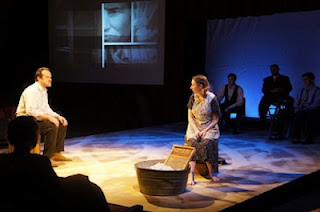

So. First time seeing Waiting For Lefty in its entirety. How does it hold up? Interesting! While employing period costumes and some kind of non-specific tough-guy New Yawk accents, the Ensemble production utilized their large video screen to bridge scene changes with footage and music from the future (HUAC testimony, Occupy Wall Street demonstrations) to empasize the continuing resonance of the work.

Remember: The Living Newspaper performances of the 1930s did use film projections and live music to bridge scene changes, and as commentary!

However, having just directed a staged reading of It Can’t Happen Here, I have been disabused of the notion that writing from the 1930s is dated, or must feel dated. Sinclair Lewis words, spoken by a contemporary cast, was suprisingly fresh, meaningful, humorous and resonance with our modern audience last Monday night. People were taken with the story, and moved by its conclusion.

A friend who caught the show reflected how much more slangy Lefty is, which explains why it is seems dated. Also, there’s no real story to be swept up in, it is a collection of vignettes on a common theme. It’s like Saturday Night Live without punchlines.

But that’s not the real problem with its presentation as a contemporary work. It’s one long debate, more like Greek drama than soap opera. For example, the tale of a young suitor, on a perfect summer’s evening, breaking up with his devoted gal because he can never be the man that she deserves in this economy, where the bosses and the company men keep the worker under his boot, where a guy can’t earn a crust while Uncle Sam stands idly by, doing as little as possible because the truth is The Man still mans the controls of government and always will, so the little guy is left to gasp meekly for dignity - let alone a dollar, and its high time we pulled together and rose up to demand what is coming to us, an eight hour day, a pension and a heart handshake, but until that day comes I will never be the kind of joe who can care for a girl the way she deserves to be treated, and not like some two-bit floozy, always promising, never committing, I mean what kind of life is that for a young American lady? The Masters of Power don’t care about these things, the velvet-gloved capitalist executive sees the workers as an endless supply of hands and muscle to hoist the gears that make the things that fill their endless, bulging pockets …

Hey, baby, where you going?
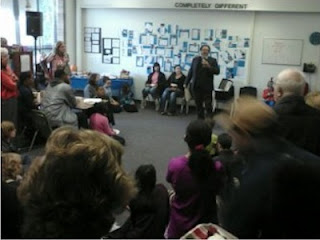

After the performance, the audience was invited into another part of Coventry Elementary (wait, do we have a name for this new community facility concept?) for a special event celebrating the opening of Lake Erie Ink.

What's that, you say? So glad you asked! It's a drop-on center for area youth with an emphasis on creative writing! HOW AWESOME IS THAT??? It's like an 826 Valencia for Cleveland Heights. I mean, it is an 826 Valencia for Cleveland Heights.
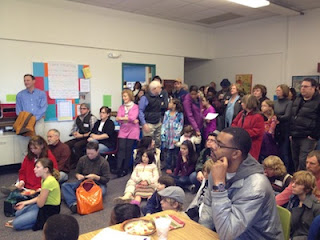

And wow-man-wow, there were a lot of people there! Cleveland Heights Poet Laureate Cavana Faithwalker represented, and world-renown hipster-shaman-beatnik-poet Ray McNiece was on hand to lead children in poetry exercises. There were a number of writing activities for young and old, I wrote a haiku on a paper pumpkin:

WORKERS THEATER
JUST SAW ‘WAITING FOR LEFTY’
LIKE AN UPPERCUT

Hey! You! Douchebag in the hat!

See also: Waiting for Lefty (1935)

Monday, October 18, 2010

Hanna Theatre

Built in 1921, the Hanna Theatre was a 1,421-seat proscenium-style Broadway touring house. The Hanna stands out from the other four major theaters (Ohio, State, Palace and Allen) that make up what is now known as Playhouse Square in a few distinct ways. 

Most obviously, the Hanna is located on East 14th Street and not Euclid as the others are. Additionally, the Hanna has a short lobby, like a Broadway house. The grand, palatial houses of Euclid Avenue had large, opulent lobbies. But from the street you could have a sold-out house and no one would know. 

Owner Carl Hanna wanted the audience to spill out onto the street, to generate public excitement for whatever was happening inside. These days, certain audience members do spill out onto the street, to smoke. 

In 1936, you could have seen taken in performances of:
  • Tobacco Road ('White Trash' On View Again in Hanna Play - Cleveland Press)
  • Katharine Cornell in Saint Joan
  • Clifford Odets' Awake and Sing! produced by the Group Theatre ("The most important play the Hanna has had this year." - W.Ward Marsh, PD)
  • Burgess Meredith in both the world premiere of Maxwell Anderson's High Tor (opened Dec. 30) and earlier that year in Anderson's Winterset opposite Peggy Ashcroft.
  • George M. Cohan in Dear Old Darling
  • José Ferrer in Boy Meets Girl
And for the record, in late 1934, Orson Welles played the Hanna in a touring production of Romeo & Juliet, starring Katherine Cornell as Juliet and Basil Rathbone as Romeo. During the course of the tour Welles played Mercutio. Once it transferred to Broadway in December 1934, Welles assumed the role of Tybalt. 

The Hanna is now home to Great Lakes Theater. 

UPDATE: Happy 100th Birthday, Hanna Theatre!


Sources: Wikipedia 
From Broadway to Cleveland: A History of the Hanna (John Vacha) 

Wednesday, August 4, 2010

Clifford Odets

"Odets, where is thy sting?"
- George S. Kaufman

Born 1906, Clifford Gorodetsky wrote Waiting for Lefty, went to Hollywood, and lost his teeth.

Named names before the House Committee on Un-American Activities in 1952, rarely wrote again.

Died in 1963 of colon cancer. He was 57.

Source: Wikipedia

Tuesday, August 3, 2010

Waiting For Lefty (1935)

Brian Pedaci was Harry Fatt
Life imitates art.

So now, after consuming several Federal Theater Project agit-prop "Living Newspapers" I finally turn to the grandfather of all labor agitation plays, Clifford Odet's Waiting for Lefty. Caught part of the Charenton Theater production, presented in a urine-scented alley as part of the Ingenuity Festival in 2005, but only the last few scenes.

Odet's play was first presented by the Group Theatre in March 1935. Harold Clurman famously described it as "the birth cry of the thirties." Framed by a Union Hall meeting, the play is a parade of brief vignettes, presenting numerous cases of injustice, or the Little Guy kept down by the Big Guy. Outrage is heaped upon outrage - marriages fall apart, relationships are abandoned, underlings are urged to spy on their co-workers, the well-connected are moved ahead, and there's even some examples of racism - against Jews, the only Black person in the play is a lowly errand boy referred to by the 'n-word' who is never actually seen.

Surprising to me is how this play, which pre-dates all the others I have so far read (not itself a Federal Theater Project production) provides the template for those which follows. I understand that Odets did not create this form of drama, the episodic panorama on a common theme, but I did not expect it to resemble a Living Newspaper so closely.

In addition, events presented in this play, produced in early 1935, set the stage for the real-life events of late 1935 and 1936 in during the Akron Rubber Strikes. Lefty begins with Harry Fatt, porcine, cigar-chomping union boss, telling his constituents to sit still, forget about going on strike, that the union was looking out for them and that everything was going to be fine. This is what the national union organizers kept telling the rubber workers of Akron.

Even more hilarious; every time someone in the crowd speaks up, to question Fatt's call for calm and order, and reassurances that Roosevelt would take care of everything, Fatt immediately roars that the interlocutor is a Communist, a dirty red, and demands they be thrown from the hall. This was the same technique used by the union bosses in Akron.

This is not to suggest that substance followed form, or that Odet's was some kind of awesome prognosticator. No, it provides me the education that these things were happening, this was the times. The only prophetic aspect of the production is the very end, when taxi driver Agate Keller takes the stage to speak, others rise to hold Fatt and his cronies at bay, and Keller stages a worker led call to STRIKE! STRIKE! STRIKE!

And so it finally happened in Akron - almost a year later - that the rubber workers stopped waiting for Lefty, refused to wait another day, began the modern labor movement without a leader, and did it themselves.