Saturday, February 25, 2023

Indie Theater Guy (book)

So I wrote a play. In 1997, The Vampyres was produced at Dobama’s Night Kitchen and I thought I was on my way to becoming a serious playwright. I printed one hundred bound copies of the script, got a copy of the Dramatists Sourcebook, and sent it to every theater in America whose submission policy seemed open to such a work.

And I waited and nothing happened and I didn’t write another play for five years.

It wasn’t until a chance visit to NYC and an invitation to see some shows at the fledgling New York International Fringe Festival (FringeNYC) that I became aware not only of the vast amount of great (and not-so-great) independent theater, but that there was a movement afoot to share and raise the profile of such work.

Around the same time, a New Jersey accountant named Martin Denton decided it wasn’t enough to experience and enjoy new works by Downtown theater artists, he needed to participate, and he has told his story, and the story of early 21st century “fringe” theater in his new book Indie Theater Guy.

He could have called it Internet Theater Guy, because it was Martin who first chose the fledgling internet as his venue for promoting and celebrating experimental work. Gatekeeping media like the New York Times or Time Out New York may, by necessity as well as design, could or would only review a few shows a week. Martin started nytheatre.com which (among other things) was dedicated to reviewing every single show at FringeNYC, every single year.

Think about it. Let’s say you were an out of town act, maybe from Cleveland. You spent time and money and effort to get a show to New York, it may or may not have received any attention. But at the very least, you were guaranteed one New York City review, at least one, and you found it at nytheatre.com.

Martin Denton
Martin himself came to see And Then You Die
 at the 2009 Fringe, and he viewed it with a critical eye, questioning whether or not I had stuck the landing with my solo performance about marathon running. I was just flattered that, out of two hundred shows to choose from and with a staff scurrying around lower Manhattan to see and report on all of them, Mr. Indie Theater himself chose mine.

Here’s the thing: While Martin’s efforts were concentrated on what was happening exclusively in New York City, the impact of his work in the first two decades of this century had a wide-ranging impact, on me in Cleveland, and for so many others. And he used the internet to make it happen.

When podcasts were first becoming a thing, Martin produced the nytheatrecast which featured independent theater professionals interviewed by empresario Trav S.D. I was a dedicated listener.

Then there was the Indie Theater Now project, an online database of play scripts. For only $1.29 you could buy a script! And playwrights across the country were encouraged to do so. I did. And people read them.

All of these efforts have served their purpose, and they have come and they have gone. But their effects are lasting. Would New Play Exchange be a thing if Martin hadn’t first proved that playwrights were not only willing but eager to get their work out there for people to read in such great quantity? Who knows?

Martin’s organizational work within NYC has also paid great dividends, and you can learn about them in his brief memoir. But this playwright is grateful for the way he used new technologies to greatly expand access to and awareness of modern theater writing for artists far and wide, and diffusing New York as the epicenter of American drama.

Last year I submitted many plays to well over one hundred theaters, without printing a page, sealing an envelope, or spending a dime. And unlike in 1997, my efforts have been successful. Can Martin Denton take credit for that? Yes. Yes, he can.

Saturday, February 18, 2023

2023 NEOMFA Playwrights Festival (Week Two)

Isaiah Betts, Amaya Kiyomi
Photo: Rob Wachala
What if you stage a terrifying and absurd fever dream and no one cares?

Well, that would be awful. And that was my fear: will this, does this, this dream I wrote on paper and which is currently having its first workshop performances at convergence-continuum this weekend, will anyone have anything to say about it … or will they just be confused?

Or worse – bored.

And to my relief the answer was no, they have not been bored, they do care, they may be a little confused, but that part is fine.

Isaiah Betts, James Rankin
Photo: Neil Sudhakaran
Scenes From a Night's Dream a big, colorful fantasia full of movement and beauty and horror, where audience members claimed they weren’t sure when it was or was not appropriate to laugh, but laugh they did, and so did I.

Speaking of a “fantasia” … during intermission Thursday night, Robert Hawkes recounted attending a revival of the Walt Disney classic Fantasia some fifty years ago, and noticing a young man sitting on his own who was obviously high. The guy was giggling almost uncontrollably at the film, and when the hippos in tutus appeared he blurted out, “My God! What will happen next?!” I was pleased with the comparison.

Samantha Cocco
Photo: Neil Sudhakaran
One audience member remarked that all of the adults in the first act were “absolutely unhelpful” while another observed how the subject of the dream eventually becomes an unhelpful adult himself. This is where the conversation was most important, to me, if or how the two acts respond to and reflect each other. And certainly, they do. But people wanted more of it.

Now, there are already a couple déjà vu moments which are played for comedy. The question is whether or not the rich stew of subconscious ego in the first act can inform the second, that what seemed abstract or random can actually be helpful or instructive. After Friday night’s discussion, I had dialogue ready to go which I was aching to feed to the actors, but that would have been inappropriate. Still, I have it and I will incorporate it into the new revision.

A'Rhyan Samford, Isaiah Betts
Photo: Neil Sudhakaran
Also, folks seem to agree with my sentiment that the True Crime Industrial Complex is bad. And that I should lean into that a little more.

Driving home, my seventeen year-old son spent the entire drive picking apart the entire script, I mean that in a good way. He talks about my work like it’s important, that I am a playwright with a style, and with substance. He said, “Your grasp of nonlinear storytelling never ceases to amaze me.”

Which brings us to the ending, the phone call. Is it redemptive? Is it appropriate? It depends on how you feel about the protagonist.

Tim Keo
Photo: Neil Sudhakaran
The boy, a musician, compared the phone call to an imperfect authentic cadence, which is a resolution, though not a conclusive one. He said my plays end where they should end, but that the audience is left feeling as though the characters will continue. This is my son saying these things.

So, that was my Masters Thesis. I have never written so many stage directions into a play, and my greatest concern was that the company would be able to successfully execute them, which they absolutely did, no question. It was fast-paced and dizzying and the audience was able to follow the entire thing. It was all right there on the page, and they made it happen. I am satisfied.

Saturday, February 11, 2023

2023 NEOMFA Playwrights Festival (Week One)

"We Call It Family" by Laura Barbieri
(Convergence-Continuum, 2023)

The 2023 NEOMFA Playwrights Festival at Convergence-Continuum is now open! I joined a sold-out house on Thursday night to see the first two of three shows offered this year.

Interview plays were the thing this past semester. Eric Mansfield and I both composed interview-based plays for workshop (see: After Roe) while our colleague Laura Barbieri penned one for craft and theory. We Call It Family is the result of several in-depth interviews with couples and individuals who have participated in the foster care system.

Laura, Eric and I with our advisor
Mike Geither (far left)
Playwrights in their third year are expected to workshop a full-length play, most years the first and second year students offer a ten-minute play or one act. Because there were just the three of us, they each had the opportunity to offer a one hour work for this first weekend.

At the first read-through for Family, Barbieri told me she was mortified to discover her forty-eight page play read at over two hours! She wasted no time editing the piece, providing a new draft that runs neatly under an hour by the next rehearsal. Considering the subject matter, which can be distressing at times, the piece really moves, thanks to her great work in braiding the dialogue among six performers.

So, anyway, how do you stage an interview play? Director Emileo Fernandez took material which on the page is presentational – direct address to the audience – and made it kinetic. While some told their stories, others often assumed the role of the children who otherwise would not be seen, only spoken about.

Eric’s piece, Home Movie, centers on a quartet of siblings who discover an unhappy secret about their parents while clearing out their childhood home. Eric has carved out a fascinating niche for himself, using his experiences as both a journalist and a member of the armed forces to take ideas from true stories and shape them into drama with a lot of humorous interpersonal relationships.

He says what we saw this weekend was a shorter version of a longer piece, and I am very interested in whether that means it's the same story with more details, or we have only seen the first half of a two act play.

This entire first weekend of performances are sold out, next weekend it’s my play Scenes From a Night’s Dream and that Saturday night performance has already sold out! So that’s good news. For promotion, I asked members of our cast to tell me what they thought the play was about and rock star Con-Con multimedia artist Neil Sudhakaran created this video.
 
The 2023 NEOMFA Playwrights Festival continues at Convergence-Continuum through Saturday, February 18.

Saturday, February 4, 2023

Scenes From a Night's Dream (inspiration)

We were in a hotel room and she was in a box and she would not come out.
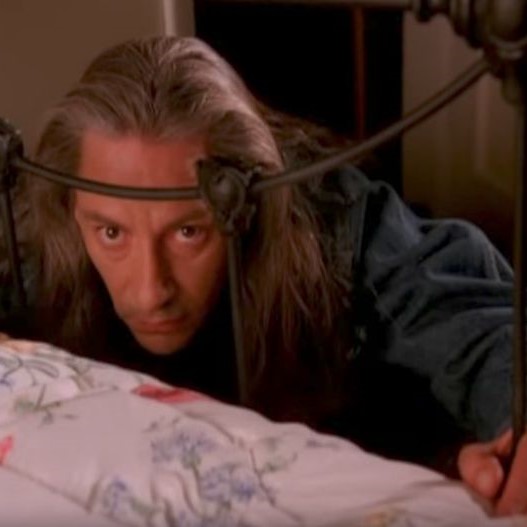
"He is Bob, eager for fun.
He wears a smile, everybody run."
(Twin Peaks)
Had the opportunity to attend a run-through of Scenes From a Night's Dream on Thursday night. The first act is a dream, and by that I mean it takes place inside a dream. There are so many entrances and exits, it's dizzying. But it's delightful. It's also horrifying.
My wife sent me to the basement to rub toothpaste on a couple of fuses. I went to the basement, the light was out, but I knew there was a fluorescent light on a cord down there, so I hurried down the stairs and found the light. I could just see the old fuse box, way across the room. I could see other things, too, and that scared me so I fled back up the stairs as fast as I could go.
The subject of my dreams has been a major part of my waking life, especially in the past couple of years. Is that true for others? Or is that incredibly self-indulgent? Musing on random imaginings which make sense only to me.
It was so big inside my parents’ house. Their bedroom was massive, with flocked wallpaper and Trompe-l'œil ceiling. But there was terrible mold and water damage. I offered that anyone who needed a place to stay the night might live there.
"Mama! Papa!"
(In the Night Kitchen)
In the past several years, between the death of my mother and the pandemic, these amorphous journeys have loomed large, featuring undocumentable trends which are difficult to trace.
With my brother and his wife in a crumbling old house. I was lecturing them about not setting the spider webs on fire.
During the lockdown, my subconscious was out there, in the world that I was visiting with much less frequency. For the past year or so, interiors have played a strong role in my dream space. And while they can be grandly spacious they are also worn and aged.
There was this rap act. They had a demo that they tried to re-record but it wasn’t as good so they made a video from the demo. For some reason, I held this particular act in contempt and used an app on my phone to change the lettering on the marquee to read “Comedians Rap Now.”
My parents stately home is often a location I return to. They may or may not be there, and the rooms are not actually the rooms as they were, but physical manifestations of the emotions those rooms represented. 
A large school many kids, flooding. High water. Lots of snacks. A beautiful schoolroom. So many kids.
Source: Cleveland Clinic Foundation
Returning to these neglected rooms, I lamented not having sold my parents' house when it was still in good order. I woke relieved because I had actually sold it. I once held a great sense of responsibility to keep the place, but that would not have made me happy. And so my dream actually reminded me that I had made a good decision, which is a useful thing for a dream to do.
Tooling down a street in my old neighborhood, noting homes that had been torn down we missed the turning and drove into the cemetery, which appeared from the opposite end to be a packed theater house.
The first act of Scenes From a Night's Dream tells a story where nothing is real but everything is true. James plays a menacing character (actually, he does that in both acts) and the other night he told me he'd unlocked the entire play in one line. I was shocked because he was absolutely correct, but I was unaware of it. You'll have to come see the show to figure out what that line is. 
Different rooms, different spaces. A big event. I was dressed as a mime, but I had to go around. Part of the performance included a shadow play in which a ballerina got stuck but was rescued by a fox with the voice of Prince.

Saturday, January 28, 2023

The Replacement Theory of Playwriting

Isobel Thom as Joan
"I, Joan" by Charlie Josephine
(Shakespeare's Globe, 2022)
Photo: Tristram Kenton
There are a few social media organizations that focus on the world of American theater and, like a lot of social media sites, generate poorly sourced and written articles which are promoted with headlines designed to drive visitors to their site and most importantly to their advertising.

This is called clickbait. But you knew that.

One of the more egregious offenders recently posted an article with the headline, [Shakespeare’s Globe Artistic Director] Michelle Terry Fears for Actors' Safety in 'Woke' Plays.

This headline is misleading. It leads one to believe that Terry fears for actors' safety when working in the company of something called a "woke play." It conjures images of actors being harmed in the rehearsal or performance of such plays, whatever they may be.

However, nowhere in the article does Terry herself use the term "woke" nor does the article attempt to describe what that word means. Her concern is for the safety of artists who are members of productions that have been defined by others as "woke."

From the article: "Some of [the Globe’s] recent productions have been accused of being 'woke'."

Really? Some have said this. Who are they? And what did they mean when they used the term "woke"? It is important to be clear about this, because these people, those "some" who have said this, they are the people who Terry believes may threaten the safety of her company of performers, and not as the headline implies, their participation in such productions.

Headline would better read: Michelle Terry Fears for Actors' Safety From Those Who Define Certain Plays as 'Woke'

The writer of this article does provide two examples of so-called "wokeism" at the Globe. One is last fall's production of I, Joan by Charlie Josephine in which the main character, inspired by the person of Saint Joan, identifies as non-binary, and a production of Romeo and Juliet which included a content warning about suicide.

It is true that I, Joan received a great deal of online bullying prior to opening from people who were angry that Joan de Pucelle was to be presented as non-binary and using they/them pronouns. They accused the playwright of "erasing" a famous woman. As far as I can see, Joan of Arc’s place in history is unaffected by the production (Shakespeare depicted her as a demon, didn't stick) though the visibility of a trans non-binary character at the center of a professional production was by itself historic and important. 

My brother, who actually saw the production, unlike any of those who decided they hated it before it had even opened or really knew anything about it, said I, Joan was, " Excellent, fun, ALIVE." It started raining the day he saw it, he says nobody left.
"The play is first and foremost about the trans experience. All the soliloquies were about identity and inclusion in very personal ways. The historical part was the body of the play but it kept coming back to Joan's experience out of time. They pondered why men are so hung up on pronouns, toilets and Twitter." - Henrik H. (my brother)
And providing a content warning for R&J? Who cares? In what possible way does taking the subject of suicide seriously, and alerting anyone unfamiliar to the conclusion of this classic play (yes, they exist and that's okay) disrupt anyone's enjoyment in watching it? And anyway, how is that "woke"?

When the article in question was posted a little over a week ago, there was a great deal of back and forth about what a shitty article it was, and I mean from a journalistic standpoint. Really stupidly written, sloppy and by extension, offensive. Written expressly to provoke, not to inform.

Read it, it's good.
#WeAreJoan
Leaping into the discussion midstream, one cishet, white, American guy on the thread (full disclosure, I am also a cis, white, American guy) attempted to define “woke” this way [brackets provided for clarity]:
"Woke people" are against a diversity of ideas and anything that questions their narcissism is deemed racist or ignorant. Actually, the majority of us don't identify as "woke" or even "anti-woke" 
We [which is to say people like this commenter, in comparison] focus on the individual responsibility of a persons (sic) instead of breaking everyone into groups based on religion, ethnicity, and whatever subgroups come out of that. We aren't interested in having a victimization contest. 
If you want a true diversity of ideas, it's best to be left of center. Reject ideology and become a complex vessel of ideas!
So many contradictions, it makes my head spin. He's true about one thing. The majority of us don't identify as "woke" because no one does that.

Further investigation (yes, I got creepy) revealed that this commenter is in fact a real-live, moderate, liberal Democrat, and not some bot or right-wing troll. It is because of him and people like him that my son is a complete Leftist.

It gets worse. Unlike some who have no particular interest but to thread-crash in order express their resentment and rage, this guy is an actual community theater director. Addressing me, specifically, he said this:
I happen to work in the performing arts as well. I can guarantee you [i.e. David Hansen] will have a harder time producing a play you've written in this climate. (Unless you live in an all-white area). Why should you give up your art to allow someone else to take your place? I think you should fight for what you've worked so hard to achieve and take a back seat to no one. Unless they prove that they have more skill.
Welp, he said the quiet part out loud. Take my place? What place is that? The assumption here is that white men remain the most-produced of playwrights because of their superior skill, that they have earned their position of supremacy, and that recent trends of centering marginalized voices are robbing these white men of their rightful place.

Here are a few reviews for the Globe Theatre production of I, Joan: 
"A rousing protest piece." - The Guardian

"A joyous celebration." - Time Out London

"Funny, fierce non-binary Joan of Arc proves sceptics wrong." - The Independent

"Joyful and unifying, this could be something of a game-changer." - Evening Standard
Does this not prove their skill? I think it doth. 

As I endeavor to get my own work produced, I am keenly aware that in a past era (maybe only five years ago) I would have had more opportunities for production. But not because my work was better.

Today’s emphasis on those whose voices have previously been ignored has inspired me to make my work more relevant, and hopefully to make me a better playwright. I want make work to be good enough and deserving enough to take my place with them.

Saturday, January 21, 2023

NYC NYE 2023 (part three)

"Room In New York"
Edward Hopper (1932)
The plan was to hit the TKTS booth and just see what they had to offer. But not all they had to offer, my wife has not been to the Whitney since they relocated, so we wanted an evening show, not a matinee, and on a Sunday those are few.

Times Square is absurd on the best of days, New Year’s Day most of all. I expected that, like the first of the year everywhere else, the streets would be empty and quiet. In fact, elsewhere in Manhattan, it was. But not Times Square, of course. It was crowded and messy. She got in line and I got coffee for us at the adjacent Starbucks. We both had a long wait.

None of the shows we had considered were having evening performances, but The Collaboration was. Written by Anthony McCarten, this new play about the brief and some might say contrived mid-80s artistic partnership between Jean-Michel Basquiat and Andy Warhol had only recently opened to mixed reviews. But hey – Paul Bettany and Jeremy Pope, live on stage? Why not?

Tickets purchased, we headed downtown, and to the Whitney Museum of American Art. Toni had friends who worked for the museum when it was on the Upper East Side, but she hadn’t visited the new site, down by the High Line. I had, with our eldest, when they were visiting New York schools.

Blue skies over the Whitney
First thing we did was head to the Studio Bar on the eighth floor. My wife loves museum cafes, and we have spent much happy time in them from London to Cleveland. It was a clear afternoon and we ventured onto the terrace to witness the downtown skyline. We appraised the design of the new World Trade Center and decided it was good.

The main exhibit was Edward Hopper’s New York. I didn’t know much about Hopper. I know Nighthawks, we all know Nighthawks. It’s as iconic (and parodied) as American Gothic or La Grande Jatte. The gist of Hopper’s work, as I understood it prior to this experience, was that of alienation, that his work was existentialist. Experiencing so much of not only his paintings, but also his sketches and his commercial work, I don’t believe that’s correct.

My favorite piece from the exhibit was Room In New York (see above). A couple are in the sitting room of an apartment building. He is reading a paper, she sits apart at a piano. But she’s not playing the piano, she’s sitting sideways, idling plinking keys. The fact that these two are not in commune with each other might suggest detachment.

"A Theater Entrance"
(or "Man Explains Play
to a Female")
Edward Hopper (1906)
But! The image is defined – literally defined – by the window frame at the left and bottom of the image. This is not their moment, but ours, because we are viewing them through a window. We are capturing a moment which is not ours, one second in the city, a passing glimpse into someone else’s apartment. Hopper makes us complicit voyeurs, and he did this again and again with each painting we experienced.

And I thought, wow. He really loves cities! I really love cities! And now I really love Edward Hopper.

We spent so much time taking in his work, it’s really the only exhibit we saw there, and that was fine with us. Light was fading, and we walked up to the High Line to experience it at night, which was a little awkward. Nice, but very crowded. I suggested we take the last stairs down before we made it to Hudson Yards, but she wanted to see where it ended. She later agreed that was a big mistake.

We tried to get to the street by cutting through “The Shops” at Hudson Yards, which is a late-stage Capitalism hellscape. I won’t get into it. Don’t go there.

Jeremy Pope & Paul Bettany
"The Collaboration"
(Manhattan Theatre Club, 2022)
And so, onto the Manhattan Theatre Club and The Collaboration. I do like plays about artists, and the artistic impulse. But I am tired of “biopic” plays, plays that read like a Wikipedia page. Did you know Andy Warhol was shot by Valerie Solanas? Some do, some don’t. The challenge for a playwright is how to share this information with people who do not (it’s relevant) without putting expositional dialogue into the mouth of the man who was not only the victim of this violence but also deeply, deeply traumatized by it, and yet make it seem effortless.

I have enjoyed John Logan’s play Red, about the painter Mark Rothko, in spite of its somewhat clunky structure. Rothko is at a difficult juncture in his career and has as his sounding board a fictional assistant. In The Collaboration two artists, one a hot property, the other coasting on decades of iconic success, at least they are both based on real people and over the course of the evening, joust with their ideas of what art means, what it’s for, why it matters, if it even matters.

Warhol elevated corporate iconography, Basquiat marked it and claimed it. They were both keenly aware of public perception of the art itself, even as they had differing ideas of whether or not they cared what people had to say about their work. Or maybe they were more alike than they knew.

Washington Heights
apartment lobby tree
Anyway, we had second row seats. Thank you, TKTS booth. It was delightful to watch the performances, Bettany’s Warhol had this tightly-wound disaffection, Pope’s Basquiat a manufactured confidence which masked an immense underlying anxiety.

Pro Tip: Both Broadway houses we happened to attend that weekend offered the European tradition of ordering “interval” drinks before the show, and we were literally the only people who did this. Folks stood irritated in long lines at the bar during intermission while all we had to do was sweep in and pick up our two lonely sippy cups waiting for us on the drink rail and enjoy the break.

After the show we sought a neighborhood trattoria. The basic joy of sitting with my love, next to a window looking out over Ninth Avenue, consuming house red and a simple chicken parm.

The next morning we met an old friend over some seriously mediocre brunch, and left for home. See you next year!

Saturday, January 14, 2023

NYC NYE 2023 (part two)

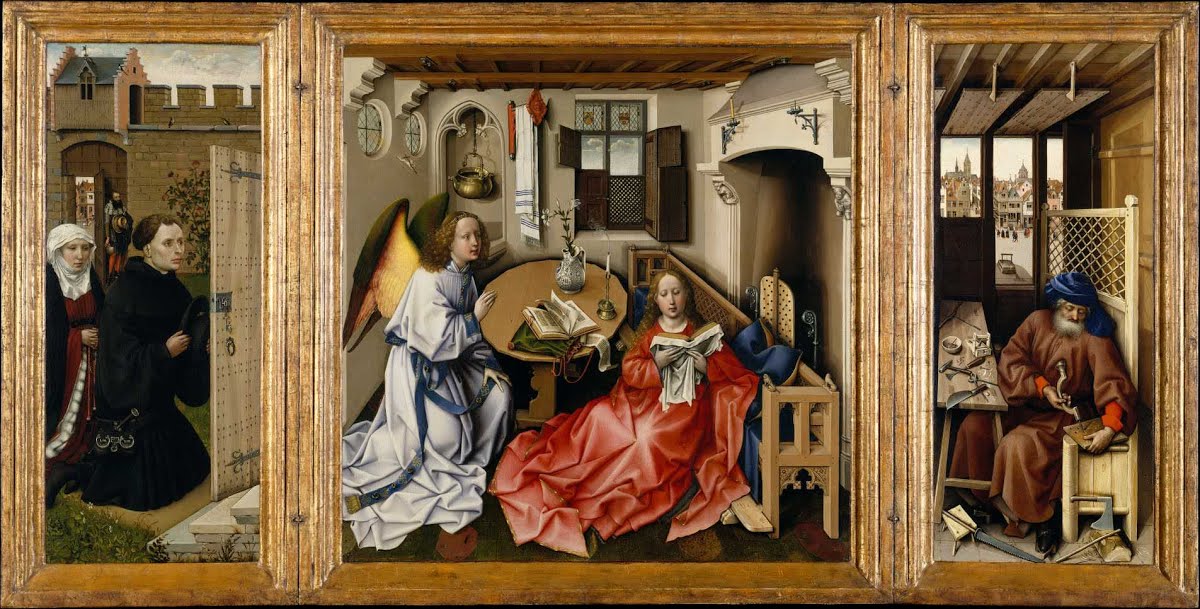
Annunciation Triptych (Merode Altarpiece)
Robert Campinca. 1427-32

Here’s the great thing about visiting New York with my wife. We don’t feel compelled to do anything, we can just be. Sure, we make plans, but it’s not like going somewhere new and strange and you feel anxious about timing, getting from place to place, or even what and when you are going to eat.

Manga comic wallpaper at Tampopo.
We’d already visited the local grocery store the night before and got a few things for the morning; coffee, cream, yogurt, bananas, granola. I was so wrung out from the events of the previous week (remember that bomb cyclone?) that I got up, ate, took a shower, and had a nap. And that was glorious.

By the time we got out, it was lunchtime, and we stopped in at Tampopo Ramen, which I first visited with our eldest three years ago. The noodles were fresh, our bowls fat with tempura. Crazy good.

New Year’s weekend in Manhattan this year, while not very cold, was certainly damp. We walked through Fort Tryon Park in the rain and mist, taking our time, wandering down to the Hudson River overlook where I proposed to her almost twenty-five years ago. You couldn’t even see the river, let alone the GWB, it was so foggy.

The Cloisters are preferable in the summer, when the gardens are in bloom and you are able to walk through them. That just meant we took more time enjoying the architecture and artwork.

I was curious, in this era where Westerners are more self-critical of our collective history of pillage and appropriation, as to when the curators of the Cloisters found in necessary to make clear, on every medieval doorway, window frame and artifact, that they were only taken from monasteries, priories and covenants that had been crumbling and abandoned ruins. Nobody cared about this stuff, okay?

Ceci n'est pas un lion.
The thing that really struck me this time around was how important the lion figured in medieval symbolism but how apparently no medieval artisans had ever seen an actual lion.

Then back to the crib for a disco nap, water and ibuprofen. These are my primary pieces of advice when visiting the big city; do only one or two things a day, stay hydrated, rest when you can, have pain reliever, pee before you leave wherever it is you are.

Finally, we embarked on our New Year’s Eve plans. There was this bro on the subway who had his headphones on and he was not selling it. That’s the thing about headphones, you really learn who knows their bars and those who do not. He was like, “hummanah-mummunah-mum O’CLOCK, mummunah-hummunah-mum MY COCK.” Keep working those rhymes, my dude.

Our New Year’s Eve dinner reservation was at Chama Mama, a Georgian restaurant on the UWS. We had seats outside, in a heated shed attached to the building. The heated shed is still a thing In New York City. It was a glorious meal, we ordered far more than was necessary, but we wanted to taste so many things. I was surprised at how (relatively) inexpensive the meal was, considering how many small plates we ordered.

First up and most notably was the khachapuri, a cheese-filled bread. Fresh baked bread in the shape of a boat, filled with a soft cheese, served very hot with an egg cracked on top. The server stirred in the egg and a pat of butter and we tore off bits of bread and cheese. I could have just eaten three of those.

Dream Big!
Unfortunately, it was raining consistently as we walked the fourteen blocks to Lincoln Center, where the Big Apple Circus was presenting a special New Year’s Eve performance of their current show, Dream Big.

What was unique about this performance, at least to me, were the videos before every act, where the circus artist provided a brief candid interview where they were able to share a little about their life and career as a performer. When do we know anything about circus performers? I thought it was nice. Most were members of extended circus families, most notably the new owner of the Big Apple Circus, the legendary Nik Wallenda.

At midnight we toasted the new year right there in the big top, and we were all invited to dance on the stage.