Showing posts with label animation. Show all posts

Sunday, April 25, 2021

Process XXVI

"The Children Who Played at Slaughtering"
Directed by Dan Riordan
Animation by Chris Gleason
My Saturday routine has been to draw all day, and especially in the evening. I have been slavishly dedicated to the all-request show Radio Free Current, where Sean McPherson refers to me as “David from Cleveland.” He’d call me that anyway, but it provides me a distinction from “David from Las Vegas.” We are both dedicated listeners. 

Perhaps it would have been worth it to bring the drawing table out of storage, but there is literally nowhere we could have put it without it being in the way for the entire semester.

This week, as I was drafting the text for the final page, I began to get depressed. Already! Completion depression, and I am not even close to finished! It needs to be turned in by May 11. I am in the zone, though. Last week I was behind, and I spent the entire weekend catching up.

But last night I was not drawing. Because I was done! I did the whole page on Friday. I mean, I’m not done-done, I need to go back and clean things up, add some backgrounds. However, the big work is complete.

Click on for detail.
I also need to write a radio drama. This is also a thing I have done. I have been repurposing a lot of my work this semester, which I am entirely justified in doing (he said somewhat defensively) because it’s about form, not originality. I adapted a comic book from a short play, there are other unproduced works that might make for good radio drama.

Speaking of which, tonight is the 2021 NEOMFA Playwriting Festival. Five short films will be presented at the Tremont Taphouse, including an adaptation of The Children Who Played at Slaughtering. It’s an eight minute film, directed by Dan Riordan, animated by Chris Gleason, with all the voices performed by Jo Roueiheb.

I’ve seen a preview. The team improved on the text, by which I mean, they changed text and for the better. It has a better ending line than the one I wrote. Also, because it is animation, they were able to add a lot of business that isn't in the text, but comments on the text, on the horrible world the kids see around them, and I love that. It’s a real collaborative effort.

Saturday, April 17, 2021

Process XXV

They say that two-thirds of the way through any endeavor, a person becomes distracted, unmotivated, desiring to quit, perhaps. Don’t ask me who “they” are, but I have heard it more than once. 

Forty-five minute class? You start watching the clock at thirty minutes. Six week rehearsal process? You start losing your focus around week four, wondering if the show will ever open. After six months of pregnancy, the father leaves.

Okay, maybe not. But maybe?

It didn’t happen to me last semester, I drove straight through without stopping to question. But after creating six out of nine panels for my queer comic, I just kind of lost it. Page six is inked but incomplete, seven is an unfinished pencil. I’m actually going to start page eight, to keep leaning forward towards completion. In that way, I may be able to bang, bang, bang, finish them all one after the other.

My wife reminds me that I have been goggling at how far ahead I have been, on everything, that I only think I’m behind because I have slowed down a bit. I think she’s right. I’m glad I didn’t leave after the sixth month.

This week I also wrote up the second part of my story about race in the 1980s for the fiction writing class. Next weekend will be quite eventful, Saturday night is the premiere of the All-Ohio Show for the 2021 State Thespian conference (see graphic for details) for which I am an advisor, and on Sunday the NEOMFA short films will debut at a bar downtown.

That’s weird. I wrote a thing. And then I will witness an animated film created from that thing I wrote. And I have zero idea what that is going to look like.

Sunday, December 15, 2013

Simple Gifts (1977)

New York at Night (1979)

R. O. Blechman (born Oscar Robert Blechman, 1930) is an illustrator and animator, you probably recognize his work. He made a name for himself creating sequential editorial cartoons for the Village Voice in the 1970s, later for The New York Times and plentiful covers for The New Yorker.

DID YOU KNOW ..? Like all great men, R. O. Blechman graduated from Oberlin College.

Without actually doing any research on the subject, I imagine the artist he is most closely compared to is Jules Feiffer, because of the shaky line. However, whereas Feiffer's people have detailed faces of angst and giddy nervous energy, Blechman's characters visages are so glyphic they are almost childlike, often succumbed by wonder.

R.O. Blechman (self-portrait)

His most-seen animation is probably something like the Alka-Seltzer commercial (1967) in which a man has an argument with his own stomach. My favorite work, however, was when he produced an hour-long holiday program for PBS called Simple Gifts. Seven animators presented works on the theme of Christmas.


Blechman's own piece, No Room at the Inn, retells the story of the Nativity with social commentary familiar to those who treasure his work. This acknowledgement of economic disparity and the plight of the poor is also reflected in Maurice Sendak's Introduction where a shoeless, miserable boy sacrifices his life to become a tree that brings joy to others.

Artist Chwast gives life to a bizarre tale from the bizarre novel Orlando by the bizarre Virgina Woolf, and there is an silly Toonerville Trolley cartoon. Three pieces, however, are biographical, and summon up Christmases from America in the 1860s (rich future President Teddy Roosevelt's My Christmas) and in the 1910s (poor future playwright Moss Hart's A Memory of Christmas)
and the tale most haunting, that of the "Christmas Truce" of 1914.


The story told in this letter from by Sir Edward Hulse was only one example of soldiers, largely British and Canadian, emerging from their trenches to meet and greet Germans (there are far fewer records of any French participating) in no-man's land. First they arranged to retrieve their dead, which led to the singing of hymns, then carols, the sharing of family photos and stories and finally playing soccer and exchanging of gifts.

The afterward to this animation, that Sir Hulse perished in the trenches, doesn't make the story any more poignant, if you are familiar with the wholesale carnage of the Great War. He died on a godforsaken field in France. Of course he did.

Following this dangerous breach of continual murderous violence, those at the top mandated that strict punishments would be meted out if there were any further peaceful gestures made toward the enemy. And once poison gas was introduced in 1915, most Christian amity was successfully broken.

A commercially produced video for Simple Gifts was last released commercial in 1993, and is currently available on VHS for around $130. It has never been released on DVD.

Wednesday, August 29, 2012

Winsor McCay, the Famous Cartoonist of the N.Y. Herald and his Moving Comics (1911)


http://www.talespinnerchildrenstheatre.org/performances/slumberland.htmOn April 8, 1911 this short film (popularly known simply as Little Nemo) directed by Winsor McCay and James Stuart Blackton had its debut. Only two minutes are actually animated, and the moving images repeat, and while fanciful, are of course very simply compared to anything we are used to. However, when you consider that McCay drew all four thousand pages himself, by hand, you have to admire his time, effort, and outstanding creativity.

This was not the first animated film, that honor goes to co-director Blackton, whose Humorous Phases of Funny Faces was released in 1906.


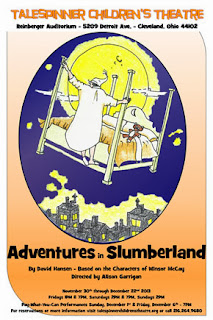
Talespinner Children's Theatre presents Adventures In Slumberland by David Hansen, Nov. 30 - Dec. 22, 2013.