Showing posts with label Oberlin College. Show all posts

Sunday, September 25, 2011

The Degenerate Art Exhibit

Exhibition catalogue
Opening July 19, 1937, "Entartete Kunst" or the Degenerate Art Exhibit opened in Munich. In an attempt to eradicate modernism, the Nazis seized over 5,000 pieces of art deemed threatening to the New Order. However, as in all things, Nazis were scholars of the past and established breathtaking, new forms of propaganda which have served as templates for every generation since.

Rather than simply destroy the offending works, they were put on display for the mockery of the general public, hung the wrong-way-round in some cases, improperly lit, cramped together, the walls festooned with mocking graffiti. "Insolent mockery of the Divine under Centrist rule" and "Deliberate sabotage of national defense" are two refrains which strike me as not-unfamiliar to today's vocabulary.

In this way, modern artists were denied any kind of martyrdom -- their worthlessness was firmly established in the public mind as thousand lined up to see the "degeneracy" and freely make up their own minds as to whether the work was offensive, obscene, immoral, blasphemous, or just plain bad. We curate, you decide.

"Self-Portrait as Soldier"
Ernst Ludwig Kirchner, 1915
Following the exhibition, the works were auctioned off, purchased by museums and individuals desperate to save them before they were destroyed. Though many works were lost, while living in Los Angeles in 1991 I had the opportunity to witness a touring exhibit of surviving pieces. If I had not already become driven to the brink of a nervous breakdown after four weeks in L.A. this experience put me right over the edge and I returned home to Cleveland for good soon after.

One example, Ernst Ludwig Kirchner's Self-Portrait as Soldier (1915) shows the artist, a World War I veteran, his painting hand severed. Kirchner had not actually lost an appendage during the war, rather the piece (painted during convalescence following a nervous breakdown) expresses his feelings that his war experience would rob him of his craft. The naked woman suggests he feared other war-related inadequacies.
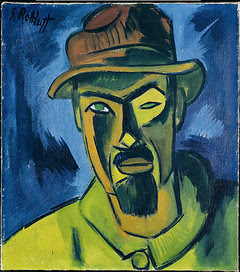
"Self-Portrait With Hat"
Karl Schmidt-Rottluff, 1919
639 of Kirchner's works were confiscated by the Nazis. This work was retitled Soldier With Whore for the Degenerate Art Exhibit. Kirchner died by suicide in June 1938. Fortunately for us, this work survives and you can visit it at the Allen Memorial Art Museum in Oberlin.

This work by Karl Schmidt-Rottluff (left) is part of the permanent collection at the Cleveland Museum of Art, also saved from the 1937 exhibition in Munich.

We saw Cabaret last night. It was very moving. There were no drunken, existential rants before bedtime. The first act closes with a spirited, patriotic round of Tomorrow Belongs To Me. My mother, seated next to me, remarked, "The Nazis did write good music," adding swiftly, "of course, they just stole a bunch of folk songs and changed the words."

"Cabaret"
(Great Lakes Theater, 2011)

Monday, June 13, 2011

Dave Brubeck


"Dave Brubeck's the swingingest."
- Jack Kerouac

David Warren "Dave" Brubeck (born December 6, 1920) is the swingingest. He was almost kicked out of conservatory because he couldn't read music, but his talent was so great they let him graduate with the understanding that he would never teach.

Serving in World War II he was allowed to create an ensemble (one of the first integrated musical combos in the Army) and met saxophonist Paul Desmond, with whom he would create his most legendary work.

He and Desmond formed the Dave Brubeck Quartet in 1951, and they were an huge hit on college campuses -- see not only Jazz at Oberlin (1953) but also Jazz at College of the Pacific (1953) and Jazz Goes to College (1954).

"This is incredible music, jazz or whatever, and you should buy it."
— Down Beat review of Jazz at Oberlin

Brubeck once cancelled a television appearance when he discovered they intended to keep his African-American bassist, "The Senator" Eugene Wright, off-camera.

It is true, there were those serious jazz fans during the 1950s who called Brubeck's work "Europeanised and overly formal." Without soul. You know what I'm saying.

But I wish to announce the opening of new sessions, and new fields, Daddy-o! Hello, Dave!


Source:
Wikipedia
Oberlin.edu
Guardian.co.uk
Poetry For the Beat Generation (Jack Kerouac & Steve Allen)

Saturday, January 22, 2011

Jazz at Oberlin

"Jazz at Oberlin" was an extremely popular record for Brubeck’s quartet and a smashing success in the Oberlin community. The concert and album presented an audience largely uneducated in jazz with some of the genres finest players, all performing at the top of their game. And while a successful jazz concert at Oberlin these days is a regular occurrence, such was not the case in 1953, when the concert halls at Oberlin were filled with Bach, Beethoven, Brahms — and occasionally Bartök — but not with Basie or Baker.

- Oberlin Online
On March 2, 1953 The Dave Brubeck Quartet played Oberlin. And my father was there. The quartet was Dave (never David) Brubeck on piano, Paul Desmond on alto saxophone, Ron Crotty on the bass and Lloyd Davis on drums.
The concert had all the ingredients of a major disaster. Aside from Oberlin’s indifference toward jazz, Brubeck and his outstanding saxophonist, Paul Desmond, had just had an argument, bass player Ron Crotty had just been given his notice, and drummer Lloyd Davis was ill with the flu and had a 103-degree fever.

- Joe Mosbrook, Jazzed in Cleveland
My father was seventeen, in his senior year at Lakewood High School. The night in question was a Monday night, otherwise he is sure he could have gotten someone to go with him. But as it was a school night he could not, so he drove to the Oberlin Conservatory of Music on his own, and experienced was he still calls “one of the greatest musical experiences I ever had.”

Brubeck also later called that night's gig, "the best thing we’ve ever done."

Tracks included on the original LP include These Foolish Things (Reminds Me Of You), Perdido, Stardust, The Way You Look Tonight and How High The Moon.
Back in 1953 any form of on-location recording was by no means a commonplace event. So much of the technology that is taken for granted today had not even been imagined: to record during ‘live’ performance meant setting up a portable machine for one-track (monaural) taping, using relatively insensitive microphones and no monitoring systems, with little or no physical or acoustic control over the surroundings.

- Orrin Keepnews in the liner notes for a 1986 CD release
My father was turned onto jazz by a guy whose name he cannot remember who worked at Lamp’s Melody Lane on Detroit, just around the corner from his home on Mars. This fellow (in his 20s? 30s? Dad’s not sure) “inculcated” my father with jazz -- and lots of other music, too. In fact, when I was speaking with him about it tonight, he was remembering how the piece he heard the Cleveland Orchestra play this weekend, Bartök’s Music for Strings, Percussion, and Celesta, was first played for him by this guy at Melody Lane.

When my father went to college he found the opportunity to go with friends to other jazz clubs, though most were pretty strict about not letting people under 21 in. He found most of them to be integrated -- mostly black clientele -- but from his perspective no one really cared.

My senior year in high school I saw Maynard Ferguson at Rocky River High School. Not the same thing.